




Abstract
For the purpose of real-time monitoring the hazard information on the electric power construction site, a personal safety monitoring system based on Artificial intelligence internet of things (AIoT) technology is designed. After the system sensing layer collects the gas information of the construction site through the gas sensor, limit current oxygen sensor and DS1820B temperature sensor, the edge computing device of the edge layer directly stores its calculation in the database of the platform layer through the data gateway. The Artificial Intelligence (AI) analysis module of this layer invokes the monitoring data of the power construction site of the database, and uses the personal safety identification method of the power construction site based on artificial intelligence technology, to complete the abnormal identification of monitoring data and realize personal safety monitoring. In addition, the system is also equipped with a power-fail detection module, which can collect the working voltage through the voltage transformer and compare it with the mains power standard to judge whether there is a power-fail risk, so as to prevent the problem of threatening personal safety due to the power-fail of the energized equipment. After testing, the system can monitor the operation status of the construction site in real time to protect personal safety.
Introduction
In electric power construction engineering, deep foundation pit operation is the most basic, the largest and dangerous important process, so that various safety accidents occur frequently, causing many people suffocation, poisoning and casualties. The cause of the accident is largely due to a large number of relying on the construction personnel to give early warning and take measures, but the safety and reliability of this protection mechanism is not high, because when the construction personnel find the danger, it may be too late [1]. Therefore, how to rely on the equipment to actively and timely find out the danger and give early warning, at the same time, automatically take effective measures, and provide more safety functions to strengthen protection and reduce casualties is an urgent key research problem [2]. In order to further strengthen the safety control of deep foundation pit operation of power transmission and transformation projects, improve the personal safety level of construction operations, and prevent infrastructure safety accidents, this paper proposes the design and research of personal safety monitoring system on power construction site based on AIoT technology.
AIoT is the fusion of artificial intelligence technology and Internet of things technology [3]. AIoT integrates AI technology and Internet of Things (IoT) technology, generates and collects massive data from different dimensions through the Internet of things, and stores them in the cloud and edge. Then through big data analysis and higher forms of artificial intelligence, AIoT realizes the digitization and intelligent connection of everything [4]. The ultimate pursuit of the integration of Internet of things technology and artificial intelligence is to form an intelligent ecosystem, in which the integration and interoperability between different intelligent terminal devices, different system platforms, and different application scenarios are realized, and all things are integrated. In addition to continuous innovation in technology, the research and development of AIoT related technical standards and test standards, the implementation of related technologies and the promotion and scale application of typical cases are also important issues that need to be broken through in the field of Internet of things and artificial intelligence at this stage [5].
In 2020, a black swan incident that had a huge negative impact on the global economy boosted the development of the AIoT industry. During the epidemic, new applications based on various AIoT technologies and products, such as track tracking, temperature monitoring and unmanned distribution, left a deep impression on the public; The remote software and hardware that can connect people, machinery and assets remotely without contact are booming; Flexible manufacturing capabilities that can cope with strong market uncertainty are more sought after by industrial enterprises [6]; The smart city platform, which can collect and analyze data in real time and supervise the details of a huge city, has become a powerful tool for government management [7]. While changing peoples’ lifestyle and technological cognition, the epidemic has promoted the integration of AloT products and technologies into various social activities, advanced the overall digitalization process, and also increased the direct demand for AloT products and technologies in the market. According to the survey data in IoT Spotlight Report 2020 released by Vodafone in October 2020, 81% of the surveyed enterprises will increase their investment in IoT after the epidemic, and 77% of the enterprises will accelerate their ongoing IoT projects.
The comprehensive monitoring of deep foundation pit engineering in China began in the 1990 s. Many scholars have done a lot of research in this area. Due to the different development environment, programming language, system functions and the development of computer technology, the functions of the system are gradually improved and the system interface is more beautiful. The early deep foundation pit monitoring system mainly focused on the management of monitoring data, and the data analysis function, prediction and early warning function are weak [8]. The foundation pit monitoring system compiled by Zhang Youliang et al. with VisualC++realized the functions of data entry, transmission, processing, early warning and so on. Shi Xingxi et al. developed the foundation pit monitoring system with Visual Basic (VB) language modularization, which mainly realized the functions of data entry, management and graphic display. Based on VS2008 as the platform, Access database as the basis, object-oriented programming language C# as the programming language, DotNetBar as the interface development component, and calling Word, CAD, Excel, ZedGraph plug-ins at the same time, the foundation pit monitoring system developed by Xing Weimin et al. realized the effective management of monitoring information, prediction and early warning, and visualization of charts.
After years of accumulation of research work, the monitoring technology and level of foundation pit engineering have made great progress and development. The first is the continuous improvement of monitoring instruments and equipment, the continuous improvement of monitoring schemes, the continuous refinement and classification of monitoring contents, and the second is the obvious achievements in the processing of monitoring data, back analysis methods, and the prediction of future working conditions [9]. The continuous progress and development of monitoring technology also provide a good material foundation and technical support for the information construction of foundation pit engineering [10]. Therefore, this paper uses AIoT technology to design a personal safety monitoring system based on AIoT technology for power construction site. The functions of this system mainly include power-fail early warning and gas over standard early warning.
Personal safety monitoring system on electric power construction site
Design of system structure
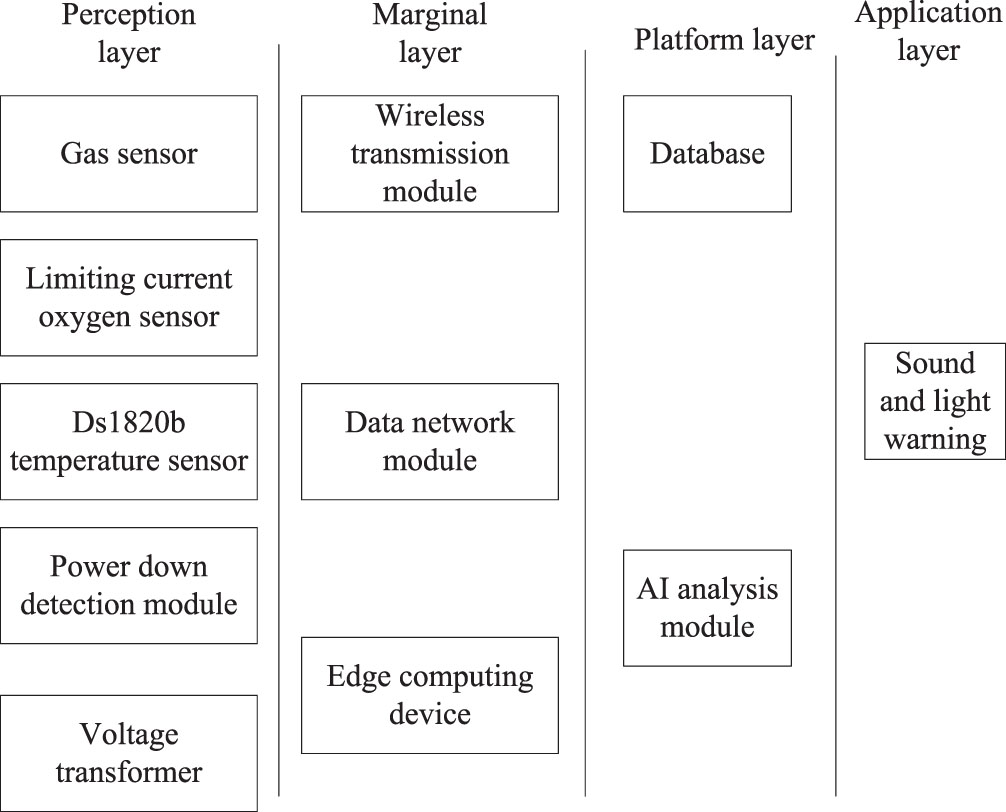
The structure of the personal safety monitoring system on the electric power construction site based on AIoT technology is shown in Fig. 1.
Personal safety monitoring system of electric power construction site based on AIoT Technology.
The structure of personal safety monitoring system based on AIoT technology in power construction site includes perception layer, edge layer, platform layer and application layer. The edge layer is used to obtain the data of the power construction site from the sensing layer and calculate the edge of the data. The sensing layer mainly collects the gas of the construction site through the gas sensor, limit current oxygen sensor, DS1820B temperature sensor and power-fail detection module to detect the power application on the construction site.
The edge layer includes edge computing device, data gateway module and wireless transmission module. Edge computing equipment is used to perform edge computing on the data of power construction operation site, that is, after the sensor collects data, it can directly calculate and analyze the sensor detection data. The calculated data can be directly transmitted to the database to improve the efficiency of data application and reduce the data load of subsequent platform layer [11]; The data gateway module is used to integrate and receive the power construction site data obtained by the sensing layer, and convert the site data into the protocol of the docking platform layer after edge calculation, such as the internet protocol, so as to facilitate the uploading of the power construction site data to the platform layer database through 5 G/4 G/WiFi/RJ45 and other Internet interfaces [12].
The platform layer is mainly divided into database and AI analysis module. Specifically, the AI analysis module invokes the data of the power construction site in the database, starts the identification method of personal safety on the power construction site based on artificial intelligence technology, and judges whether there are abnormalities in the multi-sensor data, so as to judge the personal safety status on the operation site. If the sensor data on the construction site is judged to be abnormal after identification, which poses a threat to personal safety, the application layer will start the audible and visual alarm procedure [13].
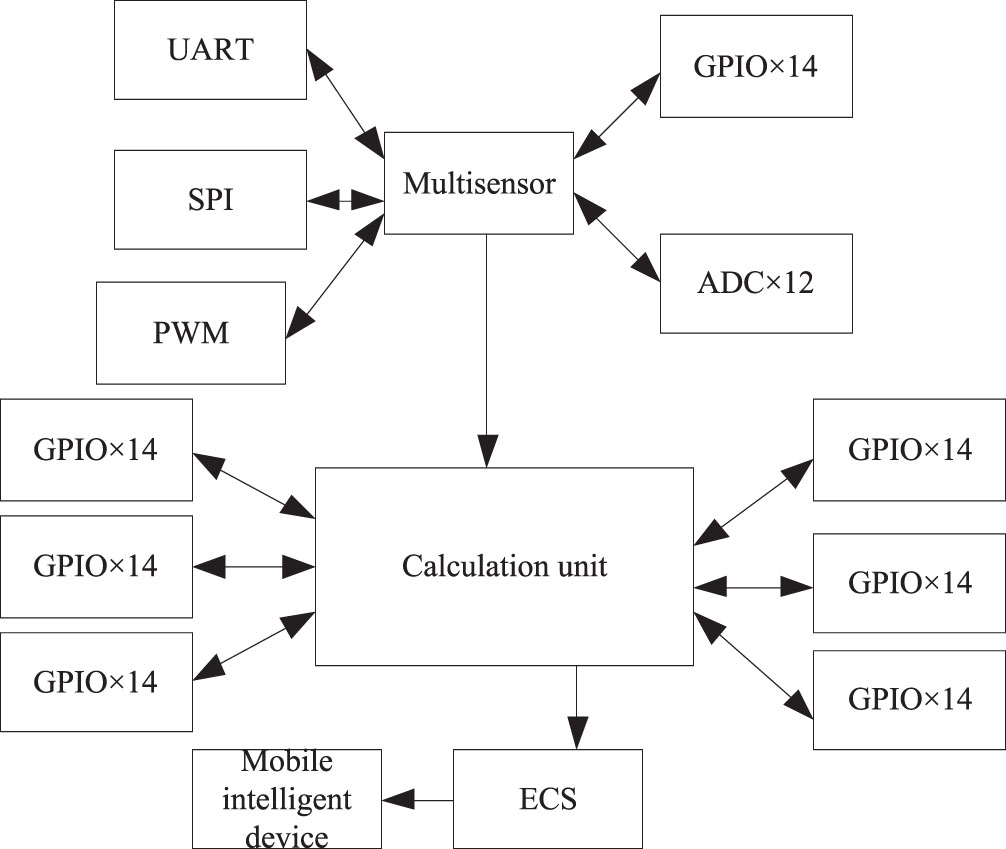
At different locations in the distribution network, there are multiple edge computing devices, which mainly serve the multi-sensor of the sensing layer. Its schematic diagram is shown in Fig. 2. When connecting with multiple sensors, the core processor used has 14 General Purpose Input/Output (GPIO) interfaces, 6 Pulse width modulation (PWM) and 12 bit analog to digital converter (ADC) interfaces, Universal Asynchronous Receiver/Transmitter (UART) serial ports, 1 SPI interface, which are connected to the controller in the form of serial ports through external modules, such as ZigBee, RS485 to RS232, etc. Its application frequency is 1.2Ghz four core BCM2837.
Structure diagram of edge computing equipment.
In the computing unit, its processor core board is 64ARMv8, its external interfaces are BCM43143WiFi and low-power Bluetooth interfaces, and it has 40 Input/Output (I/O) interfaces, 4 USB interfaces, 1 Ethernet interface, 1 High Definition Multimedia Interface (HDMI) interface, etc. At the same time, it is equipped with embedded Linux system, which has good data processing ability. When multi-sensor collects gas data from the electric power construction site, the edge computing equipment will immediately calculate and extract effective data at the edge of the sensor network, and store it in the data base through the data network [14].
(1) Gas sensor
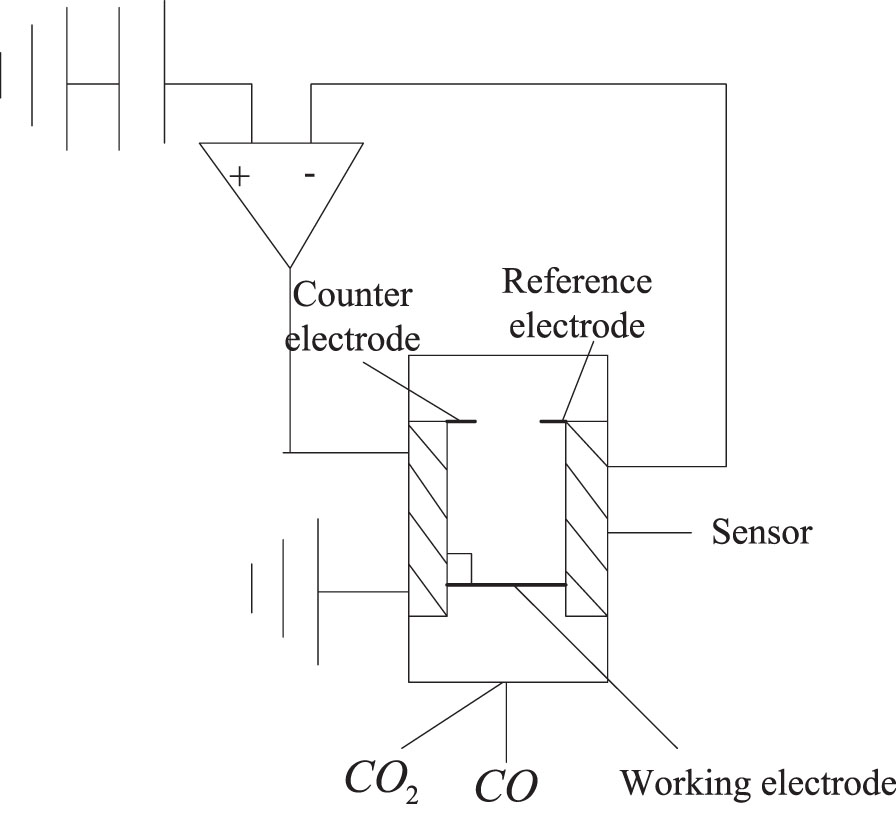
The working core of the sensor is the constant potential electrolytic sensor, which is a wet gas sensor, and its structure is shown in Fig. 3.
Structure diagram of gas sensor.
It is a synthetic resin container with a sealed structure composed of a breathable diaphragm, a working electrode, a counter electrode, a reference electrode and an electrolyte solution. The function of the circuit is to apply voltage to the two electrodes in the sensor electrolyte to oxidize or reduce the measured gas at the construction site, measure the current generated during gas electrolysis at the construction site, and then calculate the concentration of gas at the construction site. The constant potential added to the sensor is called the given potential, but since the impedance of the sensor depends on its structure, when the gas at the construction site is detected and electrolytic current is generated, the given potential will change. When the given potential changes, the electrolytic reaction of the electrode will not be stable, resulting in unstable output of the sensor [15]. Therefore, a third electrode without electrolytic current is set in the sensor, and the potential between the working electrode and the reference electrode is kept constant through control, so the potential of the working electrode and the counter electrode is kept constant, forming a potentiostat circuit. Among them, the sensor active electrode material should have the optimal sensitivity to the target gas, while the cross sensitivity should be minimized.
(2) Limit current oxygen sensor
The system mainly collects the oxygen data on the construction site through the limit current oxygen sensor. When there is electromotive force on the electrodes on both sides of the solid electrolyte of the limit current oxygen sensor, the oxygen flowing into the test chamber through the speed limit hole is pumped to the other side in the form of oxygen ions, and at the same time, an induced current is formed in the external circuit. This induced current increases when the voltage increases. When the voltage reaches a certain value, the current reaches the maximum value and remains stable, because the increasing voltage enhances the role of the oxygen pump, and the oxygen diffusion rate reaches the limit due to the limitation of the speed limiting orifice. The limit current value is directly proportional to the oxygen content to be measured and directly depends on the rate of oxygen diffusion into the detection chamber [16]. When the working temperature and the area length ratio of the diffusion hole are known, the limit current value is directly related to the oxygen content to be measured, and its value can directly obtain the oxygen content in the environment.
(3) DS1820B temperature sensor
DS1820B digital temperature sensor is a new type of temperature detection device produced by Dallas Semiconductor Company in the United States. It is a single-chip structure and can output digital quantity without additional 785 conversion. The communication adopts single line system. It has the characteristics of small volume, high precision and no calibration [17]. DS1820B digital temperature sensor is mainly composed of 64-bit ROM address, temperature sensor and nonvolatile high and low limit trigger unit TH/TL. The power can be supplied by the internal parasitic capacitor charged when the data line is at high level, or directly by the external power supply. The temperature value is generated by counting the temperature sensitive oscillator, which can accurately collect the temperature data of the construction site.
(4) Power-fail detection module
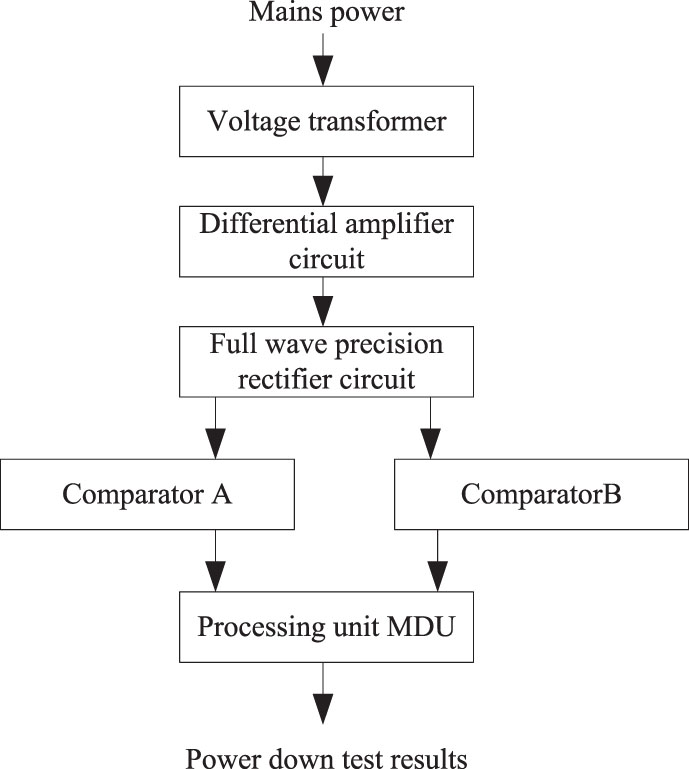
The structure of power-fail detection module is shown in Fig. 4.
Power down detection module structure.
Firstly, the on-site voltage is detected through the voltage transformer, then the transformation ratio is adjusted through the differential amplification circuit, and then the full wave rectification is carried out through the precision rectification circuit. The rectified voltage signals are sent to two comparators with different comparison values, the rectified voltage signals are sent to two comparators with different comparison values, Its comparison value is set slightly below the power standard threshold. When the rectified voltage signal enters the low-voltage comparator after full-wave rectification of the precision rectifier circuit, the low-voltage comparator will output a logical high level if the voltage is less than or equal to the power standard threshold. This indicates that there is no significant drop in current voltage, consistent with power standards. However, comparator B is a high-voltage comparator whose comparison value is set slightly above the power standard threshold. When the rectifier voltage signal after precision full-wave rectifier rectifier circuit enters high voltage comparator, if the voltage is greater than the power standard threshold, high voltage comparator will output a high logic level. This means that the current voltage does not appear obvious rise, in line with the power standard. And then the output signals of the two comparators are sent to the processing unit MDU for analysis and processing to judge whether the current voltage is consistent with the mains standard. If not, it can automatically judge the power-fail.
Since the development of artificial intelligence technology, many algorithms have been produced, such as expert system, artificial neural network, fuzzy theory, genetic algorithm and so on. On this basis, a variety of application methods have been developed. This paper uses convolutional neural network in artificial intelligence technology to realize high-speed recognition and processing of information with its advantages of small convergence, elastic topology and strong adaptability [18].
The problem of abnormal recognition of multi-sensor data on the electric power construction site is transformed into an image classification problem. The convolution neural network is used as the feature extractor and classifier to classify the process line image of multi-sensor monitoring data on the electric power construction site. The monitoring data belonging to the same monitoring point is divided into several segments according to the same time length, and the monitoring data process lines are generated respectively. If the process lines have jump points, vibration segments, steps and berms, it is considered abnormal [19]. The category of process line image is set as follows:
Category 1: there is a sudden jump point (a sudden jump point process line). Category 2: no abnormal points (no abnormal process line). Category 3: there is a vibration segment (vibration segment process line). Category 4: there are steps (step process line). Category 5: there are 3 jump points (3 jump point process line). Category 6: there is a sill (sill process line).
The input data of convolutional neural network model is the process line image of multi-sensor monitoring data on the construction site; The output data is the number of process line image, image category and abnormal position of monitoring data.
Convolutional neural network (CNN) is a kind of neural network specially used to deal with data with similar grid structure. Convolutional neural network has excellent performance in many application fields, such as handwritten character recognition, pedestrian detection, face recognition, human eye detection and so on. Convolution neural network is mainly composed of four types of layers: convolution layer, activation layer, pooling layer and full connection layer. This paper designs a batch normalization layer to normalize the process line image of multi-sensor monitoring data.
The convolution layer extracts features through convolution operation on the input process line image of multi-sensor monitoring data. The convolution layer 1 captures the low-level features of the process line image of multi-sensor monitoring data, and the convolution layer 2 captures the complex detail features of the process line image of multi-sensor monitoring data.
The function of the activation layer is to add nonlinear factors to the network model through the activation function, so that the neural network can learn the smooth curve of multi-sensor monitoring data, rather than using complex linear combinations to approximate a curve.
The function of the pooling layer is to gradually reduce the size of the process line image of multi-sensor monitoring data, reduce the number of network parameters, and then effectively control over fitting.
The classification of neural network is completed through the full connection layer, which also plays the role of mapping the extracted distributed features to the sample tag space.
To sum up, the structure of convolutional neural network model is shown in Fig. 5.
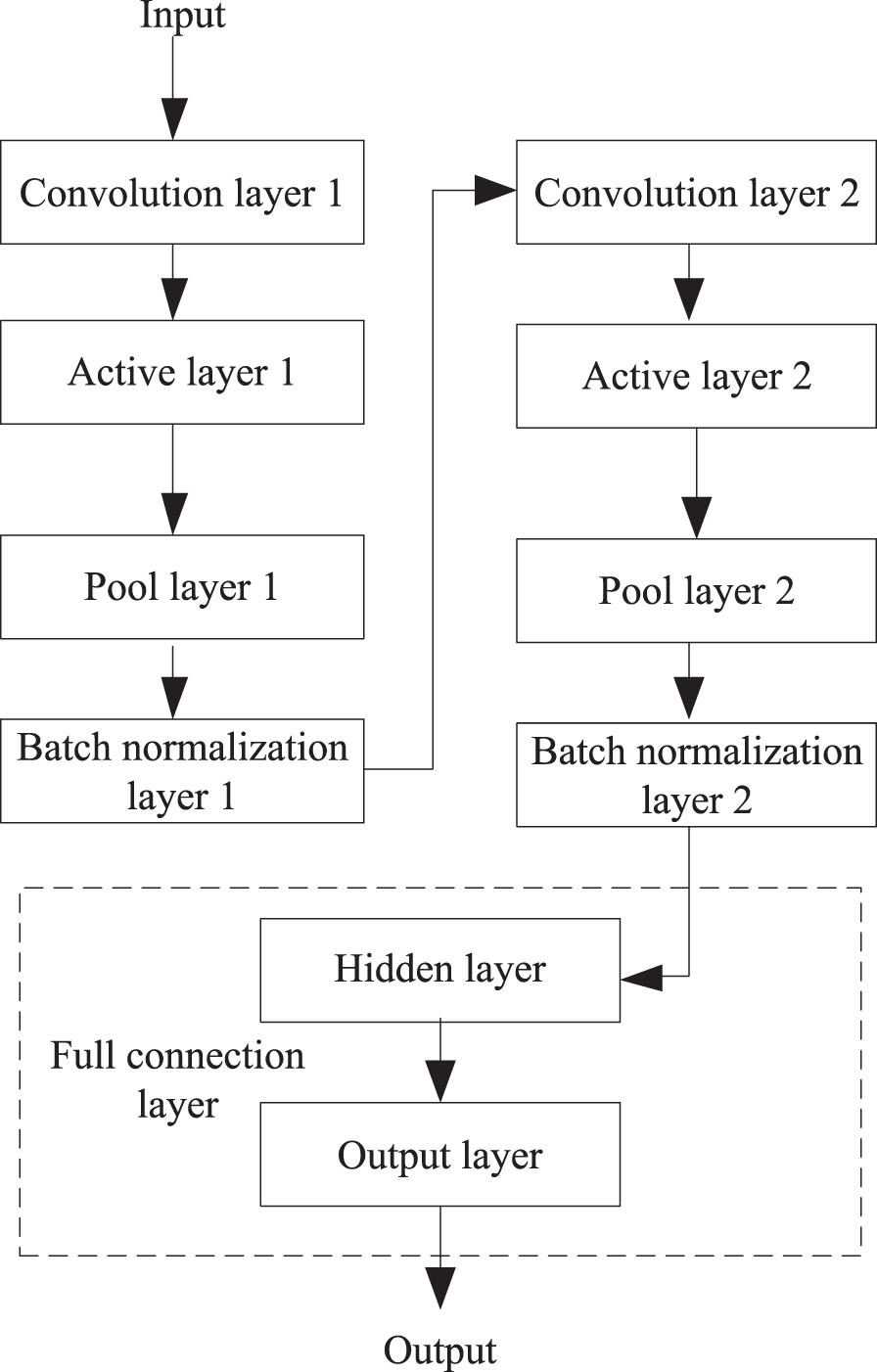
Convolution neural network model.
According to the characteristics of multi-sensor data recognition in power construction site, multi-layer convolution layer is needed to extract the characteristics of process line image of multi-sensor monitoring data. Because the number of full connection layer parameters accounts for a large proportion of the number of network parameters, reducing the number of full connection layers can greatly reduce the amount of computation on the premise of ensuring the feature extraction of process line image of multi-sensor monitoring data.
Convolution layer: 3 ×3 convolution kernels are used, of which the first convolution layer has 32 convolution kernels and the second convolution layer has 64 convolution kernels.
Activation layer: the exponential linear unit is used as the activation function of the process line image feature of multi-sensor monitoring data:
Where, β is the gradient factor of the process line of multi-sensor monitoring data; y is the position change of the process line of multi-sensor monitoring data; e y is the adjustment error of position parameters. Compared with the modified linear unit, the activation function g (β, y) solves the problem of gradient disappearance and the problem that neurons are no longer activated due to poor initialization or high learning rate.
Pooling layer: the maximum pooling operation with a space size of 2×2 and a step size of 1 is used to reduce the size of the process line image of multi-sensor monitoring data.
Batch normalization layer: the purpose of adding batch normalization layer to convolutional neural network is to normalize the process line image of multi-sensor monitoring data. Because the parameters in the network are constantly updated during the training of the network, the update of the training parameters of the previous layer will lead to the change of the distribution of the input image of the latter layer. This change in the distribution state is called internal co shift. Small changes in the front layer of the network will be accumulated and amplified to the back layer. If the distribution of each batch of training image features is different, then each iteration of the network during training needs to adapt to different distribution, which will not only lead to the decline of training efficiency, but also reduce the generalization ability of the network because the distribution of verified image features is different from the distribution of image features learned by the network.
The batch normalization operation is shown in equation (2):
Where, F [y(h)] is the mean value of the size of the process line image in the h-th batch of multi-sensor monitoring data, and y(h) and
If a(h) = y(h) and F [y(h)] = b(h), the batch normalization layer will cancel the effect of batch normalization. Therefore, through the learnable parameters a and b, the network can learn the characteristic distribution of the monitoring data process line that the original network needs to learn.
Full connection layer: the last full connection layer is composed of a hidden layer containing 100 neurons and an output layer of 10 neurons.
Before training convolutional neural network, what needs to be done is to determine the optimization function and loss function, make the training set and verification set of monitoring data process line image, and initialize the training parameters [20]. In training, the random deactivation method is used for the full connection layer to prevent over fitting the optimization function: this paper uses the adaptive moment estimation function as the optimization function. Adam function uses the first-order moment estimation and the second-order moment estimation of the gradient to adjust the learning rate of the feature state for the process line image of the monitoring data, so that the learning rate of each iteration is within a certain range. The equation is as follows:
Where, i
t
and j
t
are the first-order moment estimation and second-order moment estimation for the characteristic gradient of the process line image of the multi-sensor monitoring data on the construction site, respectively.
Initialization of parameters: initialize network parameters with small random numbers. The weights of all convolution kernels and neurons in convolution neural network take the random number of normal distribution with variance of 0.1 as the initial value.
Random deactivation: Dropout refers to the temporary deactivation of neurons in the network with a certain probability during network training. Because of the random deactivation, the network trained in each iteration is different. Dropout can effectively prevent over fitting. In this paper, the neurons in the hidden layer in the full connection layer are inactivated with a 50% probability during training, that is, half of the neurons in the hidden layer fail in each iteration.
To sum up, when carrying out the personal safety monitoring on the electric power construction site, it is only necessary to load the process line image of the multi-sensor monitoring data on the construction site into the trained network model to obtain the recognition results Δφ t of the process line image of the multi-sensor monitoring data on the construction site, so as to judge whether there are abnormal factors on the electric power construction site that affect the personal safety of operators.
The specific implementation flow chart is shown in Fig. 6.
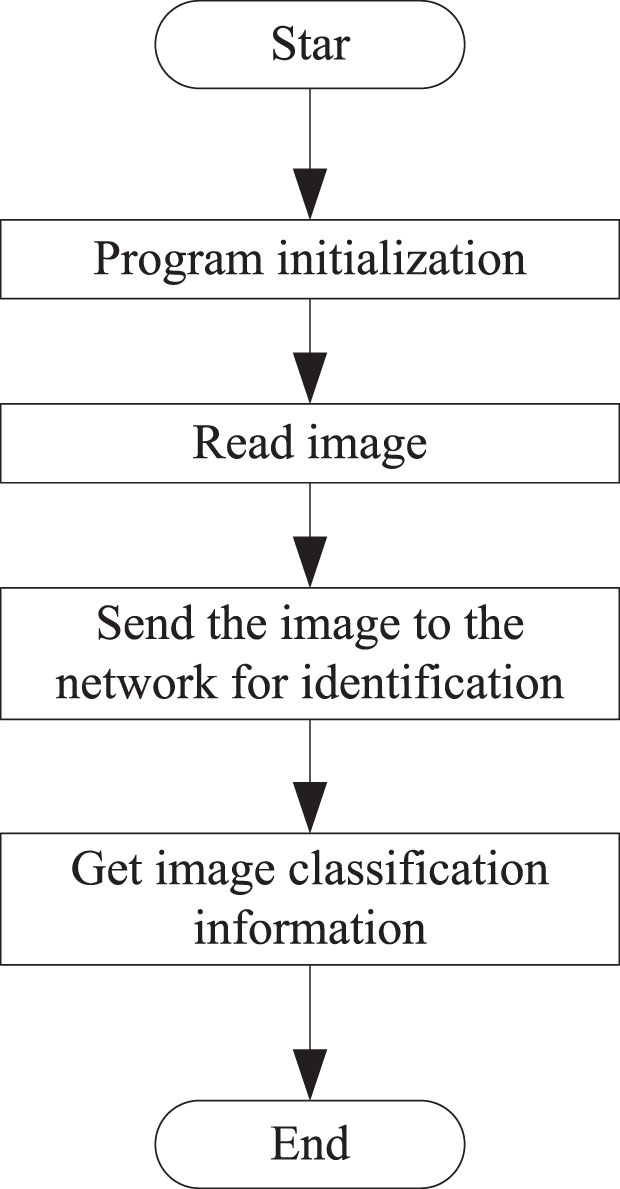
Operation flow chart of personal safety monitoring at electric power construction site.
Application basis of AIoT technology
(1) The large-scale landing application of AIoT industry has increased
With the gradual maturity of technology and products, as well as the accelerated transformation of public awareness of the epidemic, practical intelligent networking applications have further entered the daily life and work of the public, and the large-scale applications of AIoT industry have increased.
In the AIoT consumer driven application market, the application technology is rapidly maturing, the product shipments are increasing, and the market scale is expanding, resulting in the continuous decline of hardware costs. The increase in the number of hardware in the market dilutes the cost of data processing and storage, so the trend of large-scale application of AIoT in the market is gradually obvious.
(2) Actual demand basis of the project
At present, domestic deep foundation pit engineering monitoring mostly adopts the method of manual measurement, which consumes human resources and has poor data timeliness. However, the use of automatic monitoring technology can realize automatic and real-time collection, transmission, calculation and alarm, better risk prevention and ensure safety. The traditional manual monitoring method requires the monitoring personnel to use instruments to collect data on site, and then generate reports through calculation to analyze the operation of foundation pit, which is usually measured once a day.
After using the automatic monitoring system to replace manual measurement, the automatic data collection is realized through the detection instruments installed in the relevant parts, which has the advantages of fast frequency, good timeliness, high stability, true and reliable data, and can escort the construction safety in real time and accurately.
System application effect test
In order to test the monitoring effect of the system designed in this paper, this system is used to monitor the personal safety of deep foundation pit operation of a power transmission and transformation project. The deep foundation pit operation team of this power transmission and transformation project is divided into two groups. When using this system to monitor the safety of these two groups of personnel, the temperature information monitoring results of operation team 1 are shown in Fig. 7, and the on-site gas monitoring results are shown in Fig. 8.
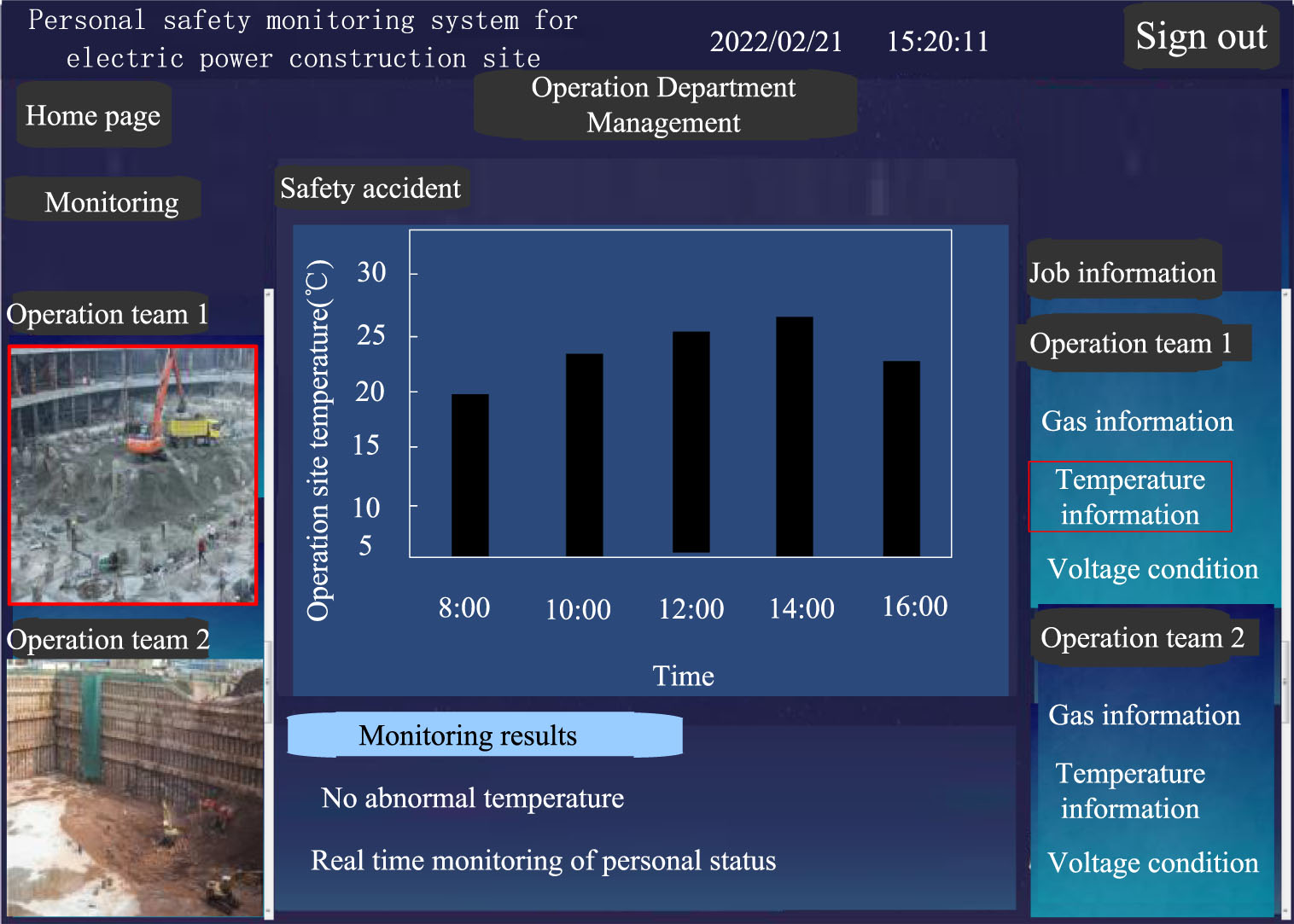
Temperature information monitoring results.
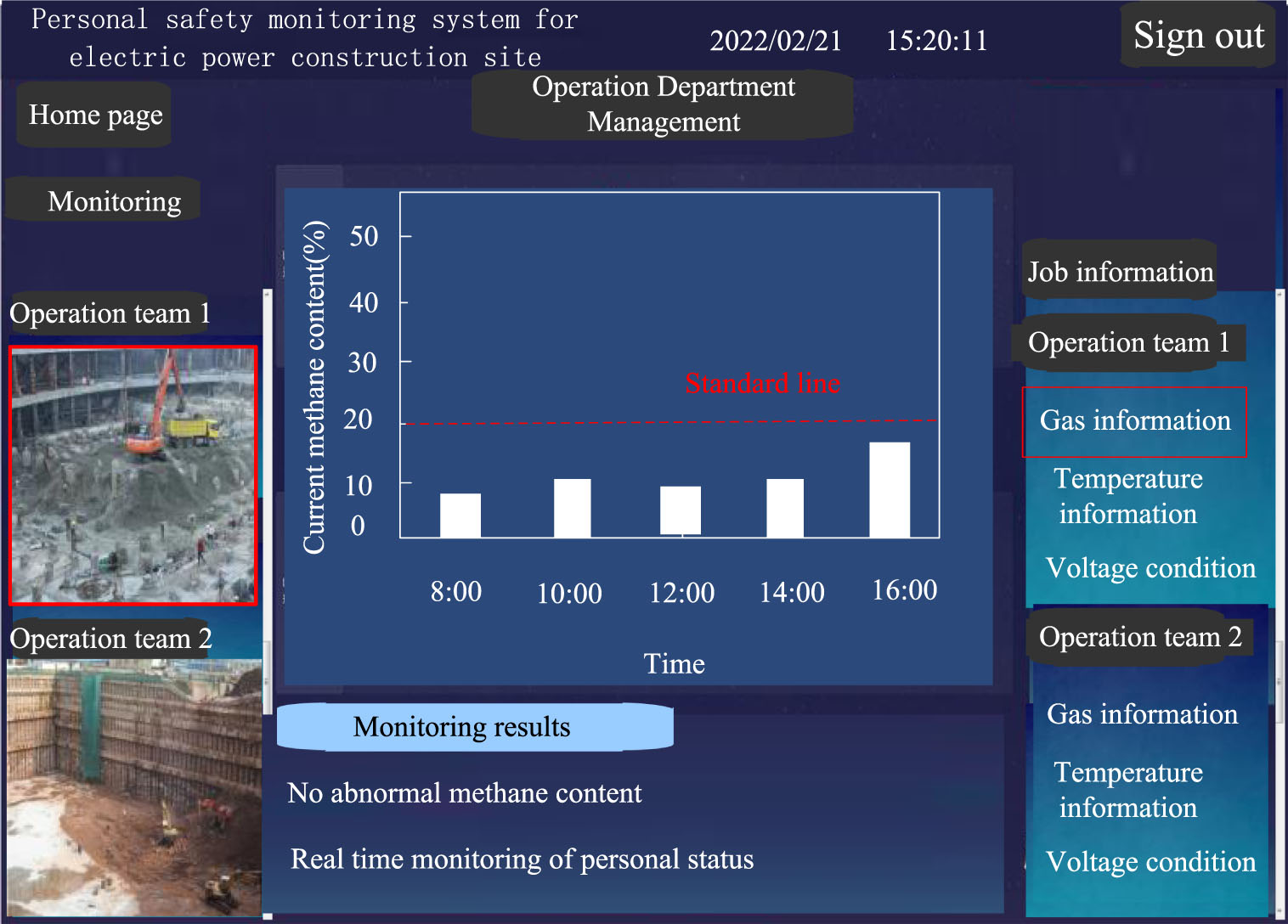
On-site gas monitoring results.
Effect of personal safety monitoring system of electric power construction site based on AIoT Technology on personal safety early warning at operation site
As shown in Figs. 7 and 8, the designed system monitors the personal safety of the deep foundation pit operation of the power transmission and transformation project, and judges whether the working environment is dangerous through the temperature and gas information of the deep foundation pit operation site of the power transmission and transformation project, so as to judge the personal safety of the operators. The monitoring results show that the working environment is normal, and the operators are not dangerous.
In order to test the application performance of the system in this paper, the electric power construction operation environment is simulated in the MATLAB platform, and the environmental conditions that can enable the system in this paper are set to generate early warning in advance, to test the error times of the system in this paper on the personal safety early warning results of the operation site. The results are shown in Table 1.
As shown in Table 1, the early warning results of the system in this paper for personal safety at the operation site are realistic and credible.
The monitoring effect of this system on gas, temperature and power-fail problems at the electric power construction site is tested. The results are shown in Figs. 9–11.
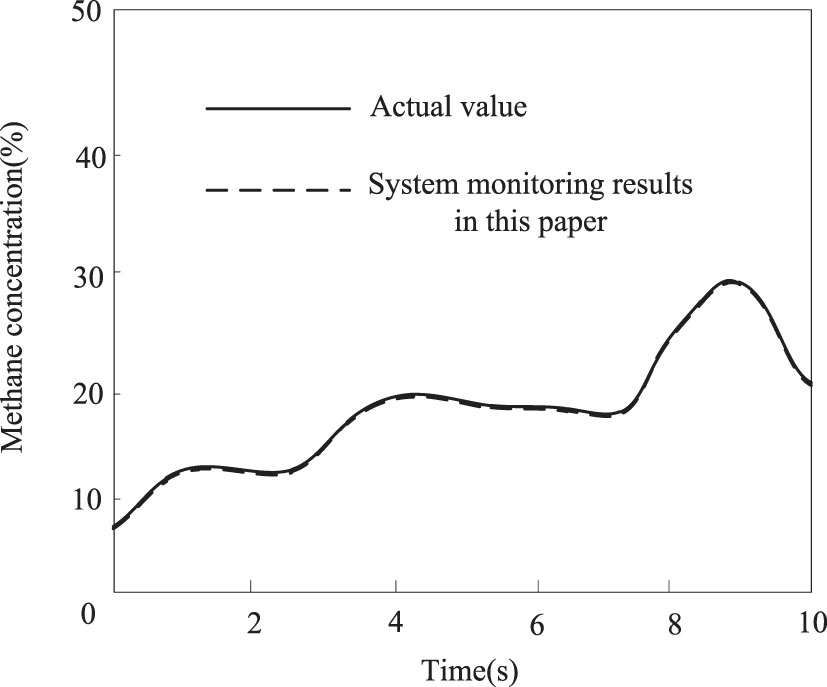
Gas monitoring results of the system on the operation site.
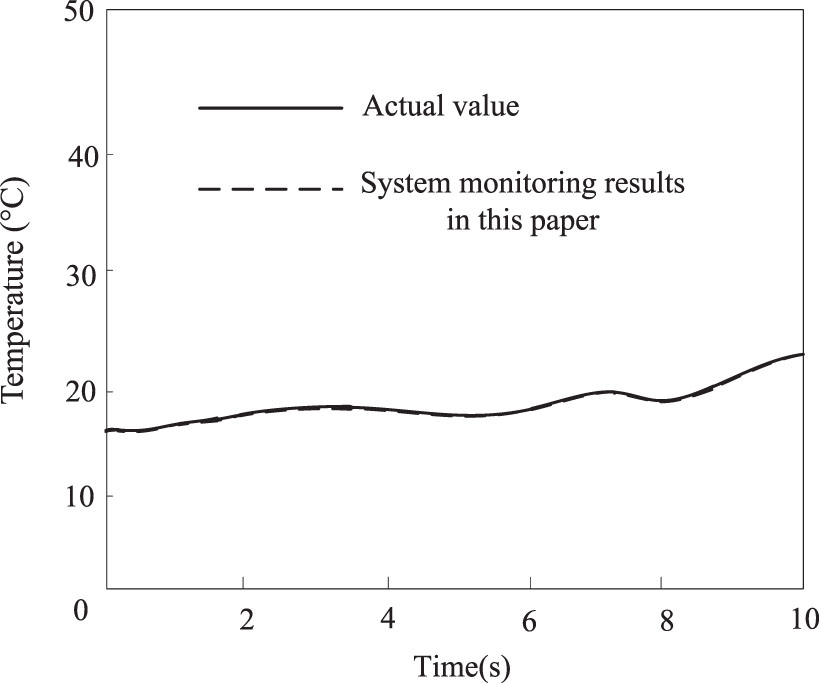
Temperature monitoring results of the system on the operation site.
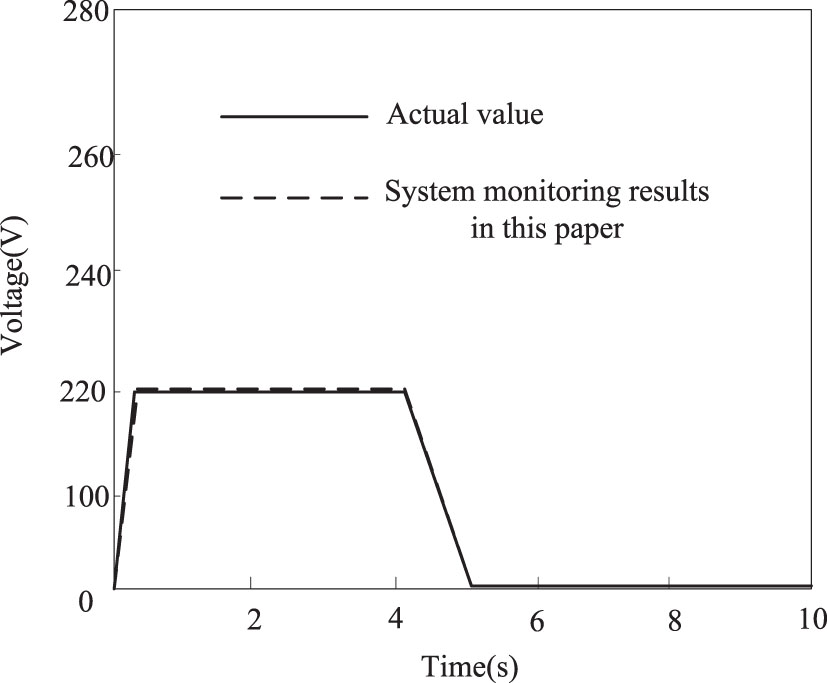
Monitoring results of the system on power-fail at the operation site.
As shown in Figs. 9–11, the system in this paper can accurately monitor the gas, temperature and power-fail problems at the electric power construction site. The monitoring results of the gas and temperature at the construction site are consistent with the actual situation. When the monitoring time of the system in this paper is 5 s, there is a power-fail problem at the construction site, and the voltage value is 0 V. The monitoring results of the system in this paper are consistent with this fact. It also shows that this system can monitor the gas, temperature and voltage status of the construction site in real time. When the power-fail problem occurs, the tracking and monitoring accuracy of its value is high. This proves that the information monitoring of this system on the electric power construction site is accurate, which can realize the real-time and accurate management of personal safety.
(1) Strictly implement safety responsibilities at all levels
The responsibility of safety production is divided layer by layer, refined and quantified to every post and every employee, to truly ensure the safety of all employees, every moment and every moment, and concentrate on safety, so as to form a closed-loop mechanism for responsibility implementation, investigation and assessment, strengthen accident statistics, investigation, analysis and assessment, establish and improve a safety management organization system with clear division of labor, each performing his own duties, each assuming his own responsibilities, and the implementation in place, adhere to the in-depth analysis of accidents and violations, find deep-seated problems, severely punish according to regulations, and promote the effective implementation of safety responsibilities.
(2) Strengthen safety awareness at all levels
Through the guidance of safety culture, it can carry out a variety of safety culture and legal education activities, firmly establish the great safety concept of “safety is paramount” in the hearts of all employees, carry out in-depth and detailed safety ideological education for all employees, and strive to improve employees’ awareness of self-protection and mutual protection. It also should organize safety warning education, and make employees change from “want me to be safe” to “I want to be safe” and “I will be safe” by facing the accident scene directly. For the accidents that occur in the system, through the live demonstration, let the employees collectively discuss the deep-seated causes and harm degree of the accidents, and write out their experiences in combination with their personal feelings, so as to draw inferences from one instance and avoid similar accidents.
(3) Strengthen on-site safety supervision and inspection
Strengthening the safety supervision of on-site work is an important part of realizing the safety production work. Through the three-level safety inspection of the company, the center and the team on the development of on-site work and the implementation of measures, increasing the frequency of safety supervision in key periods, and strengthening the rewards and punishment of anti-violation work, we can effectively improve the quality and efficiency of safety supervision, and strengthen the implementation of safety production responsibility system at all levels, so as to promote the implementation of various safety related systems and regulations, and promote the safety of on-site work.
Conclusion
Personal safety monitoring at the electric power construction site is an important concern in the field of electric power at present. In the construction site, once a variety of gases exceed the standard, they will have adverse effects on human body. If the temperature at the construction site is high, the oxygen intake of operators will become low, resulting in the risk of suffocation; In addition, power-fail often occurs on the construction site, which will lead to abnormal interruption of the operation of energized equipment on the construction site, and pose a fatal threat to the personal safety of operators. Therefore, this paper combines the advantages of artificial intelligence technology and Internet of things technology, designs a personal safety monitoring system based on AIoT technology for power construction site, and verifies its application value through experiments. The application value is mainly reflected in the following points:
The early warning results of personal safety on the operation site are in line with the reality, and the early warning results are credible; The monitoring results of gas and temperature on the electric power construction site are in line with the reality, and the system can also monitor real-time and accurately when there is a power-fail problem on the electric power construction site.
It can be proved that the designed system can accurately collect the gas, temperature and voltage information on the electric power construction site, and accurately monitor the personal safety problems of the personnel on the operation site in real time.
Data availability statement
The data are available from the corresponding author on reasonable request.
Conflict of interest
The authors have no conflicts of interest.