




Abstract
This paper introduces the concept of (O, N)-difference, for an overlap function O and a fuzzy negation N. (O, N)-differences are weaker than fuzzy difference constructed from positive and continuous t-norms and fuzzy negations, in the sense that (O, N)-differences do not necessarily satisfy certain properties, as the right neutrality principle, but only weaker versions of these properties. This paper analyzes the main properties satisfied by (O, N)-differences, and provides a characterization of (O, N)-difference.
Introduction
Difference operator is one of the main operations in classical set theory. The difference of two crisp sets E and F, denoted by E ∖ F, is given by
Roberts [1] presented an anticommutative difference operator for fuzzy sets. Dubois and Prade [2] introduced fuzzy set-theoretic differences and their use in fuzzy arithmetics and analysis. De Baets and De Meyer [3] introduced several difference operators for fuzzy sets associated to the Frank t-norms. Fono et al. [4] presented difference operations for fuzzy sets based on fuzzy implications. Alsina and Trillas [5, 6] formulated a collection of functional equations arising in modeling the concept of fuzzy difference and studied the symmetric difference. Several symmetric differences for fuzzy sets have been investigated in [7, 8]. Zanotelli et al. [9] introduced the intuitionistic fuzzy differences for intuitionistic fuzzy sets.
Alsina and Trillas [5] defined the fuzzy difference ∖ : [0, 1] 2 → [0, 1] as
Note that t-norm requires the associativity property. Fodor and Keresztfalvi [11] and Bustince et al. [12, 13] pointed out that the associativity property of the t-norm is not demanded in many applications. Bustince et al. [12] introduced the concept of overlap functions. Its dual concept is grouping functions [13]. Based on these two kinds of non-necessarily associative operators, several new concepts are introduced, such as residual implications derived from overlap functions [14], residual implications generated by discrete overlap functions [15], (G, N)-implications [16], binary relations induced from overlap and grouping functions [17] and (IO, O)-fuzzy rough sets based on overlap functions [18].
The aim of this work is to take a step forward in considering non-necessarily associative operators in the definition of fuzzy difference, introducing the concept of (O, N)-difference, by considering the overlap functions O instead of t-norm T in formula (2). This work provides new contributions related to the study of fuzzy differences constructed over basic operators. In this case, fuzzy difference is regarded as a derived operator induced by two basic operators. In this paper, overlap functions are regarded as the new extension of basic set operator ∩ different from the usual fuzzy operator t-norms. Thus the main question is: which properties are preserved. We start with the axiom set of fuzzy difference in [10]. Then we analyze the properties and give a characterization of (O, N)-difference. In particular, (O, N)-differences are weaker than the differences of formula (2) for positive and continuous t-norms, in the sense that (O, N)-differences do not necessarily satisfy certain properties, as the right neutrality property and identity principle.
The remainder of this paper is organized in the following way. In Section 2, we review necessary concepts of t-norm, overlap function, fuzzy negation, and Dai and Cheng’s definition of fuzzy difference. In Section 3, we modify Dai and Cheng’s definition of fuzzy difference, and give an axiom set of fuzzy difference and study their mutual independency. In Section 4, we introduce the concept of (O, N)-difference and present its properties. In Section 5, We give a characterization of (O, N)-difference. Conclusions are presented in Section 6.
Basic notions
Dai and Cheng [10] studied the difference operators of fuzzy sets based on the formula (2), which includes a t-norm and a fuzzy negation. Our approach to the study of difference operators on fuzzy sets is based on the formula a ∖ O,Nb = O (a, N (b)), which includes an overlap function O and a fuzzy negation N. In this part, we recall here some basic notions of t-norm, overlap function, fuzzy negation and their properties that will be frequently used.
A t-norm is positive if T (a, b) =0 ⇒ a = 0 or b = 0.
O (a, b) = O (b, a); O (a, b) =0 if and only if ab = 0; O (a, b) =1 if and only if ab = 1; O is non-decreasing; O is continuous.
• O nm (a, b) = min(a, b) max(a2, b2);
• O p (a, b) = a p b p ;
• O mp (a, b) = min(a p , b p );
• O Mp (a, b) =1 - max((1 - a) p , (1 - b) p );
•
where p > 0.
A fuzzy negation N is called strong if
A fuzzy negation N is called crisp, if
A fuzzy negation N is called non-vanishing if
A fuzzy negation N is called non-filling if
The negation operator N (a) =1 - a is called the standard negation operator.
Related work
As is well known, for a given universe X, P (X) denotes the power set of X, the difference operator ∖ : P (X) × P (X) → P (X) has the following properties: for any E, F ∈ P (X),
E ∖ F ≠ F ∖ E; E ∖ ∅ = E; E∖ E = ∅; ∅∖ E = ∅; E ∖ F ⊆ E; E⊆ F ⇔ E ∖ F = ∅; X ∖ E = E
c
; E ∖ F = F
c
∖ E
c
; E
c
∖ F = F
c
∖ E; E ∖ F
c
= F ∖ E
c
.
where E
c
is the complement of E.
Dai and Cheng [10] defined the fuzzy difference ∖ : [0, 1] 2 → [0, 1] as follows:
If a ≤ b then a ∖ c ≤ b ∖ c; If a ≤ b then c ∖ a ≥ c ∖ b; 1 ∖ 0 =1; 0 ∖ 1 =0; 1 ∖ 1 =0.
Unfortunately, the definition of fuzzy difference with these axioms is insufficient. It does not contain the law 0 ∖ 0 =0. It comes from ∅∖ ∅ = ∅ which is also a basic property of classical difference. The following example shows that this definition is unreasonable.
Definition of fuzzy difference
We first modify Dai and Cheng’s definition of fuzzy difference as follows:
If a ≤ b then a ∖ c ≤ b ∖ c; If a ≤ b then c ∖ a ≥ c ∖ b; 1 ∖ 0 =1; 0 ∖ 0 =0; 1 ∖ 1 =0.
From (FD1) and (FD5), we have a ∖ 1 ≤1 ∖ 1 =0, ∀ a ∈ [0, 1]. That is ∖ satisfies the right boundary condition
From (FD2) and (FD4), we have 0 = 0 ∖0 ≥ 0 ∖ a, ∀ a ∈ [0, 1]. Therefore, (D4) 0 ∖ 1 =0 holds. That is ∖ satisfies the left boundary condition
Therefore, fuzzy difference ∖ also satisfies the normality condition: 0 ∖ 0 =0.
The following examples of functions in Table 1 show that (FD1)-(FD5) in Definition 5 are mutually independent.
The mutual independence of (FD1)-(FD5) in Definition 5
Let O : [0, 1] 2 → [0, 1] be an overlap function and N : [0, 1] → [0, 1] be a fuzzy negation, and define the function ∖O,N : [0, 1] 2 → [0, 1], by
Obviously, the operation ∖O,N is noncommutative.
∖O,N satisfies (FD1) because O is non-decreasing. ∖O,N satisfies (FD2) because O is non-decreasing and N is decreasing. ∖O,N satisfies (FD3) because 1 ∖ O,N0 = O (1, N (0)) = O (1, 1) =1 ∖O,N satisfies (FD4) because 0 ∖ O,N1 = O (0, N (1)) = O (0, 0) =0. ∖O,N satisfies (FD5) because 1 ∖ O,N1 = O (1, N (1)) = O (1, 0) =0.
(i) The overlap function O nm (a, b) = min(a, b) · max(a2, b2) in Example 1 and the standard negation N (a) =1 - a generate the following (O nm , N)-difference;
(ii) The overlap function O2 (a, b) = a2b2 in Example 1 and the negation
(iii) The overlap function Om3 (a, b) = min(a3, b3) in Example 1 and the negation N2 (a) =1 - a2 generate the following (Om3, N2)-difference;
(iv) The overlap function OM2 (a, b) =1 - max((1 - a) 2, (1 - b) 2) in Example 1 and the standard negation N (a) =1 - a generate the following (OM2, N)-difference;
(v) The overlap function O DB in Example 1 and the standard negation N (a) =1 - a generate the following (O DB , N)-difference;
See Figs. 1–5 which reflect the characteristics of (O nm , N)-difference, (O2, N1)-difference, (Om3, N2)-difference, (OM2, N)-difference and (O DB , N)-difference respectively.
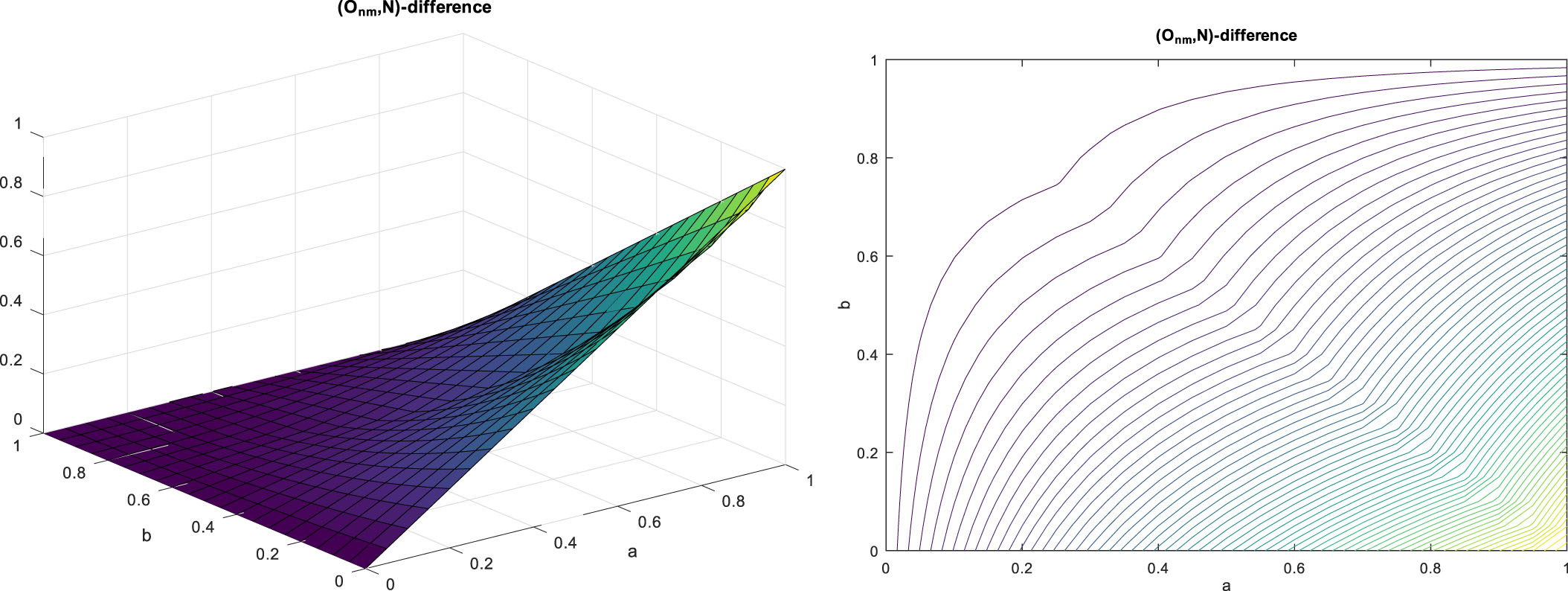
Characteristics of (O nm , N)-difference and its contour line.
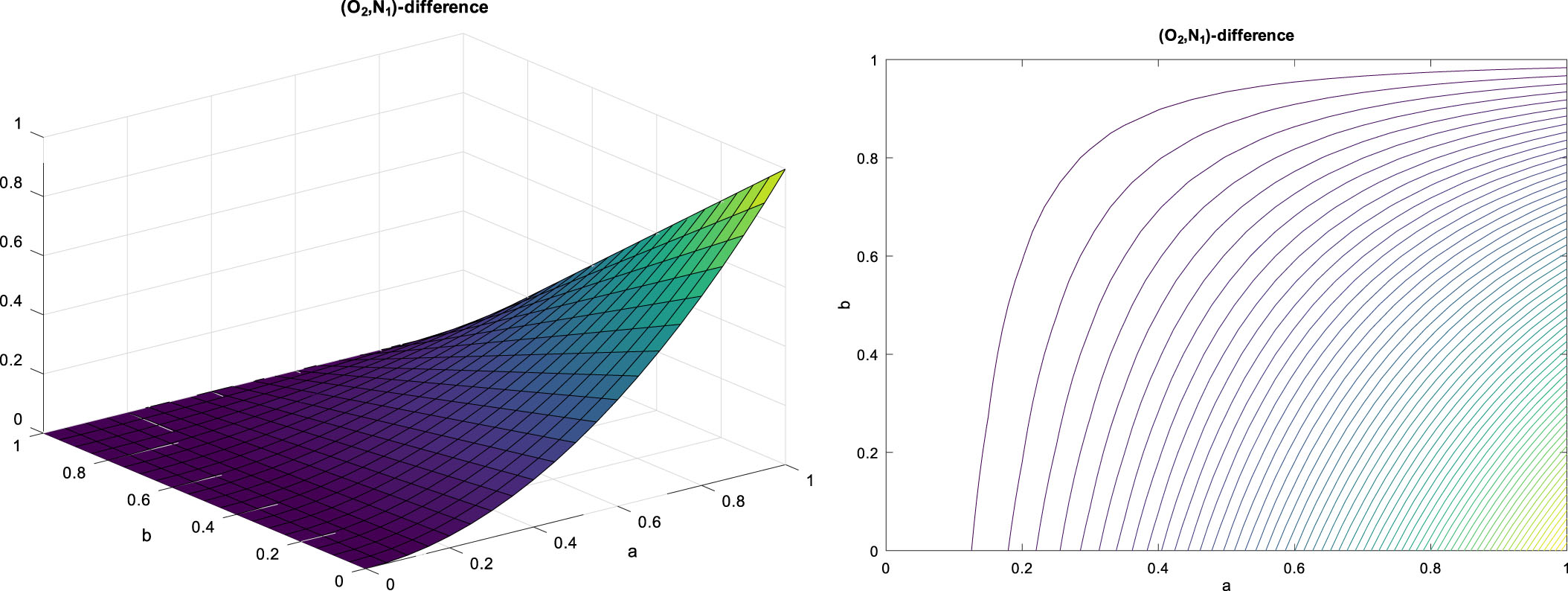
Characteristics of (O2, N1)-difference and its contour line.
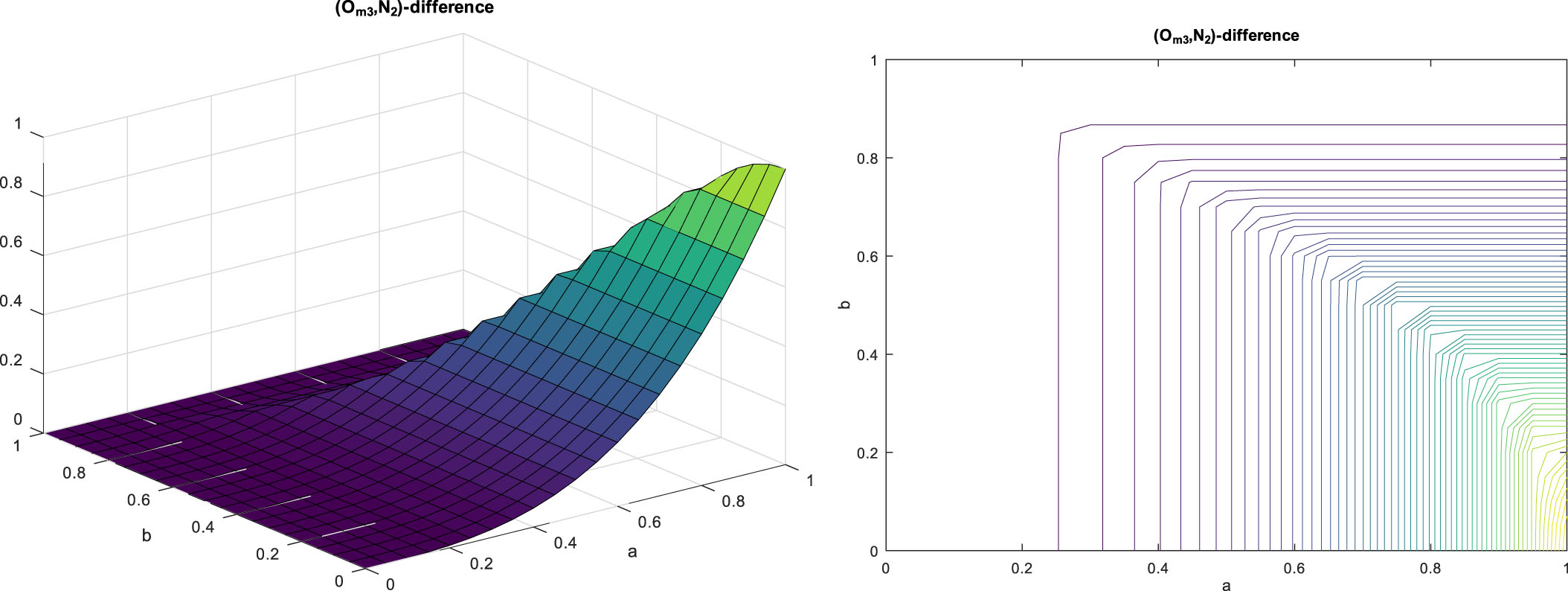
Characteristics of (Om3, N2)-difference and its contour line.
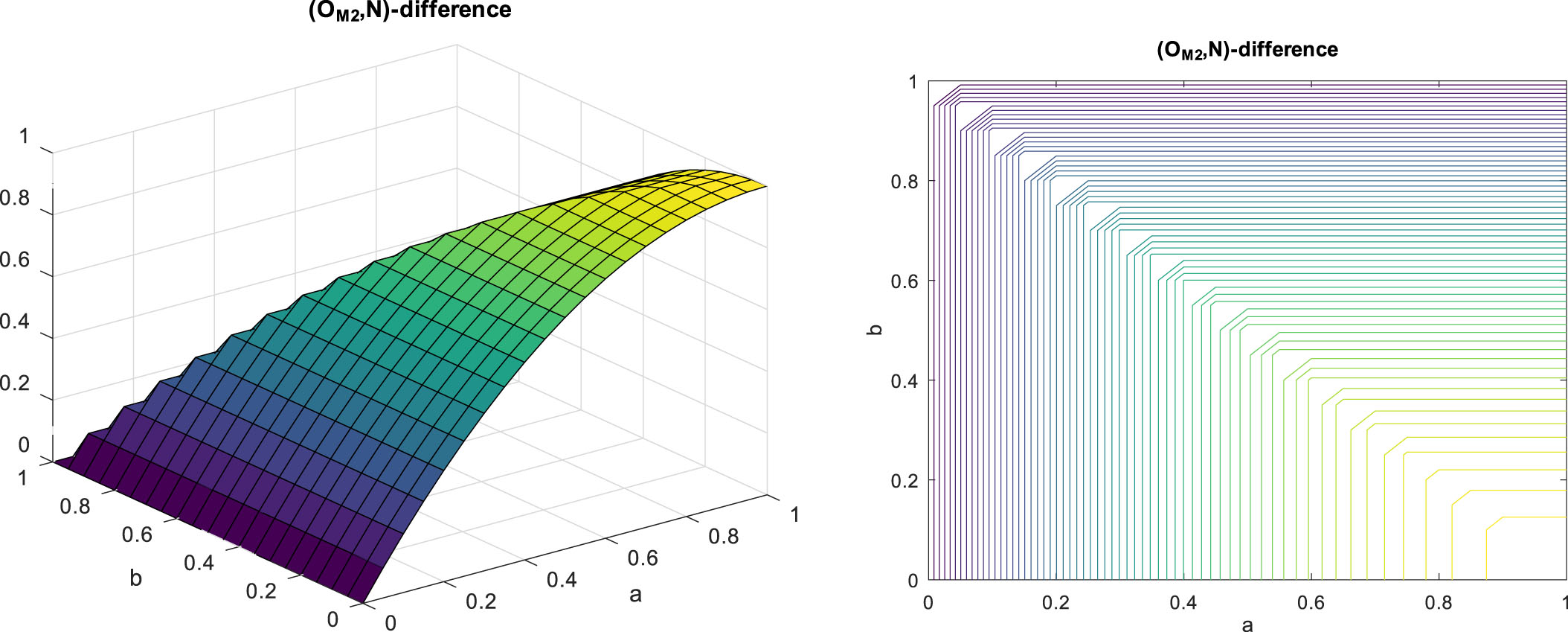
Characteristics of (OM2, N)-difference and its contour line.
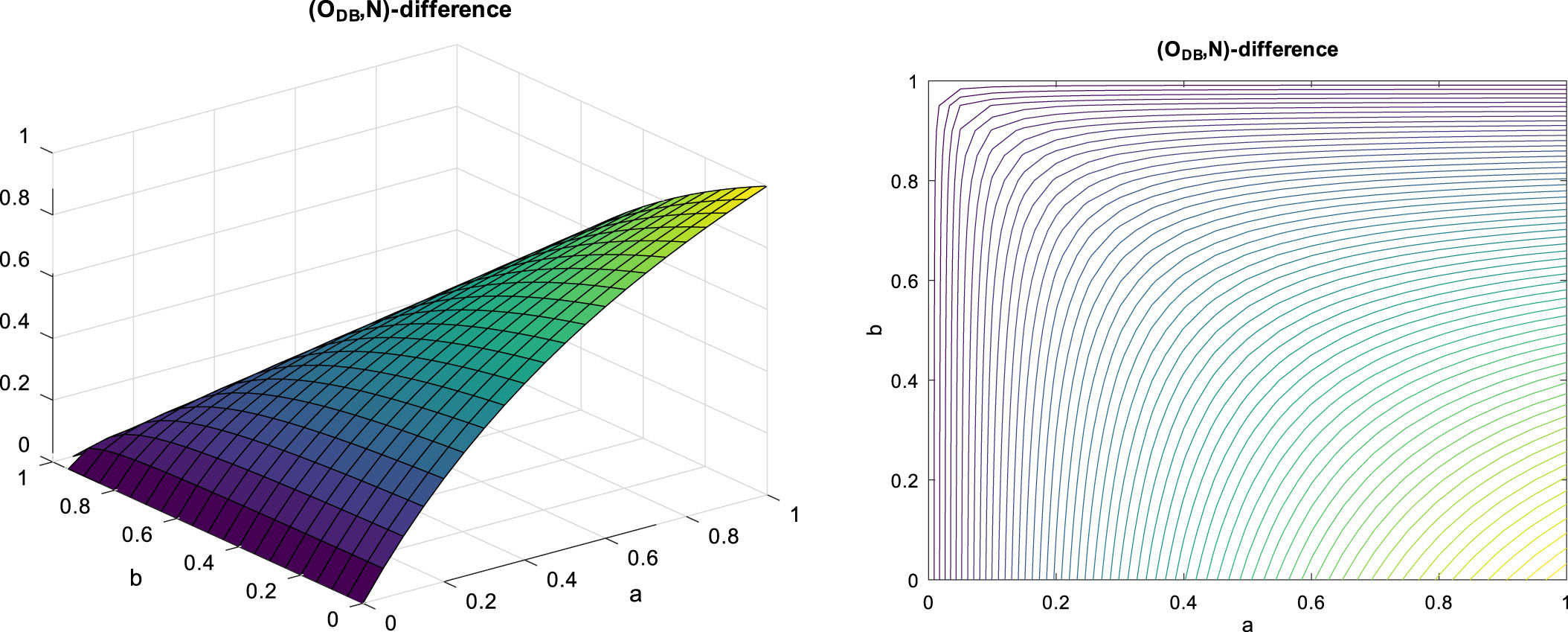
Characteristics of (O DB , N)-difference and its contour line.
The fuzzy negation N∖ defined by Equation (11) is called the fuzzy negation induced by the fuzzy difference ∖.
Classical difference have properties (P1)-(P10), in the following, we define some properties for fuzzy differences.
The right neutrality if and only if ∀a ∈ [0, 1], a ∖ 0 = a. The identity principle if and only if ∀a ∈ [0, 1], a ∖ a = 0. The left ordering property if and only if ∀a, b ∈ [0, 1], a ≤ b ⇒ a ∖ b = 0. The ordering property if and only if ∀a, b ∈ [0, 1], a ∖ b = 0 ⇔ a ≤ b. The contrapositivity property for a fuzzy negation N if and only if ∀a, b ∈ [0, 1], a ∖ b = N (b) ∖ N (a). The left contrapositivity property for a fuzzy negation N if and only if ∀a, b ∈ [0, 1], N (a) ∖ b = N (b) ∖ a. The right contrapositivity property for a fuzzy negation N if and only if ∀a, b ∈ [0, 1], a ∖ N (b) = b ∖ N (a). The strong corner conditions if and only if
∖O,N satisfies (FD6) if and only if 1 is the neutral element of O. ∖O,N satisfies (FD7) if and only if the fuzzy negation N is
∖O,N satisfies (FD8) if and only if the fuzzy negation N = N
∖O,N
If N is strong, then ∖O,N satisfies (FD10). If ∖O,N satisfies (FD10) for N and 1 is the neutral element of O then N is strong. ∖O,N satisfies (FD11) for N. If ∖O,N satisfies (FD12) for N and 1 is the neutral element of O then N is strong. ∖O,N satisfies Equation (12) if and only if N is non-vanishing. ∖O,N satisfies Equation (13) if and only if N is non-filling. ∖O,N satisfies (FD13) if and only if N is crisp.
(⇒) If ∖O,N satisfies (FD6), i.e., a ∖ O,N0 = O (a, N (0)) = O (a, 1) = a, ∀ a ∈ [0, 1], thus 1 is the neutral element of O. (⇐) The proof is similar. (⇒) Support N ≠ N
(⇐) If N = N
(⇒) If ∖O,N satisfies (FD8) then ∖O,N satisfies (FD7), and thus N = N
(⇐) Consider a ≤ b. If b = 1, then a ∖ O,N
0.6 ∖ O,N
If N is strong, then
If ∖O,N satisfies (FD10) for N, then a ∖ O,Nb = N (b) ∖ O,NN (a). By taking b = 0, then a ∖ O,N0 = 1 ∖ O,NN (a), i.e., O (a, 1) = O (1, N (N (a))). Since 1 is the neutral element of O, we have N (N (a)) = a. Thus N is strong. By (O1), O (N (a) , N (b)) = O (N (b) , N (a)), ∀a, b ∈ [0, 1]. That is N (a) ∖ O,Nb = N (b) ∖ O,Na, ∀a, b ∈ [0, 1]. Thus ∖O,N (FD11) for N. If ∖O,N satisfies (FD12) for N, then a ∖ O,NN (b) = b ∖ O,NN (a). By taking b = 0, then we have N (a) ∖ O,N0 = 1 ∖ O,Na, i.e., O (N (a) , 1) = O (1, N (N (a))). Since 1 is the neutral element of O, we have N (N (a)) = a. Thus N is strong. (⇒) If ∖O,N satisfies Equation (12), then
(⇐) If N is non-vanishing, then
(⇒) If ∖O,N satisfies Equation (13), then
(⇐) If N is non-filling, then
It follows from (ix) and (x).
Towards presenting characterizations of some classed (O,N)-differences we consider the method of obtaining overlap functions from fuzzy differences and fuzzy negations.
O∖,N (a, 0) = O∖,N (0, a) =0, ∀a ∈ [0, 1]. O∖,N is increasing in both variables, i.e., O∖,N satisfies (O4). O∖,N is commutative, i.e., it satisfies (O1) if and only if ∖ satisfies (FD12) for N. If both ∖ and N are continuous, then O∖,N is continuous, i.e., O∖,N satisfies (O5). If N is crisp, then O∖,N satisfies (O2) and (O3).
By Equation (3), O∖,N (a, 0) = a ∖ N (0) = a ∖ 1 =0. By Equation (4), O∖,N (0, a) =0 ∖ N (a) =0. O∖,N satisfied (O4) is a direct consequence of the (FD1),(FD2) and the monotonicity of N. ⇒) If O∖,N (a, b) = O∖,N (b, a), then a ∖ N (b) = b ∖ N (a) by Equation (15). Thus ∖O,N satisfies (FD12). O∖,N satisfies (O4) is a direct consequence of the continuity of ∖ and N. (⇐) If ∖ satisfies (FD12) for N, then O∖,N (a, b) = a ∖ N (b) = b ∖ N (a) = O∖,N (b, a).
From above results, we have the following characterization of (O, N)-difference when N is a strong fuzzy negation.
∖ = ∖ O,N is a (O, N)-difference for some overlap function O. ∖ is continuous and satisfies (FD1), (FD13) and (FD10) for N∖.
In this paper, we improved the concept of difference operator in [10] and showed that the axioms from our new concept are mutually independent. Then we introduced the concept of (O, N)-difference based on the notions of an overlap function O and a fuzzy negation N, together with the characterization of such fuzzy differences and an analysis of the related properties. (O, N)-difference is weaker than (T, N)-difference constructed from a positive and continuous t-norm T. This means that (O, N)-difference does not necessarily satisfy certain properties. For example, (T, N)-difference satisfies the right neutrality property and identity principle which are not satisfied by (O, N)-difference (see Lemmas 1 and 2 in [10]). The (O, N)-differences are more flexible, since they do not necessarily satisfy right neutrality property and identity principle (see Proposition 3).
It was observed that there are types of overlap functions, such as Archimedean overlap functions, overlap functions and interval-valued overlap functions. Naturally, other kinds of fuzzy differences based on these overlap functions are possible topics for future consideration. In [10], (T, N)-differences are used in constructions of pseudo-metrics which have many potential applications. In the future, we will employ the proposed fuzzy differences in some applications, such as decision-making and fuzzy inference systems.
Acknowledgments
This research was funded by the National Natural Science Foundation of China (Grant Nos. 62006168 and 62101375) and Zhejiang Provincial Natural Science Foundation of China (Grant Nos. LQ21A010001 and LQ21F020001).