




Abstract
With the rapid development of information technology, software products are playing an increasingly important role in people’s production and life, and have penetrated into many industries. Software quality is the degree to which the software meets the specified requirements, and is an important indicator to evaluate the quality of the products used. At present, the scale of software is increasing, and the complexity is increasing. It is an urgent problem to reasonably grasp and ensure the product quality. The measurement and evaluation of Software quality characteristics is an effective means to improve Software quality. Faced with the complex system of software, there are many factors that affect product quality. Current research mainly measures software product quality from a qualitative perspective. The computer software quality evaluation is a classical multi-attribute group decision making (MAGDM). Type-2 Neutrosophic Numbers (T2NNs) is a popular set in the field of MAGDM and many scholars have expanded the traditional MAGDM to this T2NNs in recent years. In this paper, two new similarity measures based on sine function for T2NN is proposed under T2NNs. These two new methods are built for MAGDM based on the sine similarity measures for T2NN (SST) and sine similarity weighted measures for T2NN (SSWT). At the end of this paper, Finally, a practical case study for computer software quality evaluation is constructed to validate the proposed method and some comparative studies are constructed to verify the applicability. Thus, the main research contribution of this work is constructed: (1) two new similarity measures based on sine function for T2NN is proposed under T2NNs; (2) These two new methods are built for MAGDM based on the sine similarity measures for T2NN (SST) and sine similarity weighted measures for T2NN (SSWT); (3) an example for computer software quality evaluation is employed to verify the constructed techniques and several decision comparative analysis are employed to verify the constructed techniques.
Keywords
Introduction
Decision making is one of human daily activities. Some complex decision-making problems often involve multiple interrelated and mutually constrained attributes, namely multi-attribute decision-making problems [1–5]. Such decision-making problems often require comprehensive consideration of multiple aspects of the problem and analysis from multiple attributes [6–10]. Due to a lack of personal abilities, knowledge, and experience, it is often difficult to make reasonable and effective decisions solely by relying on a single expert [11–14]. For this reason, group decision-making has emerged. Group decision-making can overcome the shortcomings of individual experts in terms of knowledge, abilities, and experience, balance the interests of multiple parties, and fully leverage the wisdom of the group [15–18]. Multiple-attribute fuzzy group decision-making often contains a high degree of fuzziness. To be able to handle fuzzy information in decision-making process, fuzzy systems (FSs) and intuitionistic FSs (IFSs) were constructed [19–21]. FSs and IFSs still have great limitations in practical applications [22–28], so the neutrosophic sets (NSs) [29] was constructed to handle fuzzy information. Based on NSs research, single-valued NSs (SVNSs) [30] and interval-valued NSs (IVNSs) [31] were proposed. Later scholars proposed more sets that can contain fuzzy information on the basis of these two sets. Abdel-Basset, Saleh, Gamal and Smarandache [32] proposed a new type of NSs, named type-2 neutrosophic number (T2NN) set. T2NN contains three parts, respectively truth-membership, indeterminacy-membership and falsity-membership. It uses triangular fuzzy numbers to express the information. T2NN has been widely used for MAGDM. Görçün [33] proposed TOPSIS-WASPAS method to deal with T2NN to select suitable chemical tanker vessels for shipping company. Simic, Milovanovic, Pantelic, Pamucar and Tirkolaee [34] developed T2NN-ITARA-EDAS model for MAGDM, this method is used to select sustainable route. TOPSIS was also extended to T2NN set by Abdel-Basset, Saleh, Gamal and Smarandache [32]. MABAC was used to T2NN set to make a choice for offshore wind farm site selection by Deveci, Erdogan, Cali, Stekli and Zhong [35]. Simic, Gokasar, Deveci and Karakurt [36] used CRITIC-MABAC to rank the alternatives in T2NN set. Simic, Gokasar, Deveci and Švadlenka [37] hybridized MEREC-MARCOS method under the T2NN. Li [38] constructed the cross-entropy method for MADM with T2NNs. Wang, Cai and Wei [39] constructed the TODIM method based on cumulative prospect theory with T2NNs for green supplier selection. Wang, Cai and Wei [40] constructed the TODIM-VIKOR method for MADM with T2NNs for green supplier selection.
The software product is the product of the information age. Different from the physical product, it is a collection, which contains computer data and instructions in a specific order, with Intangibility and complexity. Software products are developed based on customer needs to achieve application goals [41–43]. Users will have different requirements for software functionality and performance, such as the safety performance of financial industry software, and the reliability, stability, and accuracy of scientific research software. User needs are the driving force of software development, and software companies aim to develop high-end products that can meet customer requirements [44–46]. The software industry, as the core of the electronic information industry, with the vigorous development of the software industry, the importance and popularity of software systems are gradually increasing among enterprises, and the demand for stability and quality reliability of software products is also growing synchronously. Software quality evaluation has attracted more and more software management developers and computer scientists’ attention. There are three ways to improve Software quality in the software industry [47–49]. One is to update software production technology, the second is to improve software process and maturity, and the third is to improve software evaluation technology. Among them, software evaluation technology is an important measure to improve Software quality, while Software quality evaluation is an important aspect of software evaluation technology. Software quality evaluation process includes three parts: determining evaluation requirements, design evaluation, and implementation evaluation. Building quality model and establishing quality characteristics and attributes in the process of design evaluation is the key in the process of software evaluation [50–52]. The quality evaluation model is the reference criterion, which determines the comprehensiveness and operability of Software quality evaluation. With the intensification of social competition, the variety of software products is constantly increasing, and people’s requirements for software products are also increasing. Developing software that satisfies users has become an urgent requirement for software companies. In the Software development process, Software quality is directly related to the success or failure of product development. Software quality is the combination of various characteristics, affecting the entire software life cycle. Therefore, the quantitative evaluation of Software quality should be an essential link in the process of software development and maintenance. Through the study of users’ feedback on the use of software products, software developers gradually realized that Software quality is not only related to product quality characteristics, but also related to users’ subjective judgments [53–55]. If users can’t meet the needs of users to the greatest extent, users will subconsciously believe that there are problems in Software quality, thus causing losses to enterprises. In order to ensure that the software can meet the requirements of users to the greatest extent in the development process, Software quality evaluation is imperative. The ultimate goal of Software quality evaluation is to develop high-quality products that users most admire [56, 57]. Up to now, the research on modeling and evaluation of Software quality has a history of many years. During this period, many Software quality models have emerged, such as McCall quality model, Boehm quality model and ISO/IEC9126 quality model. The purpose of building Software quality attribute model is to make the product impact quality attributes more detailed, enable the product quality to be measured, and achieve the purpose of easy evaluation of product quality [58–60]. With the continuous progress of machine learning technology, a new perspective has emerged in the research of Software quality evaluation, which has solved some difficult problems in Software quality evaluation, laid a foundation for future research on Software quality, and has practical significance for product quality assurance and stable development of the industry. Software quality evaluation based on fuzzy information is to use support vector machine algorithm to establish an evaluation model to make Software quality evaluation more effective and accurate [61–65].
The computer software quality evaluation is a MAGDM. Type-2 Neutrosophic Numbers (T2NNs) is a popular set in the field of MAGDM and many scholars have extended the traditional MAGDM method to this T2NNs in recent years. The T2NNs [32] is a useful decision tool to portray the uncertainty during the computer software quality evaluation. Furthermore, many decision algorithms use the typical sine function [66–70] and T2NNs [32, 71–74] separately to achieve the most optimal decision selection. Thus, it has significant practical significance to discuss the computer software quality evaluation based on sine function and T2NNs. Unfortunately, we were unable to find a valuable work for sine function with T2NNs [32] during existing research literatures. Therefore, it is valuable to go deeply into sine function with T2NNs for MAGDM with applications to computer software quality evaluation. In this paper, two new similarity measures based on sine function for T2NN is proposed for decision making. These two new methods are built for MAGDM based on the sine similarity measures for T2NN (SST) and sine similarity weighted measures for T2NN (SSWT). Finally, a practical case study for computer software quality evaluation is designed to validate the proposed method and some comparative studies are designed to verify the applicability.
The main research motivation and research contributions of this paper are constructed in the following: . In this paper, a new method for T2NN to make decision is proposed. This method ranks the alternatives with similarity measure based on sine function. This method using sine similarity measure between the negative ideal solution and each alternative can make full use of the decision-making fuzzy information. . In this paper, a new kind of sine similarity measure between T2NNs is proposed on the basis of cosine similarity function between intuitionistic fuzzy sets. This sine similarity measure compares each triangle fuzzy number in T2NN. In order to more suitable for MAGDM, sine similarity weighted measures were proposed to take the weights of T2NNs into consideration. . The computer software quality evaluation is a classical MAGDM. T2NN is a popular set in the research field of MAGDM. These two new methods are built for MAGDM based on the sine similarity measures for T2NN (SST) and sine similarity weighted measures for T2NN (SSWT). At the end of this paper, Finally, a practical case study for computer software quality evaluation is constructed to validate the proposed method and some comparative studies are constructed to verify the applicability.
The structure framework of the entire article is constructed as follows: In section 2, The concept of T2NN is constructed. Section 3 is the definition of the sine similarity measures and the sine similarity weighted measures between T2NNs. Section 4 is process of decision-making with new similarity measures for T2NN. Section 5 is case study for computer software quality evaluation and result analysis. Section 6 is conclusion.
Preliminary
Wang et al. [75] proposed the SVNSs technique.
Abdel-Basset et al. [32] constructed the definition and basic computing law of T2NN.
In above formulas, T (a) portrays the truth-membership, I (a) portrays the indeterminacy-membership and F (a) portrays the falsity-membership.
The basic operating laws of T2NN are listed.
1.
Ye [76] proposed similarity measures of IFSs based on cosine function.
Based on cosine similarity measures of IFSs, two sine similarity measures between T2NN are proposed in this section.
If take the weights of T2NNs into consideration, the sine similarity weighted measures can be proposed as follows.
Let AA ={ AA1, AA2, ⋯ , AA
m
} be alternative, CC ={ CC1, CC2, ⋯ , CC
n
}be attributes. w = (w1, w2, ⋯ , w
n
) is the weight values of CC ={ CC1, CC2, ⋯ , CC
n
}, where w
j
∈ [0, 1], and
Suppose that DM = (TT ij ) m×n = (〈 (LT ij (a) , MT ij (a) , RT ij (a)) , (LI ij (a) , MI ij (a) , RI ij (a)) , (LF ij (a) , MF ij (a) , RF ij (a)) 〉) m×n is the decision matrix given by DMs, LT ij (a) , MT ij (a) , RT ij (a) , LI ij (a) , MI ij (a) , RI ij (a) , LF ij (a) , MF ij (a) , RF ij (a) ∈ [0, 1]. LT ij (a) < MT ij (a) < RT ij (a) , LI ij (a) < MI ij (a) < RI ij (a) , LF ij (a) < MF ij (a) < RF ij (a) . i = 1, 2, ⋯ , m, j = 1, 2, ⋯ , n.
Case Study
In recent years, with the rapid development of information technology, the software industry is rising rapidly. The production mode of products is transforming from industrialization and scale to globalization. The difference of software production technology and process also leads to the difference of Software quality. As an emerging industry, software plays an important role in people’s production and life. The quality of Software quality is widely concerned by users and buyers. For software developers, the evaluation results of Software quality have important reference value for developing high-quality software. In the development process of informatization and industrialization, software products have become an essential auxiliary tool for various industries, even where the core value lies. However, due to the particularity and complexity of software, software products will produce many unpredictable errors in the development process, affecting the quality of software products. The industry losses caused by Software quality problems are huge. The most influential event is the “millennium bug” problem, It has caused huge losses to industries related to the national economy, such as the financial industry, the power industry, the medical and health industry, the transportation industry, and so on, which has had a huge impact on the international scale. Even some software quality has also threatened the safety of human property, such as the Wenzhou South railway station bullet train rear end collision event in 2011 caused by the signal equipment software quality quality. Software manufacturers should attach great importance to Software quality. Software quality is related to the rise and fall of enterprises and the survival and development of human beings. Software is the result of human intellectual labor, which has certain complexity, abstraction and Intangibility. Therefore, it is difficult to quantitatively evaluate Software quality. Nowadays, the software industry, as the core industry of informatization, has entered a stage of rapid development. With the continuous improvement of people’s demand for software product quality, functionality, reliability and other aspects, Software quality has become an increasingly concerned issue. Software quality runs through the whole process of software development, is closely related to software engineering, and directly determines the success or failure of software product development. It is of great significance to establish a good evaluation and control mechanism for Software quality in software development enterprises, and it is important to establish an appropriate evaluation model and evaluation index system for Software quality evaluation. Evaluation of Software quality helps to save product production costs, reduce maintenance costs, improve user trust, establish a good corporate image, develop high-quality software, and improve enterprise market competitiveness. As the complexity of products increases, the software development cycle is lengthening, and the investment in development costs is increasing year by year, making it more difficult to evaluate and control product quality. Therefore, it is very important to study Software quality evaluation. The computer software quality evaluation is a classical MAGDM. The corporate procurement department selected five green and sustainable suppliers as candidates(ζ1, ζ2, ζ3, ζ4, ζ5). And They also selected four indicators as the main criteria for selecting suppliers. The first attribute C1 is the degree of green environmental protection of raw materials. The second attribute C2 is quality. The third attribute C3 is scientific research and experimental development. The fourth attribute C4 is production waste recycling and utilization. There are three DMs, and the weight values of each DM is ω = [1/3, 1/3, 1/3] T .
T2NN information from DM1
T2NN information from DM1
T2NN information from DM2
T2NN information from DM3
Overall matrix
NIS
Entropy weight w
SSWT1 (AA i , NIS)
SSWT2 (AA i , NIS)
And according to SSWT2 (AA i , NIS), the ranking is: AA4 > AA2 > AA5 > AA3 > AA1.
In order to demonstrate the effectiveness and correctness of this new method, the other 2 methods are used to rank the alternatives. The results comparison is shown in this section.
TOPSIS for T2NN [32]
This method is constructed by Abdel-Basset, Saleh, Gamal and Smarandache [32]. The weights used in this method are entropy weights which are shown in Table 6.
The normalized weighted matrix in this method is constructed in Table 9.
The normalized weighted matrix
The normalized weighted matrix
PIS = (0.1332, 0.1254, 0.1329, 0.1244) and NIS = (0.1246, 0.1104, 0.1175, 0.1068).
The proximity coefficient of each alternative is:
The final rank is: AA2 > AA4 > AA5 > AA3 > AA1.
Cali, Deveci, Saha, Halden and Smarandache [78] constructed T2NN-EDAS to T2NN for an energy blockchain system.
According to the T2NN-EDAS in the paper, the final appraisal information is constructed:
So the final rank is: AA4 > AA2 > AA5 > AA3 > AA1.
CRITIC-MABAC Method for T2NN [36]
This method is constructed by Simic, Gokasar, Deveci and Karakurt [36]. CRITIC-MABAC method is used to rank the alternatives. Then, the assessment score is constructed:
So the final rank is: AA2 > AA4 > AA5 > AA3 > AA1.
ITARA-EDAS Method for T2NN [34]
This method is constructed by Simic, Milovanovic, Pantelic, Pamucar and Tirkolaee [34]. According to ITARA-EDAS, the assessment score is constructed:
So the final rank is: AA4 > AA2 > AA5 > AA3 > AA1.
Results Comparison
The final ranking results obtained by these methods are listed in Table 10 and Fig. 1.
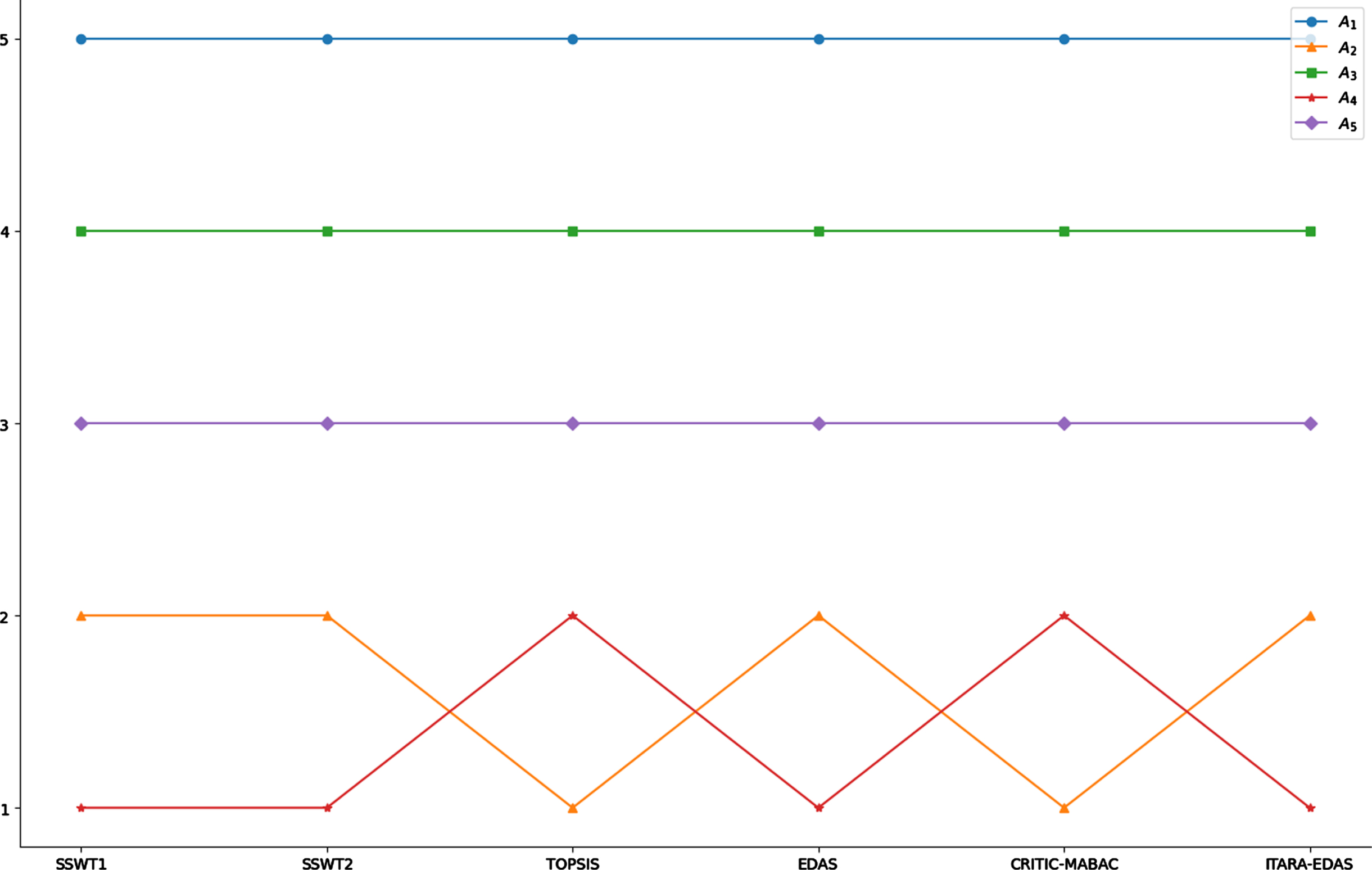
Results comparison.
Result comparison
From the comparison of the ranking results, it can be known that although the results of each method are not exactly the same, they are very close. AA2 and AA4 always rank very high and are always the best two options. The worst alternatives is AA1, It is last in the ranking of all six methods. It is evident from Fig. 1 that these alternatives are divided into two parts, AA2 and AA4 in the lower half of the picture, which always perform well. The upper half is AA1, AA3 and AA5, which perform relatively poorly. The rankings of AA1, AA3 and AA5 are stable and have not changed in the results of the six methods.
The Pearson correlation coefficient is constructed to calculate the correlation of each method ranking. The correlation between the results of each method is constructed in Table 11. It is easy could be known from the Table 11 that the linear correlation between the results is strong, with coefficients as small as 0.9 and many as 1. Through above analysis, the decision effectiveness and correctness of SSWT1 method and SSWT2 method can be proved.
Pearson correlation coefficient
With the development of computer technology and software industry, Software quality evaluation has become a hot topic in the field of software engineering. The evaluation model of Software quality is an important platform for evaluation, which supports people’s cognition and understanding of Software quality. A good model can accurately and scientifically evaluate Software quality; Poor models may mislead software development and management, and even mislead users. At present, how to evaluate Software quality scientifically has become an important research topic, and has attracted the attention of many experts and scholars. The computer software quality evaluation is a classical MAGDM. A new method which uses similarity measures based on sine function to rank the decision alternatives is constructed in this paper. It is a combination decision method under T2NN sets. The entropy method is employed to determine the weights information, and uses the SSWT between the negative ideal solution and each alternative to rank the alternatives. and the analysis of the results proves that this new proposed method is effective and can deal with decision-making problems in T2NN set. In this paper, the sine similarity measures and the sine similarity weighted measures for T2NN are also constructed for solving problems. These are new measures for T2NN set. These two new methods are built for MAGDM based on the sine similarity measures for T2NN (SST) and sine similarity weighted measures for T2NN (SSWT). Finally, a practical case study for computer software quality evaluation is constructed to validate the proposed method and some comparative studies are constructed to verify the applicability.
There are some flaws in this research are outlined: (1). In this paper, the constructed sine similarity measures for T2NN (SST) and sine similarity weighted measures for T2NN (SSWT) haven’t considered the group consensus [79–82] and the psychological behavior of DMs [83–87]. (2). The amount of decision data employed in this study example is small.
Future research works about the constructed techniques could to be continued as future research works: (1). The type of value in the formula can be improved. (2). More data can be obtained for experiments to verify the correctness of this method. (3). Trigonometric functions to measure distance and similarity can be studied in more depth, and more trigonometric functions measure methods can be proposed.