




Abstract
As a decision information preference which includes membership degree (MD), non-membership degree (NMD), and probability, the probabilistic dual hesitant fuzzy set (PDHFS) is a crucial tool for effectively expressing uncertain information. In the domains of multi-attribute decision making (MADM) and multi-attribute group decision making (MAGDM), distance measures are extremely helpful tools. In this study, a novel PDHFS distance measure is put out, on which a MAGDM method that takes decision-makers’ (DMs’) psychological behavior into account is proposed. First, a novel distance measure is put forward to effectively assess the difference between different PDHFSs by adding consideration of the distances between MDs and between NMDs. Second, a similarity-trust analysis method based on the new distance measure is employed to calculate expert weights for integrating group decisions, and the group satisfaction index and regret theory are extended to a probabilistic dual hesitant fuzzy information environment. A MAGDM method based on the novel distance measure and regret theory is proposed. Finally, the proposed method is applied to the selection of radiation protection strategies in nuclear power plants, and it is also determined through parametric analysis that DMs’ tendency to avoid regret has an impact on the outcomes of decisions. When the method proposed in this study is compared to existing approaches, the findings demonstrate that the method’s performance in resolving MAGDM issues in a PDHFS environment is superior.
Keywords
Introduction
MADM, a key component of decision theory, has been widely used in industries, economics, and management [1–4]. Due to the complexity and variability of the decision environment, the uncertainty of decision information, and the limited cognition of DMs, DMs did not provide specific and accurate values for the evaluation of alternatives; therefore, fuzzy set (FS) was proposed by Zadeh [5]. With the development of FS, it has been applied in many fields, and many scholars have extended FS [6–8]. FSs do not reflect the situation in which DMs provide multiple possible values to the decision object. To better express the DMs’ viewpoint and attitude toward the decision, Torra et al. [9] proposed the concept of hesitant fuzzy set (HFS), which allows the DMs to hesitate between several different decision evaluation values. The HFS is an important extension of fuzzy theory. Zhu et al. [10] proposed dual HFS (DHFS) based on the HFS. It contains not only MD but also NMD. Both MD and NMD consist of several possible values that are more consistent with the DMs’ perception of things. In more cases, DMs have different knowledge experiences and tendencies, and their preferences between MDs may be different, and they uphold different supports for different MDs. Xu et al. [11] proposed probabilistic hesitant fuzzy set (PHFS) based on HFS to achieve a more accurate representation of the DMs’ mental states, and PHFS gives the occurrence probability of each MD, which also solves the inconsistent attitudes of DMs. Because NMD is important information in decision problems, PHFS does not consider NMD; Hao et al. [12] combined the information of MD, NMD, and probability to propose PDHFS, which contains more comprehensive information.
Since PDHFS was proposed, there have been several studies on MADM and MAGDM under PDHFSs. Hao et al. [12] applied PDHFS to risk assessment. Ren et al. [13] proposed an integrated VIKOR and AHP approach based on PDHFS to solve the strategy selection problem of artificial intelligence. Harish et al. [14] proposed robust correlation coefficients for PDHFS and analyzed its application. Liu et al. [15] proposed an interval-valued probabilistic dual hesitant fuzzy multi-attribute group decision method. Kumar et al. [16], on the other hand, proposed a system reliability assessment method based on interval-valued probabilistic dual hesitant fuzzy elements. Shao et al. [17] extended the probabilities in probabilistic dual hesitant fuzzy preferences to uncertain probabilities and proposed a multi-objective programming approach for obtaining priority vectors in an uncertain probabilistic dual hesitant fuzzy preference environment. Song et al. [18] proposed a group decision method in an incomplete probabilistic dual hesitant fuzzy preference environment. Song et al. [19] proposed a group consensus decision method based on probabilistic dual hesitant fuzzy preference relations and studied its applications. Li et al. [20] applied the probabilistic dual hesitant fuzzy multi-attribute group decision-making model to credit risk assessment in supply chain finance. Ning et al. [21] proposed a new multi-attribute decision-making technique based on extended power generalized Maclaurin symmetric mean operator and applied it to the sustainable supplier selection problem.
The distance measure is an important tool in MAGDM. There are many studies on FS, HFS, DHFS, and PHFS distance measures [22–26], but there are few studies on distance measures for PDHFS. Garg et al. [27], Ning et al. [28], and Ning et al. [29] proposed distance measures for the PDHFS, but all of them have certain shortcomings and do not effectively compare different probabilistic dual hesitation fuzzy elements. Therefore, this study proposes a novel distance measure that can effectively compare different probabilistic dual hesitant fuzzy elements, which plays a basic theoretical support role in the research of distance measures of PDHFS.
Classical decision methods include TOPSIS [30, 31], TODIM [32, 33], etc. Ghorabaee et al. [34] in 2015 proposed the evaluation based on distance from average solution (EDAS) method, which not only has stability under different weights but also has good consistency compared with classical decision methods. The stability, validity, and simplicity of the computational process of the EDAS method have led to its rapid development in recent years. EDAS, as a relatively new multi-attribute decision method proposed in recent years, is generally applied to evaluate values for numerical decision problems [35–37], whereas less relevant research has been applied to MADM problems in which the evaluated values are PDHFSs. The above decision methods are all based on the assumption that decision experts are perfectly rational. In the actual decision-making process, DMs are often finite rational, and an increasing number of scholars are now focusing on the influence of the psychological line of DMs on the actual decision-making process and decision results [38, 39]. Regret theory can portray the decision evaluation of DMs under finite rational behavior with fewer parameters and relatively simple calculations. Regret theory compensates for some expectancy theory perspectives to explain the Allais paradox as well as the less plausible aspects of the deterministic effect and has a wide range of applications in many research fields [40, 41].
In this study, we reviewed multi-attribute group decision-making for PDHFS, distance measures for PDHFS, and classical decision-making methods; however, some problems were identified during the review process. The motivations for this study are as follows:(1) PDHFS has good flexibility and completeness in expressing fuzzy and uncertain information. (2) The distance measure is an important tool for solving multi-attribute group decision-making problems. Existing distance measures cannot effectively measure the distance between different PDHFSs, and the distance measure of PDHFS needs to be improved. (3) The multi-attribute group decision-making methods in the PDHFS environment are calculated based on flawed distance formulas and do not consider the psychological behaviors of DMs. (4) Decision-making on radiation protection in nuclear power plants is an important issue for nuclear power plants, which involves many aspects, such as society, human beings, and the environment.
The purpose of this study is to propose a novel distance measure that can effectively measure the distance between different PDHFSs and to provide a multi-attribute group decision-making method that considers the psychological behaviors of DMs to promote further research on PDHFS.
In this study, we propose a novel distance measure between two PDHFSs, using a similarity-trust analysis method based on the novel distance to determine the expert weights and construct a probabilistic dual hesitant fuzzy multi-attribute group decision-making model based on the regret theory and EDAS method, which is finally applied to radiation protection decision-making in nuclear power plants. The model is validated by parametric sensitivity analysis and comparative analysis. The main contributions of this paper are as follows: (1) Existing distance formulas for PDHFEs are briefly reviewed, and examples are provided to illustrate the defects of the existing distance formulas; in other words, the existing distance formulas only consider the distances between the products of MDs and the corresponding probabilities and the distances between the products of NMD and the corresponding probabilities, which do not effectively compare the distances between different PDHFSs. Therefore, this study proposes an axiomatic definition and calculation formula for the distance measure between PDHFSs, which adds to the consideration of the specific distribution of MD and NMD and solves the problem that existing distance measures cannot effectively measure the distance between different PDHFSs. (2) The similarity-trust analysis method based on the novel distance measure is used to determine the expert weights, which can ensure the objectivity of the expert weights and maximize the retention of the authoritative experts’ opinions so that the final group opinions will be more reasonable. The maximum deviation method based on the novel distance measure is used to calculate the attribute weights, which makes the attribute weights more accurate and objective. (3) The psychological behaviors of experts are considered, which are more in line with reality. The regret theory, group satisfaction index, and EDAS method are extended to the decision-making environment of PDHFS, and the multi-attribute group decision-making method based on the novel distance measure and consideration of DMs’ psychological behaviors is constructed to promote further research on multi-attribute group decision-making in the environment of PDHFS. (4) The proposed multi-attribute group decision-making method is applied to radiation protection decision-making in nuclear power plants, and the model is validated by parametric sensitivity analysis and comparative analysis. The constructed model provides more choices for the management to deal with the uncertainty problems of decision-making information.
The main work of this paper is as follows: Section 2 reviewed some definitions and calculation formulas for PDHFS, regret theory, and the group satisfaction index; Section 3 reviewed the distance formulas of PDHFS in the existing literature and gave an example to illustrate the defects of the existing distance measures, based on which a new distance measure of PDHFE and a weighted distance measure of PDHFS were proposed, which laid a solid foundation for future research; Section 4 proposed a MAGDM method to determine the expert weights using the similarity-trust analysis method based on the new distance formula, and the disparity maximum method to calculate the attribute weights based on the new distance formula, calculate the perceived utility of DMs based on regret theory and group satisfaction index, and use the EDAS method to rank the alternatives. Section 5 applied the proposed method to the decision making of protection from radioactive substances and verified the effectiveness and feasibility of the proposed method using parametric sensitivity analysis and comparative analysis. Section 6 presented the conclusions of this study and future work.
Preliminaries
Probabilistic dual hesitant fuzzy sets
In this subsection, we review some basic conceptions, score functions, deviation degrees, comparison methods and aggregation operators for PDHFS.
The components
If
If s (α1) > s (α2), then the PDHFE α1 is superior to α2, denoted by α1 > α2. On the contrary, there is α1 < α2.
If s (α1) = s (α2), then,
Regret theory, also known as regret theory, was proposed in literature [42, 43], respectively, and its essential idea is that in the decision-making process, the DMs will not only focus on the results obtained from the chosen alternative, but also compare the chosen alternative with the unchosen alternative. If the DMs find that the unchosen alternative brings better value than the alternative already chosen, the DMs regret it. If the DMs find that the unchosen alternative brings a worse value than the alternative already chosen, the DMs will feel elated. The DMs will anticipate possible regret and elation during the decision-making process and will obviously avoid the alternative that will cause them to feel regret. The perceived utility of the DMs after choosing the alternative is:
Where v a refers to the utility value brought about by the DM choosing alternative a, Δv refers to the gain/loss value of DMs choosing alternative a instead of alternative b, and R(Δv) refers to the regret-elation value of the DMs choosing alternative a instead of alternative b. When R(Δv)>0, a elation value is generated, and when R(Δv)<0, it means that the regret value is generated. The regret- rejoice function R(*) is a monotonically increasing concave function satisfying R(0) = 0, R'(*)>0, and R” (*)<0.
In this study, the regret- rejoice function presented by Caspar [44] is chosen:
Where ɛ(ɛ>0) refers to the regret avoidance parameter, and a larger ɛ indicates a higher degree of regret avoidance by the DMs.
Xia [45] proposed the group satisfaction index as a utility function in regret theory in MADM problems with evaluated values of hesitant fuzzy numbers. In this study, it is extended to the MADM problem with PDHFE.
Where s(α) is the score function of PDHFE and σ(α) is the deviation function of PDHFE, reflecting the degree of disagreement of the decision group.
Existing distance measures of PDHFEs have not been extensively studied. Currently, there are literature [27–29] defining the distance measures between PDHFEs. Ning and Wei et al. [28] and Ning and Lei et al. [29] pointed out that the distance obtained from the distance measures in literature [27] is less than the actual distance, so this section analyzes the distance measures proposed by Ning and Wei et al. [28] and Ning and Lei et al. [29], give an example to illustrate the shortcomings of the existing distance measures, and propose novel distance measures.
Classical distance measures of PDHFEs
The definition and formulae for the distance measure proposed by Ning and Wei et al. [28] are given in Definition 7 - Definition 8.
0 ⩽ d (α1, α2) ⩽ 1; d (α1, α2) = d (α2, α1); d (α1, α2) = 0, if and only if α1 = α2.
Where Γ = max(# h1, # h2) , Φ = max(# g1, # g2). If μ = 1, d (α1, α2) is the Hemming distance d HD (α1, α2) for both, and if μ = 2, d (α1, α2) is the Euclidean distance d ED (α1, α2) for both.
The definition and formulae for the distance measure presented by Ning and Lei et al. [29] are given in Definition 9 - Definition 10.
0 ⩽ d (α1, α2) ⩽ 1; d (α1, α2) = d (α2, α1); d (α1, α2) = 0, if and only if α1 = α2; d (α1, α2) ⩽ d (α1, α3) + d (α3, α2).
If μ = 1, d (α1, α2) is the Hemming distance d HD (α1, α2) for both, and if μ = 2, d (α1, α2) is the Euclidean distance d ED (α1, α2) for both.
The distance formulas given in the existing literature only consider the distances between the products of the MDs and the corresponding probabilities and between the products of the NMDs and the corresponding probabilities, ignoring the specific distribution of the MD and NMD in PDHFEs, and the MD and NMD in PDHFEs does not play a role in the existing distance formulas. Therefore, MD and NMD in PDHFEs should be regarded as important features of the distance measure.
0 ⩽ d (α1, α2) ⩽ 1; d (α1, α2) = d (α2, α1); d (α1, α2) = 0, if and only if α1 = α2.
Where
1) If d (α1, α2) = 0, we have
then
then
and from the Definitions 2, we get α1 =α2.
2) On the other hand, if α1 =α2, the above arguments can be reversed to obtain d (α1, α2) = 0.
The new distance measure is an improvement on the existing distance measures, which retains the characteristics of the existing distance measure and overcomes its shortcomings. To illustrate the superiority of the proposed novel distance measure, the PDHFEs in Example 1 were selected for calculation, and d (α1, α2) = 0.0759 was obtained, which can effectively clarify the distance between the two.
0 ⩽ d (M, N) ⩽ 1; d (M, N) = d (N, M); d (M, N) = 0, if and only if M = N.
Where w
j
refers to the importance of each criterion and 0 < w
j
⩽ 1,
In this section, an MAGDM method based on novel distance measures and regret theory under PDHFSs is introduced. Let Y = {y1,y2, . . . , y i , . . . , y m } be the set of different alternatives, in which yi refers to the i-th alternative, i = 1, 2, . . . , m. Let C = {c1, c2, . . . , c j , . . . , c n } be the set of attributes, in which c l refers to the j-th criterion/attribute, j = 1, 2, . . . n. Let E = {e1, e2, . . . , e k , . . . , e l } be the set of the experts, in which e k refers to the k-th decision expert, j = 1, 2, . . . , l. Each expert gives the evaluation value as probabilistic dual hesitant fuzzy expressions α ij , where α kij refers to the value of the k-th expert’s assessment of the i-th alternative under the j-th attribute.
Similarity-trust analysis method to determine expert weights
In MAGDM, the evaluation values of the group are obtained by aggregating the evaluation values of each expert. Similarity reflects the consistency of experts’ decisions, and trust reflects the trust of experts in themselves and among experts. In this subsection, we use the similarity of experts and other experts to determine the similarity weight of experts and use trust to determine the trust weight of experts. Finally the comprehensive expert weights are obtained.
The similarity between expert e k and expert e t under the j-th attribute is:
The similarity between expert e k and the group under the j-th attribute is:
The similarity weight of expert e k under the j-th attribute is:
Experts express trust in each other with the same ambiguity and hesitation, and experts use PDHFEs to express trust that is more in line with the actual expression preferences of experts. T ktj refers to the expression of trust of the k-th expert to the t-th expert under the j-th attribute, and the trust relationship matrix is obtained from the trust values given by the experts, the total trust of expert e k under the j-th attribute is:
s (T kij ) is the score function value of the assessed value T ktj .
The trust weight of expert e k under the j-th attribute is:
The comprehensive weight of the expert e k under the j-th attribute is obtained as:
Where b is the preference parameter of expert weights, 0≤b≤1.
The attribute weights of PDHFEs are determined based on the idea of the maximum deviation method, and a nonlinear programming model of the attribute weights is developed.
The optimal weights of the attributes are obtained by solving the formula using Lagrange’s theorem and normalizing it.
In this subsection, we consider the regret-avoidance psychology of experts in the actual decision-making process, calculate the regret-rejoice values and perceived utility values of PDHFSs, and then construct a multi-attribute decision model by combining the EDAS method.
(1) Calculate the average alternative evaluation value
(2) Calculate the positive distance from average (PDA) and negative distance from average (NDA) between the perceived utility value of each alternative and the perceived utility value of the average alternative by Equation (23).
(3) Aggregate attribute weights to obtain the weighted sum of PDA (SP) and weighted sum of NDA (NP) by Equation (24).
(4) Calculate the normalized SP (NSP) and normalized SN (NSN), and obtain the final appraisal score (AS) of the perceived utility for all alternatives by Equations (25-26).
A flowchart of the proposed MAGDM method based on the novel distance measure and regret theory is shown in Fig. 1.
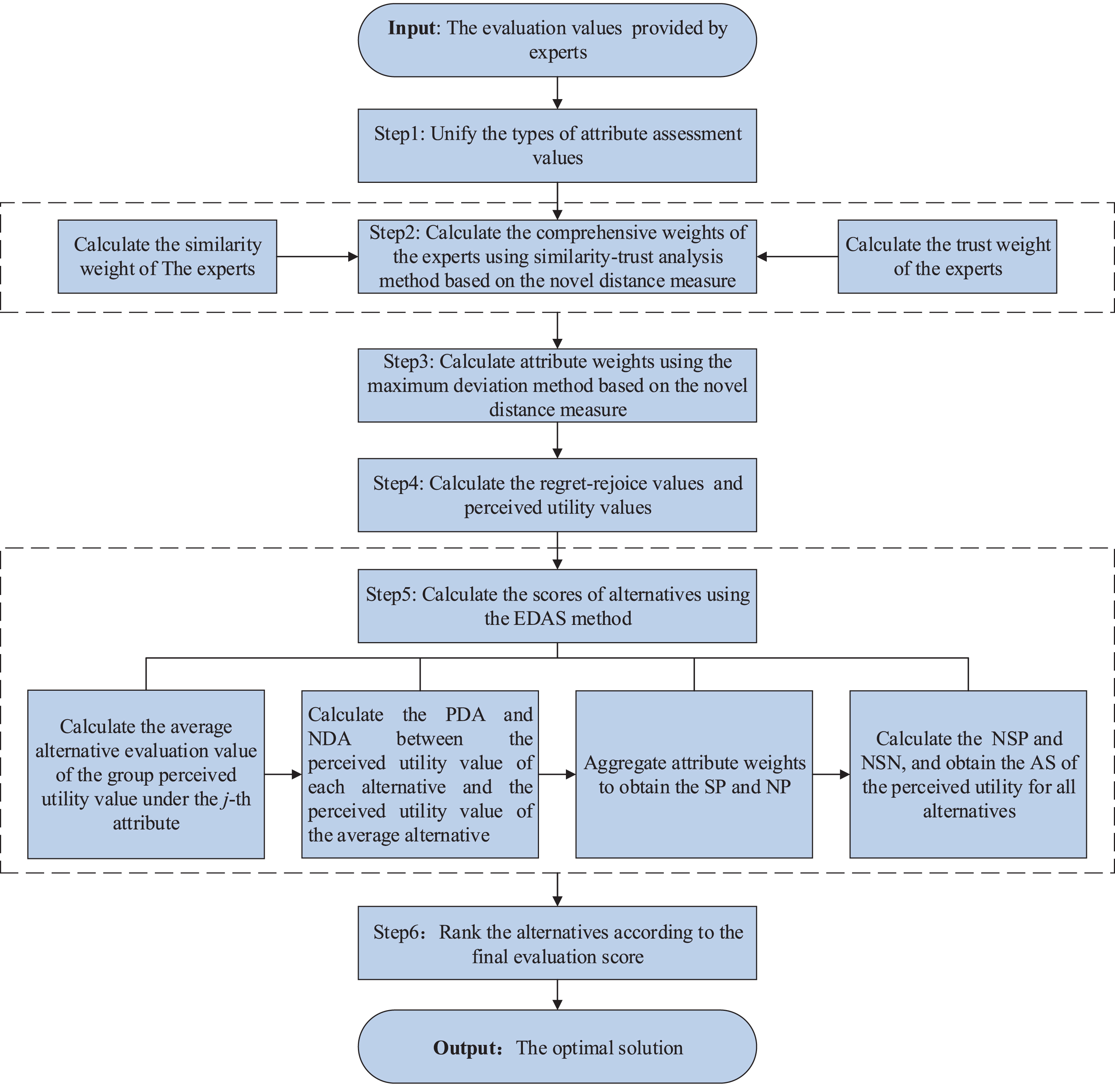
The flowchart of the proposed MAGDM method based on the novel distance measure and regret theory.
Decision-making for the protection of radiation from nuclear power plants
To verify the effectiveness of the proposed method, we took the protection of radiation under the PWR5 accident source of nuclear power plant D as an example, the choice of radiation protection strategy involves social, public, and environmental issues, and belongs to the category of MAGDM problems; therefore, three experts were invited to make decisions on radiation protection strategies. Experts evaluated the radiation protection effects of nuclear accidents under four attributes: negative psychosocial impact c1, economic cost c2, maximum preventable individual dose c3, and preventable collective dose c4, in which the attribute weights were completely unknown. The PDHFE evaluation values of the alternatives provided by experts under different attributes are listed in Table 1–3.
Matrix of evaluation values given by expert e1
Matrix of evaluation values given by expert e1
Matrix of evaluation values given by expert e2
Matrix of evaluation values given by expert e3
The trust matrix given by the experts is shown in Table 4, where experts in the columns are evaluators, and experts in the rows are evaluated.
Trust matrix between experts
Group decision matrix of PDHFEs
The perceived utility matrix
(1) The average evaluation value matrix of the perceived utility value of group decisions was calculated under the j-th attribute:
(2) The PDAs and NDAs were calculated and listed in Table 7.
PDA and NDA
(3) The SPs and SNs were calculated: SP = [3.2999,–2.2638,–1.2287,1.4600]T,SN = [–3.6471,1.0022,0.3692,–1.5400]T.
(4) The NSPs and NSNs are calculated and the AS of the perceived utility of the alternatives were obtained: AS = [0.5000,0.0196,0.2632,0.9323]T.
To better express the psychological behavior of DMs in probabilistic dual hesitant fuzzy multi-attribute decision-making, a sensitivity analysis was conducted on the regret avoidance parameter in regret theory to test the influence of the psychological behavior of DMs on the decision outcome under different regret avoidance parameters.
As the regret avoidance parameter increases, the ranking of alternatives changes from x4 > x2 > x1 > x3 to x4 > x1 > x3 > x2, then to x1 > x4 > x3 > x2, and finally to x4 > x3 > x2 > x1, indicating that the regret avoidance behavior of DMs affects the choice of alternatives and the degree of regret avoidance of DMs has an impact on the choice of alternatives. Therefore, considering the regret avoidance behavior of DMs has important practical significance in the actual decision-making process.
Comparative analysis
To further illustrate the effectiveness and feasibility of the multi-attribute decision-making method proposed in this paper, it was compared with the methods in the literature [27, 28], and [29]. The psychological behaviors of DMs are not considered in the literature [27], where the alternatives are ranked using a score function after aggregating the alternative evaluation values given by experts. The expert weights and attribute weights of the decision-making method proposed by Ning and Wei et al. [28] were given directly, and the regret avoidance psychology of the DMs was not considered. Two ranking methods have been proposed by Ning and Wei et al. [28]: (1) the same attribute weights for MD and NMD in PDHFE; (2) the experts assigned different weights to MD and NMD in PDHFE. For the first case, we used the expert and attribute weights calculated in the decision-making method proposed in this study to calculate the similarity of each alternative to the ideal solution using the distance formula of PDHFEs proposed by Ning and Wei et al. [28]. For the second case, we used the expert weights calculated in the decision-making method proposed in this study and attribute weights [0.25,0.1,0.3,0.35]T under NMD to calculate the similarity of each alternative to the ideal solution using the distance formula of PDHFEs proposed by Ning and Wei et al. [28]. The alternatives were ranked for comparison using the distance formula proposed in literature [29]. Table 9 presents the results of the comparative analysis.
Ranking of alternatives under different regret avoidance parameters
Ranking of alternatives under different regret avoidance parameters
The comparative analysis of several decision-making methods
Compared with the method in literature [27], we found that the optimum in the ranking of alternatives obtained in literature [27] was the same as the optimum in the ranking of alternatives in the method proposed in this paper with regret avoidance coefficients ɛ= 0.7, 0.9, but the other alternatives were ranked differently. The distance measure proposed by Garg et al. [27] was smaller than the actual distance between PDHFSs, which may lead to a different ranking of alternatives.
Compared with the method in literature [28], we found that the ranking of alternatives obtained in literature [28] was the same as the ranking of alternatives when the regret avoidance parameters ɛ= 0.7, 0.9, and ɛ= 0.3, 0.5, in the decision-making method proposed in this study, indicating that the decision-making method proposed in this study has some rationality. This study considered the influence of DMs’ regret avoidance psychology on the decision result, which is more comprehensive than that considered by Ning and Wei et al. [28], and presented the calculation methods of the expert weights and attribute weights, which are not in the method proposed by Ning and Wei et al. [28]. This study ranked the alternatives based on the EDAS method, which reduced the influence of extreme values to a certain extent compared to the ranking method proposed by Ning and Wei et al. [28], which only considered the distances between alternatives and the ideal alternative.
Compared with the method in the literature [29], we found that the ranking of alternatives obtained in literature [29] was the same as the ranking of alternatives when the regret aversion coefficients ɛ= 0.3, 0.5 in the method proposed in this paper, which also showed that the decision-making method proposed in this paper has certain rationality. This study improved the distance measure given in literature [29] by considering the distances between MDs and the distances between NMDs, which could compare the distance between different PDHFSs more effectively. The method proposed in this paper considers experts’ preference for risk, which is more relevant to actual decision-making.
The decision-making method proposed in this paper not only improved distance measures, which can compare the distances between different PDHFSs more effectively, but also adopted a similarity-trust analysis method based on the novel distance measure to calculate the expert weights and adopted the deviation-maximization method based on the novel distance measure to calculate the attribute weights, which is more objective and accurate than the directly given expert weights and attribute weights, making the final group opinion more reasonable. The method proposed in this study also considers the DMs’ risk preference, which is more in line with the fact that DMs are irrational individuals in the actual decision-making process.
In this study, we propose a novel distance measure for PDHFSs that considers the distances between MDs and the distances between NMDs, which makes the distance measure more complete and allows for a more effective comparison of the distances between different PDHFSs. The similarity-trust analysis method based on the novel distance formula is used to calculate expert weights for integrating group decision making, which ensures the objectivity of the expert weights and maximizes the retention of authoritative experts’ opinions, making the final group opinion more reasonable. A multi-attribute group decision making method based on the group satisfaction index and regret theory is proposed, which considers the irrational behaviors of DMs in probabilistic dual hesitant fuzzy information multi-attribute group decision-making. The proposed method is applied to radiation protection decision-making to illustrate its practicality. Through parameter analysis, we can see that the multi-attribute group decision-making method proposed in this study has more flexibility and can provide DMs with more choices by adjusting the parameters in the method to meet different needs in practice. A comparative analysis with the existing decision-making methods verifies the effectiveness of the proposed method. The novel distance measure and multi-attribute group decision-making model proposed in this study can be used to solve the multi-attribute group decision-making problem in the decision-making environment of PDHFSs.
Only expert weights and the group satisfaction index are taken into account by the multi-attribute group decision-making method developed in this study. However, in the actual decision-making process, due to the complexity of the decision-making problem, the uncertainty of the decision-making environment, and the differences in the level of knowledge, experience, and preferences of DMs, it is occasionally very difficult to come to a consensus on a particular issue, and it is necessary to continuously adjust and revise the evaluation values of experts’ alternatives to come to a consensus. This study does not consider the revision and feedback process of the group decision to achieve the target degree of consensus; therefore, future research will focus on the group consensus problem under a probabilistic dual hesitant fuzzy information environment.
Author Contributions
Wang Pingping: Conceptualization, writing— original draft preparation, writing— review and editing, methodology, validation; Chen Jiahua: supervision. All authors have read and agreed to the published version of the manuscript.
Funding
This work was supported by the Research Foundation of Education Bureau of Hunan Province, China (grant number 19A443) and Hunan Philosophy and Social Science Foundation Project (grant number 14JD51).
Institutional review board statement
Not applicable.
Informed consent statement
Not applicable.
Data availability statement
Not applicable.
Conflicts of interest
The authors declare no conflict of interest.