




Abstract
Saminger-Platz, Klement, and Mesiar (2008) extended t-norms from a complete sublattice to its respective lattice using the conventional definition of sublattice. In contrast, Palmeira and Bedregal (2012) introduced a more inclusive sublattice definition, via retractions. They expanded various important mathematical operators, including t-norms, t-conorms, fuzzy negations, and automorphisms. They also introduced De Morgan triples (semi-triples) for these operators and provided their extensions in their groundbreaking work. In this paper, we propose a method of extending quasi-overlap functions and quasi-grouping functions defined on bounded sublattices (in a broad sense) to a bounded superlattice. To achieve that, we use the technique proposed by Palmeira and Bedregal. We also define: quasi-overlap (resp. quasi-grouping) functions generated from quasi-grouping (resp. quasi-overlap) functions and frontier fuzzy negations, De Morgan (semi)triples for the classes of quasi-overlap functions, quasi-grouping functions and fuzzy negations, as well as its respective extensions. Finally we study properties of all extensions defined.
Introduction
Quasi-overlap functions were introduced by Paiva et al. in 2021 [1] as a generalization of overlap functions –an important aggregation operator introduced by Bustince et al. in 2010 [2]. Since then, quasi-overlaps have attracted the attention of the academic community, being the center of much research (see [3–9]). Other important class of aggregation functions that has been investigated in the last years (see [10–12]) and that is dual to the concept of quasi-overlap is the called quasi-grouping, which was introduced by Qiao and Zhao in [13].
In mathematics, to extend a function defined over a certain domain means to define it over a domain that contains the first one (see [14–16]). Given a function with certain properties, it is reasonable to ask under what conditions its extension preserves those properties.
In modern fuzzy logic, lattices are used as range of membership degrees, conjunctions are interpreted by triangular norms (t-norms) and disjunctions by triangular conorms (t-conorms).
In [17], Saminger-Platz, Klement and Mesiar provided a way to extend a t-norm from a complete sublattice to the respective lattice. They have considered the ordinary definition of a sublattice, i.e., the sublattice is necessarily a subset of the lattice. In order to relax this situation, Palmeira and Bedregal [18] provided a more general way of defining sublattices, via retractions; namely: given two bounded lattices, M and L, their idea was to provide a way of identifying a copy (retract), K, of M into L, such that K is isomorphic to M. Thus, the lattice structure of M, as well as its properties, are inherited by K via isomorphism. In that work, using their new sublattice definition, they provided extensions for t-norms, t-conorms, t-subnorms, fuzzy negations and automorphisms. Further, they defined De Morgan triples (semi-triples) for the classes of t-norms, t-conorms and fuzzy negations and provided its extensions.
In this article, we introduce a technique for extending quasi-overlap functions and quasi-grouping functions defined on sublattices of bounded lattices. Our approach builds upon the method put forth by Palmeira and Bedregal in [18]. We also: (a) investigate the properties inherited by the extended quasi-overlap functions; (b) define quasi-overlap (resp. quasi-grouping) functions generated from quasi-grouping (resp. quasi-overlap) functions and frontier fuzzy negations as well as investigate properties of its extensions; (c) define De Morgan triples (semi-triples) for the classes of quasi-overlap functions, quasi-grouping functions and fuzzy negations and explore properties of its extensions; (d) investigate the properties of extensions of conjugates of quasi-overlap functions, quasi-grouping functions, fuzzy negations and De Morgan triples (semi-triples).
The paper is organized as follows. In section 2, we recall some basic concepts and results that will be useful for the remainder of this paper. In section 3, we introduce extensions of n-ary functions via retractions, provide an extension for quasi-overlap functions defined on bonded lattices, and demonstrate some properties. In section 4, we supply an extension for quasi-grouping functions defined on bonded lattices, define quasi-overlap (resp. quasi-grouping) functions generated from quasi-grouping (resp. quasi-overlap) functions and frontier fuzzy negations and investigate the properties of its extensions. In section 5, we define De Morgan triples and De Morgan semitriples for quasi-overlap, quasi-grouping functions and fuzzy negations, and investigate the properties of its extensions. In section 6, we explore the relations between automorphism and the provided extensions. Finally, in section 7 you find the final considerations.
Prelim Preliminaries
This section presents an overview of some key concepts for the paper. We assume that the reader has knowledge about partial order or partially ordered set –poset (see [19], Definition 1.2), linear order or linearly ordered set (see [19], Definition 1.3), bottom and top elements (see [19], Definition 1.21), bounded posets, (complete) lattice (see [19], Definition 2.4) and bounded lattice (see [19], Definition 2.12).
Given a partial order 〈X, ≤ X 〉 we use the following notation: if X has bottom and top elements they will be denote by 0 X and 1 X , respectively; the symbols ∨ X and ∧ X will be used for the join and the meet operations, respectively. Moreover, a bounded lattice 〈L, ≤ L , 0 L , 1 L 〉 and its algebraic counterpart, 〈L, ≥ L , ∧ L , ∨ L , 0 L , 1 L 〉, are used interchangeably. In both cases we use just L to denote the structures.
Homomorphisms and retractions
In what follows we recall the concepts of homomorphism. For more details, see [18].
f (x ∧
L
y) = f (x) ∧
M
f (y), for all x, y ∈ L; f (x ∨
L
y) = f (x) ∨
M
f (y), for all x, y ∈ L; f (0
L
) =0
M
and f (1
L
) =1
M
.
Since every alg-homomorphism is an ord-homomorphism, from now on we will use the term homomorphism to mean ord-homomorphism.
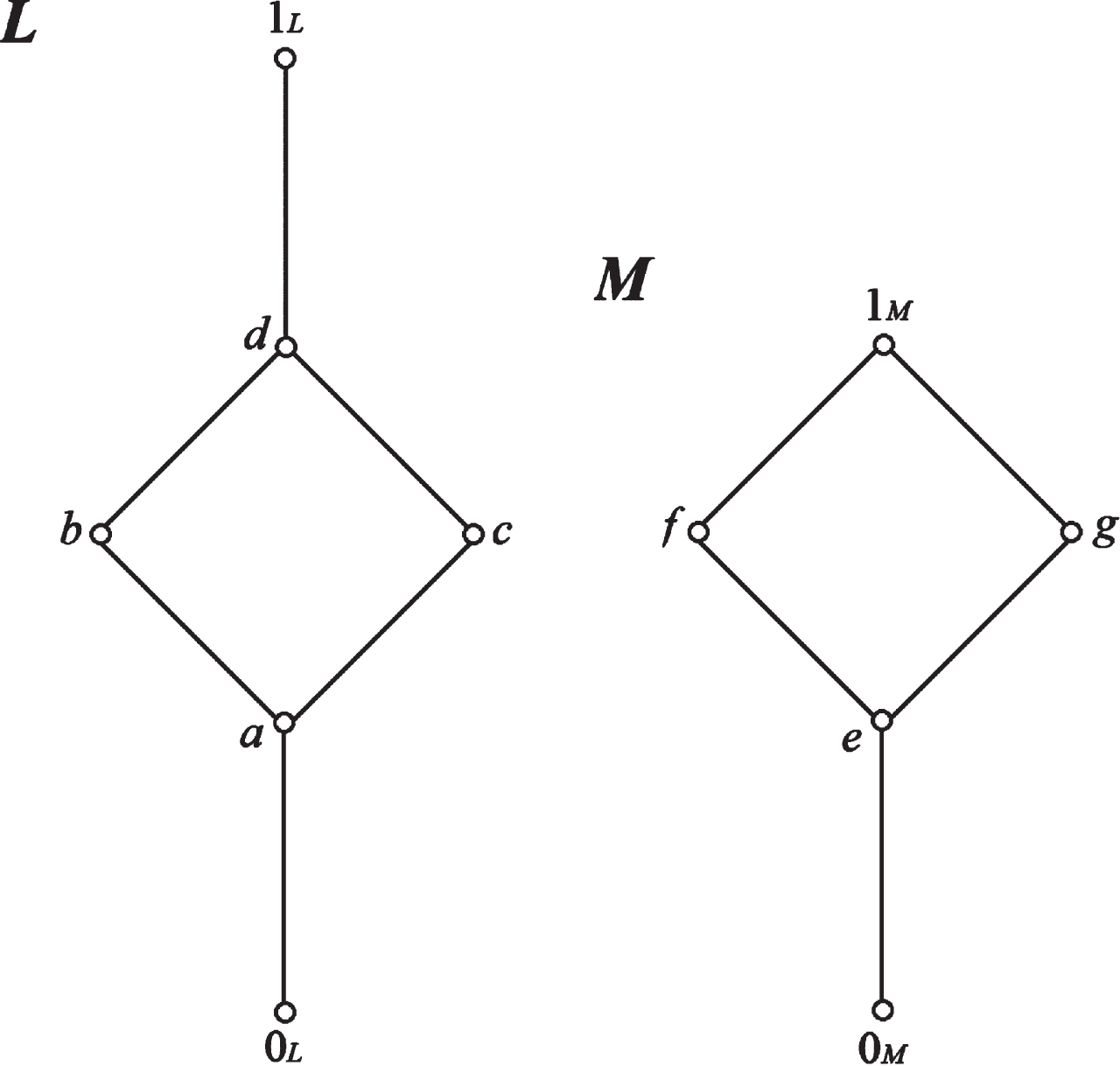
Bounded lattices L and M.
In what follows, we will use (r, s) to denote a LM-retraction, L to refer to a bounded lattice and M to indicate a sublattice (as in Definition 2.8) of it.
lower (resp. strict lower) if s ∘ r ≤
L
Id
L
(resp. s ∘ r <
L
Id
L
); upper (resp. strict upper) if s ∘ r ≥
L
Id
L
(resp. s ∘ r >
L
Id
L
).
Observe that for any LM-retraction (r, s), s is injective. Here, we also use the term LM-retraction if r and s are lattice homomorphisms.
and
The content of this part can also be found in [20, 21].
Next we recall some important properties of aggregation functions. Let us begin by revisiting the concept of bivariate function, essential for characterizing Archimedean and nilpotent aggregation functions.
If If An element x ∈ X is said to be an idempotent element of A if A (x, …, x) = x. If each element x ∈ X is an idempotent element of A, then A is said to be an idempotent aggregation.
A : unit2 → unit, given by A (x, y) = min {x, y} · max {x, y}, is an Archimedean aggregation function: A(n) (x) = x
n
and If A (x, y) = max(x + y - 1, 0) is a nilpotent aggregation on [0, 1] 2
4
. Indeed, if 0 < x ≤ 0.5, then A(2) (x) = A (x, x) = max(2x - 1, 0) =0. On the other hand, if 0.5 < x < 1, then Once 0.999 is a zero divisor element of the aggregation A (x, y) = max {x + y - 1, 0}: for all x < 0.001 it follows that A (0.999, x) = max {x - 0.001, 0} =0. However, a = 1 is not a zero divisor.
Subsequently, we revisit the concept of quasi-overlap function (cf. [1]).
O (x, y) =0
L
iff x = 0
L
or y = 0
L
; O (x, y) =1
L
iff x = 1
L
and y = 1
L
.
If there exists at least an element ξ ∈ L \ {0
L
, 1
L
}, the function O
ξ
: L2 → L, defined as
If 0
L
is a meet-irreducible element of L
5
, the binary meet function, given by x ∧ y for all x, y ∈ L, is a quasi-overlap function on L [1]. The functions A (x, y) = min {x, y} · max {x, y} and
In what follows we propose a method of extending functions defined on sublattices (in a broad sense) of a bounded lattice via retractions.
O E (x, y) =0 L
⇔s (O (r (x) , r (y))) = 0 L [FromEq . eqrefeq : extensofquas3 .]
⇔O (r (x) , r (y)) = 0 M [FromEq . eqrefeq : extensofquas1 .]
⇔r (x) =0 M or r (y) =0 M [FromDefinition3.1 .]
⇔x = 0 L or y = 0 L . [FromEq . eqrefeq : extensofquas1 .]
Similarly, O E (x, y) =1 L iff x = 1 L and y = 1 L □.
As a direct consequence of Proposition 2.9 and Theorem 3.4, we have the following:
(r, s) is a lower LM-retraction satisfying Eq. (5); (r, s) is an upper LM-retraction satisfying Eq. (6).
It is worth noting that r and s of Theorem 3.4 are not unique. For each pair (r, s), O E will represent a distinct extension of O from M to L. This implies that there are multiple ways to extend O. See the example below.
For each i = 1, . . . , n, consider r
i
: L → M defined by
Let r′, r″ : L → M defined by
Given r : L → M defined by
Next, we demonstrate that the extension O E , defined in Eq. (7) of Theorem 3.4, preserves some properties of O.
O
E
is Archimedean whenever O is Archimedean and r is strict; s (a) is a nilpotent element of O
E
whenever a is a nilpotent element of O; s (a) is also an idempotent element of O
E
whenever a is an idempotent element of O; s (a) is also a zero divisor of O
E
whenever a is a zero divisor of O.
Let O be Archimedean and consider (a, b) ∈ (L \ {0
L
, 1
L
}) 2. Using Eq. (5) and Eq. (6), we can deduce that (r (a) , r (b)) ∈ (M \ {0
M
, 1
M
}) 2. Once O is Archimedean, there exists If a ∈ M \ {0
M
, 1
M
} is a nilpotent element of O, then there exists If a ∈ M is an idempotent element of O, it follows that:
Suppose a ∈ M \ {0
M
, 1
M
} is a zero divisor element of O and consider (a, x) ∈ (M \ {0
M
}) 2 such that O (a, x) =0
M
. From proof of (ii), we have s (a) ∈ L \ {0
L
, 1
L
} and s (x) ∈ L \ {0
L
}. Therefore, (s (a) , s (x)) ∈ (L \ {0
L
}) 2 and
□
In the following we review the concept of a quasi-grouping function (cf. [10, 13]).
G (x, y) =0
L
iff x = 0
L
and y = 0
L
; G (x, y) =1
L
iff x = 1
L
or y = 1
L
.
G E (x, y) =0 L
⇔s (G (r (x) , r (y))) = 0 L [FromEq . eqrefeq : extensofqgroup .]
⇔G (r (x) , r (y)) = 0 M [FromEq . eqrefeq : extensofquas1 .]
⇔r (x) =0 M and r (y) =0 M [FromDefinition4.1 .]
⇔x = 0 L and y = 0 L [FromEq . eqrefeq : extensofquas1 .]
Similarly, G E (x, y) =1 L iff x = 1 L or y = 1 L .□
Next, we revisit the concept of fuzzy negation (cf. [23]).
N is decreasing; N (0
L
) =1
L
and N (1
L
) =0
L
. strong if it has the involutive property:
frontier if it is such that:
Further, we call N:
Regarding extension of fuzzy negations, in [18] Palmeira and Bedregal demonstrated the following:
OG,N1,N2 : L2 → L, defined by
GO,N1,N2 : L2 → L, defined by
From commutativity of G follows that OG,N1,N2 is commutative. Since N1 and N2 are decreasing and G is increasing, given x, y, z ∈ L, we have: y ≤
L
z ⇒N2 (y) ≥
L
N2 (z) ⇒G (N2 (x) , N2 (y)) ≥
L
G (N2 (x) , N2 (z)) ⇒N1 (G (N2 (x) , N2 (y))) ≤
L
N1 (G (N2 (x) , N2 (z))) ⇒OG,N1,N2 (x, y) ≤
L
OG,N1,N2 (x, z). Further, for all (x, y) ∈ L2, we have: OG,N1,N2 (x, y) =0
L
⇔N1 (G (N2 (x) , N2 (y))) = 0
L
⇔G (N2 (x) , N2 (y)) =1
L
[ByEq . eqrefeq : frontierneg .] ⇔N2 (x) = 1
L
or N2 (y) = 1
L
[ByDefinition4.1] ⇔x = 0
L
or y = 0
L
. [ByEq . eqrefeq : frontierneg .] Analogously, OG,N1,N2 (x, y) =1
L
iff x = 1
L
and y = 1
L
. It follows similarly to the proof of (i). □
In [10] (Theorem 5.2), Sun, Pang and Zhang proved that given a strong fuzzy negation N : L → L, a binary operator G : L × L → L is a quasi-grouping function iff there exists a quasi-overlap function O : L × L → L such that G (x, y) = N (O (N (x) , N (y))) , ∀ x, y ∈ L.
In what follows, we generalize this result.
left-invertible, if there exists a function f
Left
: X → X, called inverse of f to left, such that f
Left
∘ f = Id
X
; right-invertible, if there exists a function f
Right
: X → X, called inverse of f to right, such that f ∘ f
Right
= Id
X
; invertible, if it is left-invertible and right-invertible.
Analogously, we have the following result for quasi-overlap functions:
OG,N1,N2
E
: L2 → L, defined by OG,N1,N2
E
(x, y) = s (OG,N1,N2 (r (x) , r (y))), is a quasi-overlap function that extends OG,N1,N2 from M to L; GO,N1,N2
E
: L2 → L, defined by GO,N1,N2
E
(x, y) = s (GO,N1,N2 (r (x) , r (y))), is a quasi-grouping function that extends GO,N1,N2 from M to L.
OG,N1,N2
E
(x, y) = OG
E
,N1
E
,N2
E
(x, y); GO,N1,N2
E
(x, y) = GO
E
,N1
E
,N2
E
(x, y).
By Equations (7), (8), (11) and (12) it follows: OG,N1,N2
E
(x, y) = s (OG,N1,N2 (r (x) , r (y))) = s (N1 (G (N2 (r (x)) , N2 (r (y))))) = s ( N1 (G (r (s (N2 (r (x)))) , r (s (N2 (r (y))))))) = s (N1 (G (r (N2
E
(x)) , r (N2
E
(y))))) = s (N1 (r (s (G (r (N2
E
(x)) , r (N2
E
(y))))))) = s (N1 (r (G
E
(N2
E
(x) , N2
E
(y))))) = N1
E
(G
E
(N2
E
(x) , N2
E
(y))) = OG
E
,N1
E
,N2
E
(x, y) It follows analogously to the proof of (i). □
The De Morgan laws are logical rules that relate conjunctions and disjunctions through negations. More precisely, the following rules:
The logical equivalences in (14) are usually generalized in fuzzy logic using t-norms (T)
8
, t-conorms (S)
9
and fuzzy negations (N) as:
Taking y = 1
L
in Eq. (16), for all x ∈ L, we have:
Usually, a De Morgan triple is a triple 〈T, S, N〉 where T is a t-norm, S is a t-conorm and N is a fuzzy negation (all on [0, 1]) satisfying Eq. (16) and Eq. (17). Nevertheless, there are other authors which consider the Eq. (15) instead of Eq. (14) (for more details see [24]). Palmeira and Bedregal generalized this second approach for an arbitrary bounded lattices L as follows.
N (T (x, y)) = S (N (x) , N (y)); N (S (x, y)) = T (N (x) , N (y)).
De Morgan triples can be defined for other classes of operators, for example for quasi-overlap and quasi-grouping functions.
N (O (x, y)) = G (N (x) , N (y)); N (G (x, y)) = O (N (x) , N (y)).
Regarding the Definition 5.2, note that if N is a strong fuzzy negation, then (
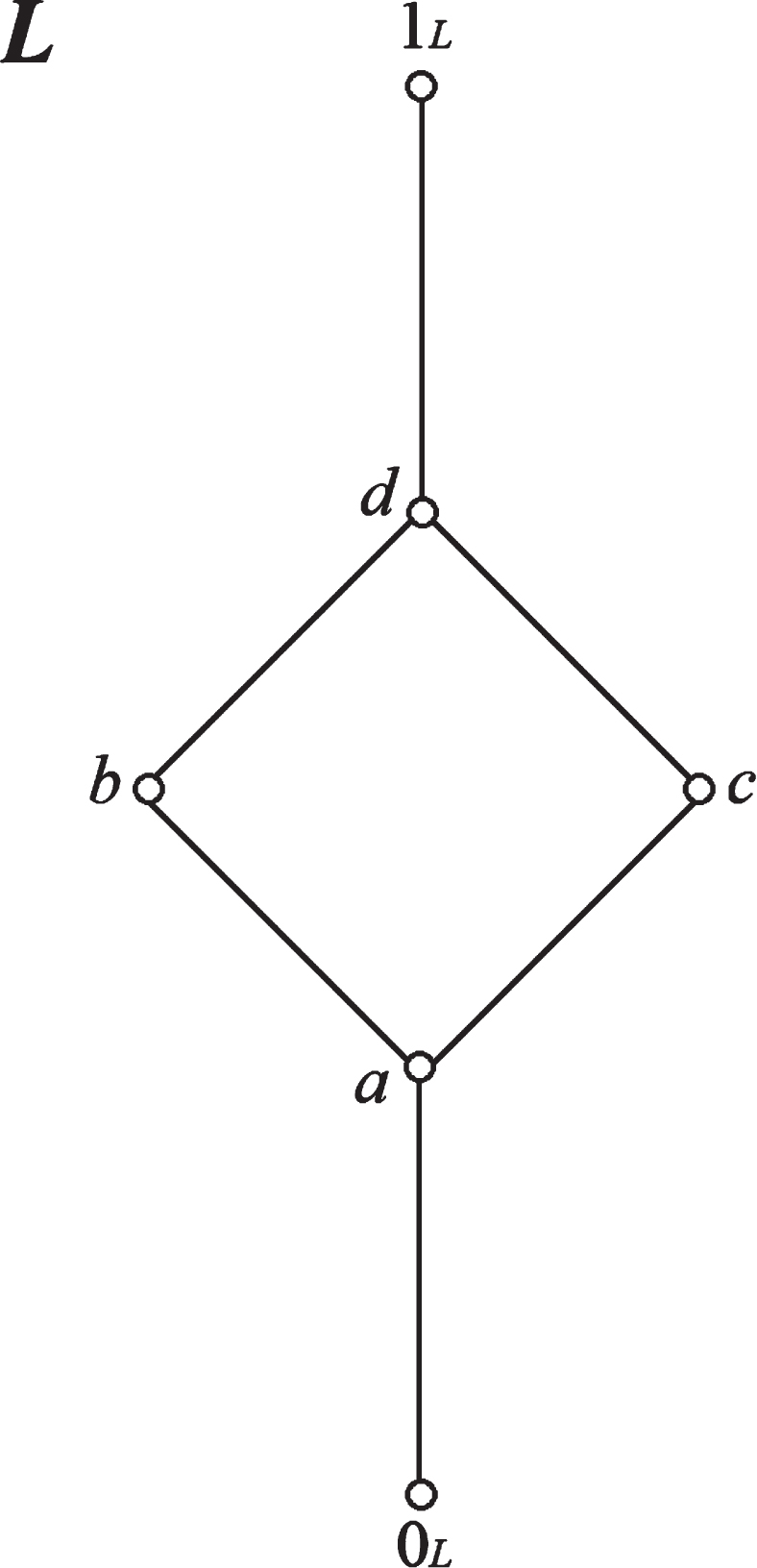
Bounded lattice L.
N × N
Let O : L2 → L be the quasi-overlap and G : L2 → L be the quasi-grouping defined in Table 2. Then, N ∘ O = G ∘ (N × N) (see Table 3). However, N ∘ G ¬ = O ∘ (N × N), as shown in Table 4.
O : L2 → L and G : L2 → L
N ∘ O and G ∘ (N × N)
N ∘ G and O ∘ (N × N)
Taking into account such a possibility, we define the following relaxed notion of De Morgan triples.
If 〈O, G, N〉 is a De Morgan O-semitriple on M, then 〈O
E
, G
E
, N
E
〉 is a De Morgan O
E
-semitriple on L. If 〈O, G, N〉 is a De Morgan G-semitriple on M, then 〈O
E
, G
E
, N
E
〉 is a De Morgan G
E
-semitriple on L.
If 〈O, G, N〉 is a De Morgan O-semitriple on M then, for all x, y ∈ L, N
E
(O
E
(x, y)) = s (N (r (O
E
(x, y)))) [ByEq . eqrefeq : extofneg .] = s (N (r (s (O (r (x) , r (y)))))) [ByEq . eqrefeq : extensofquas3 .] = s (N (O (r (x) , r (y)))) = s (G (N (r (x)) , N (r (y)))) [By ( = s (G (r (s (N (r (x)))) , r (s (N (r (y)))))) = G
E
(N
E
(x) , N
E
(y)) . [ByEqs . eqrefeq : extensofqgroup, eqrefeq : extofneg .] It follows similarly to the proof of (i). □
□
Observe that, if ρ is an automorphism on L, then ρ-1 is also an automorphism. More than that, the set Aut (L) of all automorphisms on L equipped with the composition operation is a group. It is also worth noting that
Given a function F : L
n
→ L and an automorphism ρ : L → L, the function F
ρ
: L
n
→ L, given by
O
ρ
: L2 → L is a quasi-overlap function; G
ρ
: L2 → L is a quasi-grouping function; N
ρ
: L → L is a fuzzy negation.
Since O is commutative and increasing, and ρ and ρ-1 satisfy Eq. (18), it follows that O
ρ
is commutative and increasing. Further, For all (x, y) ∈ L2, we have: O
ρ
(x, y) =0
L
⇔ρ-1 (O (ρ (x) , ρ (y))) = 0
L
[ByEq . eqrefeq : funcconjugate .] ⇔O (ρ (x) , ρ (y)) = 0
L
[ByEq . eqrefeq : aut0L .] ⇔ρ (x) =0
L
or ρ (y) =0
L
[By ( ⇔x = 0
L
or y = 0
L
. [ByEq . eqrefeq : aut0L .] Analogously, for all (x, y) ∈ L2, we have O
ρ
(x, y) =1
L
iff x = 1
L
and y = 1
L
. It follows analogously to the proof of (i). N
ρ
(0
L
) = ρ-1 (N (ρ (0
L
))) = ρ-1 (N (0
L
)) = ρ-1 (1
L
) =1
L
, and N
ρ
(1
L
) = ρ-1 (N (ρ (1
L
))) = ρ-1 (N (1
L
)) = ρ-1 (0
L
) =0
L
. Additionally, for all x, y ∈ L, we have:
□
N ρ (O ρ (x, y))
= ρ-1 (N (ρ (O ρ (x, y)))) [ByEq . eqrefeq : funcconjugate .]
= ρ-1 (N (ρ (ρ-1 (O (ρ (x) , ρ (y)))))) [ByEq . eqrefeq : funcconjugate .]
= ρ-1 (N (O (ρ (x) , ρ (y))))
= ρ-1 (G (N (ρ (x)) , N (ρ (y)))) [From (
= ρ-1 (G (ρ (ρ-1 (N (ρ (x)))) , ρ (ρ-1 (N (ρ (y))))))
= G ρ (N ρ (x) , N ρ (y)) [ByEq . eqrefeq : funcconjugate .]
Analogously, if 〈O, G, N〉 is a De Morgan G-semitriple, then 〈O ρ , G ρ , N ρ 〉 is a De Morgan G-semitriple.□
In what follows we prove that, for sublattices in Palmeira and Bedregal’s sense (see Definition 2.8), the conjugate of an extension is equal to the extension of the conjugate for quasi-overlap functions, quasi-grouping functions and fuzzy negations. First, let us demonstrate a result that will be necessary for our proof.
(ψ-1 ∘ s) (x)
= (ψ-1 ∘ s ∘ ρ ∘ ρ-1) (x) [Since ρ ∘ ρ-1 = Id M .]
= (ψ-1 ∘ ψ ∘ s ∘ ρ-1) (x) [Since ψ extends ρ .]
= (s ∘ ρ-1) (x) [Since ψ-1 ∘ ψ = Id L .]
and similarly, for all x ∈ L, we have (r ∘ ψ-1) (x) = (ρ-1 ∘ r) (x). Therefore, ψ-1 extends ρ-1.□
(O
E
)
ψ
= (O
ρ
)
E
; (G
E
)
ψ
= (G
ρ
)
E
; (N
E
)
ψ
= (N
ρ
)
E
.
(O E ) ψ (x, y)
= ψ-1 (O E (ψ (x) , ψ (y))) [ByEq . eqrefeq : funcconjugate .]
= ψ-1 (s (O (r (ψ (x)) , r (ψ (y))))) [ByEq . eqrefeq : extensofquas3 .]
= ψ-1 (s (O (ρ (r (x)) , ρ (r (y))))) [ByEq . eqrefeq : extensionr .]
= ρ-1 (O (ρ (r (x)) , ρ (r (y)))) [ByEq . eqrefeq : extensions .]
= O ρ (r (x) , r (y)) [ByEq . eqrefeq : funcconjugate .]
= (O ρ ) E (x, y) [ByEq . eqrefeq : extensofquas3 .]
The proofs of (ii) and (iii) follow analogously.□
(r, s) is a lower LM-retraction satisfying Eq. (5); (r, s) is an upper LM-retraction satisfying Eq. (6).
Saminger-Platz, Klement, and Mesiar [17] introduced a method for expanding a t-norm from a complete sublattice to the corresponding lattice. Their approach adhered to the conventional definition of a sublattice, wherein the sublattice must necessarily be a subset of the lattice. To broaden this constraint, Palmeira and Bedregal presented an alternative approach in their work [18]. Instead of considering only the strict relationship of subsets, they proposed a more comprehensive definition of sublattices by using the concept of retractions. In their groundbreaking work Palmeira and Bedregal extended various important operators, including t-norms, t-conorms, fuzzy negations, and automorphisms. Furthermore, they introduced the concept of De Morgan triples (semi-triples) for the categories of t-norms, t-conorms, and fuzzy negations, also providing their extensions. On the other hand, the generalizations: quasi-overlap and quasi-grouping have been widely investigated recently and a natural question that arises is whether the extension mechanism using retractions can be used for these operators.
In this paper we have investigated how to extend important fuzzy functions from a bounded lattice to a superlattice. We have extended: quasi-overlap functions, quasi-grouping functions, De Morgan (semi) triples and Conjugated functions. The investigation of some important properties is also provided.
As a future work we intend to study the extension of further operators as well further properties.
Acknowledgments
This work has been supported by the National Council for Scientific and Technological Development (CNPq-Brazil) within the projects 311429/2020-3, 312899/2021-1 and 403167/2022-1.
Footnotes
Observe that this concept encompasses the ordinary notion of sublattices as a special case. This occurs when s is the identity function.
A(n) (x) is as in Eq. (2).
Observe that, once aggregations functions are increasing, if a is a zero divisor of an aggregation on X, then all b ∈ X with b ≤ a is also a zero divisor.
A is known as Łukasiewicz t-norm.
A non-unit element m of a lattice L is meet-irreducible if, for all x, y ∈ L, m = x ∧ y implies m = x or m = y
Um elemento q ∈ L is said to be co-prime iff x ∨ y ≥ q implies x ≥ q or y ≥ q.
For example, fixed ξ ∈ L, the function
A function T : L2 → L is said to be a t-norm if it is commutative, associative, increasing in each argument and 1 L is its identity element.
A function S : L2 → L is said to be a t-conorm if it is commutative, associative, increasing in each argument and 0 L is its identity element.