




Abstract
This paper studies the pricing and low-carbon decision problems in a supply chain containing a manufacturer and a downstream retailer. The manufacturer produces a single product under the cap-and-trade scheme. We formulate the price and carbon-concerned demand function. To maximize their revenue, the manufacturer and the retailer determine their selling prices and carbon emission reduction rates separately. Due to the fast product updates speed, some parameters do not have enough historical data. For example, the sales cost of the retailer, the demand of consumers, and the total carbon emissions of manufacturers are far from frequency stability. This fact makes the distribution function obtained in practice usually deviate from the frequency. They are all uncertain variables whose distributions are estimated from the empirical data of experts or managers. In this paper, we give three decentralized game models to explore the equilibrium behaviors in the corresponding decision environment under an uncertain environment. Corresponding analytical solutions are offered under different game scenarios. Finally, numerical experiments are performed to illustrate the effectiveness of the established models and yield some remarkable insights.
Introduction
With economic globalization, air pollution problems have attracted worldwide attention. The leading cause of global warming is increasing carbon emissions. Excessive carbon emissions have seriously affected human health and sustainable economic development. Reducing carbon emissions not only has the advantages of protecting the environment and saving resources but also plays a good role in promoting economic growth. To effectively control carbon emissions, the United States, Australia, and other developed countries have tried to design carbon policies to reduce carbon emissions generated from manufacturing firms since the Kyoto Protocol in 1997 [11]. Among these regulations, carbon tax regulation and cap-and-trade regulation are the two most popular carbon-control regulations. In the past few years, low-carbon issues have been widely discussed by managers and many scholars under cap-and-trade regulation. For example, some scholars have discussed the application of carbon pricing mechanisms in the energy industry [23, 43]. Some scholars have investigated the optimal pricing and carbon emission reduction strategies under cap-and-trade regulation [12, 42]. Against this background, this paper investigates the impacts of cap-and-trade regulation on enterprises’ optimal decisions.
Through the cap-and-trade system, manufacturers can obtain some free carbon credits from the government, and surplus (or insufficient) carbon credits can be traded through external carbon trading markets. Cap-and-trade, as one of the most effective ways to achieve environmental protection and sustainable economic development, has been vigorously advocated by countries all over the world [10]. For example, cap-and-trade has also been applied in the United States, Japan, Europe, and some other developed countries. As a developing country, China has already started carbon emission strategies in some cities including Beijing, Shanghai, and Tianjin. In 2017, a national carbon trading platform, including multiple manufacturing industries was established, especially steel, electricity, petrochemical, and cement. Under the cap-and-trade regulation, as a dynamic supply chain manager, choosing the appropriate supply chain decision-making structure to keep their maximum profit is particularly important. In recent years, the low-carbon economy has gradually become a new worldwide trend, and consumers are showing a greater preference for low-carbon products [41]. Therefore, choosing the optimal level of carbon emission reduction is also of great significance to each member of the supply chain.
With the promotion of environmental regulations and motivated by policy support, more and more environmentally conscious manufacturers, such as HP, Siemens, Procter & Gamble, Huawei, Xiaomi, etc., actively explore carbon emission reduction technologies under the pressure of the cap-and-trade regulation. For example, in the constructing of the ecological chain, Xiaomi enterprises always have the consciousness of green, low-carbon, and environmental protection. Retailers, as one of critical members of the supply chain, also play an essential role in shifting consumer buying habits to low-carbon alternatives, such as some large retailers, Walmart, Jingdong, and Suning, have started selling green and energy-saving products offline stores [19]. Walmart, as one of the world’s largest retailers, has reduced greenhouse gas emissions by 7.575 million metric tons (MMT) through managing low-carbon supply chain projects by the end of 2015 [11]. In China, Jingdong (https://www.jd.com), as one of the biggest e-commerce platforms, guides consumers’ low-carbon environmental awareness through old products for new services. In 2014, Suning, one of China’s best-known domestic brands, cooperated with Siemens, Gree, Haier, Midea, and other green low-carbon products for consumers and increased the number of green products in the market. In addition, Suning uses LED energy-saving lights to replace traditional high energy-consuming in their offline shops to create an energy-saving atmosphere for consumers. Customers have environmentally conscious, which means they prefer low-carbon products and are willing to buy low-carbon products [31]. Therefore, carbon reduction research can promote economic development and environmental protection.
Under the cap-and-trade regulation, most literature focuses on pricing and low-carbon decision problems and does not consider the dynamic environment problem. However, there are many indeterministic factors and dynamic environments which cannot be ignored in the real world. Several parameters may be affected by indeterminacy. Nowadays, products, especially new products and high-tech equipment are usually updated quickly, such as market demand, unit cost of sales, etc. If their distributions can be obtained accurately, or the distribution function is close enough to the frequency in the future, then they can be described as a random variables. We can deal with these random parameters by using probability theory. Nevertheless, there are many cases where researchers are unable to estimate an accurate probability distribution in complex markets.
Another factor of indeterministic that has been studied is fuzziness. By now, the fuzzy set theory proposed by [51] has been widely applied to several decision problems, e.g., [14, 53], etc. However, there are still some deficiencies in its theoretical basis. For the sake of better handling the subjective uncertainty, Uncertainty theory was initiated by [26] and refined by [27], which has become a new mathematics branch for studying subject uncertainty (see Liu, 2009 for more details). At present, a great deal of researchers have used uncertainty theory to deal with many uncertain decision-making problems, such as the pricing optimization problem [44–46], production control problem [36], and project scheduling problem [18]. In this paper, we use uncertainty theory to solve the formulated uncertain model.
This paper has three main contributions to the previous research. Firstly, we investigate the pricing and low-carbon decisions in a supply chain with cap-and-trade regulation consists of a manufacturer, and a downstream retailer. The manufacturer determines the optimal wholesale price and carbon reduction rate. The retailer attracts end consumers by choosing its own sales price and the level of carbon reduction. The retailer could reduce carbon consumption. But many references don’t take into account the retailer. Secondly, we analyze the Stackelberg (MS) game with the manufacturer as the leader, the retailer as the Stackelberg leader (RS), and the vertical Nash (VN) game. Based on game theory, uncertainty theory, and optimization theory, three decentralized price, and carbon emission reduction decision-making models are established. Thirdly, nowadays, the products are usually updated quickly, and the demands, total carbon emissions, and sales cost of the retailer is far from frequency stability. This fact makes the distribution function obtained in practice usually deviate from the frequency. To solve the above problems, Uncertainty theory [26, 27] is introduced to characterize indeterministic factors. This paper can not only give carbon emission reduction innovation in theory but also help enterprise decision-making in practice.
The framework of this paper is as follows. The relevant literature is listed in Section 2. We give the optimization model of the problem, including some assumptions and notations in Section 3. And discussions are performed in Section 4. Numerical experiments are presented in Section 5. Section 6 concludes the conclusions of this paper and future research directions.
Literature review
Over the past decade, the literature on low-carbon decisions and supply chain management can be categorized into three research streams. The first is related to carbon emissions decisions which focus on phrases of manufacturing and selling. Krikke [22] constructed a decision-making model for optimizing the supply chain network configuration and discussed the impact of supply chain network configuration on carbon emissions. Chaabane et al. [5] proposed a sustainable supply chain methodology designed in a carbon emissions trading environment. Benjaafar et al. [2] conducted in-depth research on green level decision in a supply chain. Their research confirmed that supply chain members’ optimization of carbon emissions reduction can effectively improve production efficiency. Under the cap-and-trade regulation, [10] studied carbon emission reduction optimal decisions for the emission permit supplier and the manufacturer. After that, [11] further studied the problem of carbon emission reduction decision-making and the optimal production decisions of the supply chain under the cap-and-trade system. Zakeri et al. [52] investigated the effectiveness of emissions trading schemes and carbon tax on the forward supply chain. Under the cap-and-trade regulation, [9] focused on the sustainable investment issues in a supply chain with decentralized and centralized decision-making, respectively. Yang et al. [49] considered the optimal decision problem of two competing supply chains under the cap-and-trade system, each supply chain consisting of a manufacturer and a retailer. The manufacturer is the leader as the Stackelberg game in the vertical direction and the horizontal direction. The two manufacturer play a Nash game about carbon emission reduction problem decisions and several equilibrium schemes of the supply chain with different structures are compared and discussed. Supply chain optimization from the point of view of environmental protection was further extensions by [11], the Stackelberg model was used to analyze the decentralized decision problems of the manufacturer and the retailer. Both members had incorporated low-carbon efforts into decision-making. [6] studied analyzes how manufacturers’ carbon emission reduction cost coefficients affect decision results. Our study differs from the above works in which we consider the manufacturer and the retailer determine their selling prices and carbon emission reduction rates separately.
In this part, we review the literature related to low-carbon decision-making and optimization of supply chain transportation and inventory management under the cap-and-trade regulation. Diabat and Simchi-Levi [8] proposed a low-carbon supply chain in which the circulation and storage capacity of production bases and distribution centers were regarded as decision variables. Yan et al. [47] investigated how the company manages its carbon footprint in inventory management under carbon allowances and trading plans. They proved that the carbon ceiling and trading price have a great impact on retailers’ order decisions, total cost and carbon footprint. Hoen et al. [16] focused on reduction in carbon emission levels by changing the transportation methods within the existing network to achieve carbon emissions targets. They found that optimizing transportation routes can promote diminishing returns on emissions. Bazan et al. [1] investigated a low-carbon policy issue in inventory and transportation management in a two-level supply chain. Under regional carbon cap-and-trade regulation, [41] explored the optimal decisions and compared optimal decisions before and after increasing channels. By contrast, our study focuses on the manufacturer and the retailer under cap-and-trade regulation in uncertain environment.
The third research stream is related to the low-carbon decisions and optimization in indeterministic supply chain models. Under uncertain environment, the issue of pricing decisions for remanufactured products related to the supply chain has been discussed in [49]. Pan et al. [32] explored the impact of supply chain resources on the environment from a strategic level by using French case studies, and established the emission functions of railway and road transportation. Bloemhof and Corbett [3] took into account the uncertain impact of inland shipping on rivers compared to inland transport and found that road transport had the most carbon emissions. By constructing a robust formula for the design of a multi-period capacity supply chain network, [13] integrated stochastic planning and robust optimization to handle the indeterministic of market demand and recycling, as well as the regulatory parameters of different modes of traffic carbon emissions under two carbon emission regulations. In recent years, some scholars have used fuzzy set theory to describe the indeterministic in the supply chain decision model. Pishvaee et al. [33] constructed a fuzzy mathematical programming model based on bi-objective credibility to determine the configuration of the green logistics network. Among them, production costs and emissions are described by fuzzy parameters. Under the consideration of a limitation on carbon emission of the product, [48] built a game model of green supply chain with government intervention, and studied how prices, carbon emission reduction level, and expected profits are affected by government intervention and channel leadership structure. Consumer demand and manufacturing costs are described by fuzzy random variables. However, they dealt with these nondeterministic factors by the traditional probability theory or fuzzy set theory, while we use a new uncertainty theory by [26]. Uncertainty theory has been applied in several fields and dealt with subjective uncertainty [18, 44–46]. In this respect, our model differs from the existing literature.
Some scholars only consider single-structure supply chain models, not taking total carbon emissions, low-carbon efforts for retailers, indeterministic factors in supply chain into account. Our paper will fill the gaps in the existing literature. Uncertainty theory [26, 27] and game theory are used to make pricing decisions and low-carbon decisions problems in the supply chain with cap-and-trade regulation. Different from the existing literature, the main highlights of this study are as follows: (1) How should the manufacturer make decisions about product prices and carbon emissions to maximize his profits? (2) In an uncertain environment, how can the retailer carry out his own retail markups and low-carbon efforts to maximize the profits? (3) Retail cost, demand, and carbon emissions are expressed using uncertainty parameters. Which mathematical tool should be chosen to describe their uncertainty?
Problem description
In a two-stage supply chain under the cap-and-trade regulation, this paper discusses the optimal pricing decisions and low-carbon decisions for the manufacturer and the retailer. Figure 1 shows the supply chain (SC) structure discussed in this paper. The supply chain operates in the carbon emissions trading system. The government controls manufacturers’ total carbon emission allowances and the manufacturer can decide whether to buy or sell carbon emission permits through the external market based on the number of products produced. Under the uncertain environment, the manufacturer produces a single product. The retailer buys the product from the manufacturer at the wholesale price ω and then chooses its own markup policy r. Note that the sales price can be decided by p = ω + r.
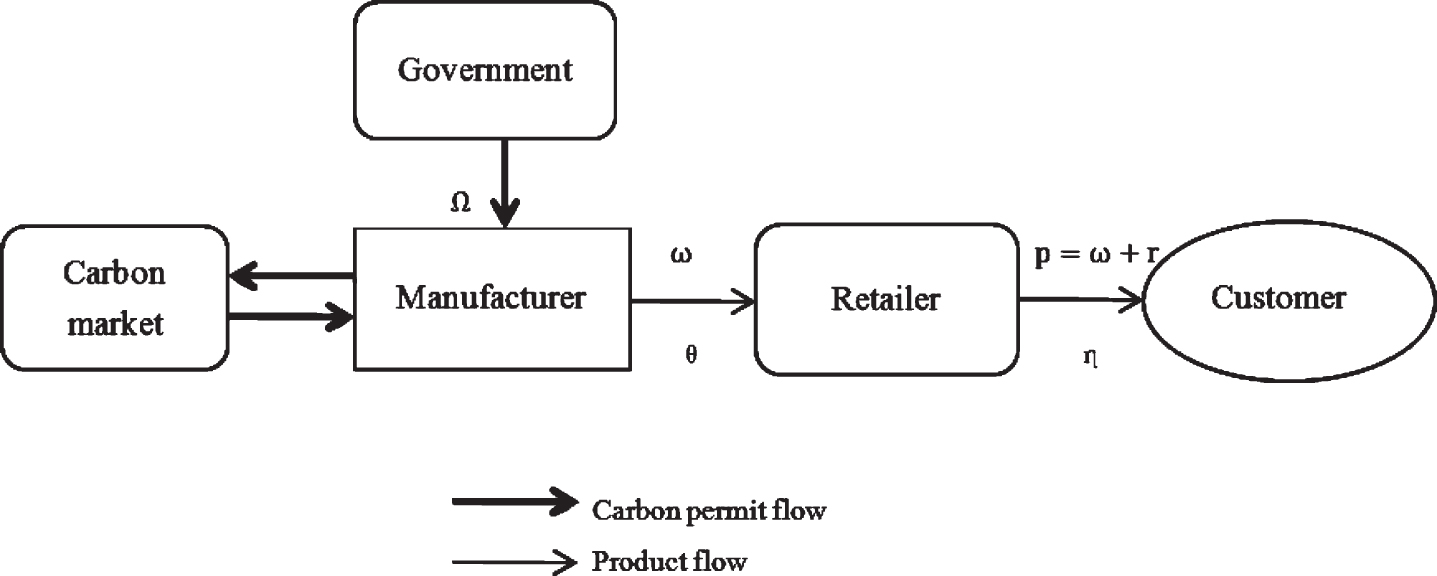
The SC structure.
With the improvement of people’s awareness of environmental protection, low-carbon products on the market are popular with consumers. A growing number of manufacturers have been formulating and implementing relevant low-carbon policies to control carbon emissions and improve the green degree of new products. The manufacturer determines its carbon emission reduction rate θ (namely product greening level). Let e0 and e denote the carbon emissions per unit of production by the manufacturer under low-carbon and no-carbon conditions, respectively. It can easily get e > e0, then
Due to consumers’ preference for green and low-carbon products, the retailer attracts customers by reducing the amount of carbon emitted per unit of product sold. This paper assumes that the retailer’s carbon reduction rate is η. The carbon reduction rate for the manufacturer and the retailer can be anywhere from 0 to 1 through their own investment, i.e., 0 ≤ θ, η < 1. Since every supply chain member makes efforts to lower-carbon of the final product, then the channel-wide low-carbon effort τ can be derived that
In the real world, operations in supply chain management need to consider various indeterministic factors. Some parameters are far from frequency stability. This fact makes the distribution function obtained in practice usually deviate from the frequency, and they cannot be described by probability distribution, especially for long-life products (e.g., engineering machinery, auto engines, locomotives and medical instruments) and some military equipment systems due to some constraints, such as technology, time, cost and so on. It is difficult for uncertain parameters to satisfy all the theorems and laws of probability. We must invite some experienced managers or domain experts to evaluate the belief degree of each event. Such as market sizes
Notations
Further, the objective functions π i represent revenue the expectations of supply chain members, here i = M, R represents the manufacturer and the retailer, respectively. Without loss of generality, some basic assumptions involved in this paper are as follows.
Thus, similar to previous literature [13, 49], the cost of the manufacturer’s low-carbon effort is considered as an increasing convex function of θ, defined as f (θ) = ρθ2/2. Similar to the cost function of the manufacturer’s low-carbon, the function g (η) = sη2/2 can been used to describe the retailer’s carbon emission reduction cost.
Let Ω be the total emissions quota of the manufacturer. When the total amount of carbon emissions exceeds the total carbon quota Ω, the manufacturer can purchase emission permits from other companies or government agencies through the external market under cap-and-trade regulation. Then, the manufacturer’s expected profit function can be expressed as follows,
By Assumptions 4 and 7, we can find that π
M
(ω, θ) is monotone increasing function of
Let
Thus, the crisp form of π
M
(ω, θ) can be attained as follows,
Similarly, the crisp forms of the retailer’s expected profit function can be expressed as
where
Aiming at the influence of various decision-making structures, this paper will investigate three decentralized game models by using Stackelberg structure and Nash equilibrium to meet the demand for carbon in the production process. All supply chain members in the game model consider low-carbon efforts.
MS model
In this subsection, one big manufacturer (such as Intel, Apple, and Microsoft, etc.) is assumed to dominate the whole market under cap-and-trade regulation. In terms of pricing, the manufacturer and the retailer are Stackelberg game leaders and followers, respectively. The manufacturer announces its wholesale price ω and carbon emission reduction rate θ to maximize its own profit. With the rising environmental awareness of consumers, the retailer observes the manufacturer’s decision and chooses its own markup pricing scheme r and low-carbon effort level η to maximize its own profits. Thus, a Stackelberg-Nash game model is formulated as
Through the conclusion of Proposition 1, we can get the following corollary.
(i) The manufacturer’s expected profit function π
M
(ω, θ) is concave in (ω, θ), if
(ii) The manufacturer’s optimal decisions are as follows,
According to Propositions 1 and 2, the equilibrium strategies of the retailer can been obtained as follows,
In the real world, some retailers are more powerful than the manufacturer, such as Wal-mart, Jingdong, Suning, and Carrefour. They have more bargaining power than the manufacturer in the supply chain. Thus, the manufacturer is the Stackelberg followers. The retailer acts as Stackelberg leader, in addition to his low-carbon effort, it can lead the supply chain members to obtain their maximum profits. Then, the RS game model is formulated as
Similarly, we can obtain Propositions 3 and 4.
(i) The expected profit function π
M
(ω, θ) of the manufacturer is concave in (ω, θ), if
(ii) The manufacturer’s optimal decisions are as follows,
Based on Propositions 3 and 4, due to the increase of customers with low-carbon preference, the equilibrium price and the equilibrium carbon reduction rate of the manufacturer can be obtained in the following form
In a supply chain, when the manufacturer and the retailer have equal bargaining power, we assume that both players make decisions simultaneously. Then, the following two-player Nash game model can be established.
From the above model, we can state the following proposition.
Numerical experiments
Under uncertain environment, the optimal results of different scenarios in the game models of the supply chain members are complex, so it is very difficult to obtain optimal results and trends in different scenarios. In this case, the uncertainty variables are estimated depending on the degree of belief given by experienced experts or managers. Interested readers may refer to Liu [26, 27] (Chapter 16: Uncertainty Statistics) for more details on how to effectively collect expert data and how to estimate the accurate distribution of uncertain variables from experimental data.
This section will use some typical numerical examples to show how the optimal carbon reduction decisions and the maximum profits of the supply chain members. Firstly, we focus on the optimal results of three different scenarios under buying carbon quotas. We further obtain the trend of carbon emission reduction with the change of φ. At last, sensitivity analysis is conducted to investigate the impact of the uncertain parameters. The values of the parameter used in this paper are shown in Table 2.
Parameters for the model
Parameters for the model
In order to implement effective management of dynamic supply chains, the nondeterministic factors cannot be ignored in the real world. For example, uncertain demand, uncertain carbon emissions, and uncertain cost. It is difficult to obtain some parameters or the parameters obtained are not enough to meet the actual needs. In these case, the degree of belief given by experienced supply chain managers or experts are employed to illustrate the distribution of uncertain parameters. For simplicity, Table 3 gives the uncertainty distributions of the uncertain parameters.
Distributions of uncertain variables
Using
In this subsection, three decentralized models are analyzed to investigate the impact of carbon-related factors and pricing decisions on the expected profits of supply chain members. This paper only considers the case where the manufacturer purchases carbon allowances through the carbon trading market in order to meet the market demand of his product. According to our survey, the average carbon emission contribution rate of manufacturers is around 80% in the supply chain. Therefore, φ is assigned with a value of 0.8 since manufacturer plays an important part in the contribution of low-carbon products. The corresponding results are shown as in Table 4.
Optimal decisions of the three structures with cap-and-trade regulation (φ = 0.8)
Optimal decisions of the three structures with cap-and-trade regulation (φ = 0.8)
The following results can be seen from Table 4,
(i) In the MS game scenario, the manufacturer can achieve the highest expected profit than in other models. In the case of RS game, the manufacturer’s expected profits reaches the minimum. The manufacturer obtains more profitable as a leader than as a follower. In the MS game scenario, for the retailer, the expected profits is always better than that in other scenarios. But the retailer achieves the lowest expected profit in the VN game case. The retailer’s expected profits is at her lowest when there are no dominant players in the supply chain system. At the same time, customers can enjoy the benefits of low prices.
(ii) When carbon contribution rate φ is assigned with a value of 0.8. In the RS game case, the optimal carbon emission reduction rate of the manufacturer and the retailer are lower than other game structures. While the VN game case would get more carbon reduction rate than the dominant participant in the supply chain system, the results show that customer demand preference for low-carbon products is increasing in carbon emission reduction rate, it will eventually bring greater benefits to the supply chain system.
This subsection seeks to find the influence of the carbon contribution rate φ on the optimal decisions based on the three decisions structures. While φ is assigned with 0 to 1 alternatively, which represent different balances on carbon contribution rate between the retailer and the manufacturer. The optimal decisions of the manufacturer’s and retailer’s carbon reduction rate under each parameter φ are shown in Figures 2 and 3 respectively. By changing the carbon contribution rate φ, we analyze the changes in the maximum profit of the retailer and the manufacturer, respectively. The results are shown in Figures 4 and 5.
From Figure 2, we have the following observations. Low-carbon contribution rate φ has a positive effect on the manufacturer’s optimal carbon reduction on the three game structures. However, it has an almost negligible impact on all decentralized policies.
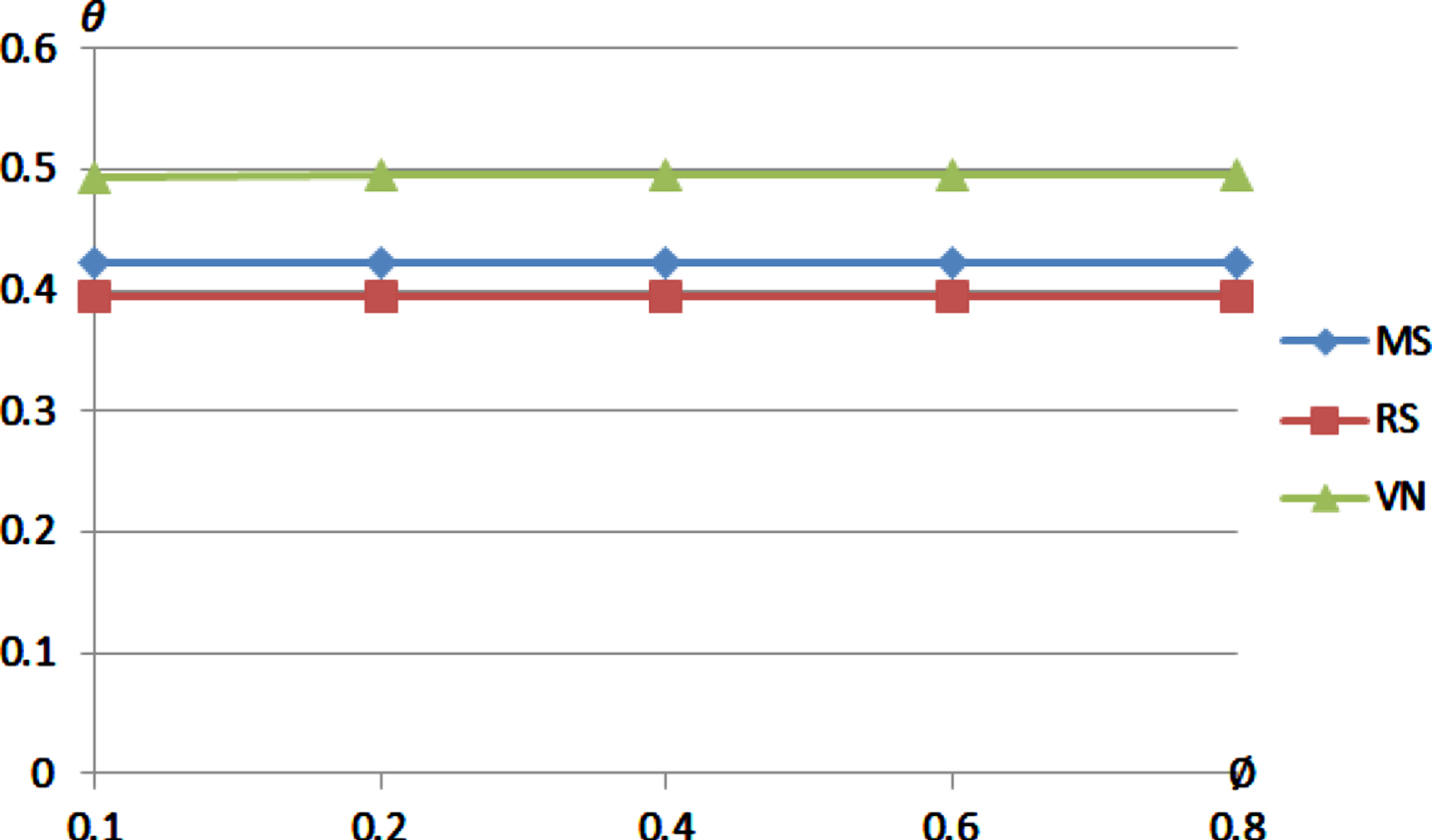
Carbon emission reduction rate θ under various parameter φ.
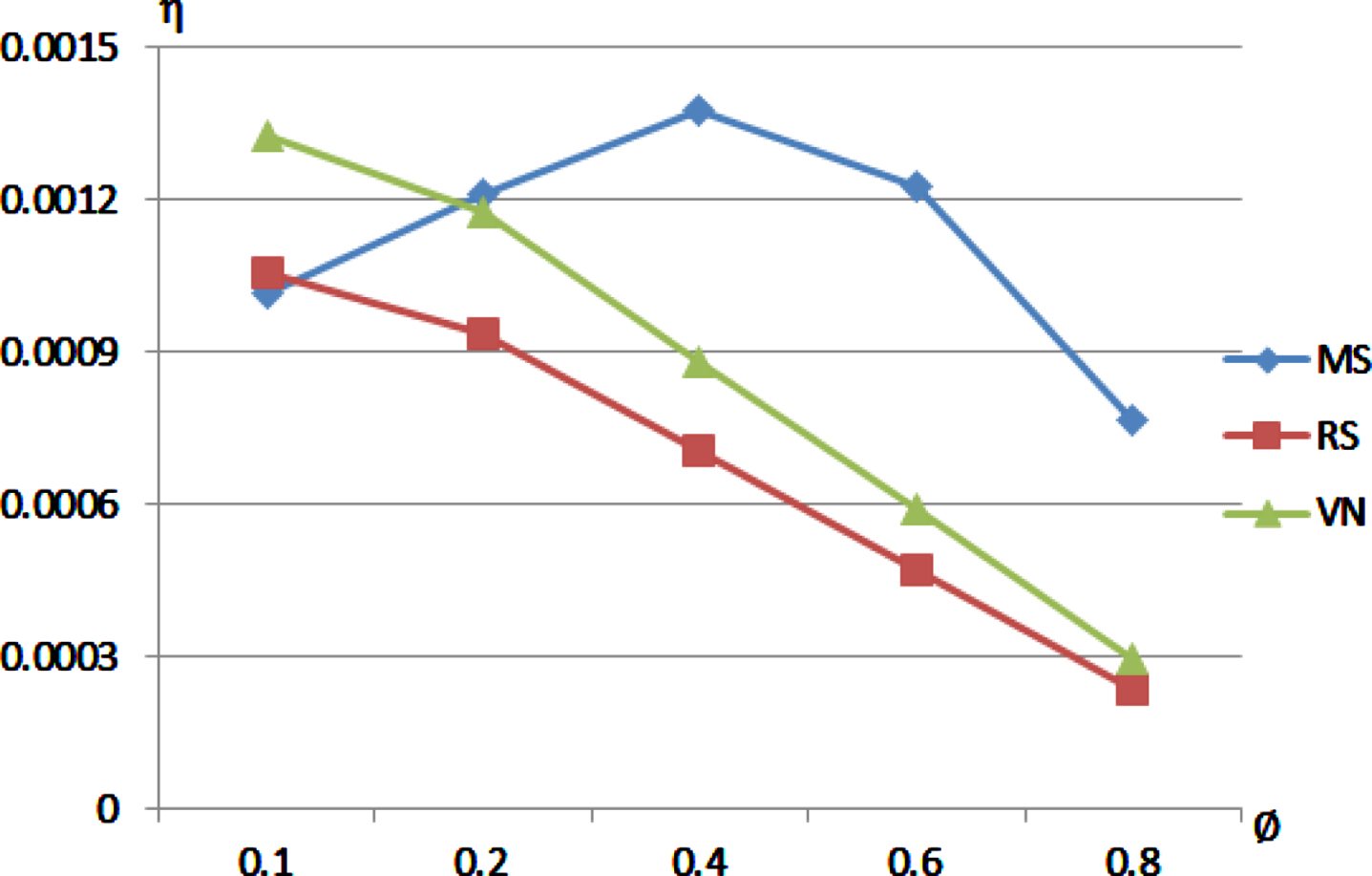
Carbon emission reduction rate η under various parameter φ.
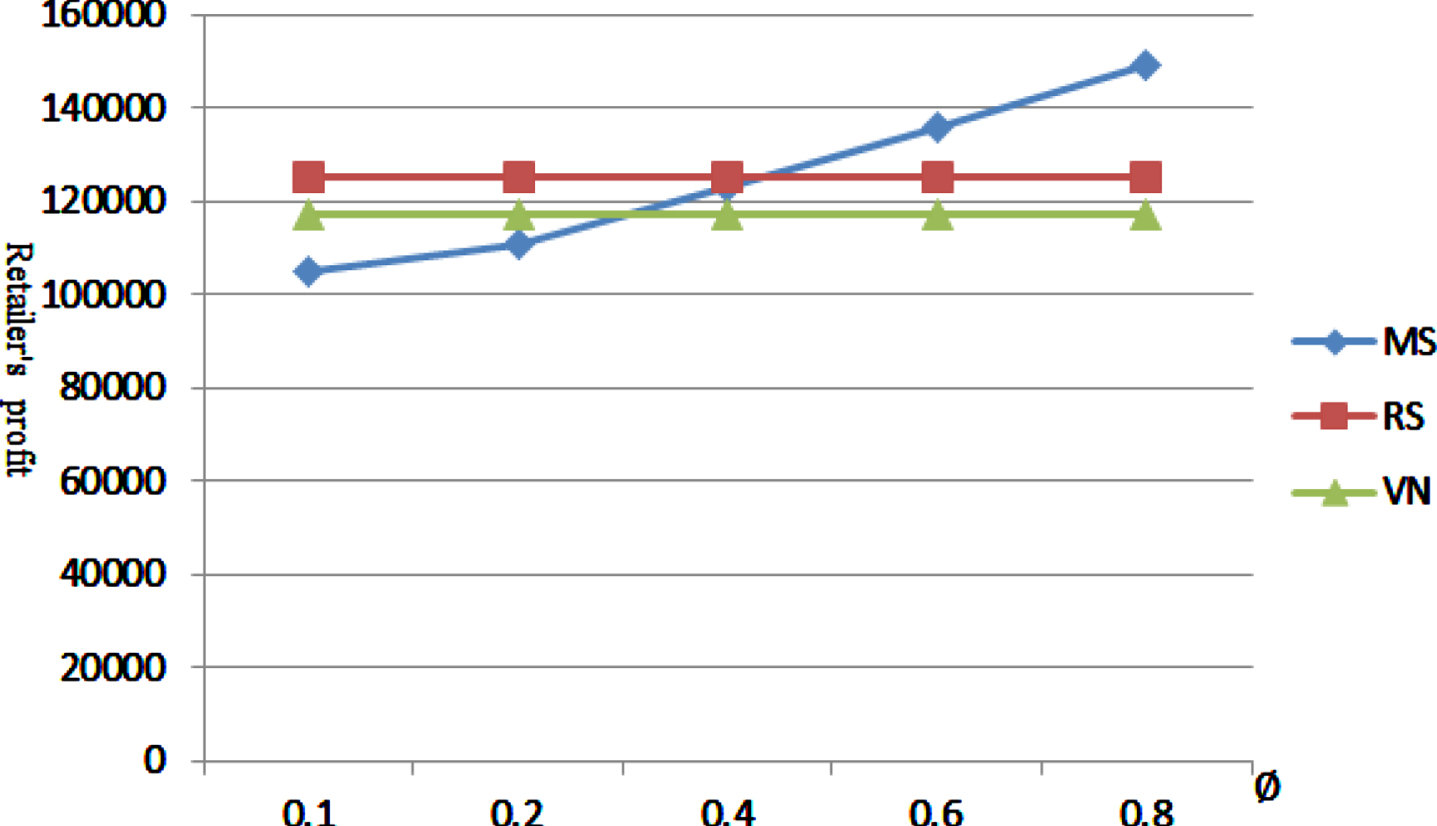
Retailer’s profit π R under various parameter φ.
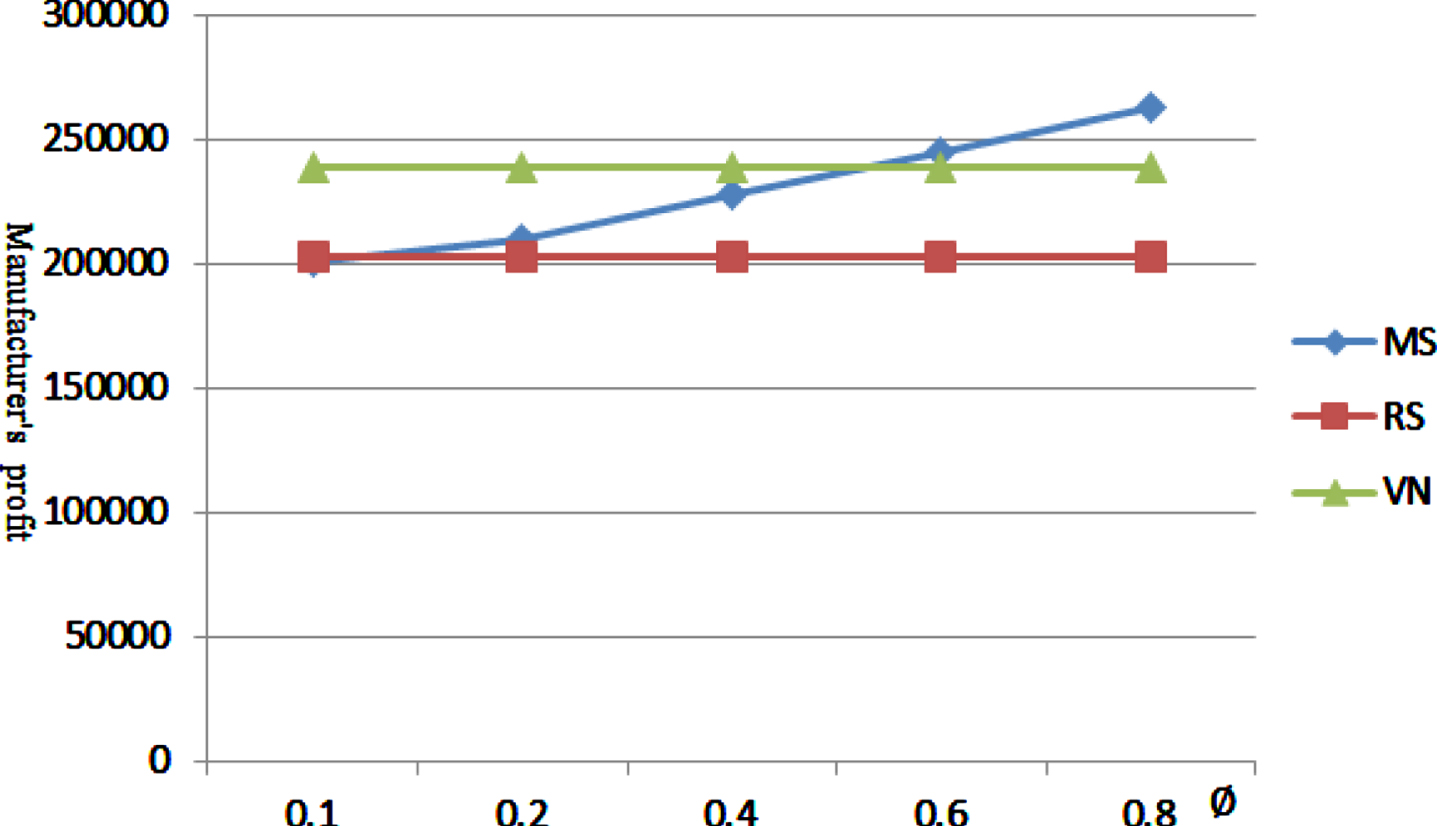
Manufacturer’s profit π M under various parameter φ.
Figure 3 reveals the following insights,
(i) The retailer’s carbon reduction rate θ will be reduced when the low-carbon contribution rate φ increases in the VN and RS game scenarios.
(ii) In the MS game scenario, the carbon emission reduction rate of the retailer increases first and then sharply decreases with the increase of low-carbon contribution rate φ.
The following conclusions can be obtained from Figures 4 and 5. The profits of the members of the supply chain become higher as the manufacturer gains more low-carbon contribution rate φ. Especially in the MS game scenario, it is noticed that the retailer’s expected profit is significantly influenced by the manufacturer’s increase in low carbon contribution rate φ, the manufacturer’s profit increases rapidly due to his higher low-carbon contribution rate in the market.
This section further studies the influence of the distribution of uncertain variables on the optimal decisions under three different game structure models. The uncertain parameters discussed mainly include the retailer sales costs
Effects of the retailer sales costs
on the optimal results
Effects of the retailer sales costs
Effects of the price elastic coefficient
Effects of the greening level elastic coefficient
From Table 5, we can obtain the following meaningful results,
(i) No matter what kind of game strategies, the manufacturer takes in VN, MS, and RS game cases, the manufacturer’s wholesale price drops slightly with increasing the variance of the uncertain variable
(ii) The retailer’s markup price, the maximally expected profits of the manufacturer and the retailer will rise and then fall with the increase in the variance of parameter
From Table 6, some meaningful conclusions are as follows,
(i) No matter what kind of game strategies, the wholesale price of the manufacturer and the retailer’s markup price will increase with increasing the variance of parameter
(ii) The carbon emission reduction rate of the manufacturer has the same values in MS, RS, and VN game cases. When the variance of parameter
Referring to Table 7, one can find the following,
(i) When the variance of parameter
(ii) The change of the uncertainty of parameter
Under the cap-and-trade scheme, pricing and low-carbon optimal decisions are considered in a supply chain that includes a retailer and a manufacturer. The manufacturer determines the optimal wholesale prices and optimal carbon reduction rate. For each game mode, the retailer appeals to more consumers by choosing its selling prices and carbon reduction levels. In this paper, many indeterministic factors are considered. Uncertain variables are used to describe the retailer’s cost of sales, consumer demands, and manufacturer’s total carbon emissions, and develop the pricing and low-carbon decisions models under three different game structures. By using uncertainty theory, optimization theory, and game-theoretic approach, we obtain some analytical solutions for the three models.
Subsequently, we analyze three decentralized game models. MS model assumes the manufacturer is the Stackelberg leader and the retailer is as follower. RS model assumes the retailer plays a dominant role, as the Stackelberg leader, and the manufacturer is the Stackelberg follower. In the VN model, each member is considered to have equal bargaining power. They make optimal decisions at the same time. Meanwhile, some precise equivalent models are given respect, and the corresponding analytical solutions are derived. Through experimental analysis, some meaningful conclusions are found: (1) Compared with the other two game models, and the manufacturer can get the highest expected profits in the MS game case; (2) the lowest expected profit is achieved in the RS game case. In three different game models, the expected profits of the manufacturer as a leader are much higher than the profits as a follower. For the general retailer, the MS game can make it get the highest expected profits while the VN game case makes get the lowest expected profits; (3)The retailer’s expected profits reach a minimum, and customers can enjoy the benefits of low prices when there are no dominant players in the total supply chain system.
To simplify the model and calculation process, there are still some limitations in this paper. Some more general problems can be considered to meet real-world situations. Firstly, some assumptions in the article can be appropriately relaxed in future research. For example, the market demand for new products is influenced by many factors. In future research, some complex demand functions can be considered to make it closer to reality. Secondly, our study can assess a game involving multiple manufacturers and retailers in the model. Thirdly, we mainly think a single product in our models, and future research may extend the multi-product model study. Finally, this model assumes carbon emissions and costs in transport don’t exist, which deviates from the real world. Trading in asymmetric information about carbon emissions is also worth studying. The influence of various factors can be fully discussed in future research.
Disclosure statement
No potential conflict of interest was reported by the authors.
Author contributions
G. Yan and Y. Ni were involved in conceptualization; G. Yan contributed to software, methodology, investigation and resources; G. Yan and Y. Ni were involved in supervision; and Y. Ni was involved in project administration and funding acquisition. All authors have read and agreed to the published version of the manuscript.
Appendix A
Footnotes
Acknowledgments
This work was supported by National Natural Science Foundation of China (No. 71471038), Natural Science Foundation of Hebei Province (No. A2022204001), the Fundamental Research Funds for the Hebei Agricultural University (No. 3118114/702), “the Fundamental Research Funds for the Central Universities” in UIBE (No. CXTD10-05) and Foundation for Disciplinary Development of SITM in UIBE.