Mathematical modeling of many natural and physical phenomena in industry, engineering sciences and basic sciences lead to linear and non-linear devices. In many cases, the coefficients of these devices, taking into account qualitative or linguistic concepts, show their complexity in the form of Z-numbers. Since Z-number involves both fuzziness and reliability or probabilistic uncertainty, it is difficult to obtain the exact solution to the problems with Z-number. In this work, a method and an algorithm are proposed for the approximate solution of a Z-number linear system of equations as an important case of such problems. The paper is devoted to solving linear systems where the coefficients of the variables and right hand side values are Z-numbers. An algorithm is presented based on a ranking scheme and the neural network technique to solve the obtained system. Moreover, two examples are included to describe the procedure of the method and results.
Solving a fuzzy linear system is one of the fundamental problems in mathematics. Many researchers have proposed different ideas and algorithms to solve such systems [1, 46]. One of these methods is the use of artificial neural networks [37]. But the problem is that the reliability of the information is not well provided. Therefore, there is a need for a new concept in information analysis. Zadeh [44] in 2011 introduced this concept, the Z-number, to describe and measure the concept of uncertainty. Compared to the classical fuzzy number, the Z-number has a greater ability to describe human knowledge [2, 42]. In other word, many real world problems lead to solving linear systems with parameters whose information are imperfect and imprecise and on the other hand they contain uncertain input data. Therefore, solving such systems is important.
The notion of Z-number is determined by an ordered pair in which the first component shows the restriction of fuzziness and the second one demonstrates the reliability of the first component. Therefore, the Z-number consists of two parts: , the first part of the constraint, , and the second part, the reliability of the constraint assessment, . By this description, the information process with uncertainty can be modeled. The concept of Z-number makes a more adequate way for description of vague information in the problems. These numbers are a combination of membership functions and probabilistic distribution functions (not in the sense of statistical probability) that their composition and structure greatly increase the complexity and ambiguity of the data. It is obvious that compared to fuzzy numbers or fuzzy data, this type of data also contains another type of uncertainty derived from distribution functions. Therefore, the modeling of these types of problems and the analysis of their answers are very important today, since it is not possible to calculate the exact answer for most problems with complex conditions [7, 35].
Nevertheless, in the procedure of applying Z-numbers, such as in decision-making, we have to encounter a problem: how to address the restriction and the reliability of the Z-number [41]. To facilitate this challenge, Ezadi and Allahviranloo introduced a numerical solution to linear regression based on Z-numbers using an improved neural network [18]. Besides, some researchers have carried out several methods to rank the Z-numbers [3, 41]. Eventually, the Z-Advanced numbers process was introduced by Allahviranloo and Ezadi in [6]. Recently, Ye in [43] studied firstly neutrosophic Z-number (NZN) sets and generalized distance and similarity measures between NZN sets, and then further introduced cosine and cotangent similarity measures based on the weighted generalized distance of NZN sets. Next, a multi-attribute decision making method using the proposed similarity measures is presented in the setting of NZN sets. In this paper, we propose a method to approximate the solution of a Z-based linear system of equations based on the ranking function. A summary of existing approaches in the subject of Z-number is shown in Table 1. This list does not demonstrate to be exhaustive, but it includes a number of representative approaches. In order to compare, the proposed approach has also been included.
The Z-number linear regression coefficients calculated using the artificial neural network, the optimization technique and the least square error method based on the distance between two fuzzy numbers
Modifying the classical fuzzy equation such that its coefficients are Z-numbers, applied to model uncertain nonlinear systems in the dual type of this model
Solving a system of linear equations based on Z-numbers
Based on direct computation on discrete Z-number and probability distribution function
Solving the linear systems with crisp coefficients of the variables and Z-numbers variables and right hand side, by splitting the system into two fuzzy linear systems
The proposed method
Solving a system of linear equations based on Z-numbers
Based on fuzzy expectation of fuzzy number and then converting the weighted Z-number to a normal fuzzy number using artificial neural network
Solving linear systems with both Z-numbers coefficients of the variables and right hand side values, based on a ranking scheme and the neural network technique
Based on the above literature, solving the Z-number linear system of equations by an efficient method can be considered as a novel problem for research. Applying a suitable ranking method to convert the given Z-number system to a crisp linear system of equations and then solving it by means of the neural network technique is the main idea of this work. The rest of this paper is structured in the following sections. In Section 2, the required concepts regarding fuzzy numbers and Z-numbers are reviewed. Section 3 contains the methods to convert the weighted Z-number to a regular fuzzy number. In Section 4, an overview of the neural network method is described. Section 5 explains the method for solving the Z-number linear system of equations. Illustrative examples are presented in Section 6. Finally, the conclusions of the paper are expressed.
Preliminaries
In this section, some basic definitions and properties of the fuzzy numbers and Z-numbers are mentioned.
Definition 1. ([12]) A fuzzy number is described as any fuzzy subset of the real line with membership function which processes the following properties:
is a continuous mapping from to the closed interval [0, w], 0 ⩽ w ⩽ 1.
, for all x ∈ (- ∞ , a].
, is strictly increasing on [a, b].
, for all x ∈ [b, c], where ω is constant and ω ∈ (0, 1].
is strictly increasing on [c, d].
for all x ∈ [d, ∞), where a, b, c and d are real numbers. We may let a = -∞, or a = b, or c = d, or d =+ ∞.
If ω = 1, in part of (4) is a normal fuzzy number, and if 0 < ω < 1, in part of (4) is a non-normal fuzzy number. The image (opposite) of can be given by .
Lemma 1. (see [12]) Denote I = [0, 1]. Assumed that and satisfy the following conditions:
is a bounded increasing function.
is a bounded decreasing function.
.
for 0 < k ⩽ 1, and .
and .
Then characterized by is a fuzzy number. Also if is a fuzzy number with , then functions and satisfy conditions (1-5) in Lemma 1.
Definition 2. ([45]) If A and B are fuzzy numbers with , and r ∈ [0, 1], then fuzzy operation between them are defined as follows:
Definition 3. (Triangular fuzzy numbers (TFN)[15]) A fuzzy number is a TFN defined by a triple (a1, a2, a3) in which the parameters a1, a2 and a3 are real values and its membership function is generally defined as follows:
Definition 4. (Ambiguity of a fuzzy number (see [8,14, 8,14])) Let be a fuzzy number with . Then the ambiguity of a fuzzy number , is given by:
In [34], the ranking function for Trapezoidal fuzzy number is mentioned as:
where [a2, a3] and [a1, a4] are core and support of , respectively.
It should be noted that the above mentioned ranking function has the linear property i.e. for all fuzzy numbers and any , we have:
Remark 1. The ranking function (3) for triangular fuzzy number reduces to
Definition 5. Suppose and be two triangular fuzzy numbers, then:
if and only if
if and only if
if and only if
The following definition is related to Z-number. The notion Z-number introduced by Zadeh in 2011 has more capability to describe the uncertain information.
Definition 6. (The Z-number [31]) The Z-number is an ordered pair of fuzzy numbers that are defined as follows:
where ] is the limitations on values with real value of definite variable and is a criterion for reliability of the first component.
The second part of Z-number (reliability) can be converted to crisp number with the defuzzification expression. For this purpose, let denotes the reliability of Z-number and denotes membership function. Then, the crisp equivalent by center of gravity method is expressed as follows:
It should be noted that for triangular fuzzy number , using (5) after some calculations, we obtain:
Definition 7. ([31]) Let a fuzzy set be defined an a universe X may be given as , where is the membership function , x ∈ X in . The fuzzy expectation of a fuzzy set is denoted as:
It should be noted that the fuzzy expectation of a fuzzy set is not the same as the meaning of the expectation of probability space. It can be considered as the information of strength supporting the fuzzy set .
The weighted Z-number can be denoted by:
Theorem 1. ([31]) Considering (5), (7) and (8), we have:
Conversion of the weighted Z-number to the regular fuzzy number
In [31] to convert the weighted Z-number to regular fuzzy number, it is denoted the regular fuzzy number as
Theorem 2. ([31]) Considering (5), (7) and (8), we have:
We consider an example to illustrate the above mentioned approach. For this aim, assume that an expert gives his opinion as follows:
The expert knowledge can be expressed to Z-number as:
We should convert expert reliability into crisp number according to the following relation:
where denotes the weighted Z-number. Convert the weighted Z-number to regular fuzzy number according to the above mentioned approach:
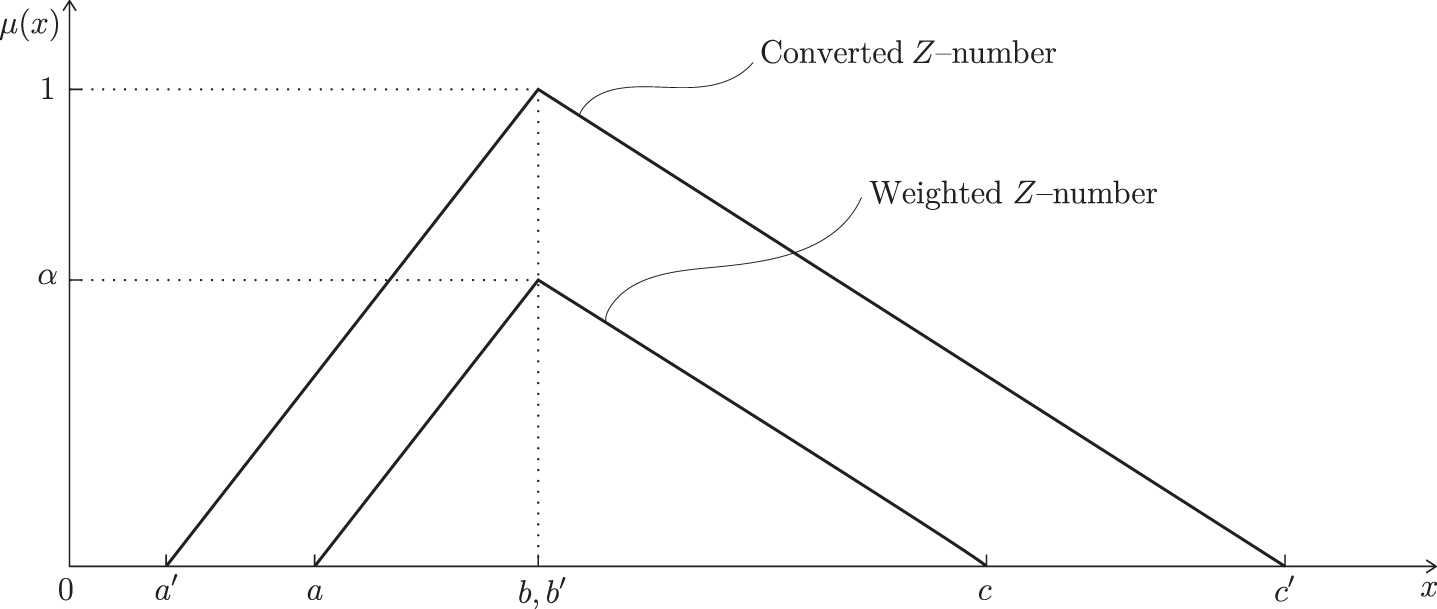
Another method to convert the weighted Z-number according to their reliability into a normal fuzzy number proposed in [7]. Figure 1 describes to convert the weighted Z-number with height α to the normal fuzzy number as schematically.
To convert weighted Z-numbers to normal fuzzy numbers by method in [7].
The authors in [7] assumed that if the membership function of the weighted Z-number be triangular then the relevant normal fuzzy number is triangular. Furthermore, the main idea of the method is that the slope of normal fuzzy number lines is equal to the slope of lines into the weighted Z-number. So, by considering as the weighted Z-number and as its relevant normal fuzzy number, the values of a′, b′ and , c′ are presented as follows:
To illustrate the above mentioned method, we consider the same presented example in the previous subsection. Considering
The part of reliability should be converted to crisp numbers according to the following relation:
where denotes the weighted Z-number. Now, we find the regular fuzzy number using relations in (10) as follows:
hence, we obtain:
The proposed method
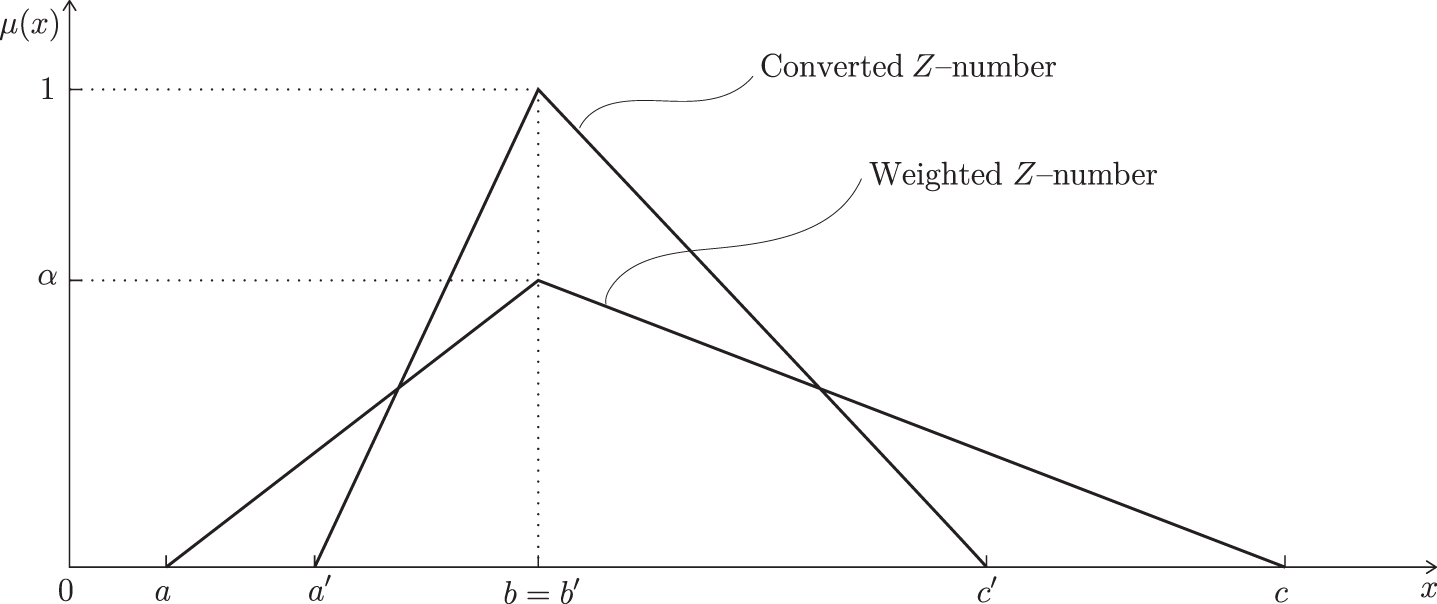
In order to transform the weighted Z-number according to its reliability into a normal fuzzy number, we consider preserving the central gravity, left and right area of the Z-number with the relevant normal fuzzy number. Figure 2 shows the procedure of the approach schematically to convert the weighted Z-number with height α to the normal fuzzy number. The advantage of this approach with respect to the proposed method in [7] has less ambiguity.
To convert weighted Z-numbers to normal fuzzy numbers by the proposed method.
We supposed that if the weighted Z-number has the triangular membership function then its relevant normal fuzzy number has a triangular membership function. To describe of the proposed method, we consider as the weighted Z-number and as its relevant normal fuzzy number. To obtain the parameters a′, b′ and c′, should be solved the following system of equations:
and we find the values of a′, b′ and c′ as follows:
To illustrate our method, we select the same presented example in the previous subsection. Considering
The part of reliability should be converted to crisp number according to the following relation:
where denotes the weighted Z-number. Now, we find the regular fuzzy number using relations in (11) as follows:
hence, we get:
Description of neural network method
In this section, the artificial neural network is introduced which is a two-layer network, the first layer of which contains the inputs and the second layer contains the weights of the neural network and the linear transfer and output functions. Neural network training is based on minimizing the sum of squared errors using optimization techniques. The inputs of this network correspond to the variables of the linear device. The weights of the neural network correspond to the coefficients of the device and the output of the network corresponds to the right side of the device.Here, the neural network’s learning rule is the "error back-propagation rule". Backward Propagation Neural Network, with its learning algorithm, is one of the most widely-used neural networks in the computational-intelligence research and engineering fields. Its learning procedure could usually be generalized as the following two steps: 1) forward computation of working signal and 2) backward propagation of training error [11].
Definition 8. (MLP Network training) A multi-layer perceptron (MLP) is a class of feedforward artificial neural network. An MLP consists of at least three layers of nodes. Except for the input nodes, each node is a neuron that uses a nonlinear activation function. MLP utilizes a supervised learning technique called backpropagation for training. Its multiple layers and non-linear activation distinguish MLP from a linear perceptron. It can distinguish data that is not linearly separable. Multi-layer networks use a variety of learning techniques, the most popular being back-propagation (BP), which is based on The error correction learning rule. So, to calculate sensitivities for the different layers of neurons in the MLP network the Derivative of conversion neurons functions is required. So functions used that have derivative. One of these functions is the sigmoid function defined. it is A real, bounded, and derivative function. The sigmoid function has a positive derivative, and has the following general relationship σ (n) =1/(1 - e-n) (see [29, 40]).
Theorem 3.(The World approximation Builder) The MLP network with one hidden layer with a sigmoid functions (Hyperbolic tangent function) in the middle layer and linear transformation functions in output layer are able to approximate all functions in any degree of the integral of the square [27].
Definition 9. (BFGS Technique) To minimize this unconstrained optimization problem, minimization techniques such as the steepest descent method and the conjugate gradient or quasi-Newton methods can be employed. The Newton method is one of the important algorithms in nonlinear optimization. The main disadvantage of the Newton method is that it is necessary to evaluate the second derivative matrix (Hessian matrix). Quasi-Newton methods were originally proposed by Davidon in 1959 and were later developed by Fletcher and Powell (1963). The most fundamental idea in quasi-Newton methods is the requirement to calculate an approximation of the Hessian matrix. Here the quasi-Newton BFGS (Broyden-Fletcher-Goldfarb-Shanno) quadratically method is used (see [33]).
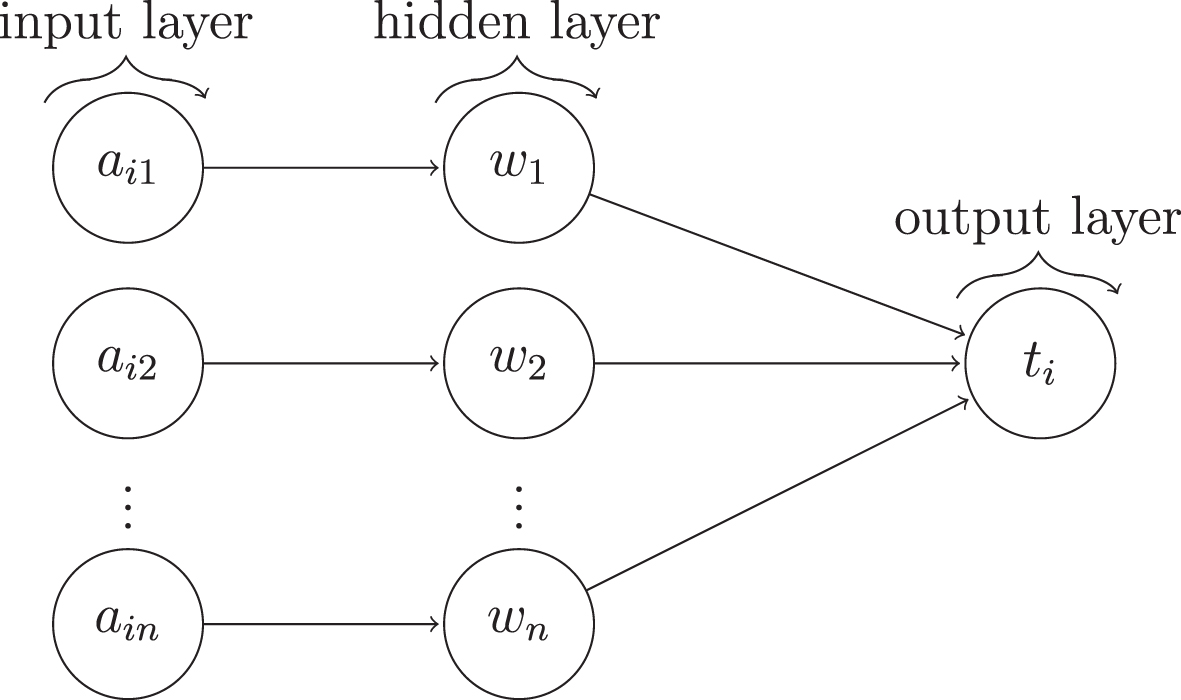
For solving a linear equation system with crisp coefficients using neural network method, we design a two-layer Backward Propagation neural network, which has the architecture as follows:
The neural network for solving linear systems.
According to Fig. 3, wi’s are the weights of the neural network corresponding to the xi’s and aij’s are the inputs of the neural network and ti is the output of the neural network which is proportional to the bi in solving Ax = b. Here, the initial value of neural network weights is considered zero. We consider the linear activation function for constructing all the neurons of such a Backward Propagation neural network. The matrix of coefficients A is considered as the input of the neural network and the vector b as the output of the neural network. We consider the activation function of the output neuron as a step function. After training the neural network, the weights obtained from the neural network are the same as the xi values in the problem.
The relationship between input-output of each unit of the neural network can be written as follows:
where wj is the weights, f is the objective function (error function), aij is the input and ti is the output of the neural network.
The objective function for the improved neural network is defined as follows:
Based on the pseudo-Newton method, we calculate the optimal weights of the neural network as follows:
where is the optimal weight of iteration k and is calculated as follows:
where γ is the network learning rate should be positive small enough.
The algorithm of the neural network technique for solving linear system of equations proceeds as follows:
Algorithm 1.
Step 1: Choose the error tolerance "tol", learning parameter γ, random weights, and set k = 0 and e = 0.
Step 2: Calculate , .
Step 3: Calculate the sum squared error as and update the weights by the following formula:
Step 4: If e(k) > = tol then k = k + 1 and go to Step 2, else go to Step 5.
Step 5: Print wj, j = 1, 2, . . . , n .
In order to implement Algorithm 1, the MATLAB is applied and tested on the final solution with a tolerance criterion. In fact, the tools used in this research is for creation of an introductory set of real numbers and descriptive variables for input. To this end, the definitions and properties mentioned in Section 2 should be used. After the necessary calculations on input characters (Z-number conversion) and the final test was performed by the use of MATLAB. For more details regarding the neural network technique, we refer the reader to [23, 36].
Proposed method for solving Z-number linear system of equations
In this section, we express the algorithm of the proposed method to solve a Z-number linear system of equations as follows:
In the above system, it is assumed that the coefficients () and the constants () are both Z-number and Y = [y1, y2, . . . , yn] where is the unknown variables of the above mentioned system of equations. The algorithm of this method for solving linear system with Z-numbers coefficients has 4 steps as follows:
Algorithm 2.
Step 1. Consider the Z-number system of equations and then convert the Z-number coefficients of and to weighted Z-number using Eq. (5).
Step 2. Convert the weighted Z-number coefficients obtained from previous step to regular fuzzy number coefficients using each of the presented methods in Section 3. After performing the required operations, we obtain the following fuzzy system:
Step 3. Convert the fuzzy coefficients matrix and fuzzy coefficients vector using ranking formula (4) to the crisp corresponding coefficients. After doing the required operations, we get the following crisp linear system of equations:
Step 4. Solve the crisp linear system of equations which obtain from previous step using neural network technique mentioned in Algorithm 1.
In the sequel, by providing practical numerical examples, we will perform the mentioned steps of Algorithm 2 and determine the unique crisp solution of the linear system of equations.
Numerical experiments
In this section, two numerical examples are considered to solve based on Algorithm 2 with .
Example 1. In this example, we consider the following system of two equations and two unknown variables with Z-number coefficients and to solve it, we apply the proposed algorithm:
where
The exact solution of the above system approximately is y1 = y2 = 1, because the each equation of this system is constructed by the examples about addition and subtraction of two Z-numbers are presented in [2] into the part of the operations on continuous Z-numbers. Now, we perform the steps of Algorithm 2 to solve the above mentioned Z-number system of equations:Step 1. In this stage, we convert the each entry of matrix and vector to weighted fuzzy number entries using Eq. (5) and we obtain:
Step 2. Now, we convert the each entry of matrix and vector to regular fuzzy numbers using method in [31], and to do this, we get:
Step 3. In this step, we convert the fuzzy matrix and fuzzy vector to crisp matrix A″ and crisp vector b″ using ranking function (Eq. (4)), and the results are as follows:
Step 4. In this stage, we solve the crisp linear system of equations A″Y = b″ based on neural network method which is shown in the Table 1.
Numerical results of Example 1, with accuracy 0.5 × 10⁻⁶ using the conversion method in [31]
y1
y2
0.9020
0.5344
If in Step 2, we consider the conversion method in [7] due to transform the weighted Z-number to normal fuzzy number, we obtain the following information:
Now, if we apply the ranking function (4), on the and , we obtain:
Finally, if the crisp linear system of equations A″Y = b″ is solved based on neural network method, we obtain the following results determined in Table 2.
Numerical results of Example 1, with accuracy 0.5 × 10⁻⁶ using the conversion method in [7]
y1
y2
1.0135
1.2302
If in Step 2 again, we consider the our conversion method due to transform the weighted Z-number to normal fuzzy number using (11), we obtain the following information:
Now, if we perform the ranking function (4), on the and , we get:
Finally, if the crisp linear system of equations A″Y = b″ is solved based on neural network method, we yield the following results presented in Table 3.
Numerical results of Example 1, with accuracy 0.5 × 10⁻⁶ using the proposed conversion method
y1
y2
1.0009
1.0259
The results in Table 3 shows that the proposed method about converting the weighted Z-number to normal fuzzy number is better than other existing conversion methods because it is obviously, the results in Table 3 is very closely to the exact solution with respect to results in Tables 1 and 2.
Example 2. In this example, we consider the following system of four equations and four unknowns with Z-number coefficients and for solving it, we perform the stages of the proposed algorithm:
In this system, it is assumed that the coefficients and the constants are both Z-number and , y = [y1, y2, y3, y4], by supposing
the information of this system is as follows:
Step 1. In this stage, we convert the each entry of matrix and vector to weighted fuzzy number entries using method in [31] and, we obtain:
Step 2. Now, we convert the each entry of matrix and vector to regular fuzzy numbers using each of method mentioned method in Section 3.
According to the results based on each of conversion method we perform Step 3. and Step 4. to solve crisp linear system of equations A″Y = b″ based on the neural network method. The solutions after performing the above mentioned methods on the related system of equations are represented in Table 4.
Numerical results of Example 2, with accuracy 0.5 × 10⁻⁶
Conversionmethod
y1
y2
y3
y4
Methodin [31]
0.6755
1.8298
2.1702
-0.2979
Methodin [7]
0.9850
1.6541
-0.1353
0.9398
Proposedmethod
1.0005
1.3233
0.6917
1.0019
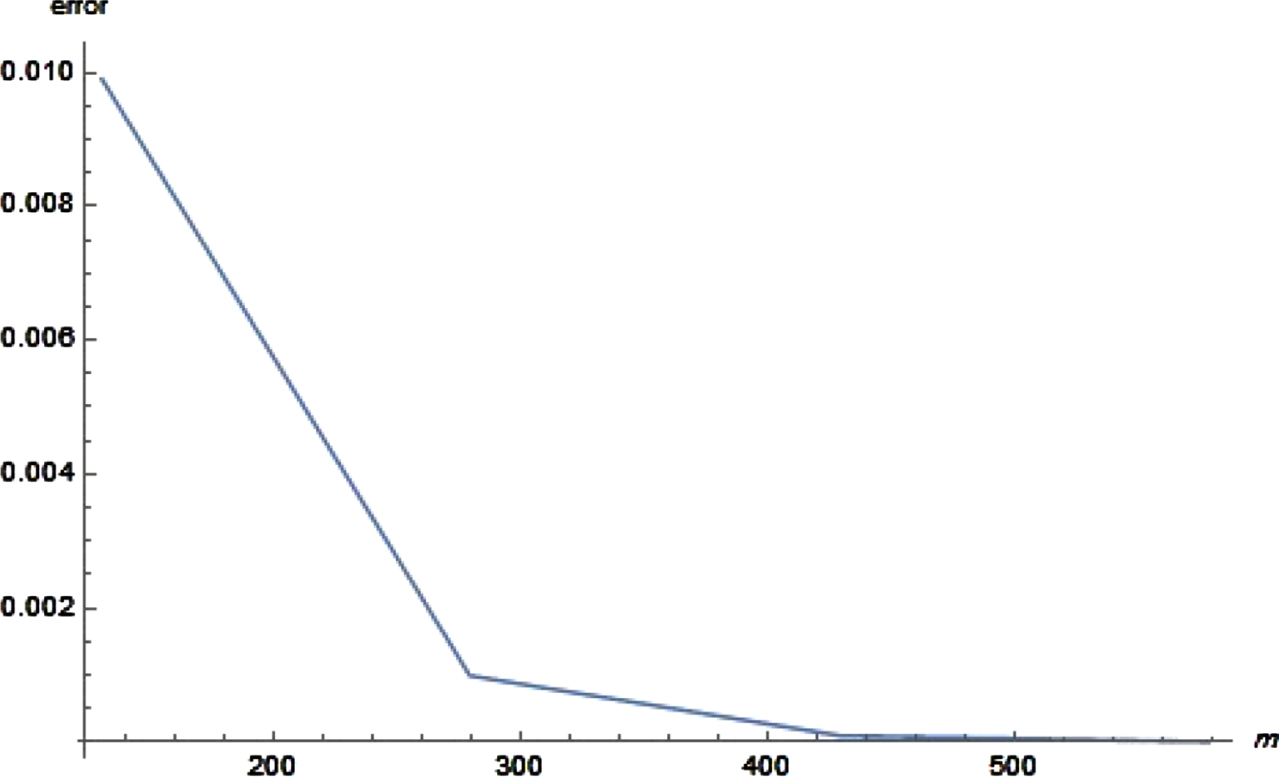
Figure 4 illustrates the variations of errors versus the number of iterations (m) in Algorithm 2 corresponding to the given values tol.
The comparison between the values of m and error in Example 2.
Conclusion
For solving a Z-number linear system based on the proposed algorithm, we are able to solve the Z-number system in four steps. We turned the mentioned system into a crisp linear system of equations. By solving the obtained crisp system via the neural network scheme, we get the final result. Also, the algorithm can be operated with more than two unknown variables correctly and the final result for the problems can be obtained. The main idea of this paper is to propose a method for converting the weighted Z-number to a normal fuzzy number, which has less ambiguity with respect to other existing conversion methods such as those presented in [7] and [31]. Due to the fact that linear systems based on Z-numbers have many ambiguities and uncertainties, solving such systems has special difficulties, and if a method is provided for solving these systems with the desired speed and accuracy, it has special importance, including the method of solving the system with neural networks. We considered two illustrative examples of the system of equations with Z-number coefficients to be solved with the proposed algorithm. The method of the neural network has high accuracy and achieves the desired result. Therefore, a system with Z-number coefficients after transforming to a crisp linear system of equations can be solved efficiently based on the neural network algorithm.
Acknowledgment
The authors would like to thank the anonymous reviewers for their careful reading and constructive comments to improve the quality of this work.
References
1.
AbbasbandyS., EzzatiR. and JafarianA., LU decomposition method for solving fuzzy system of linear equations, Applied Mathematics and Computation172(1) (2006), 633–643.
2.
AlievR.A., HuseynovO.H., AliyevR.R., AlizadehA.A. Arithmetic of Z-numbers: theory and applications, World Scientific 2015.
3.
AlievR.A., AlizadehA.A. and HuseynovO.H., The arithmetic of discrete Z-number , Information Sciences290 (2015), 134–155.
4.
AlievR.A., Witold Pedrycz and HuseynovO.H., Hukuhara Difference of Z-numbers, Information Sciences466 (2018), 13–24.
5.
AllahviranlooT., Numerical methods for fuzzy system of linear equations, Applied Mathematics and Computation155(2) (2004), 493–502.
6.
AllahviranlooT. and EzadiS., Z-Advanced numbers processes, Information Sciences480 (2019), 130–143.
7.
AzadehA. and KokabiR., Z-number DEA: A new possibilistic DEA in the context of Z-numbers, Advanced Engineering Informatics30 (2016), 604–617.
8.
BanA. and CoroianuL., Nearest interval, triangular and trapezoidal approximation of a fuzzy number preserving ambiguity, International Journal of Approximate Reasoning53 (2012), 805–836.
9.
BanerjeeR. and PalS.K., A Decade of the Z-numbers, IEEE Transactions on Fuzzy Systems30(8) (2022), 2800–2812.
10.
BandyopadhyayS., RahaS. and KumarP., Nayak, Matrix Game with Z-numbers, International Journal of Fuzzy Logic and Intelligent Systems15(1) (2015), 60–71.
11.
ChakravertyS., JeswalS.K. Applied Artificial Neural Network Methods for Engineers and Scientists, World Scientific Publishing Co. Pte. Ltd., 2021.
12.
ChouCh.-Ch., The canonical representation of multiplication operation on triangular fuzzy numbers, Computers & Mathematics with Applications45(10-11) (2003), 1601–1610.
13.
DehghanM. and HashemiB., Iterative solution of fuzzy linear systems, (1), Applied Mathematics and Computation175 (2006), 645–674.
14.
DelgadoM., VilaM.A. and VoxmanW., On a canonical representation of fuzzy numbers, Fuzzy Sets and Systems93(1) (1998), 125–135.
15.
DengY., ZhenfuZ. and QiL., Ranking fuzzy numbers with an area method using radius of gyration, Computers & Mathematics with Applications51(6-7) (2006), 1127–1136.
16.
EzadiS., AllahviranlooT. New multi-layer method for Z-number ranking using hyperbolic tangent function and convex combination, Intelligent Automation & Soft Computing (2017), 1–7.
17.
EzadiS., AllahviranlooT. and MohammadiS., Two new methods for ranking of Z-numbers based on sigmoid function and sign method, International Journal of Intelligent Systems33(7) (2018), 1476–1487.
18.
EzadiS., AllahviranlooT. Numerical solution of linear regression based on Z-numbers by improved neural network, Intelligent Automation & Soft Computing (2017), 1–11.
19.
Farooq HasanH., SultanaA. A New Approach to Solve Fuzzy Linear Equation A · X + B = C, IOSR Journal of Mathematics (2017), 22–30.
20.
Fariborzi AraghiM.A. and HosseinzadehM.M., Solution of general dual fuzzy linear systems using ABS algorithm, Applied Mathematical Sciences6(4) (2012), 163–171.
21.
Fariborzi AraghiM.A. and FallahzadehA., Inherited LU factorization for solving fuzzy system of linear equations, Soft Computing17(1) (2013), 159–163.
22.
FarzamM., Afshar KermaniM., AllahviranlooT., AminataeiA.
Ranking the Return on Assets of Tehran Stock Exchange by a New Method Based on Z-Numbers Data, International Journal of Mathematics and Mathematical Sciences (2023), 1–14. https://doi.org/10.1155/2023/2063267
23.
FausettL.V. Fundamentals of neural networks: architectures, algorithms and applications, Pearson Education India, 2006.
24.
FriedmanM., MaM. and KandelA., Fuzzy linear systems, Fuzzy Sets and Systems96(2) (1998), 201–209.
25.
GurneyK. An introduction to neural networks, CRC press, 1997.
26.
HaykinS.S. Neural networks and learning machines, New York: Prentice Hall, 2009.
27.
HornickK., StinchcombeM. and WhiteH., Multilayer feedforward networks are universal approximators, Neural Networks2 (1989), 359–366.
28.
JafariR., YuW., LiX. Numerical Solution of Fuzzy Equations with Z-numbers using Neural Networks, Intelligent Automation and Soft Computing (2018). https://doi.org/10.1080/10798587.2017.1327154
KangB., WeiD., LiY. and DengY., Decision making using Z-numbers under uncertain environment, Journal of Computational Information Systems8(7) (2012), 2807–2814.
31.
KangB., WeiD., LiY. and DengY., A method of converting Z-number to classical fuzzy number, Journal of Information & Computational Science9(3) (2012), 703–709.
32.
KrieselS. Abrief introduction on neural networks, Citeseer, 2007.
33.
LiuC. and NocedalJ., On the limited memory BFGS method for large scale optimization, Mathematical Programming45(3) (1989), 503–528.
34.
Mahdavi-AmiriN. and NasseriS.H., Duality results and a dual simplex method for linear programming problems with trapezoidal fuzzy variables, Fuzzy Sets and Systems158 (2007), 1961–1978.
35.
Motamedi PourZ., AllahviranlooT., Afshar KermaniM., AbbasbandyS. Solving a system of linear equations based on Z-numbers to determinate the market balance value, Advances in Fuzzy Systems (2023), 1–28. https://doi.org/10.1155/2023/6353911
36.
NielsenM.A. Neural networks and deep learning, Determination press San Francisco, CA, 2015.
37.
OtadiM., MoslehM. and AbbasbandyS., Numerical solution of fully fuzzy linear systems by fuzzy neural network, Soft Computing15(8) (2011), 1513–1522.
38.
Kai-Wen Shen, Jian-Qiang Wang and Tie-Li Wang, The arithmetic of multidimensional Z-number, Journal of Inteligent & Fuzzy Systems36(2) (2019), 1647–1661.
39.
XuB. and DengY., Information volume of Z-number, Information Sciences608 (2022), 1617–1631.
40.
YadavN., YadavA., KumarM. An introduction to neural network methods for differential equations, Springer Dordrecht Heidelberg, 2015.
41.
YagerR., On Z-valuations using Zadeh’s Z-numbers, International Journal of Intelligent Systems27(3) (2012), 259–278.
42.
YagerR., On a View of Zadeh’s Z-Numbers, IPMU (3) (2012), 90–101.
43.
YeJ., Similarity measures based on the generalized distance of neutrosophic Z-number sets and their multi-attribute decision making method, Soft Comput25 (2021), 13975–13985.
44.
ZadehL.A., A note on Z-numbers, Information Sciences181(14) (2011), 2923–2932.
45.
ZimmermannH.-J. Fuzzy set theory and its applications, Springer Science & Business Media, 2011.
46.
ZiqanA., IbrahimS., MarabehM. and QarariyahA., Fully fuzzy linear systems with trapezoidal and hexagonal fuzzy numbers, Granular Computing7 (2022), 229–238.