




Abstract
In conventional DEA models it has been assumed that each measure status is considered input or output. However, a performance measure in some cases can have input role for some DMUs and output role for others and is known as flexible measure. In this paper new slacks-based FNSBM models are proposed in general two-stage network DEA to determine the relative efficiency of units and the role of flexible measures. Then new radial FNDEA-R models and new slacks-based FNSBM-DEA-R models are developed in the presence of flexible measures based on the ratio of input components to output components or vice versa in the input and output orientation under constant returns to scale in general two-stage network. In our proposed models, flexible measures are determined as input or output to improve performance to maximize the relative efficiency of the DMU under evaluation. The FNDEA-R and FNSBM-DEA-R models versus FNSBM models prevent efficiency underestimation and pseudo inefficiency issues. The status of one flexible measure in the input-oriented and output-oriented FNDEA-R and FNSBM-DEA-R models may have different conclusions. The radial FNDEA and FNDEA-R models have unitsinvariant and the objective function of the FNSBM and FNSBM-DEA-R models are invariant with respect to the units of data. A numerical example is used to illustrate the procedures.
Introduction
One of the efficient methods to determine the relative efficiency of a group of homogeneous DMUS is DEA (data envelopment analysis). This method employs the same input to generate the same output. Standard application of DEA with a group of available measure assumes that each measure’s condition is completely determined as either input or output variable in the process of production before using DEA. Still, in some cases a measure of performance functions as an input for some DMUs and output for the rest. In Cook and Zhu [6] flexible variables were used and they introduced an adjustment to the standard constant returns to scale DEA model (Charnes et al. 1978) to classify these variables. In addition, they proposed an aggregate model from a manager’s viewpoint who is in charge of the collection of DMUs. According Toloo [28], their model can yield incorrect efficiency scores when a large positive number is given to the model. Therefore, He proposed a mixed integer linear programming (MILP) model to exclude large positive numbers. Amirteimoori and Emrouznejad [1] by focusing on the impact of flexible measures on the definition of the production set and the assessment of technical efficiency, proposed a mixed integer linear programming model. Toloo [29] considered alternative solutions for classifying input and output in data envelopment analysis. In the same way, Toloo [30] argued that these cases are share cases and proposed a novel model for classification that determines share cases. An SORM model was introduced by Kordrostami [17] capable of evaluating the efficiency of units with negative and flexible data. A flexible slacks-based measure of efficiency was proposed by Amirteimoori et al. [2] to achieve maximum performance and categorize flexible measures. Tohidi and Matroud [27] introduced a novel non-oriented model for determining each flexible measure status as an input or output. In addition, they proposed the aggregated model and an extension with negative data pertinent to the proposed approach. Toloo et al. [31] introduced a non-radial directional distance model for classification of flexible measures. Kordrostami et al. [18] introduced a FSBM model with integer-valued to assess the relative efficiency of DMUs in which flexible and integer measures were available. Novel radial models were proposed by Hosseini Monfared et al. [20] to classify flexible measures, which used envelopment form of CCR with constant and variable returns to scale in basic two-stage network structure. Monfared et al. [14] proposed integer-valued FNDEA methods capable of evaluating the relative efficiency of DMUs and determine the flexile measure status with integer data in general and basic two-stage network structure. Hosseini Monfared et al. [15] proposed FNDEA models using a multiplier model with variable and constant returns to scale (CRS & VRS) with general two-stage network structure. The model was employed to classify flexible measures where each one was treated as output or input to maximize overall network efficiency of the DMU under evaluation.
Several DEA studies have been conducted on DMUS with internal network structures. Among several internal structures, one popular and basic internal structure is two-stage network structure. Kao and Hwang [16] modeled the total efficiency of two-stage process as the product efficiencies of two separate stages. Chen et al. [5] showed that Kao and Hwang [16]’s model was based on CRS and may not be used for VRS. Therefore, they proposed an additive approach to aggregate the efficiencies over two-stage process. More specifically, they introduced the overall efficiency of two-stage process by determining the weighted sum of efficiencies of the two separate stages. A slacks-based network was proposed by Tone [32] to handle intermediate products. A slacks-based measure (SBM) model was also proposed by Lozano [19] for processing general networks. A general network SBM approach was proposed by Cantor and Poh [3] to define the overall and divisional efficiencies and also measure Pareto-Koopmans efficiency status. The approach was capable of showing equivalence of primal and dual (multiplier and envelopment) forms of the network DEA model. According to Chen and Zhu [4], the additive slacks-based model can be used to model network DEA in which the internal structures of decision-making units (DMUs) are under focus. Shi et al. [26] proposed a slacks-based measure network (SBM-NDEA) with good performance in terms of measuring performance of production processes with complicated structure with parallel and series processes. Qaiser Farooq et al. [25] proposed a non-radial and non-oriented SBM model for production process of three-stage network.
In several cases, it is the intention of managers to employ inputs/outputs ratios instead of original data. For instance, the ratio of discharged patients to the total number of patients in a hospital. To examine the efficiency of a group of DMUs with ratio data, DEA-R models have a better performance than traditional models. In practice, there was several cases where data is represented as ratio and input/output or output/input data are essential for decision making. In some cases, the data is given as ratio or percentage data. Generally, ratio data can be categorized in three categories. First category is when some output and input elements are ratio and the rest are as volume. The numerator and denominator representing such data are available and the ratio data can be added to the model as a decimal number. The axiom convexity of the assumptions used to estimate the production possibility set is not determined with given ratio data in this category. Hatami-Marbini and Toloo [13] introduced DEA models for ratio data and solved the drawbacks in Emrouznejad and Amin’s [8] models. DEA models were proposed by Emrouznejad and Amin [8] for ratio data through changing the convexity axiom of the key assumption to estimate production possible set (PPS). The 2nd category contains input and output elements as ratio and the rest of elements are as volume. The category includes numerator and denominator corresponding to the data which are not available and ratio data is represent as a decimal number. In addition, data ratio is employed as a decimal number. The convexity principle is not determined with the presence of ratio data. Olesen et al. [23, 24] used this category and introduced new DEA models to measure efficiency with given ratio and volume data. The third category includes models which are obtained through mixing Ratio analysis models and DEA. Ratio data in this category are not ratio inherently and they are obtained through dividing input elements to output element or vice versa. In addition, the denominator and numerators of these data are given as input or output elements. Models like this are known as DEA-Ratio based (DEA-R) models where the output and input elements are given and directly added to the model. All the ratios corresponding to the output and input elements are employed to assess efficiency. A DEA-R model was introduced by Despic et al. [7] through mixing ratio analysis, DEA models and DEA-R models in the output orientation to obtain the DMUs efficiency when ratio data is available. Wei et al. [33, 34] studied DEA-R models in input orientation and reported that with DEA-R models, the possible problems of standard DEA models are resolved. Mozaffari et al. [21, 22] utilized DEA-R models to assess revenue and cost efficiency. They introduced a relationship in DEA models without explicit input and DEA-R models. Gerami et al. [9] proposed DEA-R models for measuring two-stage network structures efficiency with ratio data. Gerami et al. [10] employed DEA-R model to examine hospital supply chain efficiency with ratio data. Gerami et al. [11] developed the SBM model for ratio data using DEA-R models. Their model demonstrated super-efficiency and efficiency scores with corresponding slack values for output/input and input/output ratio based on the orientation of the production frontier. Ghiyasi et al. [12] extended the theoretical basis of the inverse DEA-R model as a post-efficiency analysis manner. The presentation of models in the presence of flexible measures based on the ratio of input/output ratios or vice versa is critical for decision maker in two-stage network structures. Our goals in this research is to use radial and non-radial slacks-based models in DEA and DEA-R for the third category of ratio data using input/output ratios and vice versa in the input and output orientation under constant returns to scale in general two-stage network for classifying flexible measures. In proposed models in DEA-R, flexible measures are determined as input or output in the numerator or denominator of ratios to increase relative efficiency. By solving a model based on the radial and non-radial model in DEA and DEA-R, both flexible measures are classified and the relative efficiency of the units is measured. The objective function in non-radial slacks-based models in DEA-R is just linear, but the objective function in non-radial slacks-based models in DEA is linear and fractional. In the radial and non-radial models in DEA-R, all inputs and outputs should be positive and the ratios of inputs to outputs and vice versa should be defined. In the proposed radial and non-radial models in DEA and DEA-R, constraints are linear, although there are binary variables in these models. The proposed radial and non-radial models in DEA and DEA-R are feasible and bounded. The proposed radial models in DEA and DEA-R have units-invariant and the objective function of the non-radial slacks-based models in DEA and DEA-R are invariant with respect to the units of data.
In this paper novel slacks-based (FNSBM) models are proposed in general two-stage network DEA for flexible measures classification and also assessing relative efficiency of DMUs and new radial (FNDEA-R) models and new slacks-based (FNSBM-DEA-R) models are presented with flexible measures for the third category of ratio data using input/output ratios and vice versa in the input and output orientation under constant returns to scale in general two-stage network to classify flexible measures where each measure can have the role of an input for some DMUs and also the role of an output for others to achieve the highest relative efficiency of DMU under study. The models are good with key disadvantages in DEA models such as inaccurate estimates of efficiency, weak efficiency and pseudo-inefficiency. The efficiency scores by the FNDEA-R and the FNSBM-DEA-R models are higher or the same as the score of efficiency achieve by the FNSBM models. The FNDEA-R and FNSBM-DEA-R models versus FNSBM models avoid efficiency underestimation and pseudo-inefficiency. Thus, they can compute a more reliable score of efficiency of DMUs. The FNSBM models have to solve many problems in terms of pseudo-inefficiency and efficiency underes-timation in efficiency assessment. The FNDEA-R and FNSBM-DEA-R models provide a bigger feasible space for selecting the corresponding weight of output/input ratios and input/output ratios. Thus, all these ratios are considered in measuring efficiency of DMU. Taking into account the advantages of the introduced FNDEA-R and FNSBM-DEA-R models to prevent the pseudo inefficiency, they can be considered as a good replacement for the FNSBM models. The condition of one flexible measure in the input-oriented and output-oriented in FNDEA-R and FNSBM-DEA-R models in the general two-stage network structure can have different conclusions and it is expectable that a flexible measure is chosen as an input measure of one model; while an output measure in another model. In addition, when an FNSBM model has an efficient operation unit in a certain flexible measure, the measure can have the role of output and input for this unit. If so, the optimum input or output designation for a flexible measure is expected to optimize the artificial average unit efficiency. The main contributions of this research are summarized as follows: New flexible slacks-based FNSBM models are presented under constant returns to scale in general two-stage network DEA to classify flexible measures and to evaluate the relative efficiency of DMUs. New radial FNDEA-R models and new flexible slacks-based FNSBM-DEA-R models are presented under constant returns to scale in the input and output orientation based on the ratio of input components and output components and vice versa in which each flexible measure can play input role for some DMUs and output role for others to maximize the relative efficiency of the DMU under evaluation in general two-stage network DEA-RA. The relationship between the efficiency scores obtained from the FNSBM-DEA-R models, the radial FNDEA-R models and the FNSBM models in the input and output orientation are shown. The status of one flexible measure in the input-oriented and output-oriented FNDEA-R and FNSBM-DEA-R models in the general two-stage network structure may have different conclusions. The proposed radial models in DEA and DEA-R have units-invariant and the objective function of the non-radial slacks-based models in DEA and DEA-R are invariant with respect to the units of data. The proposed radial and non-radial models in DEA and DEA-R are feasible and bounded.
The paper is organized as follows. In the second section, the previous studies on classifying flexible measures and DEA-R models are reviewed in brief. In the third section, new slacks-based (FNSBM) models are proposed in general two-stage network DEA to determine the relative efficiency of units and the role of flexible measures. Then new radial (FNDEA-R) models and new slacks-based (FNSBMDEA-R) models are developed with flexible measures based on input/output ratio or vice versa in the input and output orientation under constant returns to scale in general two-stage network to classify flexible measures to maximize the DMU relative efficiency. In the fourth section, A numerical example is employed for explaining more details while the Section 5 represents the conclusion.
Preliminaries
Previous studies on flexible measure
If our aim is to assess the efficiency for n units of decision making (DMU j : j = 1, ⋯ , n) with m inputs x ij , i = 1, ⋯ , m, s outputs y rj , r = 1, ⋯ s and L flexible measures w lj , l = 1, ⋯ , L. Amirteimoori et al. (2013) introduced an SBM model to measure the relative efficiency of the DMU under evaluation and for classifying flexible measures.
In addition,
When the aim is to assess n decision making units efficiency (DMU j , j = 1, ⋯ , n) with m inputs x ij > 0, i = 1, ⋯ , m, s outputs y rj > 0, r = 1, ⋯ , s. Gerami et al. [11] developed the SBM model for the ratio data under input and output orientation based on DEA-R models is:
They defined the variables s ir , i = 1, ⋯ , m, r = 1, ⋯ , s as slacks that correspond to input/output ratios. Model (2) is linear and non-radial with input orientation which is based on the input/output ratios in CRS technology. The DMU efficiency, in the SBM-DEA-R-I model, is given using the ratio of slacks corresponding to input/output ratios with these components. When all the slacks are zero, the unit is strong efficient and inefficient otherwise.
With output orientation, model (3) is linear based on the output/input ratios in CRS technology.
New slacks-based (FNSBM) models are proposed in general two-stage network DEA to determine the relative efficiency of units and the role of flexible measures. Then new radial (FNDEA-R) models and new slacks-based (FNSBM-DEA-R) models are developed with flexible measures using the input/output ratio or vice versa in the input and output orientation under constant returns to scale in general two-stage network to classify flexible measures to achieve the highest relative efficiency of the DMU under evaluation. A general two-stage network structure is pictured in Fig. 1. Each DMU
j
, (j = 1, ⋯ , n) contains m inputs x
ij
, (i = 1, ⋯ , m) to the stage one and H outputs
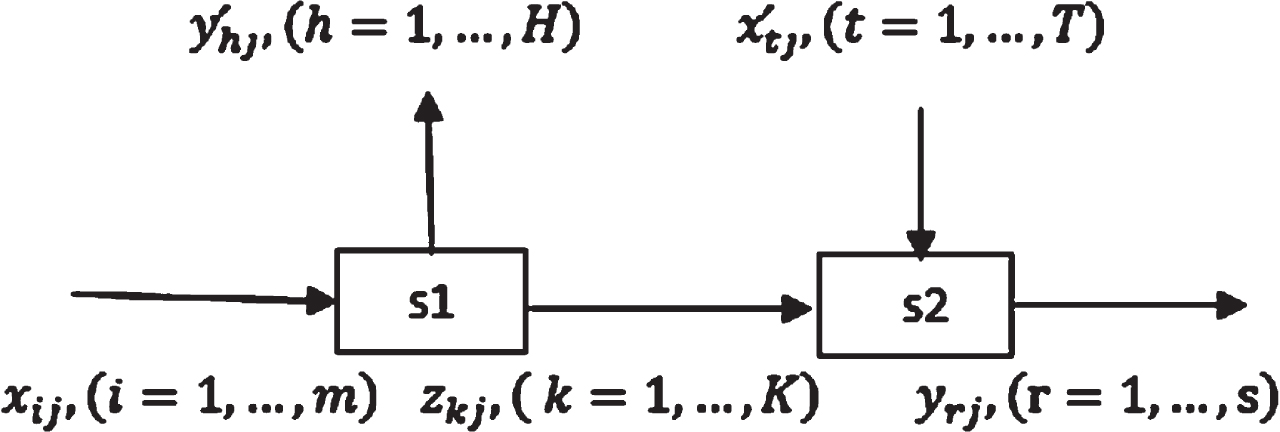
General two-stage network.
If there are L1 flexible measures to stage one
Radial FNDEA model
A new radial FNDEA model is presented using envelopment form of CCR in the input orientation in general two-stage network DEA to assess the relative efficiency and categorize flexible measures.
In this model, M is a big positive number. For each l1 and l2, binary variables
The technology set T FNDEA is defined as follows:
A new slacks-based measure FNSBM model is proposed in the presence of flexible measures under constant returns to scale in two-stage network where every flexible measure be as input for some DMUs and output for other DMUs to achieve a maximum relative efficiency of the DMU under study.
Consider that
As we know, in non-radial FNSBM model, the efficiency of a DMU is given based on the ratio of slacks referring to the input to output components, and if all of these slacks are equal to zero, then this unit is strong efficient and otherwise inefficient.
In the model (5)
Moreover,
We define:
Clearly, (6) is a feasible solution for the model (5). Here, the objective value is
This completes the proof and
Using Charnes and Cooper transformation, it is possible to convert the FNSBM model (5) into a non-fractional programming model (7) as follows. We let τ > 0 and define:
In the case of an efficient DMU
o
, no output short-falls and input excesses happens. In case of
This model is arranged in the case that
The FNSBM model as input oriented under constant returns to scale is as follows:
The FNSBM model as output oriented under constant returns to scale is:
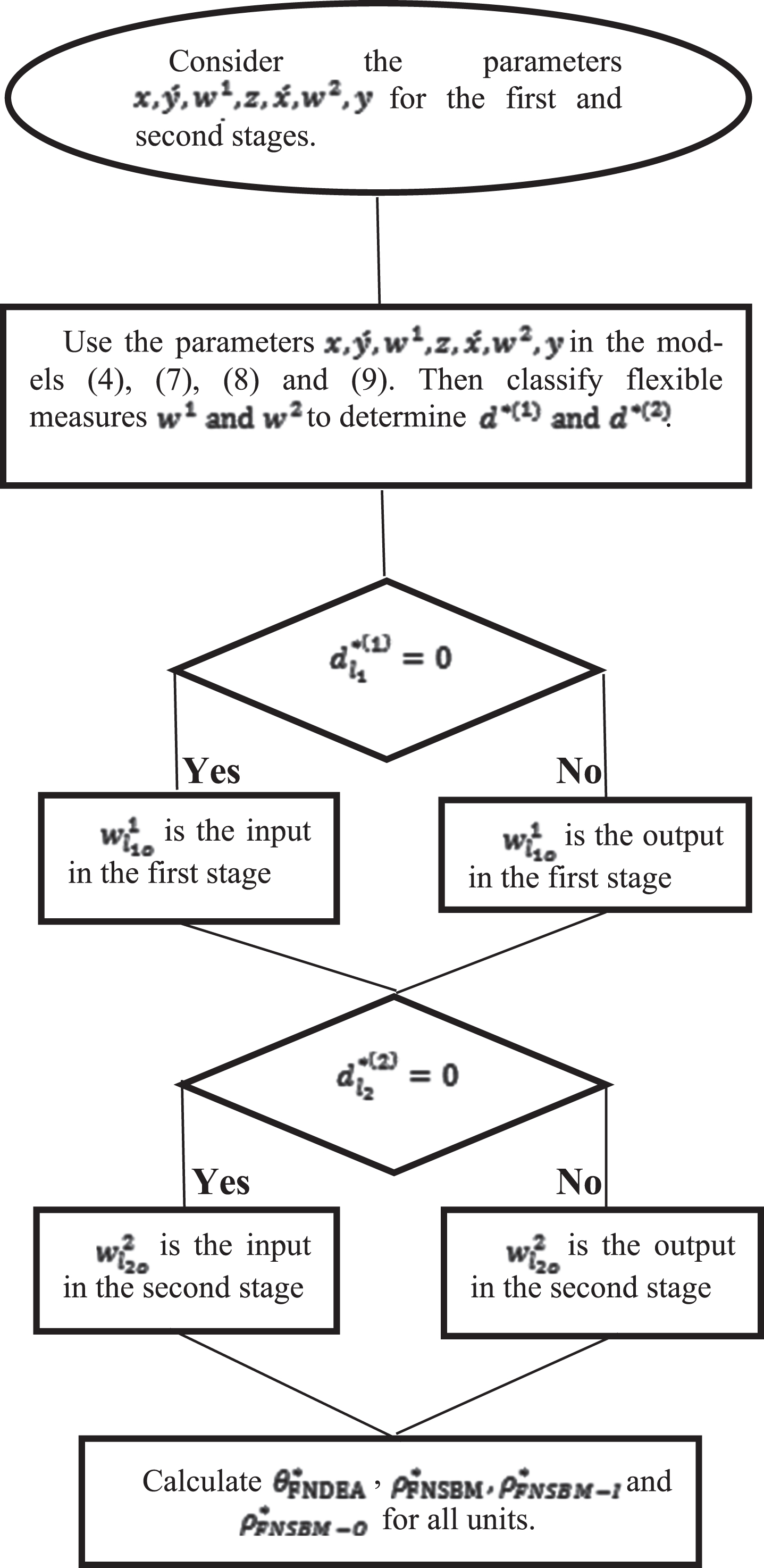
The flowchart of the proposed models in general two-stage network DEA.
Here, at first, new radial FNDEA-R models are presented in the presence of flexible measures under constant returns to scale in the output and input orientation depending on input/output ratios and vice versa. Then, new slacks based measure of efficiency FNSBM-DEA-R models are developed with flexible measures under constant returns to scale in the input and output orientation with the ratio of input components and output components and vice versa where each flexible measure functions as input for some DMUs and output for the others to achieve a maximum relative efficiency of the DMU under evaluation in general two-stage network.
Input-oriented radial FNDEA-R-I model
A general two-stage network structure is illustrated in Fig. 1. Each DMU
j
, (j = 1, ⋯ , n) contains m inputs x
ij
> 0, (i = 1, ⋯ , m) at the first stage and H outputs
with
with
with
with
with
with
These ratios are defined. A new radial FNDEA-R-I model is presented under constant returns to scale in the input orientation using the input/output ratios for classifying flexible measures to achieve maximum relative efficiency of the DMU in two-stage network.
The technology set TFNDEA-R-I is defined as follows:
New slacks based measure of efficiency FNSBM-DEA-R-I model is developed under constant returns to scale in the input orientation given input/output ratio for classifying flexible measures to achieve the highest relative efficiency of the DMU under assessment in two-stage network.
The variables of the model (11) are defined as follows.
In the model (11)
So, we have these constraints.
Here, (12) is a possible feasible for the FNSBM-DEA-R-I model (11). Since
If the ratio of outputs to inputs is given, a new radial FNDEA-R-O model is presented under constant returns to scale in the output orientation using the output/ input ratio for classifying flexible measures for maximizing the relative efficiency of the DMU evaluated in two-stage network as follows:
The technology set TFNDEA-R-O is defined as follows:
So, this is a feasible solution for the model@@ (13).
With the ratio of outputs to inputs given, it is possible to use FNSBM-DEA-R model in the output orientation. A new slack based FNSBM-DEA-R-O model is developed under constant returns to scale in the output orientation using output/input ratio for classifying flexible measures to have a maximum relative efficiency of the DMU under assessment in two-stage network.
So, this is a feasible solution for the model (14).
Here, (15) is a possible feasible for the FNSBM-DEA-R-O model (14). So, the following relationship holds.
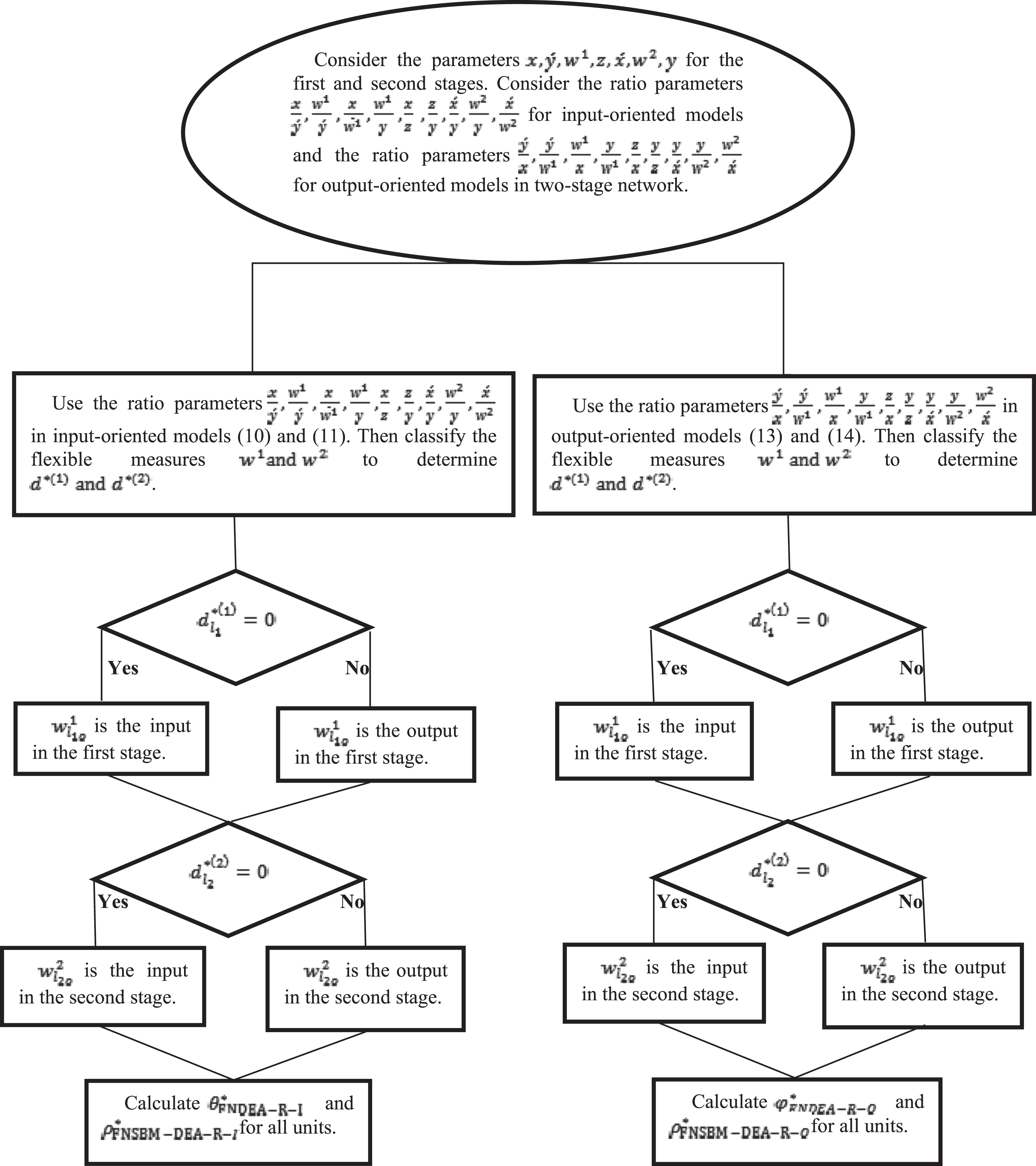
The flowchart of the proposed models in general two-stage network DEA-RA.
In this section, the models of input and output orientation are used in two-stage network for flexible measures classification. Parameters are random data are listed in Table 1 obtained columnwise using GAMS software by uniform distribution such as uniform (a, b) where a, b are the upper and lower bounds of the uniform distribution. The intervals are given at the last row of Table 1. In total, there are 30 DMUs, three inputs to the first stage (X1, X2, X3), two outputs to the first stage
The results of the FNDEA model (4), FNSBM models (7), FNSBM-I model (8), FNSBM-O model (9), FNDEA-R-I model (10), FNSBM-DEA-R-I model (11), FNDEA-R-O model (13), FNSBM-DEA-R-O model (14) in general two-stage to classify flexible measures are listed in Tables 2, 3 and 4. In FNSBM model (7) for the efficient DMU11 and DMU12, we have
In FNSBM model (7), FNSBM-I model (8), FNDEA-R-I model (10) and FNSBM-DEA-R-I model (11), most DMUs select the flexible measure w1 in the second stage as an input measure
One flexible measure status in the input-oriented and output-oriented FNDEA-R and FNSBM-DEA-R models in the two-stage general network structure may have different conclusions and it is expectable that the flexible measure is chosen as an input measure in one model and an output measure in another model. In the input-oriented FNDEA-R-I model and FNSBM-DEA-R-I model most DMUs choose the flexible measure in the first and second stage as input measures and in the output-oriented FNDEA-R-O model and FNSBM-DEA-R-O model most DMUs choose the flexible measure in the first and second stage as output measures. In these models each flexible measure be an input for some DMUs and output for others to achieve a maximum relative efficiency of the DMU.
The FNDEA model (4) is applied in general twostage network to the data sets are listed in Table 1. In Table 2 and Fig. 4 it is shown that the optimum objective value
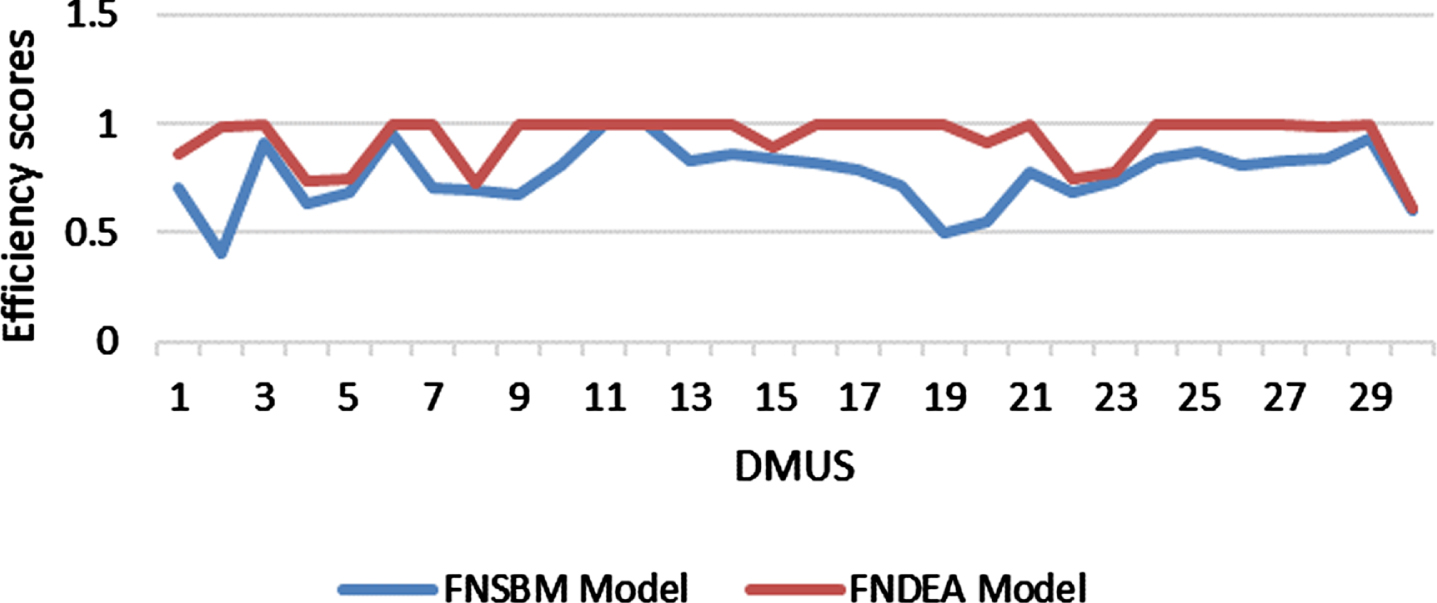
Comparing efficiency scores of FNSBM model (7) and FNDEA model (4) in two-stage network.
Data with flexible measures in general two-stage network
The results of the FNSBM models (7) and FNDEA model (4) in two-stage network DEA
The performances of FNDEA-R, FNSBM, and FNSBM-DEA-R models was compared with output and input orientations. As we know, the efficiency of a DMU, in the FNSBM-DEA-R model in the output and input orientations, depends on the ratio of slacks corresponding to the input to output components with these components and when the slacks are zero,
The results of the FNSBM-I models (8) and FNSBM-O model (9) in two-stage network DEA
The results of the FNDEA-R-I model (10), FNSBM-DEA-R-I model (11), FNDEA-R-O model (13) and FNSBM-DEA-R-O model (14) in two-stage network DEA-R
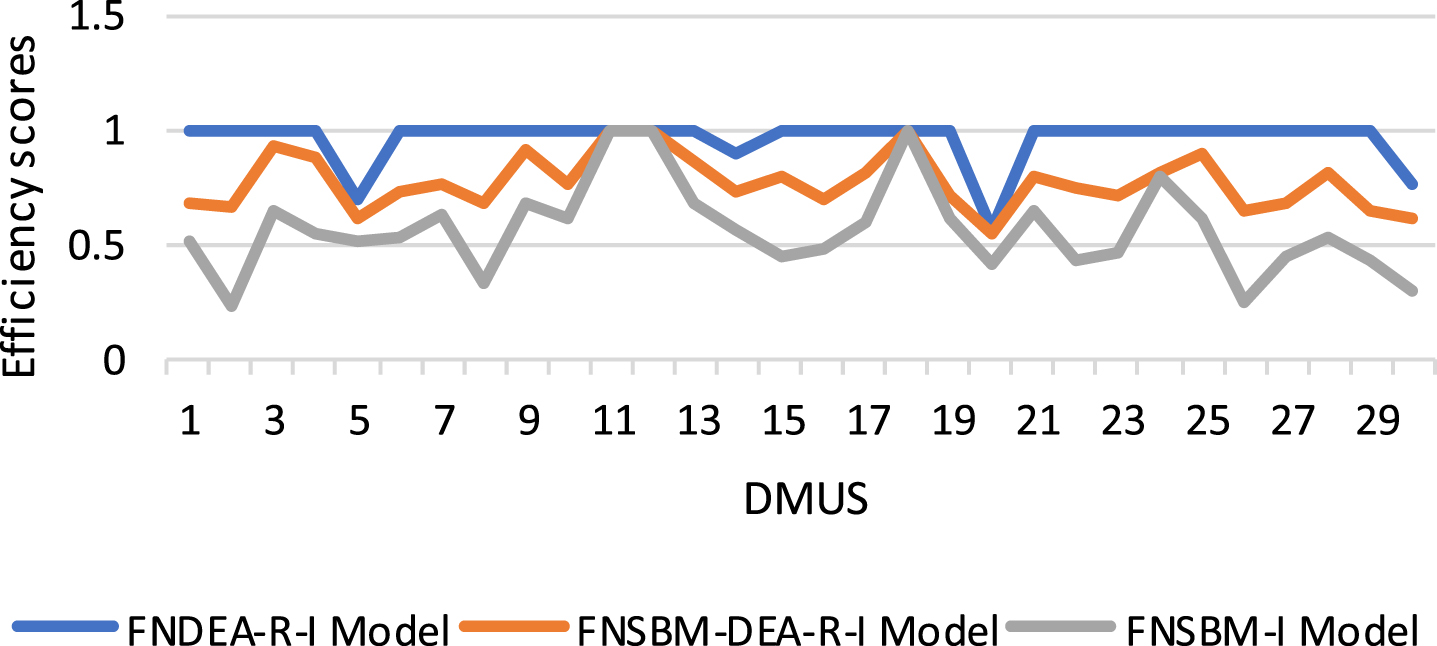
Efficiency scores FNDEA-R-I model (10), FNSBM-DEA-R-I model (11) and FNSBM-I model (8) in two-stage network.
As listed in Tables 3, 4 and Fig. 6, the efficiency scores obtained from the FNDEA-R-O model are greater than or equal to their corresponding scores obtained from the FNSBM-O and FNSBM-DEA-R-O models.
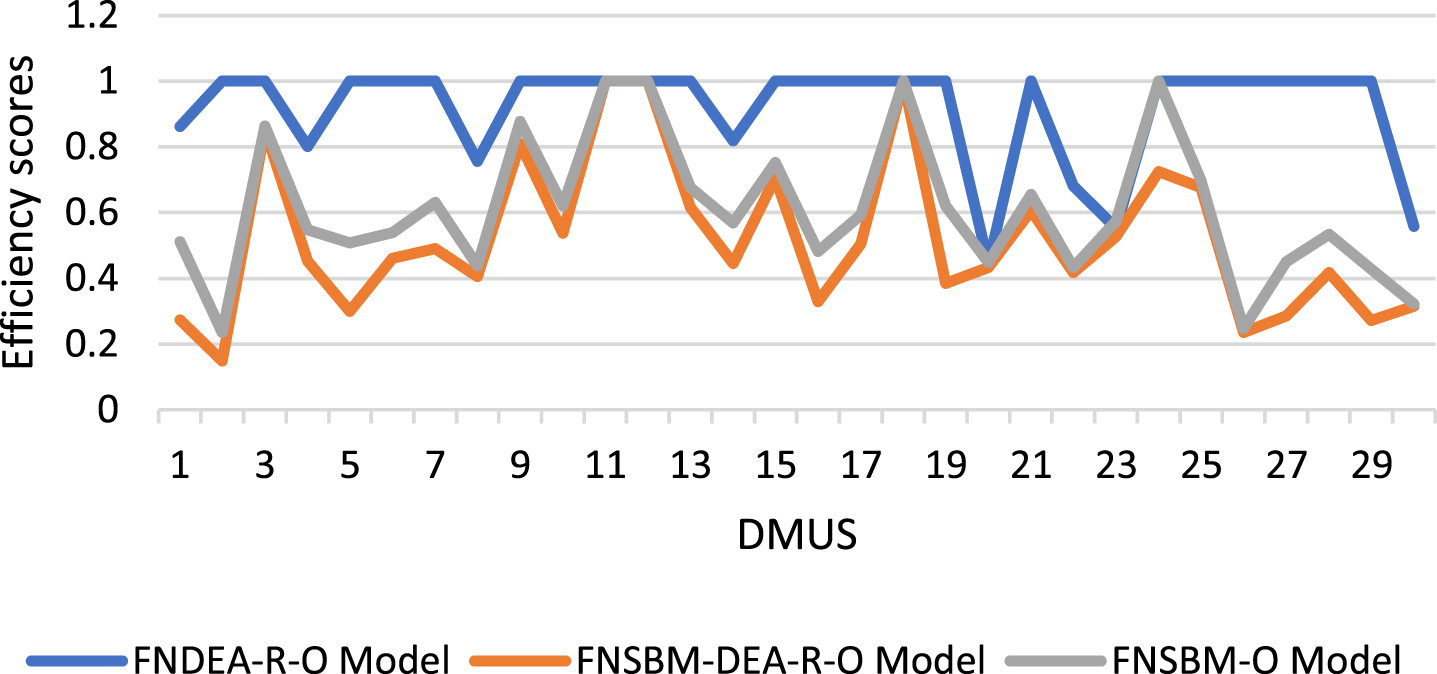
The efficiency based on FNDEA-R-O model (13), FNSBM-DEA-R-O model (14) and FNSBM-O model (9) in two-stage network.
In conventional DEA models, it requires that every variable be determined as an output or input prior to efficiency measurement. However, in realworld applications there are some measures whose status are flexible and data are the ratio of input data to output data or vice versa that is important to the decision maker in two-stage network. Novel slacks-based FNSBM models are proposed in general two-stage network DEA for the classification of flexible measure and evaluating the relative efficiency. Then, new radial FNDEA-R and new slacks-based FNSBMDEA-R models are presented in the presence of flexible measures for the third category of ratio data using the input/output ratio and vice versa in the input and output orientation with constant returns to scale in general two-stage network DEA-R to classify flexible measures where each flexible measure has an input or output role to achieve the highest relative efficiency of DMU under evaluation. The models are good with key disadvantages in DEA models such as inaccurate estimates of efficiency, weak efficiency and pseudo-inefficiency. The efficiency scores obtained from the FNDEA-R models are greater than or equal to the efficiency scores obtained from the FNSBM-DEA-R models and the FNSBM models. The FNDEA-R and FNSBM-DEA-R models versus FNSBM models prevent efficiency underestimation and pseudo inefficiency issues. Therefore, they correctly calculate the efficiency score of DMUs. The FNSBM models face with the issue of underestimation of efficiency and pseudo-inefficiency during efficiency appraisal. Underestimation of efficiency occurs when the efficiency scores of DMUs are not calculated correctly. This problem originates from the fact that the corresponding weights of some inputs and outputs are computed as zero. Therefore, the importance of that variable is not considered in the efficiency score of the DMUs. The FNDEA-R and FNSBM-DEA-R models provide a bigger feasible space for selecting the corresponding weight of output/input ratios and input/output ratios. Therefore, all the input-to-output ratios or vice versa are included to measure the DMU efficiency. Taking into account the advantages of the introduced FNDEA-R and FNSBM-DEA-R models to prevent the pseudo inefficiency, they can be considered as a good replacement for the FNSBM models. The condition of the flexible measure in the input-oriented and output-oriented FNDEA-R and FNSBM-DEA-R models in the general two-stage network structure may have different conclusions and it is expectable to select a flexible measure as an input measure for one model while an output for another. In the FNSBM model when an operational unit is efficient in a specific flexible measure, this measure can play both input and output roles for this unit. In this case, the optimal input/output designation for flexible measure is unique that optimizes the efficiency of the artificial average unit. In proposed models in DEA-R flexible measures are determined as input or output in the numerator or denominator of ratios to increase relative efficiency. By solving a model based on the radial and non-radial model in DEA and DEA-R, both flexible measures are classified and the relative efficiency of the units is measured. The objective function in non-radial slacks-based models in DEA-R is just linear, but the objective function in non-radial slacks-based models in DEA is linear and fractional. In the radial and non-radial models in DEA-R, all inputs and outputs should be positive and the ratios of inputs to outputs and vice versa should be defined. In the proposed radial and non-radial models in DEA and DEA-R, constraints are linear, although there are binary variables in these models. The proposed radial and non-radial models in DEA and DEA-R are always feasible and bounded. The proposed radial models in DEA and DEA-R have units-invariant and the objective function of the non-radial slacks-based models in DEA and DEA-R are invariant with respect to the units of data.
The FNSBM-DEA-R model can be developed for situations that imprecise factors and nonpositive data are present.