Entropy is an important tool to describe the degree of uncertainty of fuzzy sets. In this study, we first define a new entropy and distance measure in the linguistic q-Rung orthopair fuzzy (LIVqROF) environment, and verify its correctness and rationality. Secondly, in the LIVqROF environment, the new entropy formula is effectively applied to the multi-attribute decision making (MADM) with unknown attribute weights, which provides a new idea for solving the MADM problems. Finally, the feasibility and effectiveness of the proposed method are verified by a numerical example.
Zadeh [1] proposed the fuzzy set (FS), which only has the membership degree, and it is difficult to describe the negative degree of the decision maker to the evaluation information. Atanassov [2, 3] proposed intuitionistic fuzzy set (IFS) on the basis of fuzzy set, and creatively added non-membership degree to the fuzzy sets. However, intuitionistic fuzzy numbers can only be used to describe the evaluation information in the form of real numbers. Due to the complexity of the decision-making environment, the decision making information is often uncertain. Sometimes it is very difficult to express the membership and non-membership degree with real numbers. Therefore, Atanassov [4] also proposed interval intuitionistic fuzzy set (IVIFS), which membership and non-membership are interval numbers rather than real numbers. In real life, the form of linguistic terms is often used to qualitatively evaluate information. Zadeh [5] proposed the fuzzy linguistic method, and Zhang [6] defined the concept of linguistic intuitionistic fuzzy set (LIF). Similar to intuitionistic fuzzy sets, linguistic intuitionistic fuzzy sets are also limited by the representation range. Inspired by the concepts of Pythagorean fuzzy set (PFS) and q-Rung orthopair fuzzy set (qROFS) introduced by Yager in [7] and [8], Garg [9] proposed linguistic Pythagorean fuzzy set (LPFS) and Lin [10] developed the concept of linguistic q-Rung orthopair fuzzy set (LqROFS). Linguistic interval intuitionistic fuzzy numbers can better deal with the uncertainty and fuzziness of decision information, and can truly reflect the objective world. Garg proposed linguistic interval intuitionistic fuzzy set (LIVIFS) and linguistic interval Pythagorean fuzzy set (LIVPFS) in [11] and [12], respectively. Khan [13] established linguistic interval q-Rung orthopair fuzzy set (LIVqROFS).
Information measure plays an important role in fuzzy set theory, and many researchers have explored it from different perspectives. In order to deal with the fuzziness measurement between FSs, De Luca and termini [14] gave an axiomatic definition of fuzzy entropy based on Shannon [15]. Since then, Hooda et al. [16, 17], Mishra et al. [18–21], Pal [22] have studied various entropy measures of FSs. Burillo and Bustance [23] defined the intuitionistic fuzzy entropy to measure the hesitation degree of intuitionistic fuzzy sets. Liu [24] presented the interval intuitionistic fuzzy entropy.Li [25, 26] gave the study of slope entropy and fractional slope entropy. Zhang and Jiang [27], Zhang [28], Wei [29], and Wei and Zhang [30] introduced the entropy measure of IVIFSs and applied it in solving MADM problems. Rani [31] gave a new entropy measure of IVIFS, Kumar et al. [32] gave a new Pythagorean fuzzy entropy, Sonia et al. [33] gave a entropy measures for interval valued intuitionistic fuzzy soft set and Ohlan [34] presented a distance measure on IVIFS. Inspired by their research, this paper defines an entropy measure and distance measure in LIVqROF environment. The relationship between the proposed entropy measure and distance measure are studied.
The rest of this paper is arranged as follows. In Section 2, we introduce some definitions and operation rules on IVIFSs and LIVqROFSs. In Section 3, the axiomatic definitions of entropy and distance in LIVqROF environment are given, a new entropy and distance are proposed, and their rationality and relevance are proved. In Section 4, a multi-attribute decision making method is proposed in LIVqROF environment by using the proposed entropy. A numerical example is used to verify the effectiveness and rationality of the method.
Preliminary
The linguistic assessment scale is the basis of linguistic decision making. In [35], Bordogna et al. defined an additive linguistic scale.
Definition 2.1.Let
be an additive linguistic assessment scale with a linguistic term subscript non-negative integer, and let S satisfy the following conditions:
(1) The set is ordered: s
α < s
β if α < β.
(2) There is a negative operator: neg (s
α) = s
β such that α + β = t.
where t is an even number and s
α refers to linguistic terms.
After that, Xu [36] extended the discrete term set S to a continuous term set , where τ (τ > t) is a sufficiently large natural number. If s
α ∈ S, then we call s
α the original linguistic term, otherwise, we call s
α the virtual linguistic term.
Combining the concept of intuitionistic fuzzy sets [2] with the definition of linguistic terms [35], Zhang [6] first proposed the concept of linguistic intuitionistic fuzzy sets(LIFSs), which is defined as follows.
Definition 2.2.Let X = {x1, x2, ⋯ , xn} be a finite universe discourse and be a continuous linguistic term set with a positive integer τ. A LIFS on the set X is defined as
where denotes the degree of linguistic membership and denotes the degree of linguistic nonmembership of the element xi ∈ X to the set I, respectively, with the condition that 0 ≤ θ + σ ≤ τ. The degree of linguistic indeterminacy is given as sπ (xi) = sτ-θ-σ.
For convenience, the pairs of (sθ (xi) , sσ (xi)) are called as linguistic intuitionistic fuzzy value(LIFV) or linguistic intuitionistic fuzzy number(LIFN).
On the basis of LIFSs and the concept of Pythagorean fuzzy sets [7], Garg [9] proposed the concept of linguistic Pythagorean fuzzy sets(LPFSs), which is defined as follows.
Definition 2.3.Let X = {x1, x2, ⋯ , xn} be a finite universe discourse and be a continuous linguistic term set with a positive integer τ. A LPFS on the set X is defined with the form
where stand for the linguistic membership degree and linguistic nonmembership degree of the element xi to P, respectively, with the condition that 0 ≤ θ2 + σ2 ≤ τ2. The degree of linguistic indeterminacy is given as: .
Similarly, the pairs of (sθ (xi) , sσ (xi)) are called as linguistic Pythagorean fuzzy value(LPFV) or linguistic Pythagorean fuzzy number(LPFN).
On the basis of LIFSs, LPFSs and q-rung orthopair fuzzy sets [8], Lin [10] proposed linguistic q-rung orthopair fuzzy sets(LqROFSs), which is defined as follows.
Definition 2.4.Let X = {x1, x2, ⋯ , xn} be a finite universe discourse and be a continuous linguistic term set with a positive integer τ. Then the form of a LqROFS on X is defined as
where stand for the linguistic membership degree and linguistic nonmembership degree of the element xi to L, respectively, with the condition that 0 ≤ θq + σq ≤ τq. The degree of linguistic indeterminacy is given as: .
Similarly, the orthopair of (sθ (xi) , sσ (xi)) is called as linguistic q-rung orthopair fuzzy value(LqROFV) or linguistic q-rung orthopair fuzzy number(LqROFN).
Obviously, when q = 1 and q = 2, the two special cases of LqROFSs are LIFSs and LPFSs, respectively.
In [4], Atanassov and Gargov proposed the concept of interval-valued intuitionistic fuzzy sets(IVIFSs), which is defined as follows.
Definition 2.5.Let X = {x1, x2, ⋯ , xn} be a finite universe discourse. Then the form of a IVIFS on Y is defined as
where are all subsets of [0, 1] and are said to be the membership degree and nonmembership degree of the element xi to , respectively, with the condition that . The degree of indeterminacy is given as: .
For convenience, the pairs of are called as interval-valued intuitionistic fuzzy value(IVIFV) or interval-valued intuitionistic fuzzy number(IVIFN).
If and , then the given IVIFSs can be reduced to intuitionistic fuzzy sets(IFSs).
In [11, 37], Garg, Liu et al. defined the concept of linguistic interval-valued intuitionistic fuzzy sets(LIVIFSs). In [12], Garg proposed the concept of linguistic interval-valued Pythagorean fuzzy sets(LIVPFSs). On this basis, Khan et al. [13] further proposed linguistic interval-valued q-rung orthopair fuzzy sets(LIVqROFSs), which is defined as follows.
Definition 2.6.Let X = {x1, x2, ⋯ , xn} be a finite universe discourse and be a continuous linguistic term set with a positive integer τ. Then the form of a LIVqROFS on X is defined as
where are all subsets of [s0, sτ] and are said to be the membership degree and nonmembership degree of the element xi to , respectively, with the condition that . The degree of indeterminacy is given as:
Obviously, when q = 1 and q = 2, the two special cases of LIVqROFSs are LIVIFSs and LIVPFSs, respectively. If and , then the given LIVqROFSs can be reduced to an ordinary LqROFSs.
For convenience, the pairs of are called as linguistic interval-valued q-rung orthopair fuzzy value (LIVqROFV) or linguistic interval-valued q-rung orthopair fuzzy number (LIVqROFN).
In [39], Bustince and Burillo proposed the axiomatic definition of entropy measure for IFSs. Analogously, in [24], Liu, Zheng and Xiong proposed the entropy measure of IVIFSs, which is defined as follows.
Definition 2.8. An entropy measure of IVIFS (X) is a real-valued function F : IVIFS (X) → [0, 1], if it satisfies the following conditions:
if and only if or for each xi ∈ X;
if and only if for each xi ∈ X;
, where ;
if (i.e. ) when and for each xi ∈ X, or when and .
In [40], Denci proposed the distance measure on IVIFS(X), defined as follows.
Definition 2.9. Let , a mapping D : IVIFS (X) × IVIFS (X) → [0, 1] is called a distance measure between and if satisfies the following properties:
;
if ;
;
If , then and .
Entropy and distance measures for LIVqROFSs
Pal [41] proposed the exponential entropy measure of a fuzzy set A (A ∈ F (X) = {(xi, μ (xi)) |xi ∈ X}) as
Rani et al. [31] proposed the exponential entropy and distance measure for IVIFSs. Inspired by this, this study will discuss the problem of LIVqROFSs on entropy and distance measure. In the following, we give the axiomatic definition of entropy and distance measure for LIVqROFSs.
Definition 3.1.An entropy measure of LIVqROFS (X) is a real-valued function E : LIVqROFS (X) → [0, 1], if it satisfies the following conditions:
if and only if or for each xi ∈ X(i.e. is a crisp set);
if and only if for each xi ∈ X;
;
if when and for each xi ∈ X, or when and .
Definition 3.2. Let , a mapping D : LIVqROFS (X) × LIVqROFS (X) → [0, 1] is called a distance measure on LIVqROFS (X), if it satisfies the following properties:
;
if ;
;
If , then and .
Definition 3.3. Let , is a mapping, such that φ (s
α) = α.
Definition 3.4. Let , the entropy measure is defined by
where
In the following, we prove the validity of our proposed entropy measure (7).
Theorem 3.5.The mapping defined in Equation (7) is a linguistic interval-valued q-Rung orthopair fuzzy entropy measure.
Proof. Obviously to prove that is an entropy measure of LIVqROFS(X), we just need to prove that it satisfies (E1)-(E4) in Definition 3.
(E1)Let be a crisp set then we have or , that is and or and for each xi ∈ X, so we get or . From equation (7), we obtain that .
On the other hand, if , from the definition of exponential entropy given by Pal in [41], we know that or 1 for each xi ∈ X. i.e.,
or
for each xi ∈ X. Now Equations (8) and (9) hold if either or i.e. is a crisp set.
(E2)Let , i.e. for each xi ∈ X. Apply the condition to Equation (7), we can get .
On the other hand, let
if , that is , so we can get for each xi ∈ X. Take the partial derivative of equation (10) with respect to and set it equal to zero, we have
it implies for each xi ∈ X. Since g (x) = xex is a bijection function, we get , that is for each xi ∈ X. Since
we get
for each xi ∈ X. So is a concave function and has a maximum at . By Equation (7), achieves the maximum at which implies that .
(E3) Form and Equation (7), we can easily get that .
(E4)If we take and , let
where x, y ∈ [0, τ].
Taking the partial derivatives of g with respect to x and y, respectively, we get
Set and to find the critical points, we get x = y. From Equation (12) and x = y, we obtain
and
for any x, y ∈ [0, τ].
Thus, g (x, y) is increasing with respect to x when x ≤ y and is decreasing when x ≥ y. Similarly, we obtain that
and
Now if , with and for each xi ∈ X. Then we have
It implies that and . Thus, from the monotonic of g (x, y) and Equation (7), we obtain .
Similarly, when with and for each xi ∈ X and thus, it can be prove that .
By calculating the weight of each element xi ∈ X, a weighted exponential entropy measure of LIVqROFS is proposed as follows:
where wi ≥ 0, , and
It is clear, if , then . It can be easily checked that the mapping , defined by Equation (14), is an entropy measure for LIVqROFS.
For A1, A2 ∈ FS (X) , X = {x1, x2, ⋯ , xn}, Fan and Xie [42] proposed the fuzzy information for discrimination of against is defined by
The fuzzy distance between A1 and A2 is defined by
For , Ohlan [34] proposed the interval-valued intuitionistic fuzzy information for discrimination of against is defined by
where
The distance measure for IVIFSs is defined as
Inspired by the above distance measures of FSs and IVIFSs, now the distance measures of LIVqROFSs can be defined as the following.
Definition 3.6. Let , the linguistic interval-valued q-Rung orthopair fuzzy information for discrimination of against is defined by
where
Theorem 3.7. If q = 1, the relation between and is given by the following formula
where .
Proof.
Thus, we get
Definition 3.8. Let be two LIVqROFSs, the distance measure between the LIVqROFS (X) A1 and A2 is defined as follows:
In particular, if q = 1, then
Theorem 3.9.The mapping defined in Equation (20) is a distance measure on LIVqROFS (X).
Proof. In order for Equation (20) to be qualified as a sensible measure of LIVqROFSs, it must satisfy the conditions (D1)-(D4) in Definition 3.2.
(D1)It is clear that the function h (t) =2 - (1 - t) et - (1 + t) e-t in interval [-1,1] has maximum value fmax (t) =2 - 2e-1 and minimum value fmin (t) =0. h (t) is decreasing in [-1,0] and is increasing in [1]. Since , we get .
(D2)Let and be two LIVqROFSs, if then , ,, . It is clear , therefore, .
(D3) is easily known from Equation (20).
(D4)If , we have and . Then it is easy to see that and .
It can be said that is a distance measure between LIVqROFSs and since satisfies (D1)-(D4).□
Application of the proposed entropy measure of LIVqROFSs
Now we apply the proposed LIVqROFSs based weighted entropy measure to the Multi-criteria group decision making (MCGDM) problem. Therefore, we introduce a MCGDM model based on LIVqROFS weighted entropy measure.
A method of group decision making of LIVqROFS setting based on the proposed weighted entropy measure
We provide a group decision making method based on LIVqROFSs with the known experts and unknown criteria weights. Let be a set of m feasible alternatives, and be a set of attributes. w = (w1, w2, ⋯ , wn) T is the weighting vector of attributes satisfying wj ≥ 0 and . Let D = {d1, d2, ⋯ , dl} be a set of decision makers with the weighting vector V = (v1, v2, ⋯ , vl) T satisfying vk ≥ 0 and . Assume that each decision maker gives their own decision matrix , where
is the evaluation result given by decision maker dk ∈ D under the attribute for the alternative .
Step 1. Construct the linguistic interval-valued q-rung orthopair fuzzy decision matrices (k = 1, ⋯ , l).
Step 2. Based on the given expert weights, apply the proposed LIVqROF operators(Khan et al. [13]) to aggregate the LIVqROFVs. We choose the LIVqROFWA operator to aggregate all the decision matrices Rk into a collective decision matrix , where
Step 3. Calculate the weight vector of the criterion. The weight formula of the criterion is determined as follows.
where is the entropy value of the jth attribute, which is calculated by Equation (7).
Step 4. For each alternative , Equation (14) is used to calculate the weighted LIVqROF information measure.
Step 5. Rank all the alternative according to the , the smaller the value of , the better the alternative .
Illustrative example
In the following, we apply the proposed group decision method to the evaluation of college teachers. Five college teachers who participated in the evaluation from four main evaluation indexes: Teaching ability (), student training and service (),cientific research ability (), discipline construction (). Assume that, three decision makers {d1, d2, d3} evaluated five teachers with four attributes using the following linguistic scale
Step 1. The decision matrices given by decision makers are shown in Tables 1, 2 and 3.
Decision matrix R1 provided by decision maker d1
([s2, s3] , [s3, s4])
([s3, s4] , [s1, s4])
([s2, s6] , [s1, s3])
([s3, s5] , [s2, s4])
([s2, s4] , [s2, s6])
([s2, s6] , [s1, s3])
([s3, s5] , [s2, s5])
([s3, s6] , [s3, s5])
([s3, s5] , [s2, s6])
([s4, s6] , [s3, s5])
([s3, s4] , [s1, s2])
([s3, s5] , [s2, s6])
([s1, s3] , [s3, s4])
([s3, s5] , [s2, s4])
([s1, s3] , [s3, s6])
([s3, s4] , [s2, s6])
([s2, s5] , [s3, s6])
([s2, s4] , [s2, s6])
([s2, s6] , [s3, s5])
([s2, s4] , [s3, s6])
Decision matrix R2 provided by decision maker d2
([s2, s4] , [s3, s5])
([s2, s4] , [s2, s6])
([s2, s3] , [s3, s4])
([s3, s5] , [s1, s4])
([s3, s6] , [s2, s5])
([s3, s5] , [s3, s5])
([s3, s6] , [s3, s5])
([s4, s6] , [s3, s4])
([s3, s5] , [s2, s6])
([s2, s5] , [s3, s4])
([s3, s4] , [s1, s3])
([s3, s6] , [s2, s5])
([s2, s3] , [s3, s5])
([s3, s5] , [s4, s5])
([s1, s4] , [s2, s6])
([s2, s6] , [s2, s5])
([s3, s4] , [s2, s5])
([s3, s4] , [s3, s6])
([s3, s6] , [s3, s5])
([s2, s5] , [s4, s5])
Decision matrix R3 provided by decision maker d3
([s1, s4] , [s3, s5])
([s2, s4] , [s3, s6])
([s2, s3] , [s4, s5])
([s3, s4] , [s1, s5])
([s3, s6] , [s2, s5])
([s2, s6] , [s3, s5])
([s2, s5] , [s3, s6])
([s2, s4] , [s3, s5])
([s3, s6] , [s1, s4])
([s3, s5] , [s2, s6])
([s3, s5] , [s2, s3])
([s2, s6] , [s4, s5])
([s2, s3] , [s3, s5])
([s3, s4] , [s3, s5])
([s4, s6] , [s4, s5])
([s1, s5] , [s3, s4])
([s2, s4] , [s3, s6])
([s1, s5] , [s3, s6])
([s3, s4] , [s3, s5])
([s2, s5] , [s1, s3])
Step 2. The weighting vector v = (0.3, 0.5, 0.2) of decision maker is given. Let q = 3, the LIVqROFWA operator is utilized to aggregate all the decision matrices Rk (k = 1, 2, 3) into a collective decision matrix R, as shown in Table 4.
Collective LIVqROF assessment information
([s1.8765, s3.7612] ,
([s2.3973, s4.0000] ,
([s2.0000, s4.5433] ,
([s3.0000, s4.8418] ,
[s3.0000, s4.6762])
[s1.7617, s5.3128])
[s2.2855, s3.8367])
[s1.2311, s4.1826])
([s2.7753, s5.6127] ,
([s2.6008, s5.5779] ,
([s2.8545, s5.5779] ,
([s3.4835, s5.7531] ,
[s2.0000, s5.2811])
[s2.1577, s4.2896])
[s2.6564, s5.1857])
[s3.0000, s4.4721])
([s3.0000, s5.2560] ,
([s3.0802, s5.3706] ,
([s3.0000, s4.2529] ,
([s2.8545, s5.7611] ,
[s1.7411, s5.5326])
[s2.7663, s4.6382])
[s1.1487, s2.6564])
[s2.2974, s5.2811])
([s1.8080, s3.0000] ,
([s3.0000, s4.8418] ,
([s2.4256, s4.4764] ,
([s2.3146, s5.4101] ,
[s3.0000, s4.6762])
[s3.0673, s4.6762])
[s2.5946, s5.7852])
[s2.1689, s5.0506])
([s2.6008, s4.3664] ,
([s2.5316, s4.2529] ,
([s4.7083, s6.0774] ,
([s2.0000, s4.7567] ,
[s2.4495, s5.4772])
[s2.6564, s6.000])
[s3.0000, s5.0000])
[s2.7808, s4.7682])
Step 3. By using Equation (22), take q = 3, we get the criteria weight as:
Step 4. Take q = 3, calculate for each the alternative using Equation (14).
Step 5. Since We get a descending order of .
Therefore, we get is the best alternative.
Comparative analyses
In this subsection, we compare the proposed weighted entropy measure model for LIVqROFSs with other decision tools VIKOR model for LIVqROFSs proposed by Khan et al. in [13] and TOPSIS model for LIVqROFSs proposed by Gurmani et al. in [38] to illustrate the effectiveness of our proposed method.
Steps of Khan’s approach are as under:
Step 1. Construct the decision matrices. For better comparison, we select the data in Tables 1, 2 and 3.
Step 2. The collective matrix is presented in Table 4 using the given expert weights.
Step 3. According to Table 4, we get the LIVqROFS positive ideal solution and LIVqROFS negative ideal solution respectively as:
Step 4. For better comparison, we give the criteria weight as:
Step 5. Calculate the distance between the LIVqROFS positive ideal solution r+ and the alternative , and the distance between the LIVqROFS negative ideal solution r- and the alternative respectively as:
Step 6. Calculate the relative closeness coefficient of each alternatives as follows:
Step 7.Rank the relative closeness coefficients in descending order to select the best alternative.
Therefore, we get is the best alternative.
Steps of Gurmani’s approach are as under:
In order to make the comparison result more reasonable, we chose the same data, so steps 1, 2, 3 and 4 are the same as Khan’s approach.
Step 5. Calculate the group utility measure Φi and individual regret measure yi of alternatives respectively as:
Step 6. Calculate the compromise measure of alternatives .
Step 7. Rank the compromise measure in ascending order to select the best alternative.
Therefore, we get is the best alternative.
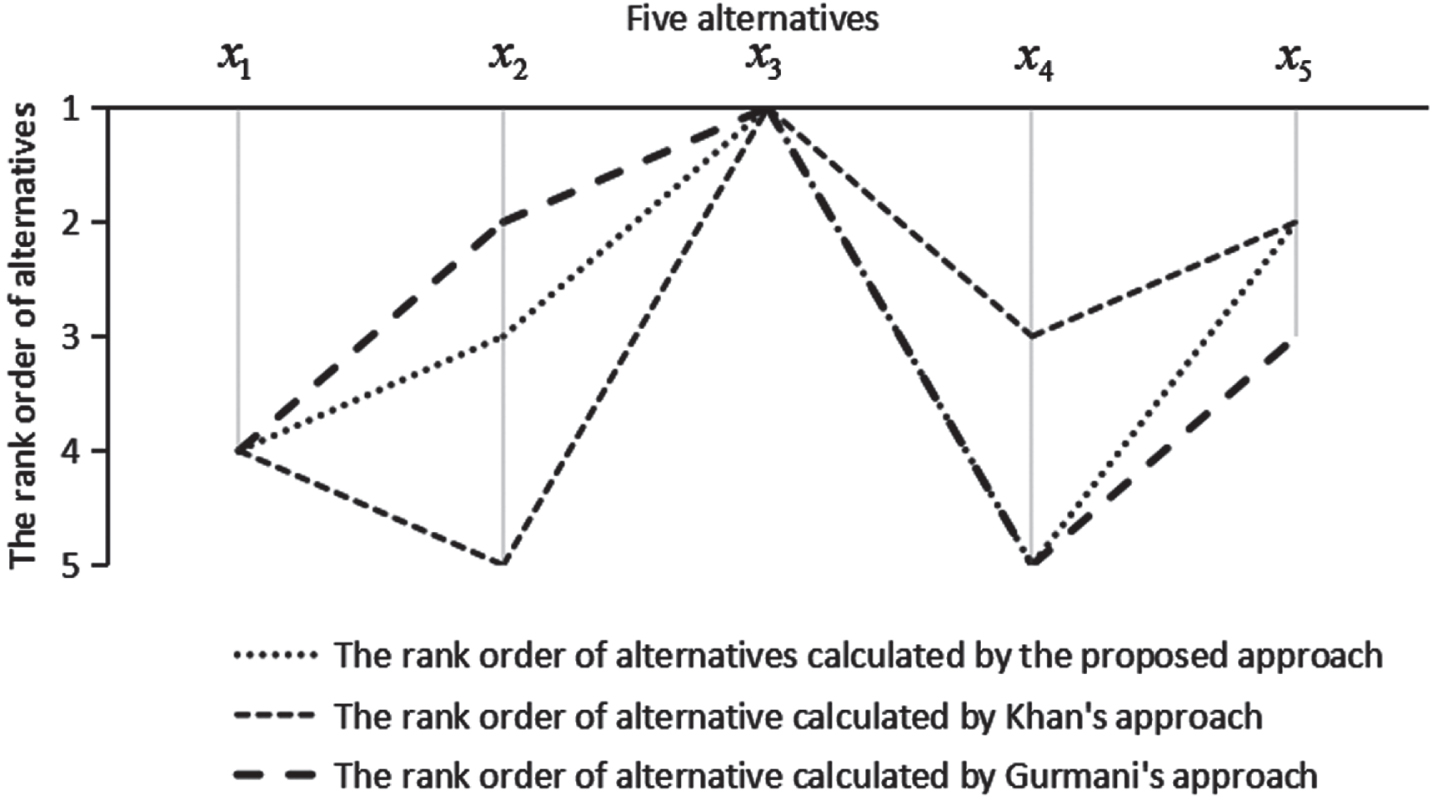
The comparison results of the proposed approach and the existing approachs are shown in Fig. 1.
The ranking of alternatives obtained by the three approaches.
According to the optimal results of the three methods, there are some similarities among the three methods, but there are also differences among the three methods from the final ranking of the alternatives. The group decision making method based on weighted exponential entropy measure in LIVqROFS environment is more efficient, simple and consistent than the existing measures and methods to solve the decision problem.
Conclusion
In this study, a new multi-attribute group decision making method is proposed under the linguistic interval-valued q-rung orthopair fuzzy environment. We propose novel entropy and distance measure for linguistic interval-valued q-rung orthopair fuzzy sets. The main innovations and advantages of this study are shown as follows:
(1) The axiomatic definitions of entropy and distance are proposed under the LIVqROF environment. It provides some important and reliable reference results for the subsequent research of complex information measures and distance measures in the LIVqROF environment.
(2) The proposed information measure is applied to the problem of multi-attribute decision making. An effective linguistic multi-attribute decision making model is established, which enriches the theory and method of qualitative decision making in the LIVqROF environment.
Theoretical analysis and numerical results show that the method is simple and intuitive without information loss. The model can be applied to medical diagnosis, personnel assessment, pollution treatment, quality evaluation and other fields. We will continue to extend the proposed method to complex decision information environment.
Conflicts of interest
I declare that I have no financial and personal relationships with other people or organizations that can inappropriately influence my work, there is no professional or other personal interest of any nature or kind in any product, service and/or company that could be construed as influencing the position presented in, or the review of, the manuscript entitled.
Funding
This work was supported by the Natural Science Foundation of Fujian Province (No. 2020J01576) and the Science and Technology Innovation Special Fund Project of Fujian agriculture and Forestry University (No. CXZX2020110A).
References
1.
ZadehL.A., Fuzzy sets,
Information and Control8(3) (1965), 338–356.
2.
AtanassovK., Intuitionistic fuzzy, Fuzzy Sets and Systems20(1) (1986), 87–96.
3.
AtanassovK., More on intuitionistic fuzzy sets, Fuzzy Sets and Systems33(1) (1989), 37–46.
4.
AtanassovK. and GargovG., Interval-valued intuitionistic fuzzy sets, Fuzzy Sets and Systems31 (1989), 343–349.
5.
ZadehL.A., The concept of a linguistic variable and its applicationto approximate reasoningI, Information Sciences8(3) (1975), 199–249.
6.
ZhangH.M. Linguistic intuitionistic fuzzy sets and application in MAGDM, Journal of Applied Mathematics (2014), Article ID 432092.
7.
YagerR.R., Pythagorean membership grades in multicriteria decision making, IEEE Transactions on Fuzzy Systems22(4) (2014), 958–965.
GargH., Linguistic Pythagorean fuzzy sets and its applications inmultiattribute decision-making process, International Journal of Intelligent Systems33(6) (1234), 1234–1263.
10.
LinM.W.,LiX.M. and ChenL.F., Linguistic q-rung orthopair fuzzysets and their interactional partitioned Heronian mean aggregation operators, International Journal of Intelligent Systems35(2) (2020), 217–249.
11.
GargH. and KumarK., Linguistic interval-valued Atanassovintuitionistic fuzzy sets and their applications to group decisionmaking problems, IEEE Transactions on Fuzzy Systems27(12) (2019), 2302–2311.
12.
GargH., Linguistic interval-valued Pythagorean fuzzy sets and theirapplication to multiple attribute group decision-making process, Cognitive Computation12(1) (2020), 1313–1337.
13.
KhanM., KhanA.S., KhanA.I., MashwaniW.K. and HussainF., Linguistic interval valued q-rung orthopair fuzzy TOPSIS method fordecision making problem with incomplete weight, Journal of Intelligent & Fuzzy Systems40(3) (2021), 4223–4235.
14.
DeLucaA. and TerminiS., A definition of non-probabilistic entropyin the setting of fuzzy sets theory, Information and Control20 (1972), 301–312.
15.
ShannonC.E., A mathematical theory of communication, Bell System Technical Journal27(3) (1948), 379–423.
16.
HoodaD.S., MishraA.R. and JainD., On generalized fuzzy mean codeword lengths, American Journal of Applied Mathematics2(4) (2014), 127–134.
17.
HoodaD.S. and MishraA.R., On trigonometric fuzzy information measures, ARPN Journal of Science and Technology5(3) (2015), 145–152.
18.
MishraA.R., JainD. and HoodaD.S., On fuzzy distance and induced fuzzy information measures, Journal of Information and Optimization Sciences37(2) (2016), 193–211.
19.
MishraA.R., JainD. and HoodaD.S., On logarithmic fuzzy measures of information and discrimination, Journal of Information and Optimization Sciences37(2) (2016), 213–231.
20.
MishraA.R., HoodaD.S. and JainD., Weighted trigonometric and hyperbolic fuzzy information measures and their applications inoptimization principles, International Journal of Computer and Mathematical Sciences3(7) (2014), 62–68.
21.
MishraA.R., HoodaD.S.Divya JainOn exponential fuzzymeasures of information and discrimination, International Journal of Computer Applications119(23) (2015), 1–7.
22.
PalN.R. and PalS.K., Object background segmentation using new definitions of entropy, IEEE Proceedings136(4) (1989), 284–295.
23.
BurilloP. and BustinceH., Entropy on intuitionistic fuzzy sets andon interval-valued fuzzy sets, Fuzzy Sets Systems78(3) (1996), 305–316.
24.
LiuX.D., ZhengS.H. and XiongF.L., Entropy and subsethood forgeneral interval-valued intuitionistic fuzzy sets, Springer Berlin Heidelberg36(13) (2005), 42–52.
25.
LiY.X., TangB.Z. and YiY.M., A novel complexity-based mode feature representation for feature extraction of ship-radiated noiseusing VMD and slope entropy, Applied Acoustics196(2022), 108899.
26.
LiY.X., MuL.X. and GaoP.Y., Particle swarm optimizationfractional slope entropy: a new time series complexity indicator forbearing fault diagnosis, Fractal and Fractional6(7) (2022), 345.
27.
ZhangQ.S. and JiangS.Y., Relationships between entropy andsimilarity measure of interval-valued intuitionistic fuzzy sets, International Journal of Intelligent Systems25 (2010), 1121–1140.
28.
ZhangQ.S., JiangS.Y., JiaB.G. and LuoS.H., Some information measures for interval-valued intuitionistic fuzzy sets, Information Sciences180(24) (2010), 5130–5145
29.
WeiC.P., WangP. and ZhangY.Z., Entropy, similarity measures ofinterval-valued intuitionistic fuzzy sets and their applications, Information Sciences181 (2011), 4273–4286.
30.
WeiC.P. and ZhangY.Z., Entropy measures for interval-valuedintuitionistic fuzzy sets and their application in groupdecision-making, Mathematical Problems in Engineering (1), (2015), 1–13.
31.
RaniP., JainD. and HoodaD.S., Shapley function based interval-valued intuitionistic fuzzy VIKOR technique for correlative multi-criteria decision making problems, Iranian Journal of Fuzzy Systems15(1) (2018), 25–54.
32.
KumarR., SainiN.GandotraN., Novel Pythagorean fuzzy entropyand its application based on MCDM for ranking the academic institutions, AIP Conference Proceedings2357(1) (2022), 1–6.
33.
Sonia, TiwariP.GuptaP.Novel distance, similarity andentropy measures for interval valued intuitionistic fuzzy soft set, Journal of Intelligent & Fuzzy Systems (2022), 1–20.
34.
OhlanA., Novel entropy and distance measures for interval-valued intuitionistic fuzzy sets with application in multi-criteria group decision-making, International Journal of General Systems51(4) (2022), 413–440.
35.
BordognaG., FedrizziM. and PassiG., A linguistic modeling ofconsensus in group decision making based on OWA operator, IEEE Transactions on Systems, Man, and Cybernetics27(1) (1997), 126–133.
36.
XuZ.S., A method based on linguistic aggregation operators for group decision making with linguistic preference relations, Information Sciences166 (2004), 19–30.
37.
LiuP. and QinX., A new decision-Making method based oninterval-valued linguistic intuitionistic fuzzy information, Cognitive Computation11 (2018), 125–144.
38.
GurmaniS.H., ChenH.Y. and BaiY.H., The operational properties of linguistic interval valued q-Rung orthopair fuzzy information and its VIKOR model for multi-attribute group decision making, Journal of Intelligent and Fuzzy Systems41(6) (2021), 7063–7079.
39.
BustinceH. and BurilloP., Correlation of interval-valuedintuitionistic fuzzy sets, Fuzzy Sets and Systems74(1995), 237–244.
40.
Düenci,M., A new distance measure for interval valued intuitionistic fuzzy sets and its application to group decision making problems with incomplete weights information, Applied Soft Computing41 (2016), 120–134.
41.
PalN.R. and PalS.K., Entropy: a new definition and its applications, IEEE Transactions on Systems, Man and Cybernetics21(5) (1991), 1260–1270.
42.
FanJ.L. and Xie,W.X., Distance measure and induced fuzzy entropy, Fuzzy Sets and Systems104(2) (1999), 305–314.