




Abstract
Neutrosophic graphs deals with more complex, uncertain problems in real-life applications which provides more flexibility and compatibility than Intuitionistic fuzzy graphs. The aim of this paper is to enrich the efficiency of the network in accordance with productivity and quality. Here we develop two Neutrosophic graphs into a fully connected Neutrosophic network using the product of graphs. Such a type of network is formed from individuals with unique aspects in every field of work among them. This study proposes extending the other graph products and forming a single valued Neutrosophic graph to find the efficient productivity in the flow of information on a single source network of a single valued Neutrosophic network. An Optimal algorithm is proposed and illustrated with an application.
Introduction
Graph Theory, a convenient mathematical tool has a broad spectrum of uses in various fields of Science and Technology. The graph is usually a graphical representation of practical, real-world problems. A graph is a collection of sets
There exists many different of information in real-world problems that can be modeled using several types of graphs such as fuzzy graphs, Intuitionistic fuzzy graphs and Neutrosophic graphs [13, 18]. Shannon and Atanassov introduced the concept of Intuitionistic fuzzy graphs [14]. Parvathi et al. [9] proposed some operations between two Intuitionistic fuzzy graphs. Rashmanlou et al. [13] proposed graph operations such as Direct product, semi-strong product, strong product, and Lexicographic on Intuitionistic fuzzy graphs. Mahapatra et al. [15] introduced the fuzzy fractional chromatic number for calculating lexicographic product on two fuzzy graphs, also investigated m-polar fuzzy graphs and their applications [16, 17]. Neutrosophic graphs are used to model real-world problems which consist of in-consistent information. Many Scientists such as Broumi et al. [7], Yang et al. [1] and Akram [3, 4] have researched under a Neutrosophic environment. Single-valued Neutrosophic sets introduced by Haibin Wang are a subclass of Neutrosophic sets that are independent of membership values ranging from [0, 1]. Related work in the extension of the single-valued Neutrosophic set is found in [1, 6].
The main motivation of this research work is to find the most efficient optical network using different operations on single-valued Neutrosophic Graphs- (SVNG) such as Lexicographic, Symmetric difference, Residue product, and Max product based on the domination parameter presented. Further extended our study on its applications and finding the effective minimal spanning tree. In section 2 the motivation and research background is listed with preliminaries for the study. In section 3 we define the different types of operations such as Lexicographic, Symmetric difference, Residue product, Max product and examine the efficiency of the network using the score function. In section 4 the optimal network of symmetric difference is identified and its applications are given for better sales training technology.
Preliminaries
T
μ (x, y) ≤ T
σ (x) ∧ T
σ (y) , ∀ (x, y) ∈ V
G
× V
G
. I
μ (x, y) ≤ I
σ (x) ∧ I
σ (y) , ∀ (x, y) ∈ V
G
× V
G
. F
μ (x, y) ≥ F
σ (x) ∨ F
σ (y) , ∀ (x, y) ∈ V
G
× V
G
.
The minimum degree of
The maximum degree of
The cardinality of an edge
The cartesian product
The vertex set of LP1 · LP2 is the cartesian product V (LP1) × V (LP2). Any two vertices (m1, n1) and (m2, n2) are adjacent in LP1 · LP2 iff either m1 is adjacent to m2 in LP1 or m1 = m2 and n1 is adjacent to n1 in LP2
σRP1·RP2 (u1, v1) = σ RP 1 (u1) ∨ σ RP 2 (v1)
and μRP1·RP2 ((u1, v1) (u2, v2)) = μ RP 1 (u1u2),
If
μRP1·RP2 ((u1, v1) (u2, v2)) ≤ σRP1(u1,v1) ∧ σRP2(u2,v2).
∀ (x, y) ∈ V1 × V2.
∀ x ∈ V1 and (y, z) ∈ E2,
∀ x ∈ V2 and (y, z) ∈ E1,
∀ (x, y) ∉ E1 and (z, w) ∈ E2,
∀ (x, y) ∈ E1 and (z, w) ∉ E2,
The Max product of two Intuitionistic fuzzy graph MP1, MP2 and is denoted by
MP1 * MP2
where
Let
The operations on single-valued Neutrosophic Graphs (SVNG) such as Lexicographic, Symmetric difference, Residue product and Max product are studied from [2, 8].
Domination on operations of single-valued Neutrosophic graphs
Lexicographic product of two single-valued Neutrosophic graphs
Definition
Let LP1 = (M1, N1) and LP2 = (M2, N2) be two single-valued Neutrosophic networks of the graphs G
LP
1
= (V1, E1) and G
LP
2
= (V2, E2) respectively. The Lexicographic product graph is denoted as
Example
Let SVNG

SVNG
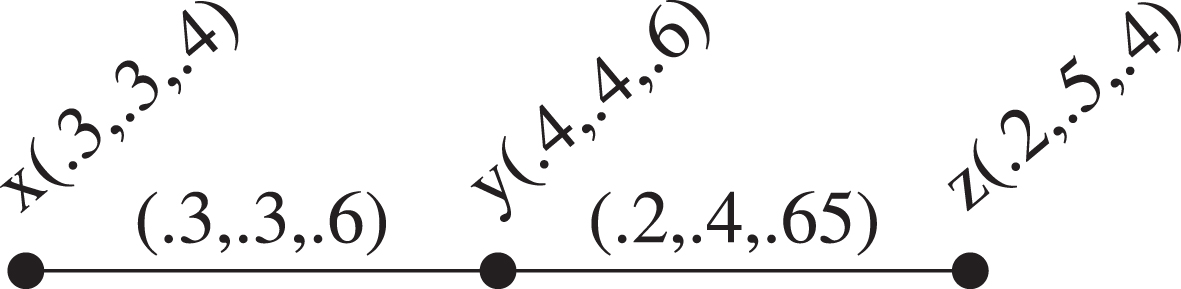
SVNG
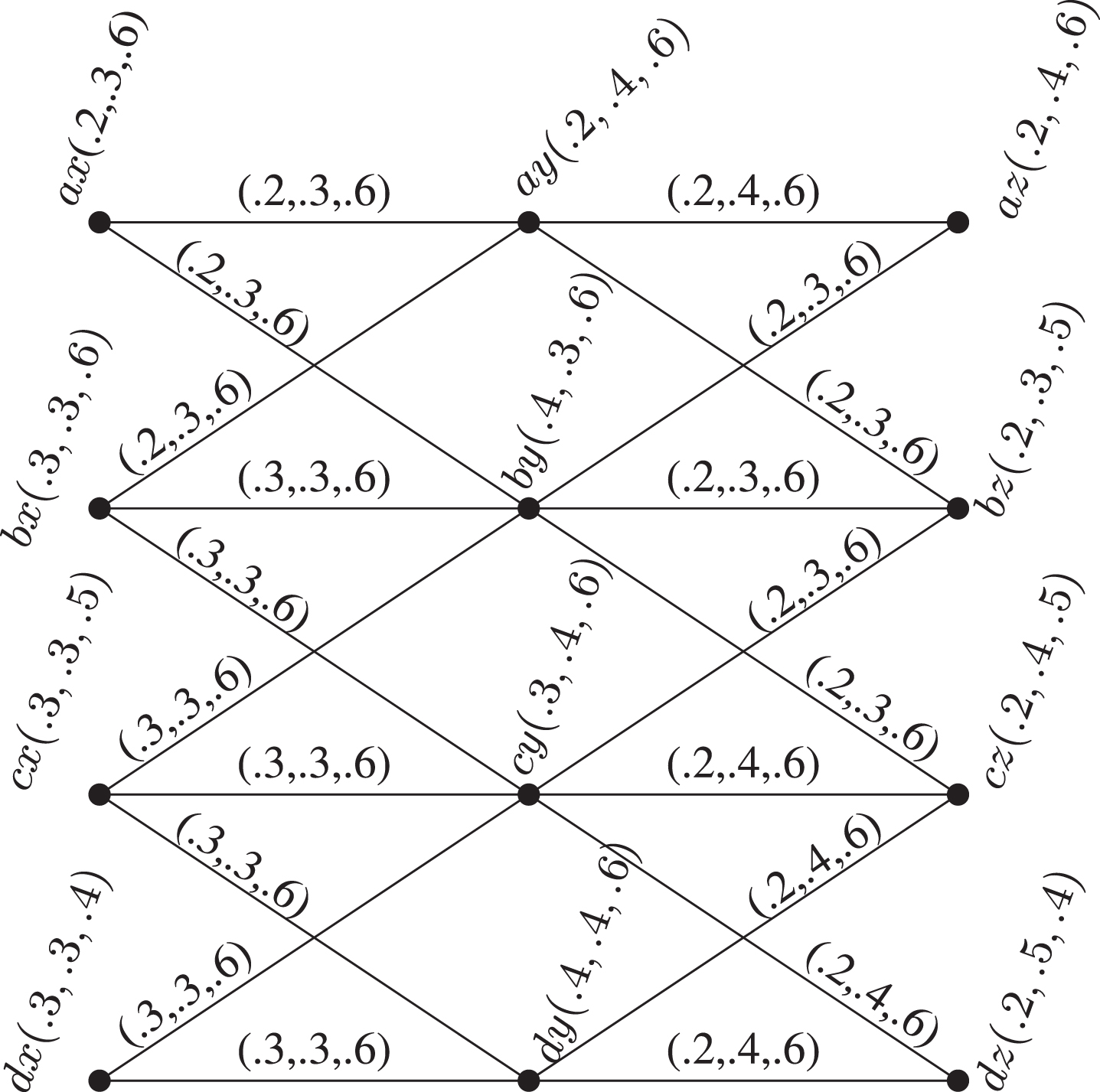
To analyze the optimal network from the constructed network, we define an efficient score function to find the minimum domination number of the weighted SVNG network. The score function defined by us is more efficient than the existing score function defined in 2.13 since, Indeterminacy value (I) does not depend on both Truth (T) and Falsity (F) value because I is not a complement of T and F and the values of T, I, F are independent of each other. Even though the value of indeterminacy is uncertain, we assume it by taking 0.5 as both chances of truth and falsity which makes our work the significant advantage of defining efficient networks.
Hence, we define the Edge score function (ESF) and Vertex score function (VSF) of a single-valued Neutrosophic graph to find the minimum weight of the spanning tree as follows:
The weighted
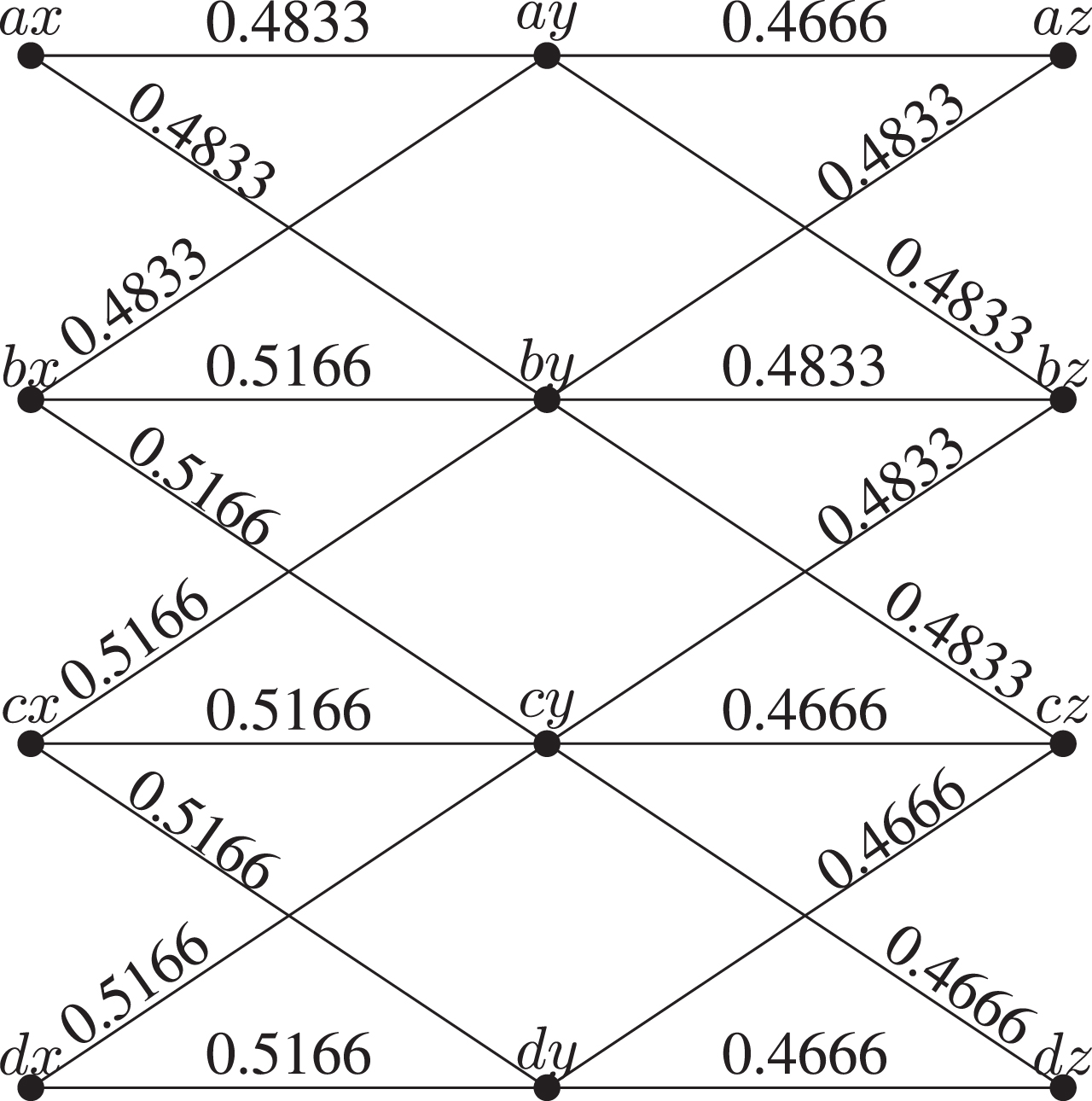
The domination number of the dominating sets S1, S2, S3, S4, S5 are
The minimal spanning tree of the weighted network
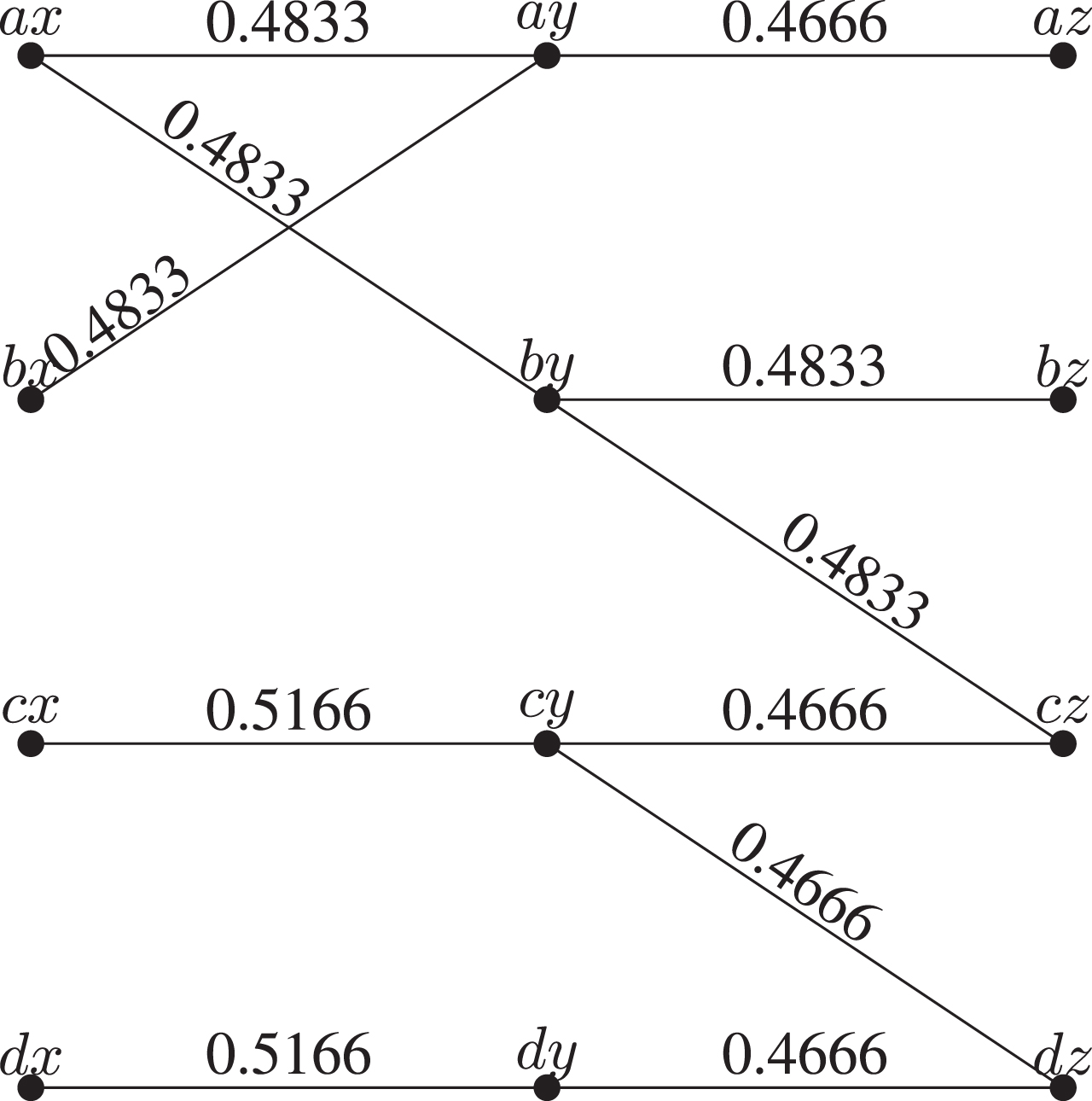
Minimum Spanning Tree of
Let SD1 = (σ1, μ1) and SD2 = (σ2, μ2) be two SVNGs of the graphs G
SD
1
= (V1, E1) & G
SD
2
= (V2, E2) respectively. Then the symmetric difference of SD1 & SD2 is defined and denoted as
∀ (x, y) ∈ V1 × V2.
∀ x ∈ V1 and (y, z) ∈ E2, (T
μ
SD
1
⊕ T
μ
SD
2
) ((x, y) , (x, z)) = T
σ
SD
1
(x) ∧ T
μ
SD
2
(y, z); (I
μ
SD
1
⊕ I
μ
SD
2
) ((x, y) , (x, z)) = I
σ
SD
1
(x) ∧ I
μ
SD
2
(y, z); (F
μ
SD
1
⊕ F
μ
SD
2
) ((x, y) , (x, z)) = F
σ
SD
1
(x) ∨ F
μ
SD
2
(y, z); ∀ x ∈ V2 and (y, z) ∈ E1,
∀ (x, y) ∉ E1 and (z, w) ∈ E2,
∀ (x, y) ∈ E1 and (z, w) ∉ E2,
Example
Let SVNG
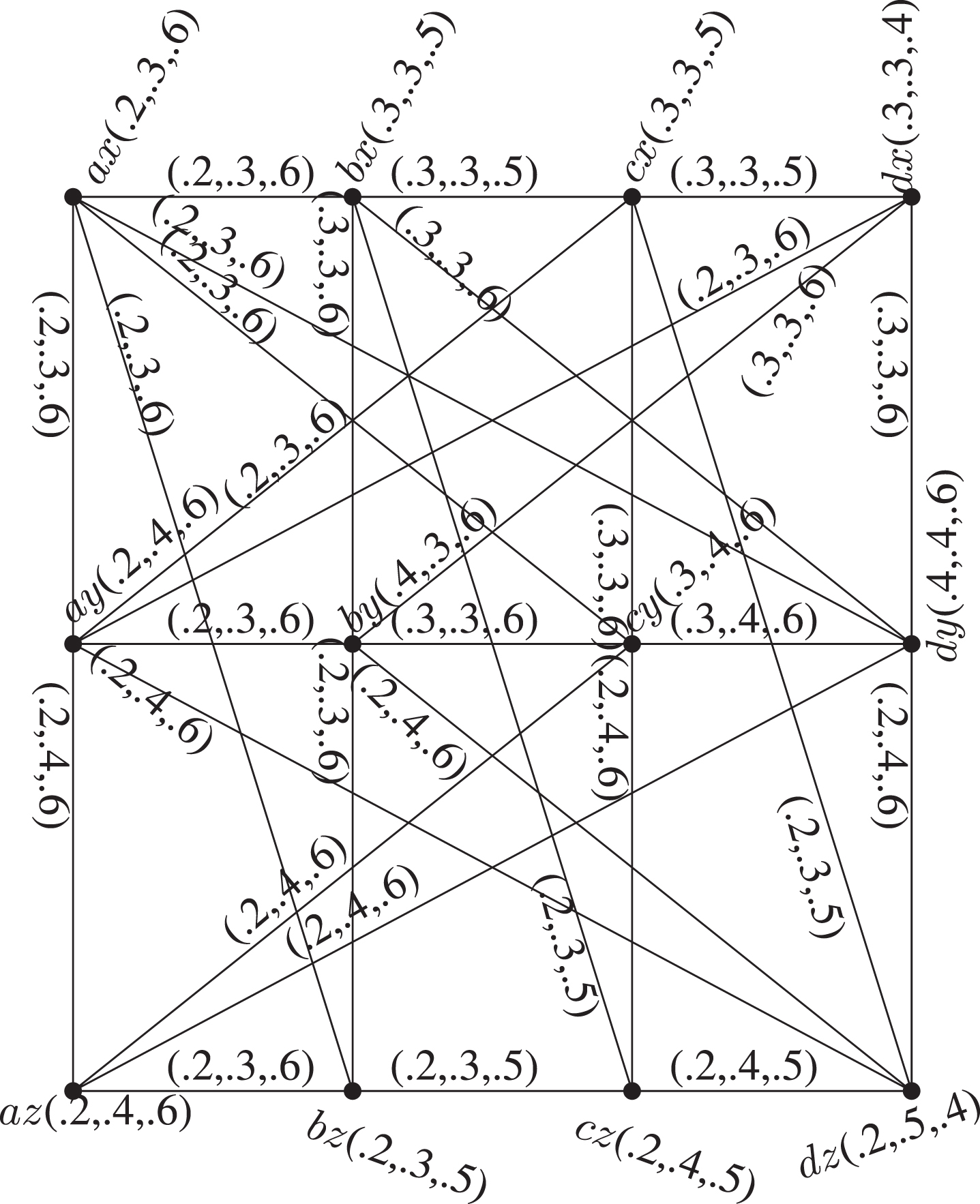
The weighted
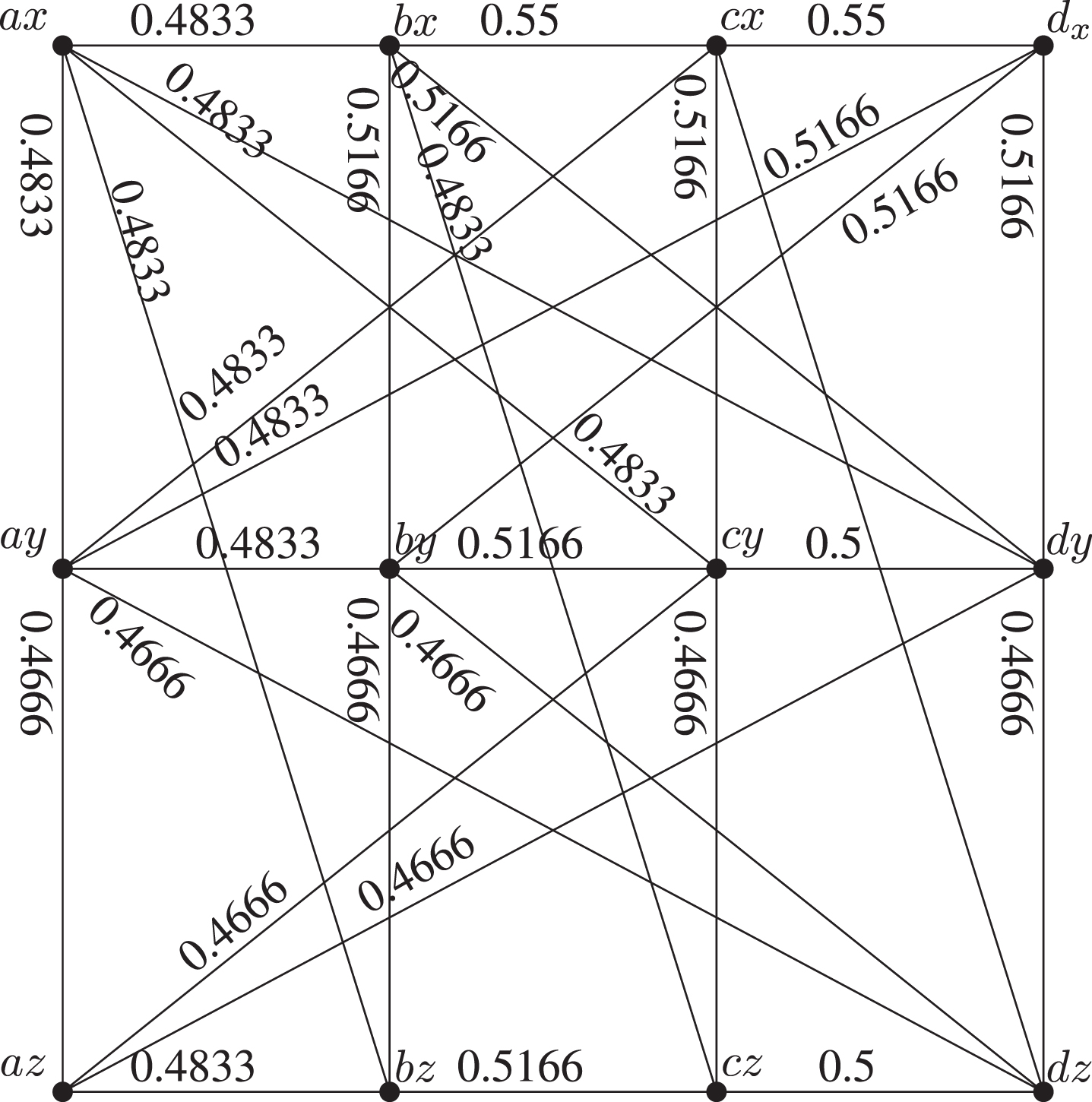
The domination number of the dominating sets S1, S2, S3, S4 are
The minimal spanning tree of the weighted network
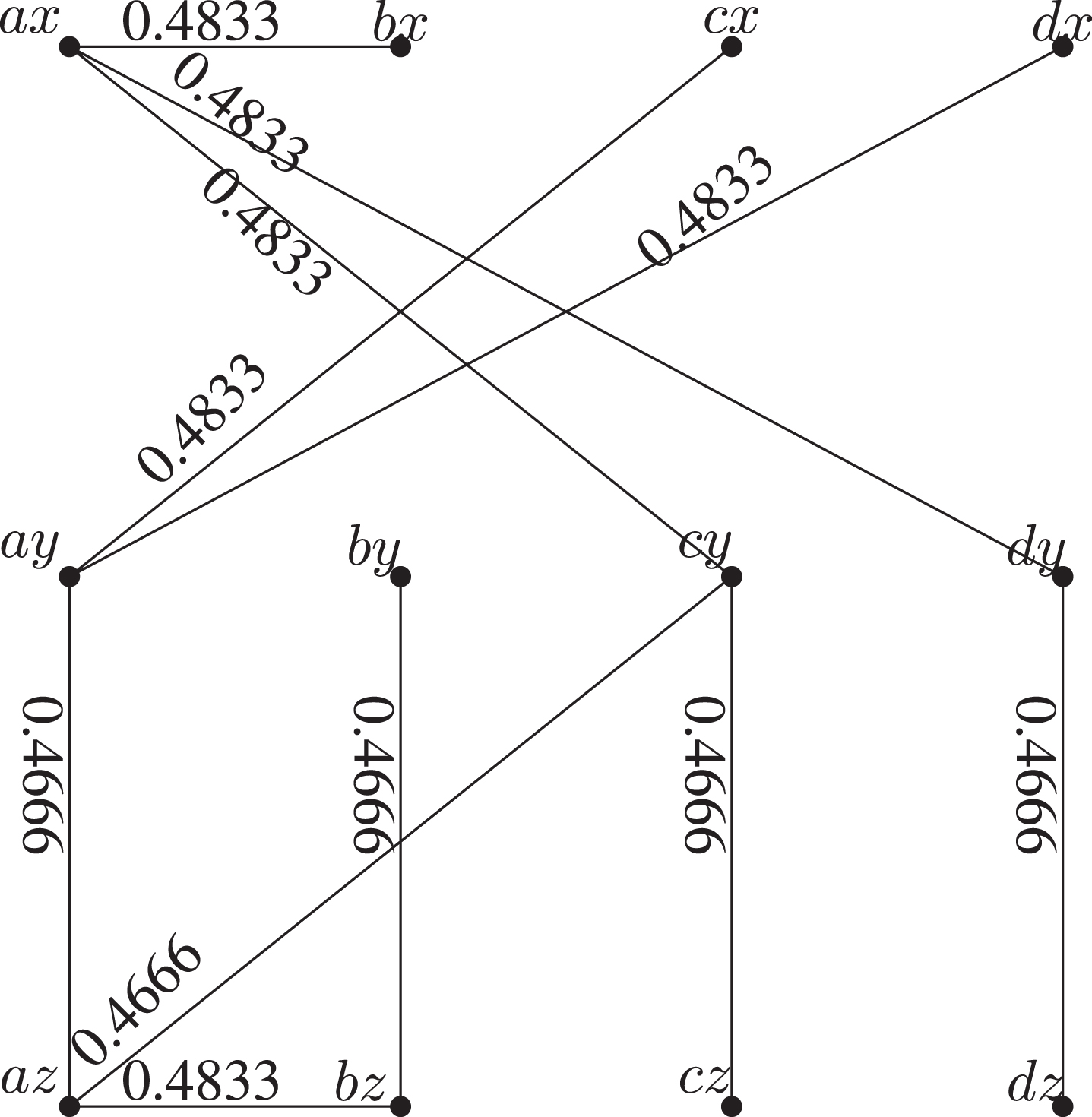
Minimum Spanning Tree of
Let RP1 = (σ1, μ1) and RP2 = (σ2, μ2) be two single-valued Neutrosophic networks of the graphs G
RP
1
= (V1, E1) and G
RP
2
= (V2, E2) respectively. Then the Residue product ∀ (x, y) ∈ V1 × V2,
∀ (x, y) ∈ E1 and z ≠ w ∈ V2,
Example
Let SVNG
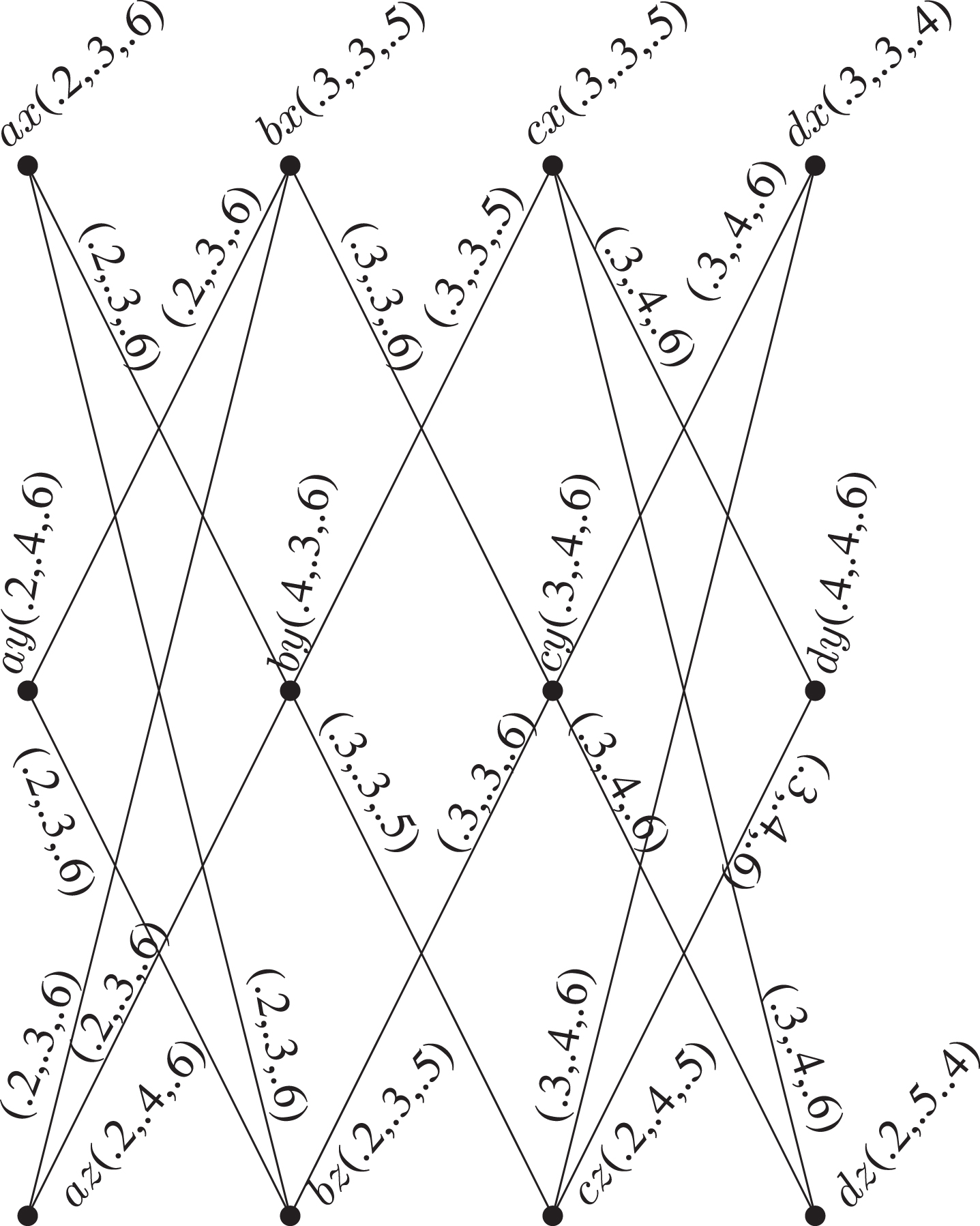
The weighted
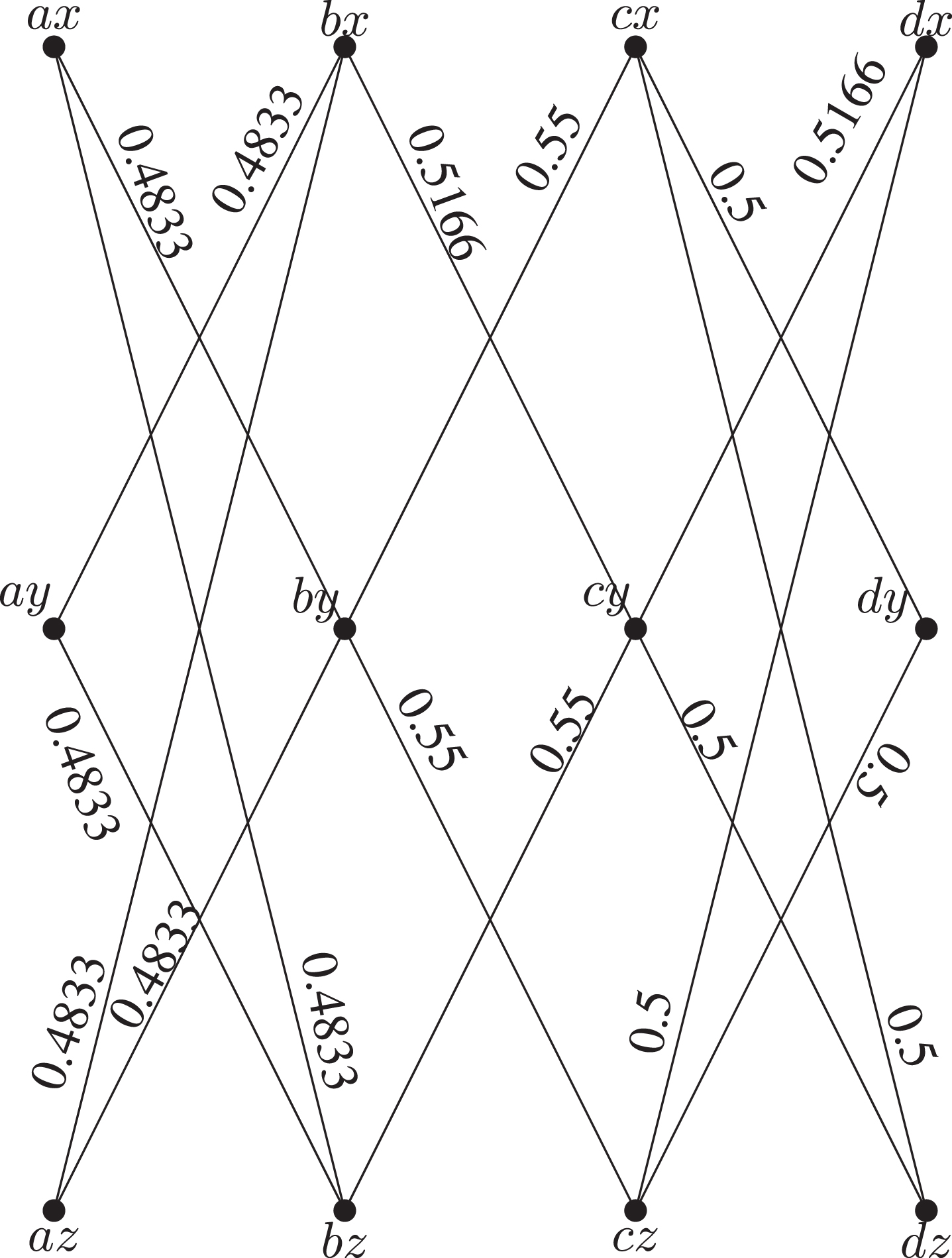
The domination number of the dominating sets S1, S2, S3, S4 are
The domination number of
The minimal spanning tree of the weighted network
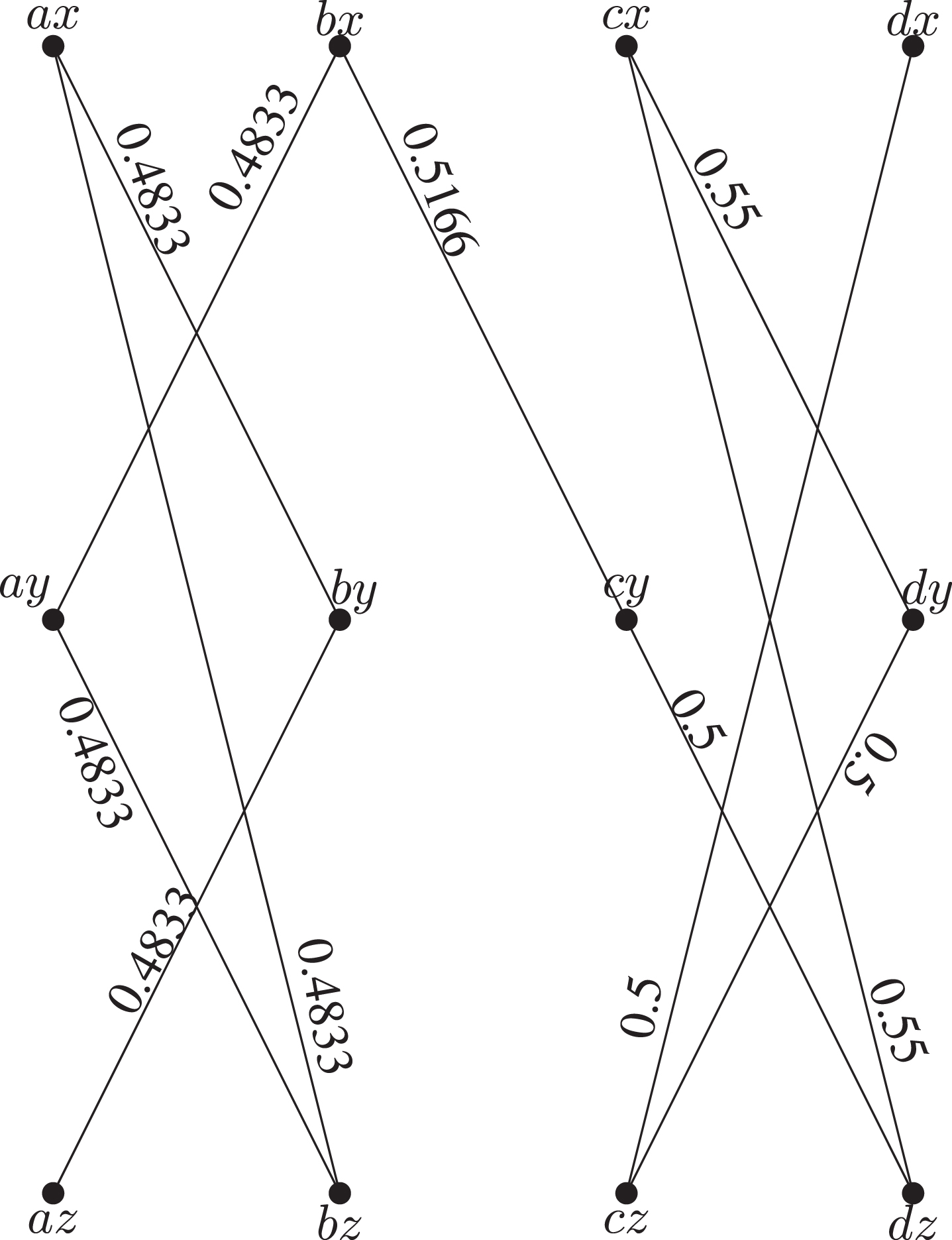
Minimal Spanning Tree of
Let MP1 = (σ
mp
1
, μ
mp
1
) and MP2 = (σ
mp
2
, μ
mp
2
) be two single-valued Neutrosophic networks of the graphs G
MP
1
= (V
mp
1
, E
mp
1
) and G
MP
2
= (V
mp
2
, E
mp
2
) respectively. Then the maximal product of the graphs MP1 and MP2 is denoted by
∀ (x, y) ∈ V
mp
1
× V
mp
2
,
∀ x ∈ V
mp
1
and (y, z) ∈ E
mp
2
, (T
μ
mp
1
* T
μ
mp
2
) ((x, y) , (x, z)) = T
σ
mp
1
(x) ∨ T
μ
mp
2
(y, z); (I
μ
mp
1
* I
μ
mp
2
) ((x, y) , (x, z)) = I
σ
mp
1
(x) ∨ I
μ
mp
2
(y, z); (F
μ
mp
1
* F
μ
mp
2
) ((x, y) , (x, z)) = F
σ
mp
1
(x) ∧ F
μ
mp
2
(y, z); ∀ x ∈ V
mp
2
and (y, z) ∈ E
mp
1
, (T
μ
mp
1
* T
μ
mp
2
) ((y, x) , (z, x)) = T
μ
mp
1
(y, z) ∨ T
σ
mp
2
(x); (I
μ
mp
1
* I
μ
mp
2
) ((y, x) , (z, x)) = I
μ
mp
1
(y, z) ∨ I
σ
mp
2
(x); (F
μ
mp
1
* F
μ
mp
2
) ((y, x) , (z, x)) = F
μ
mp
1
(z, y) ∧ F
σ
mp
2
(x);
Example
Let SVNG
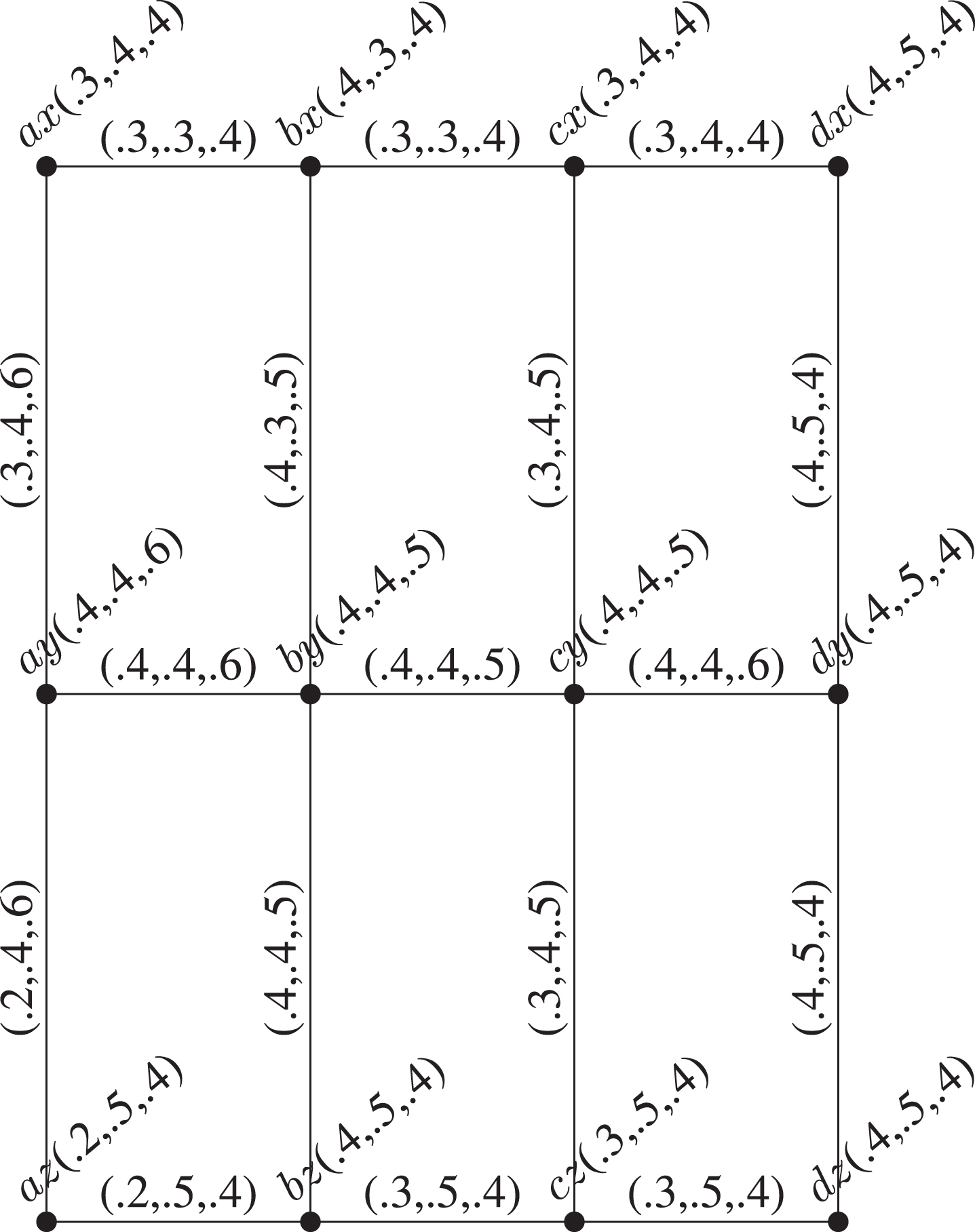
The maximal product of
The weighted
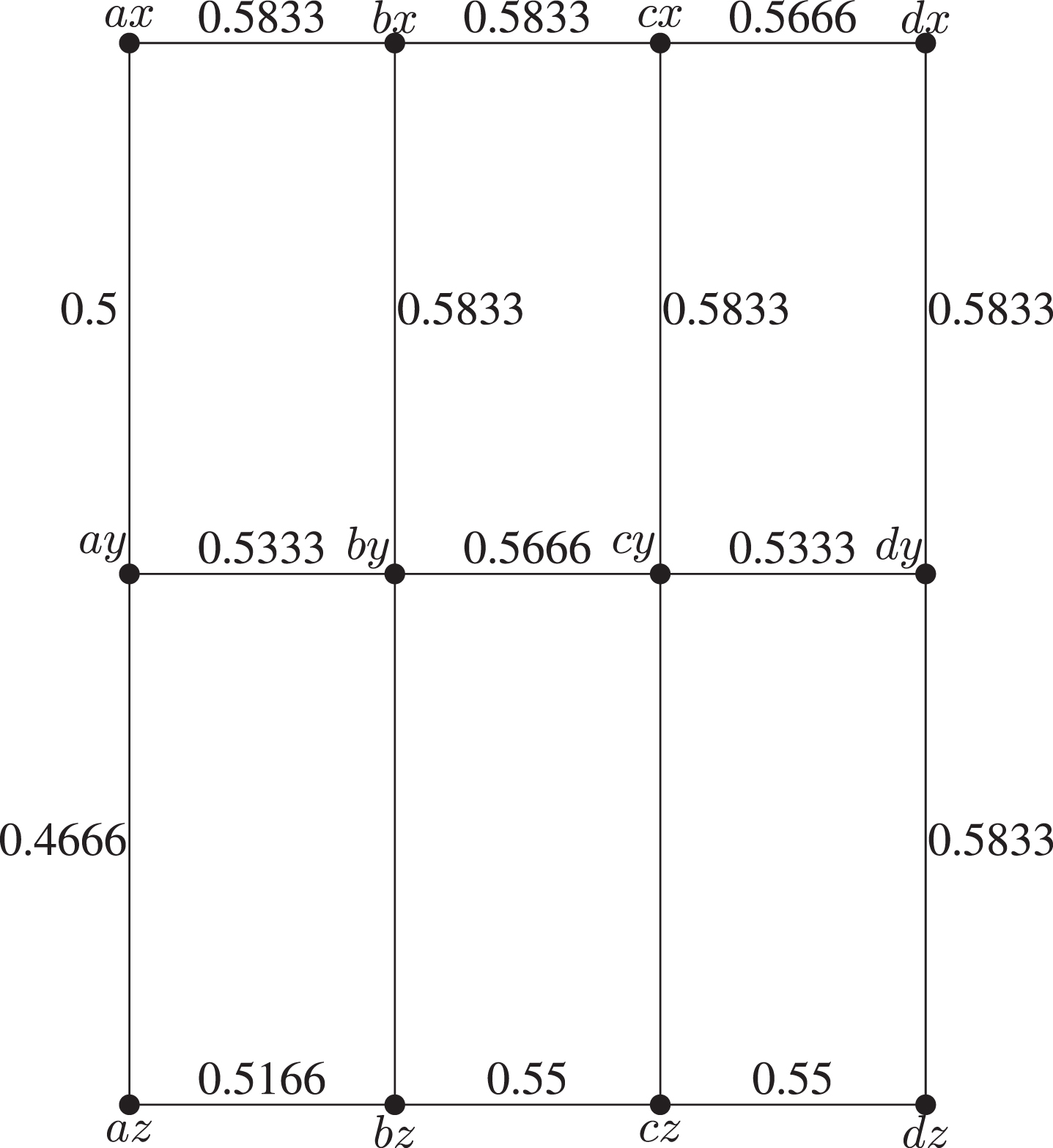
The domination number of the dominating sets S1, S2, S3, S4 are
The domination number of
The minimal spanning tree of the weighted network
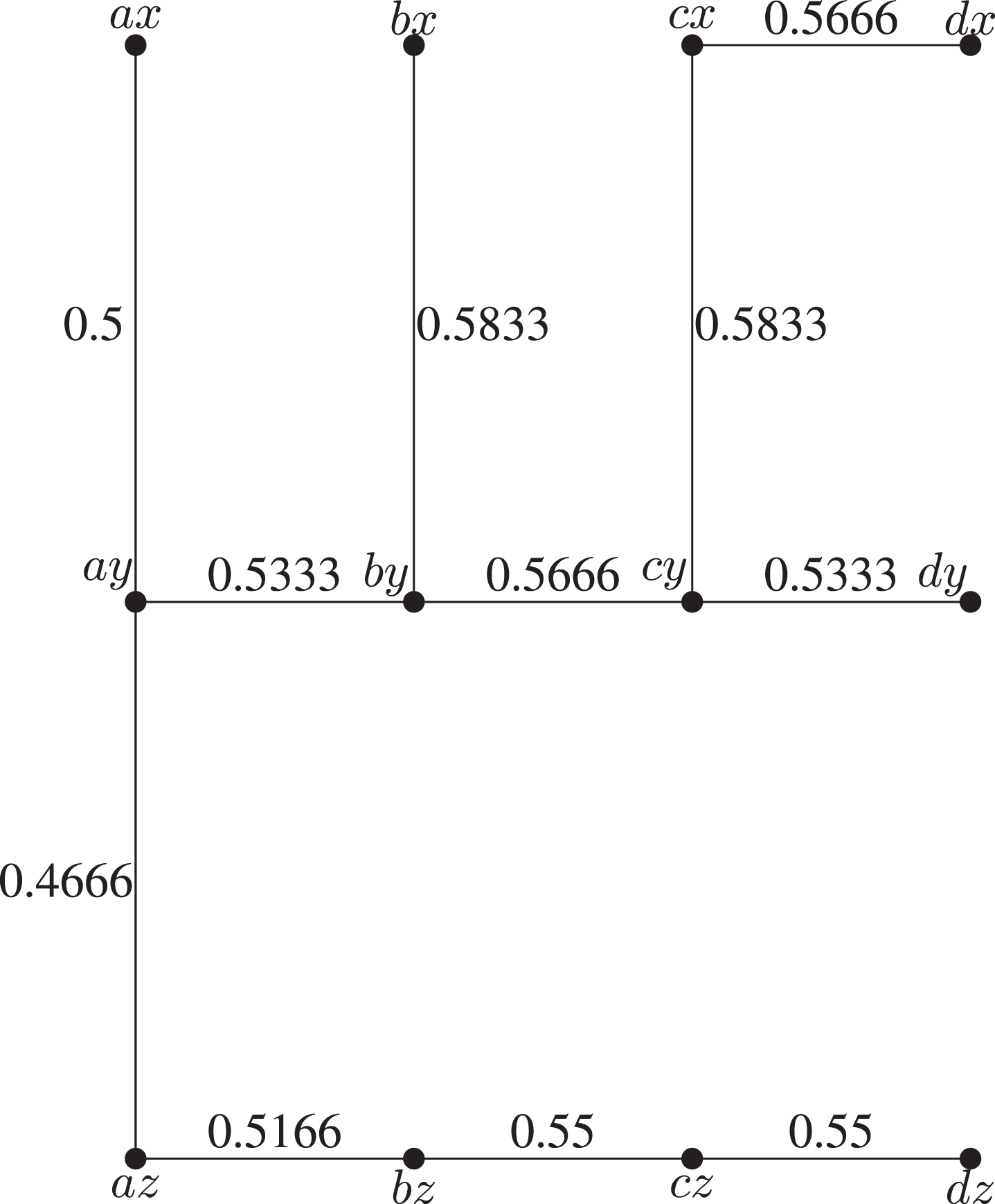
Minimal Spanning Tree of
An application of symmetric difference network
Technology salespeople fulfil responsibilities throughout their workday to help consumers find the technology that can benefit them the most. Technology sales are the result of connecting customers with technology that can provide a solution to a specific problem.
Technology sales professionals face a unique set of challenges, such as needing a deep understanding of the complex products they sell and possessing the people’s skills needed to build trust as well as sales abilities to close deals with prospects.
A sales training program is designed to help sales professionals achieve sales success for themselves or for their organizations. Most sales training programs help to develop the sales skills and techniques needed to approach leads, create new sales opportunities, close deals, and build rapport with clients and customers.
Sales team members have the right combination of technical knowledge and practical sales know how to simultaneously do well. For this reason, sales training designed specifically for technology companies is important. Especially whether selling a new technology or in a highly competitive market, these training can help the technology sales team develop the sales skills needed to serve more, reach decision makers and take deals off the line to maximize revenue.
Let us consider a group of experts who will train the group of trainees to develop their sales skills. Assume that Network
Let us assume that Network
The role of each expert in training is different from one another. So, when a skill is trained by an expert to a trainee a new skill is developed by them and also their existing skill will make the sales training more effective in technology. A trainee therefore is trained by experts and does attain other skills expect their own core competency so that the trainee can have a cleaver focus on what they can do the trust to attain and wider the scope to capture high-value opportunities in sales technology.
The experts of Network
For example, ax (.2, . 3, . 6) be the sales executive of the Network developed by the expert ’x(.3,.3,.4)’ with training in inside sales for a trainee who is good at effective communication when ’ax’ is trained they are built into a better sales executive with their existing skill ay (.2, . 4 . , .6) as insurance sales officer with a skill of better communication and training of service sales expert and az (.2, . 4, . 6) the account manager who is trained by the sales management expert by (.2, . 3, . 65) is attained by the trainee ’b(.4,.3,.5)’ with good networking skills who is trained by the expert with service sales [Sales Development Representative] and so on the expertise in each field are developed by the experts to the trainees in sales technology.
The roles of each node are different from one another, when these nodes are connected into a Symmetric difference, the above Network
Symmetric difference Network of the sales technology allows effective management of business and pursue network. Organizational structure in the first place.
Flexibility is one of the main reasons for trained employees to engage in a network organization by outsourcing work. This allows them to complete the tasks in a minimal duration of time without facing major problems.
The neutrosophic network nodes are linked to one another for the flow of information in less time to other nodes. The truth-membership degree of each node indicates the better-skilled person trained in the organization. The indeterminacy-membership degree of each node demonstrates how much the person’s skill is uncertain. The falsity-membership degree of each node tells the fewer skills gained by the person. The flow of information from one node to another the node in the network takes place in effective time management. The truth-membership degree, the indeterminacy-membership degree and the falsity-memb-ership degree of each link is given by effective time management of the node in collaboration. From the above single-valued Neutrosophic network models, we find the Optimal network whose minimal spanning tree make the network more flexible with the minimum possible weights with effective score function are found and thus the optimal network with minimum optimal value increase in profits of the organizations.
The limitations of the study is, an effective optimum network is obtained from the each constructed network with a minimum weight of spanning tree using score function. The score function defined in our study gives an Optimal value from which the effective optimal network is chosen from the various operations applied on single valued Neutrosophic graphs. This study can also be extended to different operations applied on graphs.
Optimal network algorithm
From section-3 we arrived at the following;
The domination number of
The domination number of
The domination number of
The domination number of
Minimum weight of spanning tree
Minimum weight of spanning tree
Minimum weight of spannin,g tree
Minimum weight of spanning tree
Using the Optimal network algorithm, symmetric difference
Conclusion
The single-valued Neutrosophic models give more precision, flexibility, and compatibility to the system as compared to the classical, fuzzy, intuitionistic fuzzy and Neutrosophic models. In this paper, the authors arrive at some operations such as Lexicographic, Symmetric difference, Residue product and Max product on single-Valued Neutrosophic graphs. Also, investigated some of their properties to find their efficiency and discussed the real-world application of the Symmetric difference network with a minimum spanning tree algorithm which is generated to achieve the minimum efficient productivity to complete the tasks in a social network. In the future, the study will be extended to other operations along with strategies to achive the efficiency of the constructed network.