




Abstract
The verification of reachability properties of fuzzy systems is usually based on the fuzzy Kripke structure or possibilistic Kripke structure. However, fuzzy Kripke structure or possibilistic Kripke structure is not enough to describe nondeterministic and concurrent fuzzy systems in real life. In this paper, firstly, we propose the generalized possibilistic decision process as the model of nondeterministic and concurrent fuzzy systems, and deduce the possibilities of sets of paths of the generalized possibilistic decision process relying on defining of schedulers. Then, we give fuzzy matrices calculation methods of the maximal possibilities and the minimal possibilities of eventual reachability, always reachability, constrained reachability, repeated reachability and persistent reachability. Finally, we propose a model checking approach to convert the verification of safety property into the analysis of reachabilities.
Keywords
Introduction
Reachability is one of the central problems in model checking [1, 2], program analysis [3] and verification [3], which is about whether a system in one state can reach other states [4]. Reachability is widely applied in urban transportation planning [5], human geography [6], regional economics and computer science [7]. In computer science, the use of reachability decision algorithm can avoid the loop detection of useless state space, save the memory occupancy of the algorithm, and improve the efficiency of the algorithm. The use of reachability optimization algorithm can reduce the complexity of the algorithm [4].
Reachability problems based on classical model checking were proposed in [8]. Classical model checking is to verify the qualitative characteristics of systems. Qualitative reachability aims at obtaining exact values of certain events. However, in real life, there are some randomness, uncertainties and inconsistencies that classical model checking is unable to express those information, such as a 90 percent probability of system crashing during operation [12]. To embed uncertain information into the model, quantitative model checking methods are proposed, including probabilistic model checking [4], possibilistic model checking [17], multi-valued model checking [10, 11] and fuzzy model checking [2, 18]. Quantitative reachability is to find the maximum probability [15] or the minimum probability [17].
This study extends the existing approach of the generalized possibilistic model checking to solve quantitative reachability problems. Li et al. [17, 22] propose possibility model checking and generalized possibility model checking in combination with measure theory, providing a solution to the existing problems of fuzzy model checking. In [17], the reachability problem based on the possibility measure is given, and the reachability problem is studied by using a possibilistic Kripke structure as a model. In the existing generalized possibilistic model checking, the generalized possibilistic Kripke structure is the formal model of the representation system. However, in real life, a generalized possibilistic Kripke structure cannot describe nondeterministic and concurrent fuzzy systems. For example, suppose three experts want to formulate treatment schemes for a new bacterial infection. Because different experts have different understandings of the disease, each expert has a different scheme. We use a generalized possibilistic Kripke structure K = (S, P, I, AP, L) to model the patient’s treatment process respectively. It describes three treatment processes given by three experts(α, β and γ) in Fig. 1(a), (b), (c). However, the generalized possibilistic Kripke structure can only represent the treatment process of a scheme, cannot describe the joint consultation of three experts. To solve this problem, we propose a generalized possibilistic decision process to describe nondeterministic and concurrent fuzzy systems.
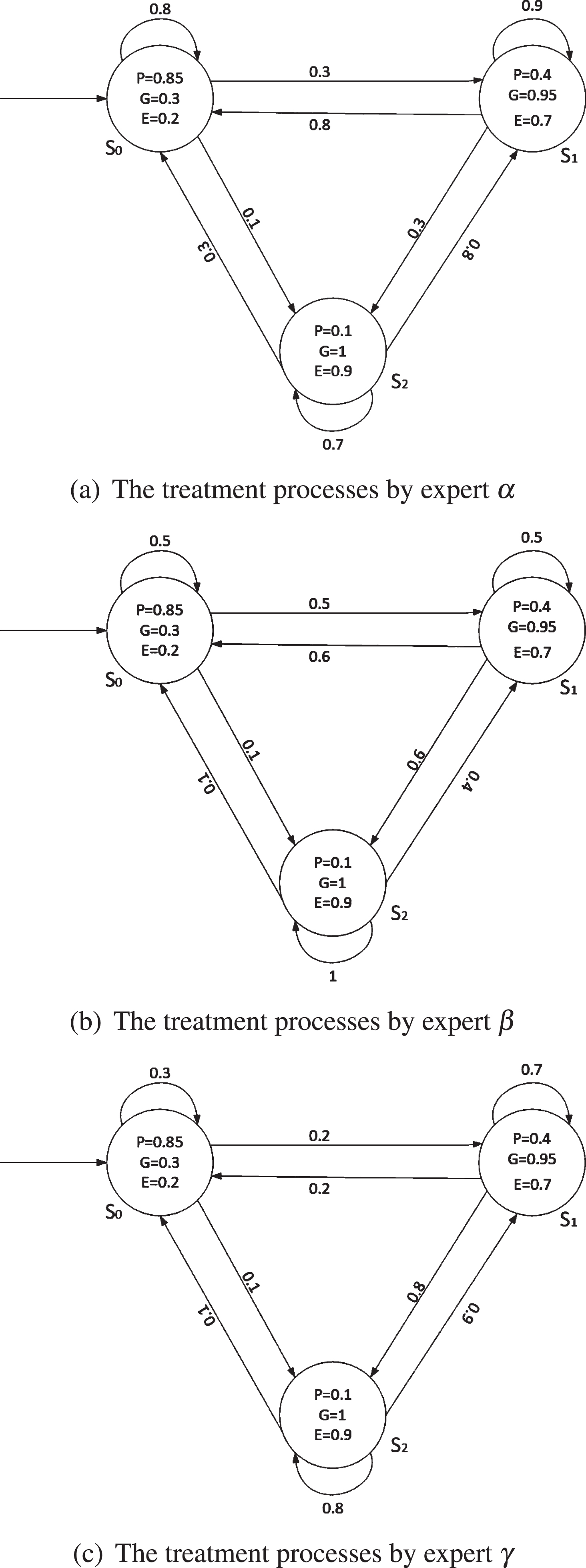
The treatment processes by three experts.
In this paper, we mainly study the maximum possibility problem and the minimum possibility problem of eventual reachability, always reachability, constrained reachability, repeated reachability and persistent reachability under a generalized possibilistic decision process. First, we propose a generalized possibilistic decision process as the model of fuzzy systems, and deduce the possibilities of sets of paths of the generalized possibilistic decision process relying on defining of schedulers. Then, the fuzzy matrices calculation methods of reachability under a generalized possibilistic decision process are given, and the results show that the compositional operations of the fuzzy matrix is polynomial time, which is better than the exponential level of existing algorithms. Finally, we propose a model checking approach to convert the verification of safety property into the analysis of reachabilities.
The rest of this paper is organized as follows. Section 2 gives some preliminary knowledge. In Section 3, we define generalized possibilistic decision processes. In Section 4, we present the fuzzy matrix calculation methods of eventual reachability, always reachability, constrained reachability, repeated reachability and persistent reachability. In Section 5, we use good prefixes to analyze the possibilistic regular safety property. Section 6 is the conclusion. The proofs of some theorems of this paper can be found in the Appendix.
To model and verify fuzzy systems, we provide some necessary knowledge including the fuzzy set, fuzzy set operation, fuzzy matrix operation, closure and others.
We use
(A ∪ B) (x) = A (x) ∨B (x) = max {A (x) , B (x)},
(A ∩ B) (x) = A (x) ∧ B (x) = min {A (x) , B (x)},
A c (x) =1 - A (x).
R = S if and only if r ij = s ij for all i, j.
R ⊆ S if and only if r ij ≤ s ij for all i, j.
R ∪ S = (r ij ∨s ij ) m×n.
R ∩ S = (r ij ∧ s ij ) m×n.
R c = (1 - r ij ) m×n.
(R ∘ S) ∘ T = R ∘ (S ∘ T);
(R ∪ S) ∘ T = (R ∘ T) ∪ (S ∘ T).
Let X be a universal set. For the fuzzy matrix R = (R (s, t)) s,t∈X, we use R+ to denote its transitive closure. When X is finite, X has ∣X∣ elements, then R+ = R ∪ R2 ∪ . . . ∪ R∣X∣, where Rk+1 = R
k
∘ R for any positive integer number k. The Kleene closure R* = R0 ∪ R+, for each 1≤ s, t ≤ ∣ S ∣,
POS (∅) =0; POS (X) =1; If E
i
∈ Ω, i ∈ I, then POS (⋃ i∈IE
i
) = ⋁ i∈IPOS (E
i
)
If only conditions(1) and (3), then POS is called a generalized possibility measure. If POS is a generalized possibility measure on the power set 2 X ,for any A ⊆ X, there is POS (A) = ⋁ a∈APOS ({ a }).
S is a countable, nonempty states set; P : S × S → [0, 1] is the possibility transition distribution, for any states s, there is a state t, such that P (s, t) >0; I : S → [0, 1] is the initial distribution of possibility and there exists a state s, such that I (s) >0; AP is a set of atomic propositions; L : S × AP → [0, 1] is a label function, L (s, a) represents the true value of atomic proposition a in state s.
For a GPKS K, its path is defined as an infinite sequence of states π = s0s1s2 ⋯ ∈ s
ω, for any i so that P (s
i
, si+1) > 0. Let Paths (s) and Paths
fin
(s) represent the set of all infinite and finite paths starting from the state s in K. Paths (K) represents the set of all infinite paths in K, Paths
fin
(K) represents the set of all finite paths in K, such as
Generalized Possibilistic Decision Processes
In this section, first, we give the notion of the generalized possibilistic decision process. Then, the definition of the scheduler is proposed to solve the nondeterministic the generalized possibilistic decision process. Finally, we solve the generalized possibility measure problems.
Nondeterminism is absent in GPKS. The generalized possibilistic decision process can be viewed as a variant of GPKS that permits both possibility and nondeterministic choices.
S is a countable, nonempty set of states; Act is a set of actions; P : S × Act × S ⟶ [0, 1] is a function, called possibilistic transition distribution function. For all states s ∈ S and actions α ∈ Act, there exits a state t ∈ S such that P (s, α, t) >0; I : S ⟶ [0, 1] is a function, there exits states s such that I (s) >0; AP is a set of atomic propositions; L : S × AP ⟶ [0, 1] is a possibilistic labeling function, which can be viewed as function mapping a state s to the fuzzy set of atomic proposition, L (s, a) denotes the possibility or truth value of atomic proposition a which is hold in state s.
Furthermore, if the set S, Act and AP are finite sets, then M is a finite GPDP. In this paper, we always assume that GPDPs are finite. A GPDP has a unique initial distribution I. For all states s, t ∈ S and actions α ∈ Act, P (s, α, t) denotes the possibility from state s under action α to state t. An action α is enabled in state s if and only if P (s, α, t) >0. Let Act (s) denote the set of enabled actions in state s. For any states s ∈ S, it is required that Act (s)≠ ∅. Each state t for which P (s, α, t) >0 is called an α-successor of s. The set of direct α-successors of s is defined as:
Post (s, α) = {t ∈ S ∣ P (s, α, t) >0}.
The set of α-predecessors of s is defined by:
Pref (t) = {(s, α) ∈ S × Act (s) ∣ P (s, α, t) >0}.
We also use the P (s, α, T) to denote the possibility from the state s under the action α to the set T of states, that is,
Paths in GPDP M are defined as infinite alternating sequences π = s0
α0s1
α1s2 ⋯ ∈ (S × Act)
ω such that P (s
i
, α
i
, si+1) >0 for all i ∈ I. Paths (s) denotes the set of all infinite paths in M that start in state s. Similarly, Paths
fin
(s) denotes the set of all finite path fragment
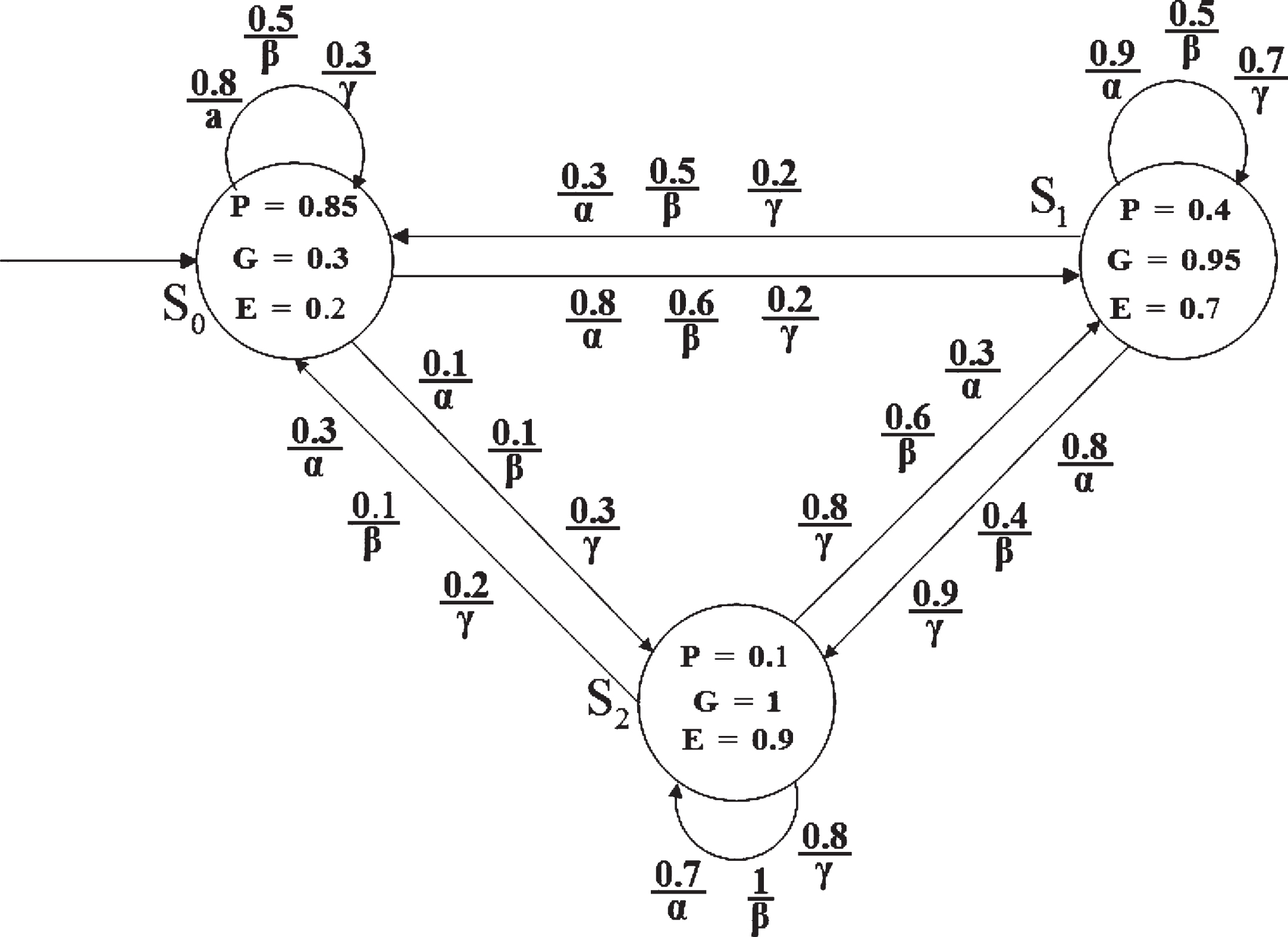
Treatment process by three experts’ consultation.
S = {s0, s1, s2}, Act = {α, β, γ}, AP = {P, G, E}. P indicates that the patient is in “bad” health, G indicates that the patient is in “normal” health, E indicates that the patient is in “good” health.
For state s0, the labeling functions are L (s0, P) =0.85, L (s0, G) =0.3, L (s0, E) =0.2. L (s0, P) =0.85 indicates that the degree of “bad” health in state s0 is 0.85. L (s0, G) =0.3 indicates that the degree of “normal” health in state s0 is 0.3. L (s0, E) =0.2 indicates that the degree of “good” health in state s0 is 0.2.
Act (s0) = {α, β, γ}, α, β, γ indicate three different treatment indicates. P (s0, α, s1) =0.8 indicates that the possibility of the patient’s health condition changing from state s0 to state s1 is 0.8 after the expert treats the patient with the α scheme. P (s0, β, s1) =0.6 indicates that the possibility of the patient’s health condition changing from state s0 to state s1 is 0.6 after the expert treats the patient with the β scheme. P (s0, γ, s1) =0.2 indicates that the possibility of the patient’s health condition changing from state s0 to state s1 is 0.2 after the expert treats the patient with the γ scheme.
Post (s0, α) = {s1, s2},Post (s0, α) indicates all α successor states of state s0.
Pref (s0) = {(s0, α) , (s0, β) , (s0, γ) , (s1, α) , (s1, β) ,
(s1, γ) , (s2, α) , (s2, β) , (s2, γ)}, Pref (s0) indicates all predecessor states of state s0.
For the GPKS K, 2
Paths
(K) is the algebra that is generated by
Let Path
Adv
(s) and
Given a GPDP M = (S, Act, P, I, AP, L), α ∈ Act, possibility distribution function P : S × α × S ⟶ [0, 1] can be represented by a fuzzy matrix. For convenience, the fuzzy matrix is written as P
α, so that P
α = (P (s, α, t)) s,t∈S, called the fuzzy transition matrix of M corresponding to scheduler α. Using fuzzy matrix
Using fuzzy matrix
The GPKS K max = (S, P max , I, AP, L) and GPKS K min = (S, P min , I, AP, L) can be constructed from matrix P max and matrix P min respectively.
Figure 3(a) shows the result of GPKS with respect to P max , Fig. 3(b) shows the result of GPKS with respect to P min .
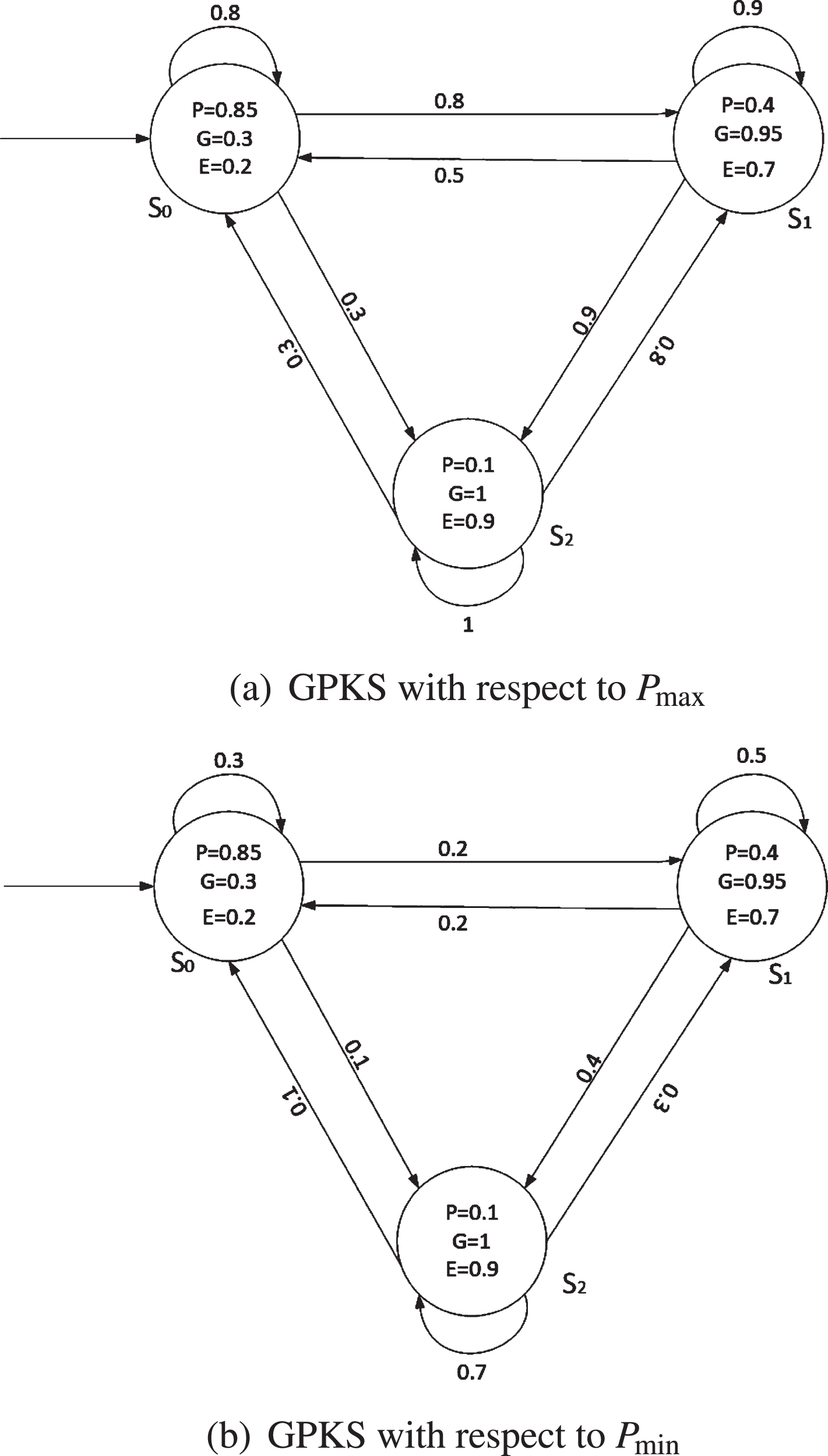
GPKS with respect to Pmax and Pmin.
Although GPDP can induce the GPKS under the consideration of some schedulers, reasoning about quantitative reachabilities requires a formalization of the possiblities for sets of paths. This formalization is based on possibility measure theory, in particular possibility spaces and generalized possibility measure theory.
The cylinder set spanned by the finite adv-paths
Let M = (S, Act, P, I, AP, L) be a GPDP, s ∈ S, α i ∈ Act, i ≥ 0, r Adv : S → [0, 1] is defined as following, which denotes the maximal possibility measure of all Adv-paths from state s in M:
The role of the function r Adv is to help us to calculate the possibility of Adv-paths in M. The Theorem 1 gives a fuzzy matrix calculation for r Adv .
In particular, P Adv is normal iff r Adv (s) =1 for any states s.
In the matrix notation, we have
The computational complexity of r Adv (s) mainly depends on the time of computational possibilistic transition closure. In [30], they gave an optimal algorithm to calculate D Adv , then we get the time complexity is O (n2 log n), where n =∣ S ∣.
r max (s0) = 0.8 indicates that under the maximal possibilistic scheduler. That is, the maximal possibility of all paths from state s0 is 0.8. r min (s0) = 0.3 indicates that under the minimal possibilistic scheduler. That is, the maximal possibility of all paths from state s0 is 0.3.
Based on Theorem 1, we can get Theorem 2, which can convert the calculation of generalized possibility measure of infinite path into the calculation of possibility of finite path.
GPo max (Cyl (s0 α0s1) ) = I (s0) ∧ P (s0, α0, s1) ∧ r max (s1) =0.8
GPo min (Cyl (s0 α0s1)) = I (s0) ∧ P (s0, α0, s1) ∧ r min (s1) =0.5 .
A typical task for the quantitative analysis of GPDPs is to compute the minimum or the maximum possibility for some reachabilities under consideration of the min or the max scheduler. This corresponds to the worst-case or best-case analysis possibility of GPDPs. Let M = (S, Act, P, I, AP, L) be a finite GPDP and B be a fuzzy set of target states. The fuzzy set B may represent a set of certain bad states that shall be visited with the minimum possibility, or dually, a set of good states that shall be visited with the maximum possibility. Some special reachabilities, such as eventual reachability, always reachability, constrained reachability, repeated reachability and persistent reachability are considered in this section.
Eventual reachability possibility
The event of eventual reachability is denoted ⋄B. We use the B : S ⟶ [0, 1] to represent the fuzzy set of states. For the given GPDP M, π = s0 α0s1 … ∈ Paths Adv (M), ∣∣ ⋄ B (π) ∣∣ = ⋁ i≥0B (s i ). In the following, the quantitative analysis of eventual reachability is reduced to the computational range for all strategies of the minimum possibility or the maximum possibility of reaching a certain fuzzy set B of states.
Then the maximum possibility and minimum possibility of the event ײ7B are respectively:
∥GPo (◊ ≤7B) ∥ max (s0) =0.8, ∥GPo (◊ ≤7B) ∥ min (s0) =0.2, describes the maximum possibility of the patient’s final state of health with the maximum possibility of “good” being 0.8 and the minimum possibility of “good” being 0.2 after 7 days treatment from state s0.
The event of always reachability is denoted B. We use the B : S ⟶ [0, 1] to represent the fuzzy set of states. For the given GPDPs M, π = s0
α0s1 … ∈ Paths
Adv
(M), B (π) = ⋀ i≥0B (s
i
). Under the maximum possibility scheduler and the minimum possibility scheduler, the methods of computing GPo
max
(s ⊨ B) and GPo
min
(s ⊨ B) are given.
fz1 = fz2, Therefore
Calculated by the same method
∥GPo ( E) ∥ max (s0) =0.2, ∥GPo ( E) ∥ min (s0) =0.2, it shows that from the state s0, it is unlikely that the patient’s health always reach a “good” state after 7 days treatment.
Given the GPDP M, and the fuzzy set of states B, C : S ⟶ [0, 1], consider the event of reaching B via a finite path fragment which ends in a fuzzy state s ∈ B, and visits only states in set of fuzzy states C prior to reaching fuzzy states s. This event is denoted by C ⊔ B. For n ≥ 0, the event C ⊔ ≤nB has the same meaning as C ⊔ B, and it is required to reach B(via fuzzy state C) within n steps. Formally, C ⊔ ≤nB is the union of the basic cylinders spanned by path fragments s0 α0s1 α1 … s m so that m ≤ n with possibility C (s i ) for all 0 ≤ i ≤ m with possibility B (s k ).
∥GPo (C ⊔ ≤7B) ∥ max (s0) =0.7, ∥GPo (C ⊔ ≤7B) ∥ min (s0) =0.2, which means that the patient’s health state is “bad” at state s0. The expert adopts three treatment schemes after 7 days of treatment, the maximum possibility that a patient’s health states turn to a “good” state is 0.7 and the minimum possibility is 0.2.
Let B : S ⟶ [0, 1] be a set of fuzzy states in GPDPs. For the event of repeated reachability, we use the ⋄ B to represent it. The set of all paths that visit B infinitely is often measurable. Let π = s0
α0s1
α1 … ∈ Paths
Adv
(s0),
When the state is s0, ∥GPo ( ⋄ B) ∥ max (s0) =0.8, ∥GPo ( ⋄ B) ∥ min (s0) =0.3, indicates that the patients in this state are more likely to relapse. When the state is s2, ∥GPo ( ⋄ B) ∥ max (s2) =0.1, ∥GPo ( ⋄ B) ∥ min (s0) =0.1, indicates that once the patient’s disease in this state is cured, and it basically will not recur.
Let us consider persistent reachability properties events of the form ⋄ B. Let π = s0
α0s1
α1 … ∈ Paths
Adv
(s0) and B : S ⟶ [0, 1] be a fuzzy set of states in GPDPs. Thus,
The possibility that the patient’s health continue to be “good” after the expert adopts the combination of three schemes. When the state is s0, ∥GPo (⋄ B) ∥ max (s0) =0.2, ∥GPo (⋄ B) ∥ min (s0) =0.2, which indicates that the patient is in a bad state of health and is already in a state of illness. For state s2, ∥GPo (⋄ B) ∥ max (s2) =0.9, ∥GPo (⋄ B) ∥ min (s2) =0.7, which indicates that the patient’s state health has been in a “good” state.
The analysis of safety properties and the techniques for checking safety properties are closely related to reachability. Safety properties are often characterized as “nothing bad should happen”. In classic model checking, safety properties are defined as linear property which does not include a bad prefix, and analyses the eventual reachability and repeated reachability. Since it is difficult to define the notion of a bad prefix in fuzzy logic or possibility logic, Li [21] uses the good prefixes to define the fuzzy safety property, and computes the always reachability possibility and persistent reachability possibility. In the following section, we use the good prefixes to analyze the possibilistic of regular safety property.
For a GPDP M = (S, Act, P, I, AP, L), we assume the alphabet Σ = l AP for some finite subset l ⊆ [0, 1] in the following.
P safe is called possibilistic regular safety property if P safe (σ) = ⋀ {Gpref (P safe ) (θ) ∣ θ ∈ Gpref (σ) }, for all σ ∈ Σ ω, Pref (σ) = {θ ∈ Σ* ∣ σ = θσ′, σ′ ∈ Σ ω} is called the set of prefixes of σ.
We call P safe a generalized possibilistic regular safety property if P safe is a generalized possibilistic safety property and Gpref (P safe ) is a fuzzy regular language over Σ.
Q is a finite nonempty set of states; Σ a finite nonempty set of input symbols; δ : Q × Σ × Q ⟶ [0, 1] is a fuzzy transition function. For any p, q ∈ Q, a ∈ Σ, δ (p, a, q) denotes the possibility of state p reaching state Q under the action of input letter a; Q0 : Q ⟶ [0, 1] represent the fuzzy initial state of fuzzy automata A,for q ∈ Q,Q0 (q) denotes q is the possibility of the initial state; F : Q ⟶ [0, 1] represent the fuzzy acceptance state of fuzzy automata A,F (q) denotes q is the possibility of the acceptance state;
For a GPDP M = (S, Act, P, I, AP, L) and a fuzzy finite automata A = (Q, Σ, δ, Q0, F), the product of M and A is defined as follows.
For each path π = s0 α0s1 α1s2 α2 … ∈ Paths Adv (M) in M, Trace Adv (π) = L (s0) L (s1) L (s2)…, the fuzzy automata A has a unique run q0q1q2… and in M ⊗ A there exists π+ =< s0, q1 > α0 < s1, q2 > α1 … corresponding to them.Similarly, the path in M ⊗ A with state <s0, δ (q0, L (s))> also corresponds to the path in M and the run in A.
Let GPo Adv ( B) = GPo Adv (s ⊨ B) s∈S, then
GPo
Adv
( B) can be solved by the maximum fixed point, where the maximum fixed point of the operator is f
B
(Z) = B ∧ P
Adv
∘ D
Z
∘ r
Adv
. For the scheduler Adv taking the maximum possibility scheduler max and the minimum possibility scheduler min, the maximum possibility and the minimum possibility that the state s satisfies the generalized possibilistic regular safety property P are respectively:
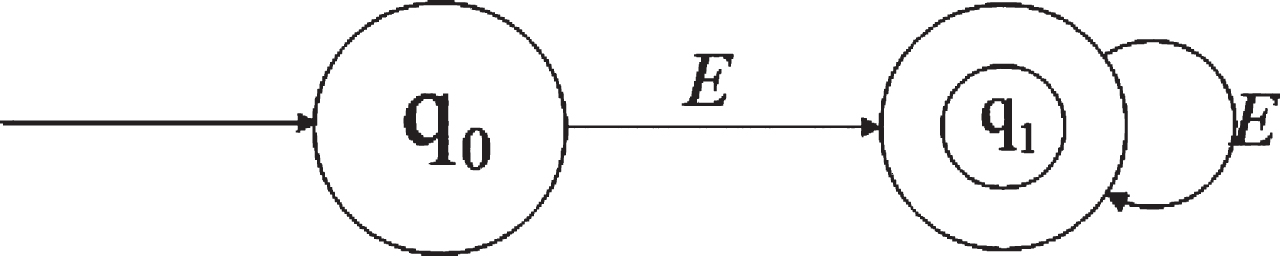
Finite automata A corresponding to Gref (P safe ).
Given a GPDP M and generalized possibilistic regular safety property P safe = {A0, A1, … ∈ Σ ω ∣ ∀ i ≥ 0, A i (E) >0}, Adv is the scheduler defined in M. The solution processes of GPo max (s0 ⊨ P safe ) and GPo min (s0 ⊨ P safe ) corresponding to Adv is the maximum scheduler and the minimum scheduler are given.
The product M ⊗ A of a GPDP M and P safe good prefix Gref (P safe ) corresponding to a finite automata A is shown in Fig. 5. According to formulas 17 and 18, there B = S × {q1} = {1, 1, 1} is
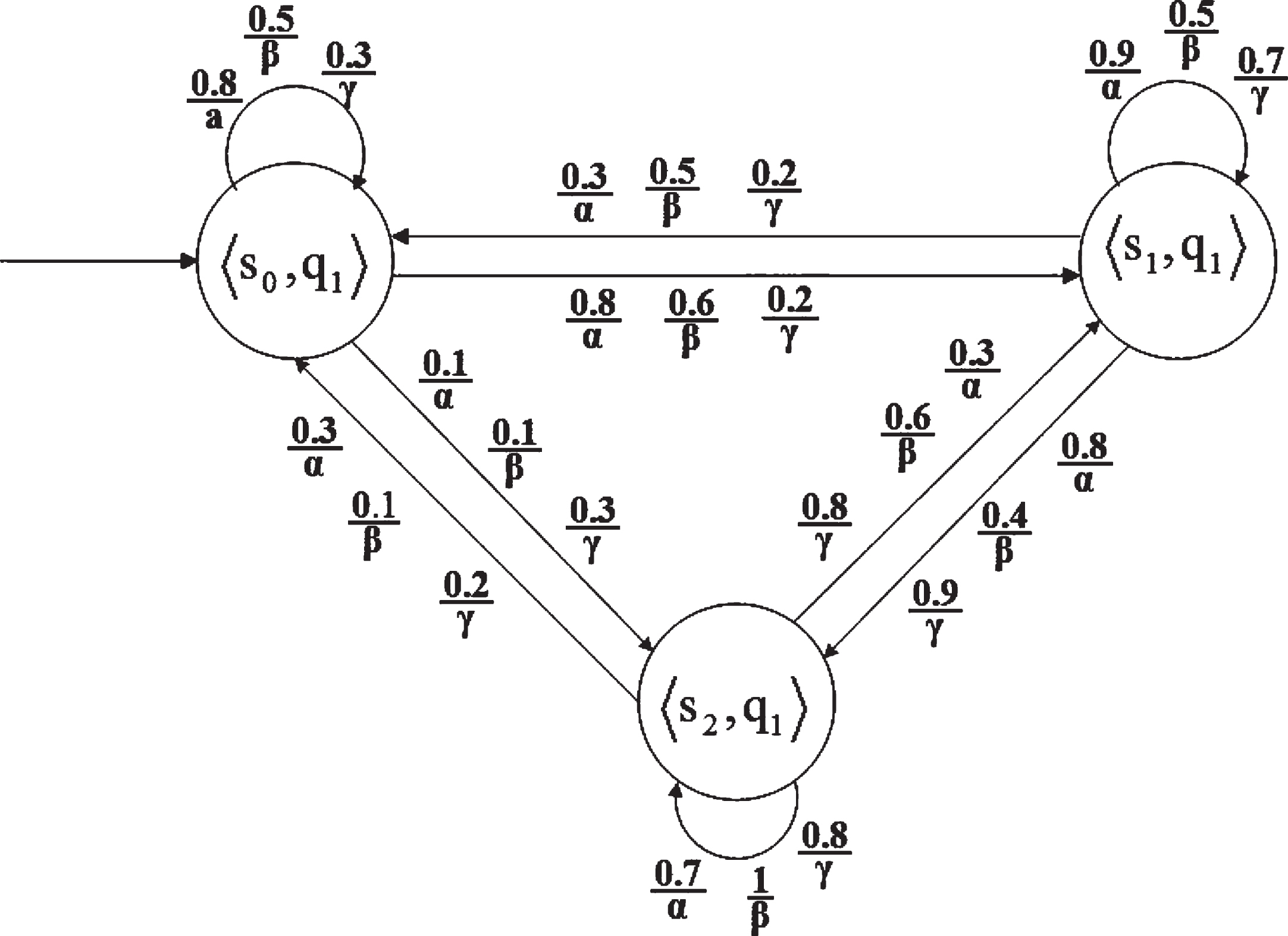
Product GPDPs M ⊗ A.
fz1 = fz2, Therefore
Calculated by the same method
GPo max (s0 ⊨ P safe ) =0.8,GPo min (s0 ⊨ P safe ) =0.3 are obtained, which shows that the maximum possibility and minimum possibility of generalized possibilistic regular safety property P safe in GPDPs M are 0.8 and 0.3.
In this paper, firstly, we propose GPDPs as the models of nondeterministic and concurrent fuzzy systems. Then, we give fuzzy matrices calculation methods of the maximal possibilities and the minimal possibilities of reachabilities. Finally, we propose a model checking approach to convert the verification of safety property into the analysis of reachabilities. We have given the method of optimization algorithm for reachability. In the future, we will investigate the optimization algorithm for reachability to solve the verification of other properties, such as liveness and fairness in fuzzy systems.
Acknowledgments
The work is partially supported by National Natural Science Foundation of China(Grant No. 61962001), Graduate Innovation Project of North Minzu University(Grant No. YCX22184 and No. YCX22196).
Appendix
Since S and Act is finite, given the scheduler Adv, the possibility transition matrix P
Adv
is also finite. Obviously, the fuzzy meet operator ∧ does not generate new element,so the set
In this case, P Adv (s, α0, s1)∧ P Adv (s1, α1, s2) ∧ ⋯
= P Adv (s, α0, s1) ∧ ⋯ ∧ P Adv (si-1, αi-1, t) ∧ (P Adv (t, α i , si+1)
∧⋯ P Adv (sj-1, α j , t)) ∧ ⋯
≤P Adv (s, α0, s1) ∧ ⋯ ∧ P Adv (si-1, αi-1, t) ∧ (P Adv (t, α i , si+1)
∧ ⋯ ∧ P Adv (sj-1, α j , t))
Hence,
Conversely, for any t ∈ S and schedulers Adv, by the definition of
Let π
Adv
= s0
α0s1
α1 ⋯ si-1
αi-1tα
i
(si+1 ⋯ s
j
α
j
t)
ω,then
Hence,
Therefore,
From
Therefore, GPo (Cyl (s0 α0 ⋯ αn-1s n ) )
= ⋁ {GPo (π Adv ) ∣ s0 α0 ⋯ αn-1s n ∈ Pref (π Adv )}
GPo max (s ⊨ ⋄ B)
= ⋁ π∈Paths max (s) (GPo max (π) ∧ ∥ ⋄ B ∥ (π) )
where P
max
is the maximum possibility transition matrix under the max scheduler, Kleene closure of P
max
is
GPo min (s ⊨ ⋄ B)
= ⋁ π∈Paths min (s) (GPo min (π) ∧ ∥ ⋄ B ∥ (π) )
where P min is the minimum possibility transition matrix under the min scheduler.
GPo max (s ⊨ C ⊔ ≤nB) = ⋁ π∈Paths max (s) (GPo max (π) ∧ ∥ C ⊔ ≤nB ∥ (π) )
= ⋁ (⋁ α0∈Act(s0)P (s0, α0, s1) ∧ ⋁ α1∈Act(s1)P (s1, α1, s2)
GPo min (s ⊨ C ⊔ ≤nB)
= ⋁ π∈Paths min (s) (GPo min (π) ∧ ∥ C ⊔ ≤nB ∥ (π) )
GPo Adv (s ⊨ ⋄ B) = ⋁ π∈Paths Adv (s) (GPo (π) ∧ ∥ ⋄ B ∥ (π) ). Let π = s0 α0s1 α1 … ∈ Paths Adv (s0), inf (π) denotes the set of states that occur infinitely many times on the path π, then ∥ ⋄ B ∥ (π) ≤ ⋁ t∈inf(π)B (t). Furthermore, for any t ∈ inf (π), π ⊨ ⋄ t, we can get GPo Adv (π) ≤ GPo Adv ({π ∈ Paths fin (s) ∣ π ⊨ ⋄ t} ) , thus GPo Adv (π) ∧ ∥ ⋄ B ∥ (π) ≤ ⋁ t∈inf(π) > (B (t) ∧ GPo Adv (s ⊨ ⋄ t) ) ≤ ⋁ t∈S (B (t) ∧ GPo Adv (s ⊨ ⋄ t) ) . Therefore, GPo Adv (s ⊨ ⋄ B) ≤ ⋁ t∈S (B (t) ∧ GPo Adv (s ⊨ ⋄ t) ) .
Conversely, for any state t ∈ S, and any path π ∈ Paths Adv (s) that satisfies the event ⋄ t,we have B (s) ≤ ∥ ⋄ B ∥ (π). It follows that ⋁t∈S (B (t) ∧ GPo Adv (s ⊨ ⋄ t) ) ≤ ⋁ t∈S (B (t) ∧ GPo Adv (s ⊨ ⋄ t) ), therefore, ⋁t∈S (B (t) ∧ GPo Adv (s ⊨ ⋄ t) ) ≤ GPo Adv (s ⊨ ⋄ B).
In conclusion, GPo Adv (s⊨ ⋄ B) = ⋁ t∈SB (t) ∧
GPo Adv (s ⊨ ⋄ t) .
We can get the method to calculate GPo
Adv
(s ⊨ ⋄ t) from these results, that is
When the Adv is the maximum possibility scheduler and the minimum possibility scheduler, we can get Theorem 6.
GPo max (s ⊨ ⋄ B)
= ⋁ π∈Paths max (s) (GPo max (π) ∧ ∥ ⋄ B ∥ (π) )
∧B (si+1) ∧ ⋁ αi+1∈ActP (si+1, αi+1, si+2) ∧ B (si+2) ∧ … )
B (si+2) ∧ … )
∧ (D max ∘ P max ) (s i , si+1) ∧ (D max ∘ P max ) (si+1, si+2)
∧ … )
∧rD B ∘P max (s i ) )
P max (si-1s i ) ∧ rD B ∘P max (s i ) )
GPo min (s ⊨ ⋄ B)
= ⋁ π∈Paths min (s) (GPo min (π) ∧ ∥ ⋄ B ∥ (π) )
= ⋁ π∈Paths Adv (s) (GPo Adv (π) ∧ P safe (Trace Adv (π)) )
= ⋁ (GPo Adv (π) ∧ ⋀ j≥0 {L (A) (θ) ∣ θ ∈ Pref (Trace Adv (π)) } )
= ⋁ (GPo Adv (π) ∧ ⋀ j≥0 {F (q j ) ∣ q j δ* (q0, L (s) L (s1) … L (s j )) } ) ⋁ (GPo Adv (π) ∧ ⋀ i≥0F (q i ) ) .
For π = sα0s1 α1 … ∈ Paths Adv (s), we define the run sequence q0q1q2… of the deterministic fuzzy finite automata by qi+1 = δ (q i , L (s i )). Vice versa, for the same run sequence q0q1q2… of the deterministic fuzzy finite automata, we have
= ⋁ π+∈Paths Adv (<s,q s >) (GPo Adv (π+) ∧ ⋀ i≥0B (π+ [i]) )
= ⋁ π∈Paths Adv (s) (GPo Adv (π) ∧ ⋀ i≥0F (q i ) ) ,