




Abstract
To learn the values of such difficult-to-measure quantities y, we need to find some easier-to-measure quantities x1, …, x n that are related to the desired quantity y by a known dependence y = f (x1, …, x k ). Then, we can measure these auxiliary quantities x i , and use the results x i of these measurements and the known dependence between x i and y to estimate the value of y.
Similarly, to predict the future state of the world means to predict the values of all the quantities y that describe this future state. To predict each of these value y based on the current state of the world – i.e., based on the current values x1, …, x n of different quantities, we need to know how y depends on x i , i.e., we need to know the dependence y = f (x1, …, x n ) between the current and the future values of different quantities.
To find the decisions or actions which will lead to most beneficial future, we need to find out how the quality y of the future state will depend on the parameters x i describing our actions.
In all these cases, we need to know the dependence y = f (x1, …, x
n
) between different quantities. In some cases, we already know this dependence, but in many other cases, we need to determine this dependence based on the known results of measurements and observations. Usually, we have some cases k = 1, …, K in which we know the values
So, a natural idea is to use our own abilities to help machine learning algorithms – or even to find the dependencies ourselves, without the help of these algorithms. How can we do it? If we simply look at the numbers that form the data, we will most probably not come up with any ideas. A natural idea is to plot – i.e., visualize – the data points, this often helps.
For example, if we are interested in the dependence of y on only one variables x1 (i.e., if n = 1), then we can plot the observed pairs (x1, y) and see if the resulting points form one of the known dependencies. Often, to see this dependence, we need to re-scale the data. We need to re-scale, if the dependence is too close to a constant. After that, we sometimes immediately see that the resulting dependence is close to a linear or to a quadratic dependence. Sometimes, we need to apply a non-linear re-scaling: e.g., the way to recognize power laws y = c · x
a
is to use the fact that in this case, ln(y) = a · ln(x) + ln(c) and thus, in the log-log scale, we will have a linear dependence between re-scaled variables
Sometimes, the set of all the points
One of the possibilities is to use Parallel Coordinates: to represent (n + 1)-dimensional data, we draw n vertical lines corresponding to n + 1 variables and represent each point
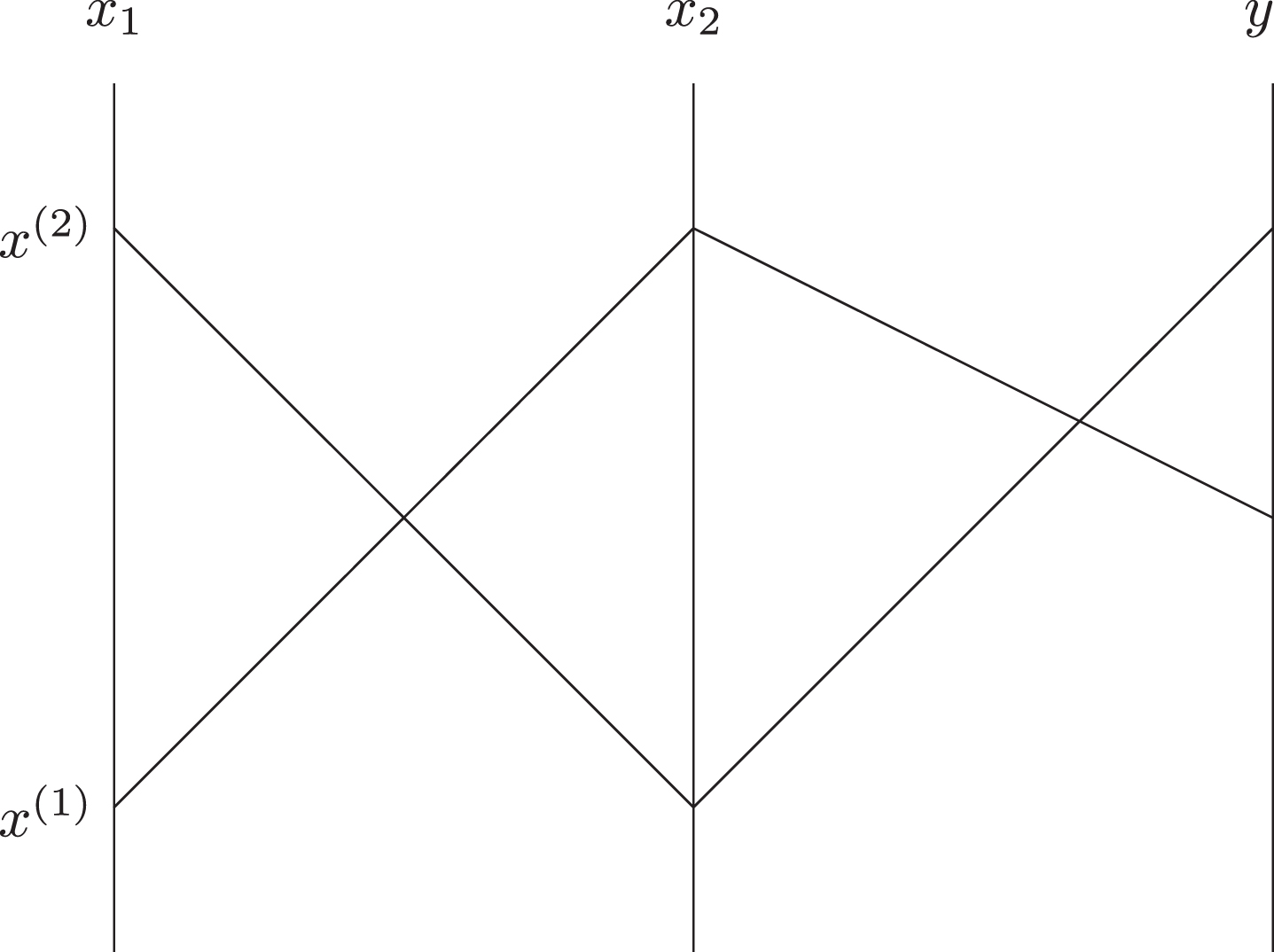
Similarly to the 2-D case, we can appropriately re-scale each of the values x i and y. We can place lines at some angle to each other. We can also use the curved lines to represent each of the values x i and y, and we can use the curved lines to connect the corresponding points.
In some cases, variables can be naturally divided into pairs. In this case, each pair can be represented as a point on the plane, and points corresponding to different pairs can be connected, e.g., by straight lines. For example, if x1 is naturally connected with x2, and x3 is naturally connected with y, then we can represent a multi-D point (x1, x2, x3, y) by drawing two points (x1, x2) and (x3, y) and connecting them by a straight line segment.
All such representations are called General Lines Coordinates (GLC). Studying such representation is the main topic of the book.
And it lists many applications to practical problems, where the corresponding visual analysis indeed helps. These example range from the study of the Challenger disaster to the analysis of World hunger data, health monitoring and computer-aided medical diagnostics, image processing, text classification, and prediction of the currency exchange rate.
Finally, students (and their teachers). This is a well-written book, with plenty of material that will help students in their future work.