




Abstract
Domain-diverse research, that research which involves more than one domain of knowledge, has driven significant advances in science and technology. Recent interest has been shown in the United States for identifying and generalizing techniques for promoting success with such work. In this paper, an exemplar history of domain-diverse research is presented. Next, several forms of domain-diverse research are identified. A spotlight is cast on a particular type, known as “convergence”. Convergence is a problem-solving approach that focuses on integrating the life sciences and medicine on the one hand, with the physical sciences and engineering on the other. Next, the design process is proposed as an organizing framework for domain-diverse teamwork. Finally, the need for research and training in the forming and running of such project groups is explored.
Introduction
This paper is an expansion of a preliminary version presented at the SDPS Taiwan conference (Lipscomb, 2020). The focus herein is not universal but particular: the development of techniques for promoting success in convergence-style domain-diverse research by organizations based in the United States. The timeframe is likewise constrained: no attempt is made to offer the latest research in the area but rather a history of its development is presented. The underlying principle of the paper is the maxim that one must know where one has been to know where one is going. A similarly minded paper was published in the first issue of the Journal of Integrated Design & Process Science: Philosophical Issues in Engineering Design (Dimarogonas, 1997). Inspired by that work, and in recognition of the twenty-fifth anniversary of the Society of Design and Process Science, this paper is offered.
In the 1990 s it became evident to some that optimal artifacts and processes could not be developed out of a single discipline. Proposals were made that the knowledge, tools, and techniques of diverse disciplines should be integrated to produce novel results. An example of this can be found in the 1991 book, Fundamentals of Computing for Software Engineers (Tanik & Chan, 1991). In it, the authors explained their reasoning through an imaginary engineering assignment.
Three separate, single-engineering-discipline teams were given the same task: design an embedded cruise-control system. Although not given as a requirement, it was assumed by each team that the artifact should be designed using the tools and techniques of each team’s domain of expertise. As a result, the mechanical engineering team built a mechanical system, the electronics team built an electronic system, and the software team built a software system.
It was proposed by the authors that a preferable cruise-control system would have integrated components from each domain. Such could not have been achieved by merely assembling a multidisciplinary team. This is because “sound engineering principles, techniques, and tools do not yet exist that systematically deal with this intertechnology interface problem” (Tanik & Chan, 1991, p. 234).
Six years after publication of Fundamentals, it was proposed that a solution would involve “systematic knowledge integration (meta-fusion)” (Tanik & Ertas, 1997, p. 77). This was in recognition of the fact that every domain contains a unique set of knowledge and jargon. It was proposed that for participants of different domains to work together, common ground must be created. The authors proposed two tools for achieving this: systems integration through abstract design, and combinatorics. As will be shown, it is relevant to the instant discussion that these proposals were made in the context of information and design.
Knowledge generation and dissemination methods (Tanik & Ertas, 1997)
Knowledge generation and dissemination methods (Tanik & Ertas, 1997)
Regarding information, the authors focused on its generation and communication. They presented a table setting out the origin and characteristics of different methods for creating and disseminating knowledge, shown above as Table 1 (Tanik & Ertas, 1997). In the table was presented a historical progression toward integration.
Also in the 1990 s, the felt need to pursue domain-diverse research was embodied in professional societies and journals. The term “domain-diverse research” is defined herein as that set of all research involving more than one domain of knowledge. An example of this kind of organization can be seen in the Society for Design and Process Science, founded in 1995. In 1997, the first issue of the Transactions of the SDPS Journal of Integrated Design & Process Science was released. In the editors’ introduction, they explained an intention to “cross the boundaries back and forth not only in mathematics but between mathematics, physics, economics, management science as well as engineering” (Ertas, Ramamoorthy, & Tanik, 1997, p. 1).
More recently, interest in discipline-diverse research has reached the government institution level. In 2014, the National Research Council (NRC) issued a report on a particular form, described as “convergence”. The meaning of this term is described infra in the section titled “The NRC view of Convergence”.
From the foregoing, it can be seen that concerted efforts have been made to develop frameworks for domain-diverse research. History can provide context for this necessary work. In the next section will be presented an historical sample of science and technology advances that have been made employing domain diversity. Attention will be given to characteristics held in common. In subsequent sections will be explored different kinds of domain-diverse research, and the need to investigate the best ways organize and operate teams. It will be argued that such efforts may be grounded in the knowledge and tools of design and information processes.
The most striking examples of historical, domain-diverse progress can be found in the 17th and 18th Centuries, often referred to as the Scientific Revolution and Age of Enlightenment, respectively. In the work of Galileo, Carnot, and Faraday can be seen the qualities and benefits of domain-diverse research. To understand what made these achievements revolutionary, it is worth considering what was established before.
In the ancient great empires of Mesopotamia and Egypt, and the great feudal societies of India and China, technological advances were made. Yet there was little scientific advancement. Rules of thumb were used, which were based on observation, repetition, and improvement. The emphases were on craft over design, utility over analysis, and procedure over conceptual understanding (Dimarogonas, 1997). Although giant structures, such as the pyramids, are often referenced in discussions of the origins of engineering, such efforts were less design, and more trial and error. The earliest exponents of rational, systematic development wrote in the Greek language.
In Classical Greece, the search for reason led to a focus on analysis and concept. Greek speakers made systematic attempts to organize the knowledge of the forces of nature, as well as the technological uses of forces of nature. They performed analyses of nature and mechanical devices by applying logic and geometry (Dimarogonas, 1997). As will be seen, an important factor in the breakthroughs of the 17th and 18th Centuries was knowledge integration that combined an analysis of nature with an analysis of engineered objects.
Engineering efforts can be divided into working with gravity, heat, electromagnetism, information, and systems (Blockley, 2012). In each of these areas, the Ancient Greeks established paradigms that held fast for over one thousand five hundred years. It was the domain-diverse research of 17th and 18th Century researchers that pushed beyond these paradigms. For purposes of illustration, research into gravity, heat, and electromagnetism will be discussed.
Research into Gravity
Regarding gravity, Aristotle (c. 384-322 BC) maintained that the movement of objects was a consequence of their nature, their gravitas. For example, an object containing the element earth moves down, he claimed, because that is the direction of its home. Similarly, fire moves upward to the moon because that is the direction of its home (Principe, 2011). Aristotle described this as “natural motion” in his work, On the Heavens. (Guthrie, 1939, 300a20). Aristotle distinguished natural motion from “unnatural” or “violent” motion, which is what occurs when one object strikes another, in his collected work, Physics. (Wicksteed & Cornford, 1934, 254b10).
This conception aligned with a central question of the Greeks: what is the nature of things? This encouraged the Greeks to explain the natural movement of objects by their nature, and that nature by what elements make up the objects. The idea that motion is based upon a substance’s nature predominated until the time of Galileo (1564-1642).
Another feature of Aristotle’s physics was a failure to comprehend relationships of the dissimilar. Magnitude, for example, could be conceived of as arising from a relationship between two like quantities, such as two distances. Because velocity and speed involve dissimilar quantities –time and distance –Aristotle could not make an account of acceleration (Blockley, 2012).
Galileo challenged these assumptions by performing a falling-bodies experiment. This he described in his 1638 work: Dialogues Concerning Two New Sciences (Crew & Salvio, 1914). Galileo rolled balls down a ruled incline, then measured their descent using a different quantity: time. In this way, Galileo made the relationship of the dissimilar explicit. Further, his method simplified and idealized the event such that the object’s “nature” was excluded from consideration.
This allowed Galileo to build a mathematical model of the subject of study, a hallmark of the Scientific Revolution. It also allowed him to create standards of measurement and data collection. This, too, was a revolutionary move, because it ran counter to another paradigm of Ancient Greek thinkers: the preference for rationalism over empiricism.
Plato (c. 428-348 BC), like the Pythagoreans before him, believed that the constant change he observed in the world meant that observation was unreliable, and therefore could not lead to “true” knowledge. For this, he turned to abstract geometrical objects, numbers, and concepts. Plato expressed these ideas in his work, Phaedo (Fowler, 1914, 96-100).
Galileo broke with this tradition. By means of his empirical method and experimental results, he came to understand that force was responsible for movement, and that force was related to acceleration. The result was the concept of inertia, and this, in turn, led to Isaac Newton’s (1642-1726) theory of gravitation.
Relevant to this discussion is that the precision required for Galileo’s experiments meant that he was compelled to investigate timekeeping. For his experiments, he relied on an ancient technology: the water clock. He also pushed for the development of a new, more precise technology: the pendulum clock. Galileo drew up plans for his son to construct a pendulum clock, but neither lived long enough to see its completion. Based on this preliminary work, Christiaan Huygens (1629-1695) built a pendulum clock in 1656. Galileo, through his cross-fertilization of basic research and time-keeping technology, had achieved a paradigm shift in physics (Matthews, Clough, & Ogilvie, 2019).
Research into Heat
Regarding heat, the Greeks also focused on the “nature of things”. Heat was explained in terms of the natural qualities of fire. Fire was considered to be an element, which was a constituent of different substances. Aristotle argued that heat was a quality and not a quantity in his work, On Coming-to-Be and Passing-Away (Forster, 1955, 333b). Later, Hero of Alexandria (c. 10-70) built what may have been the first heat engine, but it was regarded as merely an amusement. In sum, the Greek thinkers did not quantify heat and failed to grasp the significance of the use of heat to do work.
Beginning in the 17th Century, heat engines were developed to power textile mills and to pump water from mines. Many were designed to be driven by water as well as gas or vapor. There was significant cross-fertilization between the technologies ( Cardwell, 1971). Advances in technology were made by Thomas Savery (1650-1715), Thomas Newcoman (1664-1729), James Watt (1736-1819), and Richard Trevithick (1771-1833).
Yet it was Sadi Carnot (1796-1832), a French military engineer, who began the science of thermodynamics through the study of the steam engine itself. In a true interdisciplinary move, Carnot used scientific methods to investigate the efficiency of a technological artifact. He documented this in his only published book, from 1824: Reflections on the Motive Power of Heat and on Machines Fitted to Develop This Power (Thurston, 1943).
Through Carnot’s work, the steam engine came to be understood as a representation of human knowledge about natural processes. The operation of the steam engine makes explicit the capacity of heat to generate work, something obscured in nature. Carnot’s knowledge-integration established thermodynamics as the first branch of theoretical physics not based on Newton’s laws of motion (Cardwell, 1971).
Like Galileo before him, Carnot built a simplified, idealized model of the subject under investigation. In his perfectly insulated, frictionless, and leak-proof model, heat turned water to steam, the steam performed work then condensed to water again such that the cycle could begin anew. This “ideal engine” allowed for a mathematical understanding of heat efficiency and promoted the establishment of standards in measurement and data collection.
Galileo’s ball-rolling experiment integrated his new method of investigation with a technological device: the clock. Cartnot’s research integrated Galileo’s investigation method with the investigation of a technological device itself, the steam engine. Consequences included advances in science, such as the first and second laws of thermodynamics, and the development of products, such as the steam train (Blockley, 2012).
Research into Electromagnetism
Regarding electromagnetism, the Greek thinkers were divided. Explanations proceeded again from the tendency to attribute forces to the internal nature of things. Thales (c. 624-548 BC) posited that the magnet had a soul, and this explained its ability to move other objects. Democritus (c. 460-370) claimed that the cosmos contained only atoms and “the empty”, that like attracted like, and that iron magnets contained more empty and thus attracted iron shavings (Barnes, 1987).
Plato gestured at an explanation in his work, Timaeus, but it was not particularly coherent (Bury, 1929, 80c). Aristotle argued that actions at a distance could not occur unless there was some medium to carry the effects –a spiritus mundi (Principe, 2011). In sum, the Ancient Greek thinkers failed to comprehend the existence of invisible, independent forces that could act upon objects.
A Roman, Lucretius (c. 55-15 BC), proposed an effluence theory to explain magnetism. This he explained in his didactic and scientific poem, On the Nature of Things (Smith, 2001). In addition to providing discussions on physics, technology, evolution, and atomism, Lucretius wrote verses to explain how magnets work. His idea was that some substance emitted from a magnet. This substance created a vacuum that pulled objects toward the magnet.
The effluence theory predominated until the time of William Gilbert (1544-1603). In the late 16th Century, Gilbert began a scientific investigation into magnetism. Like Galileo, Gilbert called for the use of experimentation in his book from 1600, On the Lodestone and Magnetic Bodies and on the Great Magnet the Earth (Mottelay, 1893, p. 77).
Gilbert’s work inspired cross-disciplinary investigations into electromagnetism. These included the building of a static electricity machine by Otto van Guericke (1602-1686), the use of kites to investigate lighting by Benjamin Franklin (1706-1790), nerve-conduction studies by Luigi Galvani (1737-1798), the development of a continuous-supply battery by Alessandro Volta (1745-1827), and the design of an electric generator by Michael Faraday (1791-1867).
Faraday’s design combined the knowledge and technologies from many disparate works in electromagnetics. His research began when he was asked by a scientific journal, Annals of Philosophy, to write an historical account of electromagnetism. Faraday systematically reproduced previously designed experiments in electromagnetism (Blockley, 2012). Of interest here is that experiments were selected by their relevance to electromagnetism, not to their domain of origin. Faraday went on to design engineered artifacts to understand the natural phenomenon.
Faraday’s work led to a paradigm shifting idea: electromagnetism is not a substance, but a field. James Maxwell (1831-79) was encouraged thereby to develop equations that would fuel developments in science and engineering and lead to important applications. Notable here is that researchers were adding knowledge to a field from the standpoint of many different domains. This history, it may be claimed, reveals the wisdom of Faraday’s domain-diverse approach, as well as the benefits of the construction and investigation of artifacts to understand natural phenomena.
Characterizing Research Combinations
From the above examples it may be seen that science and technology research can be combined in different ways. It has been proposed that each combination has certain characteristics (Tanik & Alexander, 2016). When two technologies are integrated, a technological innovation may result. However, little scientific innovation is likely. This is often described as “product research”. When two sciences are integrated, a scientific innovation may result. However, little technological innovation is likely. This is often described as “basic research”.
Characteristics of research combinations (Tanik & Alexander, 2016)
Characteristics of research combinations (Tanik & Alexander, 2016)
When a science and a technology are integrated, two results are possible based upon which one is driving the research (Watson, 2017). When the findings of scientific research are leveraged to design a new technology, it is often described as “translational research”. When the abilities of a new technology are leveraged to allow a higher level of scientific research, it is often described as “transformative research”. A simplified version of a table developed by Tanik and Alexander (2016) is presented above as Table 2.
From the above survey, a few observations can be made. Every breakthrough heretofore discussed involved the integration of a life science or physical science with engineering. Also, every breakthrough involved the building of a mathematical model and the creation of standards for measurement and data collection. The importance of these components has recently been extolled by the National Research Council, as will be seen in the following section.
In 2014, the National Research Council (NRC) of the United States issued a report on a particular form of domain-diverse research known as “convergence”. The report covers many topics, but three are relevant here: the meaning of convergence, social barriers to success, and the need to develop implementation frameworks.
The NRC defined convergence to mean an “approach to problem solving that integrates expertise from life sciences with physical, mathematical, and computational sciences, medicine, and engineering to form comprehensive synthetic frameworks that merge areas of knowledge from multiple fields to address specific challenges” (NRC, 2014, p. 13). The authors explained that convergence “represents a way of thinking about the process of research and the types of strategies that enable it” (NRC, 2014, p. 13). In other words, convergence is a meta-research concept.
It was proposed that convergence work requires an “open and inclusive culture”; that researchers be “conversant across disciplines”; and that a common set of concepts, metrics, and goals be established (NRC, 2014, p. 15). The ideal work-product was described as “combinatorial innovation” (NRC, 2014, p.16).
The report authors proposed that convergence work was important because diverse groups “generate innovative solutions to complex problems” (NRC, 2014, p. 46). To support this, they cited research that suggests that diverse teams outperform homogeneous teams (Hong and Page, 2004; Horowitz and Horowitz, 2007). They also cited research that suggests that diverse teams demonstrate greater creativity (Stahl, Maznevski, Voigt, & Jonsen, 2010).
To delineate the different types of domain-diverse research groups, the report authors defined teams as follows. Unidisciplinarity occurs when researchers from a single discipline work collaboratively. Multidisciplinarity occurs when researchers from two or more disciplines juxtapose their separate efforts by compiling results. Interdisciplinarity occurs when researchers integrate knowledge and tools from two or more disciplines toward a common goal. Such cross-fertilization and combination require more attention to team management and communication. Transdisciplinarity occurs when researchers cross boundaries to build comprehensive frameworks or synthetic paradigms. Such work is directed to solving “real world” problems (NRC, 2014, p.31).
The difference between transdisciplinarity and convergence is not obvious from the provided definitions. However, it appears that convergence is a subset of transdisciplinarity in that it has a narrower focus. In convergence, the focus is on integrating the life sciences and medicine on the one hand, with the physical sciences and engineering on the other to promote a “third revolution” in life sciences (NRC, 2014, p. 13).
The NRC authors proposed that to achieve convergence, it is “imperative” that the life sciences embrace the continuum between research and application, something said to be well understood by the physical sciences and engineering (NRC, 2014, p. 17). This seems to suggest that one of the NRC’s goals for research on convergence is this: socially associate practitioners of the life sciences and medicine with practitioners of the physical sciences and engineering to encourage the former to take on an application mentality.
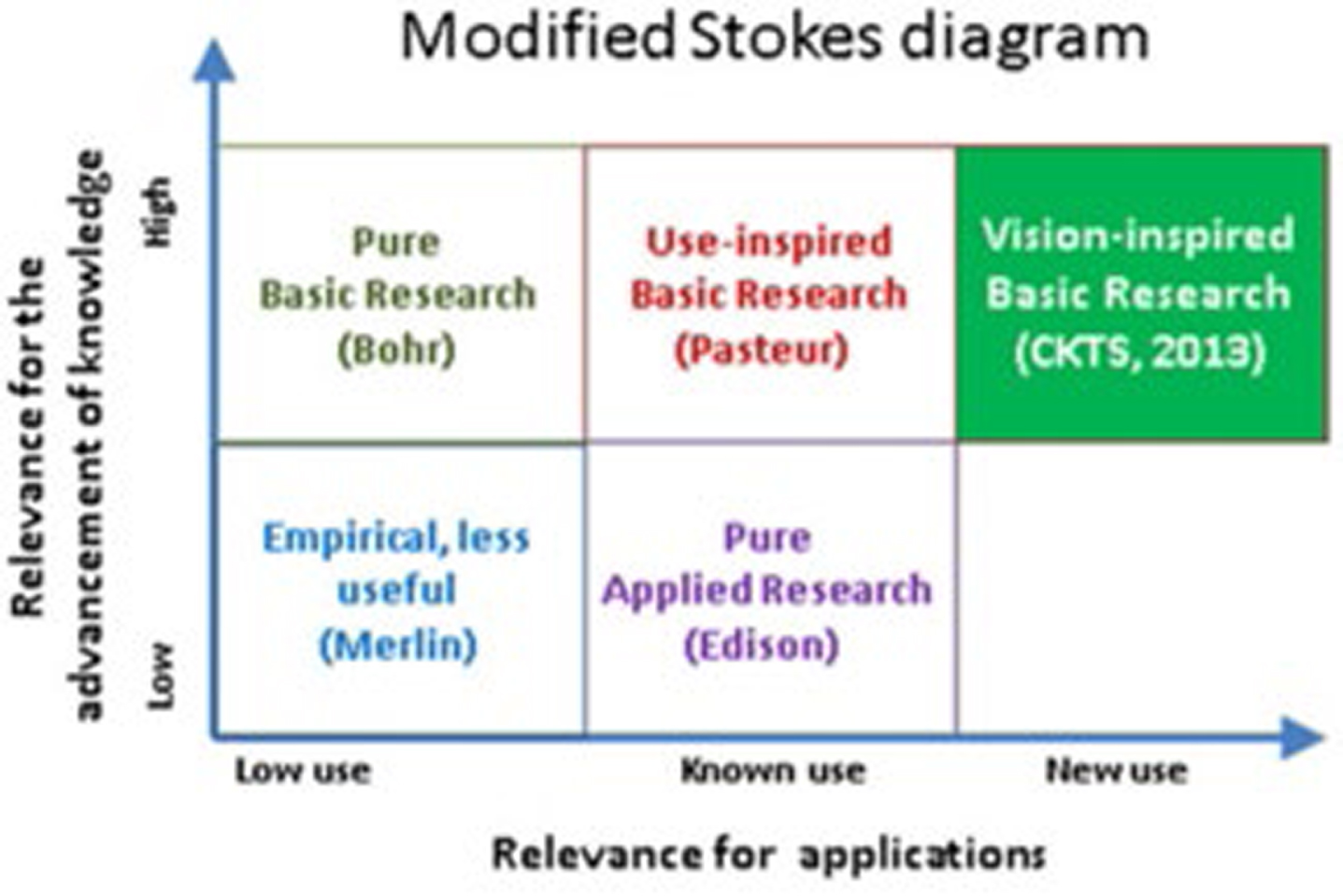
The type of research contemplated here –that which connects research to application –has been described as “use-inspired basic research” (Rococo, Bainbridge, Tonn, & Whitesides, 2013). In that conception, it was proposed that there is a range of research activities involved in a cycle of integration and divergence. In the creative phase, areas of knowledge are developed through pure basic research and empirical research. In the integration phase, diverse knowledge is brought together to create a new framework through use-inspired basic research and pure applied research. In the divergence phase, spin-off applications and elements are developed through vision-inspired basic research. These, in turn, become the basis of creative phase research, which begins the cycle anew.
A simplified graphic of this idea was presented in a later work by two of the same authors (Roco & Bainbridge, 2013). This is presented in Table 3 below.
Integration/divergence process (Roco & Bainbridge, 2013)
Integration/divergence process (Roco & Bainbridge, 2013)
The convergence report authors proposed a second requirement to facilitate development from research to application: engineers must communicate the usefulness of mathematical analysis to the practitioners of life sciences and medicine. It was posited that engineers approach problems through quantification. The NSF report authors proposed that the nature of biological systems is such that the mathematics required to model and analyze them are “extremely sophisticated” (NRC, 2014, p. 41). Therefore, integrating the engineering approach into life sciences is a “major goal” for convergence (NRC, 2014, p. 41).
Next, the authors proposed that the biomedical sciences need help achieving data reproducibility. By comparison, engineering was said to possess the tools for developing common measurement standards, and guidelines for collecting data (NRC, 2014, p. 41). This suggests that collaborations with engineers could help practitioners of the life sciences create standards for measurements and data collection.
Now that the specific meaning of convergence has been set out, it is worth considering what the report authors thought hindered its success. From the beginning, those who pursue convergence “face a lack of practical guidance in how to do it” (NRC, 2014, p. 19). The obstacles to convergence “have as much to do with interpersonal interactions as they do with science at the boundaries between disciplines” (NRC, 2014, p. 31).
It can be said that training in every discipline involves instruction on how research questions are formulated, the methods and models used to answer them, and the acceptable presentation of results. In short, students are socialized to form bounded “in-groups”. The report authors proposed that a consequence of this is that members of diverse-discipline groups will form weaker social bonds with each other; and experience more tension, less trust, and more difficulty in achieving goal interdependence (NRC, 2014, p. 33). It is proposed herein that these same obstacles exist for any domain-diverse team, not just a convergence-based team.
Multiple case studies into team science have been funded by the NSF and National Institutes of Health (NIH). Relevant here are the analyses that suggest that communication is a key component to success. For example, an analysis of 62 collaborations that received 3-year support from an NSF program suggested that lower positive outcomes were associated with institution-spanning collaborations compared with single-university collaborations. The institution-spanning collaborations were associated with reduced information-sharing, which the use of technology, such as email, did not overcome (Cummings & Kiesler, 2005).
In another study, researchers compared the work of two institution-spanning research groups. The more collaboratively successful group shared similar cultures and communicated effectively. The less collaboratively successful group approached research from different epistemic perspectives. In that situation, individual researchers conducted their own research, but failed to collaborate (Corley, Boardman, & Bozeman, 2006). From this, the report authors held that the management of a convergence research team requires special attention to social interaction and communication. A proposal for addressing this issue will be presented infra.
With the obstacle to convergence identified (social dynamics), and the key component of success named (communication), the NRC report authors next expressed the over-arching goal of convergence research. This is to “identify and understand the factors that influence the outcomes of research which successfully integrate diverse inputs dots ” (NRC, 2014, p. 33). In other words, research on convergence is an effort to find how communication and the manipulation of social dynamics affect outcomes. It is proposed that, out of this, an organizational framework can be built.
Design Process as a Convergence Activity
From the foregoing, it can be seen that conversations about the what, how, and why of discipline-diverse research have been active for decades. Different proponents have had different focuses. However, a central theme has been the need for effective communication. Further, this communication appears to be affected by social dynamics.
If this is true, then attitudes will play a significant role in the success of domain-diverse research projects. It is proposed herein that three held attitudes about domain-diverse research may be beneficial to outcomes. First, that domain-diverse research is productive. Second, that every domain represented in the group has something to contribute. Third, that design and information processes can provide a common ground.
In this paper, the first proposition has been supported in the “legacy” section supra. The second proposition is assumed to be self-evident, even though it is not universally held to be true. The third will be supported in the instant section.
It is often said that scientists answer questions and engineers solve problems. Common to both, however, is the rational, systematic development of a solution to a question or problem. This method can be called design. Although engineers tend to claim the term as their own, design is a concept that cuts across engineering and science, and must be sensitive to context (Zeng, 2004). Engineers design artifacts and processes, while scientists design investigations. This connection can be illustrated through the etymologies of two words central to these disciplines: designare and logos.
Design comes from the Latin designare, meaning “to designate” (Merriam-Webster, 2019). The terms “insignia”, “sign”, “seal” and “signal” all derive from this and convey the sense of “let me draw a picture for you” (insignia), leave my personal mark (sign), put on the final touches (seal), and communicate it (signal). An engineer draws up specifications and blueprints, then supervises manufacture. The product is signed, sealed, and delivered.
The roots of designare emphasize the plans themselves, but the plans provide a peek into the planning. In this sense, the word refers to the purpose, planning, or intention that exists behind an action, fact, or material object. Thus, design refers to the plan as well as the planning.
The recipe for a doughnut is its design. Yet a doughnut is also designed to be delicious. The hows and whys are central to the concept of design. Related to this is the fact that for the ancient Greeks, an object’s use and meaning were one and the same (Dimarogonas, 1997, p. 77).
Scientific investigations share these design qualities. The scientist must design an investigation to pose a proper question. Unless the investigation is sufficiently specified and communicated, replication is not possible. Unless the investigation is goal-directed, investigators are merely exploring.
The design of a scientific solution is called “investigation” and includes the important characteristics of empiricism: observation and experimentation. Scientists seek to understand the mechanisms of cause and effect. The design of an engineering solution is called “engineering design” and includes the important characteristics of limitations and demands, and the production of the artificial. Engineers seek to build mechanisms of cause and effect.
The duality found in the word design is closely related to a duality found in the word central to science: logos. Logos is an Ancient Greek word that means “reason” (Merriam-Webster, 2019). However, it is also used to refer to the reasoning behind an object or event. A pursuit of logos leads to logical answers and solutions. Many scientific disciplines have logos in their names. Biology, for example, is an investigation into the reasons, or the hows and whys, of biological systems.
It can be seen, then, that both designare and logos refer to the hows and whys of a problem. The roots of designare emphasize specification, and the roots of logos emphasize rationality. However, the concepts cross over: design is a systematic and rational process, and scientific investigation requires strict specification. The connection between these two concepts, which are central to engineering and science, could be used to bring the two domains together in a transdisciplinary way.
Design has developed over time to also refer to an organizational framework from which to do design work. This “design process” steers project groups, step-by-step, through productive ways of moving the work forward. The process guides the group toward a single solution considered to be “best”, given the criteria and constraints.
One of the NRC’s stated goals for convergence research is to find a common language for doing convergence work (NRC, 2014, p. 5). Design process is proposed herein to be that common language. Design process is a transdisciplinary idea that can provide common ground for collaborations between scientists and engineers. The terms, tools, and knowledge of the design process can be used as an organizing framework for the building of domain-diverse teams.
A Need for Convergence Training
Strategies for forming and participating in a convergence team are neither obvious nor intuitive. Because of this, training may be beneficial. There are substantive differences between the types of diverse-domain project groups. These differences may not be known to the participants and may encourage interactions being less effective.
Tanik & Fielder (2017) described multidisciplinary groups as those that join disciplines without concern for integrating them. Interdisciplinary groups are those that integrate disciplines without dissolving the disciplinary boundaries. Cross-disciplinary groups are those in which disciplinary boundaries are crossed to explain one subject in terms of another. Finally, transdisciplinary groups are those that join, integrate, and cross disciplines by dissolving disciplinary boundaries. It may be noted that these definitions fit generally with those of the convergence report (NRC, 2014, p. 31).
At present, this final group type, the convergence team, is not common. As such, invited participants may be unfamiliar with its structure and expectations. Further, in a convergence team, the roles of participants “may become unclear since some of the traditional departmental, functional and geographical boundaries are diminished” (Fielder, Lipscomb, Güldal, & Tanik, 2017, p. 17). Finally, there is the social dynamic aspect of convergence activity to be considered. In the convergence report, this social component was considered a significant obstacle to success (NRC, 2014, p. 31).
Convergence teamwork requires members to participate and listen in ways different than they would in traditional groups. In a traditional multidisciplinary group, each member represents an expert in a particular discipline. If a question or problem arises that falls into a domain, the domain expert is called upon. Generally, the opinion given is not questioned and is considered final.
In a convergence group, every member is expected to offer opinions and make suggestions regardless of the topic domain. Members are called upon to work in areas they know very little about. This collides with certain tendencies in human behavior regarding comfort and embarrassment. It also runs counter to the very concept of expertise.
Next, every member of a convergence group is expected to be receptive to opinions and suggestions made outside of the speaker’s expertise. Again, this is counter to notions of expertise. It may be difficult for members to listen with patience to a non-expert proposal. Convergence participation involves being able to consider how another person’s ideas can expand or change what one is thinking.
For these reasons, convergence can be understood as an interpersonal skill, rather than an abstract intellectual construct. These participation skills are easy to understand but difficult to perform. The fact that group and personal dynamics are inherent in convergence teamwork suggests that research must be done on these matters and a framework be designed. From there, a brief and effective team-training could be developed.
This work has already begun. In 2010, Paletz and Schunn presented their social-cognitive framework for multidisciplinary team innovation (Paletz & Schunn, 2009). In the paper, the authors described domain-diversity as being a “particularly challenging” factor that is mediated and moderated by cognitive (i.e. personal) and social factors (Paletz & Schunn, 2010, p. 77). Although it is beyond the scope of the instant paper to fully discuss the Paletz and Schunn framework, a few notes will benefit.
First, Paletz and Schunn argued that domain-diverse project work includes a “divergent” phase and a “convergent” phase. In the divergent phase, the goal is to generate a wide variety of ideas. In the convergent phase, the goal is to coalesce around a single high-quality output. Each phase requires different techniques that may not be cross-compatible. In the divergent phase, managed conflict and dissent must be encouraged. In the convergent phase, consensus must be encouraged. From the engineering perspective, what these behavioral scientists are describing, in broad strokes, is the design process.
The authors report two non-obvious results. First, a certain kind of group conflict should be encouraged to facilitate idea-generation. It was argued that dissenting opinions can lead to the search for additional information that can shared with the group. Second, the formal role of “expert” should be encouraged to facilitate domain knowledge expression. It was argued that a cognitive error often held by participants in domain-diverse groups is the following: that what they know is already known by the others in the group. Therefore, an express designation that a member is an expert of a particular domain should encourage that member to share their domain knowledge with the group (Paletz & Schunn, 2010). It is proposed herein that the search for catalyst-tools for convergence must continue.
It may be tempting to dismiss such “soft skills” research as not important enough to implement. Yet it is worth remembering that a consideration of the contributions of other disciplines is exactly what domain-diverse research is about. As proposed supra, the second beneficial attitude needed for convergence work is that every domain represented in the group has something to contribute.
SDPS has been pressing for transdisciplinary activity among scientists and engineers for over twenty-five years. Yet such activities have not become common. Perhaps the greatest lesson of convergence is that the human component is the most important of all.
Footnotes
Acknowledgments
We would like to thank Dr. Yong Seng, Dr. Donna Slovensky, Dr. Bernd Krämer, and Stan Gatchel for their encouragement and insight on these matters. We also thank Dr. Thomas Wan for his discussions on the impact of convergence on medicine.
Author Biographies
 ).His research interests include data science, convergence, information theory, and software applications for healthcare.