




Abstract
Teaching evaluation is a key initiative to improve the quality of education and teaching. The research significance of this study is rooted in addressing the limitations of the traditional evaluation of teaching quality (ETQ) model, which often relies on a single evaluation index, exhibits a one-sided perspective, and suffers from pronounced subjectivity. In this context, this paper delves into the application of the backpropagation neural network (BPNN) to enhance and refine the ETQ model. The intelligent ETQ model was constructed and utilized in network English teaching to enhance the effect and quality of network English teaching. By analyzing the characteristics and needs of network English teaching, the advantages of BPNN in the ETQ were explored. The intelligent evaluation model was constructed, and its application effect in network English teaching was studied and evaluated. The total number of students satisfied with the BPNN based network English ETQ model was 151, with a total satisfaction rate of 75.5%. The ETQ model on the basis of BPNN was applied to network English teaching, which helped the average final score of Class 2 improve by 5.44 points compared to the division exam. The ETQ model based on BPNN was applied to network English teaching, which can improve the rationality of teaching evaluation and help improve students’ school English proficiency.
Keywords
Introduction
The network English ETQ is a large and multi-dimensional system. In actual evaluation, there may be evaluation biases caused by subjective factors of the evaluator, which also makes the evaluation system different from the general classroom teaching evaluation system. Most existing evaluation methods can only form quantitative evaluations based on scores, and cannot qualitatively evaluate the effectiveness of teachers’ classroom teaching, which also has some drawbacks. The main manifestation is that the qualitative indicators of the evaluation of teaching quality need to be determined subjectively by the evaluator, which has uncertainty and fuzziness, resulting in the current lack of objective and suitable methods for the evaluation of teaching quality. The BPNN tool has strong learning ability and extremely high fault tolerance, and has good results in dealing with the uncertainty of ETQ. Applying it to the network English teaching evaluation model can enable school leaders to constantly understand the teaching situation of teachers and test the teaching effectiveness through the teaching evaluation model. In addition, the evaluation model can also indirectly encourage healthy competition among teachers, which is conducive to forming a good teaching atmosphere, which is very essential for enhancing teaching effectiveness.
The ETQ includes many interactive factors. Examining these factors can help better identify the ETQ of network English. To achieve the English ETQ and objectively reflect the quality level of English teaching, Zhu Yue used analytic hierarchy process (AHP) to construct a set of English ETQ index system from multiple aspects [1]. Lu Chen proposed an ETQ method on the basis of radial basis function (RBF) neural network for the current problem of low precision of English interpreting ETQ [2]. Jiang Yixuan raised an improved fuzzy RBF neural network model with back propagation-based learning and applied it to the university English ETQ method [3]. Li Nan conducted in-depth discussions on the fuzzy evaluation of college English teaching quality and established a fuzzy evaluation model for college English teaching quality on the basis of AHP, greatly promoting the improvement of college English teaching quality [4]. Liu Haiyuan summarized the content of university English ETQ and identified the factors affecting university English teaching quality. On this basis, he established a perfect system of university English ETQ [5]. However, these scholars’ studies on the aspect of English ETQ system are not comprehensive enough.
How to scientifically and reasonably evaluate teaching quality has always been a problem faced by universities. However, because there are too many ETQ indicators, and they are very easy to be affected by subjective factors, resulting in large personal equation and subjectivity, the utilization of BPNN to the ETQ has become a hot spot in this field. Wu Xiaofeng proposed an ETQ model on the basis of AHP and BPNN in view of the shortcomings in the current flipped classroom teaching evaluation process, and advocated using this method to enhance college students’ English listening and speaking ability [6]. To enhance the effectiveness of the ETQ model, Wenwen Liang adopted a BPNN as the basis for model construction and analysis [7]. Liu Chang proposed a new method for assessing the quality of undergraduate education based on BPNN and stress test, and utilized the method to construct a publicly available indicator pool [8]. Peng Jianxin established an evaluation model based on BPNN using matrix laboratory software to reduce the interference of subjective factors in the evaluation process of teaching quality, and evaluated the teaching quality of computer experimental courses [9]. Overall, the research content of the ETQ system based on BPNN is very rich, laying the foundation for applying it to network English teaching in this article.
Deeply exploring the factors that affect effective teaching and conducting effective evaluations are important ways to improve teaching quality. However, there are many factors that affect the quality of teaching, and there is a strong relationship between indicators and evaluation results, which is difficult to explain through traditional analysis and evaluation methods. Artificial intelligence represented by BPNN does not require the creation of complex mathematical models. By learning and training the input model, it is possible to explore the patterns in the data and display the relationship between data input and output, making the evaluation model easier to create and the results more objective and reliable. The ETQ model constructed by it is more conducive to the development of network English teaching.
Construction of an intelligent ETQ model
ETQ
ETQ refers to the evaluation of teachers’ academic skills, teaching, behavior, and other aspects. Currently, there is no unified curriculum ETQ system [10, 11]. Good teaching includes two qualities: “teaching” and “learning”, which are closely related to many things, such as the teaching quality of various courses in the early stage, the coordination of various teaching links in this course, the teaching effectiveness of teachers, teaching methods, students’ learning attitudes and learning outcomes, etc. Nowadays, every school attaches great importance to the evaluation of curriculum quality. Each school has established a teaching quality management center, an ETQ system, and dedicated personnel and supervisors. The hierarchical supervision mechanism of school level supervision and college level supervision has been established. The results of ETQ in most schools are still linked to the assessment and evaluation of teachers, in order to motivate them to do their teaching work well. Effective ETQ has multiple functions, but its main role is to support continuous improvement of teaching quality. The importance of evaluation does not depend on the evaluation results, but on the design process [12, 13]. The function introduction of the ETQ system is illustrated in Table 1.
Introduction to the functions of the ETQ system
Introduction to the functions of the ETQ system
Design principles
The evaluation process plays an essential role in reflecting the scientificity, completeness, and appropriateness of ETQ. Different schools may have different divisions and their own characteristics. Therefore, there is a need to build an ETQ system suitable for different schools. Effective ETQ system can bring many benefits, ultimately achieving the goal of improving teaching [14, 15]. Not only can it be a basis for evaluating teachers’ thinking, work ability, work attitude, work goals, and reasonable selection of teachers, but it can also stimulate teachers’ enterprising spirit, help teachers summarize teaching work experience and lessons and clarify the direction of efforts, so as to enhance their sense of responsibility and professionalism. The construction of an ETQ index system should be based on the following points:
Principle of consistency: The ETQ indicators should comply with the Party and national education policies and regulations, and meet the requirements of school teaching management. High-quality talents should also be trained and school reforms should be supported to help increase the importance and competitiveness of higher education institutions. The principle of comprehensiveness: The evaluation should comprehensively and clearly display the teaching objectives, taking into account all factors that may affect the quality of teachers, and at the same time, it should be clear and hierarchical to avoid the evaluation system being too cumbersome and complex, which can provide clear information for teaching management. Independence principle: The indicators are independent of each other, and the evaluation research can not be affected by the overlap of indicators. Motivation principle: Teachers can understand their strengths and weaknesses through evaluation indicators and results, in order to evaluate the improvement of their work.
Decomposition model of indicators for network English ETQ.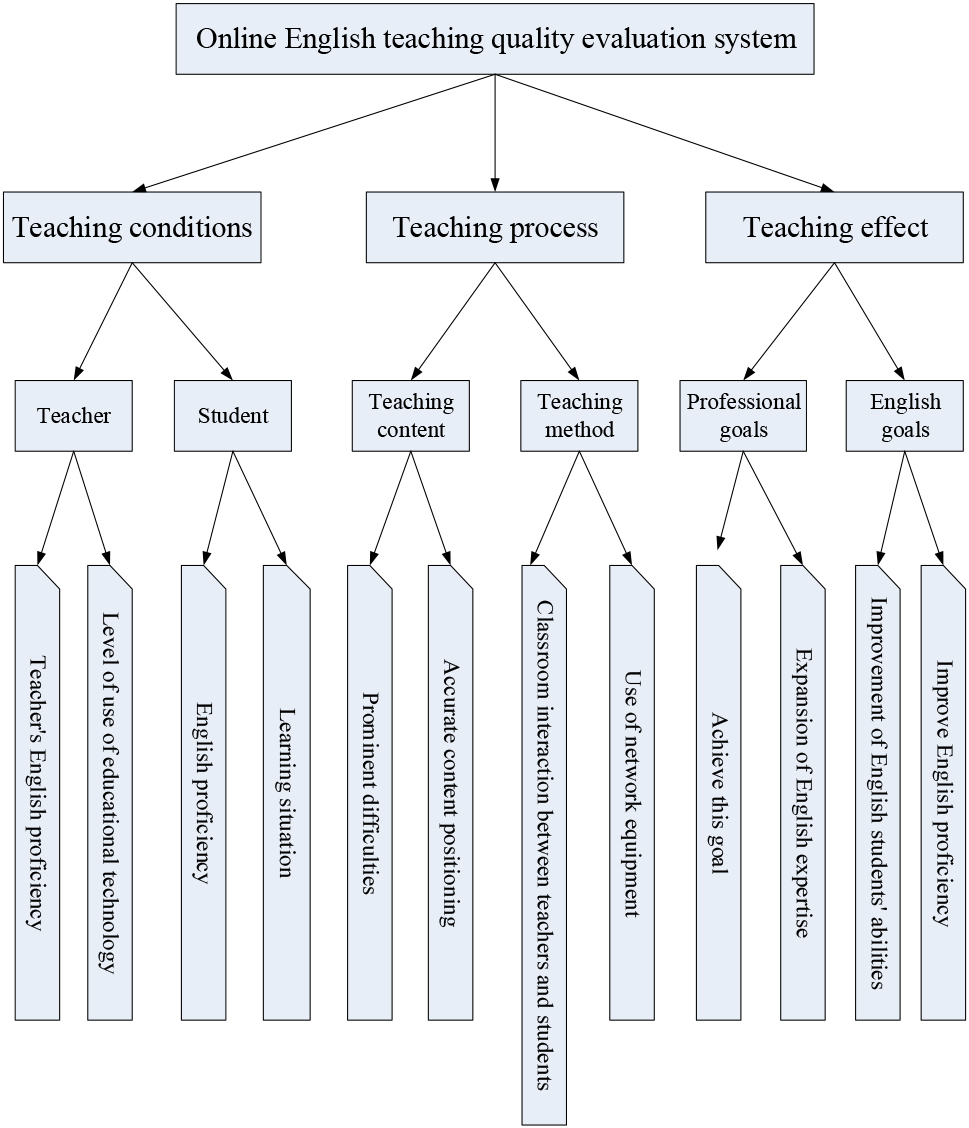
If the evaluation indicators violate the learning objectives, it leads to incorrect goals and decisions, leading to teaching errors. The ETQ model itself has the role of teaching guidance, that is, the evaluation and assessment of which indicators are valued by teachers. Therefore, the design and selection of indicators are very important. This not only requires reflecting the essence of teaching, selecting typical and objective indicators, but also paying attention to the leading role. Otherwise, too simple or excessive indicators make teaching evaluation ineffective. The decomposition model of the indicators for network English ETQ is shown in Fig. 1.
Establishing a good ETQ system is a daunting task, and scientific, comprehensive, and operational are the three principles of an excellent ETQ system [16]. Effective teaching methods not only include setting indicators, but also include collecting and analyzing compliance data. Therefore, before learning that the research is effective, a teaching evaluation quality system should be established, as illustrated in Table 2.
School English ETQ system
School English ETQ system
In teaching, students are the main body, with a large number and scale, and have a lot of say in the ETQ. Therefore, student evaluation should be the main basis for evaluating the quality of teacher curriculum teaching [17]. The assessment of students can be divided into four levels of primary indicators, namely teaching attitude, teaching content, teaching methods, and teaching effectiveness. These primary indicators may be divided into some secondary indicators. In the past, many schools often placed teachers at the center of network English teaching, and this concept must be changed to promote the growth of network English teaching. Teachers only provide guidance and assistance, while students are the main source of teaching. For the teaching situation of the teacher’s curriculum, students are the most familiar and have the right to speak. Moreover, the learning effectiveness of students and their mastery of knowledge are the most direct reflection of the quality of teacher curriculum teaching. Student evaluations are conducted every semester to ensure that all teachers have the opportunity to conduct evaluations. The student evaluation form is illustrated in Table 3.
Student evaluation form
The evaluation indicators usually adopt a process of decomposing the evaluation objectives layer by layer to establish a tree shaped indicator system that is specific and measurable from high to low [18, 19]. Network English education is different from traditional teaching methods and cannot use the original evaluation model to evaluate teaching quality. It is necessary to use BPNN to construct an ETQ model, with the teaching process as the core. The scale of English ETQ system based on BPNN is illustrated in Table 4.
BPNN based English ETQ system scale
Data sources
By studying the current situation of network English teaching, the research topic is clarified. BPNN is utilized to study the intelligent ETQ model. Next, the model is used to study network English teaching and see how applying intelligent ETQ to network English teaching can enhance students’ English grades. The sampling range of the data sample is randomly selected from W school in region A. A survey is conducted on W school in the form of a questionnaire, and 10 experts are invited to compare and rate the evaluation scores. These 10 experts are frontline English teachers, leaders in charge of English teaching at the Education Bureau, and leaders in charge of English subjects at the school, with a wide range of data sources. The assessment of student performance as a teaching criterion in the past is abandoned, and student learning outcomes are set as indicators of effective teaching.
Evaluation results for individual indicator questions:
Among them,
The expression for understanding the overall teaching quality of a course is as follows:
Among them,
The quality of sample data directly affects the research level of evaluation indicator design. Due to the significant impact of English ETQ and the influence of psychological factors, the focus of evaluation varies [20, 21]. In order to develop the most important and accurate model for English ETQ, the effectiveness of training networks and models has been increased, taking W school’s network English teaching as an example. The original data is obtained from the students’ comprehensive evaluation and the evaluation indicators that affect the quality of English teaching. In order to make the data meet the operation requirements of the training process function, the original data is normalized to make it fall within a certain range. The research results on intelligent ETQ indicate that the personal qualities of teachers, as well as a series of factors such as teachers’ teaching knowledge, degrees, professional titles, and the English foundation of students in the class they teach, to a certain extent affect the quality of classroom teaching for teachers. To determine whether there is a relationship between them, a data integration preprocessing is required.
The normalization equation used for input in this article is as follows:
Neural network technology is a cross discipline developed in recent years, which involves a wide range of contents and has many applications, such as biology, electronics, computer, mathematics, physics and other disciplines. It also has the ability of adaptive learning, fast decision-making speed of thinking, highly decentralized information storage and processing speed [22, 23]. BPNN, also known as feedforward neural network, is a three-layer feedforward hierarchical network composed of input layer, hidden layer and output layer. When a set of input modes is given to the network, the BPNN needs to follow some input steps to complete data processing [24, 25]. Firstly, the input mode is transmitted from the input layer to the hidden layer unit. After being processed layer by layer by the hidden layer unit, an input mode is generated and transmitted to the output layer. This process is called forward propagation. Then, the output results are compared with the expected values. If the expected expectation is not met, it becomes an error back propagation, and the error is returned along the original path. By modifying the connection weights of each layer of neurons, the error signal is reduced. In fact, there are two methods in BPNN that can reduce errors and improve accuracy: one is to increase the number of network layers, and the other is to increase the number of hidden layer neurons [26, 27]. The former often makes the network very difficult, and the network training time significantly increases. Compared to the former, the training results of the latter are easier to evaluate and adjust than before. Therefore, in the ETQ model based on neural networks, a three-layer BPNN with one hidden layer is adopted. The English ETQ model on the basis of BPNN is illustrated in Fig. 2.
Model of English ETQ system based on BPNN.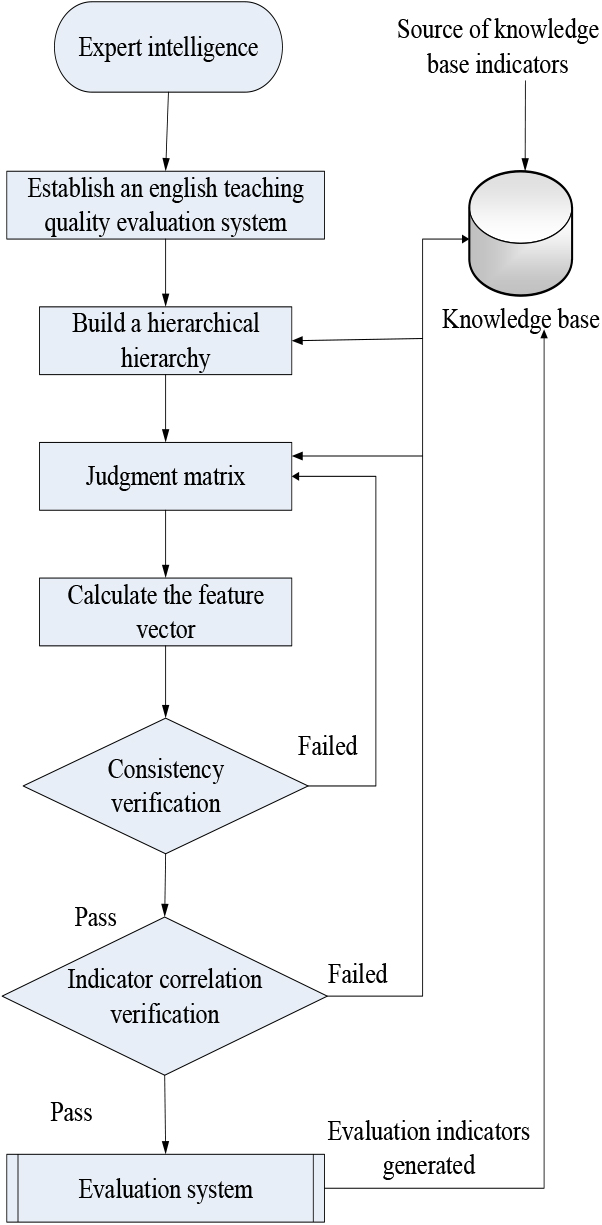
In a neural network, the calculation equation for the input value of each neuron is:
The output
For the output layer, there is:
When the network output is not equal to the desired output, there exists an output error
The above error definition equation is expanded to the hidden layer, including:
It is further expanded to the input layer, including:
The adjustment amount of weight is proportional to the negative gradient of error, namely:
How to establish a scientific, objective, and reasonable teacher ETQ model based on BPNN should follow the following steps:
Clarifying the evaluation subject: The selected evaluation subject is a qualitative evaluation that combines students and experts. Due to the existence of many uncertain factors and complex problems in the evaluation process, the evaluation method is a nonlinear problem. BPNN has good adaptability and can predict any task, demonstrating its special advantages in problem-solving. Constructing a comprehensive evaluation object, that is, creating a complete ETQ model: For different measurement items, different defined measurement methods should be used. The importance of the indicators should vary depending on the characteristics of the discipline. In formulating the evaluation indicators, all factors affecting the evaluation results need to be included as much as possible to make the evaluation indicator system as complete as possible. The weight is adjusted through gradient descent, making the weight setting more scientific and reasonable. After the establishment of the evaluation index system standards, further research should be conducted on the corresponding weights of the evaluation standards. Based on the weight parameters of experts, a BPNN model learning network is constructed through the powerful functions of the toolbox. The weights set by the experts are input, and through network training, the weights of the indicators set by the experts are adjusted to minimize errors and make the weights relatively more reasonable.
After averaging, the mean of each indicator is 1, then:
Among them,
When
For the evaluation of the quality of network English teaching in colleges and universities, a continuous change needs to be established throughout the whole process of English teaching in schools, including pre-teaching, teaching and post-teaching [28, 29]. Among them, before teaching, it often includes English business and social skills, etc. Teaching mainly includes the supply of English major teaching resources, the demand for English major teaching resources, the monitoring and evaluation of English major education quality, and the goal and management of English major teaching quality. After teaching, it mainly includes the demand for English talents from society and large enterprises. By managing the entire process of network English teaching in universities, and based on the actual growth of enterprises and society, the teaching system has been continuously enhanced and transformed. The model of the quality evaluation system for college English teaching is shown in Fig. 3.
Model of English ETQ system in higher education institutions.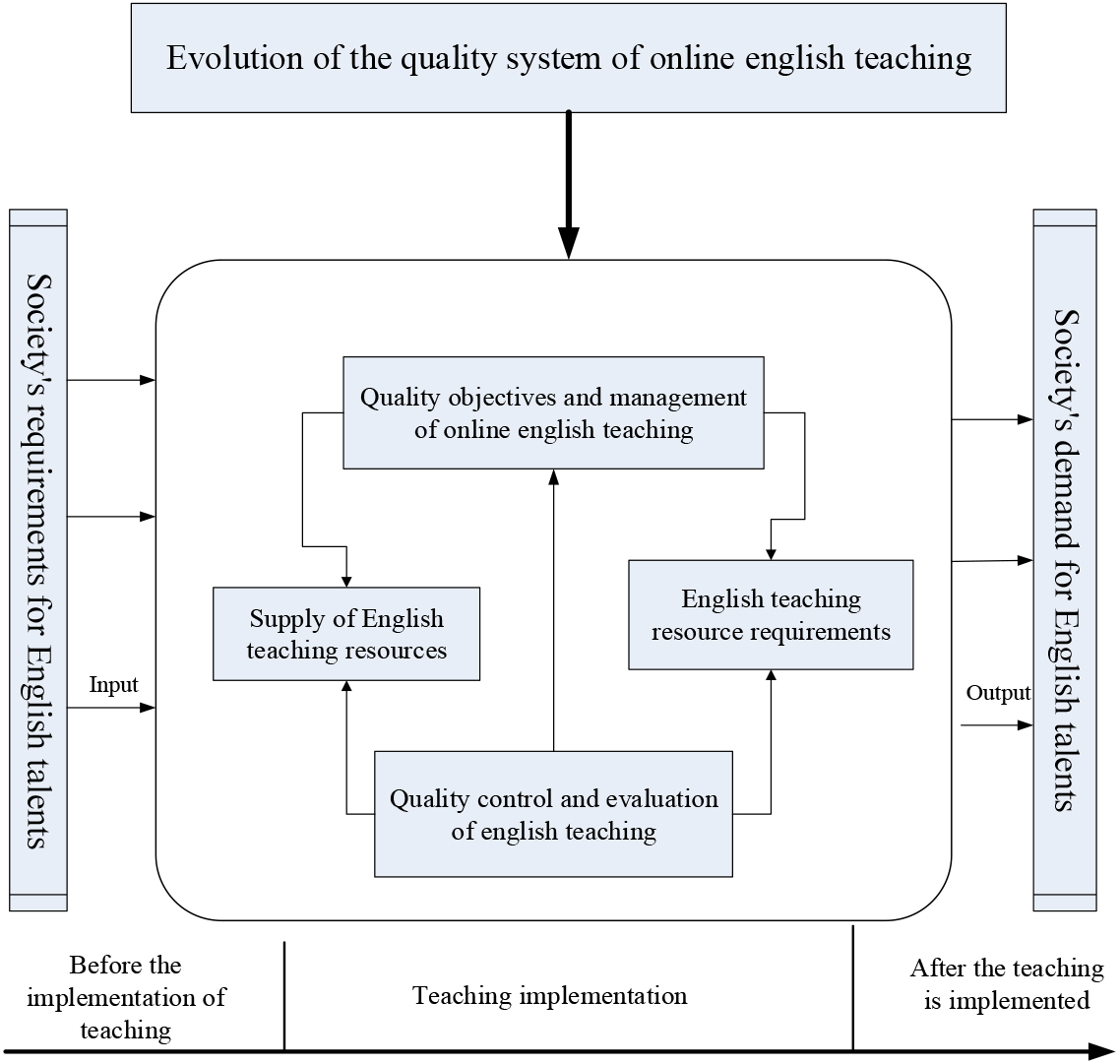
Framework of ETQ for school network English majors.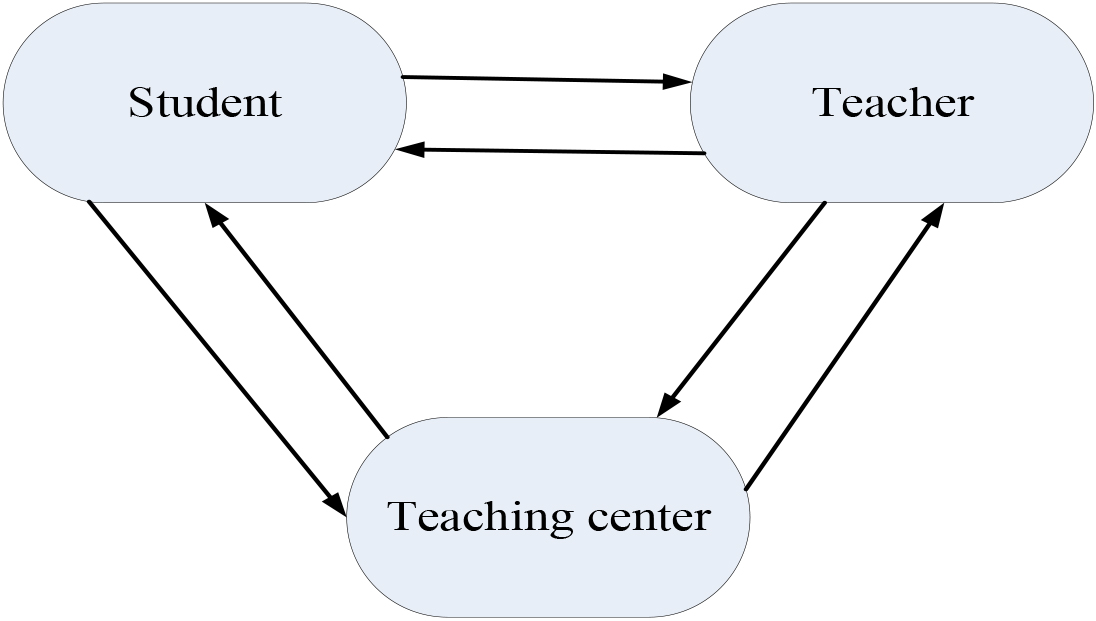
The BPNN based model for evaluating the quality of English major teaching further explains the framework of the network English ETQ model. Participants before, during, and after teaching include students, teachers, teaching staff, and teaching centers. Among them, students and teachers are participants in the teaching process, while the teaching center is the hardware foundation of teaching. Figure 4 shows the framework for evaluating the quality of network English teaching in schools. From the framework, it can be seen that students, teachers, and teaching centers are the three main roles for assessment.
Application of BPNN in the evaluation system of network English teaching
The ETQ method of BPNN is a good neural network teaching evaluation algorithm. Experts can start the evaluation results and students’ evaluation scores to find its internal laws, and use these laws to predict or evaluate the network teaching evaluation data of future students. BPNN network technology is adopted, with limited expert evaluation as the training model. The internal laws of expert evaluation of teaching and student evaluation data are identified. Computers are used to simulate the thinking of analysts to obtain appropriate training and evaluation results. The goal of using BPNN for training is to obtain the final weights and values of the output and input layers. In the training process of BPNN networks, the determination of the number of hidden layer neurons is the main problem, and traditional methods make it equal to the content of the input vector. However, when there are many input vectors, it is not possible to accept many hidden layers. Therefore, a new method is needed, which starts from training 0 neurons and increases the number of neurons in the network by detecting errors. It can be seen that BPNN has the characteristics of adaptive determination of the model, and the output is independent of the initial weight value. Applying it to the college English teaching evaluation model is conducive to preprocessing the original data of ETQ indicators.
Advantages and limitations of the model
For existing teaching evaluation methods, although they have played a good role in improving teaching quality and teachers’ teaching level, these methods also have some shortcomings. For example, the direct impact of human factors on evaluation results cannot be eliminated, and evaluation is only conducted from the perspective of student transcripts. The evaluation indicators are very single, which clearly has significant one-sidedness. Due to the fact that teaching is a process of combining teaching and learning, there are many factors that affect the effectiveness of teaching, and the impact of these factors is also different. Therefore, it is difficult to use analytical mathematical models to evaluate teaching quality. In fact, ETQ is a difficult and unrelated decision-making problem. Many existing ETQ methods carry serious subjectivity when evaluating English teaching, which may lead to errors and irrationality in the evaluation results.
However, as a new technology, BPNN has important features such as nonlinear mapping, classified learning and real-time optimization, and also provides a new way for ETQ [30]. Through continuous learning and training, BPNN can find patterns between many unknown and complex data. At the same time, it can also effectively process these data, automatically identify all nonlinear relationships, achieve all nonlinear relationships, and effectively solve the subjectivity brought by nonlinear ETQ, which is not possessed by traditional evaluation methods. Therefore, introducing the BPNN theory into the ETQ system can not only solve the problems existing in the teaching indicators, but also eliminate the complex problems that arise during the establishment of traditional evaluation systems. This improves the scientificity of teaching evaluation, reduces human interference, and produces more accurate evaluation results.
Experimentation of ETQ model based on BPNN
Applying different intelligent evaluation models of teaching quality to network English teaching has different impacts on network English teaching. However, applying BPNN based quality intelligent evaluation models to network English teaching can greatly improve the extracted evaluation indicators. Ten experts were selected from region A, and W school, which used BPNN’s quality intelligent evaluation model, was rated with a score of 100. The higher the score, the greater the benefits brought by the ETQ system, which is more helpful for improving students’ English proficiency. Since there are many evaluation indicators that affect English teaching, four first level indicators were selected for research, namely teaching attitude, teaching content, teaching methods, and teaching effects. The results were compared with the ETQ model based on analytic hierarchy process (AHP), decision tree (DT), radial basis function (RBF), and rough set theory (RST). The specific comparison is illustrated in Fig. 5.
Expert scoring of different evaluation indicators for different ETQ models. A: Teaching attitude. B: Teaching content. C: Teaching methods. D: Teaching effectiveness.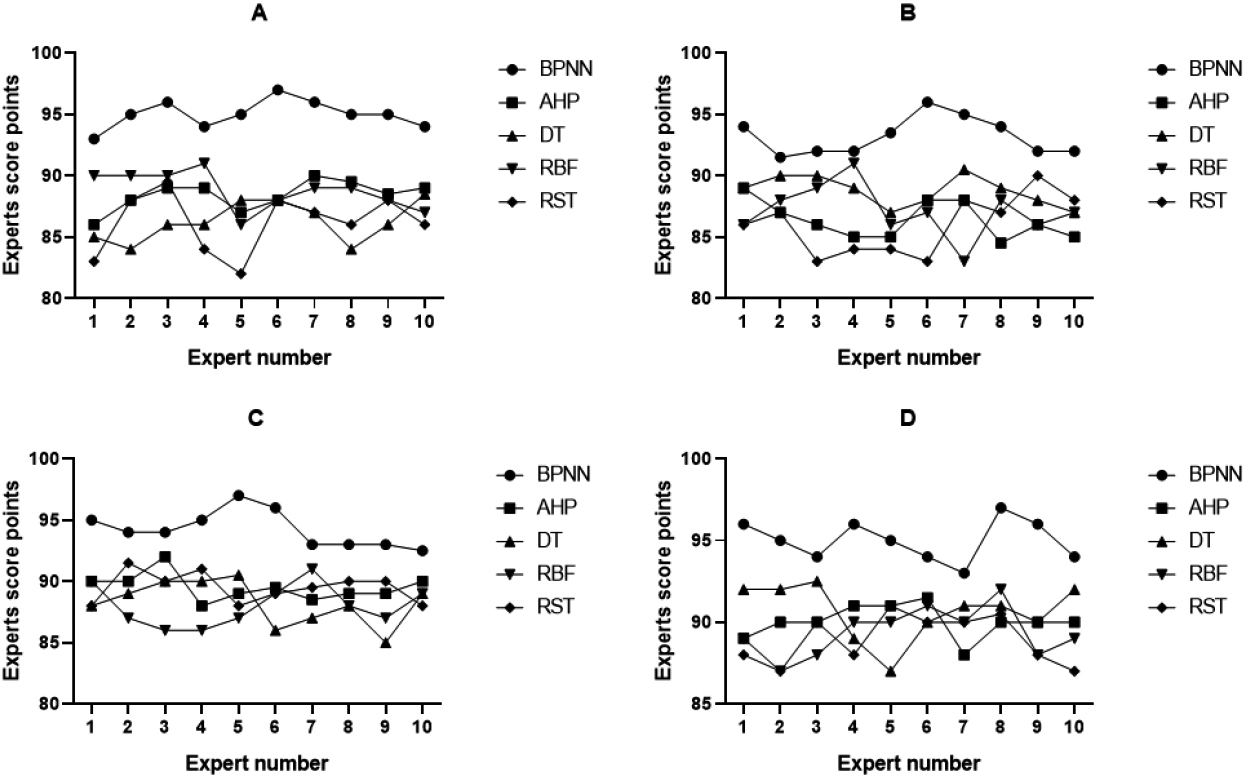
In Fig. 5A–D, the x-axis represents the number of experts, with a total of 10 experts. The y-axis represents the score given by the experts, with a maximum score of 100 points. As shown in Fig. 5, experts rated the quality intelligent evaluation model based on BPNN much higher than other ETQ models. As shown in Fig. 5A, for the evaluation indicator of teaching attitude, the expert rating of the ETQ model based on BPNN was above 92.99 points, and the average score of 10 experts was 95 points. However, the expert rating of the ETQ model based on AHP, DT, RBF, and RST was below 90.01 points, 88.51 points, 91.01 points, and 89.51 points, respectively. The average scores of 10 experts in these four models were 6.6 points, 8.75 points, 6.2 points, and 8.85 points lower than the ETQ model based on BPNN, respectively. The expert with number 1 gave the lowest score to the ETQ model based on BPNN, at only 93 points, but still scored 7 points, 8 points, 3 points, and 10 points higher than the ETQ models based on AHP, DT, RBF, and RST, respectively. As shown in Fig. 5B, for the evaluation indicator of teaching content, the expert scores of the ETQ model based on BPNN were above 91.49, and the average score of 10 experts was 93.2. However, the expert scores of the ETQ model based on AHP, DT, RBF, and RST were below 89.01, 90.51, 91.01, and 90.01, respectively. Moreover, the average scores of 10 experts in these four models were 6.85 points, 4.45 points, 6.1 points, and 7.2 points lower than the ETQ model based on BPNN, respectively. The expert with number 2 gave the lowest score to the ETQ model based on BPNN, only 91.5 points, but still scored 4.5 points, 1.5 points, 3.5 points, and 4.5 points higher than the ETQ models based on AHP, DT, RBF, and RST, respectively.
As shown in Fig. 5C, for the evaluation indicator of teaching methods, the expert rating of the ETQ model based on BPNN was above 92.49, and the average score of 10 experts was 94.25. The expert ratings of ETQ models based on AHP, DT, RBF, and RST were below 92.01 points, below 90.51 points, and below 91.01 points, respectively. The average scores of 10 experts in these four models were 4.75 points, 6 points, 6.25 points, and 4.75 points lower than those of ETQ models based on BPNN, respectively. The expert with number 10 gave the lowest score to the ETQ model based on BPNN, only 92.5 points, but still scored 2.5 points, 3.5 points, 3.5 points, and 4.5 points higher than the ETQ models based on AHP, DT, RBF, and RST, respectively. As shown in Fig. 5D, for the evaluation indicator of teaching effectiveness, the expert rating of the ETQ model based on BPNN was above 92.99 points, and the average score of 10 experts was 95 points. The expert ratings of ETQ models based on AHP, DT, RBF, and RST were below 91.51, below 92.51, and below 92.01, respectively. The average scores of 10 experts in these four models were 4.95 points, 4.35 points, 5.6 points, and 6.05 points lower than those of ETQ models based on BPNN, respectively. The expert with number 7 gave the lowest score to the ETQ model based on BPNN, only 93 points, but still scored 5 points, 2 points, 3 points, and 3 points higher than the ETQ models based on AHP, DT, RBF, and RST, respectively.
A good ETQ model can help students improve their grades. The ETQ model based on BPNN can effectively improve students’ English grades. Class 1 and Class 2 of a certain grade in W school were randomly selected. The number of students in these two classes was the same, with 50 students in both classes. Moreover, the English scores of the two classes in the division exams were similar, with an overall average score of 88.2 points for Class 1 and 88.14 points for Class 2. The teacher who teaches English in both classes is also the same, but the teaching methods are different. Class 1 is a control class, taught according to traditional methods, and Class 2 is an experimental class. Based on the ETQ model of BPNN, English teaching was carried out for one semester, and the results of the midterm exam and the final examination were compared. The main purpose is to compare the number of people and average scores in different stages, which are divided into four stages: excellent (100–120 points), good (80–99 points), pass (72–79 points), and fail (0–71 points). The specific comparison is described in Table 5.
Midterm and final examination of two classes
As shown in Table 5, after the completion of the midterm exam, Class 1 used traditional teaching methods, and their average scores increased slightly compared with their respective scores. However, because Class 2 applied the BPNN based ETQ model to network English teaching, the average score of the midterm exam was much higher than that of the divided classes, and also 2.23 points higher than that of Class 1. The number of excellent and good students in the mid-term exam of Class 2 was 3 and 4 more than that of Class 1 respectively, and the overall passing rate of Class 2 was 8% higher than that of Class 1. After the completion of the final examination, Class 1 used the traditional teaching method, and the final average score was 88.78 points, 4.8 points lower than the final average score of Class 2 who applied the BPNN’s ETQ model to network English teaching. The number of excellent and good students in the final examination of Class 2 was 8 and 4 more than that of Class 1 respectively, and the overall passing rate of Class 2 was 16% higher than that of Class 1. The average score of Class 2 at the end of the term was 2.12 points higher than that of the midterm, and 5.44 points higher than that of the score class exam, resulting in a significant improvement in the average score. However, the average final grade of Class 1 decreased by 0.45 points compared to the midterm, and improved by 0.58 points compared to the score class exam. The grade remained almost unchanged throughout the semester. The English scores of the two classes show that applying the BPNN based ETQ model to network English teaching can effectively enhance students’ English scores, help students increase their ability to learn English, and also make English grades more reasonable and reduce the failure rate.
200 students from W school were randomly selected and asked to conduct a satisfaction survey on the ETQ model based on BPNN, which has 5 levels: very satisfied, satisfied, insensible, dissatisfied, and very dissatisfied. The results were compared with the ETQ models based on AHP, DT, RBF, and RST, as shown in Fig. 6.
Comparison of student satisfaction with different ETQ models.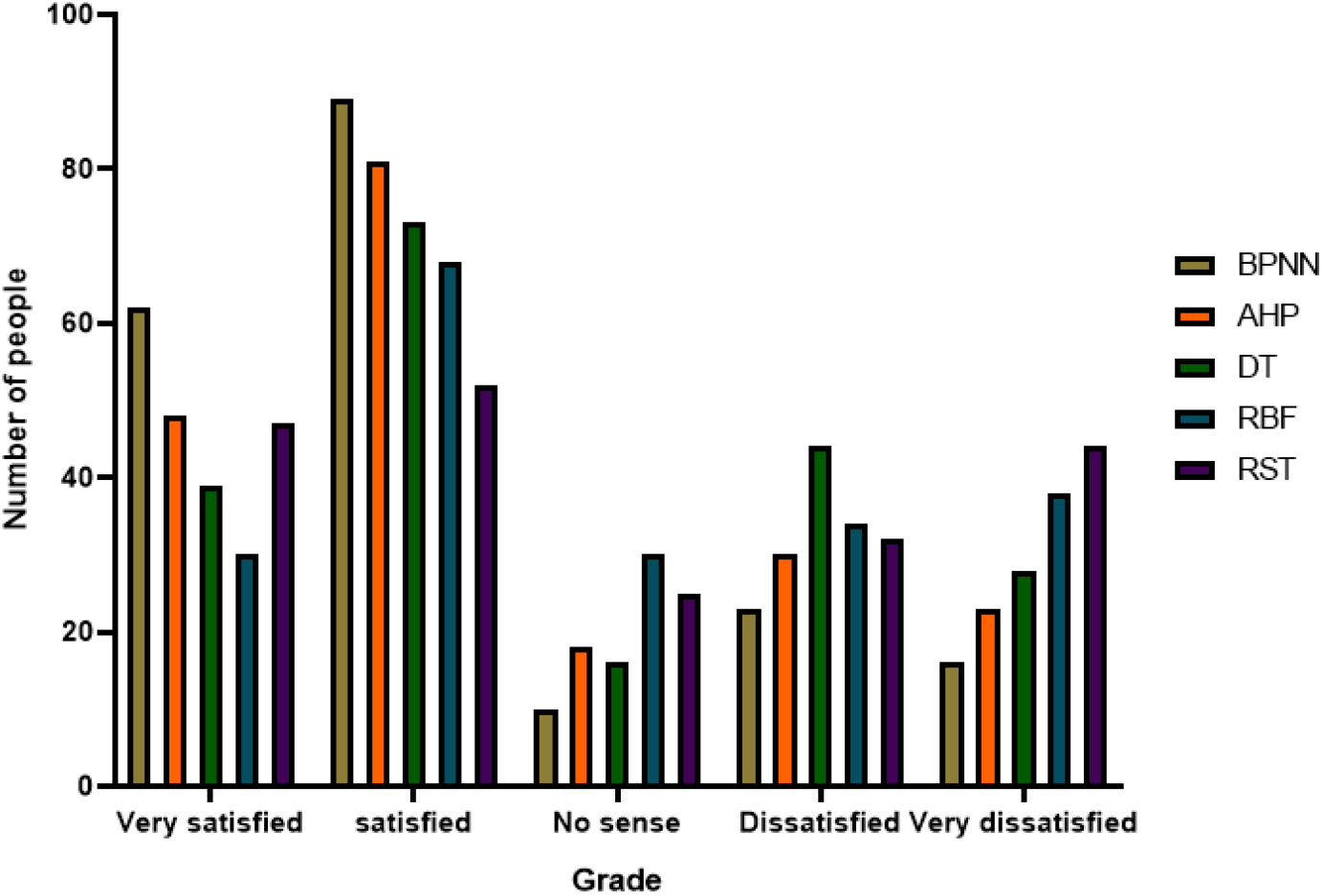
In Fig. 6, the x-axis represents the level of satisfaction, with a total of five levels, while the y-axis represents the number of students. As shown in Fig. 6, it can be found that for the students selected by W school, they were very satisfied with the BPNN based network English ETQ model. Among the five levels, 62 people chose to be very satisfied, which was much higher than other evaluation models, with 14, 23, 32, and 15 more people selected compared to the ETQ models based on AHP, DT, RBF, and RST, respectively. The total number of students satisfied with the BPNN based network English ETQ model was 151, with a total satisfaction rate of 75.5%, which was 11%, 19.5%, 26.5%, and 26% higher than the AHP, DT, RBF, and RST based ETQ models, respectively. The number of students who were very dissatisfied with the selection of BPNN based network English ETQ model selection was 16, which was 7, 12, 22 and 28 fewer than the ETQ models based on AHP, DT, RBF and RST, respectively. The total number of students dissatisfied with the BPNN based network English ETQ model was 39, with a total dissatisfaction rate of 19.5%, which was 7%, 16.5%, 16.5%, and 18.5% lower than the ETQ models based on AHP, DT, RBF, and RST, respectively.
The ETQ is a very complex nonlinear system with many influencing factors. Therefore, accurate mathematical models to describe the relationship between different factors and the quality of teaching and learning are difficult to develop. The quality of teaching in colleges and universities is determined by the quality of teaching of teachers, yet it is very hard to calculate how to evaluate the quality of teaching of teachers using a linear mathematical expression. Most colleges still use methods such as expert and after-school student evaluations to evaluate the teaching quality of teachers. Undeniably, these methods of judgment have a certain degree of practicality, but these judgment criteria also have their limitations. BPNN can be used to obtain high-precision prediction data through training and testing massive sample data, and establish a reasonable nonlinear network model. Meanwhile, the predicted findings can provide useful references for quality evaluation and teaching evaluation in universities. This paper applied the ETQ model on the basis of BPNN to network English teaching, which can not only quantitatively obtain evaluation results, helping teachers discover deficiencies in teaching in a timely manner, but also facilitate the academic affairs department to evaluate teaching quality, making the evaluation more quantitative.