




Abstract
In order to scientifically evaluate the emergency management capabilities of major cities in China, this article conducts a comprehensive study on the input and output indicators of emergency response in each city. A two-stage network DEA model was used to construct an evaluation model that reflects the emergency management capacity of cities. A dataset containing emergency management data from 36 well-known cities in China was selected to effectively evaluate its performance, and the city that demonstrated the most effective input-output ratio in the field of emergency management was ultimately determined. The research results show that using a two-stage network DEA model as the foundation to construct an evaluation model that reflects urban emergency management capabilities can promote a wise combination of subjective and objective evaluations, and achieve scientific investment in urban emergency assets.
Introduction
With the accelerating process of urbanization, cities are facing frequent occurrences of various emergencies and disasters. As a result, the enhancement of urban emergency management capability has garnered increasing attention and its significance has become more pronounced. Improving urban emergency management capability can effectively prevent and respond to various emergencies and disasters, ensuring the safety of residents’ lives and properties, as well as maintaining social stability and development. In order to promote the coordinated development of urban economic prosperity, comprehensive progress, and safety and stability, it is crucial for the government and all sectors of society to strengthen the construction of urban emergency management capability. This includes addressing weaknesses, enhancing the mechanisms and systems that revolve around emergency management departments, and promoting the modernization of emergency management systems and capabilities.
The evaluation of urban emergency capabilities is a systematic and comprehensive issue that entails reflecting the system’s emergency capabilities from various perspectives and angles. It aims to provide a comprehensive and three-dimensional evaluation of the system’s ability to respond to unforeseen events. The establishment of a comprehensive evaluation system for urban emergency management, based on the city’s overall process of public safety, can effectively evaluate the city’s emergency management efforts in responding to unforeseen events. This, in turn, enhances the city’s ability to implement diverse preventive measures and respond to emergencies. Furthermore, this system can also improve the efficiency of emergency management work and serve as an active exploration in promoting the modernization and scientific governance of urban public safety.
In the current realm of research pertaining to the evaluation of urban emergency management capabilities, the construction of an evaluation indicator system and the selection of evaluation methods have become focal points of interest among numerous scholars. Initially proposed by Charnes, Cooper, and Rhodes [1] in 1978, Data Envelopment Analysis (DEA) method serves as a mathematical programming approach for determining the relative efficiency of decision-making units involved in multiple-input, multiple-output scenarios, commonly referred to as the C2R model. In 1984, Banker, Charnes, and Cooper [2] collaborated to introduce an improved DEA model, known as the BC2 model, which eliminates the assumption of convexity and facilitates the evaluation of relative effectiveness among decision units. Currently, the DEA method has been extensively applied to evaluation problems in various domains, including economics and society [3, 4], yielding significant contributions. It is imperative for us to not only learn from international experiences and practices in modernizing emergency management capabilities but also to integrate them with the national conditions and social development of China. This entails the establishment of a distinctive evaluation indicator system for urban emergency management capabilities, characterized by its adherence to Chinese characteristics. Such a system characterizing should be forward-thinking, efficient, and scientifically grounded. Through a scientific and reasonable indicator system, evaluate the emergency management capacity of Chinese cities in a scientific manner, so that China’s emergency management capacity construction can reach the international advanced level and narrow the gap with advanced countries in the world. Through the development of urban emergency management capabilities, we can ensure the safety of citizens, maintain social stability, promote urban development, and safeguard national security.
Currently, many countries around the world have made significant progress in the research of government emergency management capability evaluation, with notable achievements from the United States and Japan. The US government has established a series of regulations and policies in urban emergency management, such as the Homeland Security Act, the Federal Emergency Management Act, and the National Emergency Plan. These policies clearly define the responsibilities of federal, state, and local governments, standardize the workflow of emergency management, and establish an evaluation framework consisting of 13 management functions, 209 attributes, and 1,014 indicators. On the other hand, Japan’s evaluation system focuses more on the prevention and control capabilities of individual disasters. Given Japan’s location in earthquake and typhoon-prone zones, the country faces constant threats from natural disasters. As a result, the Japanese government has been dedicated to researching and practicing urban emergency management capabilities. They have developed a range of emergency management technologies and tools, including earthquake early warning systems, disaster information sharing platforms, and unmanned aerial vehicle emergency rescue systems. These advancements have effectively enhanced the efficiency and accuracy of urban emergency management. In China, the theoretical research and practical application of a comprehensive evaluation system for urban emergency management capabilities are still in their nascent stages. The China Academy of Safety Science and Technology, as part of the national 13th Five-Year Plan for scientific and technological advancement, has introduced the framework for evaluating the emergency management capabilities of cities in response to sudden public incidents. This framework consists of 18 categories, 76 attributes, and 405 features. However, upon reviewing domestic and international research findings, it is evident that many evaluation indicators are overly complex, numerous in quantity, and lacking in strong interrelationships. This paper aims to establish an evaluation indicator system for urban emergency management capabilities from a comprehensive perspective. The proposed system incorporates input indicators such as emergency funds, the proportion of emergency funds to GDP, and the number of personnel involved in emergency response. Output indicators include the number of incidents, fatalities, and financial losses. By adopting a limited number of indicators, this system ensures a strong interdependence and independence among the indicators, enhancing its practicality.
In terms of domestic research, there have been several studies conducted on the construction of evaluation indicator systems for urban emergency management capabilities. Notably, Tie Yongbo [5] conducted research in 2005 on the construction of such a system, focusing on natural disasters and encompassing the entire emergency management process. Zhao Runzi [6] conducted research in 2018 on the evaluation indicator system for earthquake emergency preparedness capabilities in urban communities, specifically targeting earthquake disasters. Wu Yufeng [7] conducted research in 2015 on the evaluation indicator system for urban emergency management capabilities in China. Huang Fei [8] conducted research in 2019 on the evaluation of urban emergency capabilities from a public safety perspective, and constructed a related evaluation system for assessing these capabilities. Hao Xinyu [9] conducted research in 2021 on the preparatory stage of urban emergencies. Yang Wenguang [10] conducted research in 2022 on the evaluation of emergency management capabilities in large and medium-sized cities in China using the G1 method with weight constraints and the super-efficiency BC2 model, thereby achieving an effective and reliable ranking of urban emergency management capabilities. Xiao Chenglin [11]. In 2022, based on the multi-objective programming and DEA emergency LRP-material scheduling problem, the cross-efficiency DEA evaluation method is applied to the multi-objective programming, in order to achieve the objective evaluation of the multi-objective programming problem, so as to obtain a set of scientific and reasonable emergency LRP-scheduling scheme. In 2022, Wu Jingyuan [12] studied the optimization of the financial emergency fund guarantee mechanism in Heilongjiang Province, mainly building a unified information platform for emergency management and promoting the division of labor and cooperation among emergency management departments. Lu Yuhang [13] and the research on emergency resource scheduling of general national and provincial road network based on reliability in 2022 mainly provide scientific decision-making basis for highway emergency management departments and have reference value for emergency disposal reliability research under emergencies. In 2023, Chen Zehui [14] studied the location, path planning and risk assessment decision-making methods of emergency facilities in fuzzy environment, and proposed a location method based on bi-objective programming, in which the decision-making information is described by trapezoidal fuzzy numbers. In 2023, Ma yuanyuan [15] made an empirical study on the performance of drought and flood disaster relief in Northeast China under government behavior, and constructed an evaluation model of drought and flood disaster relief performance in Northeast China under government behavior. Zhao Youlin and Cao Hongnan [16] studied the efficiency of government microblog information exchange and its influencing factors for emergency management in 2022, mainly using DEA-BBC model to calculate the efficiency of fire microblog information exchange.
According to research findings from both domestic and international studies, the evaluation criteria for assessing urban emergency management capabilities have typically been characterized by intricate and voluminous design, with relatively weak interconnections. In this paper, however, a comprehensive evaluation framework for urban emergency management capabilities was proposed, which addresses these limitations. This framework incorporates input indicators such as emergency investment funds, the proportion of emergency investment funds to GDP, and the number of personnel involved in emergency response. Additionally, output indicators such as the number of incidents, fatalities, and financial losses are considered. The deliberate selection of a limited number of indicators within this framework ensures both interrelatedness and independence, thereby enhancing its operational feasibility.
In light of the aforementioned considerations, in order to mitigate biases introduced by subjective factors, this study incorporates the DEA method to analyze the efficiency of emergency management capabilities across different cities in China. By employing a novel network DEA model, a comprehensive evaluation and analysis of urban emergency management capabilities were conducted, aiming to provide scientifically credible insights for the advancement of emergency management practices in Chinese cities.
Methodology
The novel DEA model is an evaluation method based on Data Envelopment Analysis that possesses the distinctive feature of simultaneously considering multiple input and output indicators and transforming them into a comprehensive evaluation metric. When comprehensively evaluating urban emergency management capabilities, the novel DEA model enables the quantification of diverse indicators related to various facets of urban emergency management. These indicators are then consolidated into a comprehensive evaluation metric, enabling a more accurate assessment of the overall level of urban emergency management capabilities.
In more specific terms, the novel DEA model categorizes the indicators related to various aspects of urban emergency management capabilities into input and output indicators. Input indicators encompass factors such as emergency management investments and personnel involved in emergency management. On the other hand, output indicators include metrics such as fatalities, losses, and the number of incidents. By quantifying and comprehensively evaluating these indicators, a comprehensive evaluation metric for urban emergency management capabilities was derived. This allows for a more robust assessment of the overall level of urban emergency management capabilities.
The novel DEA model offers several advantages in the comprehensive evaluation of urban emergency management capabilities:
Simultaneous consideration of multiple input and output indicators enables a more comprehensive assessment of the level of urban emergency management capabilities. Transformation of various indicators into a comprehensive evaluation metric allows for a more accurate evaluation of the overall level of urban emergency management capabilities. Providing a scientific assessment method and reference basis for enhancing urban emergency management capabilities.
Therefore, the novel DEA model holds significant potential for widespread application in the comprehensive evaluation of urban emergency management capabilities, offering robust support for the improvement of these capabilities.
In the context of DMUp (
Equations (2) and (2) represent two independent subprocesses and do not account for the unique nature of the intermediate variable zkq, which serves as both an output of the first subprocess and an input of the second subprocess. While it is desirable for zkq to be maximized as an output of the first subprocess, it is preferable for zkq to be minimized as an input of the second subprocess. Recognizing this, Kao [17] considered the interrelationship between subprocesses within the DMU and suggested that when computing system efficiency, the nature of an element as an input or output, or its association with a specific subprocess, should not affect its weight, which remains constant. Taking this into consideration, the following model was proposed:
By employing the Charnes-Cooper linear transformation, the fractional Eq. (3) can be transformed into the following linear model:
Data of emergency management related indicators in 36 large and medium-sized cities in China
Proof: From the constraints in Eq. (3), it can be observed that
The proof is thereby established, demonstrating that
Let
According to Definition 2, it follows that
DEA system of emergency management network.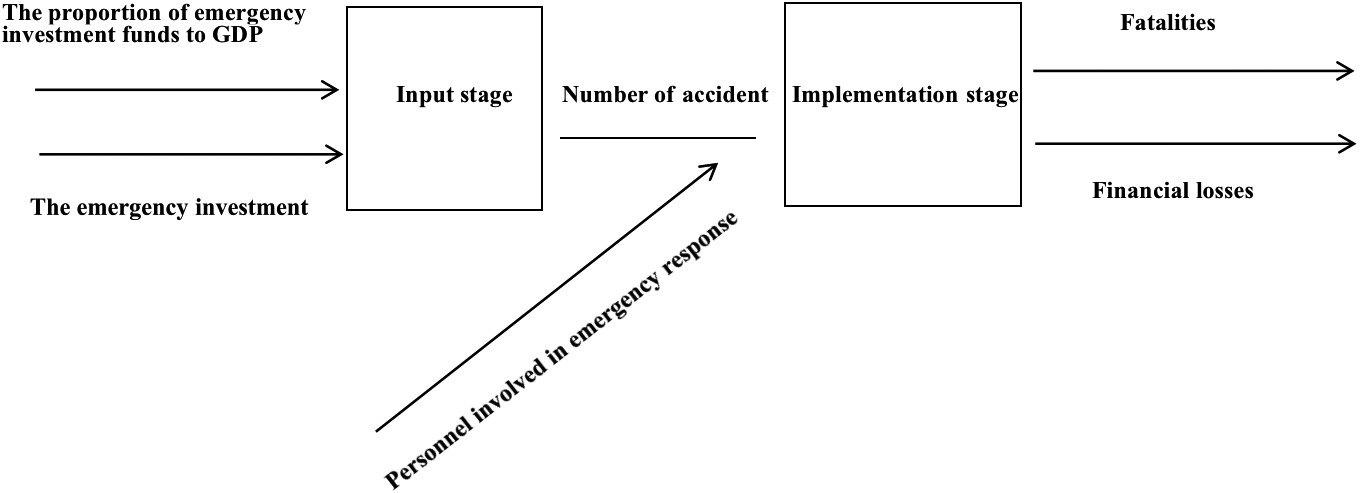
(1) Selection of samples and indicators
A total of 36 cities in China were selected as the research subjects for this study. These cities were chosen from the 2020 China Statistical Yearbook and relevant data that had been published by local emergency management bureaus. The selected cities encompass both first-tier cities in the eastern region and second-tier cities in the central and western regions, ensuring a broad representation with regards to spatial distribution across the country. Considering the significant disparities in the sizes of these cities, the corresponding variations in investments and outputs in emergency management were observed. The data utilized for evaluation comprised the information pertaining to the 36 large and medium-sized cities in China for the year 2019.
Considering that emergency management involves aspects such as financial investment, accident prevention, and accident losses, we selected six indicators for analysis: the proportion of emergency investment funds to GDP, emergency investment funds, personnel involved in emergency management, number of accidents, number of fatalities in accidents, and financial loss. The first three indicators are input indicators, while the last three indicators are output indicators. As network DEA cannot calculate negative correlation indicators, the reciprocal of the number of accidents was used as the indicatordata.
Using these indicators, we established a comprehensive evaluation system for urban emergency management capabilities, encompassing the entire process across various levels and dimensions. Table 1 presents the data of the selected six indicators for the 36 large and medium-sized cities in China.
Total efficiency value and ranking of emergency management in 36 large and medium-sized cities in China
Total efficiency value and ranking of emergency management in 36 large and medium-sized cities in China
Efficiency value and ranking of emergency management node 1 in 36 large and medium-sized cities in China
Efficiency value and ranking of emergency management node 2 in 36 large and medium-sized cities in China
(2) Modeling
Emergency management in China was divided into two stages in this paper, as shown in Fig. 1.
In the process of model construction, we chose the proportion of emergency investment funds to GDP and emergency investment funds as input indicators for the input stage. The number of accidents was used as an intermediate variable, representing the output at Node 1 and the input at Node 2. During the implementation stage, personnel involved in emergency management was taken as an input indicator, and the number of fatalities in accidents and financial losses as output indicators. This forms the framework of our two-stage network DEA model.
(3) Data operation
After determining the indicators, data, and model, we conducted calculations using the MaxDEA software. After importing the raw data, cities were defined as DMUs, with input indicators, output indicators, and intermediate variables specified. In the envelopment model, we selected radial distance, input orientation, constant returns to scale (CRS), and convexity frontier. Since we only collected emergency management data for the year 2019, we set up a non-panel data model. In the advanced model settings, we selected network DEA, with the intermediate variable as a free variable. Once the network structure was set, the calculations could be performed. The final results include the overall efficiency and two-stage efficiencies, as shown in Tables 2–4.
(4) Comprehensive evaluation and analysis
According to the overall efficiency values in emergency management, the top ten cities are Chongqing, Tianjin, Chengdu, Harbin, Suzhou, Foshan Changsha, Hangzhou, Shanghai, and Nanjing.
In terms of the first-stage efficiency values, the top ten cities are Chengdu, Suzhou, Hangzhou, Changsha, Wuxi, Jinan, Harbin, Zhengzhou, Hefei, and Nanjing.
Concerning the efficiency values for the second stage, the leading ten cities include Tianjin, Chongqing, Harbin, Foshan, Chengdu, Suzhou, Beijing, Changsha, Hangzhou, and Shanghai.
Upon comparison, it is evident that Chongqing ranks first in overall emergency management efficiency, second in the second-stage efficiency, but 17th in the first-stage efficiency. This suggests that the utilization of investment funds in the region is not fully optimized, yet the overall effectiveness of emergency management remains commendable. Conversely, Baoding exhibits the lowest overall efficiency. Further examination reveals that this city’s poor performance can be attributed to both the input and implementation stages. Although Chengdu ranks first in the first-stage efficiency, it is ranked third in the overall efficiency due to inadequate control over the number of fatalities and loss of funds during the implementation stage.
In the traditional DEA model, the important role of intermediate variables is often ignored, and the evaluation of emergency management efficiency is solely based on the input and output indicators. This approach fails to provide a comprehensive assessment of the efficiency differences at various stages, thus leading to potential misjudgments regarding the actual state of emergency management efficiency.
By employing a two-stage network DEA model, we can overcome the subjective biases and achieve objective assessments by assigning appropriate weights to intermediate variables. This approach not only addresses the issue of rank reversal but also provides a reliable and valid ranking of cities’ emergency management capabilities.
(1) Differences in emergency management efficiency among cities
In this study, an innovative two-stage network DEA model was constructed based on the foundational single-stage DEA model to assess the emergency management capabilities of major cities in China. The emergency management capabilities of 36 selected cities in the country was comprehensively evaluated and ranked. Analysis of the presented data revealed that Chengdu, Suzhou, and Hangzhou emerged as the top three cities with the most efficiently allocated resources towards emergency management. In terms of output efficiency, the first position was jointly secured by Tianjin and Chongqing, followed by Harbin in third place. From a holistic perspective, the three cities demonstrating the highest overall emergency management efficiency were Chongqing, Tianjin, and Chengdu, with respective efficiency values of 0.553328094, 0.543781698, and 0.5291877933. Conversely, Baoding, Haikou, and Fuzhou ranked the lowest in terms of efficiency, with corresponding values of 0.121191483, 0.186221886, and 0.188982588.
(2) Urgent need to improve efficiency in emergency management
Based on the data of emergency input and output indicators from major cities, it can be observed that the efficiency values of emergency management capabilities among the 36 cities are relatively low. This indicates the presence of redundant inputs and insufficient outputs, highlighting the need for further improvements and enhancements in the levels of emergency input and output. There is significant room for improvement and potential for enhancement in this regard.
(3) Developing strategies to improve efficiency in emergency management based on local conditions
In light of the aforementioned research findings, and taking into consideration the current state of the national emergency management system in 36 cities, we propose the following recommendations:
In the realm of disaster prevention, it is imperative to strengthen monitoring and early warning capabilities. Enhancing the ability to prevent and respond to unforeseen events entails the establishment of robust mechanisms and measures including social alert systems, emergency response mechanisms, social mobilization mechanisms, and hazard identification and mitigation. Identifying and rectifying potential risks and hazards, employing dynamic monitoring of factors that may pose risks, and predicting the types and scope of disasters would enable timely dissemination of information to the public, thereby facilitating effective disaster preparedness. Additionally, the training of a competent contingent of emergency responders is essential to provide on-site assistance and rescue operations promptly during incidents. Prompt response and mobilization of personnel and resources to the affected areas are crucial when disasters strike. Tailored actions should be taken in accordance with the nature and evolving trends of the disaster, intervening and controlling its development in order to minimize human and property losses. Post-disaster recovery efforts should be diligently carried out. After the crisis subsides, timely dissemination of relevant information and guiding public opinions through online platforms are essential. Proper post-disaster handling and comprehensive assessments of the situation are vital. It is imperative to refine national regulations and policies, ensuring the standardization of emergency management workflows. Concurrently, greater emphasis should be placed on publicizing emergency management efforts in various cities, fostering widespread awareness of the importance and necessity of emergency preparedness, and enhancing the dissemination of emergency knowledge to reduce the impact of disasters.
Footnotes
Funding
This Paper was supported by the Key Program of Research Foundation of Education Bureau of Hunan Province (21A0520).
This Paper was supported by the Subject of Hunan Social Science Review Committee (No. XSP22YBZ137).