




Abstract
To meet the needs of professional development promotion through cross-university collaborative construction in the era of Internet
Keywords
Introduction of the problem
In the era of global digitization, the digital economy is driving profound changes in global production, lifestyle, and governance, becoming a key force in reorganizing global resources, reshaping the global economic structure, and changing the global competitive landscape [1]. Education and teaching must adapt to this profound change, seize the opportunities of global digitization, deepen education reform, and create new forms, thus the emergence of the “Virtual Teaching and Research Room” [2].
The Ministry of Education of the People’s Republic of China has pointed out that the Virtual Teaching and Research Room is a new form of grassroots teaching organization construction in the information age [3], encouraging pilot national and regional Virtual Teaching and Research Rooms, strengthening inter-school exchanges, promoting teacher teaching capacity improvement, and improving talent training quality [4]. The construction of Virtual Teaching and Research Rooms has become a current hotspot in teaching reform research [5].
At present, the Ministry of Education has carried out two batches of national-level Virtual Teaching and Research Room construction, and various provinces have also carried out different types of Virtual Teaching and Research Room construction. Some Virtual Teaching and Research Rooms are constructed within multiple disciplines of a single college, which have issues of homogenized functions with physical teaching and research rooms [6, 7]; some are based on the collaborative construction of a single online course, with a single function but providing a reference for inter-school collaboration through information technology [8, 9]; some are based on the collaborative construction of regional Virtual Teaching and Research Rooms for a group of disciplines [10, 11], such as Beijing Printing College and Beijing Jiaotong University, among five universities in Beijing, carrying out a dual-cultivation program based on discipline groups, providing a good reference for the construction of regional Virtual Teaching and Research Rooms. However, current research and exploration of both regional and national Virtual Teaching and Research Rooms are still in their infancy [12], with challenges such as high organizational difficulty, high information technology requirements, large communication and coordination efforts, and lack of mature and referenceable standards, especially in the research of characteristic development mechanisms and operational mechanisms of Virtual Teaching and Research Rooms [13, 14].
The undergraduate program of Building Electrical and Intelligent Specialty was established in 2006, with over 100 universities offering the program nationwide. However, there are only two “double first-class” universities and 12 national first-class specialty construction sites, reflecting the short history of the program and varying levels of quality among universities. The Ministry of Education’s Teaching and Research Subcommittee for Building Electrical and Intelligent Specialty has organized annual conferences, joint graduation projects, and professional competitions, providing offline channels for inter-school teaching and research exchange. However, since the spring of 2020, due to the impact of the pandemic, related activities have been suspended or loosely organized. Based on these factors, the Teaching and Research Subcommittee organized universities nationwide offering the Building Electrical and Intelligent Specialty program to explore new channels for inter-school teaching and research exchange, successfully applying for two national Virtual Teaching and Research Rooms in 2022: the Building Electrical and Intelligent Specialty Virtual Teaching and Research Room and the Building Intelligent Experiment Course Group Virtual Teaching and Research Room, establishing a platform for cross-regional Virtual Teaching and Research Room construction.
In recent two years, both the national government and Henan Province have successively issued documents such as “Pilot Construction of Virtual Teaching and Research Rooms” and “Three-Year Action Plan for Smart Teaching,” encouraging pilot Virtual Teaching and Research Rooms, strengthening inter-school and cross-regional teaching and research exchanges, and exploring new methods for the construction of grassroots teaching organizations integrating online and offline channels with new-generation information technology. This provides policy support for the construction of regional Virtual Teaching and Research Rooms for Building Electrical and Intelligent Specialty inter-school exchange and research discussion.
Zhengzhou University of Light Industry is one of the first universities in Henan Province and among the earliest ten universities nationwide to offer the Building Electrical and Intelligent Specialty program. It is one of the 12 national first-class specialty construction sites, with a leading educational level nationwide and a prominent role among the eight universities offering this program in Henan Province. The university has actively participated in and organized various online and offline exchange activities of the Teaching and Research Subcommittee and is one of the participating universities in the two national Virtual Teaching and Research Rooms related to Building Electrical and Intelligent Specialty under the Ministry of Education. Led by Zhengzhou University of Light Industry, the collaborative construction of a regional Virtual Teaching and Research Room for Building Electrical and Intelligent Specialty in Henan Province has rich experience and strength, fully demonstrating the promotion and demonstration effects of advanced experience and serving as a part of the national Virtual Teaching and Research Room construction, providing experience and reference for the national Virtual Teaching and Research Rooms.
This article takes the Building Electrical and Intelligent Specialty as an example and explores the construction paths and safeguard mechanisms of the regional Virtual Teaching and Research Room with inter-school collaborative construction in Henan Province. It introduces the practical experience of regional Virtual Teaching and Research Room construction from several aspects, such as construction ideas, objectives, implementation plans, and effectiveness. The study aims to address the following issues:
Building an inter-school collaborative construction and sharing platform for high-quality resources in regional Virtual Teaching and Research Rooms. Collaborative construction involves various aspects such as training programs, teacher training, course construction, and practical bases. With the uneven development among schools, forming a high-quality resource sharing platform to play a leading role is crucial for realizing the inter-school collaborative construction path of regional Virtual Teaching and Research Rooms. Innovating a new teaching organization model for inter-school collaborative construction in regional Virtual Teaching and Research Rooms. Integrating new-generation information technology to address the difficulties in cross-university organization and coordination in collaborative construction is essential for innovating the inter-school collaborative construction model of regional Virtual Teaching and Research Rooms. Exploring the efficient and stable operation mechanism for inter-school collaborative construction in regional Virtual Teaching and Research Rooms. Developing relevant policies and incentive systems to overcome cross-university and cross-regional spatiotemporal constraints, promoting inter-school cooperative development, and ensuring stable operation in both online and offline environments are key to implementing the collaborative construction mechanism of Virtual Teaching and Research Rooms.
Construction path
Initially, by consulting literature and understanding national policies and the current state of Virtual Teaching and Research Room construction, we investigate the functional requirements of regional Virtual Teaching and Research Rooms by visiting cooperative universities. Then the construction ideas are proposed. Subsequently, the research findings are analysed and summarized to refine the construction approach and objectives. Next, the multi-party discussions and debates are organized to develop implementation plans. Finally, the information technology is utilized to collaboratively construct an online platform for high-quality resource sharing and teaching research. This platform is tested and refined through collaborative construction practices, ultimately forming a closed-loop system. The construction path is illustrated in Fig. 1. Where, ZZULI is the school of Zhengzhou University of Light Industry, HNCJ is the school of Henan University of Urban Construction, SQNU is the school of Shangqiu Normal University, ZKNU is the school of Zhoukou Normal University.
Construction path of regional virtual teaching and research room.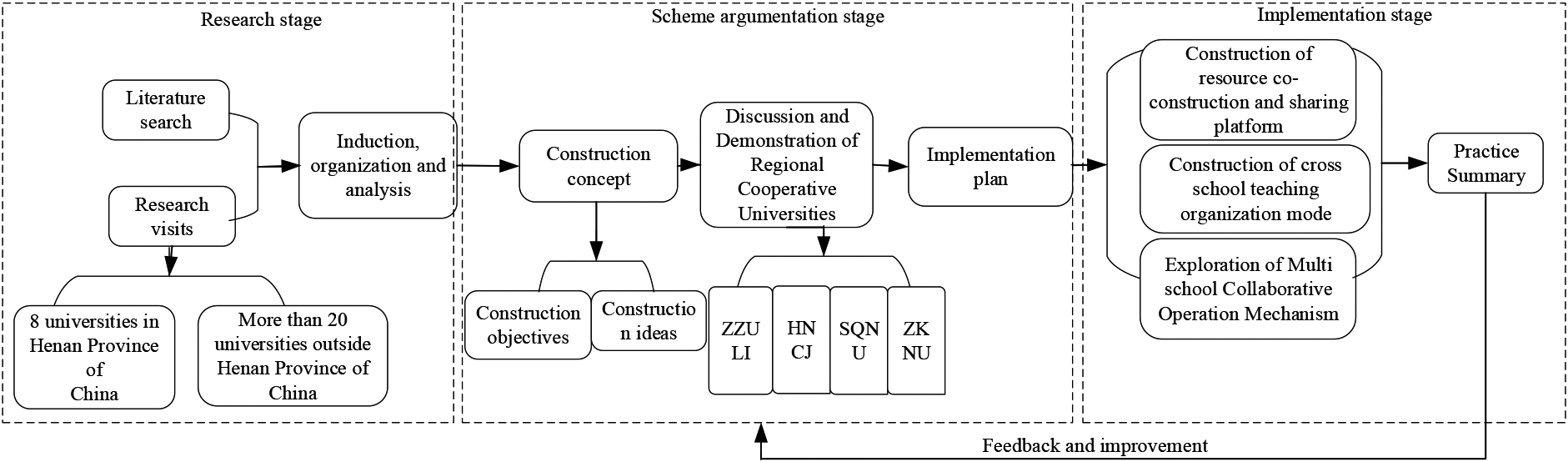
Zhengzhou University of Light Industry is the first university in Henan Province to offer a bachelor’s degree in Building Electrical and Intelligent Specialty and is among the top ten institutions in China to do so. This specialty has successively obtained the status of Henan Province Comprehensive Reform Pilot, National First-Class Specialty Construction Site, and Henan Province Outstanding Grassroots Teaching Organization. The specialty has also hosted and participated in numerous provincial-level teaching reform projects, earning special and first-class awards in Henan Province for teaching achievements, and has been assessed for national teaching achievement awards. It plays a leading role in the field of Building Electrical and Intelligent Specialty.
Adhering to the philosophy of “open education, integrating industry and academia,” the specialty focuses on collaborative talent cultivation. It maintains long-term relationships with industry experts, inviting them to lecture and guide graduation projects, while faculty members participate in engineering practice training and actual engineering projects. The specialty has jointly established the Ministry of Education’s Industry-Academia Cooperation Collaborative Education Practice Base, Provincial Off-Campus Practice Education Base, Provincial Experimental Demonstration Center, and Provincial Virtual Simulation Experimental Teaching Projects. It has also co-authored numerous engineering case guides and Internet
The specialty maintains long-term partnerships with industry enterprises and related professional universities within and outside the province, participating in and hosting multiple Ministry of Education Building Electrical Education Steering Committee meetings, teacher training, dean and department head forums, and joint graduation projects. The specialty has also collaborated with Xi’an University of Architecture and Technology in applying for the Ministry of Education’s “Building Intelligence Experimental Course Group Virtual Teaching and Research Room,” which was successfully approved, accumulating valuable experience and a solid foundation for cross-university and cross-regional collaboration.
Safeguard mechanisms
(1) Policy Guidance Mechanism: Schools actively coordinate and communicate with relevant departments, utilizing resources such as the servers provided by their information technology centers, to address cross-university and regional access permissions, as well as platform development for online courses. This enables sharing and mutual utilization of established inter-school online course resources.
(2) Resource Construction Assurance Mechanism: On one hand, fully utilize mature network resource platforms, such as China University MOOC and XueXiTong, to strengthen the use of provincially-approved high-quality online open courses and course teaching demonstration packages. On the other hand, form cross-university high-level teaching faculty teams to create superior online teaching resources for core courses.
(3) Communication and Exchange Mechanism: Open cross-university and cross-regional communication channels, periodically organize core members to conduct online seminars, sharing experiences in course construction and faculty training among various universities. Encourage project members to engage in cross-university visits and exchange activities, ensuring the efficient operation of regional Virtual Teaching and Research Rooms.
Construction approach and objectives
Construction approach
(1) Understand national policies, identify pain points in physical teaching and research rooms, sort out the functional requirements of regional Virtual Teaching and Research Rooms, and clarify construction purposes.
(2) Clarify construction content, integrate high-quality resources from various universities, leverage the leading role of first-class majors and courses, and establish a collaborative construction and sharing platform.
(3) Innovate organizational models, integrate next-generation information technology to establish virtual teaching organization platforms, and address difficulties in cross-university collaborative construction and coordination.
(4) Develop collaborative construction-related systems, explore the mechanism of multi-university collaborative construction for regional Virtual Teaching and Research Rooms, achieve complementary advantages among multiple universities, promote collaborative professional development, and improve education quality.
Construction objectives
(1) Relying on Building Electrical and Intelligent Specialty, establish a high-quality resource sharing platform that includes training programs, faculty training, course construction, textbook compilation, practical bases, school-enterprise cooperation, and discipline research. Form a new path for multi-university collaborative construction of regional Virtual Teaching and Research Rooms.
(2) Using Building Electrical and Intelligent Specialty as an example, leverage information technology to strengthen teaching organization and innovate models, forming a new mode of online and offline integration for multi-university collaborative construction of regional Virtual Teaching and Research Rooms.
(3) With Building Electrical and Intelligent Specialty as an example, formulate stable operation-related systems and incentive policies for collaborative construction, exploring new mechanisms for multi-university collaborative construction of regional Virtual Teaching and Research Rooms.
(4) Achieve complementary advantages among all cooperating universities, obtain experiences in multi-university collaborative construction of regional Virtual Teaching and Research Rooms, promote the sustainable and healthy development of Building Electrical and Intelligent Specialty, further expand its application to a larger scope, and form a new paradigm for multi-university collaborative construction of Virtual Teaching and Research Rooms that radiates throughout the province and even the entire country.
Construction practice and effects
Construction implementation plan
The implementation plan for the construction of the Building Electrical and Intelligent Specialty Regional Virtual Teaching and Research Room is shown in Fig. 2.
(1) Visiting, researching, and discussing to clarify construction objectives: Conduct visits and research on the pain points of physical teaching and research rooms and functional requirements for regional Virtual Teaching and Research Rooms in cooperating universities, consult national policies and the current status of Virtual Teaching and Research Rooms, and organize discussions among various schools. Fully consider the differences in the characteristics and levels of the majors offered by each school, learn from each other, and propose feasible ideas and objectives for the collaborative construction of regional Virtual Teaching and Research Rooms.
(2) Building a high-quality resource co-construction and sharing platform: Fully leverage the leading role of Zhengzhou University of Light Industry’s national first-class major construction site in Building Electrical and Intelligent Specialty. Rely on the high-quality resources of cooperating universities, such as provincial-level first-class courses, high-quality online open courses, ideological and political model courses, outstanding online teaching courses, off-campus practical education bases for college students, and virtual simulation experimental teaching projects. Co-construct repositories for excellent teaching resources, outstanding teaching cases, high-quality teacher training resources, internship and practical training bases, and employment information, achieving interconnected and shared high-quality resources.
(3) Constructing a new cross-university teaching organization model: Utilize information technology to build a virtual teaching and research platform, follow the “problem-oriented, work research-oriented” approach, and transform traditional vertical management in teaching and research rooms to flat management. From various perspectives, such as talent training programs, course teaching, textbook compilation, faculty training, discipline competitions, construction of internship and practical bases, postgraduate employment, discipline research, and school-enterprise cooperation, address common difficulties and forward-looking research in the teaching process. Freely form cross-university research groups, adopt a “dynamic adjustment” principle for group members, and introduce educational administration personnel, counselors, ideological and political teachers, and industry experts in a timely manner, forming a new virtual teaching organization model that breaks through time and space constraints.
(4) Exploring the multi-university collaborative construction operation mechanism: Establish a system for regular teacher discussions, relying on online communication platforms to ensure cross-temporal and spatial discussions among teachers; establish a short-term faculty training system, promoting offline visits and mutual learning among virtual cooperating university teachers; grant access permissions to high-quality resource sharing platforms for faculty and students of cooperating universities, enabling cross-university exchanges and learning; establish a discipline competition system for cooperating universities, regularly hosting BIM design competitions, green building design competitions, and other discipline competitions; establish a cross-university graduation project system, promoting interaction and mutual improvement among teachers and students of cooperating universities; establish a “cloud-based” internship and practical training system, enabling students to visit high-quality laboratories and off-campus practical bases without leaving the campus. Ultimately, form a cross-temporal and spatial, seamless online and offline integration, open and free, efficient and robust operation mechanism that strengthens communication and exchanges among “teachers, teacher-student, and student-student”.
Implementation plan for the construction of building electrical and intelligent specialty regional virtual teaching and research room.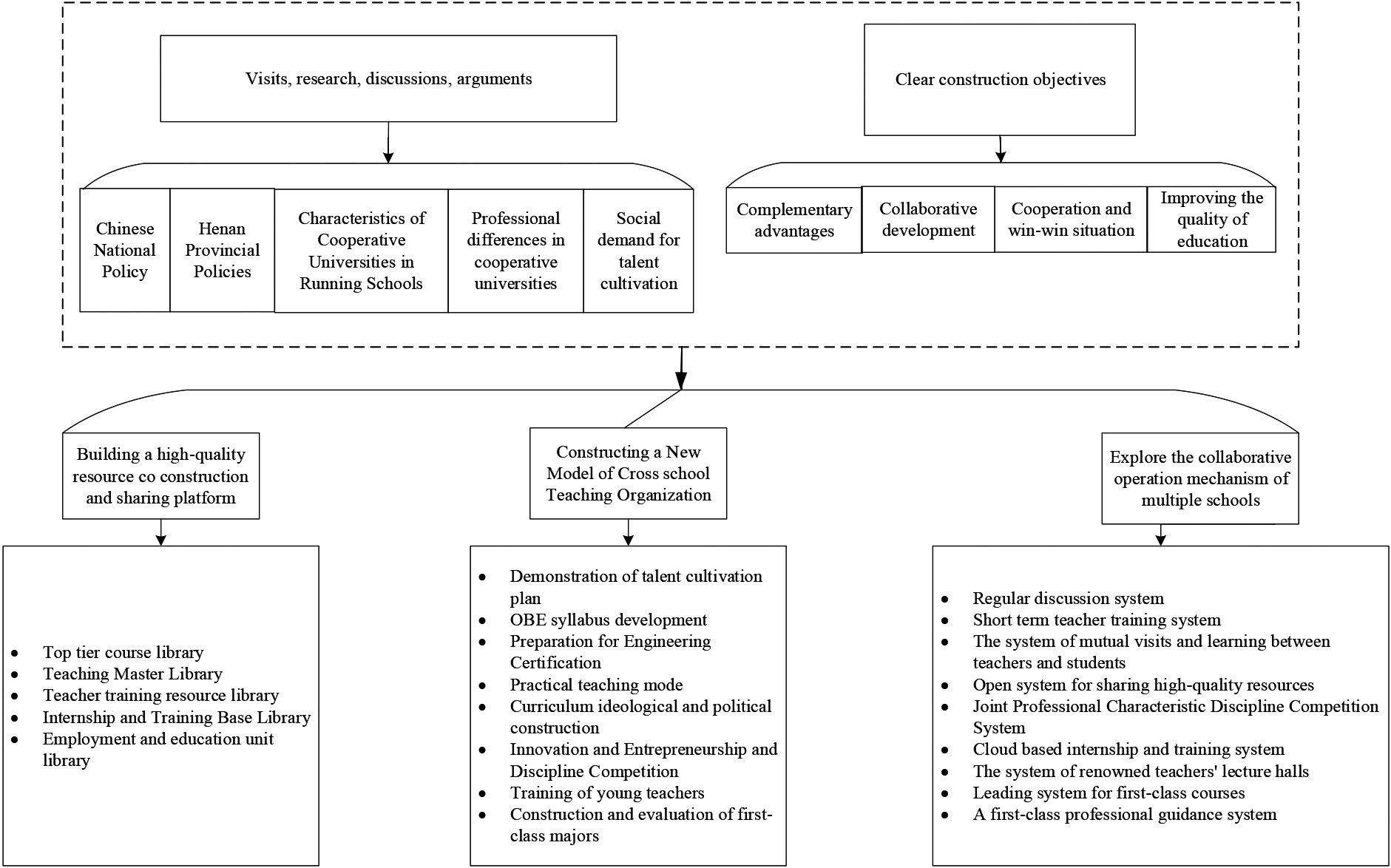
(1) Establishment of a high-quality resource co-construction and sharing platform in the Super Star Learning Platform. Leveraging information technology, multiple universities collaborate in a division of labor to jointly build repositories for high-quality teaching resources, excellent teaching cases, quality teacher resources, school-enterprise and inter-school internship/training bases, and employment information. This allows for inter-connectivity and co-construction and sharing of resources. The platform is built on Chaoxing Learning Pass, which establishes links to high-quality resources. Teachers and students from cooperating universities can access and use the resources according to set permissions. They also utilize resources available through the national-level Virtual Teaching and Research Room for Building Electrical and Intelligent Specialty and the Building Intelligence Experimental Course Group Virtual Teaching and Research Room. Table 1 shows the statistics on the high-quality resource repositories and collaborative construction and sharing in the Regional Virtual Teaching and Research Room for Building Electrical and Intelligent Specialty.
High-quality resource repositories and collaborative construction and sharing in the Regional Virtual Teaching and Research Room for Building Electrical and Intelligent Specialty
High-quality resource repositories and collaborative construction and sharing in the Regional Virtual Teaching and Research Room for Building Electrical and Intelligent Specialty
(2) Formation of cross-regional teaching and research teams. Relying on the Virtual Teaching and Research Room, online and offline communication and collaboration among teachers from cooperating universities are promoted. Research and exploration in areas such as professional construction, curriculum teaching, and teaching evaluation are strengthened, leveraging the advantages of joint research. Eight core professional courses serve as the foundation for building high-level teaching and research teams composed of full-time teachers, external industry experts, and industry mentors. Table 2 shows the statistics on the cross-regional teaching team construction in the Regional Virtual Teaching and Research Room for Building Electrical and Intelligent Specialty.
Cross-regional teaching team construction in the regional virtual teaching and research room for building electrical and intelligent specialty
(3) Development of a new collaborative co-construction model for Regional Virtual Teaching and Research Rooms. Optimizing top-level design and cross-regional collaborative construction, the professional co-construction plan is jointly discussed. Using information technology, various aspects such as talent cultivation models, teacher training, teaching reform, discipline competitions, and internship bases are addressed. Cross-university collaboration is facilitated through the interaction with the Ministry of Education’s Virtual Teaching and Research Rooms for Building Electrical and Intelligent Specialty and related courses. The responsible universities periodically organize online thematic discussions, forming a new model of online and offline integration for regional multi-university grassroots teaching organizations. Since the project’s inception in January 2022, the Regional Virtual Teaching and Research Room for Building Electrical and Intelligent Specialty has conducted 13 online teaching activities, averaging one per month. Table 3 shows the specific statistics.
(4) Establishment of an efficient and robust operation mechanism. By implementing policy documents, a dynamic, open, efficient, and stable operation mechanism for multi-university collaborative construction of Virtual Teaching and Research Rooms has been formed. Effective communication and collaboration are carried out through the Virtual Teaching and Research Rooms. Table 4 shows the policy documents for the operation mechanism of multi-university collaborative construction of the Regional Virtual Teaching and Research Room for Building Electrical and Intelligent Specialty in Henan Province.
(5) After a year of construction and practice, the professional quality and learning ability of students has been further improved. The failure rate of students has dropped significantly. Taking 84 students from Grade 20 of Building Electrical and Intelligent Engineering in Zhengzhou University of Light Industry as an example, all of them passed the course of building public safety technology, with an average score of 80.89 points. According to the survey feedback of students, the achievement of course objectives is above 0.8, and the achievement of problem analysis, problem solving, independent learning and expression ability is above 0.85, among which the achievement of expression ability is 0.9.
Online teaching activities in the regional virtual teaching and research room for building electrical and intelligent specialty
Operation mechanism of multi-university collaborative construction of the regional virtual teaching and research room for building electrical and intelligent specialty
(1) Exploring a new organizational model for regional virtual teaching and research rooms, addressing the common needs of cross-university teaching and research in the same specialty. Currently, virtual teaching and research rooms nationwide are often built based on multiple majors within the same college or the same course, leading to issues such as homogenization of functions with physical teaching and research rooms and single-functionality. This project builds a regional virtual teaching and research room for the Building Electrical and Intelligent Specialty within the province, which has strong feasibility due to the common teaching and research needs of the same specialty. By exploring multi-university collaborative construction paths, organizational models, and operating mechanisms, inter-university high-quality resources and outstanding teaching teams are co-constructed and shared, promoting collaborative development and interdisciplinary integration among cooperating universities. This approach effectively radiates to relevant majors in each university, providing valuable references for a wider range of multi-university collaborative construction of virtual teaching and research rooms.
(2) Leveraging the leading role of national and provincial first-class majors and courses to construct a cross-university high-quality resource co-construction and sharing platform. The original intention of constructing first-class majors and courses at the national level is to expand and strengthen a portion of high-quality majors and courses and to play a driving and leading role in revitalizing undergraduate education comprehensively. This project relies on the national first-class major construction site of Building Electrical and Intelligent Specialty at Zhengzhou University of Light Industry and collaborates with universities within Henan Province that offer the same major. It fully leverages the advantages of joint research among various universities and integrates high-quality resources such as provincial-level first-class courses, high-quality online open courses, ideological and political model courses, outstanding online teaching courses, off-campus practice education bases for college students, and virtual simulation experiment teaching projects. This approach achieves interconnectedness, co-construction, and sharing of high-quality resources among regional universities, driving the collaborative development of Building Electrical and Intelligent Specialty in universities within the Henan Province region.
Conclusion
This paper, taking Building Electrical and Intelligent Specialty as an example, explores the construction path and safeguard mechanism of regional virtual teaching and research rooms collaboratively built by multiple universities within Henan Province. It introduces the practical experience of regional virtual teaching and research room construction from several aspects, including construction ideas, objectives, implementation plans, and outcomes. A platform for the co-construction and sharing of high-quality resources in regional virtual teaching and research rooms has been established, and a new organizational model for collaborative construction of teaching and research organizations in regional virtual teaching and research rooms has been innovated. A set of efficient and stable operating mechanisms for multi-university collaborative construction of regional virtual teaching and research rooms has been formed, achieving the interconnection, co-construction, and sharing of high-quality resources among regional universities. This approach has driven the collaborative development of Building Electrical and Intelligent Specialty in universities within the Henan Province region and can provide valuable references for the collaborative construction of virtual teaching and research rooms on a larger scale, promoting professional construction, and improving the quality of talent cultivation.
Footnotes
Acknowledgments
The authors acknowledge the Higher Education Teaching Reform Research and Practice Project of Henan Province in China (Grant: 2021SJGLX200, 2021SJGLX188), the Graduate Professional Degree Excellent Teaching Case Project of Henan Province in China (Grant: YJS2023AL024) and the National Virtual Teaching and Research Room Project of Ministry of Education in China – the Virtual Teaching and Research Room of Building Intelligent Experimental Course Group (Grant: Higher Education Office Letter [2022] No. 3-184).