




Abstract
In order to effectively solve the problem of acquiring knowledge from tactical wargaming data, an overall analysis framework is designed based on the standard process of data mining. The data is analyzed from four aspects: time, space, maneuver path and multi-operator behavior correlation. The behavioral characteristics of single operators at different stages and the spatial distribution of key points such as shooting points, hit points and hidden points, and the association rules of movement, shooting, and occupation between multiple operators are obtained. This will provide commanders with experience and knowledge, help them to quickly accumulate combat experience, and provide behavior rules and action modes for the development of wargaming AI, effectively improving its intelligent level.
Introduction
Computer wargaming has the advantages of low training cost, unrestricted field, flexible and fast deduction. It is an effective way for commanders to train their strategic, operational and tactical command ability in peacetime [1, 2, 3, 4]. For a long time, the development of computer wargaming is in its infancy, and the research mostly focuses on the essence and characteristics of wargaming, the wargaming map technology, the operator maneuver algorithm, the deductive rule argument and other aspects [6, 7]. Although researchers have developed many advanced computer simulation systems, they still pay great attention to the traditional tool of manual wargaming, emphasizing human participation and sociality. They collect opinions from human players, and using them for policy, strategy and tactical decision making. Recently, researchers at University of California released an online multi-player computer wargaming, expecting to use the online environment for large sample data analysis to answer various research questions [8, 9, 10]. It can be seen that although there is a certain foundation in the research of computer wargaming, the research on extracting empirical knowledge from the wargaming data by means of data analysis and mining is scarce. Unless otherwise specified, the wargaming refers to the computer wargaming.
Data mining utilizes statistical methods, machine learning, and database systems to extract hidden knowledge and patterns from massive data. A method is proposed to explore the deployment patterns and deficiencies of troops, helping commanders analyse the battlefield situation. The necessity of applying extension data mining in wargaming is proposed and applied it to the construction of a knowledge base. A machine learning algorithm based on Gradient Boosting Decision Tree (GBDT) for behavioural description and classification of data samples is proposed.
In recent years, with the continuous development of game agents such as chess, Go, StarCraft and Dota [11, 12, 13, 14], the application of artificial intelligence related technology in game AI has been vigorously promoted. The key issue in this field is to solve the problem of efficient knowledge acquisition. Wargaming is similar to Go and Chess. They are all turn-based strategy games. But wargaming is a group decision in incomplete information and bounded complex environment, which is more complicated than Go and Chess [15, 16, 17, 18].
By using AI in wargaming, it will further exert the great effects in training the commander’s overall decision-making ability and higher efficiency of the wargaming deduction in simulating major military action. It will promote the development of the wargaming. In this context, this paper analyzes and mines the wargaming data, and acquires the human experience knowledge from the data to help commanders find the strengths and weaknesses in the process of deduction. It will provide support for the development of intelligent wargaming and give full play to the advantages of wargaming in training the command ability and exploring the combat theory [19, 20].
The main innovations of this article are as follows:
The behavioural characteristics of single operators at different stages and the spatial distribution of key points are obtained by using statistical analysis methods. The multi-operator behaviour correlation are obtained by using association rule mining. Based on the specific wargame system data, the work of this article has strong practicality and guidance.
The rest of this paper is organized as follows. Section 2 introduces the relevant wargaming system and data. Section 3 first introduces the overall framework of tactical wargaming data analysis, and clarifies the work that needs to be completed in each step. Then, the data of tactical wargaming are analyzed and mined from four aspects: time distribution statistical analysis, spatial distribution statistical analysis, maneuvering path analysis and multi-operator behavior association analysis. Section 4 summarizes the work of the full text and plans for future research.
“Tiejia Assault Group” wargaming system
“Tiejia Assault Group” wargaming system is an Army tactical-level wargaming deduction system. It adopts the B/S architecture and supports red and blue confrontation based on Internet and Local Area Network (LAN). It is suitable for organizing wargaming teaching, confrontation and competition. The wargaming system supports single-player and multi-players confrontation, using a hexagonal map with number, elevation and terrain elements including streams, residential areas, roads, forest and hillsides. The main operators and their behavior types include:
Tank. It has the ability to shoot under static conditions and during moving. The abilities of moving and attacking are strong. Vehicle. It can carry an infantry operator but can’t shoot during moving. The abilities of moving and defensing are strong. Infantry. It can go up and down the vehicle. It has the ability to shoot under static conditions but can’t shoot during moving. The ability of moving is poor but defensing is strong. It is generally used to observe enemy situations and occupy points.
The wargaming system adopts a turn-based deductive form. There are five rounds in one game, and four stages in each round, a total of twenty stages. All the operators have the ability to occupy points. Occupying points and destroying other side will increase the corresponding score. If the operator is killed and the corresponding score will be decreased. When the game is over, the player who has a higher score will win.
Game review, the term of Go, refers to the fact that after the end of the game, the players of both sides repeat the previous game to deepen the impression of the game and find out the inadequacies of the two sides. The wargaming data, that is, the data derived from the process of system acquisition during the confrontation of human players. It mainly consists of a log table, an object table and a result table. The log table serves as the main table, while the object table and the result table are associated with the log table through ‘ObjID’ and ‘AttackID’. A certain amount of data by collecting from the process of human players confrontation are already available.
(1) Log table
This table mainly records changes of the operator’s state, that is, every time an action or state change occurs, a piece of data is generated. Log table is the main body of wargaming data including time, operator position, behavioral action, and the like. A total of more than 1.6 million log table data were collected in 2000 games. Some of the data is shown in Table 1.
Log table (partial)
Log table (partial)
“Time” stands for astronomical time and is used to judge the order in which data is generated. “StageID” represents stage information and describes the stage in which the data generates. The stage information is mainly used to distinguish different stages, and the astronomical time is to distinguish the order in the same stage. “ObjID” is the unique identifier of an operator. “ObjPos” indicates the current position of an operator. When an operator generates an action, it is the starting point of the operator’s action, such as shooting point, hit point, hidden point, etc. “ObjNewPos” indicates the operator’s position after the action is completed. When “ObjPos” is different from “ObjNewPos”, it means that the operator has moved. Behavioral actions mainly include “ObjAttack” for shooting, “ObjHide” for concealment, “CityTake” for occupation, etc. They are all Boolean variables which determine whether the operator has generated a corresponding behavior. “AttackID” is the unique identifier of a shooting event.
(2) Object table
This table mainly records the status information of the operator and it is a supplement to the log table. Some of the data is shown in Table 2.
Object table (partial)
“ObjID” is associated with the “ObjID” in the log table and represents the unique identifier of the operator. “GameColor” represents the side of the operator, “ObjName” represents the name of the operator, “ObjStep” represents the mobility value of the operator, and “ObjBlood” represents the number of people or vehicles of the operator.
(3) Result table
This table mainly records the shooting results and it is also a supplement to the log table. Some of the data is shown in Table 3.
Result table (partial)
“AttackID” is associated with the “AttackID” in the log table and represents the unique identifier of the shooting event. “ObjID” represents the operator ID of the shooting side, “TarID” represents the operator ID of being shot side, “WeaponID” represents the weapon ID used for shooting, “WeaponName” represents the name of the weapon used for shooting, “Dist” represents the distance between the two sides when shooting, and “Result” represents the damage effect of the shooting.
Overall analysis framework
Based on the standard process of data analysis and mining, the overall framework of tactical-level wargaming data analysis is designed from five aspects: business understanding, data understanding, data preparation, data mining and model evaluation, as shown in Fig. 1.
Overall analysis framework.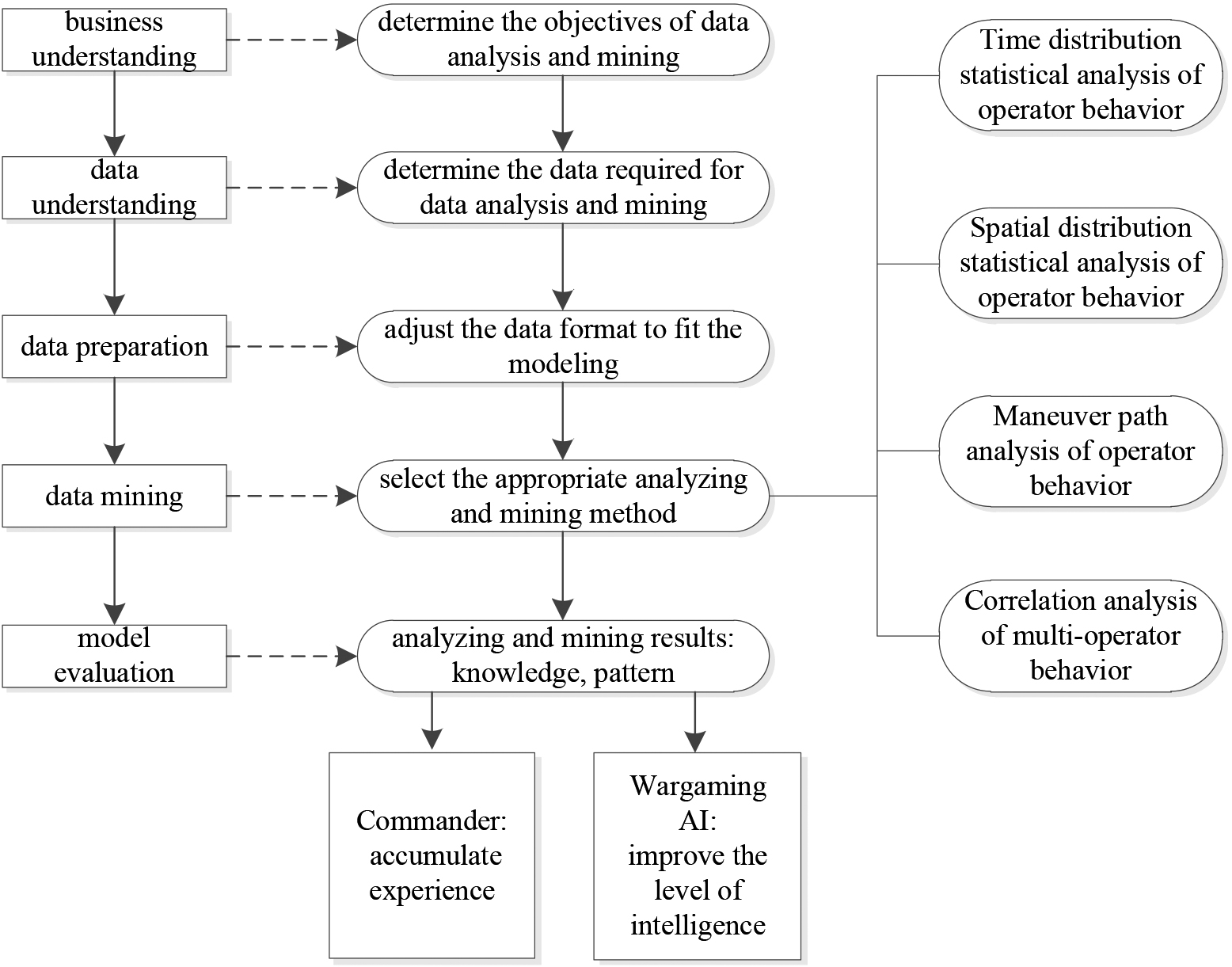
First, it is business understanding, an in-depth understanding of the tactical-level wargaming system and its related business rules. Assess the existing resources to determine the objectives of data analysis and mining. Second, it is data understanding, the description and preliminary exploration of the key elements of wargaming data. Determine the data required for data analysis and mining. Then it is data preparation. According to different analysis and mining objectives, adjust the data format including selection, cleaning, transformation to make it suitable as the input of the next model. And then it is data mining. Choose the appropriate analysis mining method to calculate the data after preparation. This paper mainly focuses on the time distribution statistical analysis of operator behavior, spatial distribution statistical analysis of operator behavior, maneuver path analysis of operator behavior and correlation analysis of multi-operator behavior. These four aspects of analysis use different analysis and mining methods. Finally, it is model evaluation. Evaluate the results of data analysis and mining, and combine business domain knowledge to deeply understand the mining results. On the one hand, it can provide commanders with experience knowledge for scientific decision-making and help them quickly accumulate operational experience. On the other hand, it can provide rules of behavior and pattern of action for the development of wargaming AI, and so effectively improve its intelligence level.
Purpose of analysis
According to the rules of the “Tiejia Assault Group” wargaming deduction system, each game is divided into five rounds and twenty stages. Each stage sets the main performing side, who does the main action in this stage, and the other side acts as the secondary performer.
Wargaming is a turn-based strategy game. As time goes by, the action in each stage will change. Therefore, the time distribution statistical analysis of operator behavior is mainly for the shooting, occupation, movement and other actions that occur in the same stage. According to different stages, the frequency of each behavior is obtained, and the characteristics of the operator behavior in different stages are analyzed. Help the commander to predict the opponent’s actions at a specific stage or guide the commander to take more reasonable action.
Data preparation
Because it is a time distribution statistical analysis of operator behavior, it focuses on the relationship between the behavior of the operator’s shooting, occupation, moving and the time stage. Therefore, the raw data is selected, the behavior and stage information are retained, and the redundant information is filtered. For all the behavior information in the data, occurrence is recorded as 1 and no occurrence is recorded as 0. Then, according to the stage grouping statistics, some of the processed data is shown in Table 4.
Time distribution statistics table of operator behavior (partial)
Time distribution statistics table of operator behavior (partial)
Table 4 shows the total number of shooting, occupying and moving actions of all operators at different stages.
According to the time distribution statistics table of operator behavior, the stage is the horizontal axis, the number of behavior occurrences is the vertical axis, and the line graph of the number of behaviors changing with the stage is obtained, as shown in Fig. 2.
Behavior and stage distribution statistical line graph.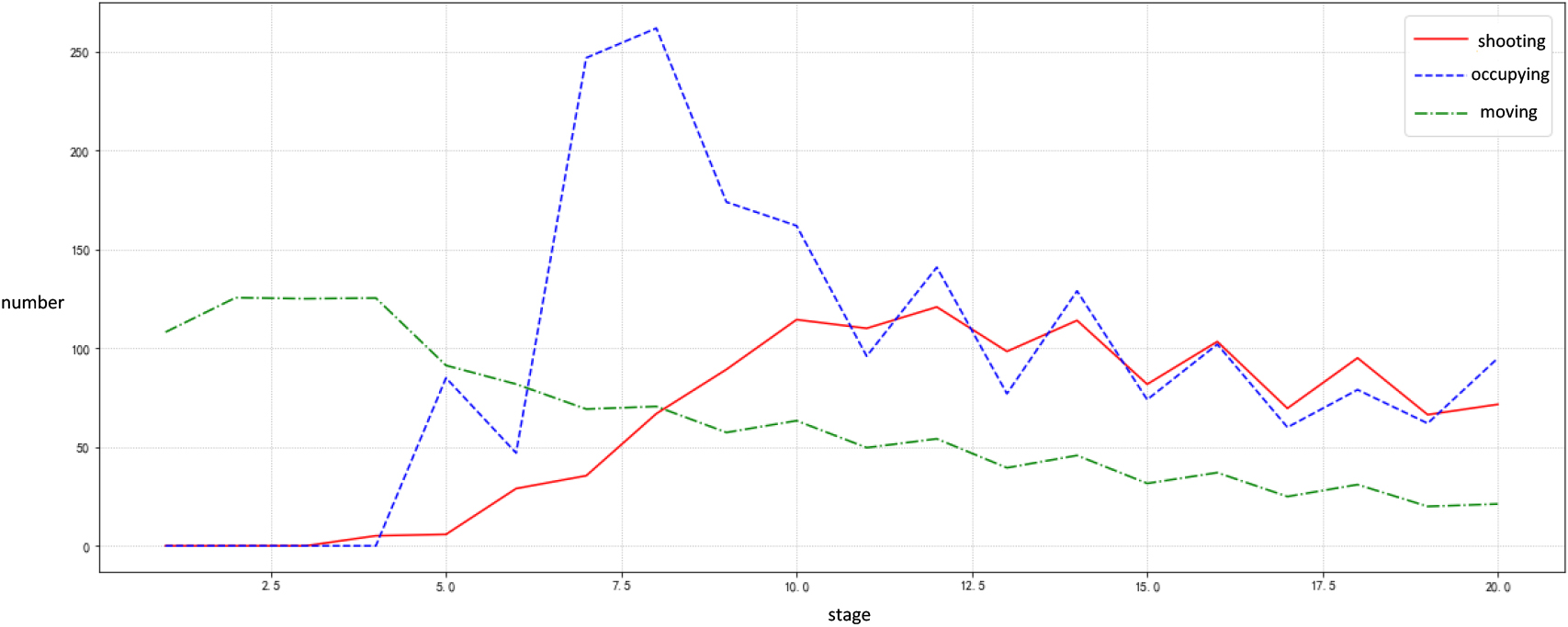
In Fig. 2, the shooting behavior increases significantly from the 5th stage, reaches the peak in the 10th stage, and maintains a high frequency of occurrence until the end. The movement behavior is frequent in the first four stages, and then gradually decreases with the advancement of time. The highest frequency of occupational behavior occurred in the 7th and 8th stages, and then gradually decreased, but in the last 20th stage, its frequency increased again.
According to the change of the line in Fig. 2, further analysis shows that:
The first six stages are summarized as the movement deployment stage, and the operators are mainly engaged in moving and troop deployment. The 7–16 stage are summarized as the main conflict stage, which is the battle between the two sides and the competition for occupying points. The last four stages are summarized as the final stage. Operators mainly carry out shooting on the remaining enemy forces and occupy the points. It is the final stage of scoring.
Based on the above analysis, the following recommendations are made for the commander:
Quickly complete the deployment of troops at the beginning of the competition, organize the formation of the troops, and prepare for the battle. The faster the deployment, the better it can seize the opportunity, and even attack when the enemy is not ready and then accumulate advantages. Pay attention to saving strength and avoid blind action. Use terrain to move and conceal, find a favorable position to carry out shooting. The occupation of the points can be carried in the final stage, so as to avoid falling into a war of attrition near the points in the early stage.
Purpose of analysis
“Tiejia Assault Group” uses a hexagonal grid map with a size of 50
Through the study of the deduction process, it is found that although the map is large, the areas where conflicts occur in general are concentrated in the middle zone. Geographical location and terrain have a greater impact on the effectiveness of the action. In order to obtain conflicting points and strategic points, spatial distribution statistical analysis of operator behavior is performed. It mainly counts the position of the operator when shooting, being hit, concealed, etc. Obtain the high-frequency points of the operator for various actions in order to assist commanders to avoid the enemy’s main firepower and choose a more appropriate regional to attack.
Data preparation
Because it is a spatial distribution statistical analysis of operator behavior, it focuses on the relationship between the behavior of operator’s shooting, being hit, concealment and its corresponding spatial position. Therefore, the raw data is selected and associated, the behavior and point information are retained, and the redundant information is filtered. For different behaviors of operators, the frequency of behaviors at different points is summarized. Some of the processed data is shown in Table 5.
Spatial distribution statistics table of operator behavior (partial)
Spatial distribution statistics table of operator behavior (partial)
Table 5 shows the total number of shooting, being hit, concealed at different points.
According to the spatial distribution statistics table of operator behavior, the point is the horizontal axis, the number of behavior occurrences is the vertical axis, and the histogram of the relationship between the number of actions and the point is obtained. Take the shooting behavior as an example, as shown in Fig. 3.
Shooting behavior histogram.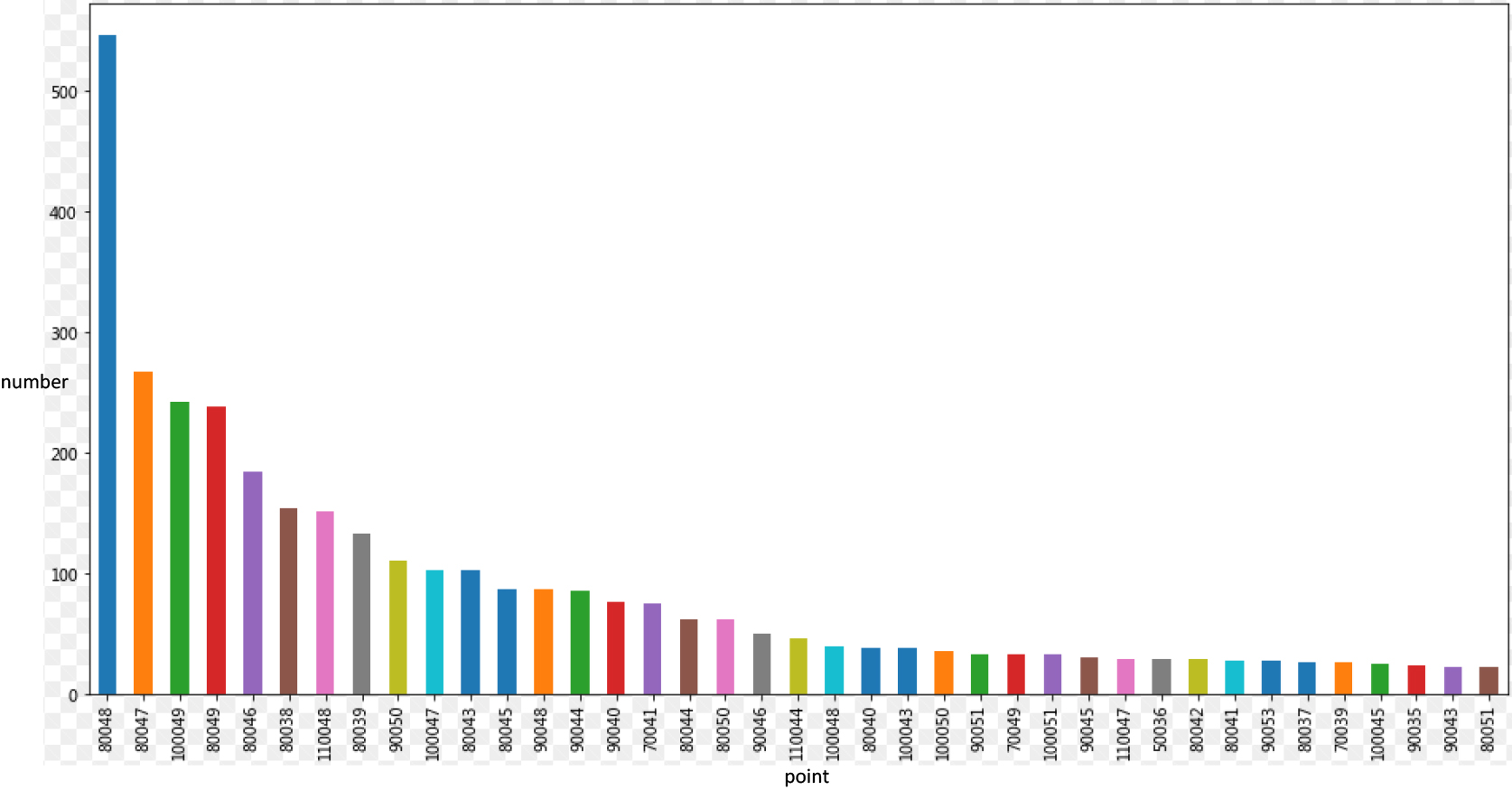
Shooting behavior heat map.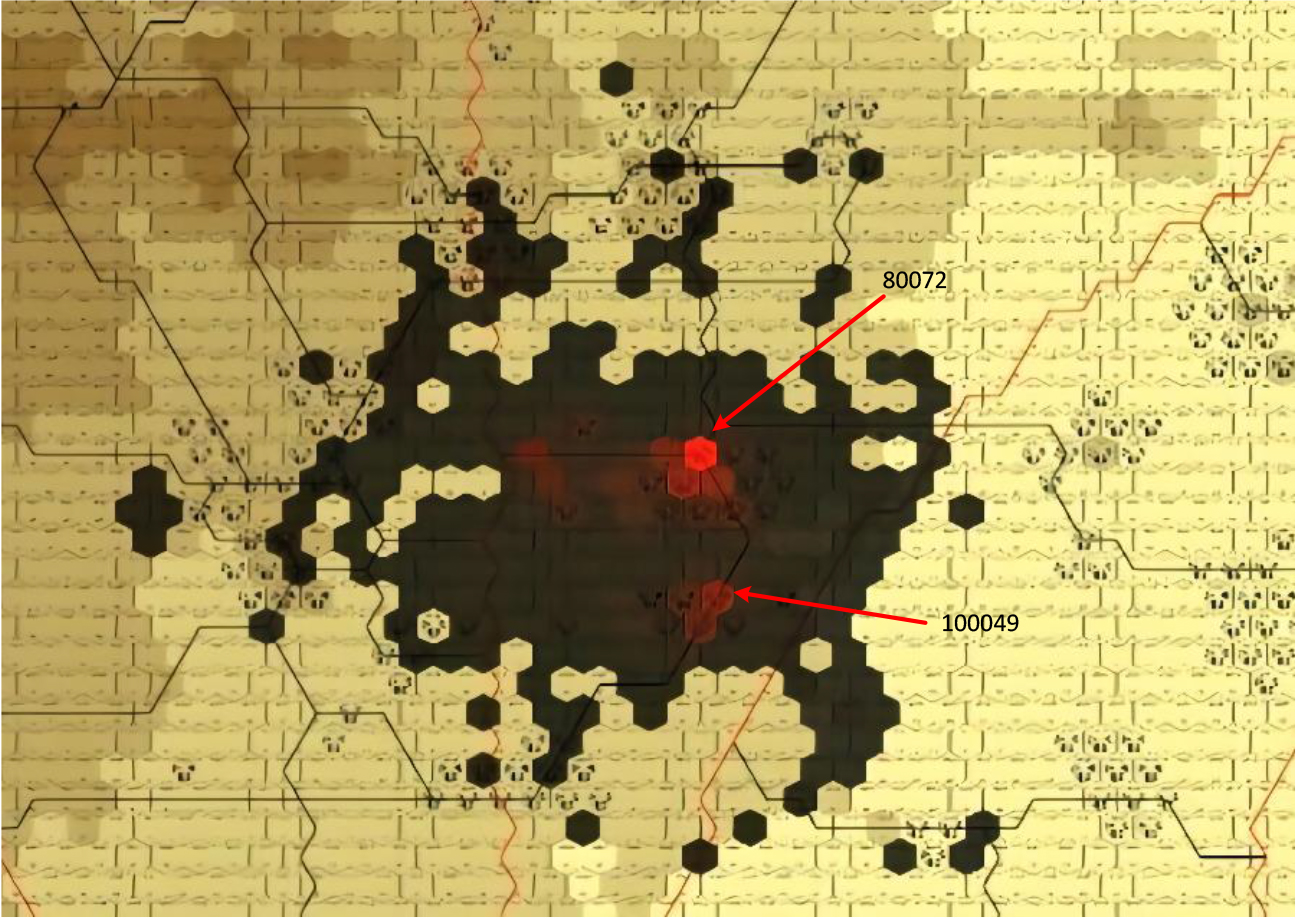
As can be seen from Fig. 3, the shooting points are mainly concentrated in two areas centered on 80048 and 100049. In order to more intuitively see the spatial distribution of operator behaviors, based on the wargaming map, the heat map of the spatial distribution of operator behavior is drawn. Similarly, take the shooting behavior as an example. The redder the color, the higher the frequency. The darker the color, the lower the frequency, as shown in Fig. 4.
According to Figs 3 and 4, the shooting point and hit point are mainly distributed in the area centered on 80048 and 100049. The concealed points such as 80072, 70041, and 50036 are mainly near 80048 and 100049.
Further analysis shows that:
Since 80048 and 100049 are occupation points, they are inevitably important strategic points. So, the battles around these two areas will be more frequent and intense and these two areas are considered as major conflict areas. The selection of concealed points is either a strategic point, such as near the seizure point, which can be more convenient to occupy the point or with geographical advantages point, such as 80072, 70041, 50036 and 70028, which can ensure operator safety.
Based on the above analysis, the following recommendations are made for the commander:
When carrying out the deployment of troops, try to avoid the main conflict areas as far as possible. In the process of moving to the occupation point, we can choose to pass through the area between the two occupation points, or consider approaching from the top of the main occupation point. Purposeful selection of concealed points. In order to occupy, concealed points need to be selected in the favorable position near the occupation points, and for operator safety, concealed points need to be selected in the location with better geographical and topographic conditions.
Purpose of analysis
Maneuver of the operator refers to the movement process from one point to another. It is the most basic action of the operator, and it is also the basis of other actions such as shooting and concealment. Therefore, it is extremely important to ensure the safety of the maneuvering process of the operator.
Based on the frequency heat map of the operator’s hit point and concealed point, the operator maneuver path is analyzed. By studying the maneuver path of the operator, analyzing the advantages and disadvantages of the route, and finding a better maneuvering route to ensure that the operator is as safe as possible. So it is beneficial for the operator to carry out the next action.
Data preparation
Because it is a maneuver path analysis of operator behavior, it focuses on the relationship between continuous maneuvering behavior of the operator and its corresponding spatial position. Therefore, the raw data is selected, the maneuver behavior and corresponding point information are retained, and the redundant information is filtered. According to the maneuvering behavior of different operators, the maneuvering paths of operators are counted separately. Taking tank operator as an example, some of the processed data is shown in Table 6.
Maneuver path statistics table of tank (partial)
Maneuver path statistics table of tank (partial)
Each row in Table 6 represents the maneuver path of a tank, and the values in the table are the coordinate points on the maneuver path of the operator.
According to the maneuver path statistics table of operator, based on the wargaming map, the heat map of the operator’s maneuver path is drawn. Similarly, take the tank as an example. In order to quickly find a path with a higher frequency, the path is partially screened, and the coordinates with a frequency less than 20 are excluded. The redder the color, the higher the frequency, the darker the color, the lower the frequency, as shown in Fig. 5.
Tank maneuver path heat map.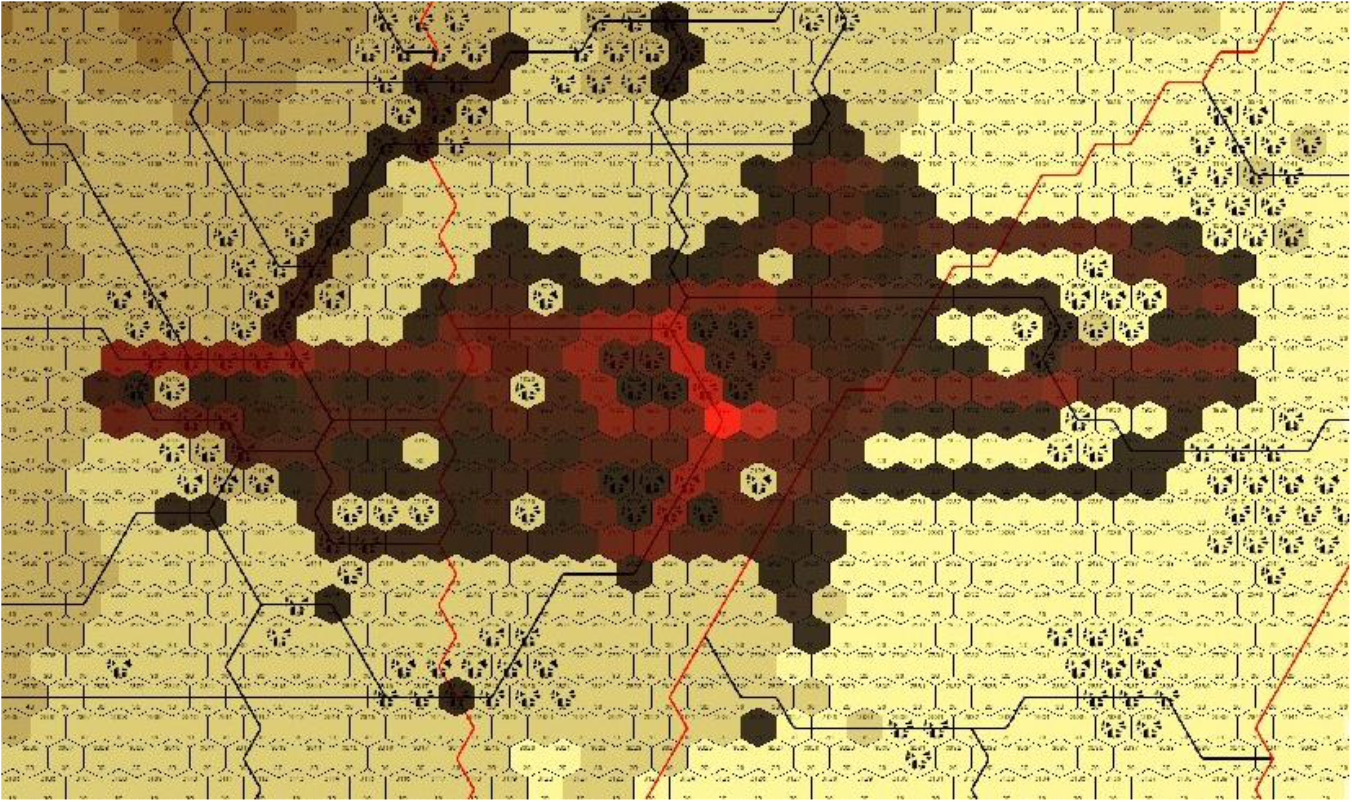
According to Fig. 5, most of the main maneuvering paths of the tank pass through the main conflicting areas. In particular, a path away from other paths appears in the upper part of the figure, which is worthy of further study.
Further analysis shows that:
The maneuver and conflict between the two sides of the game are inevitable. It is necessary to choose some favorable positions to save the strength of the side while attacking. Several paths can be selected as an unexpected tactical choice to increase the diversity of offensive operations.
The path that appears in the upper part of Fig. 5 serves as a tactical choice, and it can play a major role at critical moments. Combined with the terrain of the map, it is found that this is a preferable route. Based on the analysis of the shooting point and hit point, the path has the following advantages:
The path itself is relatively safe. The terrain in which the path is located is a highland with a good view. At the same time, there are more residents along the way and the concealment is good. This path is suitable for offense. According to the analysis of the shooting point, it is found that this path is close to several positions that we have determined to be suitable for shooting, which is beneficial for shooting. This path is convenient to maneuver, because the path itself is mainly composed of highways. It is suitable for long-distance moving and improving maneuvering speed. At the same time, this path can achieve specific tactical effects. For the red players, use this path can reach the enemy’s back, thus achieving a sneak attack. This path can achieve safe occupying. It is the area with the lowest frequency of hitting near the occupation point. The selected path is the realization of the maneuver from the top to the occupation point very fast and safe.
It can be seen that the maneuver path analysis of the operator behavior can provide an important basis for the commander to select a better maneuvering route.
Purpose of analysis
The time, space and maneuver path analysis of operator behavior are statistical analysis of a single operator combined with the rules of wargaming, space and time. So it can discover the characteristics and patterns of one single operator behavior. There may be some related behaviors between multiple operators. Therefore, the method of frequent pattern mining is used to analyze the multi-operator behaviors. The association rules between multi-operator behaviors are obtained, which provides important support for commanders to use different forces.
Data preparation
This paper mainly uses the Apriori algorithm in frequent pattern mining to find the association pattern of behavior between different operators. The basic process of the Apriori algorithm is divided into two steps: the first step is to find all the frequent item sets in the data set by iteration, that is, the item set whose support degree is not lower than the threshold set by the user. The second step uses the frequent item set to construct some association rules that satisfy the minimum confident degree set by the user.
Therefore, when using the Apriori algorithm to analyze the association between multiple operator behaviors, it must first clarify the content of the items and item sets. Then transform the raw data set to conform to the input format of the Apriori algorithm. Finally calculates the association rules for the behavior between operators through this algorithm.
A behavioral action of an operator is recorded as an item
The raw data set is transformed according to the contents of the item and the item set to form a transaction data set
A square bracket indicates a transaction
Correlation analysis of multi-operator behavior is, for the transaction data set
Among them,
Analysis of results
For the transaction data set
(1)
The association rule indicates that the probability of simultaneous occurrence of infantry shooting and tank movement is 0.796. When the infantry shoots, the probability of simultaneous tank movement is 0.913.
(2)
The association rule indicates that the probability of simultaneous occurrence of tank shooting and tank movement is 0.955. When the tank shoots, the probability of simultaneous tank movement is 0.965.
According to the association rules, combined with the relevant rules of wargaming, further analysis shows that:
(1) Moving and shooting mode of tanks is the main mean of attack.
From the previous statistical analysis, it can be seen that tank is the main type of attacking operator. After frequent pattern mining, it is found that moving and shooting of tank is very important. Tanks are the main attackers because of the ability of shooting while moving. The advantage of moving and shooting is that it can provide vision while moving. The tank can shoot quickly after finding the enemy and then move away.
(2) The tank guides the infantry to shoot.
According to the association rules, it is found that the shooting of infantry is always accompanied by the movement of tanks. From the point of view of the rules and characteristics of wargaming, infantry’s vision and mobility are poor, but at the same time they have better concealment and attack power. The tank’s mobility is strong, and the field of vision is wide, so tank is used to provide vision for infantry to ensure that infantry shoot on the enemy.
Based on the above analysis, the following suggestions are put forward for the commander:
Tanks play an important role in attacking or even winning the game. Therefore, we should pay attention to observing the enemy tanks, and at the same time protect our own tanks to ensure that they can play a role in the process of attack. Make good use of tanks and vehicles to provide full vision for infantry. In theory and in practice, the tactic of using tanks to guide infantry shoot is feasible and effective. Similarly, the mobility of vehicles is excellent, and there are tactics such as vehicle-guided infantry shooting. However, unlike tanks, vehicles do not have the ability of shooting while moving. Therefore, vehicles can only choose to provide vision for infantry in the process of guiding infantry shooting. They can’t shoot, so it is need to pay more attention to their own safety.
The development of the wargaming is entering the stage of intelligence. The wargaming AI is more diverse than the traditional manual wargaming. It is bound to bring about major breakthroughs in the training of commanders’ decision-making ability and the simulation of major military operations. Based on the “Tiejia Assault Group” tactical-level wargaming system, this paper analyzes and mines data. Effectively acquire the experience knowledge of human players from the data, which can assist the commander to analyze the battlefield situation and improve its command ability level. Meanwhile it also can provide behavior rules and action patterns for the development of wargaming AI.
In this paper, the Apriori algorithm is used in the association analysis of multi-operator behaviors, that is, the time-sequence relationship between actions is not considered. The actions of the wargaming player are in a sequential order. The next step can be to use the time series frequent pattern mining to obtain the operator behavior association rules including the timing relationship, which can more accurately reflect the correlation between the behaviors. In addition, intelligent AI is the future development direction. So how to effectively integrate the knowledge acquired based on data mining into the design of wargaming AI is also the content to be studied in the future work.