




Abstract
Feeding on crude oil and activator in porous medium, microbes remain active on the Oil-water interface under simulated reservoir conditions. At the same time, microbes degrade the residual oil and change the wettability of pore wall. Consequently, the displacement exhibits a decrease of 51.86% in membrane residual oil and an increase of 17.44% in recovery compared with water flooding. The Geobacillus stearothermophilus producing bio-emulsifier and its metabolic products can effectively emulsify reservoir crude oil and reduce the oil-water interfacial tension. In the end and the formed emulsion featured high viscosity can improve the oil flow rate and expanded wave volume of injected fluid. Correspondingly, the cluster-like, columnar residual oil were reduced by 64%, 68% respectively. In the micro porous test cell, the in-situ cultured microbes rely on specific life activities (interfacial tropism and in situ metabolism, etc.) to strip the residual oil off the wall of orifice deep inside the blind-ends, which cannot be achieved by the exogenous injection method. After the in-situ microbial culture process, the residual oil in deep blind-ends was reduced by about 47%, and the recovered oil was increased about 15% compared with exogenous injection method.
Keywords
Introduction
The geological conditions of reservoirs in China are complex and the nature of crude oil varies greatly, 70% of the residual oil after a water drive tends to remain in underground reservoirs [1]. Therefore, Residual oil research is an important prerequisite and foundation for oilfield improving reservoir production and enhancing field recovery [2, 3]. Much researchers have investigated the mechanism and remaining oil distribution pattern of microbial oil drive [3]. Studied microbial microscopic oil displacement mechanism and found that microbes changed the form and distribution of residual oil by degrading petroleum and metabolizing bio-gas, bio-surface active substances, etc., but specifically analyzing the transport effect of different shapes of residual oil [4, 5]. Zhu Weiyao and other studies found that endogenous microorganisms can be activated by throwing in high-temperature and high-pressure reservoir environment, and can effectively start different types of residual oil, and interact with metabolites to blind-ends channels that water displacement cannot reach [6].
Through the relevant literature research and analysis, it is found that the experimental research on microbial oil recovery technology is continuously developed and deepened [7]. There are few studies on the mechanism of microbial displacement of residual oil with different shapes. Based on the theory of the endogenous mixed bacteria flooding mechanism in the early stage, this paper visualized flooding experiments in microscopic scale was carried out to study the life activities of emulsified thermophilic bacteria and its products in the porous medium, and meanwhile, to understand their effects on the recovery of the residual oils with different shapes. Also, using image processing techniques and software analysis methods, the residual oil ratios of the model at different oil drive stages were quantified and analyzed. According to the different residual oil forms, it was found that the oil drive with thermophilic stearic earth bacillus had a higher recovery rate for the residual oil at the deep blind-ends, which was also beneficial to the study of oil field MEOR.
Methods
Experimental materials preparation
Crude oil used in the experiment is from Shao home with 3 blocks oil reservoirs of the Shengli Oil Field of Shandong Province in China; The viscosity is 46 mPa
Experimental instruments and devices
NDJ-9S Rotational viscometer; Microscopy; Thermostatic tank oscillating incubator; JYW-200C Automatic surface tension meter; The specific manufacturer is shown in the Table 1.
Instruments used in the experiment
Instruments used in the experiment
Micro simulation visual model, which is made of a two-dimensional pore structure etched onto the surface of a flat glass plate, and the pore structure is identical with the realistic cross-section image of a sandstone core from the Shengli Oil Field [10]; The external size, pore volume, porosity, and permeability of the model are 40 mm
High temperature and high pressure apparatus of microscopic flooding experiment is shown schematically in Fig. 1 has been described in our previous paper [10]. The experimental setup is composed of two main systems, the flooding and image capturing systems with some accessories. The flooding system consists of a syringe pump, three accumulators, a model holder and a light source (white light); the image-capturing system includes a microscope, a camera and a computer.
High temperature and high pressure Apparatus of Microscopic flooding experiment.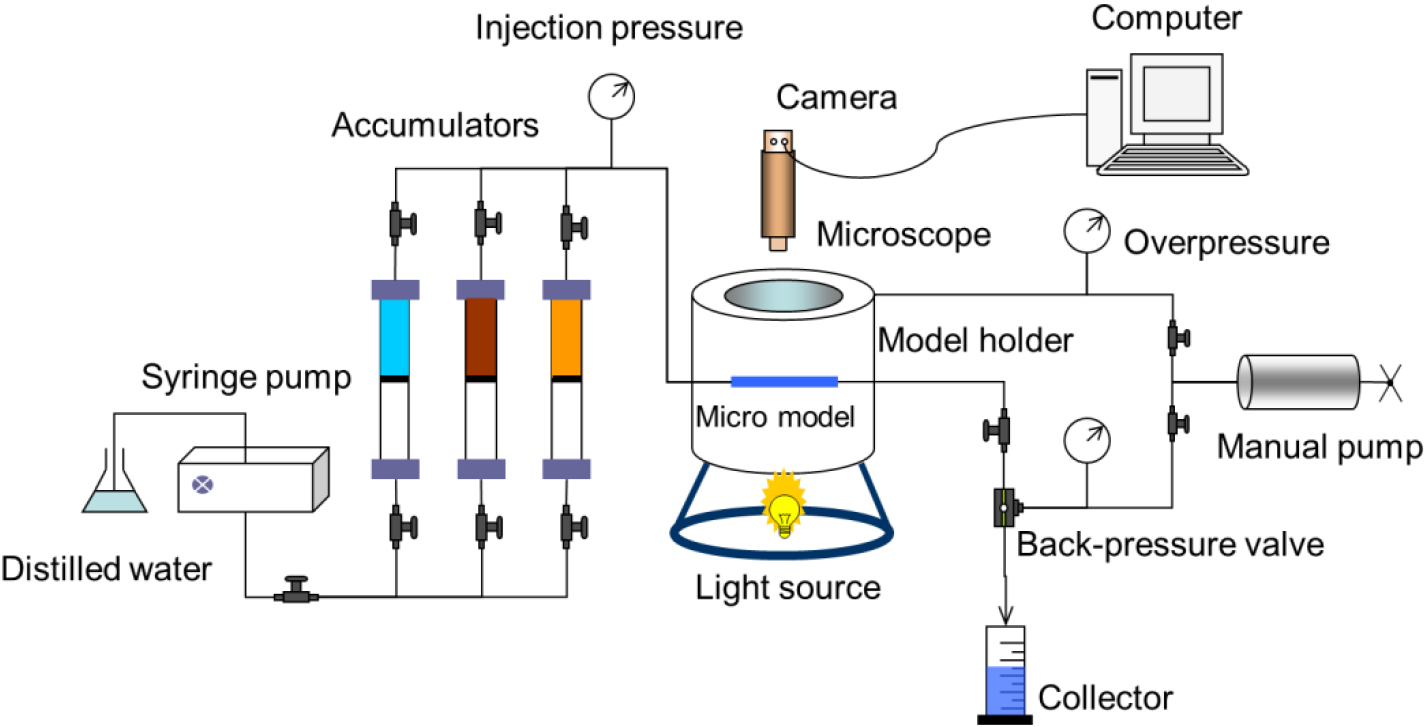
The model temperature was 65∘C, constant pressure 10 MPa, injection speed 0.08 ml/min, observe and record the experimental process. Steps: 1) Microscopic model vacuuming, saturated water; 2) model saturated oil; 3) One water displacement 1.3 PV (1.3 times of pore volume of the micro model); 4) Inject the above microbial infusion 0.8 PV into groups. The first group (the direct flooding group of fermentation broth) for Fig. 2a: the fermentation broth was injected, and then the fifth step was directly carried out; The second group (the intra-model culture group) for Fig. 2b: the cells and the activator were injected, and the temperature was kept static for 2 weeks, and observed at the same time. The residual oil changes, followed by step 5; The third group (blank control group) for Fig. 2c: step 4 is omitted, and step 5 is directly followed by step 5; 5) secondary water displacement 1.6 PV; 6) Analyze experimental pictures and data.
Procedures of flooding microscopic experiments at reservoir pressure: (a) exogenous bacterial injection ooding, and (b) the in-situ microbial culture, and (c) water displacement only.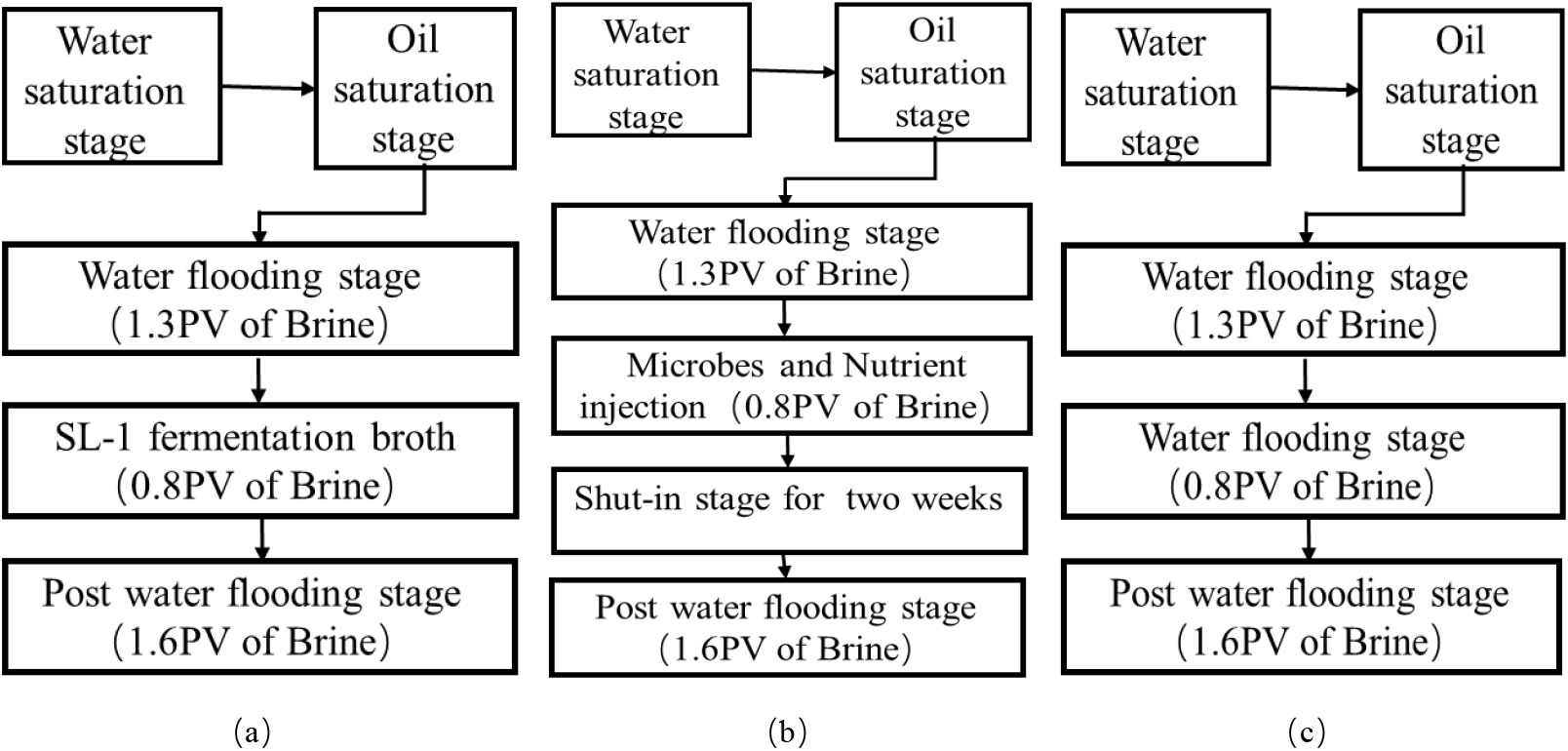
Residual oil situation in different stage models: (a) after one water displacement (b) after injecting microorganisms (c) after subsequent water displacement.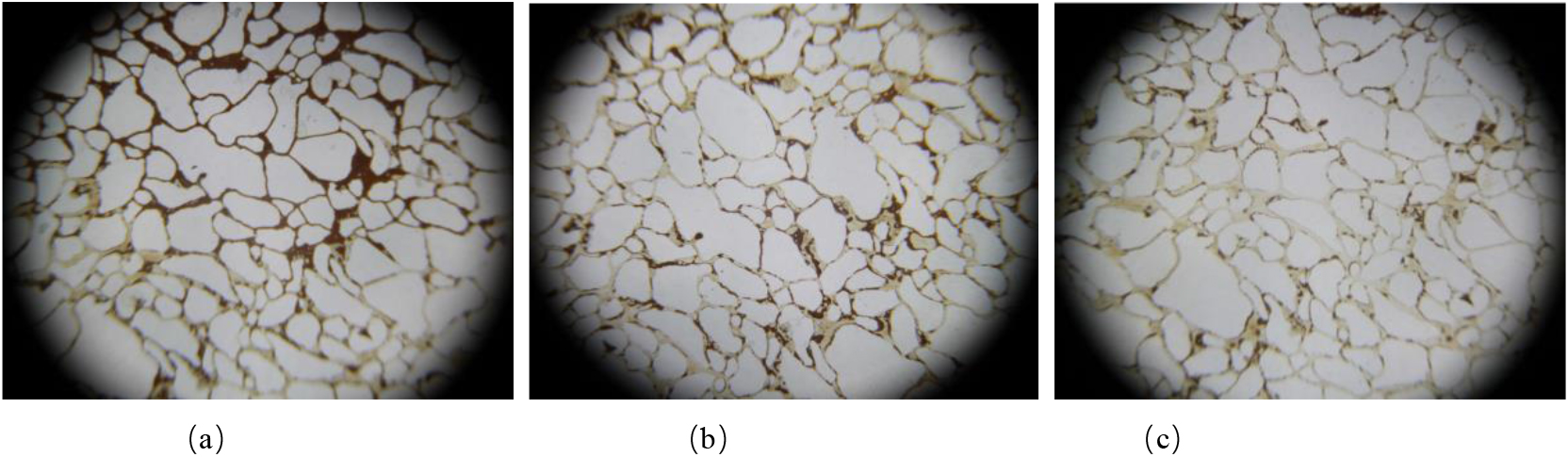
Using a program written in MATLAB, the gray value of the pore residual oil pixels in the image is analyzed to obtain the ratio of crude oil pixels to pore pixels. The percentage of oil is counted by the percentage of oil pixel [11, 12, 13].
Considering the structure and physical properties of the model pore space and the wave effect of the oil drive agent, the morphology of residual oil in the image was classified and manually defined according to the interaction between formation water, oil and porous media, divide the residual oil into the islet, membrane states, blind-ends, columnar, and the clusters. In this study, the islet residual oil referred to the isolated oil drops in the pore spaces, and membrane states referred to the residual oil that adheres to the pore surface. The blind-end residual oil referred to the residual oil sealed in the dead end or blind end of the pore, and the pore throat connected to it is mostly replaced by water. Columnar residual oil mainly exists at the throat of the connecting pore, especially in the slender throat stagnation phenomenon is obvious. Also the cluster state referred to the residual oil in the large pore space connected with several small throats, formed by the injection of water or the bypass of the repellent fluid in the pore space.
Residual oil change in microscopic model during flooding
Under the action of emulsification and hydraulic shearing of the oil-displacing agent, the crude oil disperses many small oil droplets, the process of emulsifying and transferring crude oil is repeated repeatedly. After injection to a certain extent, there are many factors in the model. An island-like oil droplet produced by emulsification and viscous action. Distribution of remaining oil within different stage models in the Fig. 3. After the microbial injection is completed, the amount of residual oil in the main channel the model is relatively small, and there are many oil droplets formed by emulsification and snapping in the pores; there are a small amount of bacterial liquid on the diagonal edge of the micro porous test cell. After entering, the bacterial liquid failed to spread to the area in a large area, and more residual film, columnar and cluster-like residual oil were distributed in the pores; after the action of microbial and products, the sweeping range of the infusion was expanded. After subsequent water displacement, the remaining oil in pore space of the model is less, the cluster remaining oil is obviously reduced, part of the membranous is not drive out the replacement, and there will be a small amount of columnar residual oil in the small pore perpendicular to the flow direction, and the individual blind-ends remains in the injection process [14, 15].
In Table 2, after 1.3 PV of water injection, about 45%
Analysis of quantitative changes of residual oil under different oil drive models
Analysis of quantitative changes of residual oil under different oil drive models
WD (Water displacement).
Image pretreatment and software programming were used to quantitatively analyze the residual oil in the model. As shown in Tables 3, the effects of functional bacteria on the residual oils of different shapes and the proportion of microbial enhanced oil recovery in the initial residual oil. The effect of microorganisms and their products on residual oil is clustered
Residual oil recovery rates for various shapes by different oil displacement methods
Residual oil recovery rates for various shapes by different oil displacement methods
The strain in the model cultured was better than the stripping effect of the residual oil in the blind-ends, the blind-ends of the triangle and the column. The EOR of the blind-ends is 1.25% and 0.22%, respectively, and 48.30% and 47.88% of the crude oil is produced relative to the respective initial residual oil. The flooding of the fermentation product of strain SL-1 mainly has a good stripping action on the residual oil of the round blind-ends and the trapezoidal blind-ends, and the crude oil recovery rate is improved by 1.0%
The analysis of different shapes of residual oil
The form of residual oil after water displacement is various, depending on the structure and physical properties of the pores of the model and the sweeping effect of the oil displacing agent [16, 17]. According to the size and distribution of the pore space occupied by the model, the residual oil is divided into clusters of residual oil and columnar. Residual oil, film-like remaining oil, island-like remaining oil and residual oil in the blind-ends. The blind-ends remaining oil has various forms according to the type of blind-ends. The blind-ends shapes in model mainly include trapezoidal blind-ends, triangular blind-ends, cylindrical (stripe) blind-ends and circular blind-ends, and the oil displacement modes are different. There is a slight difference in recovery rates for the residual oils of different shapes.
The changes observed for cluster shape oil
During the process exogenous microbial oil flooding, the strain SL-1 and the product reduce the oil-water interfacial tension and wetting pore wall, so that these cluster blocks of oil is easy to change [18]. Some cluster-like residual oil is emulsified and dispersed by the emulsifier into small oil droplets flowing downstream. Some processes are repeatedly deformed under hydraulic shearing, elongated into oil, and disconnected, and finally the residual oil blocks are greatly reduced or even completely driven away (see Fig. 4a and b).
Residual oil of clusters type changes before and after microbe action.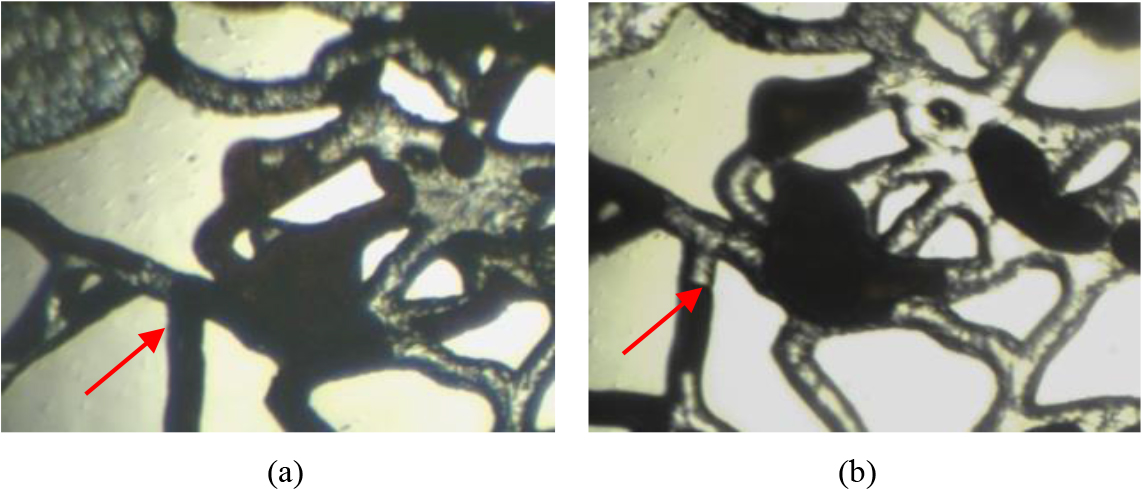
The wetting action of the bioemulsifier enhances the hydrophilicity of the pore wall surface, reduces the oil-water interfacial tension, thereby reducing the capillary force of the pores, that is beneficial for the microbial to start and transport the residual oil in the fine throat. As shown in Fig. 5a and b, after the action of microbial, the parallel throat wetting is reversed, and the column oil is much reduced.
Residual oil of columnar type changes before and after microbe.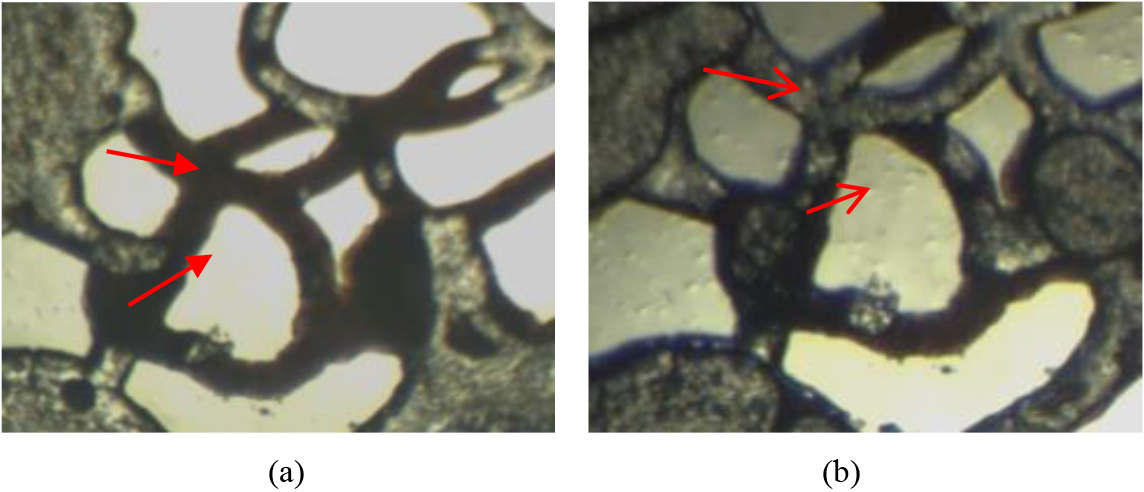
During in situ culture, the oil film on the pore wall is softened and emulsified into island shaped small oil droplets under the action of the emulsifier metabolized by strain SL-1, and then leaves the wall surface to become a free oil phase, which is driven by subsequent water displacement. As shown in Fig. 6a and b. After the action of the strain SL-1, the retention ability of the pore wall to the residual oil decreased, and increased contact angle between crude oil and wall surface.
Residual oil of membranous type changes before and after microbe.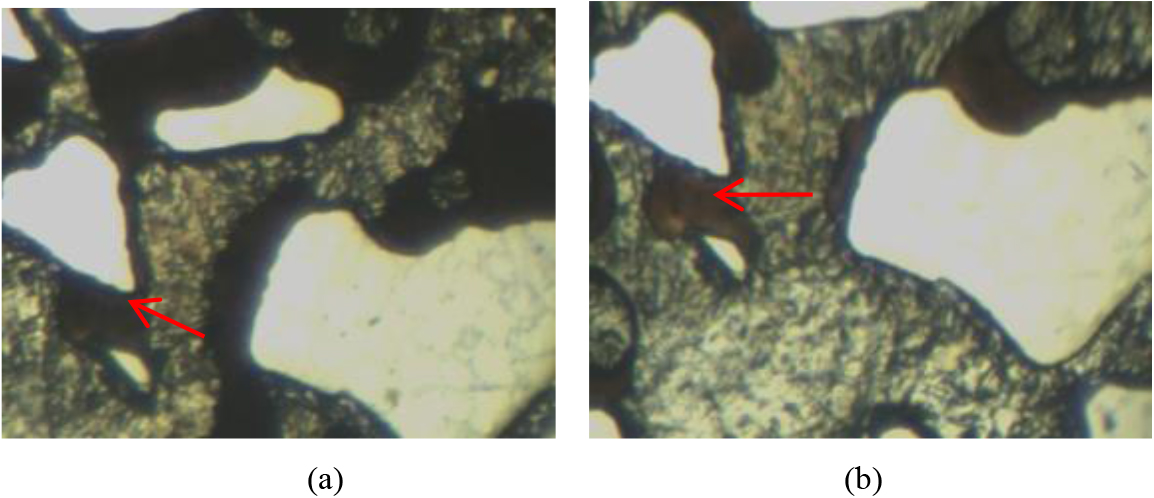
After the microbial fermentation broth is injected into the model, it is found that many of the residual oil is emulsified into island shaped small oil droplets. The above-mentioned cluster, columnar and membranous residual oil can be emulsified into island shaped small oil droplets by the microbial product. Since the amount of microbial injection is controlled within a certain range of pv, these small oil droplets are not able to escape from the model and remain to form an island-like residual oil (Fig. 7a and b).
Residual oil of island-shaped type changes before and after microbe.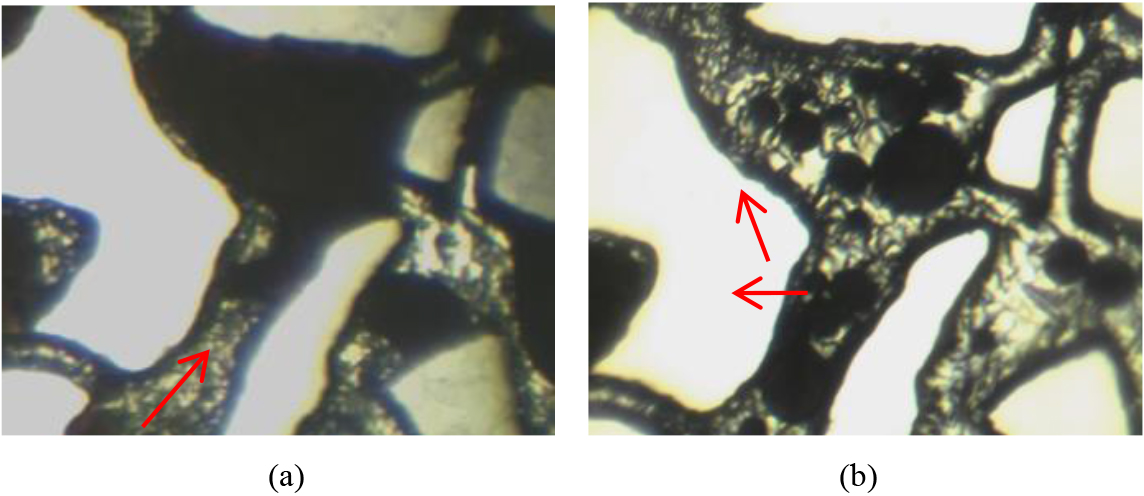
The residual oil at the blind-ends is mainly the residual oil sealed in the dead end or the blind end of the pore, and the pore throat connected to it is mostly replaced by water. The deeper the blind end, the larger the amount of residual oil, and the less likely it is to be replaced. Improving the recovery of residual oil at the blind end is also one of the very key factors in the study of microbial recovery enhancement technology. The residual oil in the round and trapezoidal blind-ends is easier to drive out than other types of blind-ends residual oil. When the strain and the product were exogenously injected, the residual oil in the circular and trapezoidal blind-ends was gradually peeled off, pulled off and driven out (see Fig. 8a and b).
The residual oil of the blind-ends of the triangle is driven differently depending on the type of the blind-ends. In the Fig. 8c and e, the experimental results show that during the in situ culture of strain, the microorganisms effectively use the semi-closed triangular blind-ends residual oil through the action of life activities, while the exogenous injection process has less effect on this part of the residual oil. Residual oil of fully open type triangular blind-ends derived by exogenous injection.
Water displacement can hardly use the semi-closed residual oil, but can use a small amount of fully open blind-ends residual oil. In the Fig. 8d, the residual oil at the blind-ends of the column is one of the most difficult residual oils to be displaced. After the end of a water displacement, the closed end of column residual oil is almost saturated with oil. The residual oil of the column-shaped blind-ends can only be stripped and degraded by the characteristics of the interface tendency of microorganisms in the in-situ culture process.
The changes of residual oil in blind-ends with different shapes after microbial action: (a) the round blind-ends residual oil; (b) the trapezoidal blind-ends residual oil (c) Fully open type triangular blind-ends residual oil (d) the columnar residual oil (e) Semi-closed triangular residual oil.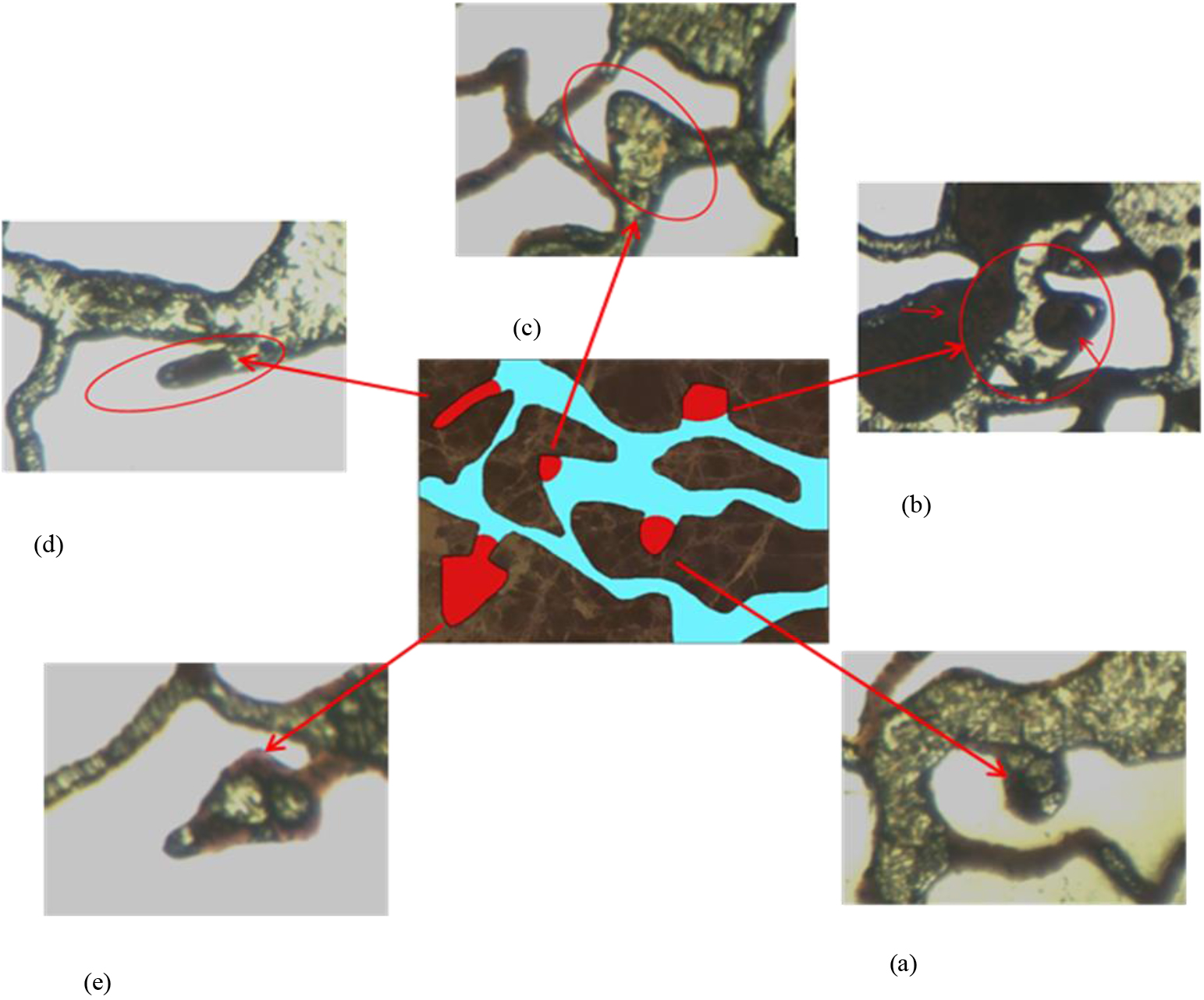
The concentration of the product in the fermentation broth obtained by exogenous culture of Geobacillus stearothermoph ilus SL-1 is high. In the process of oil replacement, the residual oil is removed by emulsification and dispersion, improved oil-water mobility ratio, and expanded wave volume of injected fluid. The final recovery factor is about 75%, which is about 11% higher than water flooding. After strain and the product, the cluster-like and columnar residual oil decreased by about 64% and 68%.
Strain SL-1 uses a crude oil and an activator as a nutrient source to metabolize the bioemulsifier, rely on the unique life activities to start the blind-ends and membrane residual oil. The proportion of residual oil in the membrane and blind-ends decreased by 51.86% and 48.19%, respectively, especially the residual oil in the deep blind-ends decreased by about 47%, which is better than that in the water displacement process. The percentage of deep blind oil reduction is 27% higher.
Footnotes
Acknowledgments
We gratefully acknowledge the Science and Technology Project of Hebei Education Department under Grant No. QN2019032, the Construction Science and Technology Research Guiding Plan Project of Hebei under Grant No. 2023-2004, the Natural Science Project of Hebei University of Industry and Technology under Grant No. ZKY2020005 for their financial support.
Conflict of interest
The authors that there is no conflict of interest.
Data availability
The data used to support the findings of this study are available from the corresponding author upon request.