




Abstract
The measurement process of corporate human capital value ignores the in-depth analysis of the influencing factors of value measurement, which leads to the inaccuracy of the measurement result of corporate human capital value. Therefore, taking an enterprise in Heilongjiang Province as the research object, a measurement model of enterprise human capital value based on binary tree is designed. Establish the corporate human capital value measurement index system, and initially fix the human capital value. Calculate the floating value of human capital under the complete information, and determine the influencing factors of human capital value measurement. The human capital value of enterprise under incomplete information is calculated to complete the construction of the measurement model of human capital value of enterprise based on binary tree. Taking the actual human resource performance score of an enterprise from 2019 to 2022 as an example, the experiment proved that the design model and the traditional measurement model evaluated the enterprise human resource performance, and proved that the measurement model based on binary tree was more accurate than the traditional model, and the final measurement accuracy of the design model reached 93.5%. Compared with the traditional measurement model ahead of 18.5%–10.3%, compared with the current advanced measurement model ahead of 5.2%–5.7%. The evaluation Angle in the research is slightly lacking of practical significance, and further research can carry out further evaluation on income to maximize the practical significance of the research. However, the model is evaluated from the perspective of pricing, but in real life, the value of enterprise human capital is reflected in income distribution. Therefore, if the measurement of human capital value is combined with income distribution in the next step, the research results will be closer to the actual situation and will have more practical significance.
Keywords
Introduction
Because the human capital itself is uncertain, dynamic and difficult to measure, it is difficult to form a unified theoretical system for the study of the value of human capital [1]. Economists have studied human capital for a long time, and the special research on human capital measurement began in the 1930s. In 1930, foreign scholars Dablin and Rocta conducted a measurement study on human capital and estimated the present value of the estimated income of human capital as a measure of the purchase of life insurance. In 1935, Walsh first estimated the cost of input capital value. Since the 1960s, human capital theory has been studied in the theoretical works and documents of foreign scholars. Among them, Becker’s greatest contribution is to provide a solid basis for microeconomic analysis for the study of this theory, and make it mathematically, refined and generalized. The researchers of the neoclassical human capital transaction cost model, represented by Hasimoto and supported by the whole industry contract theory, revealed the rationality of human capital investment and the uncertainty of human capital investment income. In the 1980s, with the efforts of a group of economists such as Romer, Lucas, and Custer, a new economic growth theory was formed to build technology internalization, and human capital factors were introduced into the economic growth model as independent variables. In the relevant domestic research, scholars’ theoretical research on human capital pricing is still in recent years. Research from the perspective of economic theory mainly focuses on the following aspects: The first is to explore the realization of residual claim and residual control of human capital from the perspective of enterprise contract theory and principal-agent theory; The second is to explore the theoretical source of human capital pricing from Marx’s labor value theory; Third, put forward the theory of human capital operation from the perspective of human capital equity; The fourth is to establish the human capital pricing model through the analysis of enterprise performance and compensation sensitivity; Fifthly, Black-Scholes option pricing model is used to price the stock option of human capital; Sixth, the equilibrium value of human capital is determined by the game model from both employers and employees; The seventh is to derive the human capital pricing model from the asset capital pricing model.
At present, in the evaluation of human capital value, the commonly used method is the human capital value measurement model based on the market method. The principle of this method is to find similar human resources in a relevant market, and to determine the value of the human capital of the evaluated enterprise through the price paid by the market to the similar human resources of the enterprise. However, in practical application, it is found that this model has some limitations and its measurement accuracy is low. In addition, the human capital value measurement model based on EVA performance evaluation mechanism is also a common method, this paper takes the listed companies of A-share central enterprises in Shanghai and Shenzhen motherboard as the basic research sample from 2008 to 2010, and measures the human capital value of the company by means of vertical and horizontal comparison regression before and after the implementation of the comparison mechanism, and by means of PSM-based horizontal comparison regression. Empirical tests verify the correlation between the synergistic effect of performance evaluation and compensation payment and the company’s human value, which provides empirical data and useful references for improving the company’s value. However, this method is not comprehensive in the analysis of influencing factors of human value. In the long-term work, relevant scholars have designed the enterprise human capital value evaluation model based on real options. The model includes three types, namely, management type, technology type and general type. Based on the analysis of the real option characteristics of human capital in enterprises, this model constructs the Black-Scholes option pricing model of human capital value according to the real option pricing model, and validates it with the relevant data of Dachi Electrical Equipment Manufacturing Co., Ltd. in Shule County, Xinjiang, and draws a conclusion. However, after putting the model into practical work, it is found that its accuracy is also low.
To solve the problems in the process of human capital value evaluation, this paper designs a measurement model of human capital value based on binary tree. This paper analyses the influencing factors of human capital value, establishes a measurement index system, makes an initial pricing of human capital value, and calculates the floating value of human capital by using binary tree method.
Establishment of human capital value measurement model based on binary tree
Measurement index system of corporate human capital value
The human capital value of enterprises can be divided into three types, namely, innovation value, leadership value and management value. Because the measurable degree of human capital value of an enterprise is different, the determination of personal value is affected by external factors and their own factors. Therefore, in order to reasonably measure the value of enterprise human capital [2], the influential factors of enterprise human capital value are subdivided, and a scientific, effective and comprehensive index of enterprise human capital value is constructed based on the principles of objectiveness, comprehensiveness, measuability, flexibility and sustainability. To ensure the consistency of the selected indicators and the measurement of corporate human capital value in the overall scope when selecting indicators, the purpose of building the index system is to be able to more scientifically measure the corporate human capital value, and thus create benefits for enterprises [3]. The index system that affects the measurement of corporate human capital value is shown in the following Table 1.
Human capital value measurement indicators
Human capital value measurement indicators
Since the measures in Table 1 above are influenced by external factors [4], except academic qualifications, they are subject to change at any time, and will be analyzed in detail in the next section. In this section, the value of human capital is initially priced by the education index, which refers to the level of academic degree obtained by an enterprise in school. Generally speaking, the human capital value of an enterprise is directly proportional to the operator’s academic qualifications, that is, the lower the educational level, the lower the human capital value of the enterprise [5]. The opposite is true, because if a low education level indicates that people receive less formal education at school and learn less expertise and skills, the human capital value of an enterprise will be low [6]. The formula for calculating the talent education index is as follows:
In Eq. (1),
Based on the above process, we complete the construction of corporate human capital value measurement index and the initial pricing of human capital value.
The floating value of human capital of an enterprise is calculated through the initial pricing results of the above human capital values [7]. Since the human capital of enterprises belongs to the highest level of human capital, it represents the higher level of human capital. In addition to the general abilities such as learning ability (including professional skills) emphasized by other types of human capital [8], adaptability, planning organization and management ability), enterprise human resources also need the ability to master the comprehensive control of various resources within the enterprise, and be able to effectively make innovative decisions [9]. It mainly includes the following aspects.
Indicators for measuring human capacity of enterprises
Indicators for measuring human capacity of enterprises
Table 2 data belongs to the corporate human capital value measurement index under the complete information, so select the above indicators to measure the corporate human capital value under the complete information, this process involves more variables. An ordered tree with at most two subtrees per node in the binary tree algorithm is usually called a left subtree and a right subtree. Each node of a binary tree has at most two subtrees (there are no nodes with a degree greater than 2). The subtrees of a binary tree have left-right divisions and the order cannot be reversed. It can solve the problem of abnormal change in value measurement, so it is important to apply it to measurement model. For this purpose, the floating value of a binary tree is calculated [10]. This method solves the problem that asset pricing cannot meet the criteria of abnormal price changes. Assuming that the price of the underlying asset changes in two ways: upward and downward, when the number of price changes increases, that is, the number of periods divided, the model is shown in Fig. 1.
Binary tree diagram.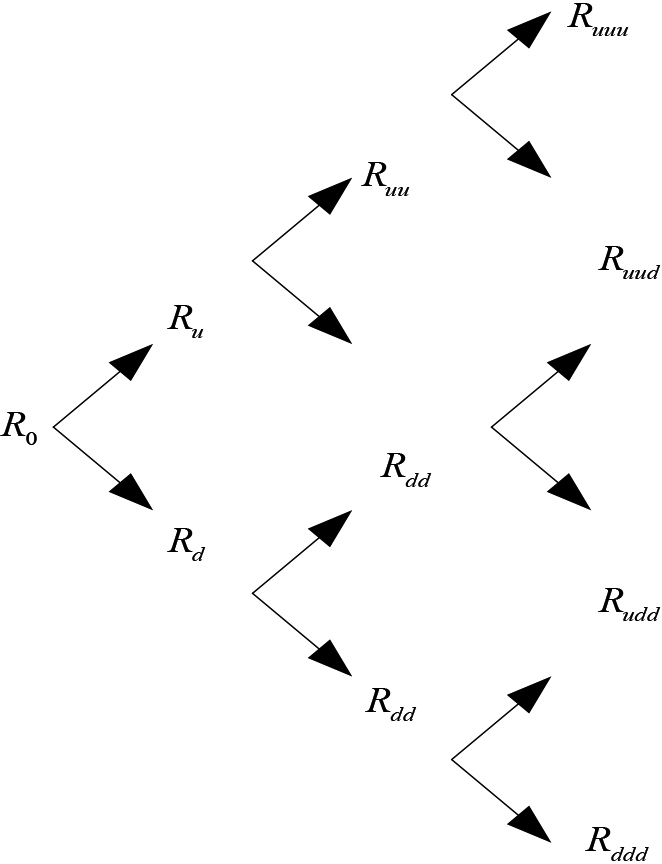
In Fig. 1,
In Eq. (2),
In the steps above, the human capital value of an enterprise under incomplete information is mainly analyzed, and the measurement of human capital value under incomplete information is mainly used to calculate the fluctuation rate of human capital value of an enterprise. The term volatility first appeared in stock options [12]. The generation of volatility is mainly caused by three factors: the impact of macroeconomic factors on an industrial sector, the impact of specific events on an enterprise, and the impact of investors’ psychological status or expected changes on stock prices. The influence of various factors will lead to the change of stock price, which will lead to the change of return on asset investment, resulting in the fluctuation of asset value or stock value. That is, the volatility reflects the expected change in the value of the underlying asset and affects the option value of the underlying asset. In terms of volatility alone, the greater the volatility, the greater the expected change in the option value of the underlying asset. The real option characteristic of human capital - uncertainty will lead to the change of human capital value, that is, the fluctuation of human capital value, which will lead to the emergence of human capital value fluctuation rate, which is a measure of the change degree of human capital return on investment [13]. The fluctuation rate of human capital value reflects the expected degree of change of human capital value and affects the option value of human capital value. Therefore, it is very important to calculate the fluctuation rate of human capital value.
Based on the internal relationship between real option and financial option, the human capital value corresponding to financial option is determined. This is because to change the way of thinking from financial option to real option, we apply the rules of financial market to the investment decision of human capital of enterprises. Among them, the corresponding relationships among financial option [14], real option and human capital option are shown in Table 3.
Corresponding relationships among financial options, real options and human capital options
Corresponding relationships among financial options, real options and human capital options
Analysis Table 3 shows that human capital is equivalent to the subject matter of the option, the present value of the related cash outflows corresponds to the execution price of the option, and the expected duration of service is equal to the time between the option expiration date. In order to obtain the present value of the investment cost of the human capital option of the enterprise is equivalent to the execution price of the option, the time from the maturity date of the stock in the financial option corresponds to the expected incumbency time in the human capital option of the enterprise, and the uncertainty of the human capital value of the enterprise corresponds to the fluctuation rate of the underlying stock price. For this purpose, the present value of expected cash flow generated by human capital options of enterprises, the cost of investing in human capital options of enterprises [15], and the measurement of uncertainty resulting from human capital investment are given, as shown in Table 4.
Factors affecting human capital value measurement of enterprises
The present value of the expected cash flow generated by the human capital option of the enterprise is measured by the present value of the expected profit brought by the human capital of the enterprise [16]. The present value of the investment cost of obtaining the human capital option of the enterprise is measured by the present value of the recruitment, training and welfare benefits costs invested by the enterprise’s personnel. Expected length of service is also the number of years in which managers are expected to be hired. The uncertainty of managed human capital value is expressed by the fluctuation rate of managed human capital value [17].
After the above analysis, we calculate the fluctuation rate and estimate it by the standard deviation of historical data changes of various types of corporate human capital value. The formula is:
In Eq. (3),
The value of human capital here is expressed as a weighted average of the employee’s performance appraisal form or the employee’s job performance. The time interval is the time between two performance appraisals, such as two monthly appraisals, then the time interval is the inverse of the number of time intervals contained in the length of the time interval in years.
From the analysis above, we can see that the human capital of enterprises has the property of real options, and the human capital in real options corresponds to the assets marked by financial options; the present value of expected cash flow generated by human capital options corresponds to the current value of options, the expected incumbency time in human capital options corresponds to the time from the maturity date of options. The uncertainty of future expected returns from human capital investment is equivalent to the volatility of options. Therefore, the option value of human capital can be expressed in Eq. (4):
In Eq. (4),
There is a Eq. (5) to measure the present value of the expected cash flow generated by the human capital option by the present value of the expected profit brought to the enterprise by the human capital option:
In Eq. (5),
Because different types of human capital have different levels of uncertainty in their value, that is, the fluctuation rate is different, and because human capital options and financial options are similar, this paper constructs a measurement model of human capital value of manufacturing enterprises:
In Eq. (6),
Through the above calculation, the calculation of the measurement model of corporate human capital value is completed, and the final measurement of corporate human capital value is generated as follows Fig. 2.
Through the above calculation, the measurement model of enterprise human capital value is completed, and the final measurement value of enterprise human capital value is generated as shown in Fig. 2. In Fig. 2, the four components of the quantitative enterprise human capital value model are taken into account in detail, namely Personal/family investment, government investment, business investment and other social groups and individuals. Among them, Personal/family investment consists of talent and self-cultivation; Both Government investment and business investment are made up of educationg, medicare and training.
Corporate human capital value measurement model.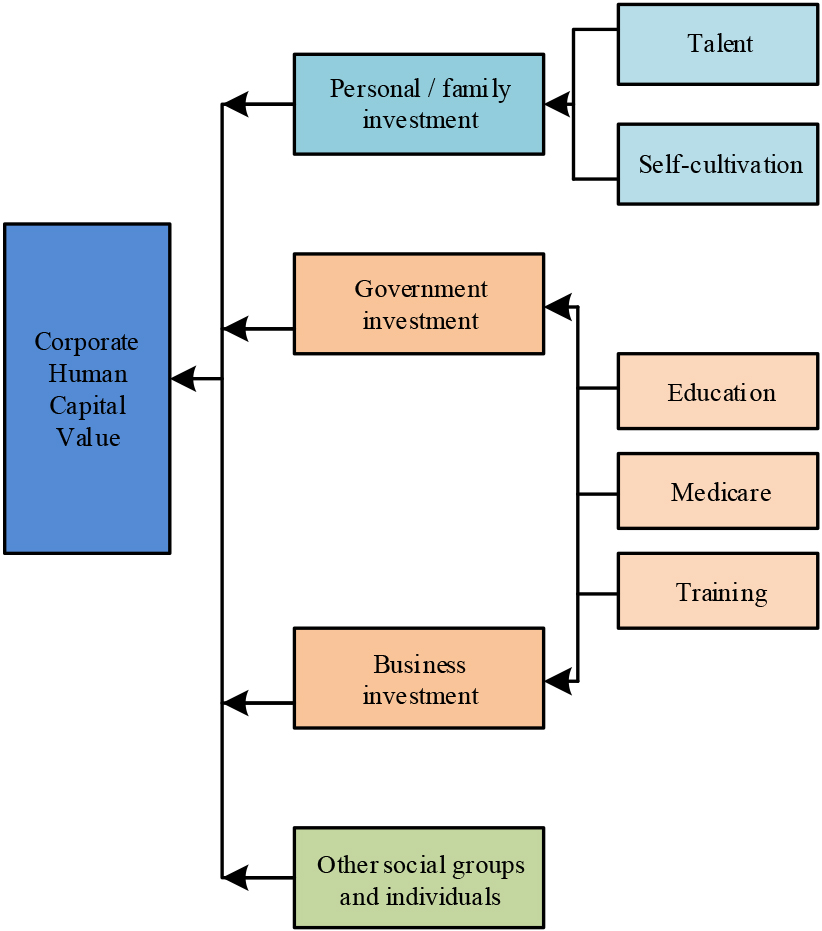
In order to verify the practical application effect of the enterprise human capital value measurement model based on binary tree designed in this paper, the traditional human capital value measurement model based on market method (comparison model 1), the measurement scheme based on EVA performance evaluation mechanism (comparison model 2), and the human capital value evaluation method based on real options (comparison model 3) are compared with the model in this paper, and the measurement accuracy of the four models is compared.
Since work performance is an important factor in determining the value of human capital in an enterprise, the historical work performance of human resources in an enterprise is used as a comparison index.
Instance content
Take operator A as an example, it is an operator of a joint stock limited liability company in a province. Operator A is 42 years old, Han nationality, a member of the CPC, graduated from a university’s mechanical and Electrical Institute and management institute, with double degrees in engineering and management, senior engineer, former engineer of a research institute, president of a research institute, assistant dean of a research institute, vice-president of a research institute, current director and executive vice-president of a joint stock limited liability company, with a working life of 24 years. In 2000, the enterprise’s assets exceeded 1 billion yuan. In many years of production and operation, Operator A has always been at the forefront of the times, making the technology and equipment of enterprises reach the leading level in China, and keeping the management level at the forefront of the industry. The financial performance of enterprises has maintained steady growth, and stock prices have risen steadily.
Through file analysis and questionnaire survey within the enterprise, relevant data of operator A are obtained. The relevant content of the data is shown in Table 5.
Actual survey score table
Actual survey score table
Due to the large number of indicators, in order to save experimental time, the performance of the above indicators was used as the experimental object. Select the performance of operator A in 2019, 2020, 2021 and 2022 as the experimental object. The detailed scores of enterprise labor performance from 2019 to 2022 are shown in Table 6.
Job performance score
Using the above actual scores as the experimental objects of the four measurement models, the data of the sample companies are evaluated year by year with different models. The results of the comparison measurement model and the designed measurement model are compared with the actual scores, and the performance of the workforce in 2019 to 2021 is compared respectively.
Comparison of work performance measurement scores for 2019
Comparison of work performance measurement scores for 2020
The results of this person’s work performance rating in 2019 are known. The comparison of the measured and scored results of the four measurement models with the known scored results is shown in Table 7.
From Table 7, we can see that the result of this design measurement model for this manpower score fluctuates between 70 and 80 points, and the actual work performance score fluctuates between 70 and 80 points, indicating that the measurement result of this design model is not different from the actual result. The results of comparative measurement model fluctuate between 60 and 80 points, which indicates that the measurement of human capital value is susceptible to other factors, leading to poor stability and accuracy in the measurement process.
Comparison of work performance measurements in 2020
The comparison models and the measurements and scoring results of the corporate human capital value measurement model based on binary tree are shown in Table 8.
Comparison of work performance measurement scores for 2021
Comparison of work performance measurement scores for 2021
Comparison of work performance measurement scores for 2022
Relevant information of operators B, C and D
Analysis Table 8 shows that the measurement results of the comparison model fluctuate between 60 and 80 points, most of the scores are above or below 60 points, which is different from the actual results. The measurement results of the designed measurement model fluctuate between 75 and 90 points. There is a certain difference between the first month and the second month, but the difference is small, and the difference is not obvious in other months.
Analyzing the actual scores, we can see that there is a trend of increasing the performance score of the worker in this year, which indicates that the worker’s ability is gradually increasing. The measurement scores of the comparison models and the designed model are shown in Table 9.
From the analysis of the table above, it is known that the score of the design model has a small difference between the actual score of the manpower, and can find the changes of the manpower. There is a certain difference between the results of the comparative measurement model and the actual results, which fluctuates between 70 and 75 points, and the evaluation process does not take into account external factors and the improvement of the level of the workforce itself, resulting in inaccurate results.
Comparison of work performance measurements in 2022
The workforce’s performance score improved significantly in 2022. The results of four models are as follows.
The analysis Table 10 shows that this design of corporate human capital value measurement model has a higher score on this manpower, and has a small difference with the actual score. This shows that the model can find the improvement of the manpower’s personal ability, and can calculate the economic benefits that the manpower brings to the enterprise, so it has a higher score. The results of traditional models still have some differences with the actual results. Although the level of human resources can be measured to some extent, the accuracy is still low.
In order to avoid too single experimental results, the subjects of study were added, including operators B, C and D. The relevant information of the three operators is shown in Table 11.
In order to avoid too simple experimental results and increase the credibility of the experiment, the study subjects were added, including operators B, C and D. In order to ensure the comparability of the survey results with A and the scientificity and objectivity of the research, the survey and statistical methods consistent with A were adopted for the three new research objects. The specific survey results are shown in Table 11.
Calculate the human capital value of operator B, C and D from 2019 to 2022, compare and analyze the measurement accuracy of different models, and set up a new measurement model in recent years – faction-based analysis method as comparison model 4, and analysis method based on micro level as comparison model 5. The results are shown in Table 12.
Comparison of measurement accuracy of different models (%)
Comparison of measurement accuracy of different models (%)
It can be seen from the analysis of Table 12 that the measurement accuracy of the model in this paper has always maintained a high level in many verifications. Therefore, the above work performance measurement experiments can prove that the measurement results of this design based on the binary tree measurement model of corporate human capital value are more accurate than the traditional measurement results.
This research designs a measurement model of enterprise human capital value based on binary tree. Experiments show that the average measurement accuracy of the design model reaches 93.5%, which is 18.5%–10.3% higher than that of the traditional measurement model and 5.2%–5.7% higher than that of the current advanced measurement model. Its theoretical contribution is to improve the accuracy of enterprise human capital value measurement and lay a good foundation for effective enterprise human resource performance evaluation.
Although this binary tree-based measurement model of human capital value of corporates has achieved some results, due to the existence of personal knowledge, time and data collection, there are some limitations in this study. Moreover, some problems related to this article or related to this article still have the feasibility and value for further improvement and development. Specific performance in the following areas:
First, due to authors’ limited ability, the survey data is not comprehensive enough, only selected a certain enterprise as the verification object, the results have certain limitations. Because each company’s specific situation is different, the problems are different. In future research, several more enterprises can be selected to verify, find problems and solve them. In addition, the assessment results in this paper are not detailed enough, so in future research, these human capitals can be classified and studied in more detail. Second, the measurement of human capital value in this paper is evaluated from the perspective of pricing, but in real life, the evaluation of human capital value of enterprises is not only reflected in pricing, but also in income distribution. Many scholars have studied the evaluation of human capital value from the perspective of income distribution. Therefore, this paper holds that if the measurement of human capital value and income distribution are combined, the research results will be closer to the actual situation, and have greater theoretical and practical significance.