




Abstract
At present, private education plays an important role in China’s education system, but there are a series of problems and challenges in the management of private education. The purpose of this study is to discuss and solve the problems existing in the management of private education through the method of fuzzy logic system. Firstly, the application of fuzzy logic systems in related fields is reviewed to understand the potential and advantages of fuzzy logic systems. Then, through the analysis of the main problems in the management of private education, the root of these problems and their impact on the education system are revealed. By establishing a private education management model based on fuzzy logic system, the application and function of this model in problem analysis and decision making are demonstrated. In the analysis of the results, the accuracy and effectiveness of the fuzzy logic system in the management of private education are evaluated, and the targeted management strategies and countermeasures are put forward to solve the problems in the management of private education.
Keywords
Introduction
With the development of social economy and the strengthening of education marketization, private education has been playing an increasingly important role in China’s education system. With its flexible operation mode, abundant educational resources and innovative teaching methods, private educational institutions provide possibilities for solving some problems in public education, such as uneven distribution of educational resources and single teaching methods. However, it is followed by a series of problems and challenges in the management of private education, such as the guarantee of education quality, the economic benefits of operation, the treatment and training of teachers, and the cooperation and competition with public education. In this case, how to optimize the management of private education, so that it can better serve students and society, has become an important research topic. The traditional decision analysis method may be unable to deal with these problems because of the complexity and fuzziness of educational management. Therefore, research needs a new approach to decision analysis to address these challenges. As a scientific decision-making method that can deal with uncertainty and fuzziness, fuzzy logic system is considered as a possible solution to these problems. Fuzzy logic system is a kind of logic system which is characterized by dealing with non-black and white binary problems. It can deal with and solve the problems with many dependent variables and complicated data in real life. This characteristic makes fuzzy logic system have a wide application prospect in decision analysis. This study, through the construction and application of private education management model based on fuzzy logic, aims to solve a series of management problems in private education and provide a new and scientific decision-making analysis method. This not only has important theoretical and practical significance for optimizing the management of private education, improving the teaching quality of private education, and promoting the development of private education in China, but also provides a new research perspective and practical example for the application of fuzzy logic in the field of education.
The core problem of this study focuses on how to understand and solve the problems in the management of private education through fuzzy logic system, especially in the aspects of resource allocation, education quality assurance, teacher treatment and training. Due to the complexity and fuzziness of educational management problems, traditional decision analysis methods may not be able to accurately reveal the nature of the problems and provide effective solutions. Therefore, the main objectives of this study are: first, to understand and clarify the main problems and challenges in the current management of private education; Secondly, based on fuzzy logic system theory, a decision analysis model for private education management is constructed. Then, by applying the model, quantitative and qualitative analysis of specific problems is carried out to obtain deep and comprehensive insight; Finally, according to the results of model analysis, effective management strategies and countermeasures are proposed and verified. Through this research, the research is expected to provide scientific and reasonable decision support for the practice of private education management, and promote the research and application of fuzzy logic system in the field of education.
As a new research field, the private education management based on fuzzy logic has attracted the attention of many scholars and researchers. In recent years, the application of fuzzy logic technology in educational management has gradually gained popularity. Adel (2020) explores the issues and prospects for privacy, security and flexibility in the use of fuzzy computing technologies in educational IoT systems [1]. The study emphasizes the importance of adopting fuzzy logic in technology integration to solve educational management problems. On the other hand, Arguedas et al. (2018) proposed a model for providing emotional cognition and feedback in online learning using fuzzy logic [2]. The model emphasizes the importance of using fuzzy logic in a personalized learning environment to better understand and meet the needs of students. Chrysafiadi et al. (2023) conducted a study on Greek students and found that an intelligent tutoring system based on fuzzy logic has a significant effect on improving students’ learning outcomes [3]. This finding further proves the practicability of fuzzy logic in educational management and teaching. Fu et al. (2021) discussed the application of big data intelligence in intelligent education management system and emphasized the importance of using fuzzy logic method to analyze and interpret complex data [4]. This study highlights the potential of fuzzy logic in big data analytics for education. However, Albaity et al. (2023), in their research on artificial intelligence analysis and application in digital education based on complex fuzzy clustering algorithms, pointed out that although fuzzy logic has strong potential, there are also some problems and challenges in the implementation process [5]. In general, private education management based on fuzzy logic is a complex field worth exploring, involving many different aspects and applications. The existing literature emphasizes the importance of using fuzzy logic to solve educational management problems and points out some implementation challenges. Future research could further delve into these challenges and examine how to overcome them to better leverage the potential of fuzzy logic in private education management.
In order to achieve this goal, the research will be carried out according to the following framework: First, the research background and significance will be elaborated, and the motivation and importance of the research will be clarified. The application of fuzzy logic system in other fields is discussed to deepen the understanding of this method. Next, the research will analyze and identify the main problems in the management of private education in detail. On the basis of summarizing the management of private education, the quality problem, resource allocation problem and management standardization problem will be deeply analyzed in order to reveal the essence and influence of the problem. Then it introduces the theoretical basis of fuzzy logic system, including its basic principle and mathematical model. At the same time, the application of fuzzy logic system in decision analysis and its potential in educational management decision making will be discussed. In the part of model construction, the research will design a private education management model based on fuzzy logic system. In the part of problem analysis and solution strategy, quantitative and qualitative analysis methods are used to comprehensively analyze the data to obtain the assessment of accuracy and validity. Through showing the analysis results, and put forward the targeted management strategies and countermeasures, in order to solve the problems in the management of private education. The conclusion part summarizes the main findings and conclusions of the research, and discusses the practical significance and theoretical contribution of the paper. At the same time, suggestions and prospects for future research will be put forward to further promote research and development in the field of private education management. Through the above research content and framework, this study aims to provide a new perspective and method for solving the problems existing in the management of private education by using the method of fuzzy logic system, so as to improve the quality and effect of private education.
Problems and challenges in the management of private education
Overview of private education management
Private education is playing an increasingly important role in China’s education system. According to relevant data, the scale of private education is constantly expanding, the disciplines and professions covered are also constantly enriched, providing diversified and personalized education services for the society, greatly enriching the education market, and providing impetus for the development of education [6]. At the same time, private education also provides more choices for society and families, and better meets the diversified needs of society and the public for education.
Compared with public education, the management of private education has its unique characteristics. First of all, the subjects of private education are diversified, including enterprises, associations, individuals, etc., which determines that the management mode of private education must have certain flexibility to meet the needs of different subjects. Secondly, the source of funds of private education mainly depends on tuition income and social donations, which requires the administrators of private education to have a certain ability of operation and management to ensure the economic benefits of educational institutions. Thirdly, due to the high degree of freedom in running a school, the private education has greater autonomy in curriculum setting and teaching methods, which requires the managers of private education to have forward-looking educational ideas and innovative consciousness. In addition, the management of private education also involves the construction of teachers, teaching quality control, student management and other aspects, which requires the administrators of private education must have a comprehensive management ability.
Analyze and identify the main problems in the management of private education
To understand and solve the management problems of private education, it is necessary to analyze and identify these problems first. Based on the study of the current situation of private education management, the main management problems can be divided into the following aspects.
First of all, the quality of education is one of the most critical issues. Although private educational institutions provide a variety of educational choices, the quality of education in some institutions is difficult to guarantee due to the limitation of educational resources, such as teaching materials, equipment, school buildings, etc., and the uneven teaching level of teachers. In addition, some institutions pursue economic benefits too much and neglect the control and guarantee of education quality, which further affects the overall image and social trust of private education [7, 8]. According to the survey, 30 percent of parents are dissatisfied with the quality of education in some private schools.
Secondly, the problem of teachers is also an important issue in the management of private education. On the one hand, some private educational institutions have difficulties in the construction of teachers, such as the serious loss of teachers, the low salary of teachers, and the inadequate training and management of teachers [7]. For example, due to the low salary of teachers in a private school, the teacher turnover rate is as high as 25%. These problems not only affect teachers’ teaching enthusiasm and teaching quality, but also bring negative effects to students. On the other hand, the structure and quality of teachers are directly related to the quality of education, so how to improve the professional quality and teaching ability of teachers has become an important topic of private education management. A recent study found that 20 percent of private schools had inadequate teacher training, which affected the quality of teaching.
Third, the problem of operation and management cannot be ignored. Due to their dependence on tuition fees and social donations, some private educational institutions are under pressure in terms of economic efficiency and scale expansion [8]. Especially in the highly competitive education market, how to effectively attract and retain students, how to enhance the value of education services, and how to balance cost and benefit are all problems that private educational institutions must face and solve. The average profitability of private educational institutions has fallen by 8% in the past five years.
Finally, the policy environment is also an important factor affecting the development of private education [9]. The changes and uncertainties of policies and the imperfection of laws and regulations have brought troubles to the development of private education. In the past five years, there have been as many as 50 policy changes involving private education, causing instability in the industry. For example, the development of private educational institutions will be affected if there is no clear and stable policy environment for the supervision policies of private educational institutions and the laws and regulations for the treatment of teachers and the protection of students’ rights and interests.
In general, the management of private education is a complex and important subject, which needs to be deeply studied and discussed in order to find an effective way to solve the above problems.
Analyze the root cause of the problem and its impact
For the problems existing in the management of private education, the research needs to explore the root causes from a deeper perspective, and analyze the impact it brings.
The root of the problem of education quality lies in the uneven distribution and poor management of educational resources [10]. Due to financial and policy restrictions, many private educational institutions are unable to obtain sufficient educational resources, such as teaching materials, teaching equipment and teachers. However, some institutions also have problems in the management and utilization of educational resources, which cannot maximize the efficiency and benefit of educational resources. In addition, some private educational institutions pursue economic interests too much and neglect to control and guarantee the quality of education. These factors will directly affect the improvement of education quality, damage the rights and interests of students, and also affect the social reputation and public trust of private education.
The root of the teacher problem lies in the imperfect treatment and management system of teachers. On the one hand, some private educational institutions do not pay high wages to teachers, which makes excellent teachers unable to get reasonable incentives, thus affecting their teaching enthusiasm and teaching effect. On the other hand, the teacher management system of some private educational institutions is not perfect, lack of training and management of teachers, which not only affects the professional development of teachers, but also affects the improvement of education quality [11, 12, 13].
The root of the management problem lies in the unreasonable management mode and management mode. Since private educational institutions mainly rely on tuition fees and social donations, they are facing pressure in terms of economic efficiency and scale expansion. However, the business model and management model of some private educational institutions cannot adapt to the pressure of market competition, cannot effectively attract and retain students, and enhance the value of education services, which will hinder the development of institutions.
The root of the policy environment problem lies in the uncertainty of policy and the imperfection of laws and regulations [14]. If there is no clear and stable policy environment for the supervision policies of private education, the laws and regulations on the treatment of teachers and the protection of students’ rights and interests, it will have a negative impact on the development of private educational institutions.
These fundamental problems not only restrict the steady development of private educational institutions, but also have a profound impact on the overall quality and equity of education. In order to solve these problems and further optimize the management, fuzzy logic system provides us with a unique perspective, which helps us to understand and improve the practice strategy of private education more scientifically, so as to improve the overall level of its education service.
Fuzzy logic system and its application in decision analysis
Theoretical basis of fuzzy logic system
Fuzzy logic system, first proposed by Lotfi Zadeh in 1965, is a kind of logic system based on fuzzy sets and fuzzy logic rules. Different from traditional binary logic systems (i.e. true or false), fuzzy logic systems can deal with fuzziness and uncertainty, and can better simulate human decision-making process [15, 16].
The theoretical basis of fuzzy logic system mainly includes fuzzy set and fuzzy reasoning.
First, fuzzy sets. In traditional set theory, there are only two possibilities for an element to belong to a set, that is, to belong to it or not to belong to it, while in fuzzy set theory, the degree to which an element belongs to a set can be any value between 0 and 1, which is called membership. For example, considering the concept of “young”, traditional set theory either classifies a person as young or not. But in fuzzy logic, a 25-year-old might be considered young, with a membership of 0.7; A 40-year-old might have a membership of 0.2. This flexible classification enables fuzzy set theory to deal with fuzzy concepts such as “altitude” and “temperature”.
Second, fuzzy reasoning. Fuzzy inference is the core of fuzzy logic system, which is the process of getting fuzzy output from fuzzy input according to fuzzy logic rules. Fuzzy reasoning mainly includes three steps: fuzzy reasoning, fuzzy reasoning and defuzzy reasoning. Fuzzification is to transform precise input into fuzzy set. Fuzzy reasoning is based on fuzzy logic rules. Defuzzification is the conversion of fuzzy output into precise output. Example: Blurring: turning a precise input like “It’s 18∘C today” into a fuzzy set like “cooler.” Fuzzy reasoning: reasoning based on rules such as “If the weather is cooler, wear a long-sleeved shirt.” Deblurring: Turning fuzzy outputs such as “wear long-sleeved shirts” into specific decisions, such as “wear long-sleeved shirts of moderate thickness.”
The theoretical basis of fuzzy logic system makes fuzzy logic system can deal with ambiguity and uncertainty in the real world effectively [17]. In decision analysis, fuzzy logic system can provide a flexible and effective decision support tool, which can deal with all kinds of complex and fuzzy decision problems. Therefore, fuzzy logic system has been widely used in many fields, such as control system, pattern recognition, prediction and optimization.
Application of fuzzy logic system in decision analysis
Fuzzy logic system is widely and deeply used in decision analysis. Its flexibility, comprehensiveness and inclusiveness make it an ideal tool to deal with multiple, complex and uncertain decision problems. As shown in Table 1 above:
Application of fuzzy logic system in decision analysis
Application of fuzzy logic system in decision analysis
First, deal with uncertainty and ambiguity. In many practical decision-making scenarios, the information faced by decision makers is often vague or not completely certain. In this case, fuzzy logic system can help decision makers better deal with this uncertainty and fuzziness, because it allows for fuzzy reasoning and estimation, thus providing a more comprehensive decision basis. Second, multi-criteria decision analysis. In many decision problems, multiple decision criteria need to be considered at the same time, and there may be conflicts or contradictions between these criteria. In this case, fuzzy logic system can help decision makers to make comprehensive evaluation and balance by setting fuzzy priorities or weights, so as to achieve the optimal or most satisfactory decision. Third, prediction and optimization. In many decision scenarios, you need to predict future situations or optimize decision outcomes. In this case, fuzzy logic system can help decision makers to predict and optimize through fuzzy reasoning and learning, so as to provide better decision basis. Fourth, deal with unstructured problems. In many decision problems, the structure of the problem may not be clear, or the circumstances of the decision may be constantly changing. In this case, fuzzy logic systems can help decision makers deal with such unstructured problems through dynamic and adaptive reasoning and learning, thus providing more flexible decision support.
In general, the application of fuzzy logic system in decision analysis can provide a new way for decision makers to make decisions, and help to improve the scientificity and effectiveness of decision making, which is of great significance for dealing with complex and uncertain decision making problems in modern society.
Fuzzy logic system has great potential in educational management decision-making. Because of its ability to deal with uncertainty and ambiguity, it can provide more comprehensive, flexible and precise solutions to various problems in educational management [18, 19]. Here are some specific application areas:
Teaching evaluation: In the teaching process, teachers need to evaluate students’ learning progress and effect, which usually involves many vague and uncertain factors, such as students’ learning attitude, participation degree, understanding ability and so on. Fuzzy logic system can help teachers to make more accurate and fair teaching evaluation by dealing with these fuzzy factors. Allocation of educational resources: The allocation of educational resources usually needs to consider multiple factors, such as the needs of students, educational goals, availability of resources, etc. Fuzzy logic system can help decision makers to balance these factors and make better resource allocation. Education policy making: Education policy making involves many complex and fuzzy issues, such as the setting of educational goals, the allocation of educational resources, and the evaluation of educational effects. Fuzzy logic system can help decision makers deal with these problems and make more scientific and rational education policies. Student behavior analysis: Fuzzy logic system can be used to analyze students’ behavior and performance, so as to discover their learning habits and potential problems. This plays an important role in improving the quality of education and improving the learning effect of students.
In general, the application of fuzzy logic system in educational management decision-making has great potential, which can provide more powerful, flexible and accurate decision support tools for educational management. With the continuous development and improvement of fuzzy logic technology, it is expected that its application in educational management decision-making will be more extensive and in-depth exploration.
Model design
When constructing the private education management model based on fuzzy logic system, the research first needs to consider the key factors concerned in education management and express them as fuzzy sets. Taking student satisfaction as an example, research can divide it into several categories, such as “very dissatisfied,” “dissatisfied,” “medium,” “satisfied,” and “very satisfied.”
Collect data information through questionnaire survey and get sample data.
The study considers three input variables: student engagement (
This study can define a fuzzy logic rule, expressed as:
If (
The construction of fuzzy logic rules is based on the practical analysis of educational management and the suggestions of experts. Fuzzy logic rules can be represented by fuzzy sets and membership function. For example, research could define a membership function
As shown in Fig. 1 below, an example of fuzzy set and membership function under fuzzy logic rules is shown.
Example value of membership function under fuzzy logic rules.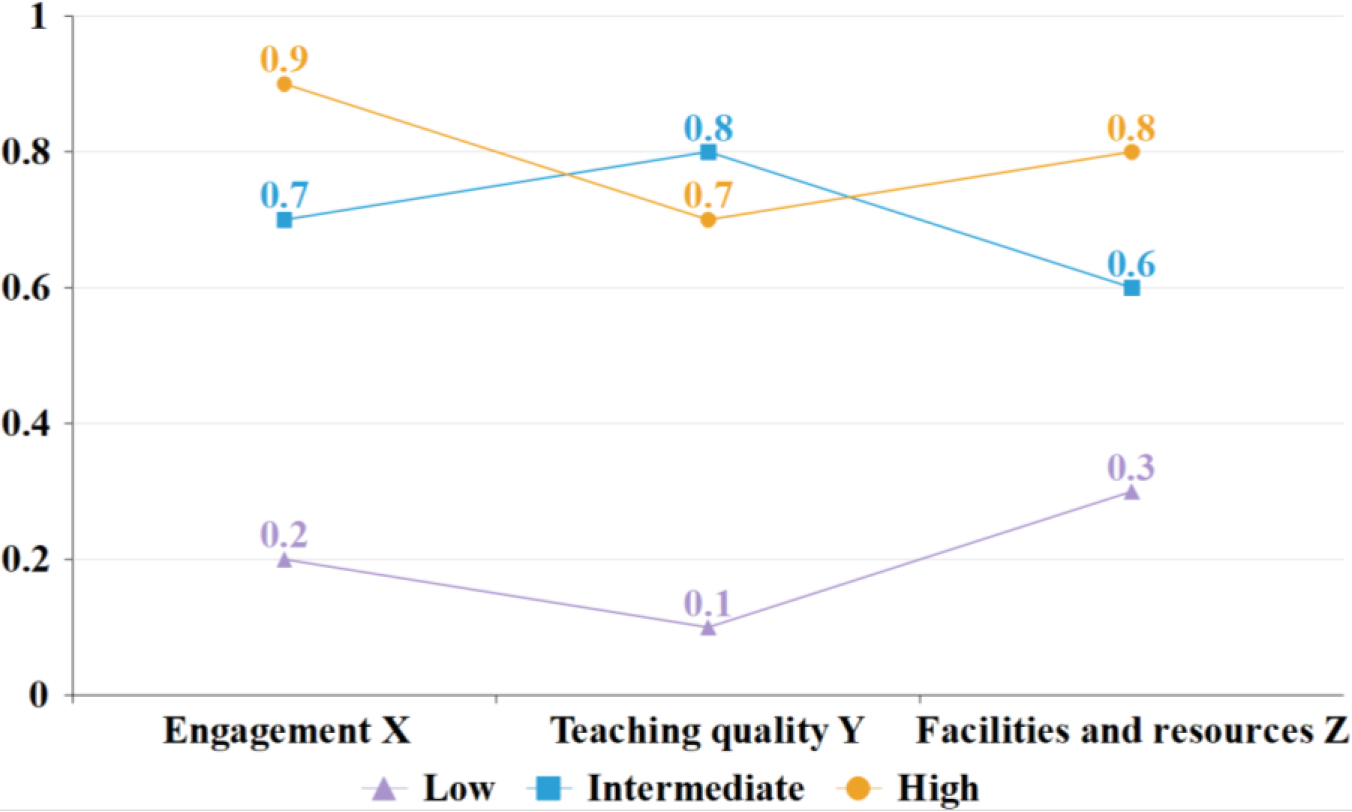
The output of the model, student satisfaction, can also be represented as a fuzzy set whose membership function is
For fuzzy logic rules, studies usually use min or product as the meaning of the fuzzy connective word “and”. For example, if the minimum method is used, the output membership of the model is shown in Eq. (1):
After the fuzzy set of output is obtained, the research needs to convert the fuzzy output to a clear value by defuzzification. The commonly used defuzzification methods include centroid method, average value method and so on.
This model can be used as a basic framework to provide information and decision support for private education management. By using fuzzy logic systems, decision makers can make better decisions under uncertain and fuzzy conditions.
The private education management model based on fuzzy logic system in this study mainly consists of the following parts:
Input variables: Input variables are the basis of the model, including student engagement (
Sample values of input variables. Fuzzy set and membership function: Each input variable is associated with a fuzzy set, which is described by membership function. Membership function is a function that maps the actual value of the input variable to the interval [0, 1], indicating the membership degree of the input value to a fuzzy set. Fuzzy logic rules: Fuzzy logic rules are the core of the model and are used to describe the relationship between input variables and output variables. Rules are usually in the form of “if …So …”. For example, research can define the following fuzzy logic rules: If ( If ( Inference mechanism: Inference mechanism is the operation part of the model, which is used to calculate the membership function of the output variable according to the fuzzy logic rules and the membership function of the input variable. Common reasoning mechanisms include minimum reasoning and product reasoning. Defuzzification method: Defuzzification method is used to convert fuzzy output to a clear value. The commonly used defuzzification methods include centroid method, average value method and so on.
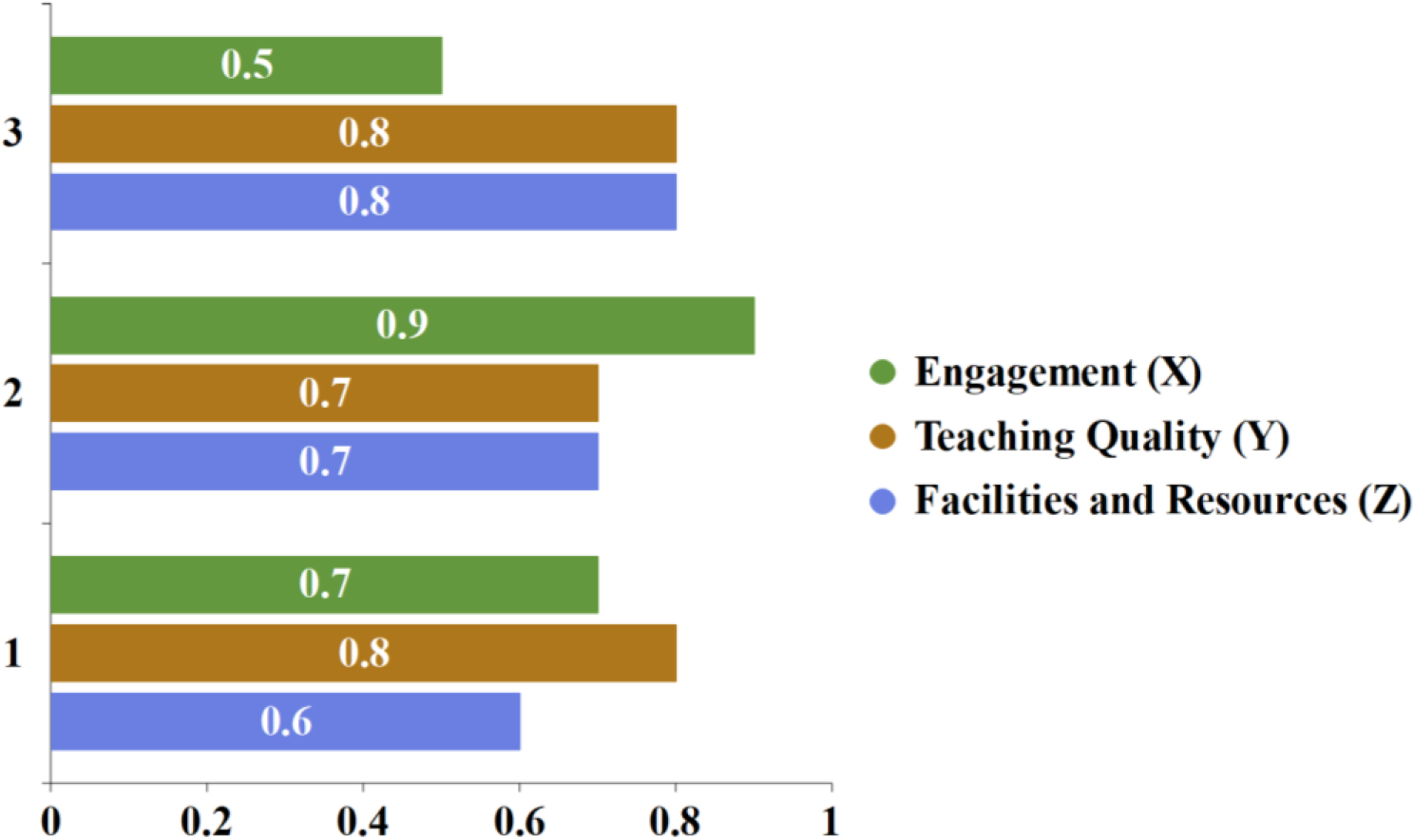
Through the above parts and functions, the model can calculate a fuzzy output according to the value of the input variable through the fuzzy logic rules and reasoning mechanism, and then get a clear output value through the method of defuzzification. This value can be used to evaluate and make decisions on the management of private education.
After applying the private education management model based on fuzzy logic system, this research is expected to get more refined evaluation and decision-making results.
Expected results
More accurate assessment and decision making: The model can handle clear data and is able to deal with the uncertainties and ambiguities that are common in educational management. This helps improve the precision and efficiency of decision making.
Quantitative evaluation of student satisfaction: The fuzzy output set of student satisfaction can be obtained by using fuzzy logic system, and the clear output value can be calculated by using centroid method for de-fuzzification. This value can be used to quantify the evaluation of student satisfaction. The following Eq. (2) is shown:
Here,
Figure 3 below shows the satisfaction of the fuzzy output set and its corresponding membership value.
Fuzzy output set.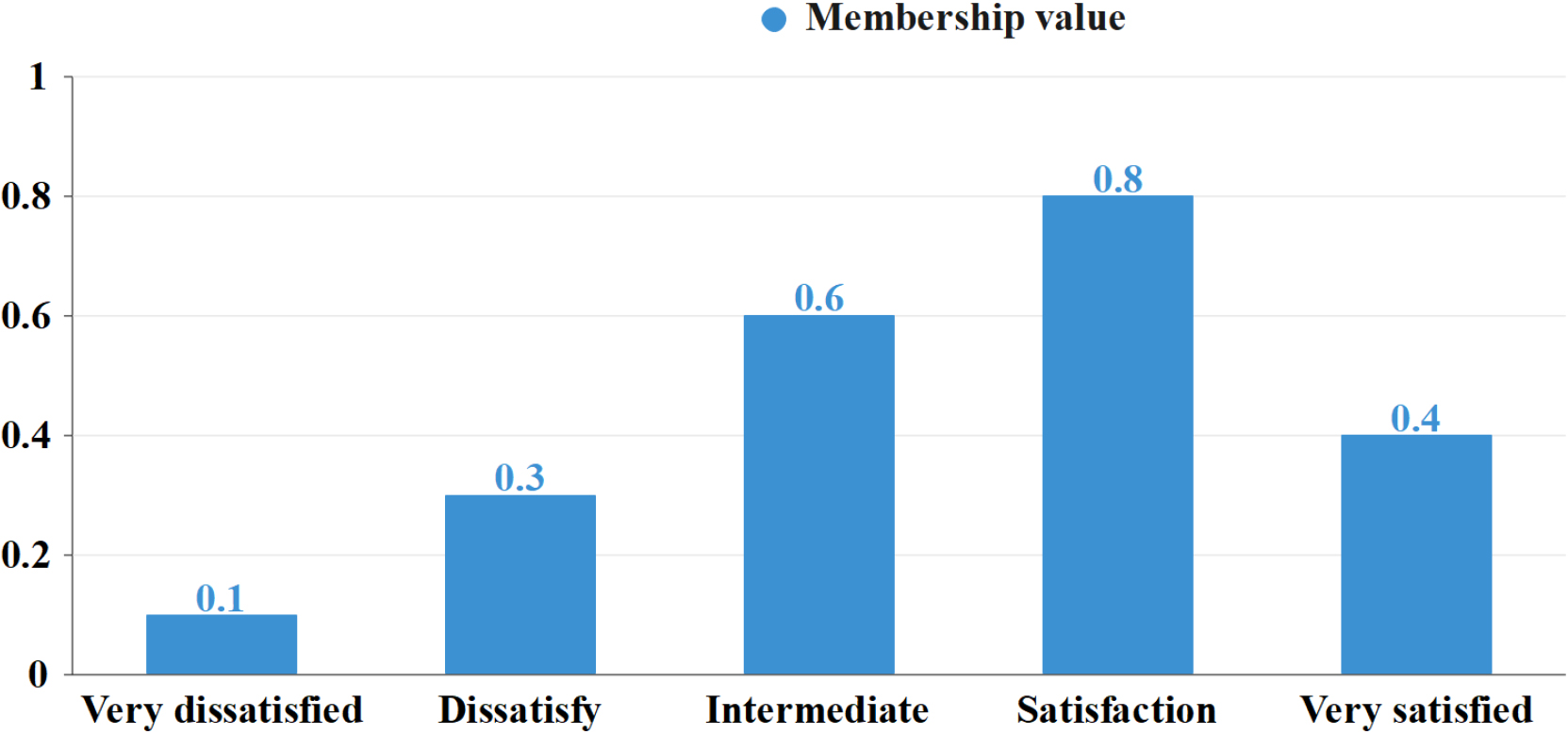
Applying this model, this study can obtain clear output values of student satisfaction:
This value can be further interpreted as a relatively high level of student satisfaction.
Applications
First, improve the quality of decision making: Through fuzzy logic, managers can make more reasonable decisions in uncertain and ambiguous situations.
Second, optimization of resource allocation: By assessing the impact of teaching quality, facilities and resources, schools can optimize resource allocation to improve the quality of education.
Third, teaching quality improvement: Based on the feedback of the model, the school can understand what needs to be improved and take corresponding measures to improve the quality of teaching.
Fourth, personalized education program: Through model analysis, schools can develop personalized education programs for different student groups.
Through the above application, the private education management model based on fuzzy logic system is expected to bring about significant improvement in education management.
Quantitative and qualitative analysis
After applying the private education management model based on fuzzy logic system, this study can conduct quantitative and qualitative analysis. The following is a possible method of analysis:
First, research requires the collection of data on input variables, which can be done through questionnaires, observations, or other data collection methods. On the basis of the collected data, these data can then be input into the fuzzy logic system to calculate the fuzzy output value. This step requires the application of fuzzy logic rules and reasoning mechanisms defined in this study. Then, the study can use the method of defuzzification to convert the fuzzy output value into a clear output value. This value can be used to evaluate and make decisions on the management of private education.
The quantitative analysis is shown in Fig. 4 above.
Quantitative analysis.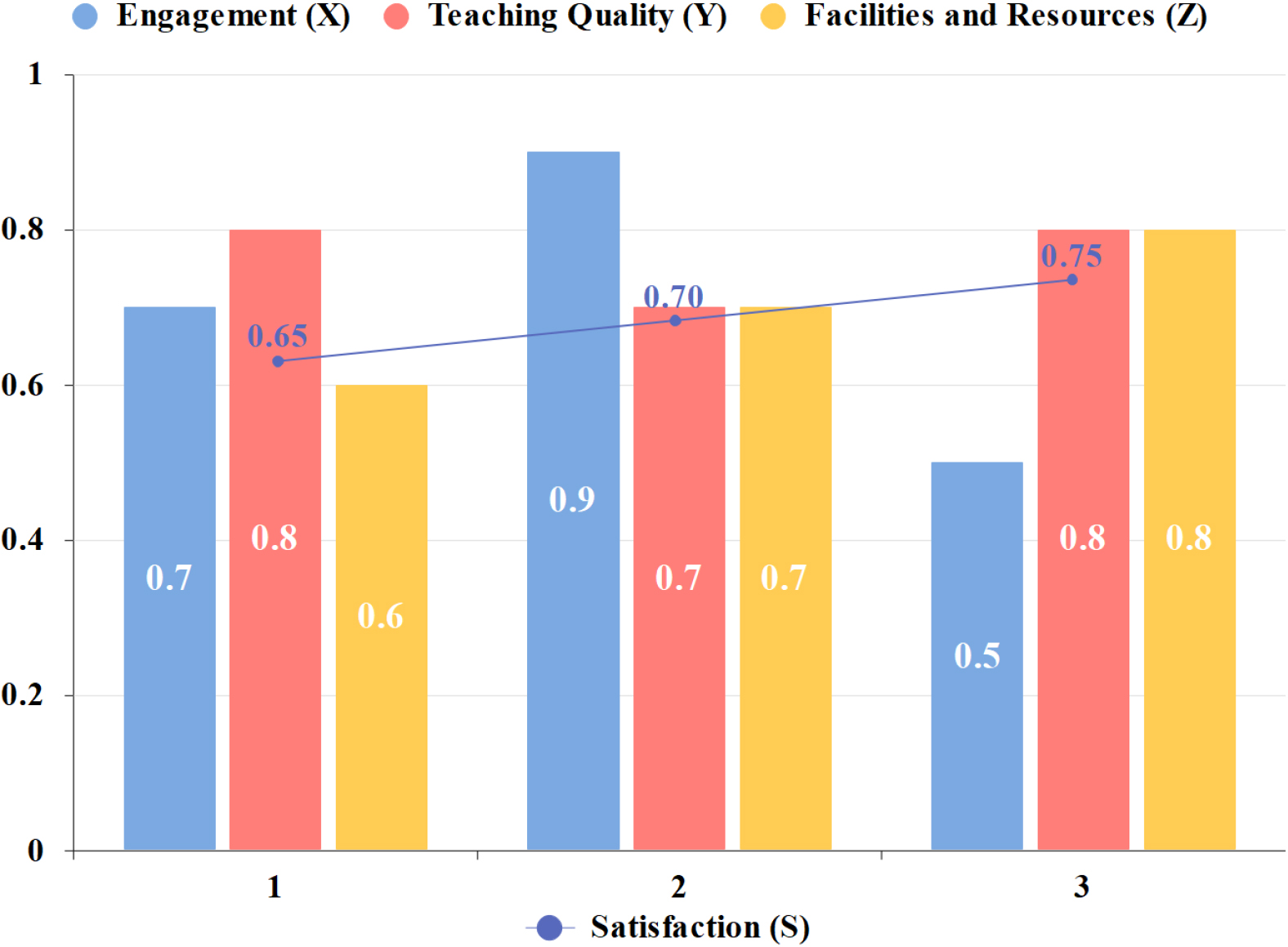
By analyzing these output values, the study can learn that:
Student 3 has the highest satisfaction, probably because of their high participation, teaching quality and facilities. Student 1 has the lowest satisfaction, probably because they have lower facility resources.
The quantitative analysis section can not only calculate the satisfaction of each student, but also find out the main factors that affect the satisfaction.
In the qualitative analysis section, research can analyze and interpret fuzzy logic rules, such as:
The rule “If ( The “If (
Qualitative analysis can help this research understand how the fuzzy logic system works, and can provide implications for improving the strategy of private education management.
In general, quantitative analysis provides specific data and findings on the satisfaction of private education, helping to reveal the influencing factors, while qualitative analysis provides explanations for understanding these phenomena, thus providing a strong theoretical support for improving and optimizing the management of private education. The comprehensive application of this analysis method not only reflects the scientificity and logic of the study, but also improves the rigor and operability of the study.
After the quantitative and qualitative analysis of private education management based on fuzzy logic system, the research needs to further analyze the results. The following is the result analysis process:
Firstly, the collected satisfaction data are analyzed statistically. Statistical analysis provides an overall understanding of the data, including the central tendency (mean, median, mode) and degree of dispersion (standard deviation) of the data. The statistical analysis results are shown in Fig. 5 above.
Statistical analysis results of satisfaction.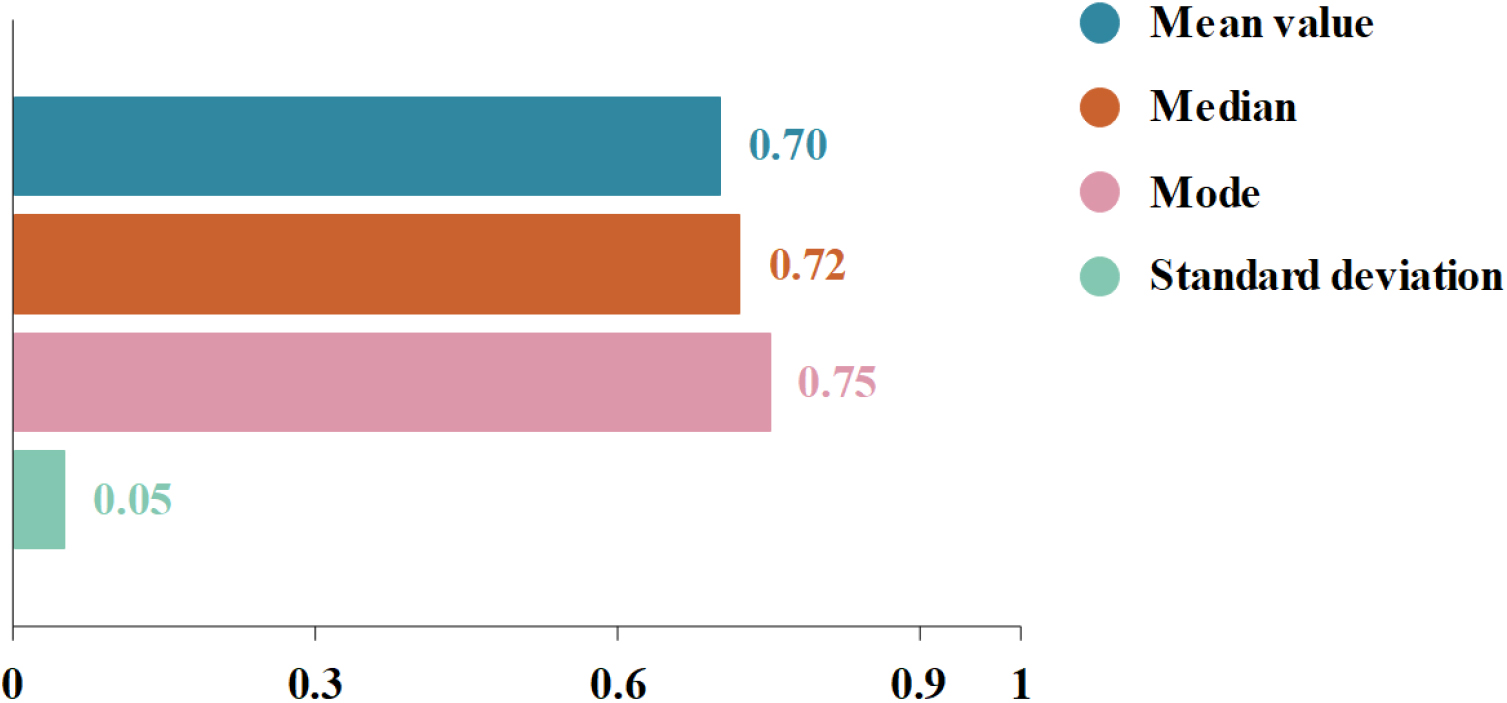
As can be seen from the figure above, the average satisfaction of students is 0.70, which means that on the whole, students have a high satisfaction with the management of private education. The median was 0.72, indicating that the majority of students were satisfied around that level; The mode is 0.75, meaning that the most common satisfaction is 0.75. In addition, the standard deviation of satisfaction is 0.05, which indicates that the distribution of student satisfaction is relatively concentrated, the degree of dispersion is not large, and the management level is relatively stable.
Second, correlation analysis can be performed to examine the relationship between input variables (participation, teaching quality, and facility resources) and satisfaction. The results of correlation analysis are usually presented in the form of correlation coefficients, which range from
Results of correlation analysis.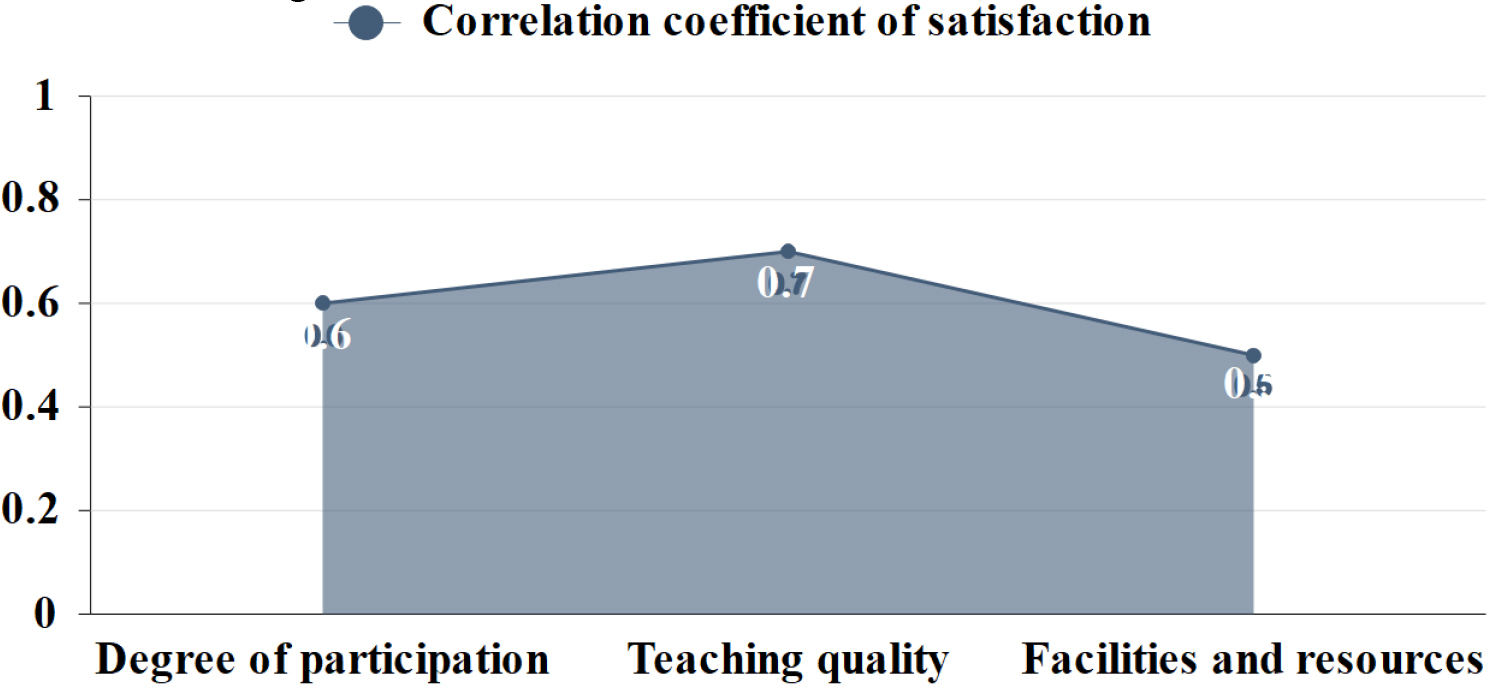
As can be seen from the figure above, the correlation coefficient between teaching quality and satisfaction is the highest (0.7), which indicates that the improvement of teaching quality will significantly affect students’ satisfaction. The correlation between participation (0.6) and satisfaction is the second, indicating that students’ participation is also an important factor affecting satisfaction. Facilities and resources (0.5) have the weakest correlation with satisfaction, which may indicate that facilities and resources have relatively little impact on student satisfaction in the model. This means that improving the quality of teaching may be the most effective way to increase student satisfaction.
Through the analysis of the above results, this study can draw some preliminary conclusions, and put forward some strategies to improve the management of private education.
When designing and implementing any model, it is critical to evaluate its accuracy and effectiveness. The accuracy of the model will be evaluated to ensure that it accurately describes and predicts the actual situation. The study will also evaluate the effectiveness of the model to determine whether it has a use in practical applications.
First, in order to evaluate the accuracy of the model, the results predicted by the model can be compared with the results of actual observations. For example, you can calculate the difference between the satisfaction predicted by the model and the satisfaction obtained from the actual survey. An example of the accuracy evaluation results is shown in Fig. 7 above.
An example of the accuracy evaluation results.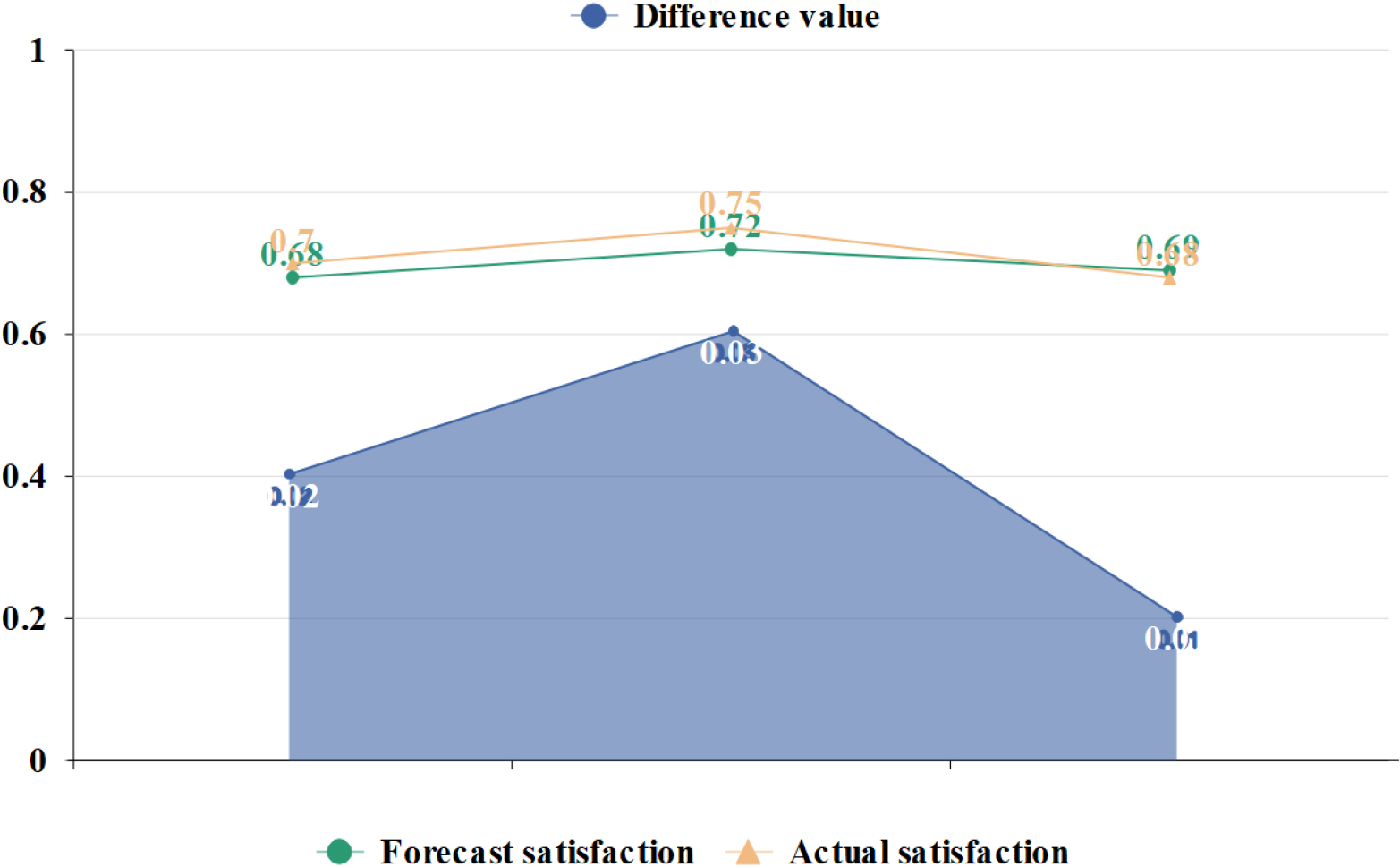
Results of effectiveness evaluation.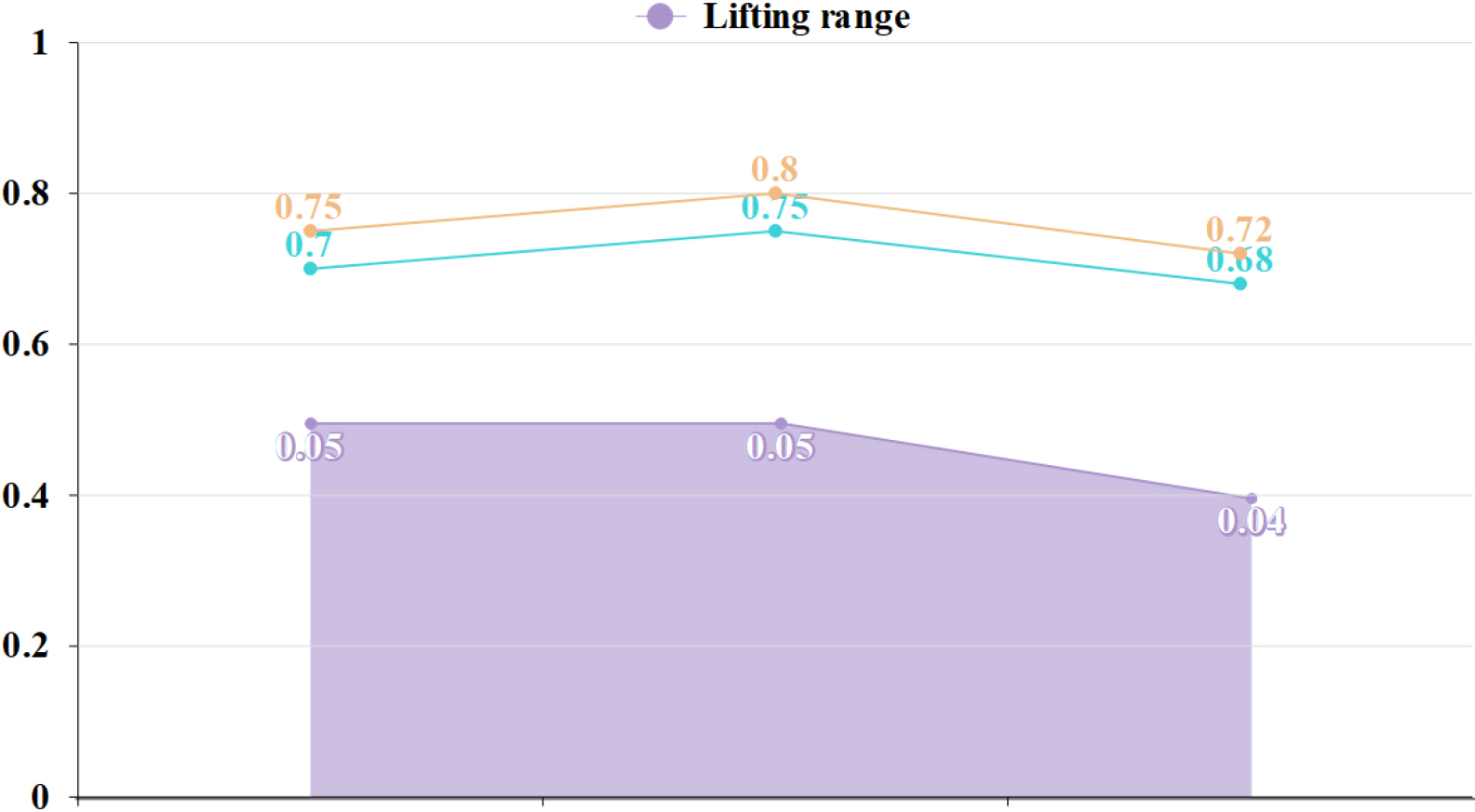
As can be seen from the figure, the difference between the satisfaction predicted by the model and the actual satisfaction is small, which indicates that the accuracy of the model is high.
Second, in order to evaluate the effectiveness of the model, research can look at whether the model can produce useful results when solving real problems. For example, you can make improvements based on the model, then implement them, and finally see if satisfaction increases. An example of effectiveness evaluation results is shown in Fig. 8 above.
As can be seen from the figure, after the implementation of the improvement plan proposed by the model, the degree of satisfaction is improved, which indicates that the model is highly effective.
Through the above accuracy and effectiveness evaluation, it can be confidently said that the model of this study is reliable and effective in solving the problems of private education management.
On the whole, we can confidently say that this research model is reliable and effective in solving the problems of private education management. Not only does it provide accurate explanations and predictions, it also has the potential to actually improve the educational management process. This provides a solid foundation for further research and practice.
According to the results and analysis of the model, the research can put forward some management strategies and countermeasures to help solve the problems in the management of private education. These strategies and countermeasures are aimed at the specific problems identified in the problem analysis of this study, such as quality problems, resource allocation problems, standardization problems, etc. Table 2 above shows some targeted management strategies and countermeasures proposed based on the results and analysis of the model.
Targeted management strategies and countermeasures
Targeted management strategies and countermeasures
Improve the quality of teachers: In order to improve the level of teacher education and teaching, we propose to set up teacher training centers and conduct regular teaching skills training. In addition, external experts can be invited to give special lectures to give professional guidance to teachers from different angles and levels. Such a concrete implementation plan can ensure the all-round improvement of teachers’ quality, thus improving the teaching quality and the satisfaction of students’ parents.
To solve the problem of resource allocation: In order to ensure the rational use of resources and optimize the efficiency of the use of educational resources, we propose to conduct a comprehensive resource demand analysis and formulate an annual resource plan according to the actual situation. In the implementation process, it is necessary to monitor the use of resources in real time, adjust and optimize the allocation of resources in a timely manner, and ensure that resources are properly used in the right place.
The key to improve management efficiency is to strengthen standardized management. We offer to develop a detailed management manual and conduct regular management training to ensure that every manager understands and implements the management code. In addition, management norms need to be reviewed and updated regularly to ensure that management measures match the actual needs, so as to improve the effectiveness of management and the quality of education services.
Through the implementation of these targeted management strategies and countermeasures, this study is expected to effectively solve the problems existing in the management of private education, so as to improve the quality and effect of private education.
Aiming at the key problems in the management of private education, this study deeply discusses the core issues such as education quality, resource allocation and management standardization, and constructs a new analysis model by using fuzzy logic system. The model performs well in the accuracy and effectiveness evaluation, showing significant advantages in solving problems of private education management. According to the analysis results of the model, this study puts forward a series of targeted management strategies and countermeasures, such as improving teacher quality, optimizing resource allocation, strengthening standardized management and so on. These strategies and countermeasures are designed to be practical and feasible programs aimed at improving the quality and effectiveness of private education.
Although the model in this study has achieved some success, there may still be biases and errors in the process of data collection and model construction. Therefore, future studies should further improve the model, enhance its robustness and universality, and conduct empirical tests under more diverse backgrounds and larger sample sizes to verify and enhance the application value of the model. In addition, private education management is a complex and diverse field, and future research can also explore other factors and dynamics that may affect private education management.
In general, this study not only provides a new perspective and method for understanding and solving the problems in the management of private education, but also has important theoretical and practical significance for the practice of private education management. The limitations of the research also point out the direction of future research, and more scholars are expected to make more in-depth exploration in this field.
Footnotes
Acknowledgments
This project was supported by Research on the Implementation Path of Classified Management Reform of Existing Private Colleges in Shaanxi Province (Education Department of Shaanxi Provincial Government) (NO. 22JM017).