




Abstract
Since current real-name management for construction workers is unreasonable, this study has divided the management levels of construction companies into five categories, based on their IT applications. Apart from adopting literature induction approach and the project management maturity model (PMMM), the study also considers the six modules of human resource management. It has solicited expert opinions and evaluated them with different indicators and the improved Delphi method. Moreover, analytic hierarchy process (AHP) is employed to determine the algorithm of multiple indicators and the weights. This study has created a system to evaluate the maturity of real-name management of construction workers, offering reference fo enterprises’ personnel information management. It can also be used for industrial and social supervision to promote real-name management.
Introduction
To better implement Chinese government’s Management Measures for Real-name System of Construction Workers (Trial), it is necessary to establish an online platform for a standard management of construction workers. However, there is a lack of standardized platform for sharing information across provinces and cities. Construction companies, driven by their own interests, are reluctant to establish such a system. Consequently, project data update and transmission are often delayed, affecting the management of the real-name system.
The construction industry, which is characterized by labor segmentation and high turnover rate, faces many challenges in construction workers’ management [1]. For example, the real-name system data lacks authenticity, completeness, and systematicity in nature; and the facilities in the construction management departments are insufficient for data collection, processing, and analysis. Moreover, many construction companies are not interested in building a real-name system to manage their construction workers, so current information management system often lack clear management objectives. The construction workforce digitization remains limited, so personnel manager has to work on fragmented information [2]. Data supervision is also ignored in current real-name system management, which is unfavorable to project management, personnel management, rectification, attendance, and salary distribution. The construction standards’ compliance, data integration, and information utilization are three issues to be solved.
This study applies the real-name system to the management of construction workers to improve the management efficiency of construction workers’ information. Based on the PMM model and AHP algorithm, we have established a system to evaluate the maturity levels of the real-name system management for enterprise self-evaluation, policy implementation and industry supervision.
The proposal of a real-name system management maturity model
Theories on the management of the real-name system
The real-name system is responsible for managing construction workers’ employment, training, skills, rights, and interests. Through the authentication of identity information, it can offer human resources management services for the construction site. Multiple policies have been formulated to facilitate the digitalization of construction enterprises, including encouraging the establishment of the real-name system. Luo et al. [3] conducted an extensive research on construction workforce management projects, in which he pointed out that labor resource management model was service-oriented. He also analyzed the management model from organizational relationships, management processes, and technological frameworks. Hasan and Sacks [4] proposed an event processing model (EPM) based on BIM. This model adopts multiple monitoring techniques and algorithms to interpret data from multiple streams to control operations. Based on GPS and cloud computing, Tang et al. [5] developed the personalized safety instruction management (PSIM) system that allows the real-time and automatic processing of key construction information of workers as well as its visualization. Zhao et al. [6] conducted a Scopus search and found that AI has the potential to forecast labor demands in the construction industry. Chong et al. [7] designed an E-prime software with wearable devices (HKR-11C+) to collect skin conductance response signals of construction workers. This is to better and measure their physiological status and manage the labors. Yan et al. [8] showed that virtual reality (VR) significantly facilitated construction workers’ work willingness. Modern technologies to manage the real-name system, which is the future trend in policy, include BIM, GPS, cloud computing, AI and VR. They can also be applied in the management of construction workers. Therefore, the management of the real-name system is highly feasible.
The research conducted by national and international scholars primarily focuses on three aspects: 1) interpreting national policies, 2) designing management systems, and 3) developing software and interface. However, there are few workable evaluation methods to assess the effectiveness of the real-name system management. Somarathna [9] evaluated the management strategies based on theories of human resources. Adekunle et al. [10] proposed using information management systems to enhance the collection, sharing, and storage of information about construction activities. He believed that valuable information can motivate construction companies. Zhang N [11] built an HR management evaluation system for enterprises. After determining the weights, the results can be derived directly. Irfan et al. [12] used the Project Management Maturity (PMM) model to assess the strengths and weaknesses of current projects, which can be applied to various research fields. Bai et al. [13] employed the PMM model in environmental management, creating a 2D model for construction project environmental management maturity (EMMMCP). Karim et al. [14] reviewed the review and found that some organizations employed the technology of the Project Maturity Model (PMMM) to its complete capacity when evaluating the maturity in their areas of interest. Sanchez et al. [15] research shows that a higher level of project management maturity (PMM) will result in a better performance of the project and reduces the risks of cost overruns. Hence, the PMM-based evaluation model on construction projects’ personnel management could make a breakthrough in improving the management effectiveness of the real-name system.
The framework of real-name system management maturity model
Project maturity is described by Kerzner (2001) as a gradual progress from a basic knowledge [16]. The project management maturity (PMM) model can be divided into five levels. The maturity of management depends on the following factors: the clarity of personnel responsibilities, the streamlining of management processes, and the overall integrity of the management. When we are evaluating construction companies’ management skills, we can combine the PMM model with the real-name system. Basically, the level of personnel management can be categorized into five levels: in chaos, structured, systematic, well-managed, and optimized. For the above-mentioned levels, management skills are improved in an ascending order, as can be shown in Fig. 1.
Division of real-name system management maturity.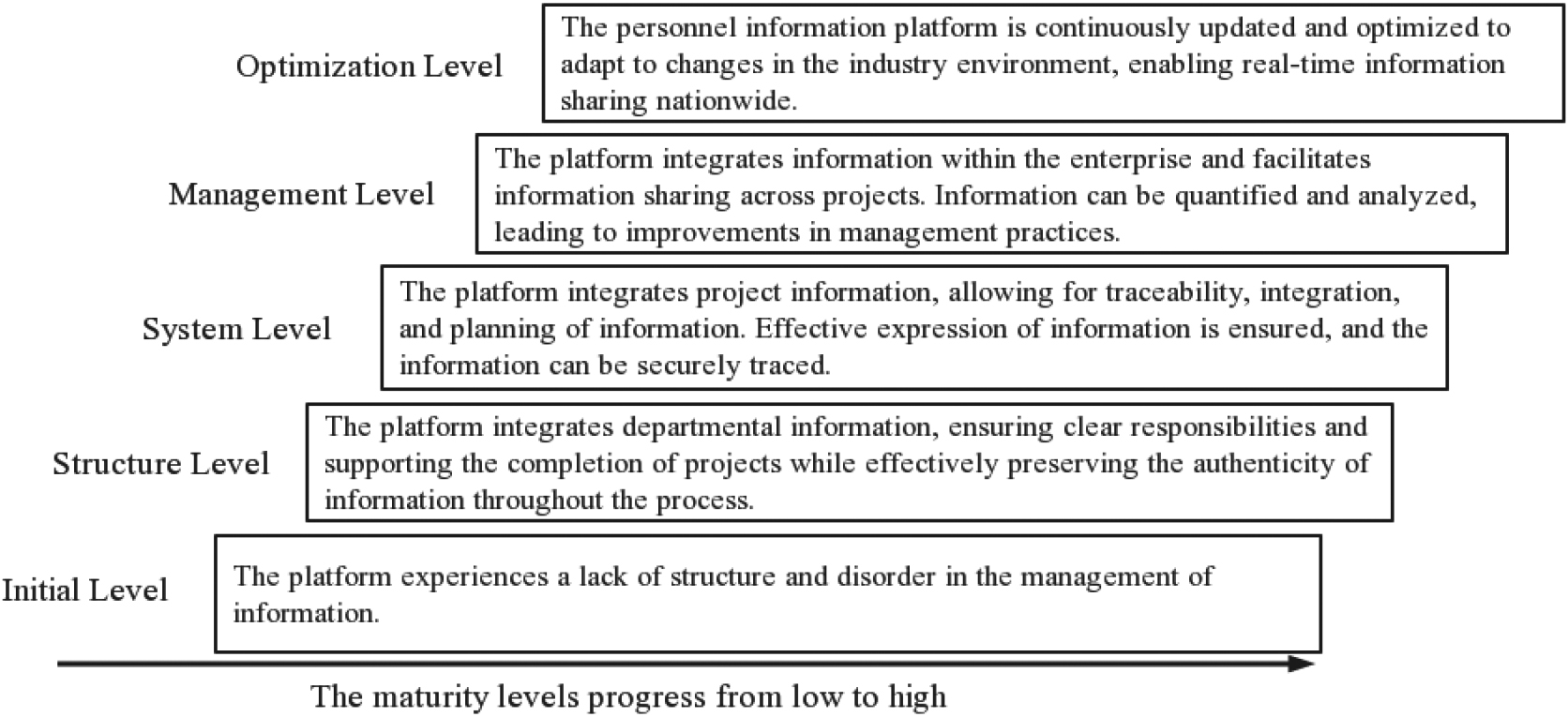
Principles and ideas for the construction of evaluation system
Principles for the construction of evaluation system
The indicator system aims to assess the effectiveness of the real-name system management for construction workers. The five levels of real-name system is meant to use robust metrics to evaluate the human resource management. The selection of indicators adheres to the principles of scientific rigor, systemic coherence, conceptual clarity, and practical applicability.
Ideas for the construction of evaluation system
As the information technology advances, it is essential for enterprises to build an electronic personnel information management system that can inquire, add, modify, and track personnel information [17]. Apart from meeting the requirements of construction companies and conforming the maturity levels of the real-name system management, the study has selected several evaluation indicators from the HR management module. The information types are classified and organized to form an evaluation system capable of reflecting the maturity of the real-name system. Through a questionnaire survey using the Delphi method, the importance of the evaluation indicators is scored, and expert opinions are sought. The Analytic Hierarchy Process (AHP) is used to quantify decision-makers’ value judgments and reasoning, as well as assign weights to the indicators. In this way, a maturity evaluation system for real-name system worker management is established.
Construction workers real-name management enterprises demand analysis
Construction projects are extensive undertakings, with workflows spanning the entire construction. Construction workforce management involves various aspects such as recruitment, attendance, payroll, and separation. Construction workers often have low educational level and unstable jobs. Companies hiring construction workers often find it hard to maintain workforce quality, ensure their safety, and avoid technical losses [18]. Personnel management is the most important risk factor for project construction [19]. Management that does not consider the allocation of human resources may make incorrect decisions [20]. Therefore, it is necessary to effectively manage human resource information and make sure that enterprises are well informed who could be otherwise affected by unsafe behaviors due to information gaps.
Romo et al. [21] proposed that it is wise for construction companies to invest in human resource management systems. Ghodrati et al. [22] gathered data from 111 general construction projects that demonstrated the effectiveness of incentives, labor management, trainings, communication, supervision, planning, resource deployment, and advanced construction methods and management in increasing productivity. Aghayeva and Ślusarczyk [23] conducted a questionnaire survey involving 350 workers and managers from 25 construction companies. According to the results, methods to improve efficiency for all construction employees include salary, job security, bonuses, and additional benefits. Wu [24] discussed the integration of an efficient human resource management model for enterprises, which include the management of personnel, recruitment, attendance, training, work, and salary. Based on a comprehensive integrated approach, Darvazeh et al. [25] extracted five important components of human resource management from the literature, including recruitment and selection, performance management, rewards, employee empowerment, and training.
Therefore, based on principles of management studies, the realm of human resource management can be categorized into six modules: strategic human resource planning, recruitment and placement, training and development, performance management, salary and benefits administration, and labor relations management. To streamline these modules and meet the requirements from the construction industry, a construction worker’s real-name management platform is built for construction companies. This platform can capture and process essential employee information and dynamic data. Such information covers a wide range of aspects, including fundamental worker details, employment records, worker mobility status, vocational skill training and assessment, complaint handling, misconduct incidents, integrity evaluations, and statistical analysis. This platform furnishes a foundation for human resource management of construction projects. It can classify and organize information as required, which can be shown in Fig. 2.
Construction of maturity evaluation indicators
Questionnaire screening based on expert authority index
The Delphi method uses a five-point scale to rate the importance of the six modules of information requirements for construction companies (Fig. 2). Experts were asked to evaluate the modules’ content and process information elements. Parameters and values were set based on the background information of the experts (Table 1). The expert authority index,
Description of evaluation parameters and values of expert authority index
Information demand of employment in construction companies.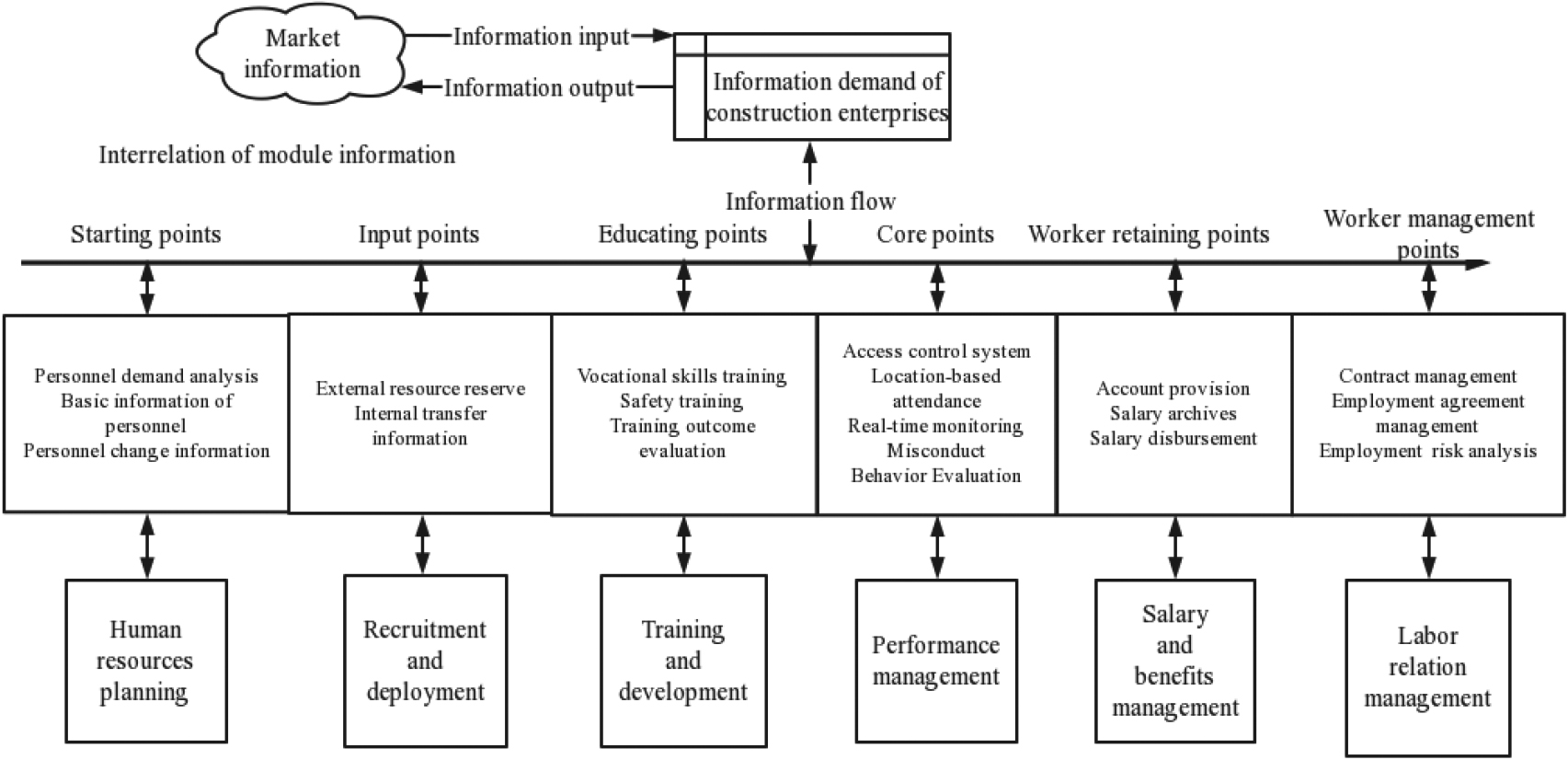
To get an expert opinion, a questionnaire survey was used, which targeted the human resource specialists, real-name management specialists, project managers, and professors. A total of 25 questionnaires were distributed through government visits, association recommendations, school-enterprise cooperation, and university exchanges. Among them, 6 questionnaires were excluded due to insufficient information. Based on the level of expertise, questionnaires with expert authority index values greater than 0.7 were retained. This study selected 15 experts, including 5 human resource management professionals and 10 project management personnel from construction companies. These 15 questionnaires were valid for further analysis.
According to the results of demand analysis and feedback from experts, the six modules of human resource management are retained as indicators to organize the content and workflow of indicators given by experts. Based on the input requirements, the basic information includes work, salary, training, real-name attendance, schedules, monitoring, salary, and contract. Expert opinions were sought, and multiple feedbacks were iterated to supplement the information. Finally, a mature evaluation indicator set for real-name management information was categorized. The indicators and their explanations are outlined in Table 2.
Evaluation indicator set of real-name system management maturity
Evaluation indicator set of real-name system management maturity
The analytic hierarchy process (AHP) is a decision-making method that allows the relative prioritization and assessment of alternatives under multiple criteria contexts [26]. In this study, AHP algorithm is used to achieve the overall goal, decompose the indicators according to the hierarchy, and compare the indicators in pairs to quantify the value judgments and the reasoning of decision-makers. The weights of the indicators will be determined.
AHP algorithm model
(1) Defining goals and indicators
To have systematic solutions and share personnel information and establish a standardized personnel management information system for construction companies, the model integrates organizational process information and connects with the real-name management platform. The goal is to have effective information management and reduce employment risks. The indicators for real-name system management maturity of construction workers were confirmed (Table 1).
(2) Expert scoring and forming the judgment matrix
Based on the maturity goal, this paper assumes that the evaluation indicators are A1, …, An. Pairwise comparisons are made to determine the importance of each indicator. The importance involves five levels: equally important, slightly important, considerably important, significantly important, and absolutely important. The importance levels are assigned with scores of 1, 3, 5, 7, and 9, respectively. Values between two adjacent levels were assigned scores of 2, 4, 6, or 8. This forms the comparison scores
Where,
(3) Combining weight coefficients and completing a one-time test
The judgment matrix A was normalized using the product-sum method and column normalization to obtain matrix B,
The weight values
It was normalized to get
The maximum eigenvalue
The consistency ratio CR was calculated to verify the consistency of expert judgment,
Where,
The opinions of individual experts were combined and examined through a consistency test. The ones that did not pass the test were excluded. Thus, a list of importance levels was formed (Table 3). The CR values in the table are less than 0.1, indicating that the calculation results meet the requirements.
Importance coefficient of maturity evaluation indicators
According to the importance coefficient table, there are certain differences in the subjective judgments of HR experts and experts of construction companies. HR experts emphasize the IT application in human resource planning, as well as the coordination of information systems plans with key business plans. They consider performance management to be the core of personnel management, giving it a significant weight. On the other hand, construction project managers believe that the human resource planning and the recruitment of construction workers are the responsibilities of labor service agencies, so they give IT application in this field a moderate importance. Conversely, they believe modules related to benefits and risks have greater importance, such as performance, salary, and contract management. With standardized hiring procedures, the construction industry has also established special departments to oversee the trainings. The two groups of experts agree that the applications of information technology in recruitment, deployment, training and development are necessary but not critical. HR experts tend to improve the efficiency of personnel management, while project managers lean toward practical engineering. Considering the opinions from both groups of experts, the indicators’ weights were determined using the average method. Ultimately, the weights of human resources planning, recruitment and deployment, training and development, performance management, salary and benefits, and labor relations were calculated to be 0.304, 0.064, 0.069, 0.255, 0.146, and 0.162, respectively.
Level definition and application of maturity model
Definition of real-name system management maturity level
The real-name system management includes five maturity levels: first-level, structure level, system level, management level and optimized level. At the enterprise level, information is collected, shared, and dynamically updated based on qualities such as clarity, integrity, dependability, integration, and openness of platform information. The measurements are presented in Table 4.
Description and measurement of maturity level
Description and measurement of maturity level
We have built an indicator evaluation system to measure the maturity levels of the real-name management, with different scores assigned (Table 5).
Evaluation system for real-name management maturity level
Evaluation system for real-name management maturity level
The ratings given by experts for each evaluation indicator can be used to derive the final maturity evaluation score on a 20-point interval scale. Sij stands for the the j-th expert’s rating for the i-th indicator. Ai denotes the average rating for the i-th indicator, and Wi represents the weight assigned to the i-th indicator. As a result, the formula of the final maturity evaluation score is:
The final scores can reflect an enterprise’s maturity level of construction workers’ real-name management: 0–20 points represents the initial level, 20–40 points are for the structural level, 40–60 points corresponds to the systemic level, 60–80 points reach the managerial level, and 80–100 points are the optimized level. Enterprises that have some knowledge about the real-name system management and are open to feedback are more suitable for model evaluation. The maturity levels and indicators allow enterprises to analyze and identify deficiencies in projects and facilitate regulatory authorities’ supervision work.
This paper proposes a management maturity evaluation system – real-name system for construction workers. It systematically organizes construction workers’ information, defines the construction standard, and integrate the data. The hierarchical decomposition enables enterprises to better manage the construction workers’ information. While meeting the demands and boost the development of the enterprise, we need to implement policies to ensure the construction of the real-name management system for the industry.
This study has assigned weights through AHP algorithm to the indicators, defined the maturity level of the real-name system management, and established related evaluation model. As most experts are project managers, the weights of the indicators in the research may have some subjectivity. Since construction companies often employ labour through subcontractors, it poses a great obstacle to their information maturity. To ensure the maturity of information in construction companies, the evaluation of real-name management should effectively integrate personnel information and project management information. Furthermore, we need to promote reforms in the employment of outsourced workers.
Footnotes
Funding
This article was supported by Science and Technology Research Project of Colleges and Universities of Hebei Provincial Department of Education “Design of Real-name Data Ecosystem Based on the Perspective of General Contracting” (ZC2021026).