




Abstract
This study aims to evaluate the quality of physical education in colleges and universities by using the evaluation method based on fuzzy logic. First, summarize the basic concept of fuzzy logic and its application in the evaluation process. Then, a physical education quality evaluation index system covering teaching quality and students’ physical quality, teachers’ team construction, sports facilities and management is constructed. Then, the evaluation object and evaluation level are determined, and the specific evaluation results and ranking are calculated by fuzzy comprehensive evaluation model. In the empirical analysis, use the simulation data for model application and result analysis, and further find the problems existing in college physical education. Finally, in view of these problems, a series of improvement and optimization suggestions are put forward. This study shows that the evaluation method of physical education quality based on fuzzy logic can effectively reflect the diversity and complexity of education quality, and provide a practical evaluation tool for colleges and universities. At the same time, this study also provides a reference for other universities to help them better understand their own problems, so that they can take effective measures to improve. In addition, this method can be applied to other fields of education quality evaluation in the future, so as to provide more useful information for education reform and development.
Keywords
Introduction
With the development of society and the deepening of people’s attention to health, the quality of physical education in colleges and universities plays an increasingly significant role in the field of education. Physical education in colleges and universities can not only improve students’ physical quality, but also cultivate their teamwork ability and competition consciousness. Therefore, evaluating the quality of college physical education is of great significance to guide the reform of college physical education.
The traditional evaluation methods of physical education quality in colleges and universities have some limitations, such as too strict evaluation standards and too dependent on objective data. Therefore, seeking a more scientific and reasonable evaluation method has become an important research topic. Fuzzy logic, as a mathematical method to deal with uncertainty and fuzziness, has been widely used in the field of educational evaluation.
Modern physical education environment is greatly affected by information technology and artificial intelligence technology, and the application of these technologies has begun to show its value in college physical education. Liu et al. [1] used artificial intelligence to optimize the sports activity development model, and Zhang [2] discussed the reform and innovation of artificial intelligence technology in college sports information service. These studies provide a new perspective on how to improve the quality of physical education through the use of the latest technology. In the aspect of physical education teaching quality evaluation, fuzzy logic technology has made some progress. For example, Cheng et al. [3] conducted a study on the training and evaluation of human cardiopulmonary endurance based on fuzzy algorithms, while Eyoh et al. [4] applied fuzzy logic to the hybrid learning of Type-2 intuitive fuzzy logic system. These studies show that fuzzy logic has good performance when dealing with problems with uncertainty and fuzziness. In addition, the physical and mental health and academic performance of students should be considered in the evaluation of physical education quality in colleges and universities. For example, Martin et al. [5] found that increasing physical activity levels can improve cognitive ability and school achievement in children and adolescents who are obese or overweight. In terms of the management quality of physical education teaching, Crissien-Borrero et al. [6] studied the measurement method of education management quality, and Yang et al. [7] proposed an optimized BP neural network model for teaching management evaluation. These work provide a systematic method to evaluate and improve the management quality of physical education teaching. To sum up, the evaluation of physical education quality in colleges and universities based on fuzzy logic needs to be comprehensively considered in combination with information technology, artificial intelligence technology, mental health and academic achievements, so as to evaluate teaching quality more accurately and fairly. At the same time, the evaluation of the quality of educational management is also an important aspect, which can help educators better understand and improve the teaching effect.
This research mainly focuses on the evaluation of physical education quality in colleges and universities based on fuzzy logic. The main contents of the research include: the basic principle of fuzzy logic is summarized, and the application of fuzzy logic in the evaluation process; Construct a physical education quality evaluation index system covering teaching quality and students’ physical quality, teachers’ team construction, sports facilities and management, etc. Fuzzy comprehensive evaluation model is used to determine the evaluation object and evaluation level, weight coefficient and evaluation level, and calculate the specific evaluation results and ranking. Through the empirical analysis, using the simulation data to model application and result analysis, found the existing problems in college physical education; In view of these problems, a series of improvement and optimization suggestions are put forward.
The purpose of this study is to construct a scientific and reasonable evaluation method of physical education quality in colleges and universities by combining the fuzzy logic theory. Through empirical analysis and case study, this paper discusses the effectiveness of the evaluation method in practical application, and provides useful reference for the reform of physical education in colleges and universities. The significance of this study is reflected in the following aspects: First, by introducing fuzzy logic, this study puts forward a more scientific and reasonable evaluation method of physical education quality in colleges and universities, which is helpful to overcome the limitations of traditional evaluation methods. Secondly, this study combs and integrates the existing physical education quality evaluation index system in colleges and universities, providing a reference for subsequent research. Finally, this study verifies the effectiveness of the proposed evaluation method through empirical analysis and case study, and provides targeted improvement suggestions for the reform of physical education in colleges and universities.
To sum up, this study aims to provide beneficial theoretical support and practical reference for the reform of physical education in colleges and universities by constructing the quality evaluation method of physical education in colleges and universities based on fuzzy logic. The research process is shown in Fig. 1.
Research flow chart.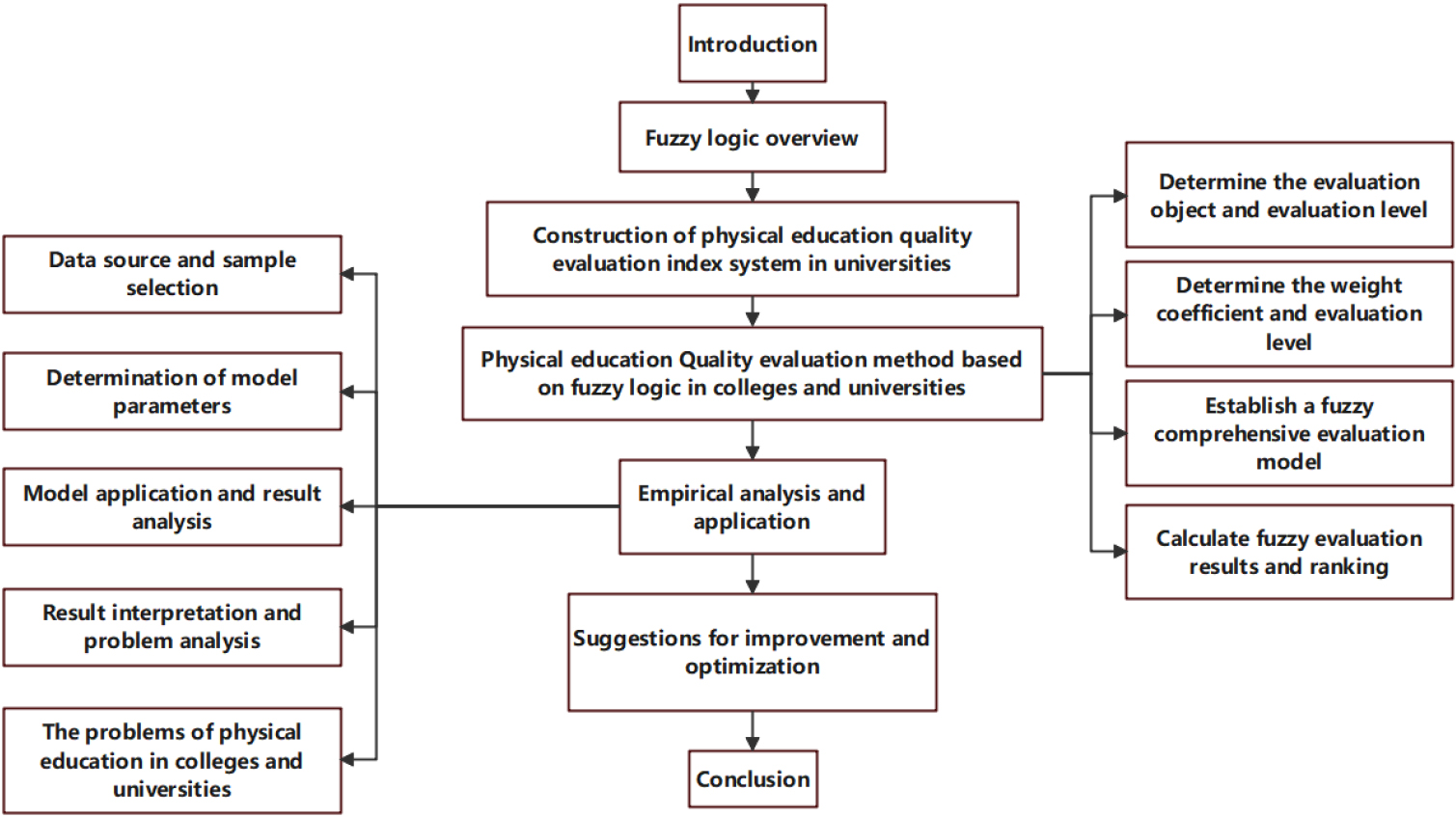
Fuzzy logic, first proposed by mathematician Zadeh in the early 1960s, is a mathematical method for dealing with uncertainty and ambiguity problems, which opens up new ways to deal with fuzzy information [8]. This theory has been widely used in many fields, including but not limited to control systems, pattern recognition, decision support systems, etc. Unlike traditional binary logic, fuzzy logic allows a certain degree of fuzzy relationship between things, so it can better simulate complex problems in the real world [9]. In this section, the basic concepts of fuzzy logic, fuzzy sets and fuzzy relations, and fuzzy evaluation methods and processes are summarized.
Fuzzy set and fuzzy relation
Fuzzy set is a kind of set based on the concept of membership degree, which is used to describe the fuzzy problem in the real world [10]. In the fuzzy set, each element has a membership value between 0 and 1, indicating the degree to which the element belongs to the fuzzy set. The membership function of fuzzy set can be expressed as
Fuzzy relation is a method to describe fuzzy relation between things in fuzzy set theory, which can be expressed as a fuzzy matrix. In fuzzy relation matrix, row and column represent the elements of two fuzzy sets respectively, and the elements in matrix represent the degree of fuzzy relation between corresponding row and column elements. Fuzzy relation can be used to express causal relation and similarity relation in real world.
Fuzzy evaluation method and process
Fuzzy evaluation is a kind of evaluation method based on fuzzy logic. Its main process includes determining evaluation index system, constructing fuzzy evaluation model and making fuzzy evaluation [11]. Fuzzy evaluation method has strong practical significance and can reflect the fuzziness and uncertainty of things well.
Determine the evaluation index system
The evaluation index system is the foundation of the evaluation process and should be determined according to the characteristics of the evaluation object and the research purpose. Generally speaking, the evaluation index system includes first-level index and second-level index. First-level index is the main aspect of evaluation, while second-level index is the specific content of first-level index.
Construct a fuzzy evaluation model
The construction of fuzzy evaluation model mainly includes determining the weight coefficient, evaluation level and membership function. The weight coefficient is used to represent the relative importance of each evaluation index, which can be determined by analytic hierarchy process, entropy weight method and other methods. Evaluation level is the basis for dividing evaluation results and should be set reasonably according to the actual situation [12]. Membership function is used to express the membership degree of the evaluation object at each evaluation level, and can be in the form of trapezoid, triangle and other functions.
Fuzzy evaluation
Fuzzy evaluation mainly includes calculating fuzzy evaluation matrix, fuzzy comprehensive evaluation and fuzzy evaluation result ranking. Firstly, according to the actual data of the evaluation object, the fuzzy evaluation matrix is calculated, which contains the membership degree of the evaluation object in each evaluation index. Then, through fuzzy comprehensive evaluation methods, such as fuzzy weighted average method, fuzzy ideal solution method, the comprehensive evaluation value of the evaluation object is calculated [13]. Finally, the evaluation objects are sorted according to the comprehensive evaluation value, so as to get the evaluation results.
Fuzzy evaluation method has the advantage of dealing with uncertainty and fuzziness and can better reflect the complex relationship in the real world [14]. In the field of education evaluation, fuzzy evaluation method can solve the limitation of traditional evaluation method effectively and provide beneficial theoretical support for education reform.
To sum up, fuzzy logic is a mathematical method to deal with uncertainty and fuzziness problems, which has strong practical significance. Based on fuzzy logic, this study will construct a quality evaluation method for physical education in colleges and universities, and through empirical analysis and case study, explore the effectiveness of this method in practical application.
Construction of physical education quality evaluation index system in colleges and universities
In order to evaluate the quality of college physical education more comprehensively and effectively, this study constructs a composite evaluation index system on the basis of fully considering all aspects of physical education. The index system mainly includes teaching quality and student physical education quality, teacher team construction, sports facilities and management.
Specifically, the choice of teaching quality and students’ physical education quality is mainly based on the fact that teaching quality is the core standard to measure teaching effect, and students’ learning effect is a direct reflection of teaching quality [15]. Therefore, the setting of this index is helpful to directly grasp the actual situation of teaching quality. High quality teaching staff is the key factor to improve teaching quality, teachers’ teaching ability, professional accomplishment, teaching attitude and so on have a direct impact on teaching effect. The perfect and effective management of sports facilities plays an important role in promoting the quality of sports teaching. Good sports facilities can provide a better teaching environment, and effective management can ensure the normal use of facilities and the smooth progress of teaching.
In general, this evaluation index system is designed to reflect all aspects of college physical education comprehensively and systematically, so as to make a comprehensive evaluation of college physical education and provide more referential evaluation results.
Teaching quality and students’ physical quality
Teaching quality and students’ physical quality are the core indicators to measure the quality of physical education in colleges and universities, which include curriculum, teaching methods, students’ sports level, health status and so on. The curriculum needs to consider the richness and pertinence of the curriculum, while taking into account the interests and needs of students. In terms of teaching methods, we should pay attention to cultivating students’ autonomous learning ability and teamwork spirit, and improve the interactive teaching. The sports level and health status of students are the important basis to evaluate the sports quality of students, which needs to pay attention to the performance of students in sports skills, physical strength, psychological quality and other aspects.
Construction of teachers
The construction of teachers is one of the key factors affecting the quality of physical education in colleges and universities. This study evaluates the construction of teachers from the aspects of their professional quality, education and teaching experience, teacher training and development. Professional quality mainly includes the teacher’s education background, academic background, professional title and other aspects, as well as the master degree of sports professional knowledge. Educational teaching experience can be measured from the teacher’s teaching years, teaching results and other aspects. Teacher training and development mainly focus on the training and support policies of colleges and universities for teachers, as well as the professional development of teachers.
Sports facilities and management
The influence of sports facilities and management on the quality of physical education in colleges and universities cannot be ignored. In practice, sports facilities are directly related to students’ sports experience and whether they can get proper exercise and practice. High quality and extensive facilities help students to better participate in sports activities, thereby improving their physical fitness and motor skills. The maintenance of facilities ensures that the facilities are always in good condition to avoid affecting the quality of teaching due to equipment damage or outdated facilities. The utilization rate of the facilities reflects whether the facilities are fully used and the level of students’ enthusiasm for sports activities.
On the other hand, effective sports facilities management is also crucial to maintain and improve the quality of sports teaching. A good management system and organizational structure can ensure the reasonable distribution and use of facilities and improve teaching efficiency [16]. At the same time, the work efficiency of the management and the ability to cooperate with other departments also have an impact on physical education teaching. For example, good coordination with the school’s cleaning and equipment maintenance departments ensures that facilities are always in top condition, providing students with a better sports environment.
Evaluation method of physical education quality in colleges based on fuzzy logic
Determine the evaluation object and evaluation level
When using fuzzy logic to evaluate the quality of college physical education teaching, first of all, determine the evaluation object, such as the quality of college physical education teaching in this study. At the same time, set the evaluation level. For example, you can set five ratings: “Excellent”, “good”, “average”, “poor” and “poor”. The object and level of evaluation should be determined to provide a clear direction for the subsequent evaluation process.
Evaluation object: Evaluation object refers to the colleges and universities that need to evaluate the quality of physical education. Colleges of different types, sizes and regions can be selected to reflect the diversity of physical education quality in colleges and universities. For example, comprehensive universities, universities of science and engineering, normal universities and other different types of universities can be selected. Or choose universities in different provinces and cities to investigate the influence of regional differences on the quality of physical education.
Evaluation level: Evaluation level refers to the hierarchy involved in the evaluation process, usually including the target level, criterion level and index level. In this study, the objective layer is to evaluate the quality of physical education in colleges and universities. The criterion layer is the first-level index, that is, teaching quality and students’ sports quality, teachers’ team construction, sports facilities and management; The index layer is the second-level index, that is, the specific evaluation content under each first-level index. It is helpful to organize the evaluation process better and ensure the reliability and validity of the evaluation results by clarifying the evaluation level.
In short, determining the evaluation object and evaluation level is the first step of evaluating the quality of college physical education based on fuzzy logic. By selecting the appropriate evaluation object and clarifying the evaluation level, it can provide a good foundation for the subsequent evaluation method selection, model construction and empirical analysis.
Determine the weight coefficient and evaluation level
In the quality evaluation of physical education in colleges and universities based on fuzzy logic, it is a key step to determine the weight coefficient and evaluation level, which reflect the relative importance of each index and the basis for dividing evaluation results. According to the aforementioned index system, weight coefficient is set for each evaluation index to reflect its importance in the overall evaluation. Each evaluation level is fuzzy and assigned a membership value.
Determine the weight coefficient
The weight coefficient represents the relative importance of each evaluation index in the overall evaluation. Can use the analytic hierarchy process (AHP), entropy weight method and other methods to determine. Taking analytic hierarchy process as an example, the judgment matrix is constructed first, and then the weight coefficient is calculated. There are the following judgment matrices:
This matrix represents the relative importance of the first-order indicators. By calculating the eigenvector and eigenvalue, the weight coefficient of each level index can be obtained. The calculated results are as follows:
This means that in the overall evaluation, teaching quality and students’ sports quality accounted for 60%, the construction of teachers 27%, and sports facilities and management 13%. Similarly, the weight coefficient of the secondary index can also be calculated.
Evaluation level is the basis for dividing evaluation results and should be set reasonably according to the actual situation. For example, evaluation results can be divided into five grades: excellent, good, medium, poor, and poor. At the same time, it is necessary to determine the corresponding membership function of each level. If the triangular membership function is used, it can be expressed as:
Where,
To sum up, it is a key step to determine the weight coefficient and evaluation level in the quality evaluation of college physical education based on fuzzy logic. The reliability and validity of the evaluation results can be guaranteed by setting reasonable weight coefficient and evaluation level.
Establishment of fuzzy comprehensive evaluation model
In the evaluation of physical education quality based on fuzzy logic, the establishment of fuzzy comprehensive evaluation model is the core part of the evaluation process. The fuzzy comprehensive evaluation model is used for comprehensive evaluation. The model construction mainly includes fuzzy matrix construction and fuzzy matrix operation. The row of fuzzy matrix represents the evaluation object, the column represents the evaluation level, and the matrix element represents the membership degree of the corresponding evaluation object at each evaluation level. The following is the model construction process.
Construct fuzzy evaluation matrix
According to the evaluation index, weight coefficient and evaluation level determined above, the fuzzy evaluation matrix can be constructed. Taking teaching quality and students’ physical quality as an example, there are three secondary indicators: course satisfaction, teaching effect and students’ physical fitness test scores. Set five evaluation levels, respectively excellent, good, medium, poor, poor. Set five evaluation levels, respectively excellent, good, medium, poor, poor. Firstly, the corresponding data is collected and the membership degree of each secondary index at each evaluation level is calculated. The fuzzy evaluation matrix can be obtained as follows:
Similarly, the fuzzy evaluation matrix under other first-order indexes can also be constructed.
Determine the weight vector
According to the weight coefficient determined above, the weight vector can be constructed. Take the first-level index of teaching quality and students’ sports quality as an example, the weight coefficients of each second-level index are 0.4, 0.3 and 0.3 respectively, then the weight vector is:
Fuzzy comprehensive evaluation
According to fuzzy evaluation matrix and weight vector, fuzzy comprehensive evaluation can be carried out. For the first-level index of teaching quality and students’ physical quality, the calculation process is as follows:
Where,
Model integration and comprehensive evaluation results
The fuzzy comprehensive evaluation vector under each level index is integrated into the total evaluation vector, and the final evaluation result can be obtained by deblurring. For example, the maximum membership principle can be used to de-blur. The specific process is as follows:
Firstly, the fuzzy comprehensive evaluation vector under each level index is integrated into the total evaluation vector:
Among them,
Then, calculate the product of the total evaluation vector and the weight vector of the first-level index. The following Eq. (1):
Where,
Finally, according to the principle of maximum membership degree, the evaluation grade with maximum membership degree is found as the evaluation result.
Through the above process, the quality evaluation model of college physical education based on fuzzy logic can be established, and the evaluation results can be obtained. This model can fully consider the relative importance and uncertainty of each evaluation index, which is helpful to improve the reliability and effectiveness of the evaluation results.
After establishing the evaluation model of physical education quality based on fuzzy logic, the results of fuzzy evaluation can be calculated and sorted. Through fuzzy matrix operation, the comprehensive membership degree of evaluation objects in each evaluation level is calculated, and then sorted according to the comprehensive membership degree, the final evaluation result is obtained. Here is the process of calculating and sorting.
Calculate the fuzzy evaluation results
Assume that the total evaluation vector has been obtained:
Next, it is necessary to de-blur, using the center method to de-blur. First, determine the score corresponding to the rating level. For example, excellent, good, medium, poor, and poor correspond to scores of 100, 80, 60, 40, and 20, respectively. Then, the fuzzy evaluation results are calculated. The following Eq. (2):
Where,
Assuming that there are several physical education quality evaluation results of colleges and universities, the evaluation results can be sorted to understand the performance of physical education quality of colleges and universities. For example, the fuzzy evaluation results of three universities are shown in the following chart:
Fuzzy evaluation results of three universities
Fuzzy evaluation results of three universities
According to the evaluation results, the three universities can be ranked: C
Through the above process, the evaluation results of physical education quality based on fuzzy logic can be calculated and sorted. It is helpful to understand the performance of physical education quality in colleges and universities and provide basis for improving physical education.
Data sources and sample selection
In the stage of empirical analysis and application, data sources and sample selection should be determined first. The following is a description of data sources and sample selection.
Data sources
In order to ensure the accuracy and reliability of evaluation results, authoritative and reliable data channels should be selected as data sources. Here are some suggested data sources:
Annual physical education report issued by colleges and universities themselves;
Relevant statistics released by the national education department or the sports administrative department;
Data from other relevant research reports or papers.
Sample selection
In order to ensure the extensiveness and universality of the research, representative samples should be selected from multiple universities. Here are some suggested sample selection principles:
Sample size: at least 5 universities were selected as samples to ensure the reliability of the study.
Sample type: different types of universities (such as comprehensive, engineering, liberal arts, etc.) are selected to ensure the research breadth;
Geographical distribution: Universities in different regions are selected to ensure the universality of the research.
This study has selected at least 5 universities of different types and regions as samples. Although the sample size does not guarantee representativeness, choosing 5 universities can improve the reliability of the research compared with choosing a smaller number of universities. Such sample type coverage ensures the breadth of the research, making the research results applicable to different types of universities. There are differences in economy, society and culture among different regions, which may affect the quality of physical education in colleges and universities.
In this study, 5 universities are selected as samples, namely A, B, C, D and E. The fuzzy evaluation results of these universities under the three first-level indicators are shown in Fig. 2.
Although the study has made every effort to select a representative sample, these five schools may not be fully representative of all colleges and universities in the country due to various practical limitations. However, we believe that the evaluation model of college physical education teaching quality based on fuzzy logic has universal applicability, and reliable and effective evaluation results can be obtained even if it is applied in other universities. Through these data, can continue to determine model parameters, model application and result analysis and other subsequent steps.
Determination of model parameters
Before the empirical analysis, it is necessary to determine the model parameters, including the weight coefficient of the first-level index and the setting of the evaluation level.
Determine the weight coefficient of first-level indicators
When determining the weight coefficient of first-level index, we can use expert scoring method, analytic hierarchy process (AHP) and other methods. Using the expert scoring method, 5 experts were invited to score the three first-level indicators. The scoring results are shown in Table 2.
Determines the weight coefficient of first-level indicators
Determines the weight coefficient of first-level indicators
Fuzzy evaluation results.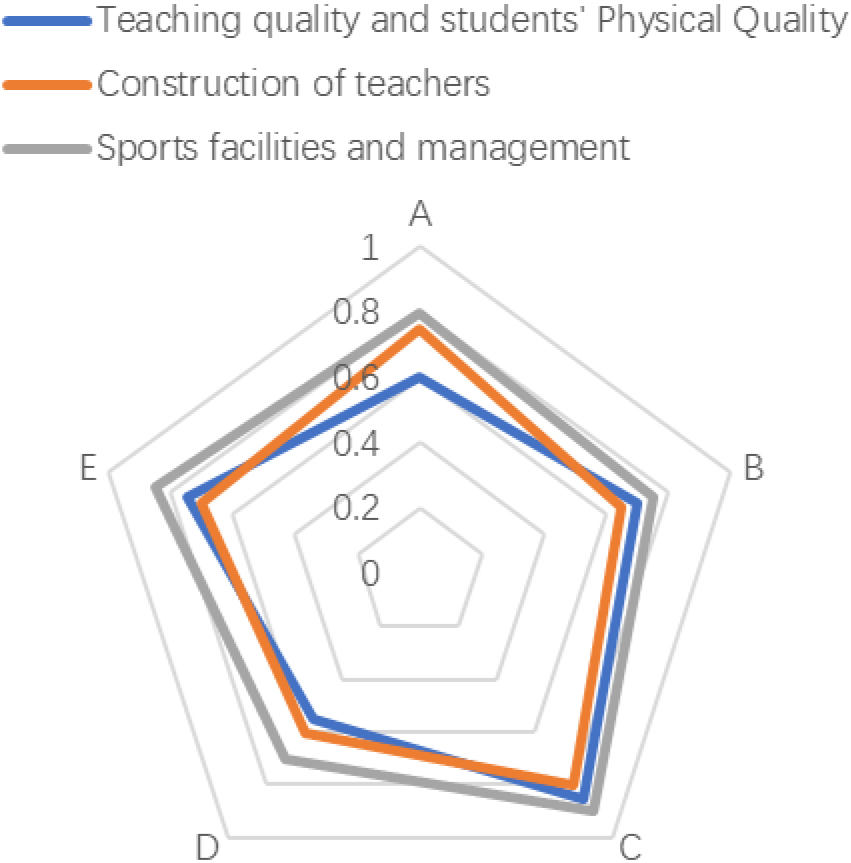
According to the expert scoring results, calculate the average weight coefficient of the three first-level indicators:
When determining the evaluation level, it can be set according to the actual situation. Set 5 ratings: excellent, good, medium, poor, poor. Each evaluation level corresponds to a score, which is: 100, 80, 60, 40, 20. Meanwhile, this study sets the membership range of each evaluation level, as shown in Table 3.
Set the membership value range of each evaluation level
Set the membership value range of each evaluation level
By determining the weight coefficient and evaluation level of first-level indicators, can continue to carry out model application and result analysis.
After the model parameters are determined, the model can be applied to the actual data to evaluate the quality of physical education in colleges and universities, and the results are analyzed.
Model application
According to the sample data and model parameters given in the preceding chapter, the fuzzy evaluation result matrix of each university under three first-level indicators can be calculated:
The weight coefficient matrix is:
Through matrix multiplication, can get the total evaluation vector of each university:
Result analysis
Model result analysis
According to the total evaluation vector, can de-blur processing and calculate the evaluation score of each university, as shown in Table 4.
Analysis of results
Analysis of results
According to the score, can rank the universities: C
These results support the theme of this study that the quality of physical education teaching in different universities can be effectively assessed and compared by using a fuzzy logic evaluation model. The model takes into account the relative importance and uncertainty of each evaluation index, and improves the reliability and validity of the evaluation results.
In addition, the findings can provide a reference for universities to understand their own performance in the quality of physical education teaching and develop improvement strategies accordingly. For example, the University of D performs poorly in the quality of physical education teaching and may need to further review its physical education curriculum, teaching methods or faculty to find room for improvement.
However, these results do not determine the specific performance of each university in all aspects of physical education teaching and need to be analyzed in conjunction with more detailed information. For example, a university may perform well in the quality of teaching but may have problems with facilities. Therefore, for each college, it is necessary to conduct a detailed analysis of various indicators on the basis of comprehensive evaluation, in order to understand the advantages and disadvantages of its physical education more comprehensively.
Result interpretation and problem analysis
Through the application of the model and the analysis of the results, can find the differences in the quality of physical education among colleges and universities. For universities with poor performance, we can further analyze the specific problems, such as teaching quality, teacher team construction, sports facilities and management. In view of these problems, we can put forward some measures to improve the quality of physical education in universities. At the same time, universities with good performance can learn from their advantages and experience to improve and promote.
Through the application of the model and the analysis of the results, can better understand the performance of the physical education quality of colleges and universities, and put forward the improvement measures for specific problems. This is helpful to improve the quality of physical education in colleges and universities and promote the overall improvement of students’ physical quality. At the same time, this evaluation method can also provide valuable reference information for policy makers and university administrators, so as to better consider the importance of physical education in the decision-making process. In short, the evaluation method of physical education quality based on fuzzy logic provides an effective tool for evaluating and improving physical education in colleges and universities.
According to the model application and result analysis in the preceding chapter, can find that there are some common problems in college physical education. Combined with the simulation data, here are some possible problems.
Teaching quality and students’ physical quality
According to the results of the model calculation, can find that some colleges and universities in the teaching quality and students’ sports quality evaluation is low. The specific performance is shown in Table 5.
Evaluation of teaching quality and students’ physical quality in colleges and universities
Evaluation of teaching quality and students’ physical quality in colleges and universities
As can be seen from the table, college D has the lowest evaluation in terms of teaching quality and students’ sports quality, which may be caused by inappropriate teaching methods, incomplete curriculum and low participation of students.
The construction of teachers is an important factor affecting the quality of physical education in colleges and universities. According to the calculation results of the model, find that some universities have problems in the construction of teacher teams, as shown in Table 6.
Teacher team construction in colleges and universities
Teacher team construction in colleges and universities
As can be seen from the table, the evaluation of university D in sports facilities and management is also low, which may be caused by insufficient sports facilities, inadequate maintenance of facilities, imperfect management system and other reasons.
Through the analysis of the existing problems, can better understand the need for improvement in college physical education. In view of these problems, we can make targeted measures and policies to improve the quality of physical education in colleges and universities. At the same time, these problem analyses can also provide reference for other colleges and universities to help them better understand their own problems, so as to take effective measures to improve. In a word, by applying the evaluation method based on fuzzy logic, can find the problems existing in college physical education more clearly and provide strong support for improvement.
In this study, some problems need to be improved and optimized in the process of quality evaluation of college physical education based on fuzzy logic. To solve these problems, this chapter puts forward a series of targeted suggestions, including the optimization of teaching quality, the improvement of students’ physical education quality, the improvement of the construction of teachers and the optimization of sports facilities and management.
Suggestions on optimization of teaching quality
In order to improve the teaching quality of physical education in colleges and universities, it is suggested to start from the curriculum, teaching methods and evaluation system. First of all, the curriculum should fully consider the needs and interests of students, increase the types and richness of courses, and pay attention to the balance between professional physical education courses and popular courses. Secondly, the teaching method should pay attention to the students’ subjectivity, advocate independent learning and team cooperation, and use modern educational technology to improve the teaching interaction. Finally, a scientific, fair and effective evaluation system should be established to evaluate students’ physical education quality and teaching effect comprehensively and objectively.
This requires strong support from the school administration. For the curriculum, it is necessary to fully investigate and understand the needs and interests of students, which may require a significant investment of time and resources. In addition, improving teaching interactivity may require teachers to further upgrade their teaching skills and master some modern educational technologies, which may require special training.
Suggestions for improving students’ physical education quality
In order to improve the physical education quality of students, we can start from the following aspects: first, strengthen the practical nature of physical education courses, so that students have more opportunities to exercise and practice in class; Secondly, various sports activities and competitions should be carried out to stimulate students’ interest in sports and active participation. Third, strengthen physical health education, improve students’ sports knowledge and health consciousness; The fourth is to provide personalized sports guidance and training to help students achieve better results in sports.
Such as providing more practical opportunities, holding various sports activities and competitions and so on. At the same time, personalized exercise instruction may require adding more teacher resources and time.
Improvement measures for the construction of teachers
In order to improve the level of the construction of teachers, it is suggested to improve from the following aspects: first, strengthen the recruitment of physical education teachers, attract more teachers with excellent professional quality to join the physical education in colleges and universities; Second, strengthen the training of teachers to improve their professional skills and teaching ability; Third, establish a teacher incentive mechanism to encourage teachers to participate in academic research and educational reform; Fourth, pay attention to the professional development of teachers, provide more promotion and development opportunities for teachers, stimulate their work enthusiasm and innovative spirit.
This has its challenges. For example, attracting more good physical education teachers may require more attractive pay packages and working conditions, which may require schools to invest more money. There is also a need to invest resources in the professional training of teachers.
Optimization scheme of sports facilities and management
In order to optimize sports facilities and management, we can start from the following aspects: first, increase the investment in sports facilities to ensure the quantity and quality of facilities to meet the needs of physical education in colleges and universities; Secondly, rational planning and utilization of sports facilities to improve the use efficiency of facilities; The third is to strengthen the maintenance and update of facilities to ensure that the facilities are always in good running condition; Fourth, optimize the management system and organizational structure of sports departments to improve work efficiency; Fifth, strengthen the cooperation with other departments to form the overall development pattern of college physical education.
Through the above suggestions for the improvement and optimization of teaching quality, students’ sports quality, teachers’ team construction and sports facilities and management, it is expected to promote the overall improvement of physical education quality in colleges and universities, and further promote the physical and mental health and all-round development of students. At the same time, these suggestions also provide useful reference information for relevant policy makers, school administrators and teachers, so as to take targeted measures to improve.
In general, these recommendations have high implementation value, but there may be some difficulties in the implementation process. Therefore, it requires the active participation and cooperation of all parties, including school management, teachers, students, and relevant policy makers. At the same time, these proposals should be flexibly adjusted and optimized according to the actual situation.
Conclusion
This study evaluates the quality of physical education in colleges and universities by using the evaluation method based on fuzzy logic. Firstly, review the basic concept of fuzzy logic and explain the method and process of fuzzy evaluation. Then, the index system of physical education quality evaluation in colleges and universities is constructed, including teaching quality and students’ physical education quality, teachers’ team construction, sports facilities and management, etc. Then, the evaluation object and evaluation level are determined, the weight coefficient and evaluation level are determined, and the fuzzy comprehensive evaluation model is established. Through the empirical analysis and application, obtained the specific evaluation results and ranking, and analyzed the problems existing in college physical education. Finally, in view of these problems, the improvement and optimization suggestions are put forward.
The significance of this study lies in that the evaluation method of physical education quality in colleges and universities based on fuzzy logic can better reflect the diversity and complexity of education quality and provide an effective evaluation tool for colleges and universities. Through the analysis of the evaluation results, can find the problems existing in physical education in colleges and universities, and provide strong support for improvement. At the same time, this study also provides a reference for other universities to help them better understand their own problems, so that they can take effective measures to improve.
In short, the evaluation method of physical education quality based on fuzzy logic has great application value and enlightenment significance. In future studies, the evaluation index system and model parameters can be further optimized to improve the accuracy and reliability of the evaluation. In addition, this method can also be applied to the evaluation of education quality in other fields, so as to provide more useful information for education reform and development.