




Abstract
With the rapid development of microgrid in the electric power industry, the microgrid electric energy transaction has begun to be marketized, and the research on the microgrid electric energy trusted transaction has important theoretical research value and social value. The existing blockchain-based microgrid electric energy trusted transaction models mostly focus on energy management and scheduling control between microgrids when conducting electric energy transactions, and do not fully consider the bidding problems in the market-based transaction of microgrid electric energy, resulting in trading strategies are difficult to adapt to new market changes. In response to this problem, this paper proposes a reliable transaction approach for microgrid electric energy based on a continuous two-way auction mechanism. The proposed strategy accounts for the volatility of electricity prices in the microgrid trading market and employs the continuous two-way auction mechanism to evaluate the microgrid electricity trading tactics. In the microgrid electric energy transaction, the self-adaptive learning theory is applied to adjust the quotations of both parties, so that both parties can make reasonable quotations according to the market environment. By simulating experimental data, the findings indicate that the continuous two-way auction mechanism transaction strategy enables both parties to modify their quotations based on market transaction information, thereby displaying a high degree of flexibility in microgrid electricity’s market-oriented trading.
Keywords
Introduction
As an important energy source for the development and progress of modern society, electric energy provides a basic guarantee for the high-quality life of human beings [1, 2]. In recent years, China’s economy has been developing rapidly, and the power industry has also continued to develop and progress, and people’s demand for electricity is increasing [3, 4]. At present, most of the power generation industry adopts the traditional centralized factory power generation technology, and the scale of power generation of the power grid is constantly expanding, which not only increases the cost of power generation and the difficulty of system operation, but also becomes more and more difficult to meet people’s demand for electricity safety [5, 6]. Therefore, the traditional centralized scheme is more and more difficult to adapt to the current user’s electricity demand [7, 8]. At the same time, as a power grid structure that can operate relatively independently, the microgrid, which can realize the combination of distributed renewable energy and user load, and can directly use local distributed renewable energy to reduce the power shock to the large power grid [9, 10].
The microgrid is a small power distribution and consumption system organically integrated by distributed power sources, loads, energy storage systems and converters. The microgrid can greatly promote access to distributed energy and renewable energy. Due to the close distance between distributed energy and load, it can greatly improve the reliability of the power supply and reduce operating costs. Therefore, microgrid systems are gaining more and more importance in the world’s attention worldwide. With the development and maturity of microgrid technology, some researchers propose a microgrid energy management system to manage the energy transaction between distributed energy and loads, but this method relies on the central management agency for management, and the transparency of transactions over-reliance on central regulatory agencies. When the central management agency is self-interested, there will be the risk of energy transaction data being tampered with. The traditional energy management model is difficult to adapt to the new microgrid energy transaction. The traditional method is to use the central management agency to manage the energy transaction entities [11, 12], which is different from the microgrid system and cannot manage the microgrid system well. Emergence may provide solutions to these problems [13, 14].
Blockchain is an emerging Internet technology [15, 16]. The data of the blockchain is stored in chronological order. Timestamps, asymmetric encryption, and distributed storage technologies are used to ensure that transaction data cannot be tampered with. Applied to the energy transaction of microgrid, it can effectively ensure the transparency and reliability of transaction data. Blockchain technology is a type of distributed ledger storage that facilitates decentralization and establishes a dependable database by being collectively maintained by multiple nodes. Blockchain platforms can be divided into three types of public and federated chains, and the difference between the two can be reflected in several aspects of user management, node access, decentralization, number of nodes, and storage methods. Using blockchain technology, local renewable energy transactions between microgrids can be better developed [17, 18].
In order to solve the bidding problem in the blockchain-based microgrid electric energy trusted transaction model, this paper studies the microgrid electric energy trusted transaction strategy based on the continuous two-way auction mechanism. The proposed strategy accounts for the volatility of electricity prices in the microgrid trading market and employs the continuous two-way auction mechanism to evaluate the microgrid electricity trading tactics. In the microgrid electric energy transaction, the self-adaptive learning theory is applied to adjust the quotations of both parties in a timely manner, so that both parties can make reasonable quotations according to the market environment. The effectiveness of the proposed trading strategy in this paper has been confirmed through the simulation of experimental data.
Related work
The main purpose of trusted storage and reliable communication of data at the physical level of the microgrid is for the trusted transaction of microgrid power. The requirements of electric energy trading will promote the market construction of the microgrid electric energy trading platform. In order to promote the market-oriented transaction of microgrid electric energy, Alam et al. proposed to build a demand-side management system for P2P energy transaction coordination, using load and electric energy scheduling to optimize the energy transaction strategy [19, 20]. In reference to [21], a hierarchical bidding and trading structure based on blockchain technology was introduced. Firstly, this structure incorporates multiple agents to refine the estimated cost probability distribution of other microgrids by applying Bayes’ theorem, bringing the probability closer to the actual value. To optimize the benefits of microgrids, [21] utilized the Nash equilibrium in the Cournot model to determine the most favorable offers and outputs of various bidding strategies for microgrids operating under distinct electricity demand conditions. But all transaction information in the system is obtained by the unified central entity management is easy to burden the system, and the unified central entity management system is prone to the single point of failure. Multiagent technology is beneficial to deal with the complex market environment of microgrids, and multiagent technology has been applied in many fields [22, 23]. The application of multiagent technology in the field of electricity market simulation is also increasingly widespread. Coelho et al. believe that multiagent technology can effectively promote the development of microgrid communication [24, 25]. In order to realize a complete P2P electricity market, Sorin et al. proposed a peer-to-peer electricity market with multi-bilateral economic dispatch, allowing multi-bilateral transactions based on product differentiation [26, 27]. In [28], a peer-to-peer (P2P) energy trading scheme was introduced for high penetration electricity markets with distributed energy resources (DER). This study presents a new algorithm using the primal gradient method to clear the market in a completely decentralized manner without the involvement of any central entity. Furthermore, to accommodate technical constraints in energy trading, bilateral trading’s line flow constraints are incorporated to prevent system overload or congestion. Although microgrids have not yet directly entered the power market, as the national power reform continues to progress, microgrids will participate in power market competition, enabling the more efficient and localized consumption of energy. Therefore, the marketization of microgrid electric energy trading deserves further research.
Trusted transaction strategy of microgrid electric energy based on continuous two-way auction mechanism
During the trusted transaction of microgrid electricity, both parties adapt their pricing based on the present market information. Therefore, before each round of transactions, both parties obtain the current optimal selling price and optimal buying price information based on the Nash equilibrium solution, and gradually adjust the quotation. Until the transaction is successful, the user’s quotation strategy is shown in Eq. (1):
where
where
Considering that the predictions of users and microgrids for their own consumption and purchase of electricity cannot be completely accurate, after the microgrid market transaction is closed, prediction errors may occur, resulting in excess or shortage of electricity. In this case, the users and the microgrid are settled separately with the large grid transaction due to the shortage or excess of electricity caused by forecast errors. For the user, when the user’s actual consumption of electricity is less than the transaction electricity, the excess electricity is sold to the grid. When the user actually consumes more electricity than the traded electricity, the user needs to purchase electricity from the grid to supplement their own electricity. Therefore, considering the user’s prediction error, the user’s actual expenditure is shown in Eq. (3):
where
For the microgrid, when the microgrid actually emits more electricity than it sells, the microgrid trades excess electricity with the grid. When the electricity actually emitted by the microgrid is less than the electricity sold, it is necessary to purchase the excess electricity from the grid to make up for the lack of its own output. The actual benefit of the microgrid is shown in Eq. (4):
where
In the microgrid electric energy transaction, after receiving the market quotation information, the adaptive learning theory is used to adjust the quotations of both parties in time, so that the two parties can make reasonable quotations according to the market environment. The two parties of the microgrid electric energy transaction adjust the aggressiveness
where
where
Microgrid basic quotation information
Microgrid basic quotation information
Assuming that there are 6 microgrids and 8 users in the microgrid electric energy trading market conducting electric energy transactions, the continuous two-way auction mechanism is utilized by both transaction parties to engage in bidding transactions. Table 1 displays the fundamental quotation details of the microgrid, including the electricity available for sale, the desired selling price, and the minimum selling price before the initial quotation. Table 2 exhibits the fundamental quotation information of users, which includes the amount of electricity that each user needs to purchase, as well as the target power purchase price and the maximum power purchase price before the first quotation.
User base quotation information
Microgrid quotation per round.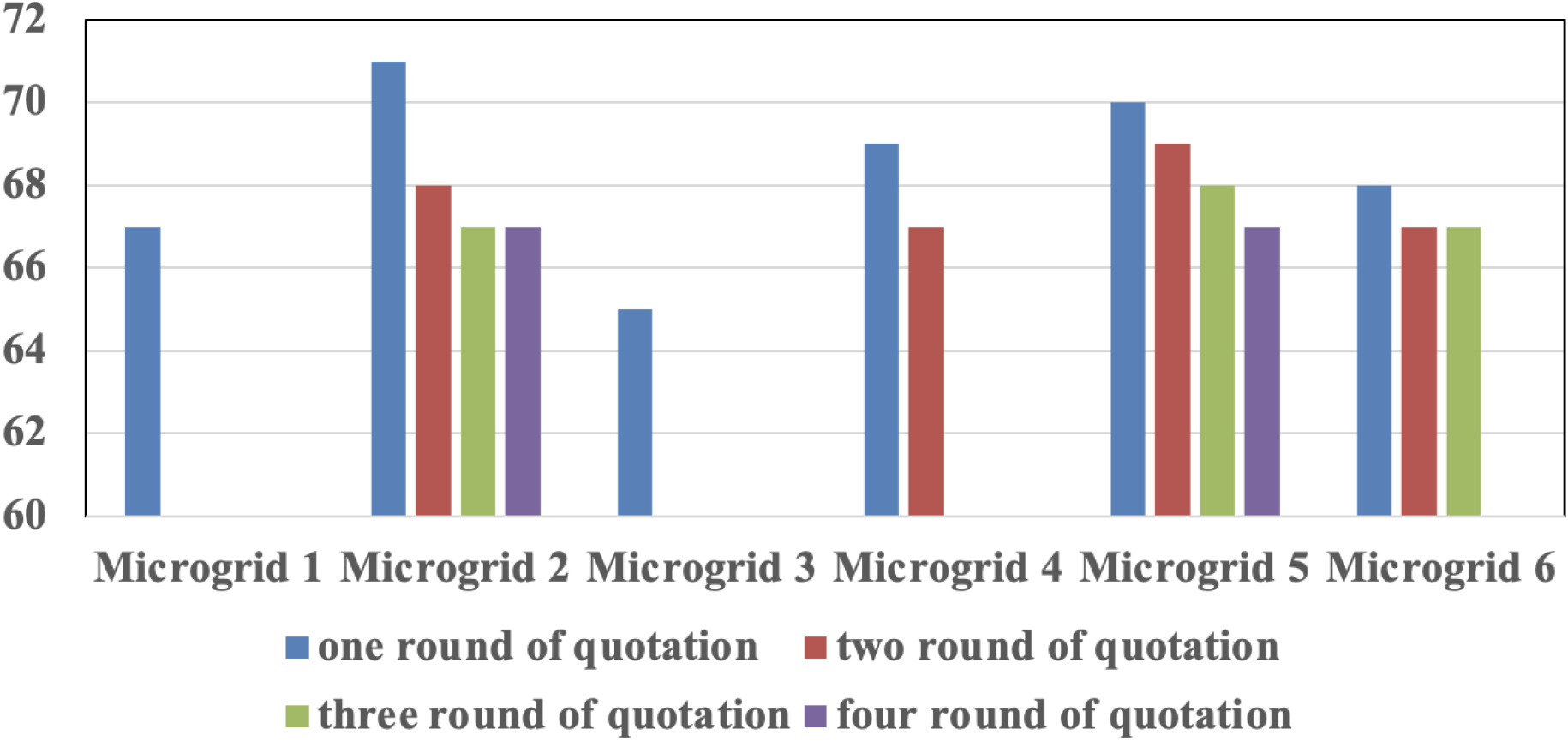
User quotation per round.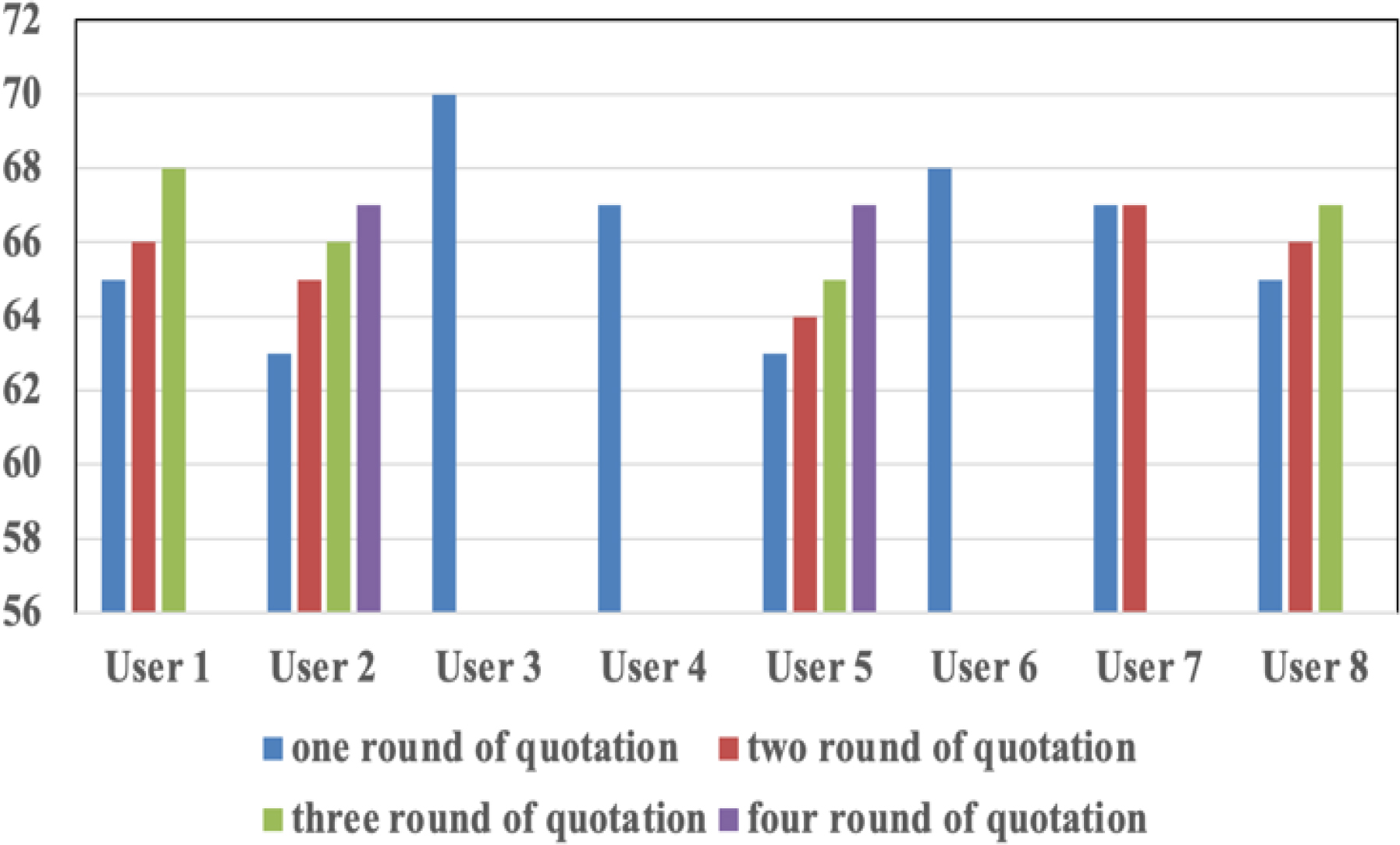
In the microgrid electric energy trading market, the two parties finally completed 8 transactions through 4 rounds of quotations. Each round of quotation of the microgrid is shown in Fig. 1, and each round of quotation of users is shown in Fig. 2. The two parties to the transaction in the order of the transactions in the market are Microgrid 3-User 3, Microgrid 1-User 4, Microgrid 1-User 6, Microgrid 4-User 7, Microgrid 6-User 1, Microgrid 2-User 8, Microgrid 2-User 5 and Microgrid 5-User 2. Microgrid 3-User 3 is the first to reach a transaction with each other. This is because when making an offer, Microgrid 3 sells electricity at the lowest price, while User 3 purchases electricity at the highest price and exceeds the selling price of Microgrid 3. Therefore, the transaction is concluded first. In the end, the transaction was concluded on Microgrid 5-User 2. This is because the two parties to the transaction have higher requirements for improving their own interests when adjusting the quotation through the adaptive learning theory. The adaptive learning parameters set to pay more attention to the transaction price, resulting in the previous three rounds of quotations failed to be traded due to price issues.
This paper studies the bidding problem in the trusted transaction model of microgrid electric energy based on blockchain. The existing blockchain-based microgrid electric energy trusted transaction models mostly focus on energy management and scheduling control between microgrids when conducting electric energy transactions, and do not fully consider the bidding problems in the market-based transaction of microgrid electric energy, resulting in trading strategies that are difficult to adapt to new market changes. Therefore, this paper proposes a trusted trading strategy for microgrid electric energy based on a continuous two-way auction mechanism. This strategy can take into account the fluctuation of electric energy prices in the microgrid electric energy trading market, and use the continuous two-way auction mechanism to analyze the microgrid electric energy trading strategy. The experimental results show that, compared with the existing trading strategies, the trading strategies are more suitable for the marketization of microgrid electricity trading, and serve as a reference for developing microgrid electricity trading platforms.
Footnotes
Acknowledgments
This work was supported by the Electric Power artificial Intelligence Engineering Center Project of the Shanghai Municipal Commission of Science and Technology (grant no. 19DZ2252800).