




Abstract
The outbreak of the COVID-19 (Corona Virus Disease 2019) has been becoming the most serious public health event in the world, threatening the health of hundreds of millions of people. The anti-pandemic policies mostly aim to prevent the spread at domestic and the import from abroad. In this paper, we discuss the issue of individual protection measures and customs quarantine strategy based on game theory. First, we develop a 2*2 Bayesian model and show that individual protection decisions depend on the size of excess payoff of taking protective measures (EPP). EPP is affected by the protection cost, the protective efficiency, the risk exposure and the information disclosure in this model. Then, we describe a repeated game between customs and airlines, and discuss the ideal strategy for customs to prevent the virus input. It comes out that a punishment mechanism for an airline is meaningful to prevent the import of the virus only if the discount rate of the airline is greater than the threshold. The threshold is positively correlated with the detection cost, and it is negatively correlated with the revenue of the airline and the testing reliability. We can also benefit from establishing a credit mechanism to give airlines that deviate from cooperation an opportunity to re-cooperate, especially for those in low risk areas. This study provides theoretical support for some government policies to prevent COVID-19, and underscores the significance of considering individual and organizational decision-making in health policy making.
Introduction
Since its discovery at the end of 2019, COVID-19 has spread all over the world, and more than 165 million people have been infected. The secretary of United Nations, António Guterres even regards the new coronavirus as “the biggest test we have faced since the establishment of the United Nations” [1]. The Asian Development Bank estimated that the global economic loss caused by the pandemic ranges from $5.8 trillion to $8.8 trillion, which is equivalent to 6.4%–9.7% of global GDP (gross domestic product).1
Source:
The index R0 is widely used in the medical community to measure the infectivity of viruses, which refers to how many susceptible individuals will be infected by an infected person on average without any external intervention. Hellewell et al. develop a stochastic transmission model, parameterized to the COVID-19 outbreak [2]. They find that when R0 is less than 1.5, the outbreak can be controlled without much intervention while much more strict measures must be taken to prevent the pandemic from spreading when R0 is more than 2.5. Even there is still no consensus on R0 of COVID-19 from the scientific community, most studies estimate that R0 is around 3 [3, 4], which indicates that the virus is highly infectious.
Despite some vaccines have put in the market, a big gap still exists between vaccine production capacity and the people to be vaccinated. Moreover, a partially effective vaccine can lead to more risky interactions, which may increase the probability that agents get infected [5, 6]. Nanshan Zhong, a famous epidemiologist points out that prevention from the source is still the simplest but the most effective way.2
Source:
Understanding of the virus infection mode is the very first thing of non-pharmaceutical interventions. Respiratory droplets and close contact are the main exposure routes of virus transmission. The transmission routes of aerosol and digestive tract are also possible in some extreme situations. People are likely to catch pneumonia unconsciously as long as they breathe in the environment with the existence of virus. The risk of infection becomes much higher in the crowded and closed spaces. What makes things worse is that the incubation period of the virus can be up to 14 days. The infectors are infectious even if they do not have any symptoms and thus an individual without any symptoms can also be dangerous. Nucleic acid testing is the most accurate method to identify infected individuals, it makes diagnosis by detecting virus specific nucleic acid sequence [9, 10]. However, the nucleic acid testing requires expensive testing equipment and strict testing conditions, and also the individuals often need to make appointments in advance.
To effectively and efficiently prevent and control the virus, most governments have implemented decisive and resolute pandemic prevention and control measures. Most of the anti-pandemic policies aim to prevent the spread at domestic and the import from abroad. However, cross-country heterogeneities can be decisive [11]. Some countries have encountered great resistance in implementing these measures and have not achieved the desired results. Therefore, it is worth to assess the outbreak and relevant policies carefully.
Most studies assess the outbreaks by adopting the widely used SEIR dynamic model [10, 12, 13, 14, 15, 16] which classifies all population into the following four categories: susceptible, exposed, infected, and recovered individuals.3
In the SEIR model, a healthy but potentially at risk of infection individual is also referred to as a susceptible individual.
In order to take individual or organization decision-making into account, some studies concentrate on using the game theory to solve the epidemiological issues [17, 18, 19, 20, 21, 22]. Özkaya and İzgi use the pay-off matrix to analyze the effects of self-quarantine in the first wave of COVID-19 pandemic, and they find countries with higher benefits of self-quarantine (e.g. South Korea) are more likely to control the spread of the pandemic [17]. Reluga shows that social distancing could prevent disease transmission by reducing contact frequency, but people need to trade-off between social distancing and the risk of infection [18]. Social distancing is particularly useful when it is inexpensive and can delay the pandemic until a vaccine becomes widely available. Furthermore, Chen insists that the likelihood of eliminating an infectious disease through behavioral changes depends critically on the amount of information that individuals have access to [19]. Vilaca and Rodrigues attempt to analyze the process of influenza transmission using the ideas of repetitive games [20]. The above studies reveal the importance of individual behavioral decisions. However, these studies only consider very limited factors, nor do they recommend how to change the decisions.
In this study, we create a series of game models to investigate how some factors affect agents’ best responses. In the first part of the study, we evaluate the factors that influence behavioral strategy of pandemic prevention based on a 2*2 Bayesian game. We find that the high protective efficiency and risk exposure promote protection behavior, while the protection cost is in the opposite position. Next, we discuss the importance of information disclosure by relaxing the assumption that the protection cost is constant. In the second part, we use repeated games to analyze the best strategies to prevent the input of infectious cases. The results show that a punishment mechanism for airlines may reduce the imported cases, however we should also give airlines in low risk areas an opportunity to re-cooperate.
This study contributes to health policy and epidemiological literature in two ways. Methodologically, our game-theory-based approach reveals the individual-level decision making in pandemic prevention and control. Substantively, we introduce multiple factors to study the issue that is urgent and practical, which is crucial to improve our public health management system and cope with future public health emergencies.
Adopting protective measures: A dominant strategy
In order to analyze how individuals make protection decisions, let us conceive such a scenario: two agents, Ann and Bob are planning to meet and thus they have to decide whether they need to take protective measures (i.e. wearing masks, keeping social distance, etc.) or not in advance. To simplify the problem, we first assume that the protection cost c and the protective efficiency
By denoting the loss of catching the virus as
Payoff matrix of adopting protective measures
Payoff matrix of adopting protective measures
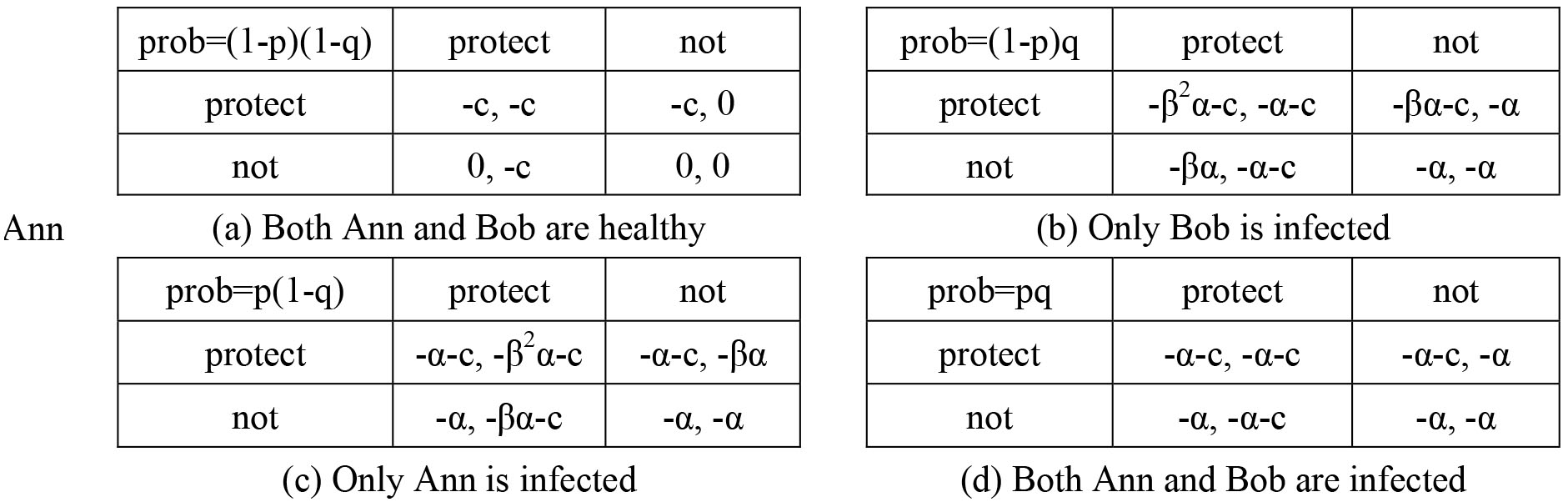
Table 1 shows the payoff matrix of the game, which describes the benefits for two agents based on their health statuses. Without loss of generality, we can only consider how Ann adopts protective strategies. If Ann is infected, just like Table 1(c) and (d), the payment of Ann by adopting protective actions is:
Otherwise, the payment of the infected Ann without adopting actions is:
It is evident that the dominant strategy of Ann is taking no action if he/she is infected.4
A dominant strategy refers to the strategy optimal for the agent regardless of others’ choice of strategy.
Payoff matrix given Ann is healthy

Further, it is more significant to pay attention to how a healthy individual determines his/her protective strategy. The payoff matrix in Table 2 gives the case that Ann is healthy. If Bob is healthy as well, we can see that the payment of Ann adopting measures is
Interim means an agent knows his/her own type but not the types of the other agents.
Unfortunately, Ann does not know the health status of Bob. Therefore, he/she can only determine his/her strategy based on his/her estimation.
The expected payment of the healthy agent Ann by taking measures is:
The expected payment of the healthy agent Ann without taking actions is:
Assume Ann is a risk-neutral agent (i.e., always prefer higher expected return). She will take positive strategy if the excess payoff of taking protective measures (EPP) is greater than 0:
We can see that the protection decisions depend on the size of EPP in this game. Agents prefer to adopt positive strategies under the condition of higher EPP. Specifically, for given loss of catching the virus
Protective efficiency Protection cost c is negatively correlated with EPP. Greater risk exposure q increases the value of EPP.
The above theoretical analyses enable us to understand the mechanism-based outcomes in different countries and regions by enforcing the control polices. For the regions with poor hygienic conditions, people suffer much more loss from this disaster mainly due to the low protective efficiency. In addition, in some areas advocating neoliberalism, much people face higher monetary costs and psychological costs.6
Neoliberalism opposes government intervention in the market and restrictions on individual freedom; Therefore, the prices of medical materials are difficult to control. People also tend to doubt pandemic prevention recommendations from the government, which leads to higher psychological costs.
It should be pointed out that the above analyses are conducted based on the assumption that their health status information is accessible to themselves. We can further expand the above model by assuming that the agents do not know the health status of anyone. Instead, they only know the probability distribution of the health status in both sides. In other words, agents need to make decisions under the circumstance of uncertain health.
In such a situation, the expected payment of Ann by taking measures is:
Otherwise, the expected payment without taking actions is:
Similarly, a risk-neutral agent Ann is expected to take protective actions only if
Based on the model for uncertain health status, the conclusions are basically consistent with the predictions based on expression (5). In addition, expression (8) shows that people of higher possibility being healthy are more likely to take protective measures.
In the “adopting protective measures” game as illustrated in Section 2.1, the protection cost c is fixed. We can relax this assumption and regard c as a continuous variable on the basis of Table 2. Thus, the protective efficiency
It is easy to state that
Pareto improvement means to make at least one person better without making anyone worse.
Payoff matrix of adopting protective measures (with continuous c)
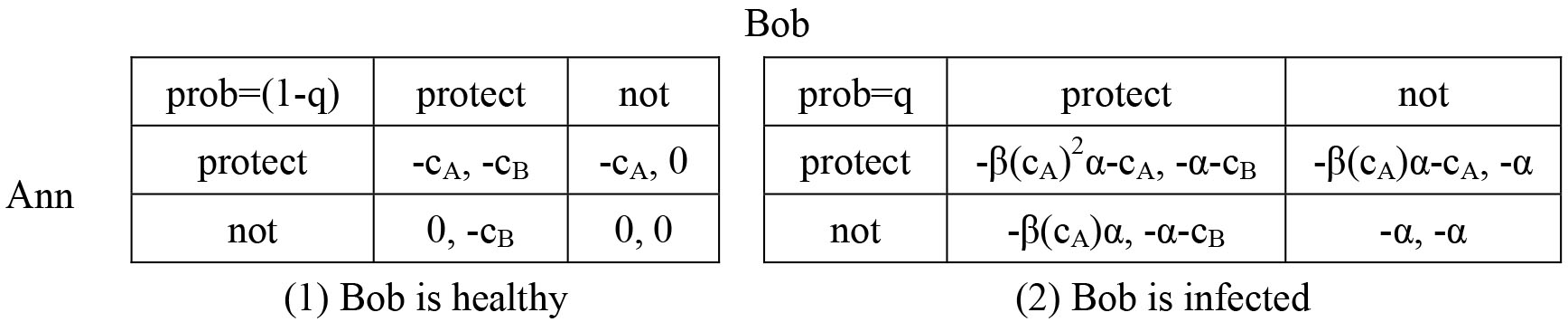
Case 1. The health status of Bob is hidden to Ann
If the type of Bob is private information, Ann has to choose the optimal level of protection cost
By taking the first-order derivative of the function
Rearranging expression (11), yields:
Since
Case 2. The type of Bob is revealed to Ann
If Bob is healthy, it will be the dominant strategy for Ann to take no action, and they both will get the payment of 0. However, if Bob is infected, Ann will choose optimal
By taking the first-order derivative of the function
Rearranging expression (14), yields:
Therefore,
Payment of Ann given Bob’s type
The payment of Ann in case 1 and case 2 are presented in Table 4. Whether Bob is infected or not, the expected payment of Ann is always higher after revealing the type of Bob. Considering that revealing Bob’s type does not influence the payment of him, EPP as well as the total expected payment after the disclosure increases:
Thus, we conclude that information disclosure is a Pareto improvement in this game, which can help Ann choose his/her optimal protection level based on complete information. If the information of both agents is revealed, this game becomes a complete information game and the equilibrium becomes an ex-post Nash equilibrium.8
Ex-post means that the agent knows all agents’ types.
In the real world, however, revealing information is not cost-free. Local administration has to balance between the intensity level of information disclosure and its cost. If the intensity level of information is appropriate so that the extra benefit covers the cost, the disclosure increases the total payoff of society. Such measure is also a Pareto improvement if the disclosure cost is afforded by the susceptible individuals or society. Since the infected people have no incentive to pay the cost of information disclosure, we should not passively wait for the suspected patients to take the initiative to accept the test. Reducing the cost of information disclosure and additional punishment for concealing health status can help to encourage high-risk people to take the initiative to accept the nucleic acid test and “prevent from the source”. Concerning that people are likely to overreact to information [23] or misunderstand the information [24, 25, 26], positive guidance and correct explanation are also indispensable.
With the global spread of COVID-19, it has become the major task for customs to prevent the import of the virus. Some airlines are asked by local governments to guarantee their passengers to be healthy. Otherwise, the airlines will be punished, such as canceling flights.9
Source:
An airline decides whether to organize nucleic acid tests for passengers. Meanwhile, the customs decides whether to permit the entry or not. We assume that the probability of there existing infectors among the passengers is p. The testing reliability is q, which means that the possibility that all the infectors can be identified is q. R1 and R
Payoff matrix in the battle of pandemic import
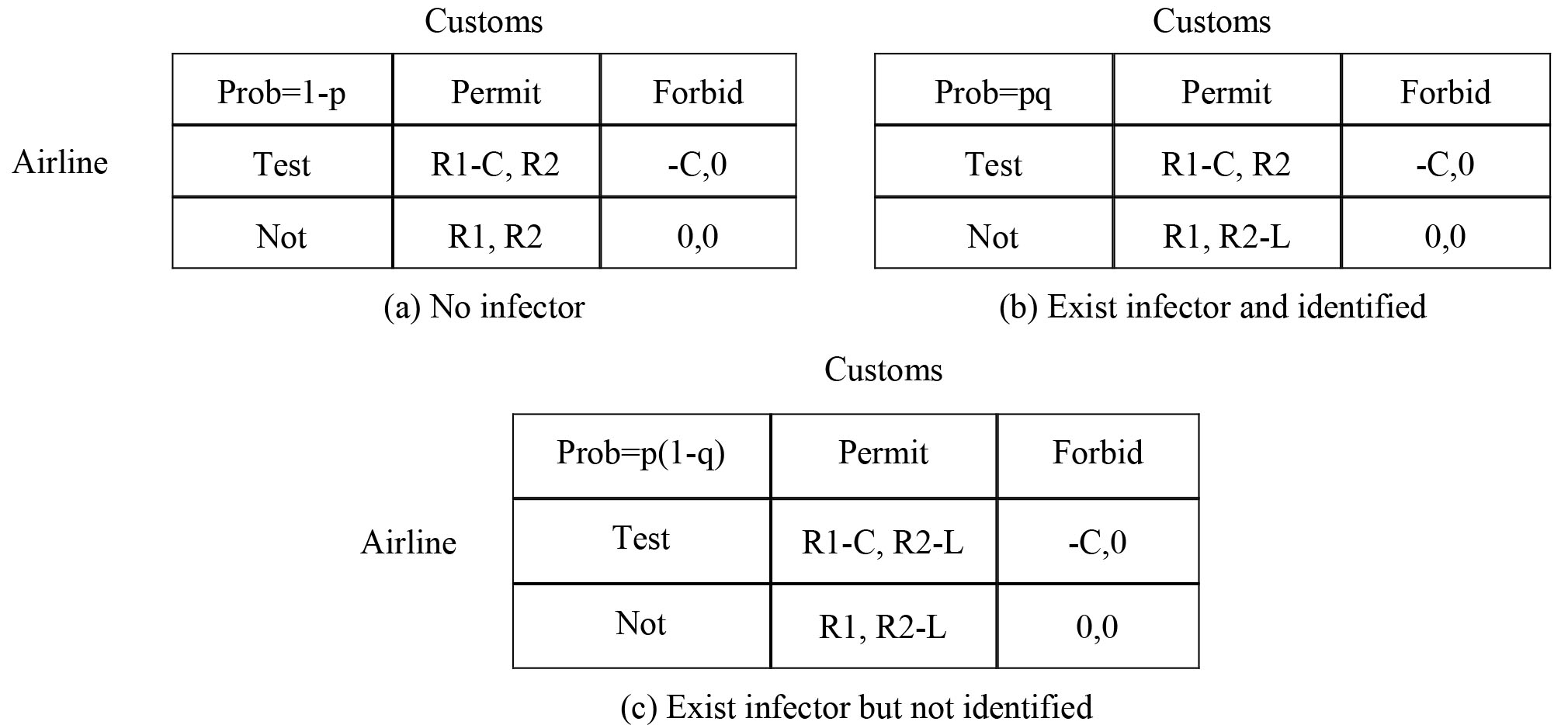
If this is a single-stage game, the equilibrium is obvious. “Not test” will be the dominant strategy since it brings more payoff in all cases. The customs may suffer a loss because of virus introduction.
However, if we regard this case as repeated games [17, 20], cooperation becomes possible. Noticing that (test, permit) is a win-win outcome compared with (not, forbid), cooperation becomes possible. The problem that the customs faces is to ensure that the airline does not deviate from cooperation. Assume that the airline cares about the future just as much as the present, but with probability of
This is equivalent to the situation that the pandemic continues, but the discount rate of the company is 1-
Case 1: Trigger.
Start out permitting, and once an unidentified infector is found and cause losses, the customs will play “forbid” forever. Since the payoff outcome of a stage is given before next stage begins, the airline can predict what actions the customs will play in next stage. Thus, we can eliminate the outcome of (test, not).
Outcomes: the cooperative airline vs. the customs of trigger.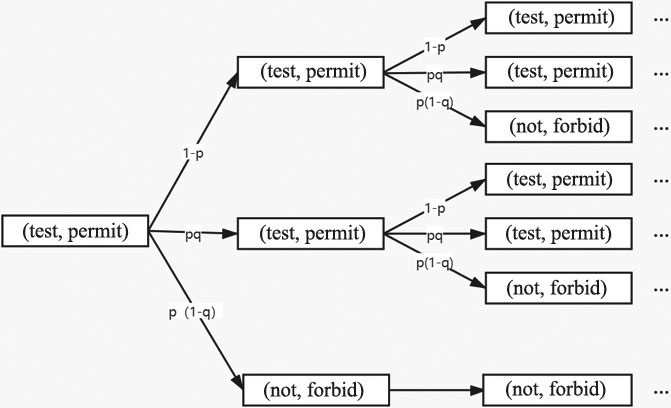
Given the action strategy of the customs, we can predict what the airline will do. If the airline plays “test” when the customs plays “permit”, the performances of the outcomes can be shown in Fig. 1. There are 3 possible outcomes:
There is no infector among the passengers and the customs will play “permit” in the next stage, the possibility is There exist infectors among the passengers and they are all identified, the custom will play “permit” in the next stage, the possibility is pq, as shown in Table 5(b). There exist infectors among the passengers but some of them can not be identified, the customs will suffer the loss L and play “forbid” forever, the possibility is
Notice that the sub game with the beginning node of (test, permit) is the same as the original game. The PV (present value) of the airline to cooperate is:
Rearranging expression (17), yields:
We can calculate the PV of the customs as:
Rearranging expression (19), yields:
Similarly, if the aviation company plays “not” when the customs plays “permit”, the performances of the outcomes can be shown in Fig. 2. The sub game with the beginning node of (not, permit) is the same as the original game. The PV of the airline to defect is:
Rearranging expression (21), yields:
The PV of the customs in this situation is:
Rearranging expression (29), yields:
When
Outcomes: the airline of defection vs. the customs of trigger.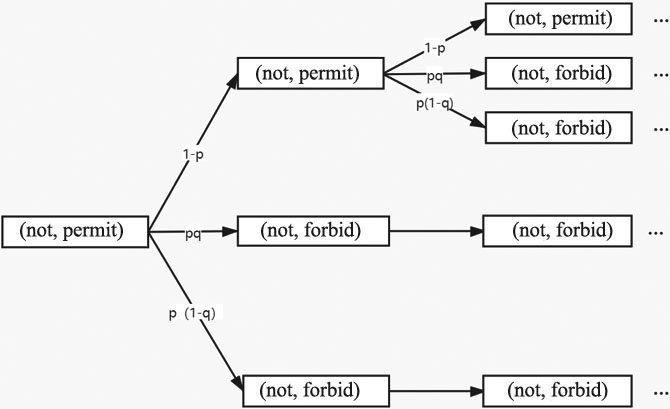
Case 2: Tit for tat.
Start out permitting, and once an unidentified infector is found and cause losses, the customs will play “forbid” in the next stage, then go back to “permit”. Instead of playing “forbid” forever, the customs only punish the airline for one-stage. It is a strategy with both punishment and forgiveness.
Outcomes: the cooperative airline vs. the customs of tit for tat.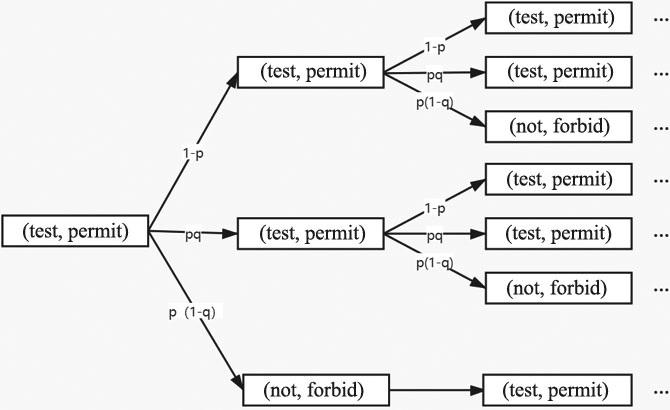
If the airline plays “test” when the customs plays “permit”, the performances of the outcomes is shown in Fig. 3. As in the first case, the sub game with the beginning node of (test, permit) is the same as the original game. We can calculate the PV of the airline and the customs in such a situation:
Rearranging expression (32), yields:
Rearranging expression (28), yields:
If the airline plays “not” when the customs play “permit”, the performances of the outcomes can be shown in Fig. 4. The PV of the airlines and the customs are:
Rearranging expression (30), yields:
Rearranging expression (32), yields:
Outcomes: The airline of defection vs. the customs of tit for tat.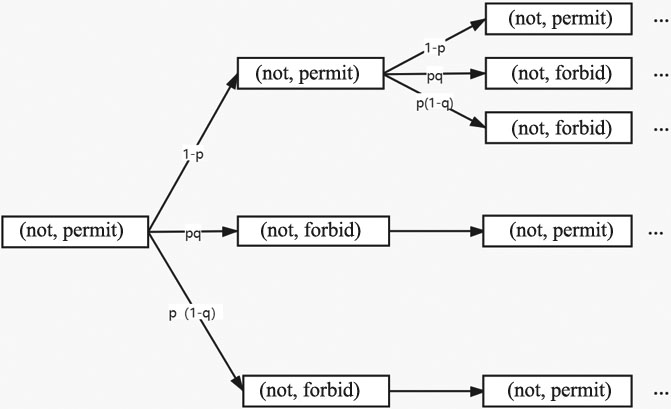
The airline does not defect on the condition that
Compared expression (34) with expression (31), we can see that the limit to
The model shows the application of repeated game theory in the field of pandemic prevention and control. First, consistent with folk theorem [27], if the discount rate
Airlines’ threshold is defined here as the lowest discount rate
In addition, the tit-for-tat strategy requires higher
Based on the game theory, this study provides the theoretical support for government policies to prevent and control COVID-19, and explains why similar policies achieve very different effects in different countries and regions.
In the first model, we review how people adopt protection strategies in a 2*2 Bayesian game. It shows that the protection cost, the protective efficiency and the risk exposure are the key factors that affect decision-making of healthy individuals. In terms of health policy, it would be useful to encourage the construction of new mask production lines and increase the supply of other protection materials. In addition, advocating correct hygiene manners in social activities is also helpful to improve protective efficiency and promote positive protection strategies. In contrast, a severe outbreak of COVID-19 may occur due to the lack of protective measures in some areas where neoliberalism prevails or basic hygienic conditions are difficult to guarantee.
Furthermore, by relaxing the assumption that protection cost is constant, the model underscores the importance of the disclosure of health information. Information disclosure, such as publicizing the local vaccination rate and the itinerary of infectors, increase social welfare by influencing individual decision-making. According to the result, measures aim to reduce the cost of information disclosure and promote information disclosure is of great significance to improve social welfare and limit the spread of the pandemic. In China, “Trip Code” enables residents to display where they have been recently according to GPS data, further reducing the cost of disclosing information considerably. The European Union’s digital vaccine passport also allows low-risk international travelers to provide low-cost health signals. These methods have effectively promoted information disclosure and restricted the spread of the pandemic with the help of digital technologies. Facing the risk of future pandemic transmission, we should encourage further innovation in improving the detection efficiency and reducing the cost of information disclosure.
In the second model, we discuss the best strategy to prevent the import of the virus by developing repeated games between local customs and airlines. Based on the uncertainty of detection efficiency and technology, we find it meaningful to set up a punishment mechanism for aviation companies to release the pressure of customs. However, the mechanism works only if the discount rate of the airline is greater than the threshold. The threshold is positively correlated with the detection cost, and it is negatively correlated with the revenue of the airline and the testing reliability. We also benefit from establishing a credit mechanism to give airlines that deviate from cooperation an opportunity to re-cooperate, especially for those in low risk areas.
The result of this study underscores the significance of taking into account individual and organizational decision-making in policy making. Health policy design based on users’ and airlines’ decisions is more conducive to the implementation of policies and preventing the spread of the pandemic. Measuring these interventions is also crucial to improve our public health management system and better respond to future public health emergencies.
While this study highlights the reference value of game theory approach in public health policy making, there are several limitations. First, this study is based on a game analysis that is not directly related to the field relationship, but to the outcome relationship. Although we have proposed several criteria to analyze individual and organizational decision-making, they are still limited compared with the reality. Future research should go beyond our theoretical analysis by combining with behavioral data based on real residents’ decision-making. Second, our study mainly concerns the general factors affecting behavior in pandemic prevention and control. Some direct monetary interventions, such as fines and rewards, are not included in this study. Third, the models in our study are two-player games. It may also be interesting to discuss the cases of multi-player games about the above issues.