




Abstract
Diets enriched in plant-based foods are associated with the maintenance of a good well-being and with the prevention of many non-communicable diseases. The health effects of fruits and vegetables consumption are mainly due to the presence of micronutrients, including vitamins and minerals, and polyphenols, plant secondary metabolites. One of the most important classes of phenolic compounds are anthocyanins, that confer the typical purple-red color to many foods, such as berries, peaches, plums, red onions, purple corn, eggplants, as well as purple carrots, sweet potatoes and red cabbages, among others. This commentary aims to briefly highlight the progress made by science in the last years, focusing on some unexpected aspects related with anthocyanins, such as their bioavailability, their health effects and their relationship with gut microbiota.
Cancer, cardiovascular diseases, obesity, diabetes, cognitive impairment and respiratory pathologies are the major leading cause of disability and death in the world, affecting both developed and developing countries [1]. Many risk factors are linked with the onset of these non-communicable diseases (NCDs): some of these, including aging, gender and genetics, are not modifiable, while others, such as lifestyle-related factors, exert a prominent role in NCDs development, especially at individual level; among these factors, nutrition is one of the most important [2–4]. Indeed, dietary choices, based for example on high levels of refined grains, saturated fats, processed meats, salt and sugar but lacking in vegetables and fruits, increase the risk to develop cancer, diabetes and cardiovascular diseases, by increasing inflammation, oxidative stress, hypercholesterolemia and hypertension, among others [5]. In the view to address unhealthy dietary patterns, in the last years the World Health Organization (WHO) has promoted some initiatives for reducing behavioral risk factors, recommending, for example, balancing the daily energy intake, limiting the intake of trans- and saturated fats, augmenting the consumption of vegetables and fruits and reducing those of sugar and salt. Some common diets follow the recommendations promoted by WHO, such as for example the Mediterranean diet [6], the Mediterranean-DASH Intervention for Neurodegenerative Delay (MIND) diet [7], or the Dietary Approaches to Stop Hypertension (DASH) [8]. One peculiarity shared by these diets is the large daily consumption of fresh vegetables and fruits, that, besides micronutrients such as minerals and vitamins, contain a wide quantity and variety of phytochemicals, including polyphenols, which confer most of the health benefits correlated with the intake of plant-based foods [9, 10]. One of the most common group of polyphenols are anthocyanins, pigments that provide red, pink, blue and purple color to several vegetables, fruits and flowers [11]. The most important dietary sources of anthocyanins are berries, like blueberries, strawberries, grapes, blackberries, blackcurrants, bilberries, pomegranates, chokeberries, cherries, but also black beans, peaches, plums, red radishes, red onions, purple corn, eggplants, purple carrots, purple sweet potatoes and red cabbages. The concentration of anthocyanins in plants depend on many factors, including the species and the cultivars, as well as the environmental aspects, including light and temperature, ranging from 0.205 mg/100 g in currants to 2468 mg/100 g in chokeberries, as recently reviewed [11]. Other current underestimated sources of anthocyanins are tropical and subtropical fruits, such as, for example, Brazilian jussara palm tree (Euterpe edulis) and Açai (Euterpe oleracea Mart.) fruits, Australian Davidson’s plum (Davidsonia pruriens), Asian butterfly pea flower (Clitoria ternatea), and Indian mangosteens (Garcinia indica), where the concentration of anthocyanins may reach up to 691 mg/100 g [11].
Regarding the chemical structure, anthocyanins are formed by an anthocyanidin backbone (aglycone), namely cyanidin, pelargonidin, malvidin, delphinidin, petunidin and peonidin, linked to a range of mono-, di-, and trisaccharides (often glucose, galactose, rutinose and arabinose), which can be acetylated to aliphatic and aromatic acids, resulting in numerous anthocyanin structures [11].
Considering the wide diffusion of anthocyanins in common dietary plan-based foods, in the last 30 years many efforts have been done by the scientific community to evaluate their health effects, as evidenced by the increasing number of papers published on PubMed every year (Fig. 1); 14.7% of these studies have been performed on culture cells, 50.0 % on animals, and 32.3 % on humans.
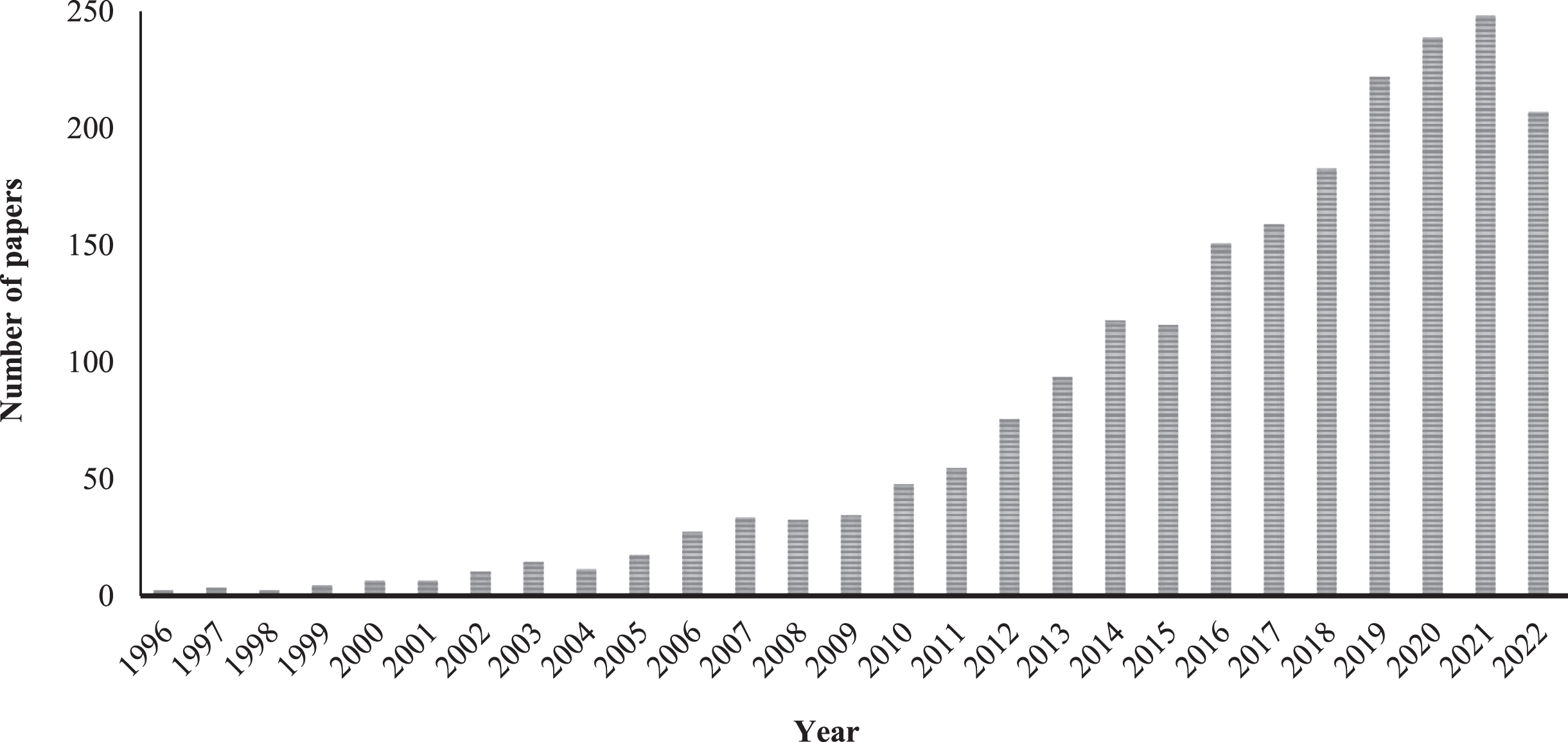
Number of papers published on PubMed from 1996 and focused on anthocyanins and health effects.
Current summary evidence from meta-analyses suggests a potential association between higher anthocyanin intake and reduced CVD risk [12] and mortality [13], lower risk of hypertension [14] and type-2 diabetes [15], as well as reduction of certain cancers [16]. Moreover, later summary evidence from observational and intervention studies shows a potential preventive effect of anthocyanin intake for cognitive disorders [17].
In this context, the progress made recently by science and technology shed the light on many unexpected aspects related with anthocyanins. For example, today we know that anthocyanin bioavailability is not so low as thought in the past (less than 1–2%), when only the parental anthocyanidin glycosides and few phase II metabolites were detected and quantified: thanks to the metabolomic approach, indeed, a series of new metabolites derived from phase I or II biotransformation, enzymatic and chemical reactions, as well as from gut microbiota degradation, have been described [18–20]. Some studies showed that anthocyanins are present as hundreds of derivates of phase II conjugates, both in circulation and in tissues, for a prolonged period [21–23]. For example, after cranberry juice consumption, the maximum concentration of parental anthocyanins was at least 1000-fold lower than that of the anthocyanin glucoronide metabolites in plasma and 30-fold lower than that of their phase II glucoronide metabolites in urine [24, 25]; similar results were found also after strawberry consumption [26].
Besides bioavailability, another advance made by science regards the type of activities exerted by anthocyanins. A growing body of recent studies suggests in fact that anthocyanins and their biometabolites may prevent several common chronic diseases through complex mechanisms of action [11, 27–34]. For example, regarding cardiovascular diseases, the effects of anthocyanins and derived compounds seem to be related to their capacity of attenuating endothelial inflammation and oxidative stress, improving lipid profile and modifying vascular glycocalyx, while in metabolic disorders, like diabetes and obesity, anthocyanins consumption has shown to decrease blood glucose and glycated hemoglobin levels, inflammation and oxidative stress, ameliorate insulin secretion and resistance, reduce body mass index and total fats, increase lipolysis [11]; similarly, in cancer anthocyanins are associated with an inhibition of apoptosis, cell growth and differentiation, inflammatory responses and oxidative stress [11]. All these effects are ascribed not only to the mere antioxidant capacity (i.e., the ability of compounds to neutralize and sequester radicals) of anthocyanins as thought in the past, but especially to their ability in modulating different molecular pathways, including, for example, those correlated with cytoprotection and inflammation (i.e., nuclear factor erythroid 2-related factor 2, nuclear factor kappa-light-chain-enhancer of activated B cells, eNOS), metabolism (i.e., phosphoinositide 3-kinases (PI3K)/protein kinase B (AKT), AMP-activated protein kinase (AMPK), peroxisome proliferator-activated receptor gamma pathways) [35], proliferation and apoptosis (i.e., AMPK, MAPKs, and PI3K/AKT/mTOR pathways) [10, 36–38] as well as angiogenesis [39].
Finally, another recent aspect is the anthocyanin effects on gut microbiota. A positive correlation between the intake of anthocyanins and the composition of gut microbiota has been indeed discovered [40]. The effects of anthocyanins on intestinal microbiota include, for example, the increase in the overall microbial quantity and diversity (in terms of both Phylum and Genus changes), together with the increased production of specific microbial substances, such as acetate, propionate, butyrate and short chain fatty acid [34, 35]. Through affecting the ratio between harmful and beneficial bacteria taxes, anthocyanins could be very beneficial in those pathological conditions where a lack of microbiome diversity has been highlighted, including cardiovascular diseases and neurological disorders [11, 44].
In conclusion, even if many steps forward have been made in recent years, several aspects remain to be understood, such as for example the dose/response effects, the ability of anthocyanins to cross cellular membranes or their interactions with biological molecules or other food components; in addition, other factors to take into consideration should regard the different technological processes used to isolate anthocyanins from foods or to increase their stability in commercial fortified products.
Funding
The work received no funding.
Conflict of interest
Maurizio Battino (Editor-in-Chief), Francesca Giampieri (Associate Editor), Josè Luis Quiles, Tamara Yuliett Forbes-Hernandez and Bruno Mezzetti (Editorial Board members) disclose their roles in the journal. However, none of them have been involved in or accessed any of the peer-review steps.