




Abstract
Background:
Recent research has shown beneficial results for music-based interventions (MBIs) for persons living with Alzheimer’s disease and related dementias (AD/ADRD), but reports often lack sufficient detail about the MBI methodology, which reduces replicability. A detailed checklist for best practices in how to report MBIs was created in 2011 by Robb and colleagues to remedy the lack of detail in MBI descriptions. The implementation of the checklist specifically in AD/ADRD research has not been established. Given the complexity of music and the variety of uses for research and health, specific MBI descriptions are necessary for rigorous replication and validation of study results.
Objective:
This systematic mapping review utilized the “Checklist for Reporting Music-Based Interventions” to evaluate the current state of MBI descriptive specificity in AD/ADRD research.
Methods:
Research articles testing MBIs and reviews of MBI efficacy published between January 2015 and August 2023 were scored using the checklist and the results were summarized.
Results:
Forty-eight studies were screened, and reporting was inconsistent across the 11 checklist criteria. Ten out of 48 studies fully reported more than 5 of the 11 criteria. Only one of the 11 scoring criteria was at least partially reported across 47 of 48 studies.
Conclusions:
Thorough reporting of intervention detail for MBIs remains limited in AD/ADRD MBI research. This impedes study validation, replication, and slows the progress of research and potential application of music in practice. Greater implementation of the reporting guidelines provided by Robb and colleagues would move the field of MBI research for AD/ADRD forward more quickly and efficiently.
INTRODUCTION
Music-based interventions for health and wellbeing are receiving increased attention due in part to their lower cost, broader accessibility, and minimal side effects relative to pharmacological interventions. There is favorable evidence from recent research that music-based interventions (MBIs) are beneficial for people with Alzheimer’s disease and related dementias (AD/ADRD). One hypothesized reason for the effectiveness of MBIs is the observation that musical memory is retained and can still evoke a response throughout the progression of the disease, even in later stages when communication becomes more difficult.1–4 Multiple review papers have concluded that MBIs produce beneficial outcomes for people with AD/ADRD,2–15 while others have conceded that beneficial outcomes are probable although the direct evidence may be weak.16–18 Some benefits MBIs provide for people with AD/ADRD are reduced stress, reduced emotional disturbances and depression, and improved memory and cognitive function.1,2,4,6,8,10,13,14,16,18,19, 1,2,4,6,8,10,13,14,16,18,19 These benefits may also extend to caregivers of people with AD/ADRD, who also often experience a decrease in quality of life as they care for their loved ones.8,10,20, 8,10,20
The interest in the effectiveness of MBIs as a non-pharmacological treatment continues to grow, and evidence for their beneficial effects is favorable. However, specific features of the music need to be consistently identified and described to move music-based interventions from anecdotal evidence into the realm of prescriptive interventions. A wide variety of funding opportunities which allow for the incorporation of music-based interventions, including one specifically focused on funding MBI research, are available and will likely continue to fuel this increase in MBI research. 21 However, the mechanisms which produce the beneficial effects of MBIs are not always clearly defined or understood. Understanding the underlying biological or psychological mechanism likely to be affected by the MBI gives a clearer understanding of which aspect of the intervention is producing the effect. This is also an area of interest for the NIH. Funding for dementia studies with a specific focus on the underlying mechanisms is also available, a fact which further supports both the level of importance placed on clearly defined mechanistic understanding and the necessity for more detailed and rigorous research. 22
The importance of choosing specific music elements to focus on when designing and describing an intervention has been similarly highlighted by the NIH and others. Musical elements and the ways in which humans respond to these elements are both complex. This complexity requires clear descriptions of the hypothesized interactions when designing an intervention and clear reporting of the musical elements used and the methods which drive their selection. Clear description of these elements is necessary, not only to define the mechanism of the intervention and interpret results but also to aid in reproducing the effect in future studies. Establishing guidelines and frameworks for reporting is an essential part of achieving clear reporting, which has been recently provided by the NIH in the Music-Based Intervention Toolkit and in the Therapeutic Function of Music framework outlined by Dr. Deanna Hanson-Abromeit.23,24, 23,24
Previously published reviews have focused on the results of music-based interventions for AD/ADRD, but few have considered the potential variability of the music interventions themselves resulting from the lack of detailed and specific descriptions. Differences and similarities between MBIs from one study to the next are difficult to determine because they are often only vaguely described. Without specific descriptions of the qualities of the music elements within music stimuli, the MBIs cannot be accurately reproduced, limiting the conclusions that can be drawn regarding efficacy. Unfortunately, reproducing individual study results in subsequent trials has proven difficult given the inconsistent levels of detail used to describe the music interventions across studies.
This gap was identified in 2011 by Dr. Sheri Robb and colleagues, who described the need for consistent and specific MBI reporting standards across inter-disciplinary research on music-therapy interventions. 25 This team of music therapists and researchers created the “Checklist for Reporting Music-Based Interventions” to assist future researchers and improve transparency and rigor in music-based intervention research. 25 In a 2018 follow-up review, Robb and colleagues examined the reporting specificity, based on their checklist, of MBI studies from 2010–2015 across a wide range of disciplines in healthcare. The result of their study was that consistent detailed reporting was not observed. 26 To map the quality of reporting for MBIs specifically in AD/ADRD research since the previous review, we conducted an updated systematic mapping review of reporting rigor for MBI research studies in AD/ADRD from 2015–2023. For the purposes of this review, we searched for studies published since 2015 to identify studies published after the previous 2018 review by Robb and colleagues. Our aim was to discover whether reporting of MBIs for people with AD/ADRD had improved since the evaluation conducted up to 2015, and to describe any consistencies and inconsistencies that we observed in recent reporting.
METHODS
A systematic mapping review was conducted, searching PubMed, Cinahl, and Embase for papers published between January 1, 2015– August 22, 2023 related to music interventions and Alzheimer’s or dementia. The search terms used, inclusion, and exclusion criteria are in Table 1. The results of these searches were filtered, using the PubMed, Cinahl, and Embase search filters. The PubMed filters were to include only papers published between 2015–2023, with free full text in English available that were either meta-analysis, review, systematic review, or randomized controlled trials. The Cinahl filters were Boolean/Phrase, Apply equivalent subjects, Full Text, January 2015– August 2023, English Language and Randomized Controlled Trials. The Embase filters were Publication years 2015–2023 and Randomized Controlled Trial. For this review, our search was limited to papers in English as the checklist was published in English; however, evaluation of each paper included extraction of the country where the study was conducted. The resulting paper titles were screened for inclusion based on our inclusion and exclusion criteria (Table 1). Articles with titles referencing Alzheimer’s/dementia/cognitive decline and a music-based intervention were selected, and duplicate articles discovered across multiple searches were removed. The remaining articles were divided into review articles (meta-analysis, review, systematic review) and study articles (randomized controlled trial, prospective study). The review articles were then further screened based on full text review and level of relevance to MBIs for AD/ADRD. Review articles were excluded after full text review if they were not focused on AD/ADRD, if they did not include MBIs, or if AD/ADRD or MBIs were only briefly mentioned as part of a broader review. Those review articles with the highest level of relevance were retained. Review results were used to evaluate whether MBIs had beneficial outcomes, and what specific outcomes had been observed, because they synthesized a wide range of data that had already been reviewed for study quality. Each study article was further screened based on full text review and further study articles were then selected using the reference lists of the selected study articles. Screening was carried out by coauthor, BH.
Search terms, inclusion, and exclusion criteria
The study articles were evaluated to determine the specificity of MBI descriptions and whether they met the standards of the “Checklist for Reporting Music-Based Interventions” (Supplementary Table 1). Each of the qualifying studies was scored based on the checklist which has 7 items. One of these items consists of 5 sub-categories which were treated as separate items for the purpose of this analysis for a total of 11 scored items. These scores were used to identify patterns of reporting across studies. Each checklist item could receive one of three possible scores, based on whether the item was found anywhere in the MBI description or within the article. The three scores were 0 (not observed/described), 0.5 (partially observed/described), or 1 (fully observed/described). A score of 0 was assigned if no description of a checklist item could be found within the full text of the report. A score of 0.5 was assigned if a description of a checklist item was found within the full text of the report, but all the item components were not described. A score of 1 was assigned if a description of a checklist item was found within the full text of the report and all item components were described. The scoring was carried out independently by two raters (Rater initials: BH and AZ). Interrater scoring disagreements were reviewed and reconciled by a third reviewer (RJL). The scoring was summed across checklist items and studies and visualized in Microsoft Excel to generate charts and observe qualitative patterns in the data. A PRISMA checklist for this systematic mapping review is provided in Supplementary Table 2. 27
RESULTS
The PubMed, Cinahl, and Embase searches resulted in the selection of 113 articles which were divided between 65 studies and 48 reviews. After full text examination of the studies, 23 articles failed to meet inclusion criteria and were excluded as ineligible. The reference sections of the remaining 42 study articles were searched for additional relevant literature; 6 additional study articles were identified and included for a combined total of 48 studies. The 48 reviews were then further screened based on full text review and level of relevance to MBIs for AD/ADRD, those with insufficient relevance were removed which resulted in 19 total reviews. This screening was carried out by BH (Fig. 1, Table 2).
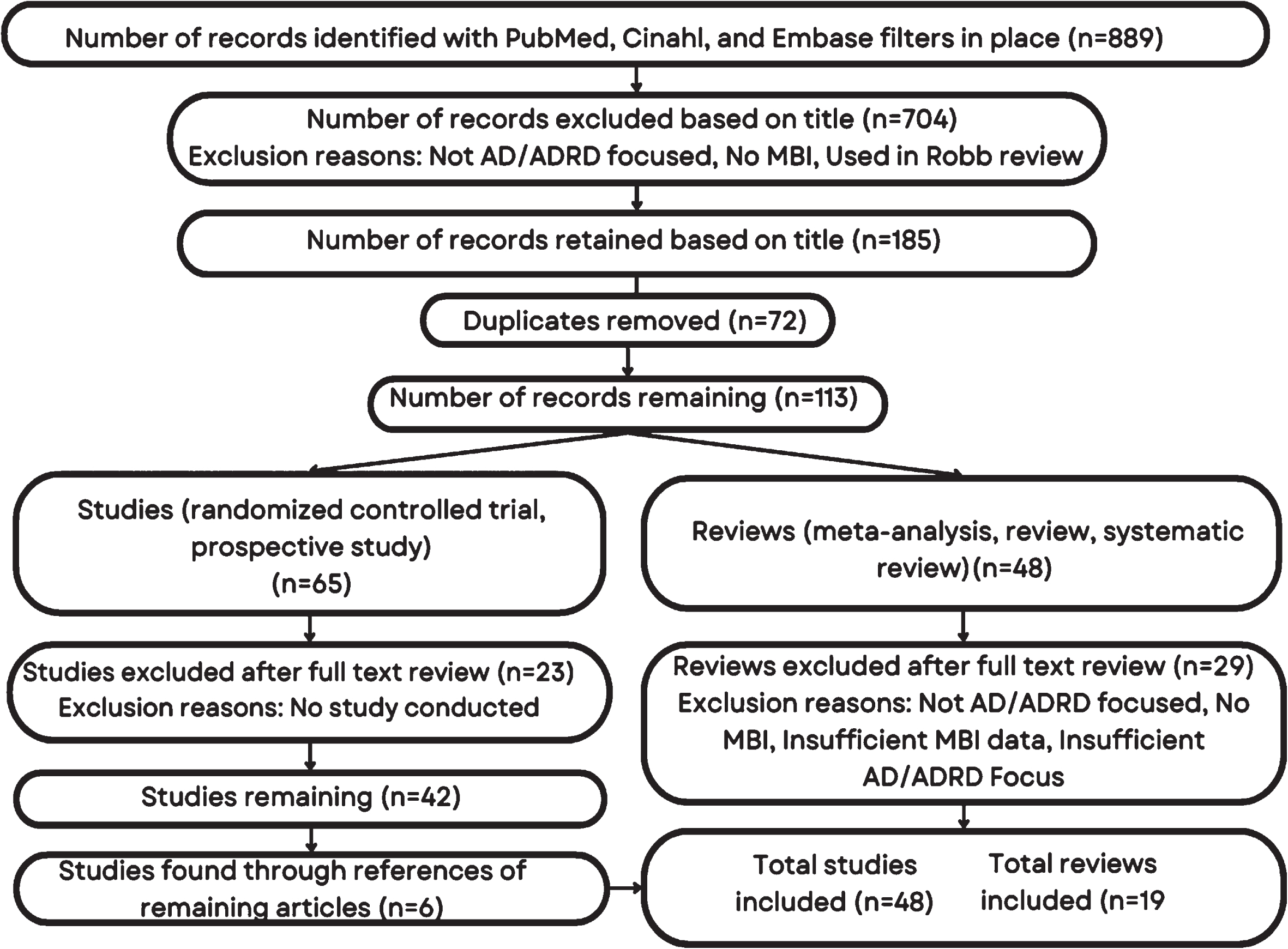
Search results flowchart.
Studies evaluated for reporting specificity (n = 48)
Analysis of the country where each study was conducted revealed that the included studies originated from North America, South America, Europe, Asia, and Australia. No studies were included that were conducted in Africa (Table 2). It should be noted that only one of the 48 studies included in this review cited the 2018 paper by Robb and colleagues which included the reporting checklist, 26 and that study did not include the checklist as a table or supplementary material identifying where each item was located within their manuscript. Consequently, the studies cannot be reasonably expected to include the checklist items verbatim. However, the checklist still serves as a valuable reference for determining how specific the descriptions were. The checklist items are “A: Intervention Theory”, “B: Intervention Content” (contains five sub-categories), “C: Intervention Delivery Schedule”, “D: Interventionist”, “E: Treatment Fidelity”, “F: Setting”, and “G: Unit of Delivery.” 25 The MBI descriptions in the study articles were limited, and full points were rarely awarded. Two studies received full points for eight items, three received full points for seven items, five received full points for six items, four received full points for five items, and the remaining 34 studies received full points for four or fewer items. Figure 2 displays the total score each study received, with each bar section color coded to show the point value contributed by each checklist item. Studies are not identified in the scoring as the goal of this analysis was to highlight the general pattern of reporting rather than to identify specific authors for lack of clarity in reporting as the checklist was not specifically used in any of the papers. The data supporting the findings of this study are available on request from the corresponding author (RJL). Full points and half points are indicated by the height of each column section. The maximum score each study could receive was 11. As seen in Fig. 2, only ten studies fully described more than five of the 11 items on the checklist, and when accounting for partial scoring, only 23 of the 48 studies achieved a score exceeding 5.5 out of 11. Figure 3 shows the total score for each checklist item across all studies, each section of the mountain plot is color coded to identify which study contributed the point value, full points and half points are indicated by the height of the section. The maximum score each checklist item could receive was 48 (the number of studies). As shown in Fig. 3, the most consistently described item was “C: Intervention Delivery Schedule”. Thirty-four studies fully reported item C, 13 partially reported item C, and only one study failed to report item C. The least reported item was “B.2: Music”, with only seven studies partially reporting this item. Despite achieving an upper range score, item “A: Intervention Theory” was also underreported, with only 25 studies fully reporting a theoretical rationale for how the MBI was hypothesized to effect change and 19 out of 48 studies partially reporting this item.
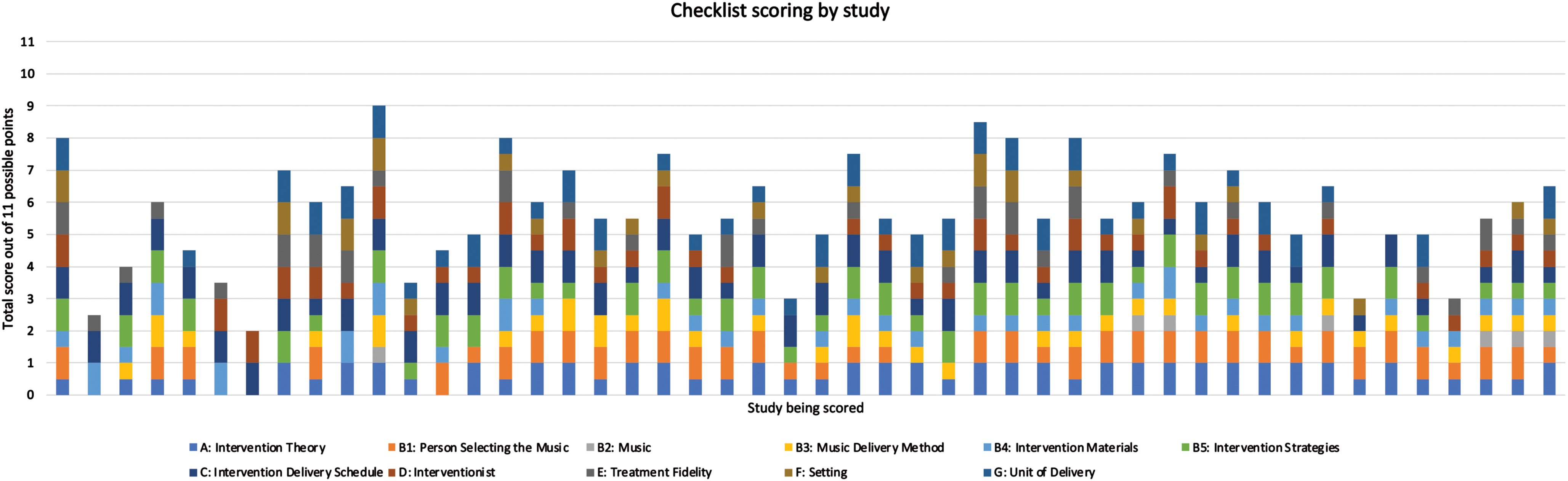
Number of checklist items reported in each study. Whole or half points are represented for each checklist item by the color coding described in the legend.
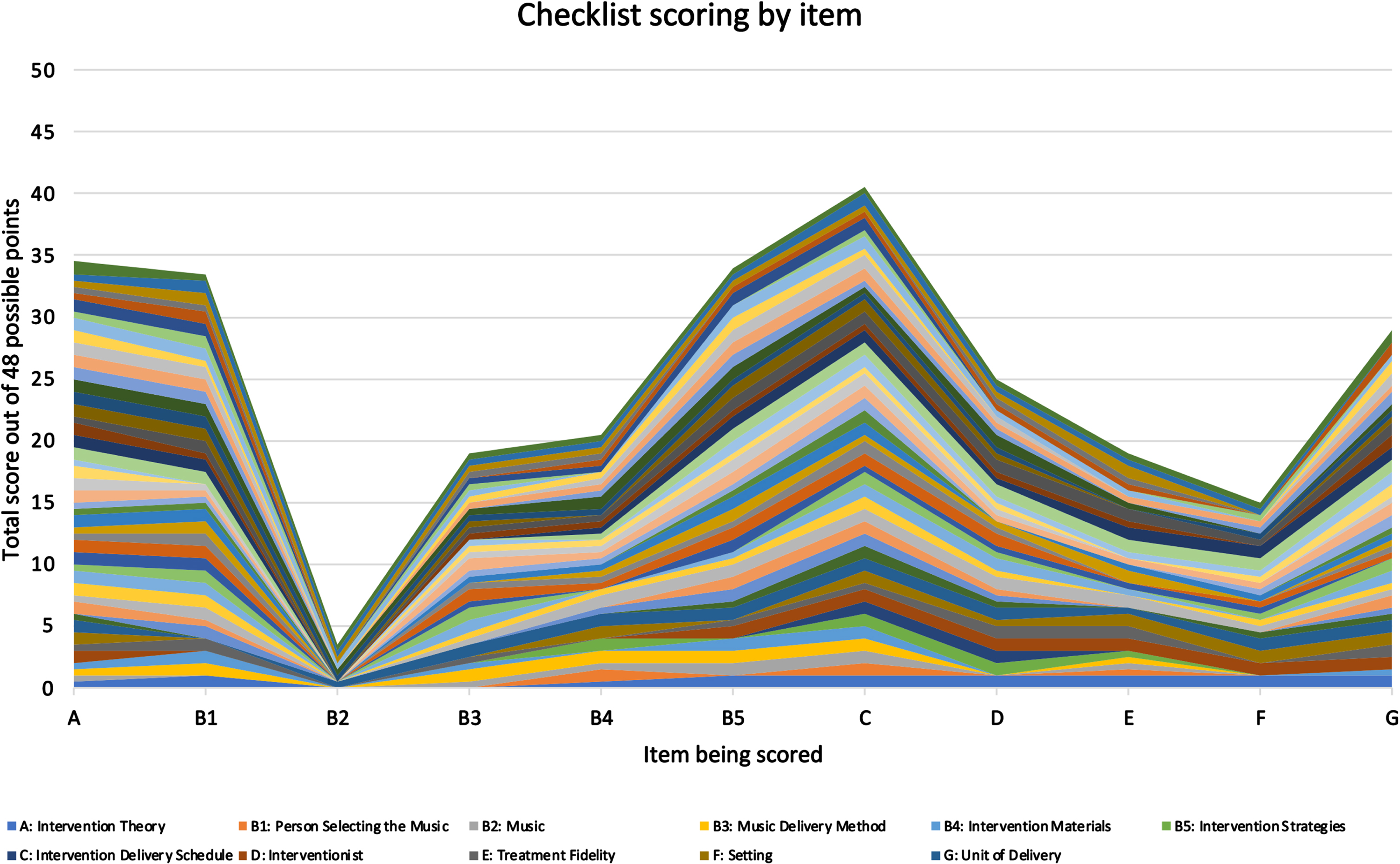
Number of studies reporting each checklist item. Each study is represented by a unique color on the mountain plot. Checklist items are labelled in the legend according to the original checklist (Supplementary Table 1).
Frequency and duration of the interventions were some of the most consistently reported details. Because of this, it was possible to discern that the frequency and duration of MBIs for AD/ADRD varied widely between the studies. No other details could be accurately compared because of the inconsistent item reporting and lack of detailed intervention descriptions across the studies. Specific songs or music genre used in the MBI was rarely reported, and the environment in which the music was delivered was rarely described. Within the manuscript text, the location of the specific details of the music interventions also varied. Most often, specific descriptions were reported in the methods section. However, some details were only found in the introduction or discussion sections, or could only be inferred from the descriptions as they were not overtly stated. This added difficulty when identifying whether a checklist item had been fulfilled, because it required careful and repeated reads through the papers to locate each specific item. Beyond the difficulty of locating the information, the specific details included in the intervention descriptions varied so greatly that precise replication of a reported intervention would be nearly impossible.
DISCUSSION
There is favorable evidence that MBIs produce beneficial outcomes for those living with AD/ADRD and their caregivers. However, the lack of consistency in which details are reported combined with the lack of detailed descriptions of the specific components of these MBIs makes accurate reproduction of these interventions nearly impossible. Without the ability to accurately reproduce these interventions, validation of their results remains inconsistent. The specific music used in interventions was the most underreported checklist category, which is unfortunate because it is the foundation of a music-based intervention. Music is a diverse and general term, and even if a specific genre or song title is provided there is still variation in music components across performers and performances. These subtle musical variations could greatly influence the results of the intervention. 25
One of the most underreported items across studies was “B.2: Music”. Most studies described intervention duration, frequency, and group size, but few offered more than a vague description of music type, and specific songs and artists were rarely included. Several studies narrowed music intervention into active or passive categories, but these categories give little insight into the nature of the music itself. Most studies did not describe delivery volume, tempo, location or any other specifically descriptive categories. Replicating an MBI when the only details which have been provided are duration and frequency of the intervention is bound to result in a host of differing musical components which will cause changes in the effects produced. Providing specific references and descriptions of the music used in an intervention would allow more replicability for independent validation of an MBIs results.
Another highly underreported item, “A: Intervention Theory”, is also a crucial component of any study. Without a clear theory underlying the music intervention design, the biological mechanism being targeted, and the expected results; it is difficult to determine whether the intervention was truly effective. Studies frequently reported large conceptual domains that could be affected by music, such as memory or cognition, but rarely described how music specifically was hypothesized to affect a specific change. Results may be observed, but understanding what intervention component is producing them and what biological mechanism is being utilized is challenging if the theory has not been clearly defined and utilized in intervention design. This further contributes to the difficulty in replication and validation.
Limitations of this review include records only in English and one reviewer (BH) for record screening. It is possible that some papers published in other languages were excluded. However, the analysis of the country where the study was conducted revealed that the search included publications from across the globe. Our review does not explicitly include sound stimulation like vibroacoustic therapy as all search terms and combinations included the word, “music,” and therefore does not capture the use of auditory stimulation not described by the authors as music. However, two studies did include multisensory stimulation as a comparison to the music condition.28,29, 28,29 Rigor was increased by having two independent scorers (BH, AZ) and a third scorer (RJL) to review and reconcile any interrater disagreement in scoring.
Our mapping of the current literature provides evidence that reporting music-based interventions with enough detail to replicate and validate the fidelity of interventions remains limited, thus restricting progress in the development and efficacy of music-based interventions for AD/ADRD. One goal of intervention research is to influence effective clinical practice. Translation of research into clinical practice has historically been lengthy, taking an average of 17 years. 30 Systematic reviews are one way to translate evidence-based research into clinical practice; 31 however, transparent reporting is needed within primary research studies to effectively support translation of clinical research to practice. According to Google Scholar, there are over 300 citations of the Reporting Guidelines for Music-based Interventions. The original article, published in 2011 in the Journal of Health Psychology, was also reprinted that same year in Music and Medicine, an interdisciplinary journal of the International Association of Music and Medicine that is specific to music-based intervention research and clinical practice. 32 The reporting guidelines for music-based interventions are easily accessible but have not been adopted as quickly as needed to align with trends in transparent reporting of health interventions, such as recommendations by the Equator Network. 33 Use of the checklist is encouraged and cited by the recent NIH Music-Based Intervention Toolkit, and the implementation of those standards for researchers seeking NIH funding may increase adoption. 23 Other opportunities to encourage use specifically for AD/ADRD research could include presentations at Alzheimer’s disease focused conferences, such as those highlighted on the Journal of Alzheimer’s Disease website. 34 Journals could also encourage usage in their reporting standard guidelines for authors or by publishing editorial commentaries on the topic. Finally, cross-disciplinary collaborations are critical to align standards across music therapy, MBI research, and aging and AD/ADRD research.We urge researchers to include music therapists or other music-based intervention experts into the conceptualization and operationalization of music-based interventions to ensure the intervention details are evident within the intervention manual and protocol implementation and to align with recommendations to advance rigor, replication, and translation of music-based interventions.23,25, 23,25
Replication and validation of results is a crucial component of scientific progress. A theory cannot be refined without repeated testing. A lack of clear and detailed descriptions of the theory behind an intervention design or the musical components of an intervention would be problematic if only one of these items was not reported. The lack of both of these items from a report makes replication and validation nearly impossible. The “Checklist for Reporting Music-Based Interventions” contains both of these items along with other important details and has been freely available since 2011. It was created with scientific rigor and for a specific purpose. Following this checklist will provide a framework to aid in consistent reproducibility of studies, and validation or invalidation of reported results. However, the checklist was only cited by one of the 48 studies we reviewed and was not included as a table or supplemental material by any studies. The checklist can be reproduced without permission in the same way that the PRISMA checklist is intended to be used, identifying the page numbers where each element can be found within a manuscript, and we recommend this practice to standardize reporting. 27 If MBIs cannot be consistently validated their observed results will remain anecdotal in nature. To move MBIs from the realm of anecdotal evidence into the realm of prescriptive intervention, a consistent and ordered method of reporting is necessary. This method has already been provided, now is the time to put it to use.
AUTHOR CONTRIBUTIONS
Rebecca J. Lepping (Conceptualization; Formal analysis; Funding acquisition; Investigation; Methodology; Resources; Supervision; Validation; Writing – original draft; Writing – review & editing); Benjamin J. Hess (Data curation; Formal analysis; Investigation; Visualization; Writing – original draft; Writing – review & editing); Jasmine M. Taylor (Writing – review & editing); Deanna Hanson-Abromeit (Methodology; Writing – review & editing); Kristine N. Williams (Funding acquisition; Methodology; Writing – review & editing).
Footnotes
ACKNOWLEDGMENTS
The authors thank Ava Zatloukal (AZ) for assistance scoring the study articles.
FUNDING
Research reported in this publication was supported by the National Center for Advancing Translational Sciences of the National Institutes of Health under the Award Number UL1TR002366. The content is solely the responsibility of the authors and does not necessarily represent the official views of the National Institutes of Health.
CONFLICT OF INTEREST
The authors have no conflict of interest to report.
DATA AVAILABILITY
This review was not registered and a protocol was not prepared. The data supporting the findings of this study are available on request from the corresponding author.
