




Abstract
Background:
High day-to-day blood pressure variability (BPV) has been associated with an increased risk for cognitive decline and mortality in the general population. Whether BPV is associated with increased all-cause mortality in older people with cognitive impairment is unknown.
Objective:
To investigate the association between day-to-day home BPV and all-cause mortality in older patients attending a memory clinic.
Methods:
We included 279 patients attending a memory clinic, who measured home blood pressure (BP) for 7 consecutive days in the morning and evening. Within-subject BPV was defined as the variation independent of the mean (VIM). Time-to-death was verified through the Dutch population registry. Cox proportional hazard regression was used. Separate analyses were performed for morning-to-morning and evening-to-evening BPV.
Results:
Mean age was 73±9 years, dementia and mild cognitive impairment were diagnosed in 35% and 34% respectively, and mean home BP was 139/79 mmHg. After a mean follow-up of 3.2 years, 52 patients had died. Neither day-to-day systolic nor diastolic VIM were associated with mortality (adjusted hazard ratio [HR] systolic VIM: 0.99, 95% -CI 0.92–1.06, p = 0.770, HR diastolic VIM: 1.04, 95% -CI 0.93–1.17, p = 0.517). When morning and evening measurements were analyzed separately, systolic morning-to-morning VIM was associated with mortality (adjusted HR: 1.09, 95% -CI 1.01–1.18, p = 0.033).
Conclusion:
In this study, day-to-day BPV was not associated with all-cause mortality in patients attending a memory clinic. However, morning-to-morning BPV was. Due to the short assessment window, there is still a lack of clarity; hence future research is warranted to clarify the role of all BPV components in aging.
Keywords
INTRODUCTION
Hypertension has a high worldwide burden of disease, is one of the strongest risk factors for cardiovascular diseases (CVD), and leads to a higher risk for mortality [1–3]. Studies have convincingly reported that chronic hypertension during mid-life is also a strong risk factor for cognitive impairment in late-life [4–6]. However, the role of late-life blood pressure (BP) in the risk for cognitive decline and dementia remains inconclusive [7–9], and optimal BP targets in those with cognitive impairment are unknown, leading to the lack of clear clinical guidelines for BP management in older frail people [10]. Furthermore, little is known about factors that are associated with the heterogeneous prognosis of cognitive impairment [11]. More knowledge of factors that can forecast the longitudinal course of an individual with dementia is of importance for society and patients, and is relevant for BP management, since with a poor life expectancy the benefit-risk ratio of treatment changes.
Historically, BP management and research have focused on the effects of mean BP. However, BP is known to have noticeable fluctuations over time, such as minutes, hours, days, and months. Over the past two decades, this so-called blood pressure variability (BPV) has attracted attention and is no longer considered a random phenomenon [12]. High BPV has been related to CVD, stroke, and cerebral small vessel disease [13–15]. Moreover, studies have found an association between high BPV and all-cause mortality in the general population [16–19]. These studies measured BPV over a period of months or years, called visit-to-visit BPV. This long exposure time hampers the use of this information in clinical practice. BPV measured at home over a period of several consecutive days, day-to-day BPV, is likely to have a better clinical applicability. It provides information on the consistency of BP within a shorter timeframe, is more reproducible, offers better prognostic value [20] and out-of-office measurements are generally more representative for actual BP than office measurements [10, 21]. Day-to-day BPV has also been related to all-cause mortality in the general population, albeit with less evidence [22–24].
Previous work has linked both high visit-to-visit and day-to-day BPV to an increased risk for cognitive decline and dementia [25]. Moreover, in patients with pre-existent Alzheimer’s disease (AD), high BPV was associated with increased progression of AD [26, 27], although this was not found in all single studies [28]. It is hypothesized that the alterations in cerebral hemodynamic and damage on cerebral microvasculature caused by high BPV, may promote AD pathophysiology [27, 29]. However, causality remains unclear and a bidirectional relationship is suggested, since there is also growing evidence that BPV is increased among AD patients compared to cognitive normal controls [29].
In addition, high BPV was associated with higher odds for vascular damage such as cerebral small vessel disease, which in turn contributes to a heightened risk for mortality [30, 31]. Older people with dementia often present with a mix of AD and vascular pathology [32], both being associated with increased BPV. Whether high day-to-day BPV is associated with mortality in this group is unknown. Exploring this association could provide new insights in the ongoing debate regarding what to focus on in the BP management in this vulnerable group, if we understand how day-to-day BPV variability is related to the prognosis of patients with dementia.
The population attending a memory clinic comprises people with newly diagnosed dementia, mild cognitive impairment or at risk for dementia. As such, they represent the population in which uncertainties exist regarding optimal BP management, the associations of BPV with dementia and/or mortality, and regarding individual prognosis. Therefore, we studied a population of older people attending a university hospital memory clinic and aimed to investigate the association between day-to-day BPV and all-cause mortality. We studied day-to-day BPV because of the shorter timeframe in which this can be collected and the higher potential for clinical practice, compared to visit-to-visit BPV. Secondary aims were subgroup analysis of participants with dementia, morning-to-morning versus evening-to-evening BPV, and to investigate the effects of different lengths of follow-up, since this might result in different insights [33].
METHODS
Study design and participants
In this observational retrospective cohort study, a database consisting of older people attending the memory clinic of the Radboud university medical center (Nijmegen, The Netherlands) was used. This database and protocol have also been described elsewhere, and this is a secondary analysis of an existing database [34, 35]. Inclusion started in January 2014 and lasted until July 2019. All eligible patients who visited the memory clinic were asked to perform home blood pressure measurement (HBPM); there was no age or cognitive test score cut-off. Eligibility was judged by the attending physician or nurse and based on the capability to understand the Dutch language and to perform the BP measurements at home. If necessary, patients could be aided by a proxy who also received instructions, to improve eligibility of the measurements. The study was reviewed and approved by the Medical Ethics Committee (CMO Arnhem-Nijmegen, file number 2016–2753), who exempted the study from the need to obtain written informed consent, because of the minimal burden of the measurements. Oral informed consent was asked from each patient and, if applicable, their informal caregiver.
In total, 340 patients agreed to participate in the study. Of these, 10 participants performed 0 BP measurements, of 8 participants the medical records were missing in the database, 5 participants in the database were seen at the ‘diagnostic day center’ instead of the memory clinic, 1 participant did not provide consent for the use of information extracted from medical records, and 1 participant died from brain metastases soon after measurements were taken. These participants were excluded from further analysis, leaving 315 participants in the current study.
Home blood pressure measurements
Participants received instructions, both written and oral, on how to perform HBPM. If possible, or necessary, they could be aided by their caregiver. An automatic oscillometric device with a memory function was used (Microlife WatchBP Home, Microlife, Heerbrugg, Switzerland) [36], and the measurements were carried out according to an international protocol [21]. This protocol consisted of the instruction to measure BP twice a day: in the morning (4.00–11.00 am) and in the evening (4.00–11.00 pm), for 7 consecutive days. Participants received instruction to rest for 5 min before measuring BP and not to measure within 1 h after food or drug intake. During each measurement, two BP readings were performed. These duplicate readings were averaged, and measurements of the first day were removed, as by standard practice. A minimum of 8 (out of 12) duplicate measurements was set as a requirement to be included in the analysis. Morning and evening BP measurements were also analyzed separately and are further on referred to as “morning-to-morning” and “evening-to-evening” BPV. For these analyses, a minimum of 4 duplicate measurements was required.
BPV was evaluated using two parameters: The variation independent of the mean (VIM) and coefficient of variation (CV). The CV is calculated by dividing the standard deviation (SD) with the mean (CV = SD/mean*100%), but can still be correlated to mean BP [13]. Therefore, VIM has been developed as a new measure uncorrelated with mean BP [13]. VIM was determined by the formula: VIM = SD/meanx. The parameter x was estimated from fitting a curve through a plot of SD of BP (y axis) against mean BP (x axis) [13, 37]. VIM was used as the primary parameter in this study since its correlation with mean BP is almost zero. However, results are also presented for CV, because values of VIM cannot be compared across populations. VIM and CV were determined for systolic and diastolic day-to-day, morning-to-morning and evening-to-evening BPV.
Outcome
The primary outcome in this study was all-cause mortality. No distinction could be made between different causes of death. Data on mortality was retrieved from the Dutch Personal Records Database [38] and was assessed until December 3th 2019, and this date was used as a censoring date for survivors.
Other variables
Additional information was extracted from the participant’s medical record at baseline. Information included: age, gender, education level, smoking status, alcohol, body mass index (BMI), diabetes mellitus, history of CVD, hypertension, cognitive diagnosis, and current medication use. Education level was defined as low, medium, or high following the Dutch ‘Verhage’ system, as previously described [39]. CVD included (chronic) heart failure, coronary heart disease, cardiac arrythmias, peripheral artery disease, and cerebrovascular disease. A vascular score was calculated by scoring the presence of each of the 5 cardiovascular comorbidities + diabetes mellitus + smoking status [8, 40]. If cardiovascular comorbidity was absent but the patient was using a statin or anticoagulants, 1 point was added to the total score, leading to a maximum score of 7. Hypertension was defined as mean home SBP ≥135 mmHg and/or home DBP ≥85 mmHg. Cognitive diagnoses were established in a multidisciplinary meeting with geriatricians and neuropsychologists and were based on information from the geriatric assessment and international DSM-5 criteria [41], the NINCDS-ADRDA criteria for Alzheimer’s disease, NINDS-AIREN criteria for vascular dementia and the criteria of Albert et al. for mild cognitive impairment (MCI) [42]. When deemed necessary, additional diagnostic testing (i.e., neuropsychological testing or neuroimaging) were performed. Patients were categorized into four groups: dementia (any type), MCI, subjective cognitive impairment (cognitively normal), and other diagnosis (neurological or psychiatric diagnosis such as depression).
Statistical analyses
Baseline characteristics of participants are presented as mean±SD for continuous variables and frequency (percentage) for categorical variables. Missing data for covariates (smoking status, vascular score) were imputed using multiple imputation with 5 chained datasets, assuming these covariates were missing at random. Extreme outliers in BPV (defined as ≥4 SD from the mean) were converted to a value similar to mean +3 SDs, to limit the influence of these outliers. This was the case for 12 values of VIM (3 for day-to-day, 4 for morning-to-morning, 5 for evening-to-evening). The same procedure was followed for CV. Furthermore, multiple linear regression was used to assess the association between covariates and systolic VIM.
Cox proportional hazards regression was performed to assess the association of day-to-day, morning-to-morning and evening-to-evening BPV with all-cause mortality. The proportional hazards assumption of the Cox models was checked using Schoenfeld residuals and the interaction with time-dependent variables, no violation was observed. Three models were constructed: model 1 included adjustment for age and gender; model 2 included additional adjustment for vascular score and use of antihypertensive drugs; model 3 additionally included mean systolic BP for the analysis of VIM SBP and mean diastolic BP for the analysis of VIM DBP. The number of events limited including more covariates in the analysis. Imputed data for vascular score was used in the Cox models and pooled hazard ratios were given. First, VIM and CV were modelled as a continuous variable, and hazard ratios are reported per unit increase. Models were constructed using both systolic and diastolic BPV. Next, systolic and diastolic VIM were divided into tertiles. Kaplan-Meier function estimated cumulative all-cause mortality across tertiles of VIM, and differences between tertiles were assessed using the log-rank test.
A secondary analysis restricted to participants diagnosed with dementia was conducted. Two Cox models were constructed to assess the association of VIM with mortality: model 1 included adjustment for age and gender; and model 2 additionally included mean systolic or diastolic BP.
Furthermore, separate Cox models were performed after 1, 3, and 5 years follow-up to evaluate the prognostic value of VIM at different lengths of follow-up. Participants with a follow-up longer than the period of interest were censored. The same models were used as for the analysis of patients with dementia. A p value < 0.05 was considered statistically significant. Analyses were performed using IBM SPSS Statistics 25.0 (SPSS, Inc., Chicago, IL, USA) and Stata 16 (Stata Corporation, College Station, TX, USA).
RESULTS
Baseline characteristics of participants
315 patients performed HBPM. Of these, 279 obtained≥8 duplicate measurements and were enrolled in the analyses. We had complete BP datasets (12 measurements) in 129 out of 279 patients (46%), and 236 patient (85%) performed at least 10 measurements. The median number of measurements performed (11, interquartile range 10–12) did not differ between those who died and those who did not die, and there was also no difference among the patients when split by cognitive diagnosis. Additionally, 289 participants obtained ≥4 morning measurements and 267≥4 evening measurements. Table 1 shows the baseline characteristics of the total study sample and stratified by event status (alive/deceased). Mean age of the study population was 73.2±8.6 years and 56.3% were male. Dementia was diagnosed in 97 (34.8%) and mild cognitive impairment in 94 (33.7%) participants. The dementia subtypes that were present in the sample were: Alzheimer’s disease (52), vascular dementia (17), mixed dementia (17), unknown origin (4), and other (7).
Characteristics of the study sample and stratified by event status (alive/deceased)
Results are presented as mean±standard deviation or as a number (percentage). *Defined using home blood pressure measurements: mean systolic blood pressure ≥135 and/or mean diastolic blood pressure ≥85 mmHg. **Neurological or psychiatric diagnosis.
Blood pressure values
Mean SBP and DBP were 139.0±16.4 mmHg and 78.7±9.3 mmHg respectively, mean day-to-day systolic VIM was 10.2±3.8. Morning-to-morning and evening-to-evening systolic VIM were 8.0±3.4 and 9.6±4.3 respectively (see Supplementary Table 1). CV measures and BP values stratified by cognitive status are found in Supplementary Tables 2 and 3 respectively. Paired samples T-test showed that evening-to-evening VIM was higher than morning-to-morning, for both systolic VIM (mean difference = 1.58, 95% -CI 1.00–2.15) and diastolic VIM (mean difference = 0.91, 95% -CI 0.51–1.31), whereas mean SBP and DBP were higher in the morning. Higher systolic VIM was significantly associated with female sex, older age, and higher vascular score. Systolic VIM was higher in patients with dementia compared to participants with MCI or subjective cognitive impairment, but not for participants with other diagnoses (see Supplementary Table 3).
Analyses of all-cause mortality
Follow-up ended on December 3, 2019 and mean follow-up time was 3.2±1.7 years (range 0.1–5.9). During follow-up, 52 deaths occurred. Cumulative all-cause mortality did not differ across tertiles of the distributions of day-to-day VIM (Fig. 1; log-rank test VIM SBP p = 0.22, VIM DBP p = 0.10). Table 2 shows the hazard ratios for all-cause mortality for each unit increase in VIM. Systolic and diastolic VIM were not associated with all-cause mortality. However, both systolic and diastolic morning-to-morning VIM were associated with a higher risk for mortality, with an unadjusted HR of 1.09 (95% -CI 1.01–1.17, p = 0.02) and 1.10 (95% -CI 1.00–1.20, p = 0.04) respectively. After adjustment, only systolic morning-to-morning VIM remained significant (HR 1.09 (95% -CI 1.01–1.18, p = 0.03)) in the fully adjusted model. Evening-to-evening VIM did not show an association with all-cause mortality. Analyses with CV showed similar results (Supplementary Table 4). A complete-case analyses without participants with imputed data was comparable (Supplementary Table 5).
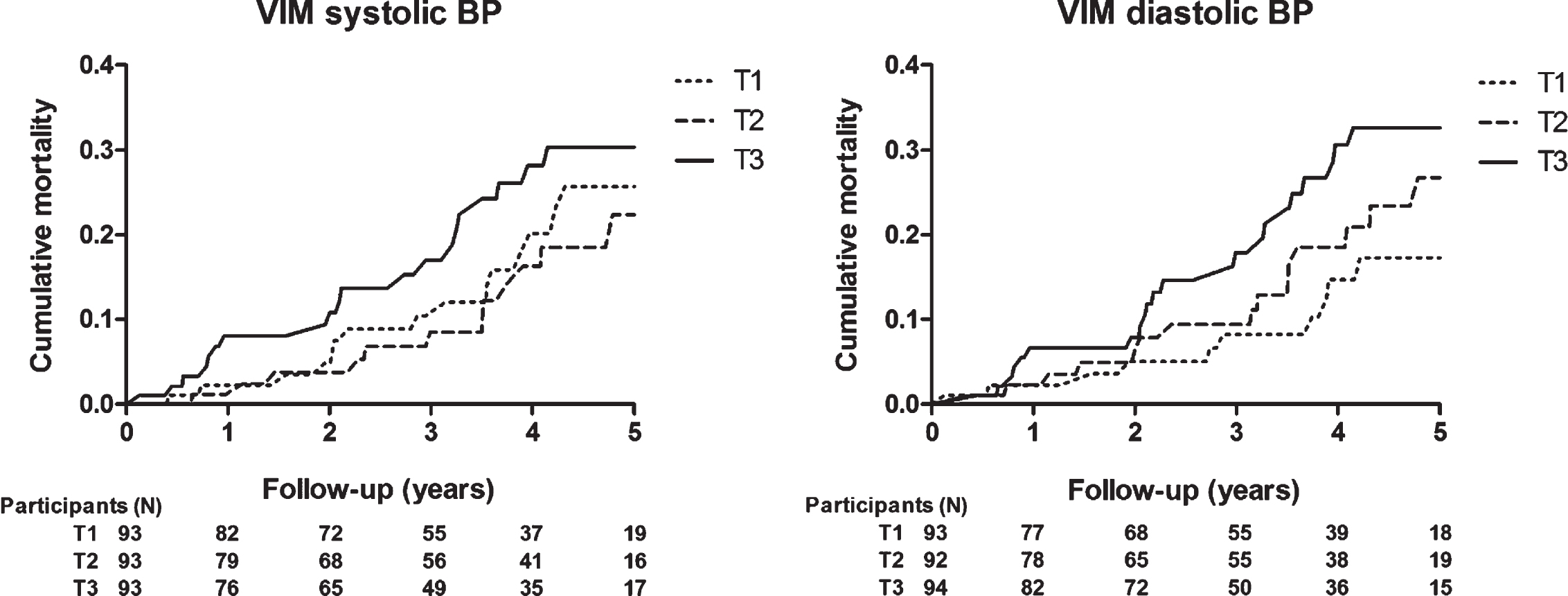
Kaplan-Meier cumulative all-cause mortality estimates across tertiles of day-to-day blood pressure variability; VIM of systolic blood pressure (left) and diastolic blood pressure (right). T1 to T3 indicate ascending tertiles; cut-off points were 8.03 and 11.19 for systolic and 4.59 and 6.62 for diastolic BP. Participants (N) represents the number at risk during follow-up. VIM, variation independent of the mean; BP, blood pressure.
The association between VIM and all-cause mortality
Hazard ratios for all-cause mortality for each unit increase in systolic or diastolic VIM. Model 1: adjusted for age and sex. Model 2: model 1 + vascular score and use of antihypertensive treatment. Model 3: model 2 + mean systolic blood pressure (for models with VIM SBP as the outcome) or mean diastolic blood pressure (for models with VIM DBP as the outcome). *Pooled hazard ratios after multiple imputation. BPV, blood pressure variability; VIM, variation independent of the mean; HR, hazard ratio; SBP, systolic blood pressure; DBP, diastolic blood pressure.
Analysis of patients with dementia
In patients with dementia, cumulative incidence for all-cause mortality differed across tertiles of the distributions of systolic VIM, but not for diastolic VIM (Fig. 2; log-rank test VIM SBP p = 0.042, VIM DBP p = 0.888). Table 3 presents hazard ratios for all-cause mortality for each unit increase in VIM. As with the total group, VIM in both SBP and DBP was not associated with mortality, although a different trend is shown with a higher HR. In the fully adjusted model, HR was 1.07 (95% -CI 0.99–1.16, p = 0.104) for systolic SBP. Throughout the models, morning-to-morning VIM showed a higher HR per unit increase, although this was marginal. In this subgroup, systolic evening-to-evening VIM was associated with a higher risk for mortality, with a HR of 1.09 (95% -CI 1.01–1.17, p = 0.030) in both adjusted models.
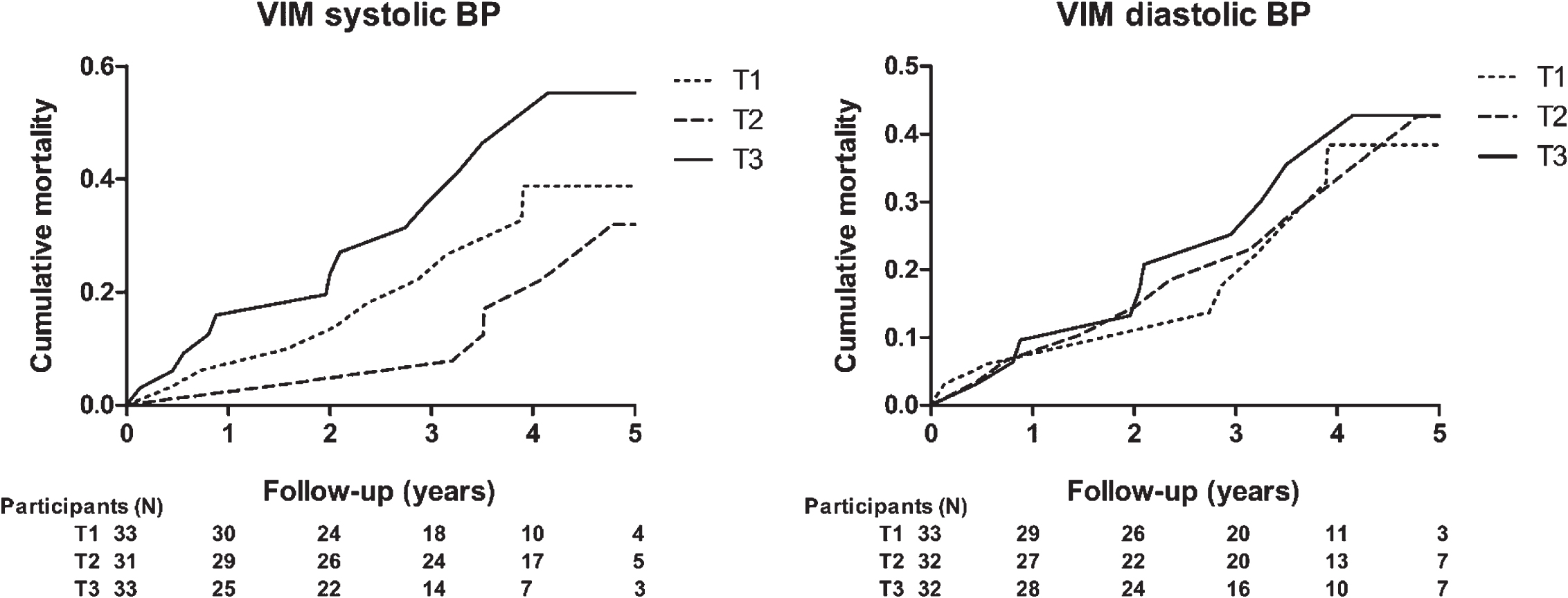
Kaplan-Meier cumulative all-cause mortality estimates across tertiles of day-to-day blood pressure variability for participants with dementia; VIM of systolic blood pressure (left) and diastolic blood pressure (right). T1 to T3 indicate ascending tertiles; cut-off points were 8.78 and 11.78 for systolic and 4.91 and 6.96 for diastolic BP. Participants (N) represents the number at risk during follow-up. VIM, variation independent of the mean; BP, blood pressure.
The association between VIM and all-cause mortality, in patients with dementia
Hazard ratios for all-cause mortality for each unit increase in systolic or diastolic VIM, in patients with dementia. Model 1: adjusted for age and sex. Model 2: model 1 + mean systolic blood pressure (for models with VIM SBP as the outcome) or mean diastolic blood pressure (for models with VIM DBP as the outcome). BPV, blood pressure variability; VIM, variation independent of the mean; HR, hazard ratio; SBP, systolic blood pressure; DBP, diastolic blood pressure.
Prognostic value over time
Table 4 displays the association between day-to-day VIM and mortality after 1, 3, and 5 years follow-up. For systolic VIM, the HR seemed to be highest after 1 year follow-up (fully adjusted HR =1.12, 95% -CI 0.98–1.27, p = 0.105), and decreased over time, although this was not significant. The HR for diastolic VIM remained stable throughout the years. For morning-to-morning VIM, the HR was highest after 1 year for both systolic and diastolic VIM, which is shown in Table 5. In the fully adjusted model, the HR for systolic and diastolic morning-to-morning VIM was 1.21 (95% -CI 1.06–1.38, p = 0.004) and 1.21 (95% -CI 1.01–1.44, p = 0.039) respectively. After 3 and 5 years follow-up, the HR decreased, but remained > 1.00 with marginal significance. (Data evening-to-evening VIM is shown in Supplementary Table 6).
The association between day-to-day VIM and all-cause mortality after 1, 3, and 5 years follow-up
Hazard ratios for all-cause mortality for each unit increase in systolic or diastolic day-to-day VIM after 1, 3, and 5 years follow-up. Model 1: adjusted for age and sex. Model 2: model 1 + mean systolic blood pressure (for models with VIM SBP as the outcome) or mean diastolic blood pressure (for models with VIM DBP as the outcome). BPV, blood pressure variability; VIM, variation independent of the mean; HR, hazard ratio; SBP, systolic blood pressure; DBP, diastolic blood pressure.
The association between morning-to-morning VIM and all-cause mortality after 1, 3, and 5 years follow-up
Hazard ratios for all-cause mortality for each unit increase in systolic or diastolic morning-to-morning VIM after 1, 3 and 5 years follow-up. Model 1: adjusted for age and sex. Model 2: model 1 + mean systolic blood pressure (for models with VIM SBP as the outcome) or mean diastolic blood pressure (for models with VIM DBP as the outcome). BPV, blood pressure variability; VIM, variation independent of the mean; HR, hazard ratio; SBP, systolic blood pressure; DBP, diastolic blood pressure.
DISCUSSION
This study examined the association of day-to-day BPV with all-cause mortality in a memory clinic population. The key findings are as follows: 1) overall systolic and diastolic day-to-day BPV were not associated with all-cause mortality in this population; 2) increased systolic morning-to-morning BPV, however, was associated with a higher risk for mortality; 3) in the analysis of patients with dementia, evening-to-evening BPV was associated with mortality, while morning-to-morning and day-to-day BPV showed potential associations; 4) hazard ratios and predictive value of systolic day-to-day and morning-to-morning BPV seemed to decrease for longer survival time.
Previous studies assessing the association between BPV and mortality have shown conflicting results [16–19, 43–45]. The majority of these studies used visit-to-visit BPV, which is assessed across multiple visits to the clinic. Day-to-day BPV measured at home is likely to have a better clinical applicability. It provides information on the consistency of BP within a shorter timeframe, is more reproducible, offers better prognostic value [20] and out-of-office measurement are generally more representative for actual BP than office measurements [10, 21]. 24-h ambulatory BP monitoring (ABPM) is another method to measure BPV. However, this is the only method of measurement which takes into account BP both at rest and during daily activities, leading to a higher range of blood pressures depending on the activities a person does during the day. Only three studies, of which two used the same Japanese cohort, investigated the association of home-measured day-to-day BPV with mortality, and showed a modest association [22–24]. Furthermore, the first Osahama study divided causes of mortality into cardiovascular and non-cardiovascular mortality, which showed a comparable HR. Moreover, both the Finn-home and the second Osahama study reported that systolic morning-to-morning BPV was associated with mortality, while systolic evening-to-evening BPV was not [23, 24].
Similar to these studies, we found an association between increased morning-to-morning BPV and all-cause mortality. However, we did not find an association between day-to-day BPV and mortality. There are several differences between our study and previous studies, which limit their comparability. Both the Finn-home and Osahama cohorts consist of a general, relatively healthy, middle aged population or with a wide age. The Japanese Osahama cohort represents an ethnically different population, with a lower incidence CVD [46]. Furthermore, only non-duplicated measurements were used, which might increase the possibility that BPV is affected by measurement error. The Finnish study used the SD as a measure for BPV, which is known to be correlated to the mean. Both studies included a younger population compared to our study. Older age is associated with higher BPV [16, 47], as was the case in this study. In older age, frailty increases as a consequence of age-related decline in multiple physiological systems, leading to vulnerability to minor stressors [48]. Physical resilience, which is the ability of an organism to respond to physical stress that disrupts normal homeostasis, is decreased in older adults [49]. Therefore, a higher day-to-day BPV in older people could be a reflection of this lower resilience. Thus, some authors have proposed a larger prognostic value of BPV among older adults compared to younger and middle aged adults [16]. Others contradict this suggestion, stating that the association between BPV and mortality or other adverse events does not correspondingly increase in older populations [33, 50]. This study did not aim to distinguish between different categories of age, but it is tempting to hypothesize that in older persons more competing mechanisms are present compared to younger persons, leading to a lower or no association with mortality compared to study populations including middle-aged adults.
This study had a shorter follow-up period compared to the previous studies (mean follow-up 3.2 years versus 11.9 and 7.8 years). A study examining visit-to-visit BPV and mortality found that BPV was predictive for mortality in the longer (7 years), but not in the short follow-up (3 years) [33]. However, results for visit-to-visit BPV cannot be compared with day-to-day BPV, because of the different timeframe and setting. Moreover, it is proposed that different measures of BPV are weakly correlated and not interchangeable [51, 52]. In contrast, in the Osahama study the predictive value of BPV for non-cardiovascular mortality weakened after censoring the first 2 years [22]. In our study, the association between BPV and mortality appeared to be higher after the first year, compared to 3 or 5 years of follow-up, although this was only significant for the morning measurements and mostly for SBP. This might indicate a more refined predictive value for day-to-day BPV for the short term. An explanation could be that over time, changes can occur in a participant’s health status, leading to competing mechanisms. Another possibility might be reverse causation; high day-to-day BPV could be an indication of underlying disease or an expression of dysfunction of the cardiovascular system, leading to adverse outcomes in the short term. This finding regarding different associations during follow-up should be interpreted with caution however, and ought to be considered explorative.
Bearing in mind that this area of research lacks a gold standard for BPV, the differences in observations between studies may also endorse the need for standardized methods to quantify BPV and the importance of replicating research results.
Morning-to-morning BPV
Returning to our finding that morning-to-morning BPV is associated with all-cause mortality. Due to the short assessment window and small sample size of this study, the results should be interpreted with caution. However, it is interesting to speculate about possible explanations for this finding. Determinants and correlates of BPV are still under investigation and the mechanisms underpinning BPV remain speculative. Different types of BPV have been associated with multiple predictors of cardiovascular events, such as increased left ventricular mass index and arterial stiffness [53–56] and more pronounced hypertension-mediated target organ damage, independent of mean BP [57].
The morning hours are characterized by the highest incidence of cardiovascular events [58–60], which has been linked to increased thrombocyte aggregability [61] and activation of the sympathetic nervous system in the morning [60, 62]. Another concept is the so-called morning surge: a disproportional high peak in BP after waking up. Sudden activation of the sympathetic nervous system is seen as the primary mediator [59], and this morning surge is proposed to be a risk factor for cardiovascular events [59, 63]. For example, it may disrupt vulnerable plaques causing rupture and thrombosis [60]. On the other hand, higher BPV could also reflect a decreased adaptability to this stressor in the morning, due to a lower resilience. Therefore, higher morning-to-morning BPV might reflect the varying presence of a morning surge and decreased adaptability to this stressor, increased activity of the sympathetic nervous system, arterial stiffness, and other predictors of (fatal) cardiovascular events.
Analysis of patients with dementia
Analysis of patients with dementia showed a trend with a higher hazard ratio for mortality compared to the total study sample. Patients suffering from dementia are more likely to become frail over time and have a lower resilience compared to older persons without dementia [64, 65], which could result in a larger impact of high BPV on adverse outcomes. They might be more susceptible to fluctuation in BP due to decreased adaptability to stressors. This hypothesis should be further examined in future research. It would also be interesting to add BPV to a prognostic cardiovascular model for patients with dementia and to examine the added value of this predictor. This could be valuable in patients with a high cardiovascular burden, since there are indications that BPV is a stronger predictor in subjects at high cardiovascular risk, while the contribution of BPV to risk stratification is low in subjects without cardiovascular comorbidities [66, 67].
Strengths and limitations
This study has several strengths and limitations. The use of duplicate BP measurements, twice a day for 7 consecutive days, ensured a high degree of reproducibility and made the measurements less prone to fluctuation caused by external factors such as change in lifestyle or environment. Although participants (and in most cases an informal caregiver) received individual instruction on how to perform the measurements correctly, they performed HBPM unguided, making it not possible to ensure adherence to instructions. However, the use of a validated device with a pre-programmed measurement schedule and automatic saving of BP measurements limited user errors and reporting bias. Furthermore, patient characteristics were assessed at baseline and no additional information was available, such as a change in medication or comorbidities during follow-up, which is a limitation. Despite this, BP was measured at baseline in this study, and not overlapping with follow-up, as is the case in some previous research [68]. Additionally, the use of VIM provided a reliable measure for BPV, uncorrelated to the mean. Patients with lower cognitive functioning were less likely to agree to perform HBPM, leading to a selection bias. Still, the study sample included a large diversity in cognitive functioning. Other limitations include the small sample size and number of events. The sample size of this study was too small to look at dementia and MCI subtypes, and analysis of morning-to-morning VIM might have been prone to multiplicity. Lastly, the setting of an outpatient memory clinic does not allow direct generalization to, e.g., primary care, although the variety in cognitive performance in this sample represents quite a proportion of the general elderly population with cognitive complaints.
Perspectives
This study is the first to investigate day-to-day BPV and mortality in a population with cognitive impairment. Even though no association between day-to-day BPV and mortality was found, a multitude of studies on (visit-to-visit/day-to-day) BPV are available which share the common finding that higher BPV is modestly associated with mortality and other adverse outcomes. However, the methods used are heterogeneous and a gold standard is lacking. Thus, more research is needed into the optimal schedule for measuring BPV and how to quantify variability in routine practice. Besides, future research should address to the effects of BPV in patients with dementia, and to the association of morning-to-morning BPV with adverse outcomes since this measure seems promising.
Improved knowledge concerning this subject could have several clinical implications for the future. Day-to-day BPV might be used to determine the resilience of older, cognitively impaired, patients. It is proposed that dynamic measures, i.e., measures with a time scale, can be used to forecast resilience in older persons [69]. Day-to-day BPV is a dynamic measure and could be of use to predict chances for recovery, for example prior to major surgery. Moreover, little is known about the longitudinal course of an individual with dementia, in which BPV might play a role. Should BPV prove to have a causal association with progression of dementia or mortality, BP management in the future should not only focus on lowering mean BP, which is the current standard [10], but also on reducing large fluctuations. It is suggested that certain antihypertensive drugs, such as calcium channel blockers, lower both mean BP and fluctuations, while others may increase fluctuations [70–73]. However, the impact of BPV lowering on organ damage or dementia prognosis is unknown. At this moment, convincing evidence is still absent and fundamental questions remain unanswered, including the optimal variability index and measurement schedule, and the threshold that defines increased BPV. Further research is needed to refine understanding of the causes and consequences of day-to-day and morning-to-morning BPV in older persons with cognitive impairment, but also in other populations. Until this knowledge becomes available, clinicians and researchers should remain aware of the associations with, and implications of, variability in BP.
CONCLUSION
In this study, day-to-day BPV was not associated with all-cause mortality in a memory clinic population, while morning-to-morning BPV was. In addition, hazard ratios seemed to be higher in patients with dementia and after a shorter follow-up period. However, results should be interpreted with caution and there is still a lack of clarity, hence future research is warranted to clarify the association of all BPV components with mortality in older adults with cognitive impairment.
Footnotes
ACKNOWLEDGMENTS
We are grateful to all study participants and their caregivers for their time and effort. We thankfully acknowledge all individuals for the recruitment and gathering of the data. The study was funded by the Dutch Alzheimer Society (grant number WE.09-2015-03).
