




Abstract
Background:
Epigenetic changes may contribute importantly to cognitive decline in late life including Alzheimer’s disease (AD) and vascular dementia (VaD). Bromodomain and extra-terminal (BET) proteins are epigenetic “readers” that may distort normal gene expression and contribute to chronic disorders.
Objective:
To assess the effects of apabetalone, a small molecule BET protein inhibitor, on cognitive performance of patients 70 years or older participating in a randomized trial of patients at high risk for major cardiovascular events (MACE).
Methods:
The Montreal Cognitive Assessment (MoCA) was performed on all patients 70 years or older at the time of randomization. 464 participants were randomized to apabetalone or placebo in the cognition sub-study. In a prespecified analysis, participants were assigned to one of three groups: MoCA score≥26 (normal performance), MoCA score 25–22 (mild cognitive impairment), and MoCA score≤21 (dementia). Exposure to apabetalone was equivalent in the treatment groups in each MoCA-defined group.
Results:
Apabetalone was associated with an increased total MoCA score in participants with baseline MoCA score of≤21 (p = 0.02). There was no significant difference in change from baseline in the treatment groups with higher MoCA scores. In the cognition study, more patients randomized to apabetalone discontinued study drug for adverse effects (11.3% versus 7.9%).
Conclusion:
In this randomized controlled study, apabetalone was associated with improved cognition as measured by MoCA scores in those with baseline scores of 21 or less. BET protein inhibitors warrant further investigation for late life cognitive disorders.
Keywords
INTRODUCTION
Neurodegenerative disorders such as Alzheimer’s disease (AD) and vascular disorders including vascular dementia (VaD) are major causes of late-life cognitive decline. AD and related disorders (ADRD) including VaD are a significant burden to global healthcare systems and there is a large unmet need for effective therapies to prevent or retard ADRD progression [1]. There is considerable evidence that the risk of AD and VaD increases with age and the presence of cardiovascular disease, diabetes, and chronic kidney disease [2–6]. Populations with diabetes and cardiovascular disease (CVD) typically have cerebrovascular pathology at autopsy [7]. Accordingly, the focus of drug development has recently expanded to include processes common to these disorders, including vascular inflammation and calcification, neuroprotection, lipid metabolism, protein degradation and clearance, and glucose metabolism [8]. There is growing appreciation that these processes are regulated by epigenetic transcriptional controls.
Bromodomain and extra-terminal (BET) proteins are epigenetic ‘readers’ that recognize and bind to acetylated lysine residues on histone tails and other nuclear proteins [9]. These interactions localize BET proteins to discrete locations along chromatin strands, where they recruit and facilitate assembly of factors that control gene expression [10, 11]. Through this mechanism BET proteins can play a role in maladaptive gene expression leading to chronic disease states including CVD [9–11]. Recently a role for BET protein-dependent effects in central nervous system (CNS) disorders, including memory disorders and AD, has been recognized [12–15].
Apabetalone is an orally bioavailable, small molecule BET protein inhibitor (BETi) that was recently assessed for secondary prevention of CVD events in 2,425 patients with diabetes and recent acute coronary syndrome (ACS) in the randomized, placebo controlled BETonMACE trial [16]. Apabetalone-treated participants experienced an 18% favorable trend in the incidence of the primary composite endpoint of major adverse cardiovascular events (MACE, comprising cardiovascular death, non-fatal myocardial infarction, and stroke (p = 0.11)) and a 41% reduction in hospitalization for congestive heart failure (p = 0.03) [17–19].
To explore the effect of apabetalone on cognition in this population with risk factors for AD and VaD, we collected performance on the Montreal Cognitive Assessment (MoCA) in BETonMACE participants 70 or more years of age. MoCA is a brief, 30-point screening instrument for cognitive dysfunction [20]. The MoCA assesses eight cognitive domains including attention and concentration, executive function, memory, language, visuoconstructional skills, conceptual thinking, calculations, and orientation. MoCA is not a diagnostic tool and will capture cognitive impairment from any cause. The MoCA has been shown to be sensitive to change in AD, VaD, and post-stroke patients [21–23]. In this nested prespecified analysis of the BETonMACE trial, we examined the effects of apabetalone on cognition using the MoCA.
A secondary aim was to determine if serum alkaline phosphatase level was a biomarker associated with cognitive change in the MoCA analysis cohort. Serum alkaline phosphatase is increased in the brain and plasma in AD [24]. Alkaline phosphatase is elevated in stroke and may be a biomarker for VaD or mixed dementia [24]. Apabetalone consistently lowers serum alkaline phosphatase [25].
MATERIALS AND METHODS
Study design
The design and primary CVD results of the phase III BETonMACE trial have been reported [16–19]. The protocol was approved by the responsible institutional review board or ethics committee at each participating site. In brief, eligible participants had an ACS within 7–90 days prior to randomization, a low high-density lipoprotein cholesterol (HDL-C) level, and a diagnosis of type 2 diabetes. Among exclusion criteria was any condition which, in the opinion of the investigator, was likely to prevent the subject from complying with the requirements of or completing the study. Qualifying patients who provided written, informed consent were randomized in a 1:1 ratio to receive apabetalone 100 mg orally twice daily or matching placebo. In addition, participants received high-intensity statin therapy with atorvastatin or rosuvastatin and other clinically defined standard of care. The primary outcome was time to the first occurrence of MACE.
Cognitive function and alkaline phosphatase measurements
Cognitive evaluation with the MoCA in patients 70 years and older at time of randomization was included as a prespecified endpoint in the supplemental statistical analysis plan (included in the Supplementary Material). Patients were classified into three mutually exclusive categories according to a baseline MoCA score of 30–26, 25–22, or≤21. The cut-off score of 26 is regarded as the threshold separating cognitively normal individuals from those with cognitive impairment [23]. Scores of 25–22 typically reflect mild cognitive impairment (MCI), and scores of 21 and below are consistent with dementia [20]. MoCA was collected at baseline, 12 months, and 24 months, as well as at the last visit on treatment (LVT). Biochemical measurements were obtained at baseline, week 24, week 52, and every 24 weeks until LVT. Liver function biochemical parameters including alkaline phosphatase (ALP) were obtained at baseline and every 2 weeks until week 12, then every 4 weeks until week 28, then every 12 weeks until LVT. For each individual patient, median biochemical parameter values were calculated across all collected time points after baseline until LVT. All parameter measurements were performed by a central laboratory (ICON, Farmingdale, New York). The normal range for serum ALP was 40–150 U/L.
Statistical analysis
Baseline characteristics were summarized for all patients who completed a baseline MoCA and for the MoCA subgroups by treatment arm. Data were expressed as mean (standard deviation (SD)) or median (interquartile range (IQR)) for continuous variables and counts and percentages for categorical variables. Change in MoCA score from baseline to last observation captured (LOC) was evaluated in the MoCA subgroups using an analysis of variance model (ANOVA). Changes in MoCA were analyzed using analysis of covariance models (ANCOVA) with baseline MoCA score, statin, age, sex, race, years of education, duration between baseline and LOC, and baseline clinical chemistry measurements as covariates. Results from the ANCOVA analyses are reported as least squares (LS) means. Treatment duration between baseline and LOC was evaluated as mean (standard deviation [SD]) with comparison between treatment groups using Student’s t-test. For biochemical parameters, a median was calculated across all post-randomization time points for each patient until LOC to calculate change from baseline and percent change from baseline. The analysis approach for change in biochemical parameters used a Wilcoxon test between treatment groups with results summarized as median (IQR). Analyses were performed with R software, version 3.5.1 or higher (R Foundation for Statistical Computing). p-values less than 0.05 were considered statistically significant without adjustment for multiplicity in this prespecified exploratory analysis.
RESULTS
Of a total of 2,425 randomized participants in the BETonMACE trial at 190 sites in 13 countries, 1,215 were assigned to apabetalone and 1,210 to placebo. A total of 485 participants (20%) 70 years of age or older were eligible for the cognitive sub-study. Of these, two did not receive apabetalone or placebo and 19 did not have a baseline MoCA measurement and were excluded from analyses, 464 (95.7%) had a baseline MoCA measurement and comprised the cognition subgroup; 212 were assigned to apabetalone and 252 to placebo. The aggregate cognition subgroup included 223 participants (48%) with baseline MoCA≥26, 144 participants (31%) with baseline MoCA 25–22, and 97 participants (21%) with baseline MoCA≤21. A comparison non-cognition subgroup comprised all patients < 70 years of age.
Figure 1 shows the patient flow diagram for the cognition subgroup. Table 1 shows baseline demographic and clinical characteristics of the trial participants according to baseline MoCA category. The average age of the cognition subgroup was 73 years, compared to 59 years in the non-cognition subgroup. Consistent with this age difference, participants in the cognition subgroup were more likely to be female, to have a history of hypertension and a longer duration of diabetes, to have higher systolic and lower diastolic blood pressures, to be a current smoker, and to have had non-ST elevation MI as the qualifying ACS. Irrespective of cognition status, more than 90% of participants received inhibitors of the renin-angiotensin pathway, beta-blockers, and anti-platelet agents. However, fewer participants in the cognition subgroup were treated with high-intensity statins, metformin, insulin, sodium-glucose cotransporter-2 (SGLT2) inhibitors, or glucagon-like peptide 1 (GLP-1) receptor agonists. Levels of glucose, cholesterol (total and low-density lipoprotein (LDL), triglycerides, high-sensitivity C-reactive protein, and alkaline phosphatases were similar in cognition and non-cognition subgroups while hemoglobin A1c (HbA1c) and alanine aminotransferase were lower and HDL-C, total bilirubin, and the neutrophil to lymphocyte ratio were higher in the cognition subgroup. In each baseline MoCA category, baseline characteristics and time from baseline to LOC were well-balanced among treatment groups. The treatment duration from baseline to LOC was balanced between apabetalone and placebo irrespective of baseline MoCA. Among participants with baseline MoCA score≥26, treatment duration was 729 (529–951) days in the placebo-treated group compared to 699 (541–909) days in the apabetalone-treated group; in participants with baseline MoCA score 25–22, 694 (513–937), and 731 (548–939) days in placebo-treated and apabetalone-treated groups, respectively; and, in participants with baseline MoCA score≤21, 702 (512–912) and 701 (493–778) days in placebo-treated and apabetalone-treated groups, respectively (p > 0.05 for all three comparisons).
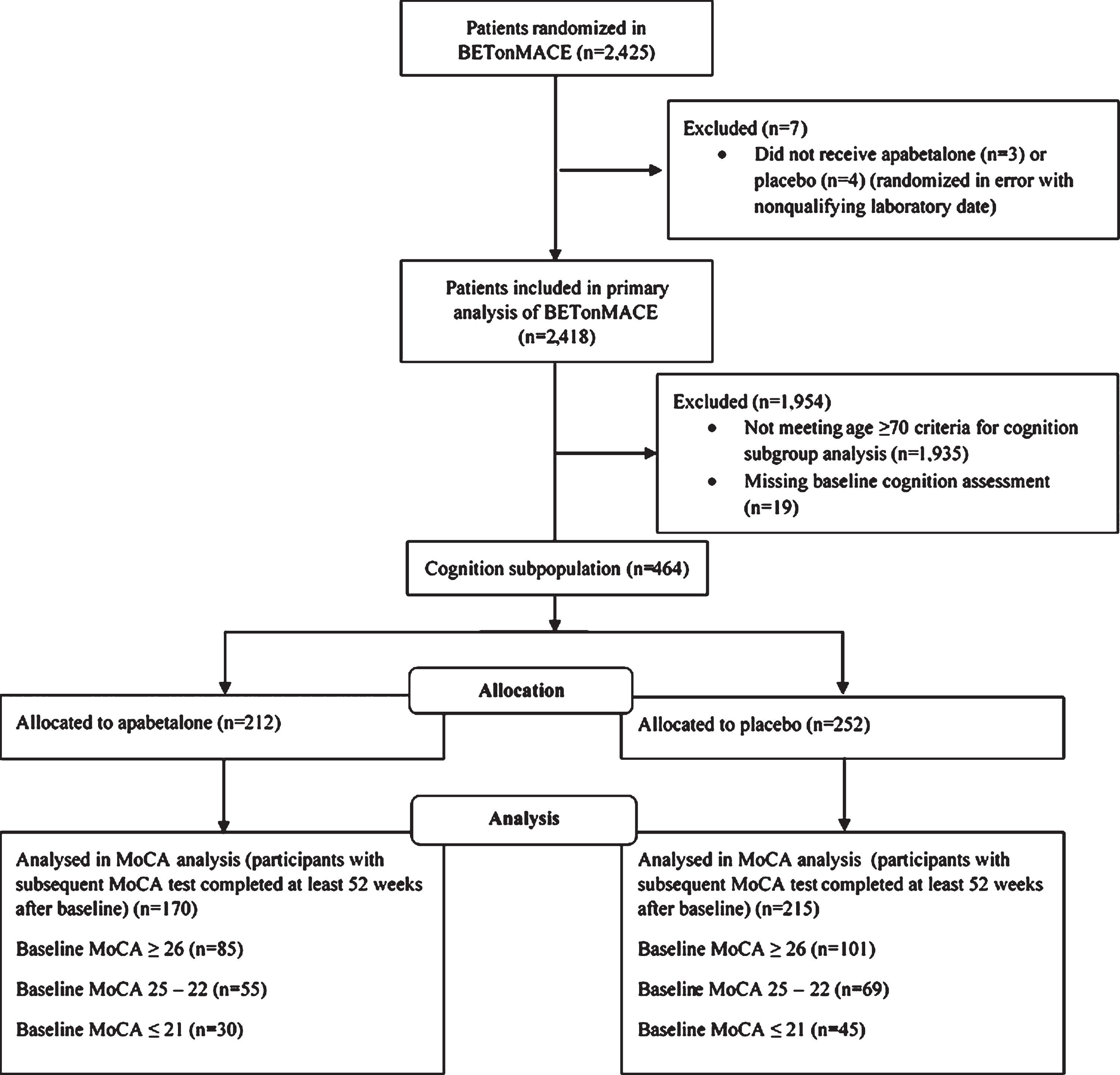
Patient flow diagram for the cognition subgroup of the BETonMACE trial of apabetalone.
Demographics, clinical, pharmacologic and laboratory characteristics of the BETonMACE trial participants at baseline according to MoCA subgroup and assigned treatment group
MoCA, Montreal Cognitive Assessment; ACS, acute coronary syndrome; NSTEMI, non-ST segment elevation myocardial infarction; STEMI, ST-segment elevation myocardial infarction; ACE, angiotensin-converting enzyme; ARB, Angiotensin II receptor blocker; DPP4, dipeptidyl peptidase; SGLT2, sodium-glucose cotransporter 2; GLP1, glucagon-like peptide 1; HbA1c, hemoglobin A1C; LDL, low-density lipoprotein; HDL, high-density lipoprotein; BP, blood pressure; hsCRP, high-sensitivity C-reactive protein; NLR, neutrophil-lymphocyte ratio. Continuous variables are presented as mean (SD) or median (quartile 1−quartile 3). Categorical variables are presented as n (%). p-values comparing groups at baseline were calculated using z-test or Wilcoxon tests for continuous variables and chi-square tests for categorical variables. p-values of < 0.05 are considered statistically significant and are highlighted in bold. †There was no significant difference in proportion of MI versus unstable angina as an index event (p = 0.61), but among those with MI as the index event, there were significant differences in proportion of STEMI versus non-STEMI (p = 0.025).
Apabetalone treatment was associated with a significantly increased total MoCA score compared to placebo among participants with baseline MoCA≤21 (p = 0.02). There was no difference between treatment groups in total MoCA score among participants with baseline MoCA 25–22 or MoCA≥26. Changes in MoCA score over the course of the study from baseline to LOC for the prespecified baseline MoCA score ranges and treatment groups are shown in Fig. 2. Supplementary Table 1 shows that in the participants with baseline MoCA≤21 placebo treatment shifted 16 (35%) participants to the 25–22 strata, and 1 (2%) to the≥26 strata, which compared to 14 (46%) and 3 (10%) for the apabetalone group, consistent with an apabetalone treatment effect. Shifts for the participants with baseline MoCA 25–22 and≥26 differed minimally between placebo and apabetalone.
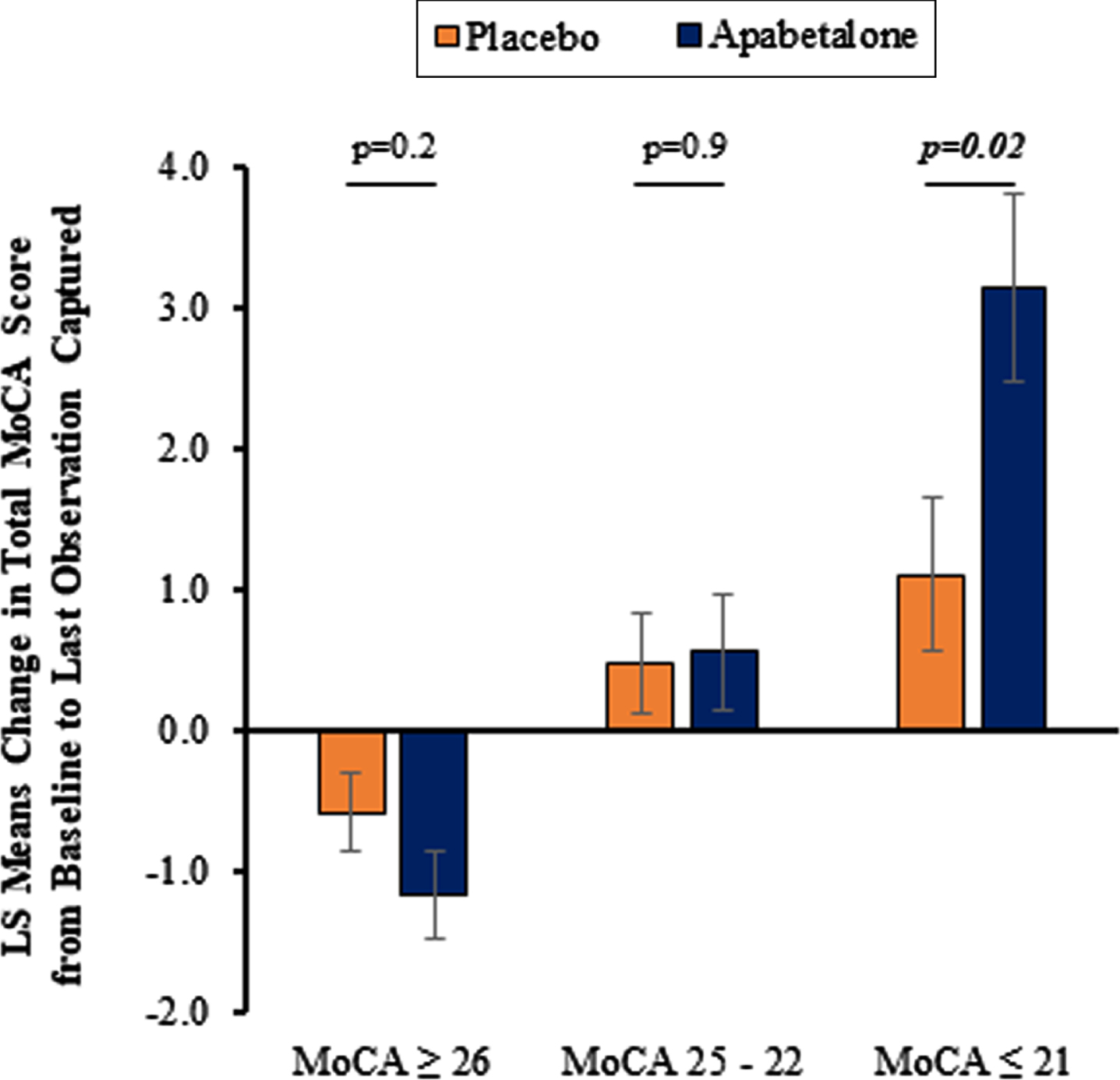
Least Squares (LS) mean change in total Montreal Cognitive Assessment (MoCA) score from baseline to last observation captured according to MoCA subgroup and assigned treatment group. Error bars represent standard error of the LS means. p-values were calculated using ANCOVA statistical analysis to compare change in total MoCA from baseline to last observation captured between apabetalone-treated patients and placebo with baseline total MoCA serving as a covariate and treatment arm as a factor. p-values of < 0.05 are considered statistically significant.
Supplementary Table 2 shows the analysis of changes in MoCA from baseline to LOC across the MoCA domains in both treatment groups. There was a trend (p = 0.099) for greater improvement in delayed recall in the most severely impaired group compared to placebo; this trend was not seen in the higher functioning patients. The analysis indicated an association between MoCA change from baseline to LOC and baseline MoCA category in the apabetalone-treatment group but not in placebo-treatment group.
Table 2 shows the results of ANCOVA models of change from baseline to LOC in total MoCA scores between treatment groups. Apabetalone treatment was associated with a significantly increased total MoCA score compared to placebo among participants with baseline MoCA≤21 after adjustment for demographic, clinical, and treatment variables. Figure 3 shows that assessing treatment effects on the MoCA at 52 and 100 weeks and last value treated provided lower numbers of participants compared to LOC. LOC provided the highest number of participants and thereby best power to detect treatment effects.
Change in total MoCA score from baseline to last observation captured according to MoCA subgroup and assigned treatment group. Data are presented as Least Squares (LS) means with standard error
MoCA, Montreal Cognitive Assessment; ALP; alkaline phosphatase; HbA1c, hemoglobin A1C; HDL, high-density lipoprotein. p-values were calculated using ANCOVA statistical analysis to compare change in total MoCA from baseline to last observation captured between apabetalone-treated patients and placebo. p-values of < 0.05 are considered statistically significant.
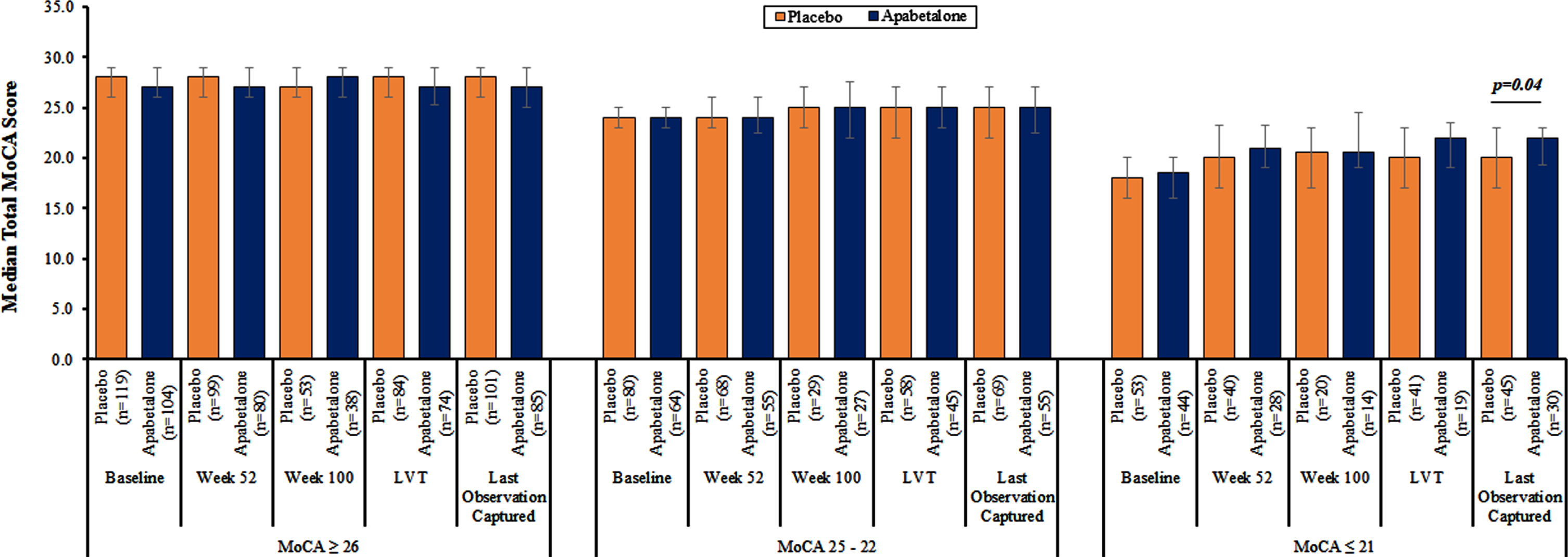
Median total Montreal Cognitive Assessment (MoCA) score from baseline to last observation captured according to MoCA subgroup and assigned treatment group. Error bars represent the interquartile ranges. p-values were calculated using Wilcoxon tests for continuous variables. p-values of < 0.05 are considered statistically significant and are highlighted. All other p-values were not significant. LVT, last visit on treatment.
Biochemical parameters and their change across all time points following treatment with placebo and apabetalone are summarized in Supplementary Table 3. Apabetalone treatment resulted in decreased alkaline phosphatase levels irrespective of baseline MoCA category. Among participants with baseline MoCA≥26, median change from baseline of alkaline phosphatase was 0.0 U/L in the placebo-treated group compared to –8.5 U/L in the apabetalone-treated group (p < 0.0001); in participants with baseline MoCA 25–22, –1.0 U/L in placebo-treated and –9.0 U/L in apabetalone-treated groups (p = 0.003); and in participants with baseline MoCA≤21, –3.0 U/L in placebo-treated and –8.5 U/L in apabetalone-treated groups (p = 0.03). No correlation was found between change in MoCA scores and change in alkaline phosphatase levels.
In the cognition subgroup, more participants allocated to apabetalone than placebo discontinued study drug [24 (11.3%) versus 20 (7.9%)] for adverse events including elevated liver function tests (LFT). Fewer participants in the cognition subgroup allocated to apabetalone than placebo died during the study [8 (3.8%) versus 13 (5.2%)]. Table 3 shows that among participants in the cognition subgroup, similar numbers of participants in the apabetalone and placebo groups experienced adverse events (150 [71%] versus 171 [68%] and serious adverse events (36% versus 35%).
Adverse Events (AEs) according to assigned treatment group1
1Safety population includes all patients who received at least 1 dose of study medication. 2Includes treatment-emergent adverse events only, defined as those occurring after the first dose and within 14 days of the last dose of the study drug. 3Defined as occurring with a frequency of 5% or more in any of the cognition or treatment groups.
DISCUSSION
Therapeutic intervention through epigenetic approaches, and specifically BET inhibition, is a novel area of study in CNS diseases and in late-life cognitive disorders such as VaD and AD [12, 28]. Apabetalone is a small molecule BETi and in the BETonMACE trial, was associated with an 18% favorable trend towards a lower risk of the composite MACE endpoint (p = 0.11) and a 41% reduction in hospitalization for congestive heart failure (p = 0.03) [17–19]. These observations suggest that apabetalone-mediated BET protein inhibition may have beneficial cardiovascular effects in patients with diabetes who are at elevated risk for further cardiovascular events.
Meta-analyses indicate that diabetes increases the risk of all-cause dementia by a factor of 1.7, VaD by a factor of 2.27 [29] and AD by a factor of 1.36 [7]. At autopsy, patients with diabetes have increased cerebrovascular pathology compared to non-diabetic patients [30]. When diabetes, cerebrovascular disease and AD-related pathology occur concomitantly, they interact to worsen cognition [31–33]. Converging evidence that BET proteins play a role in AD, neurodegeneration, and cerebrovascular disease in the setting of diabetes provided the rationale for assessing the effects of apabetalone on cognitive outcomes in older participants in the BETonMACE trial [12–15, 34]. Age of at least 70 years rendered the analysis subgroup at high risk for VaD and AD and defined a subgroup in which a cognitive effect of apabetalone might be more readily identified [35]. Results of this nested, prespecified analysis suggest that in those participants with cognitive impairment at baseline, apabetalone treatment resulted in cognitive improvement over the ensuing 2 years. A likely reason is that the post-ACS, type 2 diabetes population with MoCA≤21 had a more advanced cerebral vascular and circulatory deficit, and thus were more likely to have benefited from the proposed mechanism of apabetalone.
The treatment-placebo difference on the MoCA for those with baseline scores of 21 or less was 2.1 (1.7 for the placebo group; 3.8 for the treatment group; p = 0.03). This 2.1-point difference is in the upper range of the minimum clinically important difference (MCID) of MoCA scores which varies between 1.22 and 2.15 in a similar (post-stroke) population treated with rehabilitation [21]. This outcome is sufficiently promising to warrant further investigation into the possible beneficial effects of apabetalone on cognition in patients with dementia of AD, vascular, or mixed etiology.
Mechanisms underlying an effect of apabetalone on cognitive function cannot be determined in a large, multicenter clinical trial but can be hypothesis-generating. Effects may include reduction of vascular inflammation and calcification, modulation of the complement and coagulation cascades, decrease in lipid levels, and reduced systemic inflammation, as have previously been reported for apabetalone [36, 37]. Improved cerebral blood flow [38, 39] and a reduction in inflammation-induced dysfunction of the blood-brain barrier (BBB) may contribute to cognitive improvement [40–45]. Systemic inflammation activates BBB endothelial cells, heightening the surface abundance and release of inflammatory molecules into the brain and into circulating blood, increasing BBB permeability to peripheral leukocytes. Vascular inflammation and BBB breakdown are both causative factors of neuroinflammatory and neurodegenerative processes [46]. Apabetalone suppresses BBB endothelial cell secretion of cytokines and chemokines and reduces the abundance of surface adhesion molecules in vitro. It lowers monocyte chemokine receptor expression, and monocyte chemoattraction [47]. As a result, apabetalone prevents the binding of monocytes to BBB endothelial cells stimulated by cytokines [47]. In a mouse model of systemic inflammation, administration of oral apabetalone decreases brain expression of pro-inflammatory mediators, despite being largely BBB impermeant [47]. Apabetalone is proposed to protect the BBB by reducing systemic and local inflammation, resulting in less neuroinflammation and decreased neurodegeneration.
The search for blood-based biomarkers for cognitive dysfunction is an area of active research with hope of identifying biomarkers that are diagnostic, prognostic, and predictive of therapeutic outcomes [48, 49]. Serum alkaline phosphatase has recently been shown to be associated with AD diagnosis and pathophysiology and to predict cognitive decline [50–52]. Alkaline phosphatase has previously been shown to decrease in apabetalone-treated patients in studies of CVD or CKD patients [25]. In this cognition sub-study, alkaline phosphatase levels decreased significantly in the apabetalone-treatment subgroup compared to the placebo group across all pre-defined cognitive subgroups. Apabetalone exhibited direct effects on the expression of alkaline phosphatase in cellular models [53]. It is unknown whether modulation of alkaline phosphatase levels reflects an attenuation of underlying inflammation [54]. No relationship between MoCA change and change in alkaline phosphatase was observed in this study.
This study has important limitations. Dichotomization of the study population at age 70 years was arbitrary but intended to focus on patients at high risk for cognitive decline. Effects of apabetalone on cognition in younger patients are unknown. The MoCA is a brief instrument that was feasible to administer in a large, multicenter cardiovascular clinical trial. More comprehensive cognitive assessments are required to better define the effects of apabetalone. Neither the duration of treatment to achieve optimal effects on cognition nor the persistence of effects on cognition after discontinuation of treatment could be determined in the BETonMACE trial. In BETonMACE the cause of the cognitive impairment in the participants with MoCA scores of 21 or less is unknown, and we cannot deduce whether the treatment effects occurred in participants with AD, VaD, or both. MoCA scores increased directionally from baseline in the treatment group with the lowest baseline MoCA score category and decreased directionally from baseline in both treatment groups of the highest baseline MoCA score category. These observations are consistent with regression to the mean in both treatment groups; however, this would not account for the significant differences between treatment groups in the evolution of MoCA scores over time. Notwithstanding these acknowledged limitations, the data justify further study of apabetalone’s effects on cognition.
In conclusion, the results of the cognitive sub-study of the BETonMACE trial hold promise that BET protein inhibition with apabetalone may provide a novel therapeutic approach for patients with concurrent CVD and cognitive impairment. New treatments for AD and VaD are US and global research priorities [55]. The findings of this sub-study of BETonMACE suggest epigenetic interventions may be a safe and efficacious therapeutic approach to augment cognitive capacity and warrant further study [56]. More specifically, the current findings provide impetus for a dedicated, placebo-controlled trial to test the efficacy of apabetalone on cognitive function with assessment instruments, outcome measures, and trial design strategies suited to investigate cognitive effects.
