



Abstract

Introduction
With a theme of “Building Technological Support for Scholarship and Scientific Publishing,” the 18th conference of Academic Publishing in Europe (APE) met in Berlin in January 2023. This year’s meeting welcomed around 200 professionals working in STM publishing, offering a varied program regarding the overall progress of scientific publishing and serving as a forum to express opinions on the subject. While the last two conferences were virtual due to the pandemic, this year’s event could meet in person, and it was wonderful to have face-to-face interactions again with colleagues who share this expertise. The event’s hybrid format, in-person and virtual, allowed even more participants to attend, learn, and reflect on what keeps the scientific publishing industry occupied: The challenges, developments, and exciting new advances.
APE moved from its classic location on the Gendarmenmarkt to the newly-chosen European School for Management and Technology (ESMT) building in the city center. Delegates enjoyed a wonderful view of Berlin’s architecture (and its continuous renovation) from the grand meeting room, and networked alongside the building’s impressive stained-glass windows. As usual, participants enjoyed a fine dining experience, this time in restaurant Gendarmerie.
Given by Dr. Ulrich Dirnagl, the
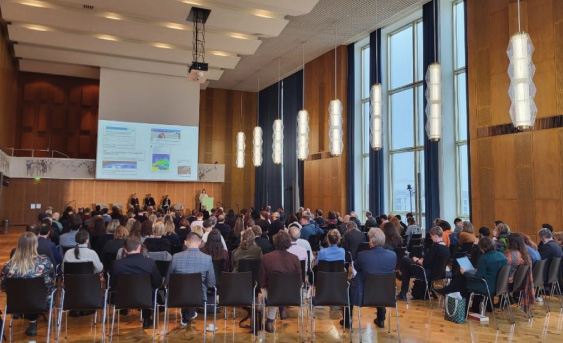
APE 2023 was held in the impressive meeting room of the ESMT building in Berlin.
Growth! There are more authors looking for outlets. Competition has risen. New predatory journals have entered the fray. There is journal saturation. Peer review: The system is pressured and finding peer reviewers is becoming harder (even named the “Peer Review Crisis”). Meanwhile, the job of the peer reviewer becomes more complicated with the rising emergence of fraud and integrity checks. The pressures to succeed for authors, related to impact factors, careers and funding. How to certify open data and open science.
Thankfully, a few solutions and key takeaways were also given. For example, publishers are increasingly concerned with solving equity problems for authors, diversifying editorial boards, and offering new opportunities and waivers. We were given the advice to use the market to experiment.
A takeaway I particularly took home: We can work together towards a more economically sustainable form of open access. The transformative agreement can possibly solve the issue of equity in journals. The social sciences can ride the wave of their sister STM journals. The question may be, “can the little fish survive?” As an employee of a comparatively little fish, I have confidence that we can!

APE 2023 was held in the European School for Management and Technology (ESMT) building in Berlin’s city center.
After lunch, we continued with
How to measure scientific output has been a longstanding discussion, with the impact factor (IF) contentiously coming out as the winner, though with much wailing and complaining from across the field. Clarivate VP Dr. Quaderi noted that it is important to use metrics responsibly, and that the IF should be used to profile journals, but not to rank individual researchers. One of the changes that the IF will see this year is that the number of decimal places is being reduced (so instead of a 7.123 IF, a journal will simply have 7.1), and emerging journals from the ESCI database will receive an impact factor for the first time this year. My note is that Web of Science has profited significantly by being one of the major measurements used by institutions to assess how a researcher’s output is valued. It can contribute to making or breaking careers. A question raised was who could make that change to the system, which honestly is not WoS’s responsibility? Is it the government, funders, institutions? I believe there was a silent concession that publishers do not make the policy and are forced to play the impact factor game without the capability to change it.
Other key points from the session were to move away from the PDF as the major research output and qualifier (a complaint heard for many years, and well taken once again), and to focus more on the key output of the results.
The quote of the day was given by Chris Graf of Springer Nature who told us to remember that “Science is brilliant and thriving! We must advocate for science!'' This received a burst of applause and was a nice moment of optimism and a call for solidarity. Meanwhile, Chris also acknowledged that “we became too reliant on trust,” and it was noted that the more you look into the problem of research fraud, the worse it gets. Several interesting points were made as the discussion moved along:
Discouraging the offenders is important, do not let infractions slide. Moving to full open access creates good will which will allow us to focus on integrity. Do not feel shame for retracting papers: We are all doing it and it means you are watching closely. The problems are broad, therefore we need to invest in the tools and training to identify problems, and not simply rely on peer reviewers to do it for us. We need to make proper use of identifiers and authentication.
A consensus amongst the panel seemed to be that making research data openly available would be a major solution, until it was pointed out by an audience member that people willing to commit fraud can fake that data. A real answer to this apt remark could, in my opinion, not be given. At the same time, I am coming to grips with the fact that fraud exists, everywhere, always, where there are stakes or gains to be had. All we can do is our best to help weed out as much of it as we can. Editorial offices are not the perpetrators or guilty of the offense; we are a line of defense.
The cap of the day was

APE is a great event for networking and learning from each other.
The second day kicked off with the recurring “
imagetwin.ai: image plagiarism and manipulation detector ScientifyRESEARCH.org: a platform connecting funding to research Sciscore.com: research article methods checker, making sure your data is in order hum.works: data collection platform for businesses to analyze their linked data Audemic.io: creates an audio-version of scientific papers Prophy.science: reviewer finder tool
Of these startups, it was not surprising that Prophy.science was the audience’s favorite. The “peer review crisis” (a problematic shortage of timely, good reviewers), was mentioned on several occasions during the conference. Finding suitable peer reviewers is one of the main obstructions to scientific publishing today, delaying decision times and frustrating authors and handling editors alike, and any tool that can help match a paper to a peer reviewer is of interest. However, for me personally I liked Imagetwin.ai the best. Plagiarism and image manipulation are very urgent issues, and I would love to use this tool to verify the authenticity of an article’s images, ideally as an add-on in peer review systems and even more ideally, as part of iThenticate.
My kudos to all the dotcoms that presented on this day: I generally find this the most energetic, engaging session, which is always a good way to kickstart the morning.
After the coffee break was a long session called “
Publishing has traditionally been the behemoth of leaving a paper trail. Nowadays, the majority of our publishing activities have moved online, though improvements can surely be made. As a medium-sized publisher, IOS Press cannot compare to the big publishing houses and has more modest goals to reach, but learning from other initiatives leads to new insights even on a smaller scale. Let us all hope that it does not come too late: One of the main takeaways from our Berlin visit this year, and frequently mentioned among the delegates, was how unseasonably warm it was for a January in Berlin.

Dr. Erik Schultes presented FairConnect, a new publication data portal created in collaboration with IOS Press to expand on the principles of FAIR (Findable, Accessible, Interoperable, Reusable) data publication.
Following lunch, a broad session entitled “
The session on “
The last session of the day brought several “
And with that, I bid APE 2023 farewell and look forward to seeing what’s in store next year!