




Abstract
Healthcare Professional Social Networks (HCPSNs) have become a global resource. There are numerous networks visible in countries around the world. This research looks at a selected sample of global HCPSNs with a particular focus on the potential of these emerging networks to become a growing source of professional content. The research evaluates the content offerings of six networks, Sermo, Doximity, QuantiaMD, Neuros, DXY and Networks in Health. First, there is a brief discussion of trends in the membership dynamics of these organizations. The next section summarizes the content services available from each network at a high level. The findings reveal that HCPSNs offer their members an opportunity to be content producers, as well as an available audience for various forms of educational and promotional forms of content. The presentation offers a view of the impact of these networks on the STM publishing industry, including professional medical societies.
Introduction
Social Networking has become ubiquitous in our daily lives. This trend has extended from personal mass-market resources to include professional networks devoted to career development and communications. Perhaps the most familiar professional network is Linked-in. This network caters to a wide-array of professions and markets. However, many professionals who work in specific industries, such as healthcare, have elected to participate in specialized professional networks that offer targeted professional content and services. These specialized networks offer a range of benefits associated with a particular industry as well as stricter guidelines for attaining membership that require valid professional credentials. The focus of this paper which is based on a presentation delivered at the 2015 NFAIS Annual Conference will be to limit the discussion to a small number of visible Healthcare Social Networks. These networks are devoted to the needs of Healthcare professionals, usually defined as Doctors of Medicine, Doctors of Osteopathy, Medical and Osteopathic students, and allied Healthcare Professionals (HCPs). Although there is a growing number of healthcare social networks, including some that add patient dialog to the mix, this paper will limit the criteria for coverage to professional-to-professional networks (HCPSNs).
Objective
The objective is to demonstrate the potential value of these networks as an effective and revenue- generating source of high-caliber content. The objective will not attempt to be an in-depth view of benefits, challenges, and market potential for these networks. The networks described were selected because of their global visibility.
HCP usage dynamics
The initial research explored the rate of participation. A report in the Dallas Ft. Worth Health Daily in January 2012 offered a high level review of a 2012 study published in the Journal of Medical Internet Research [1].
The headlines proclaimed:
One out of four US Physicians use social media daily to seek out medical information….
About one out of seven physicians actually contribute content daily to a social media website.
More than half stick to physician-only websites.
Only seven percent said they were active on Twitter [1].
A quick read of the news report was followed by a review of the original journal article. Based on a closer look the number of respondents totaled 485 (28.1% of a random sample of 1,695 oncologists and primary care physicians in the US), which appears to be a relatively small sample when compared with the total number of physicians in the US. Based on another study there were 878,194 licensed physicians in the US in 2012 [3].
The review of the source article also led to more details about the reported findings. For example:
“The main factors influencing a physician’s usage of social media to share medical knowledge with other physicians were perceived ease of use and usefulness…. Neither age nor gender had a significant impact on adoption or usage of social media”.
Lead author, Brian McGowan, PhD stated: “20% of physicians think using social media sites is a bad idea, around 30% think it’s great, and 50% are somewhere in the middle – and might be in favor of social media if more studies would highlight its positive side, rather than dwelling on its dangers” [5].
Also significant, the conclusion stated: “While social media will never replace traditional channels of research and learning for the medical profession, it can be a valuable addition to a physician’s knowledge base – and a useful forum for discussion”.1
An assessment of this research concluded that although it was a well-designed and significant study, the material has become dated and more recent knowledge is needed about the latest attitudes of the universe of 70% of the doctors, who are either undecided or not buying in to the concept. More recent data was needed to see if this large undecided population has been swayed in either direction.
Manhattan Research, a unit of Decision Resources Group (DRG), offers ongoing research on the digital media practices of HCPs. The firm provided Fig. 1 which surprisingly indicates a decline in the actual participation in physician-only social networks in 2014, while in contrast, the interest in participating actually increased. The data focused on three US social networks that present the highest membership counts. When asked for a reason for this trend, an analyst from DRG reported that it may be due to competition from other forms of digital content that are easy to use, coupled with a limited amount of available time for physicians to participate. He also noted there had been previous peaks and valleys over a five year period.2
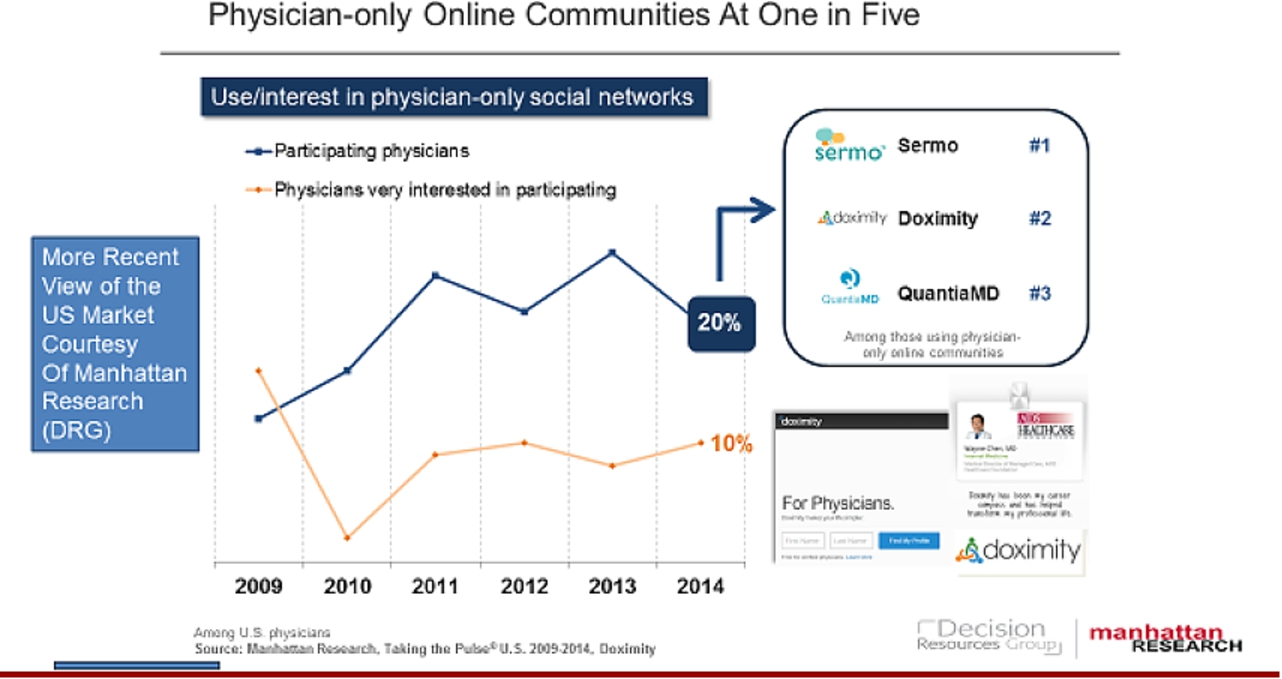
Illustrates data about interest in Healthcare Professional Social Networks.2 Courtesy of Decision Resources Group. (Colors are visible in the online version of the article;
In summary, it is reasonable to assume based on both past and more recent research that around 20% of US HCPs participate in the HCNs while another group of professional users are poised to participate when the value proposition becomes clearer to them. Also, the issue of available and competing digital content is likely a variable based on where in the world a HCP actually lives. Regardless, there is data that suggests that there is a potential number of unaffiliated users that could eventually participate and enable these networks to expand to a much higher level of participation.
The next goal of the research was to review the content offerings of the selected networks. The following section summarizes the content that is associated with the six networks.
Sermo (www.sermo.com)
Sermo is an established online physician community and social network for doctors. Acquired by WorldOne in 2012 this network claims more than 300K members.
Sermo permits its members to: “Solve, Vote, Discuss and Earn”. The SERMOSolves capability is described as “Medical crowdsourcing in action”. Physicians are able to ask a question about a patient case and get a second opinion. This is especially useful when patients present unusual symptoms or the case occurs in a remote part of the globe. Also notable, SERMOresearch permits physicians to gain revenue (via Honoria). Those experts who have experience with specific drugs, medical devices or other treatments are potentially available to advise colleagues.3
SERMO organizes research products in two segments: Market Research & Intelligence and Awareness & Promotion. The research services include quantitative and qualitative offerings. It appears that while the Market Research & Intelligence helps increase knowledge, the Awareness & Promotion positions the members as a resource available to Pharmaceutical companies seeking to communicate to a select audience about key developments pertaining to clinical trials, new studies, and various campaigns.4
SERMO also offers Social Hubs devoted to a number of therapeutic areas, such as Multiple Sclerosis, Oncology, Diabetes, etc. Each of the Social Hubs is led by three to five SERMO advocates. These experts generate discussion topics as they provide a forum for professional networking and development.5
Doximity (www.doximity.com)
Doximity is a community of physicians in the US that may be the fastest-growing US HCP network. The CEO is Jeff Tanguey, the founder of Epocrates, an innovative online drug reference resource that was eventually acquired by AthenaHealth. Doximity is a network well-suited to developing professional connections and finding employment opportunities as it is often described as the “Linked-in” for doctors.6
Of the HCP social networks selected, Doximity appears to be the one most focused on helping members achieve professional placement with services aimed at locating career opportunities. For example, Doximity offers a fee-based service to recruiters who may utilize the app to post job listings. In addition, Doximity also offers a range of day-to-day professional services including:
Secure communications capabilities for members.
Credential validation services.
Sponsored access to online courses for Continuing Medical Education (CME).
Opportunities to achieve revenues as expert resources needed for Pharmaceutical market research.
Members may earn Honoria that is said to be $375 per hour.7
Doximity states among a series of FAQs that it earns money by assisting companies “recruiting physicians with specific expertise for projects including consulting, locum tenens, career opportunities and international aid work. Members always have the ability to opt-out of these features and profile data is never sold to third parties”.8
In addition to the professional development services Doximity offers a range of content: Continuing medical education offerings built in partnership with the Cleveland Clinic. This program extends AMA PRA Category 1 Credit™ to over 250,000 physician members through a free search and learn program.9
Doximity states that it now “serves as the primary source for physician opinion in the US News annual Best Hospital rankings, expanding the survey’s historical reach from ∼3,000 physicians to over 50,000”.10
Doximity offers a blog that covers professional, promotional and collegial content of interest to physicians.11
Doximity also offers secure messaging, personalized reading, recruiting tools, and research recommendations.12
QuantiaMD (www.quantiamd.com)
QuantiaMD offers “social learning and collaboration platforms that helps physicians stay ahead by interacting and learning from experts and peers on computers, tablets, and phones”.13 QuantiaMD provides content to three segments:
Pharma: “Quantia’s web and mobile platform packages and communicates Pharma’s message within the context of an independent online community. Physicians will listen because Quantia utilizes advanced engagement science, which includes a mix of social technologies and targeted, expert content, that drive meaningful engagements that lead to truly unique behavior changes”.14
Health Systems: QuantiaMD offers a highly scalable and interactive platform that is valued by physicians and proven to create change.15
Med Tech: Provides a way to communicate with physicians (who have limited time) to promote brand awareness.16
In a review published in 2011, the Carlatpschiatry blog observed that “QuantiaMD generates revenue through sponsored content that is delivered to physicians as short, interactive, educational presentations narrated by medical experts. This content is always accompanied by sponsors’ logos, and the decision to view is at the physician’s discretion, with no associated penalties or rewards. QuantiaMD proprietary technology ensures that physicians will only be offered sponsored content that aligns with their specialty. Sponsors do not, in any way, influence the non-sponsored content that QuantiaMD members experience”.17
QuantiaMD has also offered member surveys in collaboration with Capgemini Consulting.
Neuros, Hyderabad, India (www.neuros.org)
Neuros was founded by Dr. Waiz Wasey and Ravi Kiran. It is a social network for medical students, doctors and all other health care professionals. Integrated with a study center, Neuros aims to be a platform where like-minded professionals socialize and interact intellectually.
Content offerings are geared towards study aids and social networking and includes: Solved Qbanks and Groups: A study center that also includes various exam questions. These questions are either solved by merit students, professors or users of the network. Clinical Pictures and Study Aids: Under the pictures categories, the network offers a gallery of medical cases where students can browse through various medical photos to add to their knowledge. These pictures may prove useful to both doctors and students. Apart from user generated content, the Neuros team of doctors and medical students, produce high quality content which includes; study aids, charts and illustrations. Social Components: Neuros has basic social networking options, such as chat, like, share posts, ways to follow people and learn about their capabilities, along with a blog. Mobile App: Neuros may be accessed via handheld android devices. The app provides social networking that permits healthcare professionals to discuss, browse and interact. There are reported plans to launch Windows and Apple friendly apps as well.18
DXY (www.dxy.cn)
Based in China, DXY (“lilac garden”) is an online community for physicians, health care professionals, pharmacies and facilities, established in 2000 by Tian Tian (Stanley) Li. The network is geared towards the medical community in China. It is one of the largest HCPSNs with more than four million registered members. The membership includes 1.2M HCPs. The site claims more than 200,000 daily users and 320,000 daily followers on WebChat. DXY has received substantial financial investment from Tencent. It also has partnerships for content with the New England Journal of Medicine and Medscape.
DXY offers a variety of content offerings including:
More than 80 medical text and reference books.
16 open access journals (including 2 covered by The Web of Science and 8 in PubMed).
More than 10,000 posts per day.
More than 1,200 industry news items per month.
More than 130 KOL online webinars and interviews per year.
A total of more than 1000 webinars and interviews.19
DXY has made notable progress as a content publisher including the journals accepted into the Web of Science and coverage within PubMed. In addition, the content covered in DXY permits analysis of user preferences and hot topics based on the data within the largest medical hub in China.
DXY also serves the Pharmaceutical community. It offers the following services to more than 50 Multi-national and local Pharma companies:
Customer Data Services.
Medical Content Services.
Management Platform Solutions.
E-Marketing Services.
The founder of DXY, Stanley Li, has been visible in various conferences and webinars. He is highly motivated to provide targeted content as evidenced by a quote from 2010, “We need to classify different levels of content and provide them to different groups, such as junior doctors, senior doctors and GPs. Content is King and it always will be”.20
Networks in health (http://www.networksinhealth.com/)
Networks in Health is part of the
Advertising services.
Promotional programs.
Branded content.
Educational programs (both arms-length and accredited).
Conference Highlights.
Market Research through M3 Global Research and medeConnect which is another part of the M3 Group.21
From a content perspective, Networks in Health offers quite a bit of content aimed at the members. Specifically, the branded content-offering appears to be a way to derive content from the expert members. Branded content is described as covering “…a range of formats such as therapy area microsites, key opinion leader (KOL) webcasts, patient case studies, clinical paper summaries and clinical guidance algorithms. The content is commissioned directly by clients and features brand imagery and key messages. Branded content can stand alone or be used as part of a microsite or multi-wave program. Networks in Health’ s content and design team are able to create the content or it may be supplied by a third-party creative agency”.22
The Market Research Services offered through M3 and medeConnect also leverage the membership as a resource for expert market research services.
HCPSN: Content-related findings
Based on this high-level view of a small number of selected HCPSNs it is reasonable to conclude that these networks offer two types of content:
Content aimed at the expert membership including pharmaceutical-related promotional and awareness campaigns. There are also examples of continuing education content including certifications, journal articles, information alerts, conference proceeding highlights along with study aids or other forms of collaborative content or reference sharing.
Content derived from the membership, such as market research studies, journal articles, expert viewpoints and internal networking.
HCPSN networks appear to be particularly attractive to the Pharmaceutical industry. Of particular interest, a research study that appeared in the Harvard Business Review that reported, “Research by our team and others shows that social networks play a key role in doctors’ prescribing choices. Even after a drug has been proven effective, doctors tend to be slow to recommend it, often waiting until other doctors they trust start doing so. Studies have shown that physicians were much more likely to prescribe the diabetes medication Januvia if they had Januvia adopters in their networks – an effect that extended to three degrees of separation (a colleagues’ colleagues’ colleagues). Social connections can also work the other way, turning physicians away from certain drugs. Sales of Pfizer’s cholesterol drug Lipitor declined precipitously when a generic came on the market: Interconnected doctors switched their prescriptions almost simultaneously, like a flock of birds changing direction [4]”.
During the course of developing this presentation it was also observed that Healthcare professionals could be included as the source of research studies merely by participating in social networks of any type or simply tweeting. For example, Fig. 2 illustrates a study by Creation Healthcare using Creation Pinpoint presented findings from HCP Digital Opinion Leaders about the differing emphasis about Diabetes across different countries. This research utilized the following sources to develop conclusions:
More than 700 websites.
Full Twitter “Firehose” feed.
“All” major social media.
More than 100K verified HCPs from sources covering websites and social media [2].
This study illustrates the way social media can be monitored and analyzed by sentiment analysis or other semantic algorithms. In fact the, Twitter Firehose permitted third parties to acquire feeds from Twitter for various forms of analysis. (Interestingly, well after the NFAIS conference in April 2015 news stories revealed that Twitter would be cutting off access to this service that it now owns following the May 2014 acquisition of Gnip.23 )
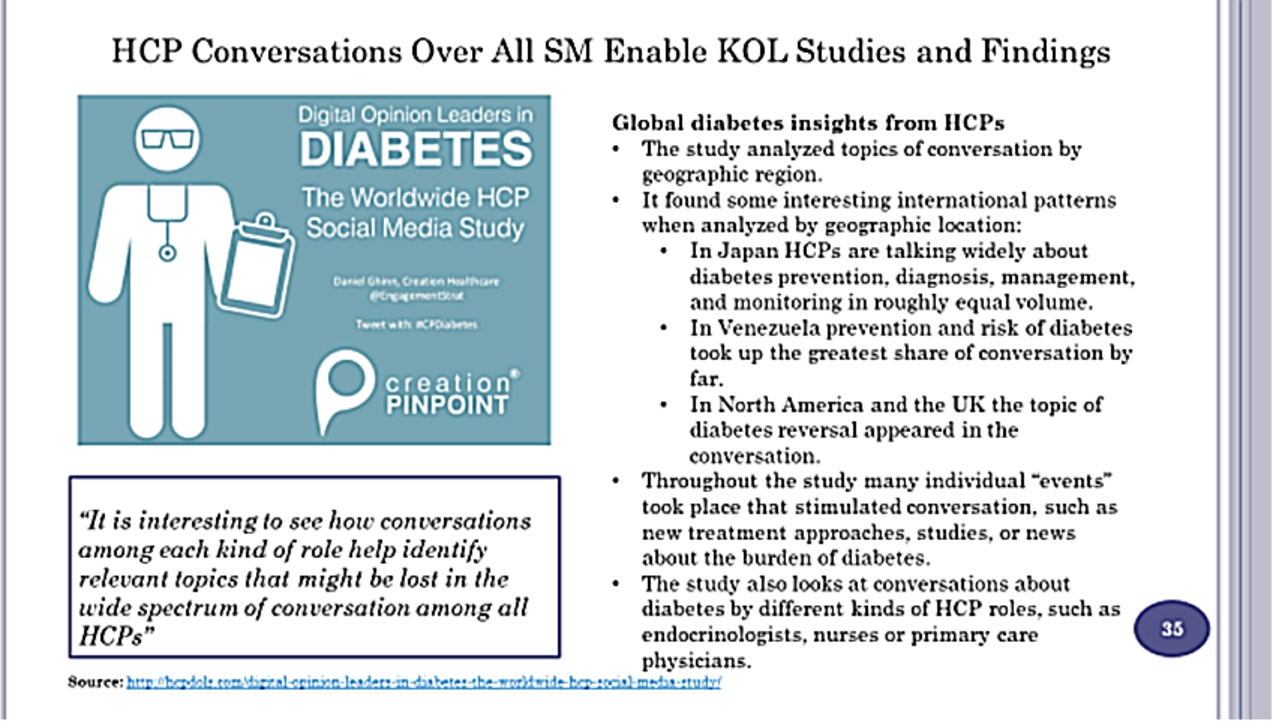
Illustrates a big picture view of a social network enabled research initiative.24
(Colors are visible in the online version of the article;
There are various positive factors and potential challenges that may develop over time within the HCPSN content agendas. Here is a brief view of some factors to consider:
Positive factors:
Emerging sources of digital content that supports the healthcare professional could be delivered in real-time and easy to access.
HCPSNs could become robust digital content platforms in regions where there may be a need for more content sources.
The networks support content collaboration among HC professionals – new source of outreach to experts.
Various forms of content are available from members or delivered to members depending on the network, such as: email, articles, KOL views, video, treatment reviews, CME, study aids, virtual meeting rooms, etc.
Potential ways to avoid certain “never events” or unthinkable treatment mistakes, such as instant alerts when miss-labeled products appear or other critical developments are reported in the field.
HCPSNs should grow as a strong source of market research needed by the Pharmaceutical Industry.
Challenges: As they progress HCPSNs could stimulate a more competitive environment between networks and medical societies as they each seek to grow membership by adding attractive value. There may even be mergers or drop-out networks along the way. Content will be increasingly available but will require quite some time and improved quality control to become an alternative of peer reviewed research. Privacy may be an issue if personal patient information is somehow included or simply deducible. For example, US HIPPA regulations need to be completely followed. Professional conduct may be impacted by commenting too rapidly without thinking about ethical implications of the statements. Potential legal issues such as copyright, or inadvertently discussing items undergoing the litigation process. Lack of time from members could be a challenge to providing quality content. Global networks are challenged by variations in approved treatments and regulatory policies across various geographic locations. An expert in one location may be unaware of the practice requirements within distant regions. There will be a need for standardized attribution metrics to ensure credit for those professionals making a strong impact or contribution from their efforts.
Impact on STM publishers
The HCPSN is a global concept capable of offering a range of benefits to members, including the ability to of the expert membership to gain revenue as a source of content or audience for content. Professional publishers and societies should be, at minimum, aware of this evolving global resource of expert content. Although it does not appear that the networks can offer a competitive threat to the diligence required to produce peer-reviewed journal content or books, the networks do offer an additional source of content that over time could become more of a direct high-quality publishing channel. In fact, publishers may benefit from developing content alliances with these groups to either plan for new content, or engage the expert members in a social commentary about published articles. From the perspective of the professional society there should be some consideration to the growing number of members joining the networks. Although it was not attempted in this research, one follow-up project would be to compare the actual membership of HCPSNs to various Associations. Perhaps if any competitive dynamic from the potential of these networks exists it would be more of a challenge to the societies.
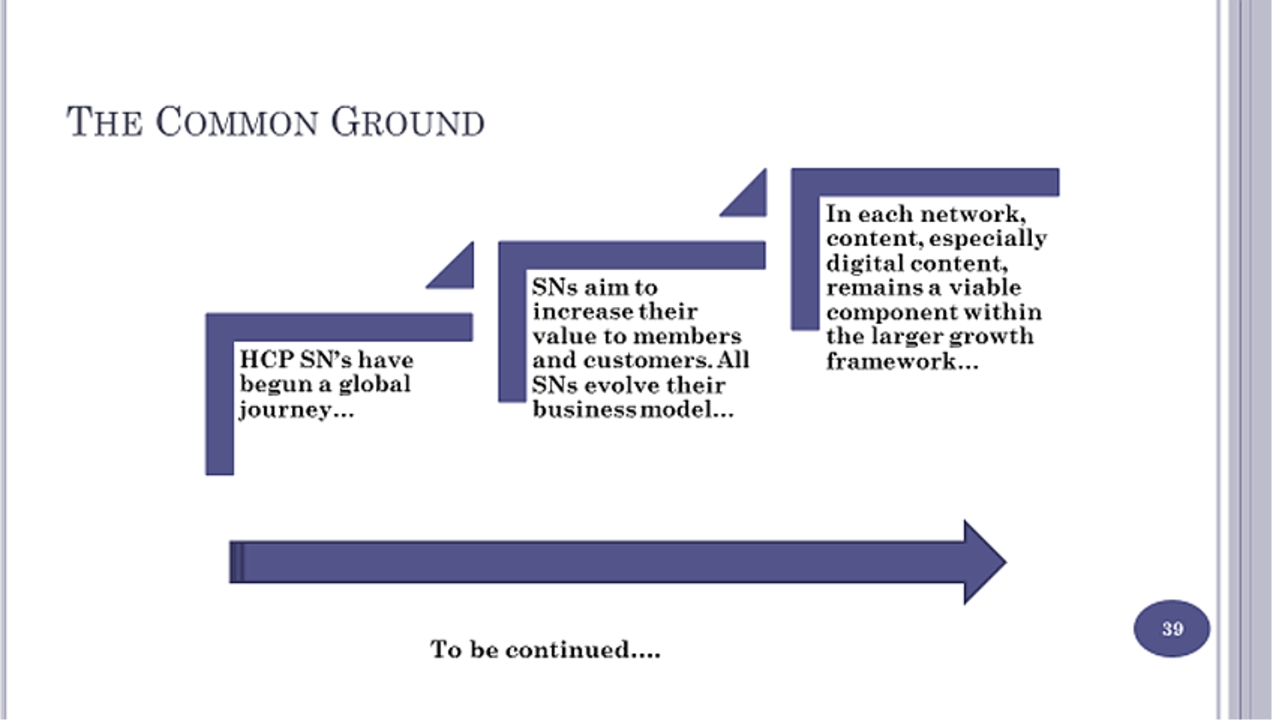
Illustrates the potential path for HCPSNs as they continue to expand and become more visible. (Colors are visible in the online version of the article;
Also worthy of ongoing evaluation is the potential these networks offer as resources for alternative metrics. It seems reasonable to state that the impact potential of KOL social networking deliverables could be widespread and worthy of a standard attribution and professional recognition.
HCPSNs have demonstrated value as resources for members to access and/or deliver content in a variety of formats including brief messages, more detailed opinion and editorial pieces; research summaries; promotional messages; market research data; and alerts in a variety of formats, including video. Professional social networks have come a long way since the advent of Web 2.0. Figure 3 illustrates a potential path towards maturity.
We should monitor developments among these networks to see how far they progress either as independent or possibly merged organizations. At this point there are several questions that will be answered over time: For example,
Could these networks become direct competitors to traditional STM publishers and indices?
Could they become the preferred source of pharmaceutical market research?
Could they challenge the role of professional medical societies?
At this point, one thing appears to be certain. There are several highly-experienced and dedicated leaders managing a global array of HCPSNs who are planning to assertively evolve and grow their businesses over the near and longer term future. Stay tuned….
Footnotes
Op. cit. McGowan.
Manhattan Research, “Taking the Pulse”: US 2008–2014, Doximity.

Ibid. Sermo.
Ibid. Sermo.
Ibid. Doximity.
Ibid. Doximity partners.
Information provided by DXY.
About the author
Victor Camlek is a veteran market and competitive intelligence analyst with extensive corporate experience within the telecommunications, publishing, and healthcare industries. In 2013, Camlek founded Camlek Concepts, a Market Intelligence firm. Prior to this role, Camlek was Vice President of Market Intelligence for the IP & Science Business of Thomson Reuters.