




Abstract
Background:
Among the challenges for implementation of Waterborne public transportation (WPT) are the difficulties in procuring efficient ferries tailored towards local requirements. Fundamental questions on the ferry’s environmental impact, speed and procurement costs linger in the public transport (PTP) mind.
Objective:
In this paper, a methodology for adopting a platform architecture for ferries is illustrated by a modular design approach.
Methods:
For this, WPT operational profiles are categorized by three route types in a structure for operational requirements including sustainability performance. Generic parameters for size and speed of WPT ferries are defined. Using these parameters as a skeletal structure, a modular commuter ferry concept is proposed as a set of basic modules. As a combination of these functionally independent modules, a ferry can be tailored to fit the operational requirements.
Results:
The paper proposes standard sizes for waterborne commuter craft and shows that ferries are compatible with land-based public transport in terms of energy efficiency and speed. Suitable speed ranges for mono hulls and catamarans are investigated and the idea of modular design for rational procurement is explored and illustrated for the three type routes.
Conclusions:
The proposed concepts can make WPT more attractive for PTPs as a sustainable option to complement the existing network.
Keywords
Introduction
Waterborne Public Transportation (WPT) is perceived as a sustainable and environmentally friendly mode of transport [84] that is economical, safe, versatile, reliable, and energy efficient with low emissions [60]. It is also identified with qualitative metrics such as a better onboard work environment, better inter-personal communication and a higher level of comfort [70]. Lately, WPT has been gaining popularity among public transportation providers (PTP) to tackle increasing urban congestion, pollution and reap associated benefits of better routing and waterfront economic development [9]. Copenhagen has acquired seven new electric ferries for operations [20], New York began operations of a new ferry system in 2017 [6] and Stockholm is increasing its waterborne transport capacity [65].
Recent studies on WPT include benchmarking of existing water transit in terms of operating modes and ferry designs, [77] and [11] discuss planning, development rationale and the land use implications of WPT [83]. The economic benefits and property value effects around terminals are studied by [54] and [45] while studies on passenger travel patterns have been conducted by [55] and [69].
Despite WPT’s advantages and recent interest, its establishment and development pose several challenges including funding constraints, competition from other modes, low political will, low opportunity, local legislation and technical issues [7]. Of these, technical issues holds considerable potential in mitigating the aforementioned barriers. A technically robust and efficient WPT system could lower costs, increase competitiveness, motivate political will, create opportunities, and influence local legislation. Broadly, technical issues comprise route planning, docking infrastructure and ferry design. Of these, energy efficiency, emissions and the one-off tradition in shipbuilding is pivotal. [66] and [78] show that PTPs and urban planners in Sweden consider WPT as slow, environmentally unfriendly and cumbersome in practice since there are no standard vessels off-the-shelf. The principal procurement strategies are either to acquire new custom-designed ferries or retrofit/refurbish existing vessels.
In cities like Amsterdam, Copenhagen and Sydney that operate custom-designed ferries, [11] observed that WPT integrates well within the public-transportation framework and operations have proven profitable [35]. WPT is integrated with a common ticketing system with special hubs to facilitate coordinated transfer between modes. While custom ferries make WPT efficient, they have high production costs and construction times, arising from an extensive design process involving manufacturing of custom-designed parts and a general absence of platform-based manufacturing. Typically, ferry construction can last several months to a year which can impede WPT’s implementation and deter PTPs, leading them into adopting alternate modes as observed by [63] in the automotive industry.
For cities that operate refurbished old ferries or retrofitted vessels, the advantages are low procurement costs and short acquisition times. However, they are subject to availability and may suffer from an operational role mismatch and incompatible design due to poor superstructure space utilization, higher emissions and ill-suited hull forms leading to inefficiency in meeting operational requirements. This can cause difficulties in WPT’s integration with the public-transportation framework (e.g., as observed in Istanbul, Hong Kong and New York, [11]) affecting planning, leading to high operational costs, low transit frequency, poor inter-mode transferability, long waiting times, inadequate last-mile connectivity and a high environmental footprint [86]. The latter risking adding fuel to the view of waterborne being environmentally unfriendly per se.
Central to both procurement strategies is, in meeting the diverse set of operational requirements. The consequence of customers’ evolving needs over time and a lack of a common structure for these requirements can be seen in the large variety of ferry designs operating worldwide. Variations have been observed in hull type and shape, number of decks, passenger capacities, superstructure arrangement, entrance locations, engine type, propulsion systems, operational speed, maneuvering systems, machinery arrangement and amenities offered [11]).
This paper sees a potential in an established structure for operational requirements so that PTPs and shipyards have a common understanding. This may lead to manufacturing under a platform-based product strategy whose success depends on standardization in facilitating flexible manufacturing that will result in cost-effectiveness [61]. Tackling the large variety in operational requirements while preserving economies of scale as well as satisfaction of diverse expectations is possible with mass customization [53]. Under it, product family design and platform-based product development are effective strategies that produce a high variety with reduced costs [50] To facilitate this, an assessment of commonality vs modularity is fundamental where commonality can lead to cost savings while modularity can increase the diversity of products [72]. In developing a product family, a modular architecture can facilitate establishment of a ferry family with shared modules across functional variants.
A modular architecture combines the advantages of standardization and customization while negating their respective disadvantages. Together, they promote economies of scale [40], design flexibility [59], greater variety of design combinations for assembly and production [29]), reduction in tooling and inventory requirements [22], increased efficiency of processes [29] and optimized equipment usage and resources [64]. Modular design also promotes recyclability [30], serviceability [15], reparability [14] and upgradability [1].
In practice, modular architectures can be found in many engineering applications and current trends indicate that the next generation of vehicles will be more modular [49]. In the marine sector, Marintek in Norway has been exploring the application of modular design for offshore-supply vessels [24]. [81] are looking at modularly designed cruise ships in the Mediterranean. Damen Shipyard has developed modular ferries that are operational in Copenhagen [20]. Fjellstrand shipyard is developing a fast ferry incorporating modularity to begin operations by 2022 in Norway [28]. However, it is unlikely that these shipyards will produce ferries that will have compatible modules, which reduces the scope of benefits arising from a product platform. Correspondingly, it would be beneficial to lay a methodology for the development of a modular ferry, standardized in its skeletal form and customizable towards WPT’s operational requirements as part of a product platform system. This could potentially result in a large variety of functional variants at lower costs and procurable off-the-shelf, similar to buses.
This paper explores the possibility of ferries being available to the PTPs as standardized units that are procurable off-the-shelf and comparable in speed and energy efficiency to buses. The modular design framework is emphasized, and the resulting design is a way to indicate feasibility. The methodology followed here is first the identification of key metrics characterizing operational requirements. Then the principal sizes, speed-range and hull types are deduced constituting the overarching definition of WPT vessels and showing them potentially even more energy efficient than buses at a comparable speed. Following this, a modular ferry concept is developed with the deduced WPT ferry parameters as its skeletal form. Finally, the authors discuss customization of the ferry concept under different operational scenarios and its practical implications.
Routes and operational requirements
Based on WPT in 23 cities, [11], operational profiles are categorized into three standard route types; City, Bridge and Suburban, summarized in Table 1. City routes are ferry services along a river or a waterbody. These linear ferries (nomenclature by [73]) typically have more than 3 stops arranged in a linear fashion with inter-stop travel time ranging from 5–15 min while covering distances between 0.5–5 NM. Their key characteristics are operational speeds comparable with inner-city buses, high frequency, high accessibility, and efficient multi-modal integration. Bridge route refers to shorter routes with two or three stops either in a cross-river or triangular three-point configuration. The ferries typically have an inter-stop travel time of 2–10 min while covering distances less than 2 NM. Their key characteristics are high frequency, short turnaround times with quick embarkation and docking and large capacity with accessibility to stowing bicycles. Finally, the Suburban routes link suburban areas with the inner-city. They typically have more than 2 stops with a total travel time under 60 mins while covering distances between 8–12 NM. Key characteristics of Suburban ferries are comfort, reliability, and year-round operability independent of weather conditions.
Classification of WPT operational profiles into standard route types
Classification of WPT operational profiles into standard route types
The three route types provide a broad requirements framework for the corresponding ferry’s design. However, multiple designs are possible under each route-type due to regional, cultural, population density, geographical and regulatory differences [44]. One can further discretize the broad outline within the constraints set by material, technological, economic, legal, environmental and human-related considerations that change with time [5]. Correspondingly, an operational requirements hierarchy is developed in Cheemakurthy and Garme [13] starting with route type on the primary level, followed by vessel requirements at the secondary level and ferry performance requirements at the tertiary level as shown in Fig. 1.
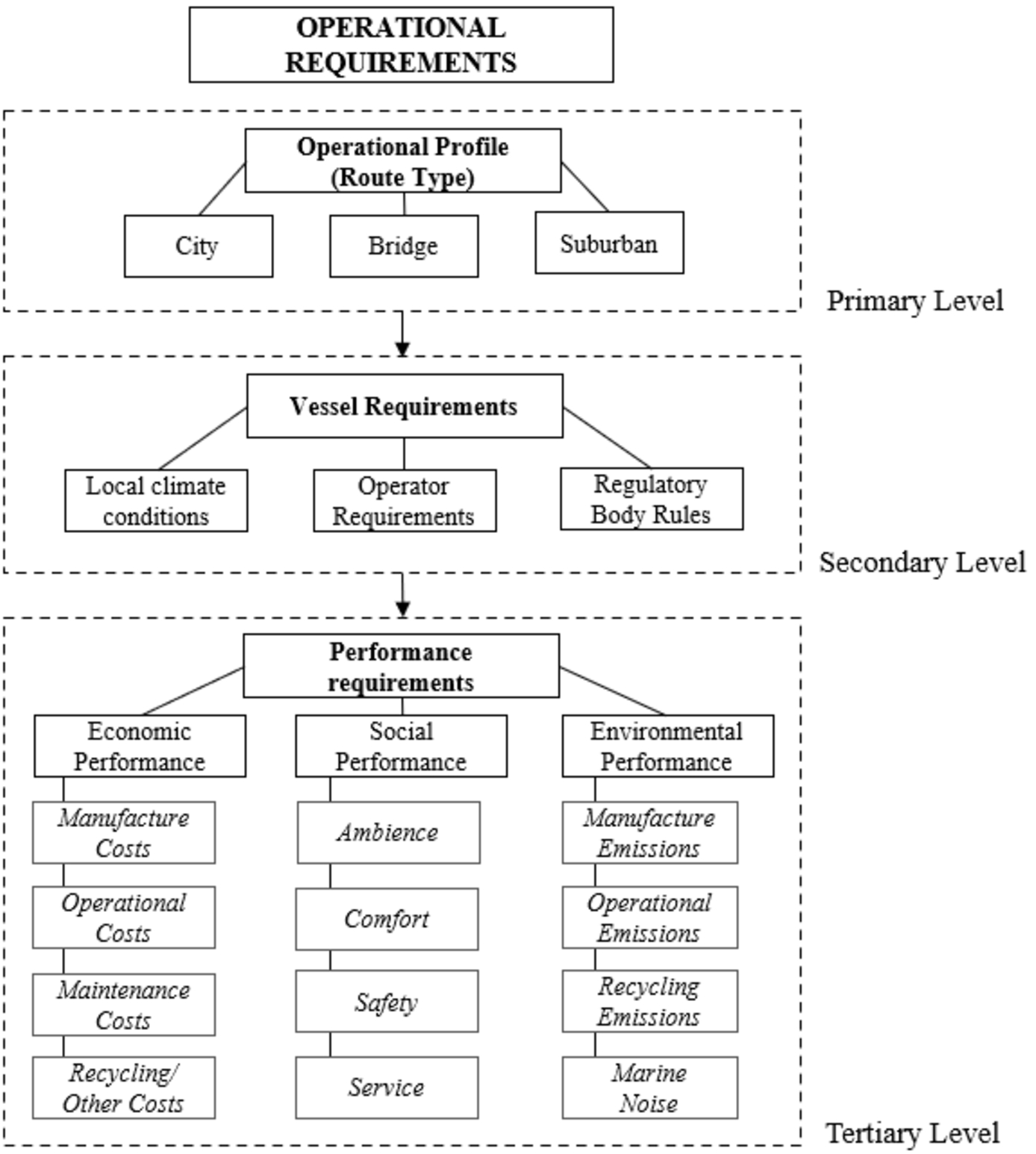
The proposed structure for operational requirements describing the establishment of a ferry product family.
The structure aims at describing the variety of requirements for a product family. The requirements proposed by design methods like Ship-systems based design [39] and Ship synthesis [2] are adept in driving an individual ship’s design but may be cumbersome to apply towards product families. The operational requirement’s structure here helps in the design flow beginning from broad characterization described by the route type and vessel requirements to specific details outlined by performance requirements. Moreover, the structure incorporates environmental and social factors within the framework of design which are partially absent in existing ship design structures. This can help create a uniform image of requirements that both PTPs and vessel manufacturers can use, thus removing ambiguity in their understanding.
Within the hierarchal structure, the route on the primary level introduces vessel speed, size and general arrangement (GA) characteristics, the vessel requirements at the secondary level are the requirements/conditions laid down by the operator, regulatory bodies and local climate conditions. This level is comparable to the shipbuilder requirements defined by [39]. The tertiary level establishes performance requirements based on economic, social, and environmental metrics. Requirement fulfillment can be evaluated, and different designs can be compared. Here, the economic performance requirements constitute ferry’s life cycle costs including manufacturing, operational, maintenance, recycling, and other costs. Social performance requirements constitute commuter expectations related to the service. Environmental performance requirements consider emissions from an entire life cycle perspective of the ferry including manufacture, operations and recycling phases and marine noise. A few of these tertiary metrics are synonymous to Levander’s [39] ship owner’s requirements. With an aim to maximize overall performance, the tertiary level can either drive design improvements through iterations in a design spiral or linearly for functionally independent modules, a concept that is introduced in Section 4.
A solution towards improving the accessibility to ferries to PTPs is to have a family of ferries sharing a platform architecture. For developing this, we cannot completely rely on traditional ship design techniques like the design spiral model [25], ship synthesis [2] and system-based ship design [39] which are suited towards design of individual vessels. Instead, we suggest a design methodology combining principles of naval architecture with elements of product platform design. Broadly, first a skeletal ferry platform is defined and next a modular architecture is laid to facilitate establishment of multiple functional variants as part of a ferry product family.
Assuming the commuter ferry’s role in the public transport system being the waterborne equivalent to bus and articulated bus, we are looking for two sizes of deck area that are practical units for WPT. The areas together with length, width and weight must be chosen with respect to passenger capacity and comfort as well as to ensure low energy use at running speed. In achieving this, good transverse stability and practical draught variation as passengers embark or disembark is considered.
Capacity
We target a range of 100–450 (representative of the majority trends from data compiled in [11]) for two vessel sizes. The two ferries are subjected to constraints representing target occupancy ratio
The OR range is assumed considering the number of seats/capacity ratio onboard ferries in Stockholm. As an initial condition, it is assumed that a commuter size of 300 passengers is waiting to board the two ferries (∼300 is the sum of average commuter volumes per trip on Line 80 and 82 in Stockholm [47].
The solution to the above constraints yields multiple combinations of ferry capacities (Fig. 2). Of these, two ferries having capacities of 150 and 250 are chosen considering:
Stockholm’s PTP’s requirements: 150 passengers and 40 bicycles [75].
Contemporary passenger capacity trends.
Dimension constraints set by modular architecture (see Section 4)
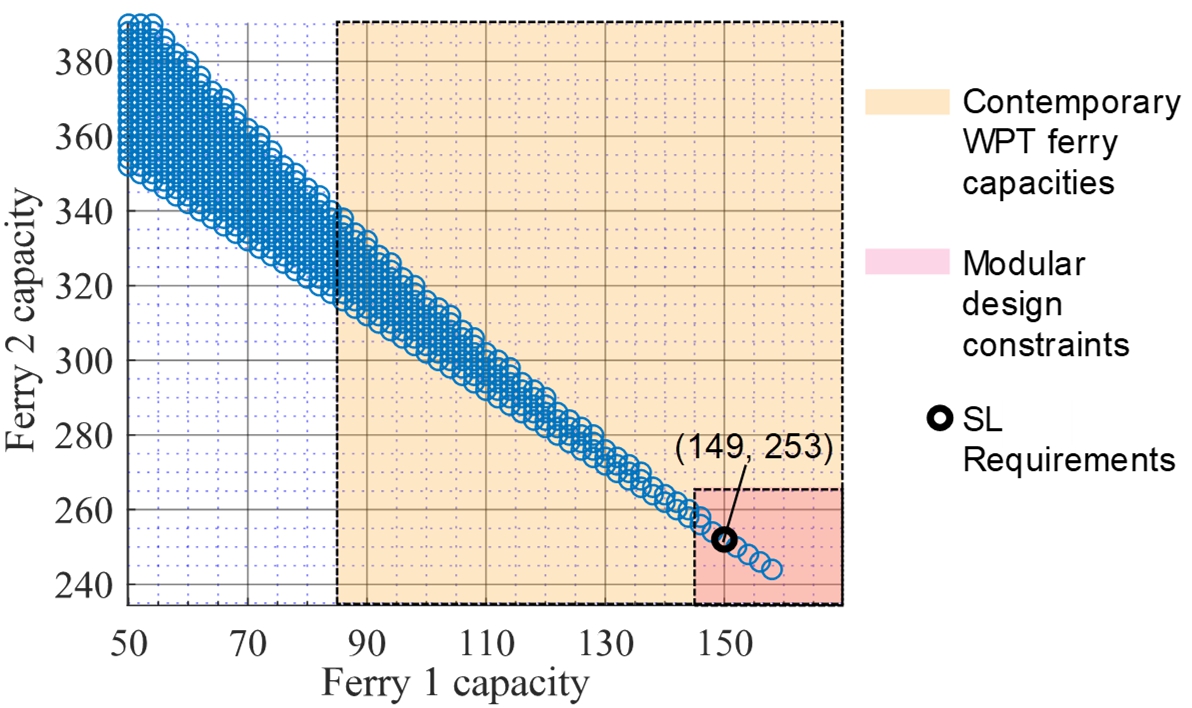
The blue circles represent ferry capacities that satisfy the constraints. The yellow box indicates contemporary capacity trends [11], the red box indicates modular design constrains and the black circle indicates Stockholm’s PTP-SL’s preference.
The capacities are chosen assuming City route ferry with a GA oriented in-between passenger comfort and high commuter volume. This allows the ferry to adapt towards the target capacity range of 100–450 by modifying the GA influenced by route type.
Considering passenger capacities of 150 and 250 and a GA oriented towards the City route type, the superstructure areas are calculated to ∼180 m2 for the larger variant and ∼138 m2 for the smaller variant. The estimations are based on typical GAs of such ferries and calculations are made considering 75% passengers seated including regular as well as priority seating, standing area for the remainder, aisle clearances, engine room access, navigation room/bridge, luggage space, space for stowing 40 bicycles, disability reserved spaces, baby stroller spaces, exit ramp clearances, WC and a 10% reserve area accounting for additional components, modular design constraints and ramp-space for double ender ferries (details see Table 2).
Area calculations for commuter ferry based on route type A GA. All areas are indicated in m2
Area calculations for commuter ferry based on route type A GA. All areas are indicated in m2
*Storage includes bicycles and luggage space.
**Amenities include WC and reception.
***Other components include driver cabin and engine room access.
A similar estimate for areas of components below deck, including engine and transmission, propulsion and control systems components are made and checked for feasibility with data from an ice going WPT ferry Yxlan [8]. The comparison indicates sufficient below-deck area. Total areas and volume estimates for the ferries are summarized in Table 3.
Area and volume calculations for the two ferry sizes
For the target capacity ranges for the two ferry sizes, Table 4 shows a rough weight estimation based on data in [62].
Weight estimation of large and small ferry variants for different structural materials and passenger capacities
Weight estimation of large and small ferry variants for different structural materials and passenger capacities
The modular constraints require that both ferries must be constructed from the same basic modules which is a core tenet of platform architecture where standardized components are used across product lines [33]. With the deck area based on passenger capacity, the length and width are set by modular constraints defined in Section 4 to a common width of 6.4 m and lengths of 22 m and 28.6 m respectively.
A number of hulls can fit these broad dimensions. In this paper, four well-designed WPT hulls are chosen to assess stability, seakeeping, draught sensitivity to dead weight and performance ranges for speed and energy consumption. The body plans for the hull variants are shown in Fig. 3.
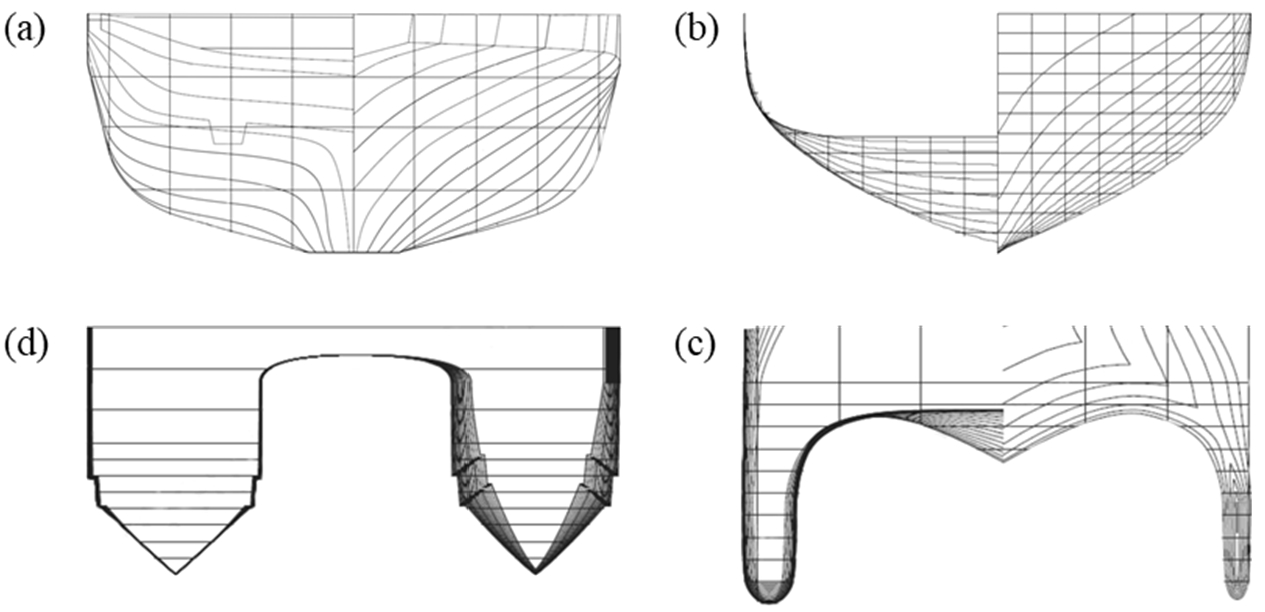
The main particulars for both sizes of these four hulls are summarized in Table 5. These hull forms do not represent optimal designs but are a means to estimate the performance for the chosen main dimensions.
Particulars of hullforms scaled to fit the deduced overall dimensions for both sizes. Indicated draught and displacement consider an aluminum hull and max passenger capacity
The chosen hulls meet International Maritime Organization’s [16] stability and safety requirements (see Fig. 4). Static large angle stability favors the catamaran hulls at ferry displacement greater than 65 t for the larger variant. However, higher manufacturing expenses of catamarans can affect economic performance. For operations in ice, historically, only mono hulls have been used and little research or examples of application of catamarans operating in ice are available. From a passenger comfort perspective, seakeeping was found non-critical owing to the conditions in urban sheltered waters.
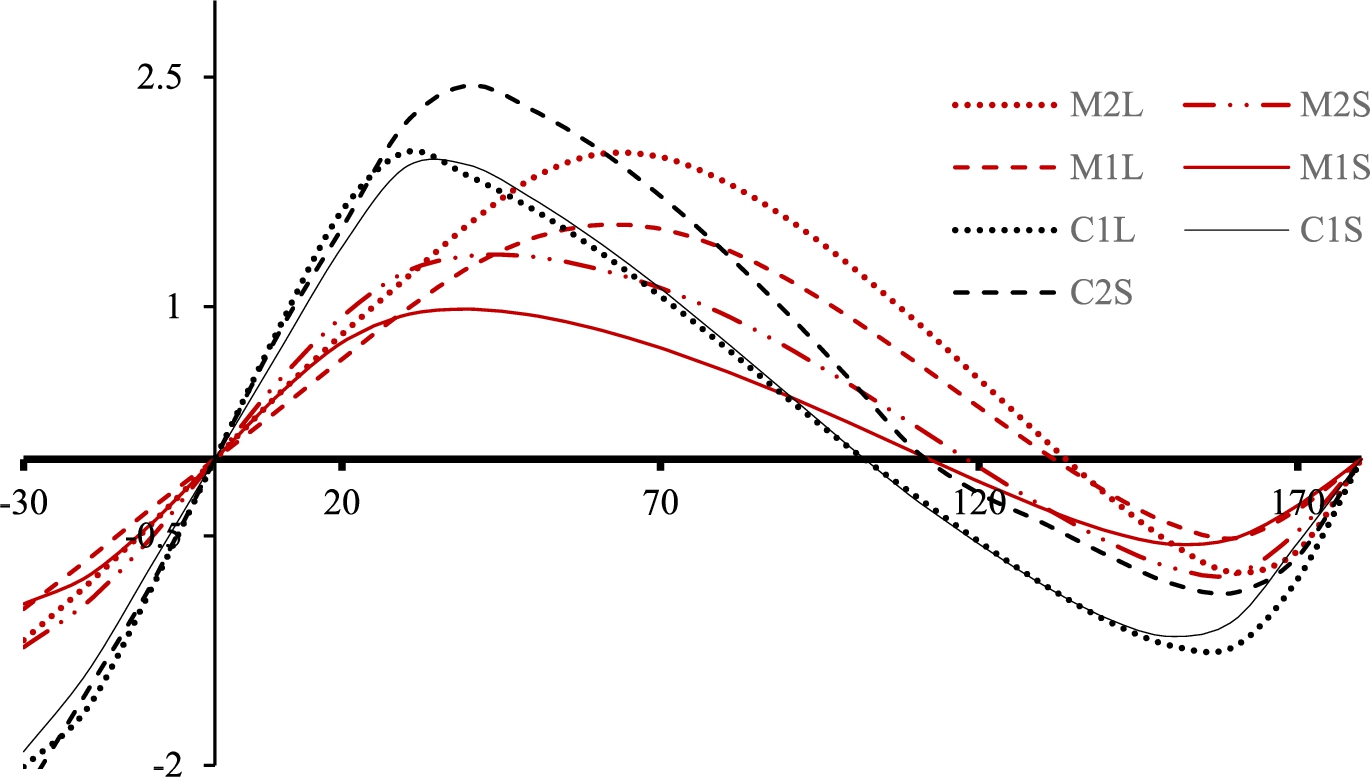
GZ curves of hulls under investigation.
The draught’s sensitivity to change in deadweight (DWT) during passenger embarkation/ disembarkation is indicated by TPC (tons per cm). Corresponding to the larger variant’s maximum capacity of 450 passengers, DWT can change by around 32 tons (based on average passenger weight in Europe [82]. Assuming that a 32 cm change in draught can be handled safely, the limiting TPC is 1 t/cm, corresponding to a minimum waterplane area of 100 m2. Figure 5 compares the four hulls and marks minimum displacements at which TPC is over 1 t/cm. For
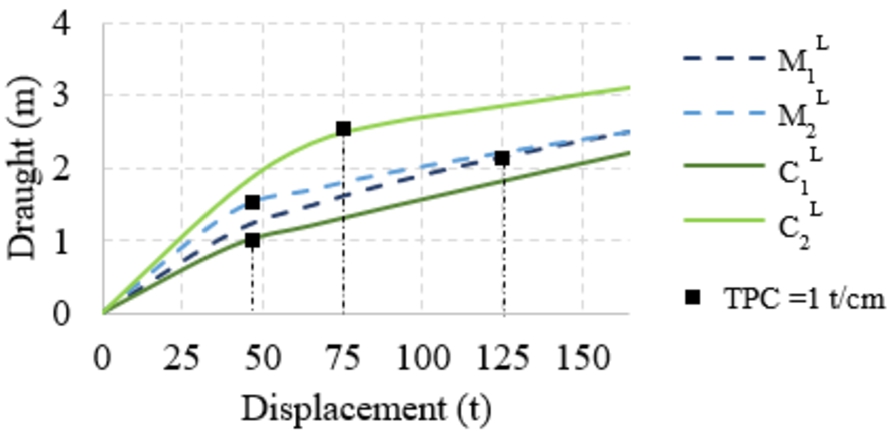
Vessel draught vs displacement. The black square indicates the minimum displacement for TCP ⩾ 1t/cm.
The operational speed of the ferry should be comparable with alternate transport modes while having a low per capita energy consumption. This will maximize service under social performance and operational-emissions under environmental performance (with reference to the performance requirements of Fig. 1). The energy consumption is a function of the hull resistance and propulsion system efficiency. Further, hull resistance depends on the displacement, hull shape and speed. With certain exceptions, the hull resistance generally increases with vessel displacement, whose major contributors are hull material weight and passengers. An advantageous endeavor is to minimize displacement while maximizing the load carrying ratio (DWT/LWT). This can be done by choosing lighter hull materials. For instance, the BB Green ferry achieved a 40% reduction in structural weight by transitioning to carbon-fiber composite (CFRP) [58] and the Ampere ferry offset 50 t battery weight by transitioning to Aluminum [56]. Table 4 compares the load carrying ratios for the two sizes. However, it is important to be aware of the disadvantages of lighter hull materials. E.g., CFRP is expensive and has poor impact strength with high maintenance costs and poor workability [74]. Also, they have poor recyclability [80] and are unsuitable for ice operations [27]. These factors affect economic performance and safety under social performance.
Figure 6 shows resistance for the four hulls. At speeds under 11.5 kt, frictional resistance dominates and monohull
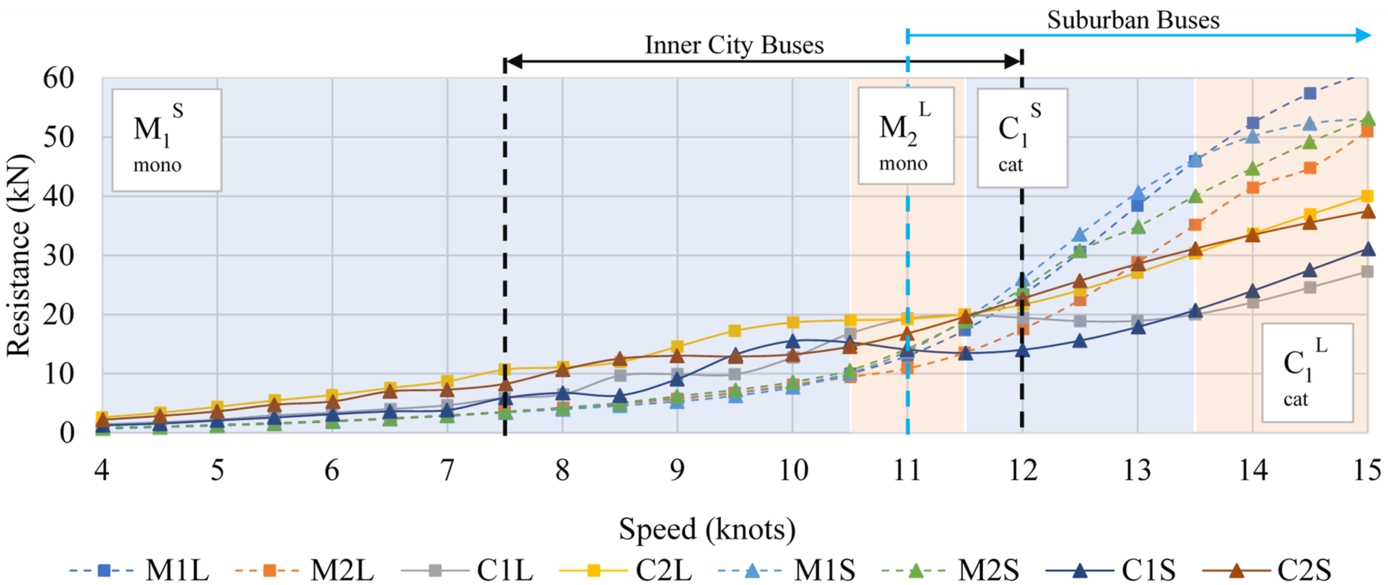
Calculated resistances of the four hulls. The blue and orange areas show speed range favoring the smaller and larger variant respectively. Most suitable hull for each speed range is indicated in a white box. Speed ranges of inner-city buses and suburban buses are marked [10]. Catamaran resistance was calculated using the slender body method [76] while Monohull resistance was calculated based on Compton method with transom sterns [17].
The final parameter affecting energy consumption is the propulsion system efficiency. Typical observed efficiency for a marine electric system is 0.85 [41] while that for a marine diesel combustion engine is 0.35 [41]. Hybrid propulsion systems have an energy efficiency varying within this range. Figure 7 relates the per capita energy consumption to vessel characteristics like propulsion type, speed, passenger capacity, hull material, hull-type, ferry size and compares them with the average consumption of alternate modes. Some observations are:
Hull material can have a significant impact on energy savings which can lower operational costs and increase operational speeds. E.g., at 12.6 kt, hull
A lighter material is beneficial in achieving a higher energy efficiency even at low ORs.
Energy consumption due to a heavier hull may be compensated by having a large passenger capacity.
For ice going ferries, presupposing a monohull, an appropriate open-water operational speed is 11 kt or lower with electric propulsion and under 10.1 kt with diesel propulsion with at least 100 passengers on board.
Assuming 60% packed ice, the ice resistance is ∼2 times open water resistance [34], the monohull can navigate at 8 knots to be comparable with a diesel bus.
Electrically propelled catamarans have a similar energy consumption as an electric bus for speeds up to 14 kt.
Catamarans can typically choose to go at a higher speed as their energy consumption is relatively flat between 10.1–13.4 kt.
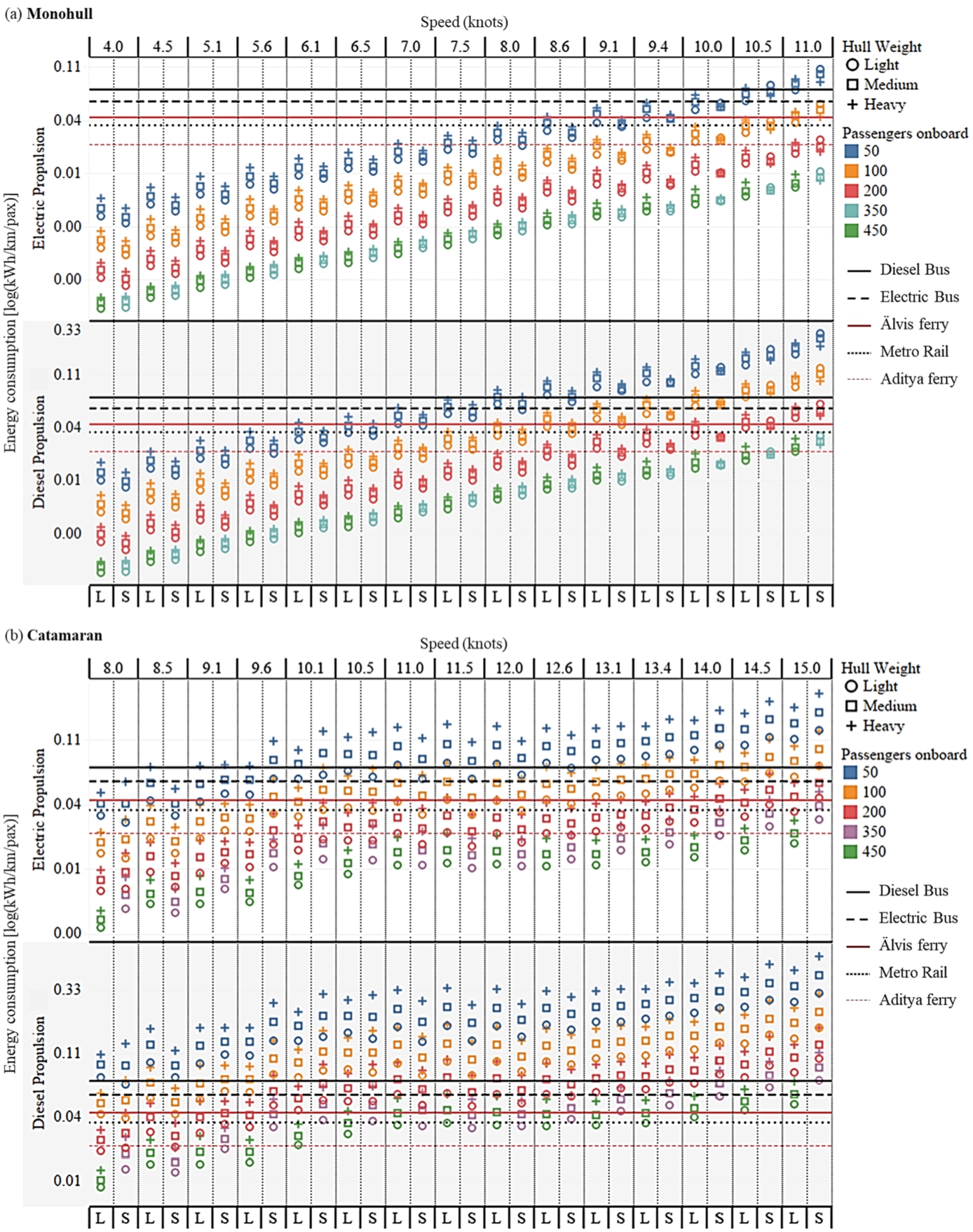
Per capita energy consumption for large (L) and small (S) variants. (a) monohulls at speed range 4–11 knots; (b) catamarans at speed range 8–15 knots. Variations in LWT, propulsion and passengers are plotted. Energy consumption for electric bus is 0.055 kWh/km/pax (45-seater bus with 65% OR with consumption 1.6 kWh/km [37]), for diesel bus is 0.07 kWhkm/pax (based on 2.1 kWh/km [43]), for metro rail is 0.034 kWh/km/pax (based on 14.4 kW/km calculated from a total traction power of 650 kW [42] and a capacity of 650 commuters in 3 bogies), for a solar ferry ‘Aditya’ is 0.027 kWhkm/pax [71] (65% OR of 75 pax capacity and speed 6 knots) and Älvis commuter ferry is 0.04 kWhkm/pax [66] (65% OR of 200 pax capacity and speed 8 knots).
Figure 7 points towards having a lighter hull material, a high passenger capacity and an electric propulsion system. While electric propulsion due to its higher energy efficiency, emission free and silent operations [70] is favorable, its disadvantages include the need for frequent charging of batteries, expensive systems, difficult disposability/recyclability, and high battery weight.
Speed at sea strongly influences the energy consumption and emissions. One can compensate for a lower speed by saving time during pier-ferry interaction including alignment, fastening, ramp-laying, and alighting. Improving maneuverability through thrusters and podded propellers can greatly decrease docking time, as observed by us in Hamburg where vessels with thrusters took nearly 90 seconds lesser to dock. This is recommended particularly for City ferries having many stops. For Bridge ferries, it is advantageous to have double ender ferries. Since for Suburban ferries, docking times are insignificant in comparison with travelling times, a rudder system is a more economical and energy efficient option. Finally, the embarkation time can be improved through strategic ferry exit and terminal design, which requires a flexible GA design capability.
A summary of the principal parameters describing WPT ferries are compiled in Table 6. They define the skeletal structure representing the standardized aspect of the ferry product family. In the following sections, the skeletal structure is used as basis to define a modular architecture and customization will be addressed using the operational requirements.
Summary of principal parameters of inland WPT ferries
Summary of principal parameters of inland WPT ferries
*Lower range of energy demand corresponds to 8 kts, 450/350 passengers and a lightweight hull with electric propulsion. The upper range corresponds to 14 knots, 200/100 passengers and a heavy hull with diesel propulsion.
1[26].
2[21].
The previous section proposed main particulars of a ferry product platform and illustrates vessels for WPT that by speed, capacity and energy efficiency are comparable with buses. This might encourage PTPs and urban planners to considering the waterborne mode in transport network development. Nevertheless, vessels are not off-the-shelf products and the cumbersome procurement options remain. In order to define the ferry, with respect to the requirements and open for lower costs and stronger PTP influence on the resulting vessel design, a modular commuter ferry concept is introduced.
Within the framework of main particulars, the specific requirements must be fulfilled as functional variants of the basic ferry outline. Since producing many tailored variants is expensive, rationalization is possible if each functional variant is based on a combination of basic modules and assemblies as part of a product-family in a ferry design-platform which offers high model variety with comparably low levels of complexity [49]. Ferries as a combination of standardization and customization have been termed flexibly standardized by [63]. Standardization is driven by the skeletal form of the ferry and defined modules while customization is driven by the PTP’s choices under the operational requirements structure in Section 2.
A module is a structurally independent building-block with well-defined interfaces [5] and have a one-to-one correspondence with function structures and accomplish an overall function [79]. A modular product architecture divides the ferry into basic functionally independent modules with the goal to minimize inter-modular interactions [61]. Each module can then be independently subjected to tailoring based on the operational requirements. In contrast with the design spiral, linear improvements on individual module’s design can be made, thus flattening the spiral.
The degree of resolution of the ferry concept into function-oriented modules is key. The endeavor is to have adequate resolution to allow functional independence [4] while minimizing the number of modules by integrating functions on commonality. This is essential for economic and technical favorability [5].
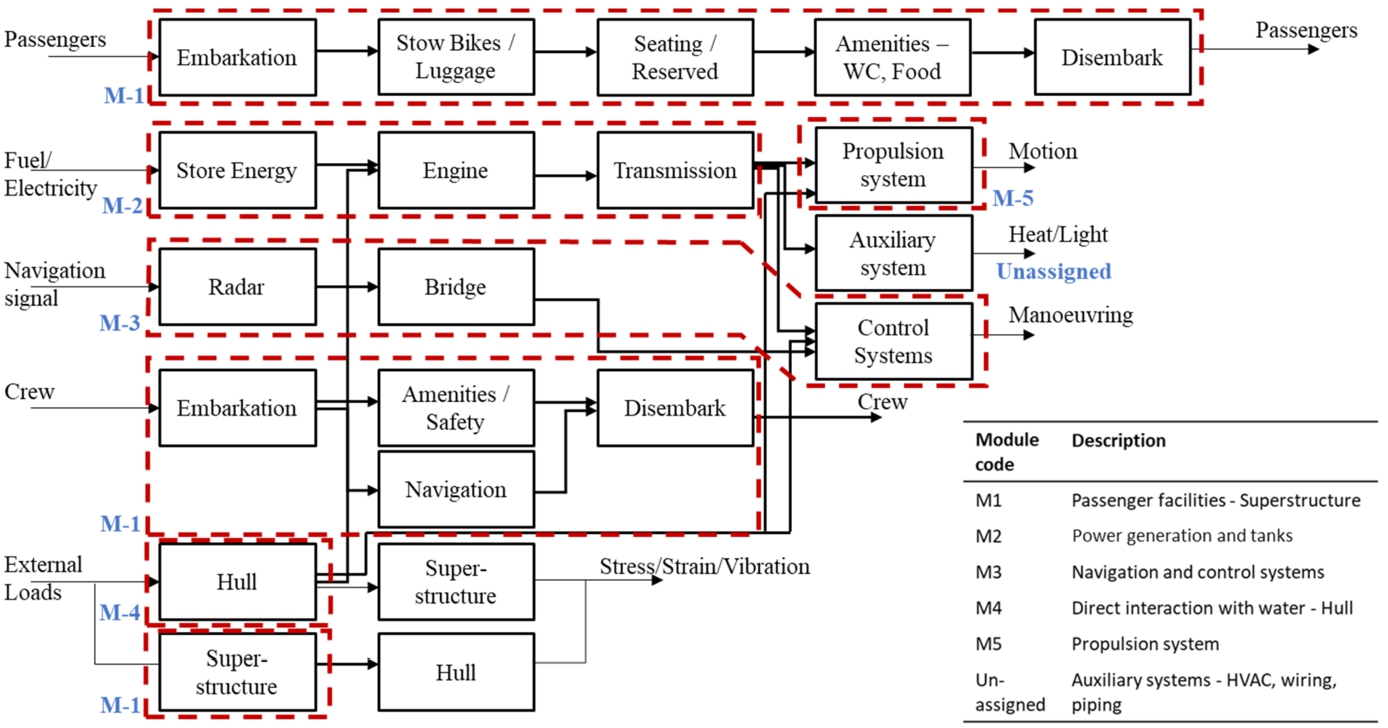
Function structure of a commuter ferry developed using FSH for identifying modules and sub-modules.
Three widely used methods for identifying modules are Design Structure Matrix (DSM) clustering, [52], Modular Function Development (MFD), [23] and Function Structure Heuristics (FSH), [67] and [85]. The three methods can lead to different modular suggestions and engineering judgment of the designer is paramount [32]. DSM is suitable for complex product architectures. MFD is a management-oriented method designed to modularize existing products on the basis of 12 modularity drivers. FSH is applicable for product families. This approach provides modularity suggestions based on flows visualized through the function structure. In this paper, DSM was found sensitive to clustering control variables and gave counter-intuitive modular suggestions while FSH performed well.
We start with building the ferry’s functional decomposition block diagram through which we model flows representing passengers, power, navigation signal, crew and structural loads as shown in Fig. 8. The paths taken by flows are segregated as modules and the sub-functions within are defined as sub-modules. In addition, [49] suggests considering production and assembly constraints. We also consider transportation constraints set by limiting cargo dimensions of 25.25 m × 2.6 m × 3.3 m [38] since handling and transporting bigger modules risk in an over-proportional increase in logistics costs, [63].
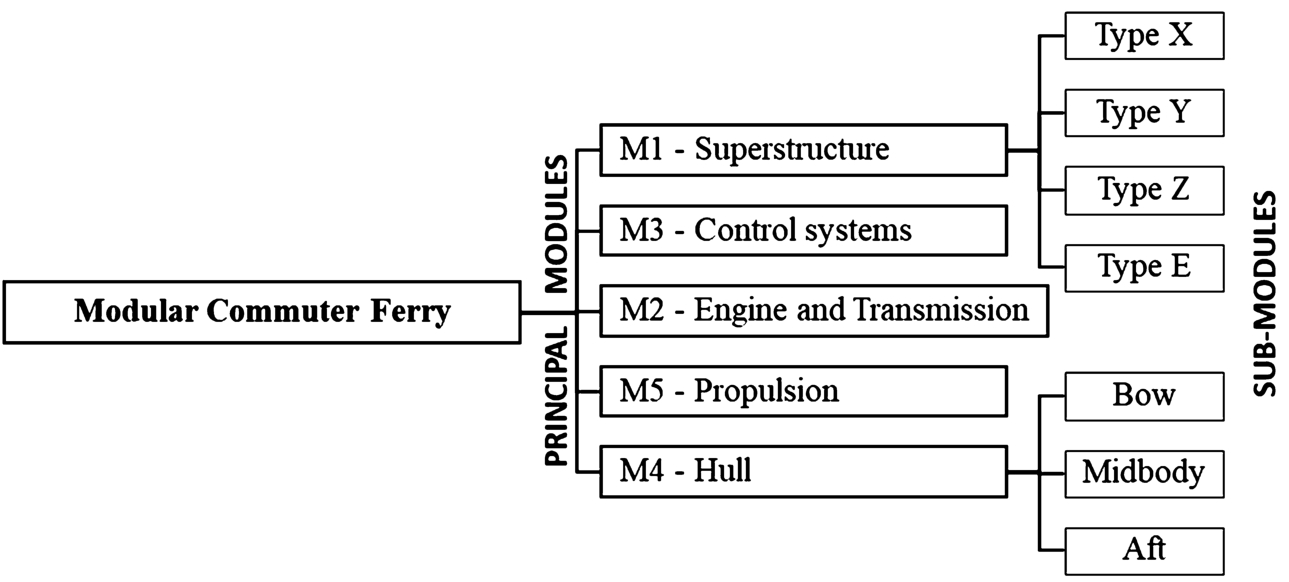
Modular hierarchal decomposition based on the ferry function structure.
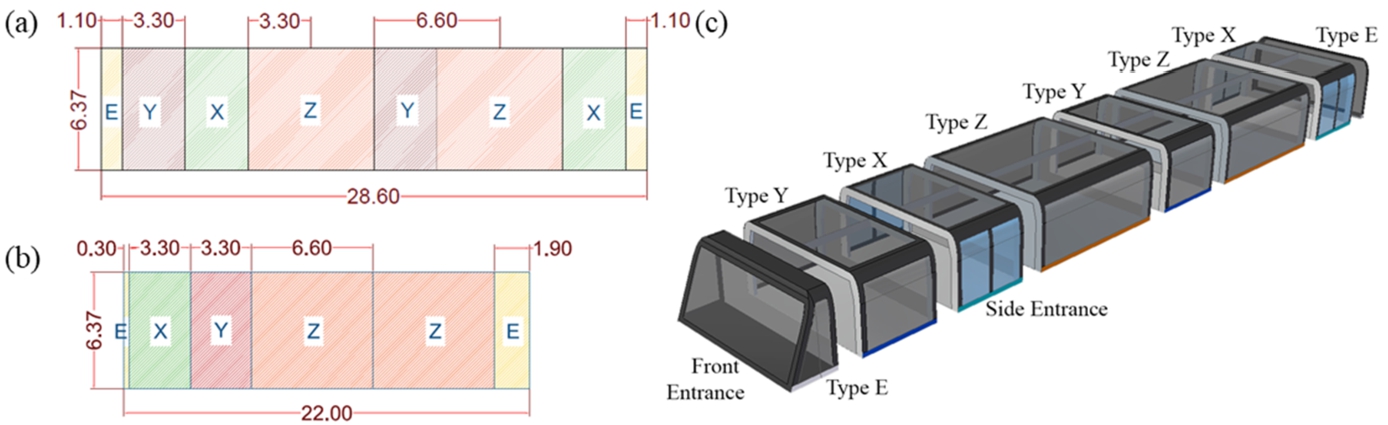
Superstructure sub-modules for large variant (a) and (c); small variant (b). Note the 3 sizes for Type E.
Correspondingly, the proposed modular commuter ferry concept is envisaged as an assembly of the five basic modules, M1–M5 in Fig. 8. The command bridge sub-function is included within the superstructure module M1 due to its proximity to the passenger facilities. Auxiliary systems, HVAC, piping and wiring run throughout the ferry and hence do not fall under any particular module. These are defined as non-modules by [5]. The modular hierarchy is shown in Fig. 9.
The dimensions of the modules/sub-modules are calculated considering repeatability of modules across functional variants as part of the platform architecture concept, shown in Fig. 10. The constraint equations are,
On solving these constraint equations, we get modular dimensions,
The modules are envisaged to have standardized, accessible and well-defined interfaces that are connected kinematically [63] so that modules containing integrated components like cables and piping are connected securely. This is key to achieving geometric interdependence [5]. Clearly defined interfaces offer ample opportunities for manufacturers to outsource the design and construction process and reduce the complexity [49].
Superstructure module
This module represents the passenger and crew flow in Fig. 8’s function structure. Its identified sub-functions are embarkation/disembarkation, stowing bikes/luggage, seating, amenities, and navigation. Correspondingly, 4 sub-module types are proposed to preserve functional independence. Then, the large diversity in commuter preferences can be addressed through independent module-wise tailoring.
The four sub-module types, designated as Type X, Y, Z and E are the basic building blocks on both ferry sizes. Sub-module type X undertakes amenities and navigation sub-functions. In addition to connecting structurally, it integrates with the hull module for operations wiring, sewage and exhaust piping and HVAC integration. The submodule houses the navigation compartment, WC, kiosks, safety equipment, reserved seating and empty space with provision for side entrances as shown in Fig. 11. A smaller unconventional navigation compartment is shown as an example in view upcoming developments towards smart systems and autonomous navigation. However, the design does cater for a traditional bridge which can be installed over sub-module type Y and Z. The side entrances are envisaged to be sliding doors with a 1.6 m wide gap, similar to metro trains [51], suitable for passenger embarkation including wheelchairs and carriages.
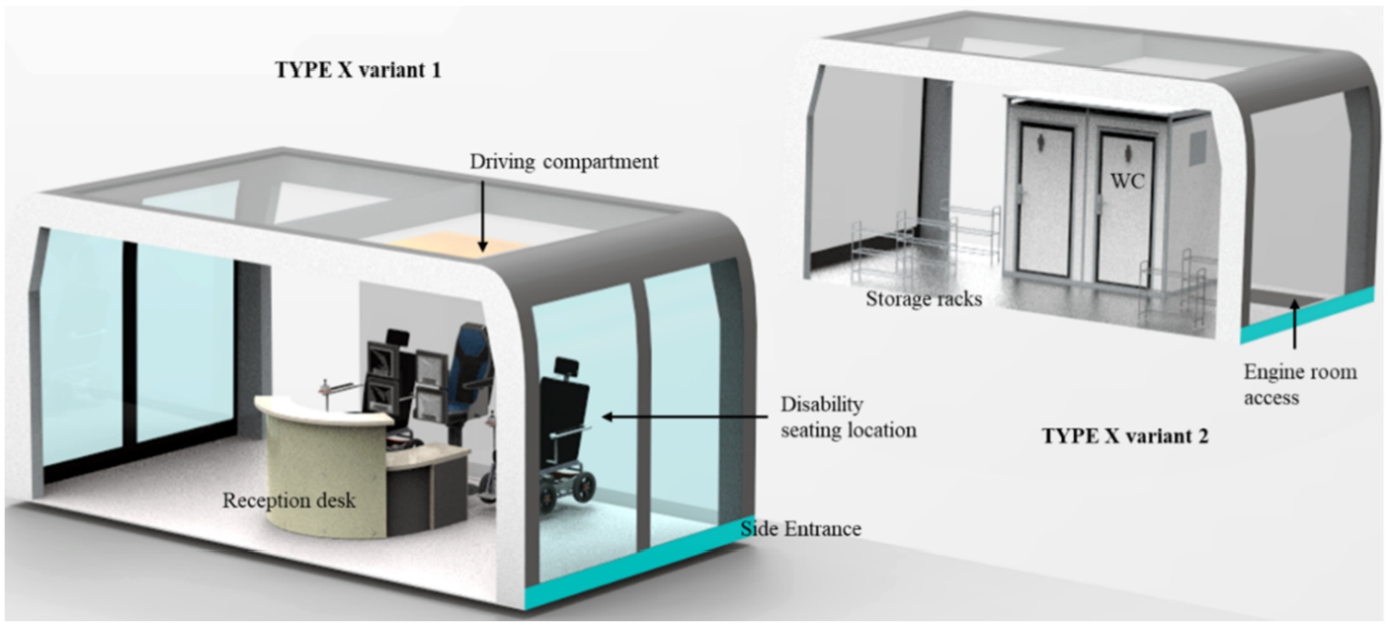
Examples of layouts for submodule type X.
Sub-module type Y represents the sub-functions: bicycles, and luggage spaces and type Z represents seating and standing spaces in Fig. 8. However, on grounds of commonality, their sub-functions can be interchanged. The reason for having two separate submodule types is to reduce the total number of submodules to be assembled. Correspondingly, type Z is defined as twice the length of type Y. The submodules may be designed to facilitate an additional sun deck and bridge on top. Examples of their layouts are shown in Fig. 12. Some new ideas are explored, for e.g., Fig. 12(e) shows a workstation layout with desks for commuters having long travel times. Figure 12(c) represents a transformable conference room for use during off-peak hours, encouraging efficient utilization of space and economic sustainability for the PTP.
Sub-module type E are at either ends of the superstructure. They represent the sub-function: embarkation/disembarkation in Fig. 8. Correspondingly, they may be modeled as entrances consisting of a ramp with sufficient space both passenger and bicycle embarkation. They come in three standard sizes as seen in Fig. 10(a), (b). A conventional ferry has a longer front submodule and a narrow aft submodule while a double-ender ferry has equally dimensioned submodules on either end.
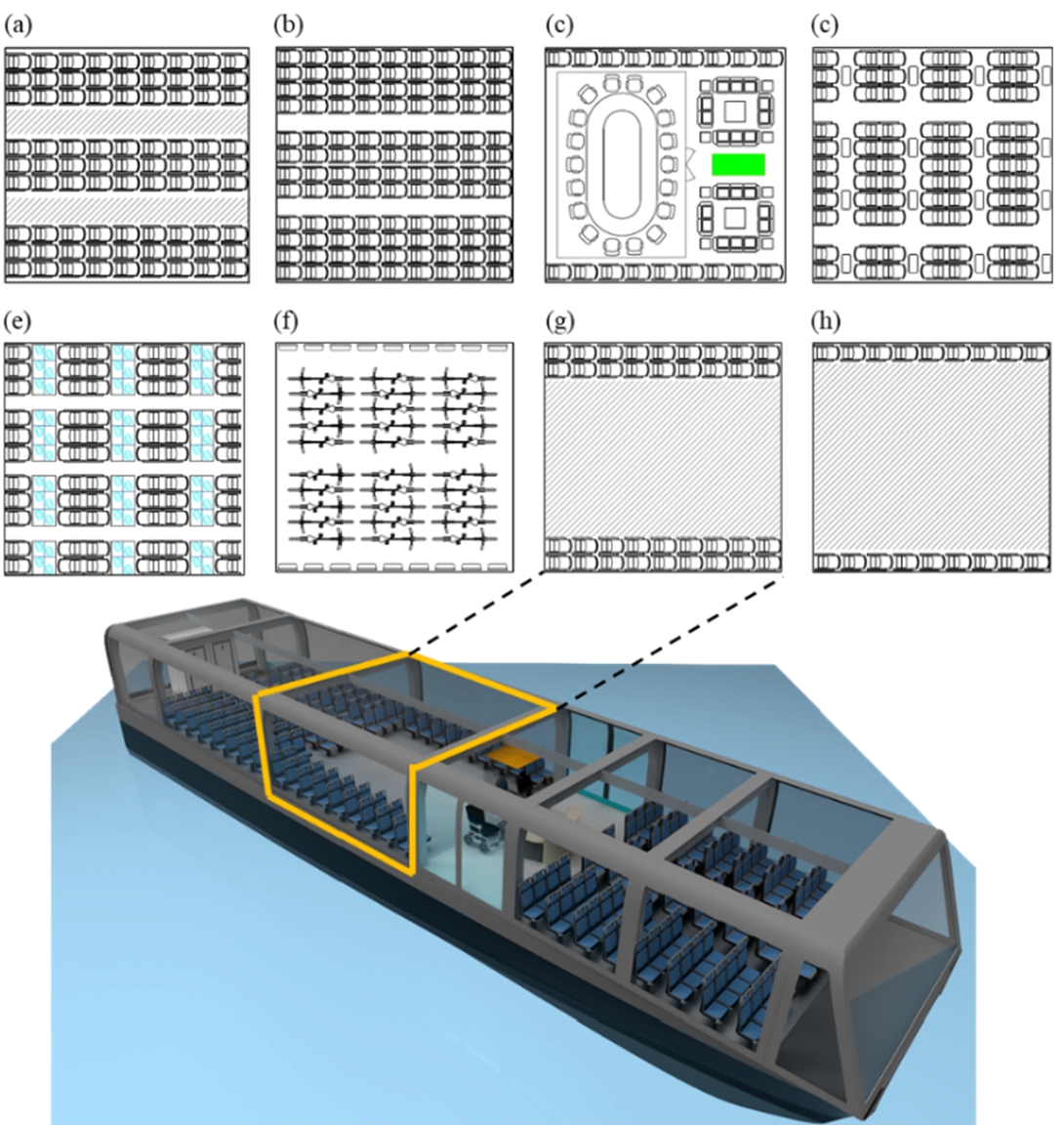
Functional variants of sub-module type Z. (a), (b), (d) represent seating layouts as observed in City and suburban route ferries. (f), (g), (h) represent layouts for standing passengers and bicycles typically seen on Bridge route ferries. (c) and (e) are new ideas representing a transformable conference room and an on-board workstation.
The hull can either be chosen from a set of standardized hulls or constructed modularly. The standardized hulls are a possibility considering sheltered urban waterways are largely similar. However, such hulls may not have an optimal form, material, or structural arrangement. Alternatively, a modular hull consisting of three basic sub-modules can improve adaptability to local conditions, as shown in Fig. 13.
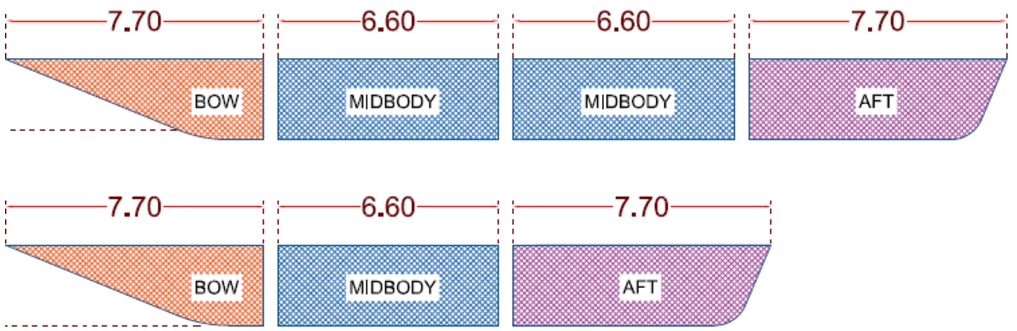
Hull sub-modules (m).
The dimensions of bow, midbody and aft sub-modules are chosen to accommodate repeatability of the midbody submodule while allowing room for aft/bow form variations. The sub-module depth is indicative of crew and machinery space requirements adapted from the ferry Yxlan [8]. Since the sub-module dimensions are larger than that permitted by road transport, they can be decentralized under the Japanese inhouse production model [68] or the industrial condominium model with outsourced production in the vicinity of the assembly yard [57]. Alternatively, the submodules may be split longitudinally such that the breadth is ∼3.2 m and eligible for transport.
The internal arrangement of the hull is imagined having standard interfaces for docking machinery, components, and tanks such that piping, and wiring is integrated between them. Figura 14 shows an example of an interface layout.
The manufacturing of engine & transmission, propulsion and control system components are generally outsourced to independent producers. However, [49] note the difficulty in integrating due to different sizes and no standard interfaces. If the hull GA aboard ferries are standardized, components can be installed in a plug-and-play setup facilitating easier upgrades and replacements. Correspondingly, the dimensions of component interfaces are deduced from an ice going WPT ferry Yxlan [8] as shown in Fig. 15.
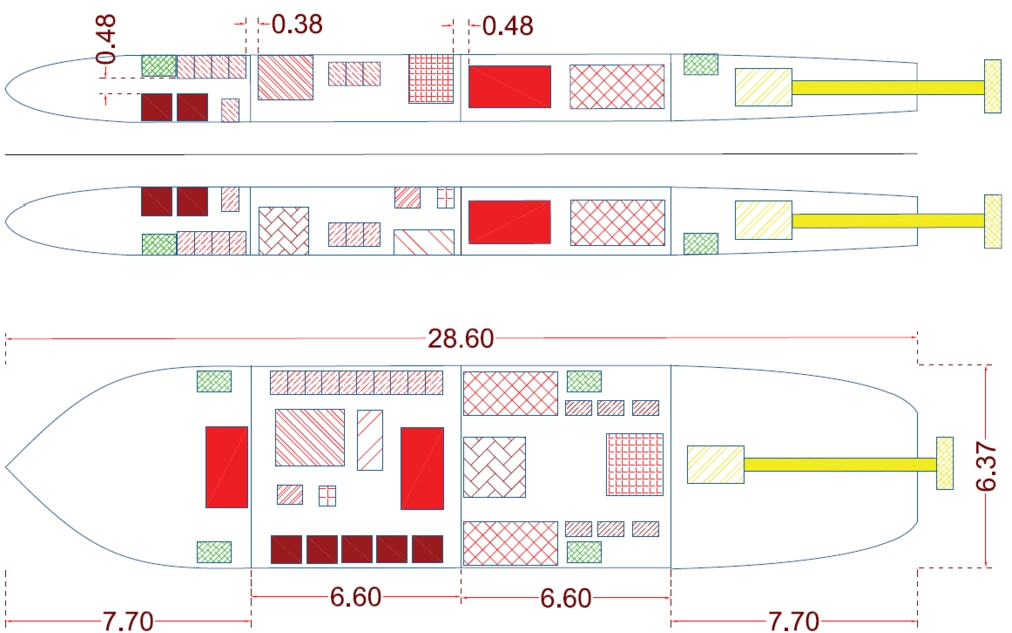
An example of intra-hull interface layout for the larger variant arranged for a catamaran and a monohull. Red slots represent engine & transmission, green represents control systems and yellow represents propulsion components.
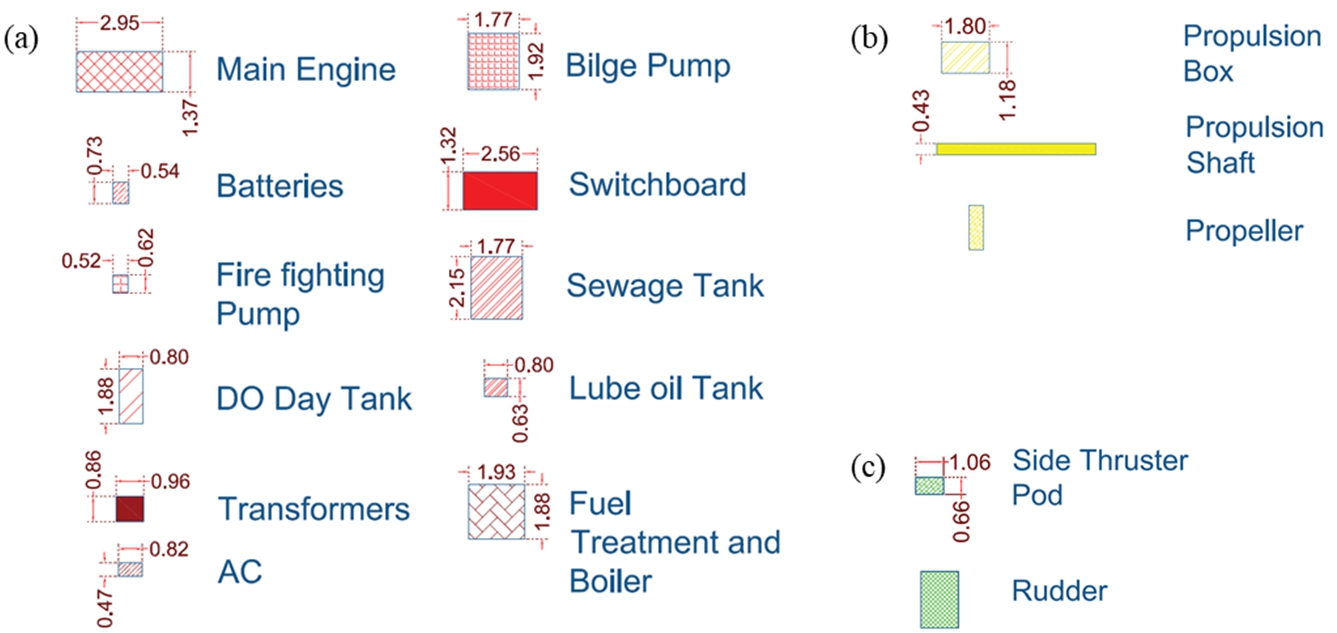
Engine & transmission (red), propulsion (green), and control systems (yellow) interfaces (top view).
An example of arrangement is shown in Fig. 14. The interface dimensions are envisaged such that most contemporary components can be accommodated. The interfaces must securely mount components while integrating piping and wiring between components. Such functionality enables the vessel to be future-proof allowing compatibility with modules [63].
Functional variants of modules and sub-modules can be cataloged as a database of designs which will enable assembly of a tailor-made ferry adhering to local operational requirements. The next section maps these requirements to modules for their customization and provides examples of the ferry concept’s application.
The modular arrangement shown in Fig. 16 is a template of functionally independent modules that can be individually tailored to meet operational requirements. To do this, one relies on a functional mapping between modules and requirements as shown in Fig. 17. Broad design choices may be made using the first two levels of the operational requirements structure. For fine-tuning of choices, one relies on the tertiary level: performance requirements. The functional mapping highlights important drivers that need to be considered during selection of appropriate modules from design catalogs. For example, in Fig. 12, both options (g) and (h) suit Bridge ferries. But an evaluation considering economic and social performance is necessary in choosing the most appropriate option. The methodology for choosing modules is further developed in [12].
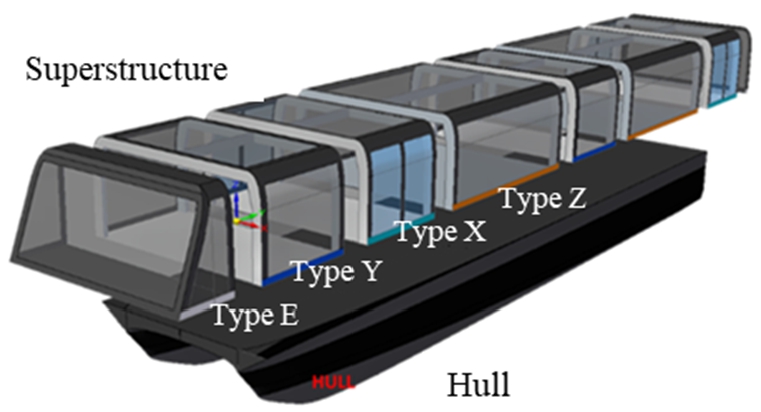
Modular arrangement of the modular commuter ferry concept.
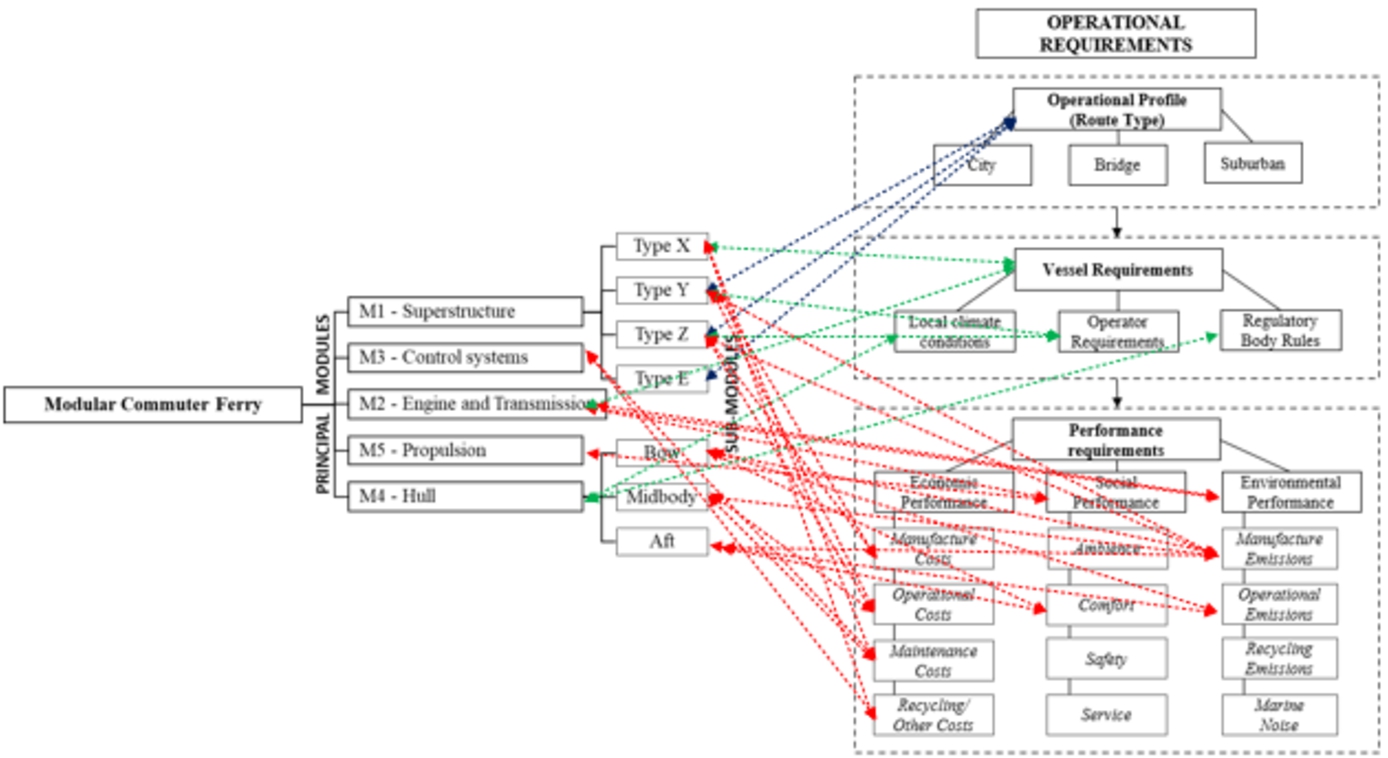
Mapping diagram between modules and operational requirements.
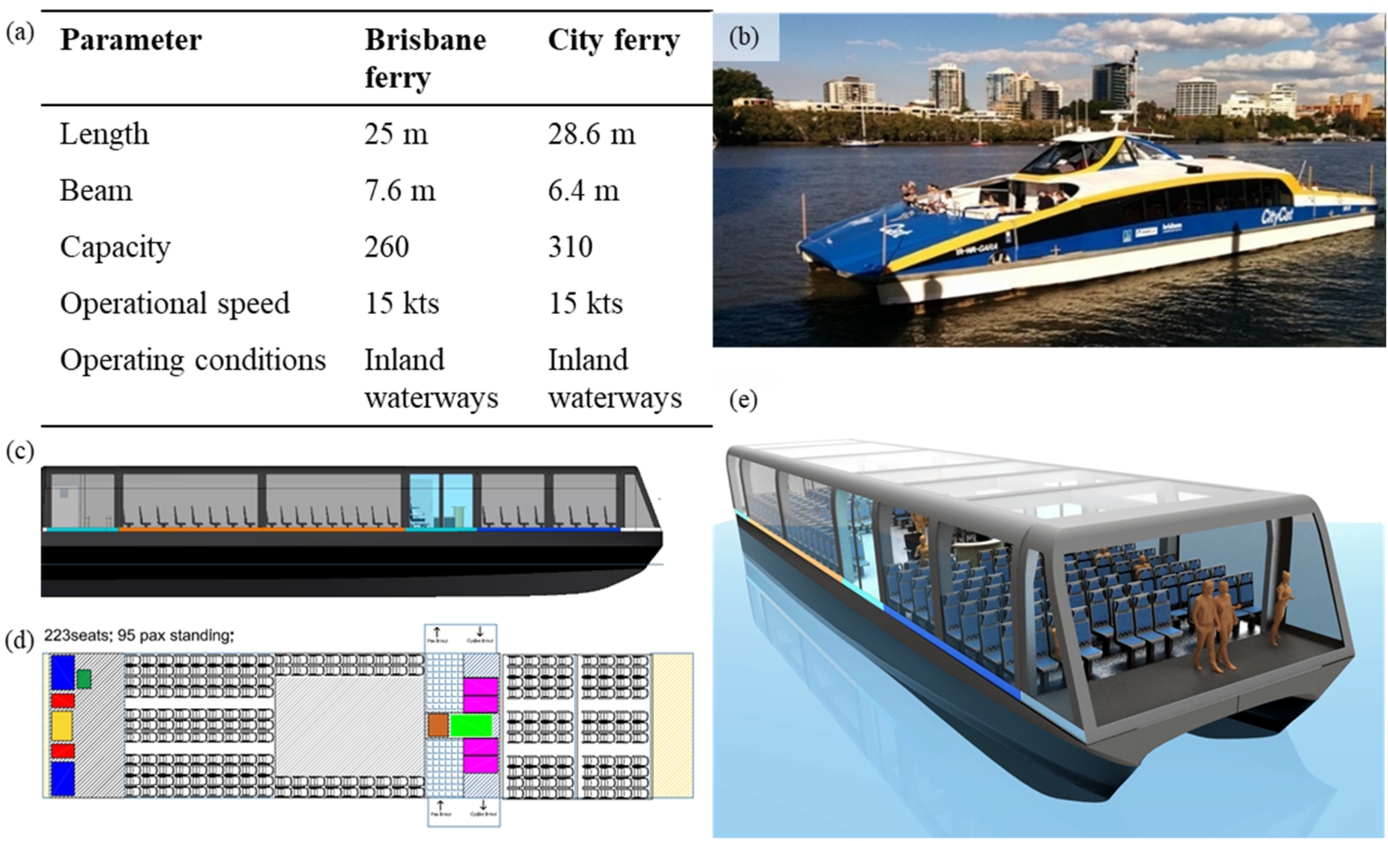
(a) Comparison of Brisbane ferry and City ferry vessel parameters. (b) CityCat ferry in Brisbane. (c), (e) Adaptation of modular city ferry for Brisbane. (d) GA of the city ferry tailored for operations in Brisbane.
Application of the modular ferry concept adapted to the three standard route types is shown and compared with WPT ferries in service. In these examples, the customization of modules is driven by their economic, social, and environmental performance requirements. All ferries have the same skeletal structure but are individually tailored to meet local needs.
City ferries serve a role similar to city buses. They commonly have front and side entrances, a mix of seating and standing spaces, basic amenities and bicycle stowing equipment. Figure 18(b) shows an example of such a ferry in Brisbane. On its route, the catamaran covers 6–8 stops with a total journey less than one hour. There is a high commuter volume between stops 2–4. Vessel particulars are compiled in Fig. 18(a).
In assembling the modular ferry, we assume similar operating conditions as in Brisbane and consult the energy comparison chart in Fig. 7(b). We observe that the larger catamaran variant with electric propulsion at a design speed of 15 knots and a medium weight hull meets conditions for Brisbane. The energy consumption of this variants is comparable with the diesel bus provided there are at least 100 passengers on the ferry. The modular adaptations are shown in Fig. 18(c)–(e) and its particulars are compared with the Brisbane ferry in Fig. 18(a).
In Fig. 18(d), submodule type Y and Z have been chosen based on social performance criteria such that the ferry has seats on either ends to cater for long distance commuters. The second submodule type Z’s layout is chosen to enable high commuter flow between stops 2–4 with quick access to side entrances on submodule type X.
Bridge route ferry
Bridge ferries act as vital connections across water bodies. They usually have double ended hulls, wide entrances and a high passenger capacity with minimal seating and ample space for bicycles. Passenger amenities are generally absent. An example of such ferry can be seen in Amsterdam, Fig. 19. It shuttles between 2 stops with the journey under 10 min and several commuters embark with bicycles.
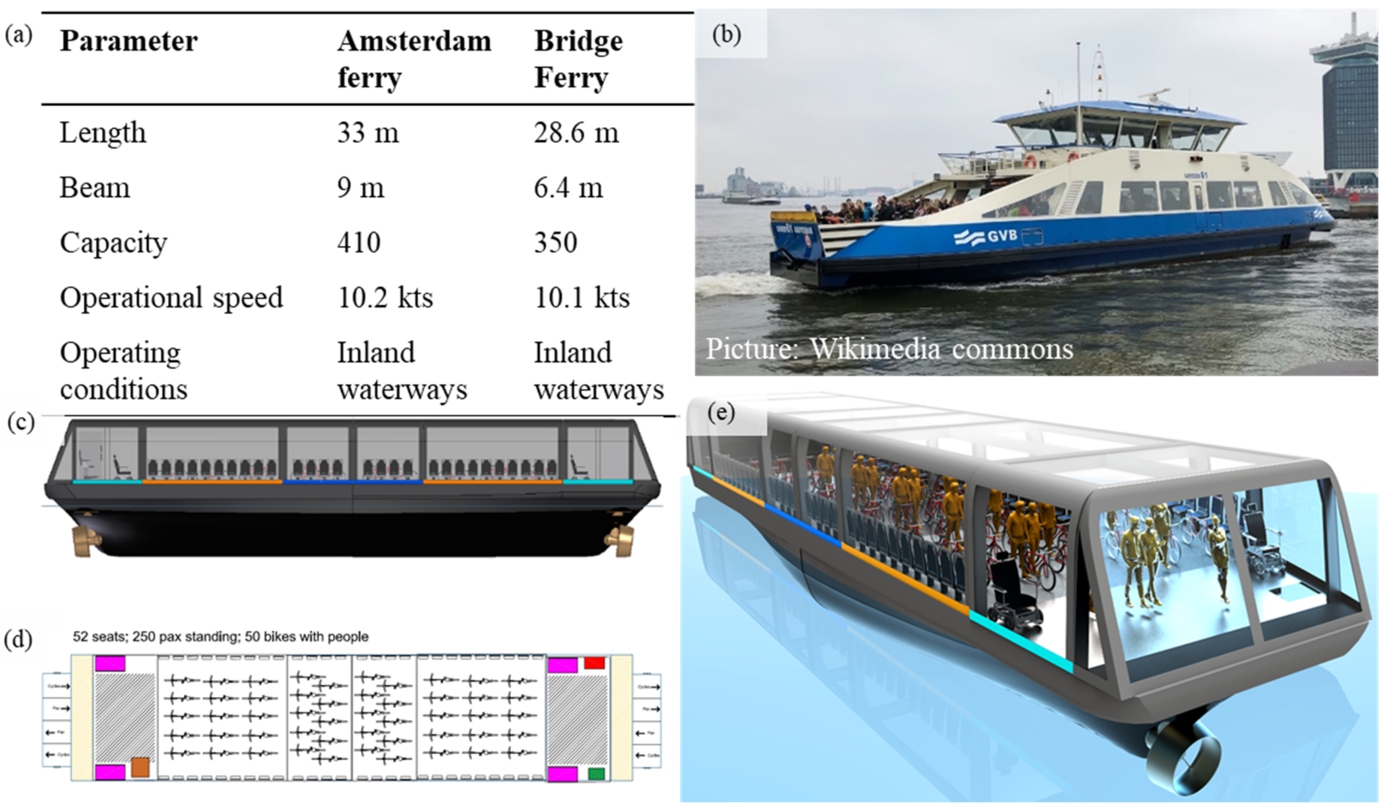
(a) Comparison of Amsterdam ferry and Bridge ferry vessel parameters. (b) Amsterdam ferry. (c), (e) Adaptation of modular bridge ferry for Amsterdam. (d) GA of the bridge ferry tailored for operations in Amsterdam.
Assuming the operating conditions in Amsterdam, the modular ferry is assembled in consultation with the energy consumption chart in Fig. 7(a). We observe that at high capacities, there are limited energy savings to be expected from a lighter hull. Considering economic performance, a heavy double-ender hull with diesel propulsion is suitable. At 10.1 knots, the energy consumption is comparable with a diesel bus provided there are at least 100 passengers on the ferry. The modular adaptations are shown in Fig. 19(c)–(e) and its particulars are compared with the Amsterdam ferry in Fig. 19(a).
In Fig. 19(d), submodule types Y and Z focus on bicycle and standing passenger capacity with one row of folding seats along the edges. The entrances are placed for smooth embarkation and disembarkation. Submodule type X have wheelchair spaces close to the entrances. The double ended ferry has wide exit ramps on both ends that can extend out.
Suburban ferries connect suburban areas to the inner city. The design orientation is towards comfort and achieving meaningful time spent onboard. They have comfortable seating, desks/tables and amenities like WC, cafeterias and Wi-Fi and have space for bikes and luggage. Figure 20(b) is an example of such a ferry in Stockholm. The city faces ice during winter. The route has 4 stops with an inter-stop travel time of over 15 mins. Some commuters travel with bikes. Onboard activities include working, relaxing, eating and socializing [70]. Vessel parameters are compiled in Fig. 20(a).
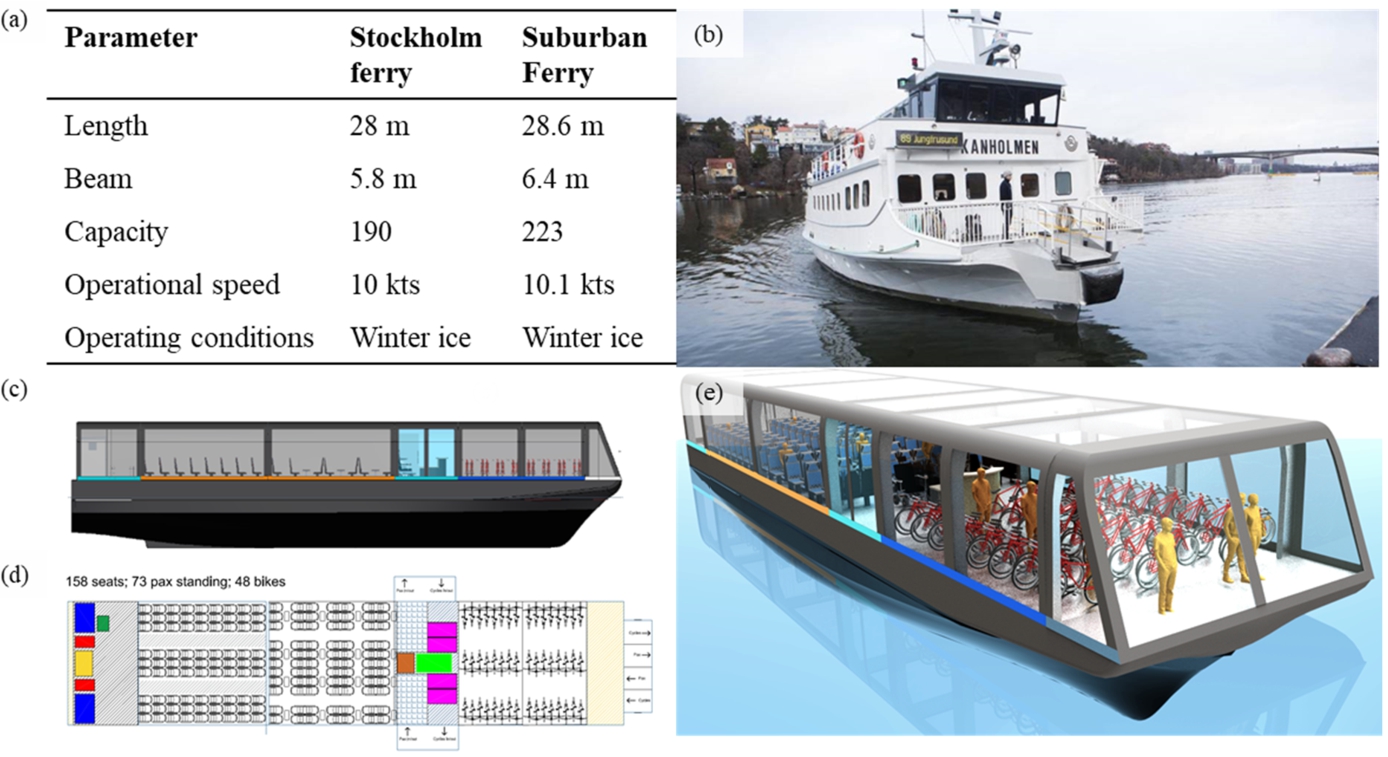
(a) Comparison of Stockholm ferry and Suburban ferry vessel parameters. (b) Stockholm ferry. (c), (e) Adaptation of the modular suburban ferry for Stockholm. (d) GA of the suburban ferry tailored for operations in Stockholm.
Assuming operating conditions in Stockholm, the modular ferry is adapted to have a steel monohull with diesel propulsion to navigate in ice. From the energy consumption chart in Fig. 7(a), an operational speed of 10 knots provides an energy consumption comparable to diesel buses provided there are at least 100 passengers on the ferry. The modular adaptations are shown in Fig. 20(c)–(e) and its particulars are compared with the Stockholm ferry in Fig. 20(a).
In Fig. 20(d), both submodule type Z’s are configured for spacious and comfortable seating which is both front facing as well as twin facing with tables to encourage socializing. The forward submodule type X has been adapted to host a cafeteria with vending machines. The wheelchair spaces are placed close to the side entrances. The two forward submodule type Y are oriented to stow bikes. The forward Type E submodule has a wide entrance for bike passengers. At the aft of the vessel, there is a WC, safety boxes and a luggage storage area. All superstructure modules have large windows and Wi-Fi that promote comfort under Social performance.
WPT presents a good complement to the existing transportation network in alleviating urban congestion and pollution and in adding travel paths. However, its implementation today is riddled with challenges. Further, PTPs view on ferries being difficult to procure, slow and environmentally inefficient dents their confidence in adopting WPT. In overcoming some of the challenges it is expressed that availability of efficient, economical, and easily procurable ferries is pivotal towards improving the current state of WPT. Correspondingly, this paper explores the idea of a ferry product family as part of a platform architecture. A modular architecture is adopted to meet this goal resulting in a modular ferry concept whose overall parameters, module definitions and interfaces are standardized while their designs customizable. This leads to a large variety of functional variants with savings in production cost and time. In the development of this ferry concept, vessel parameters are identified where its energy efficiency is comparable with buses. Such a ferry can be efficient as an integral part of the public transportation network.
The process begins with developing a commuter ferry template suitable for urban sheltered waters. The template represents a standard platform. Starting with such a platform may not be the best approach when there are a large number of functional requirements. But by identifying system boundaries corresponding to route type and local weather, it might be possible to possible to limit the diversity of functional requirements. Then, starting with standardization of the ferry platform may be justified. Two major outcomes of this phase are vessel size and speed, including overall dimensions. To deduce these, one relies on information gathered up to the secondary level of the operational requirements structure. In this paper, two standard vessel sizes are identified along with an operational speed range as a function of hull-weight, number of passengers, propulsion-type, hull-type and vessel size. Through the investigation, speed ranges are identified where ferries are comparable in speeds and energy consumptions with buses. The charts presented provide a good starting aid in picking vessel parameters. In general, one might intuitively opt for a lighter hull to be more energy efficient, but a heavier hull in certain cases, especially for bridge routes might be a more economical option. In general, ferries and busses are compatible in energy efficiency and speed.
Building upon the skeletal structure as frame, a modular architecture for the ferry is developed following FSH, leading to five standard modules. The definition of modules is based on physical standardization of components. But there can be other ways of defining modules (for example, by function and requirements) which can significantly change the design methodology. Our adopted definition traditionally suits high-volume production models. We justify the possibility of high volume through the proposed division into routes-types and sheltered WPT conditions. However, further work in defining system boundaries is needed before large scale production can be justified.
Under FSH, we base the proposed modularization on design and transportation constraints. Being built upon a product platform strategy, the modules are uniform across functional variants. The standardization arises from defined modular dimensions and interfaces. Its internal arrangement is open to customization. Some modules are further divided into submodules to increase design flexibility while some sub-modules are combined on grounds of commonality to reduce design complexity. Different functional variants of modules/submodules can lead to a catalogue of designs for the PTP to choose from. The tertiary level of the operational requirements structure aids in choosing between alternatives. This enables the PTP to participate in the design process from early on, giving them greater control as opposed to the existing model.
A careful first design of the modular ferry concept together with the modules are required to set the standard for WPT. Then, modular ferries configured with custom modules suitable for the given operational profile will exhibit high operational efficiency. Some key advantages and disadvantages of the concept are worth discussing.
One advantage of modular architecture from a design perspective is that it can lead to flattening of the design spiral. Since modules are pre-defined, improvements are limited to individual modules instead of re-designing the entire vessel, as is prevalent under the ship design spiral model. Further, modular functional variants can have significantly lesser costs than their individually tailored counterparts [5]. The design effort for new vessel orders at shipyards also gets reduced which could lead to a potential ∼11% time savings [46]. In terms of labour requirements, there are significant savings due to standard modules and interfaces [5]. Also, there are time-savings with faster and cheaper conceptual developmental times [18] and faster processing times for new orders [63]. Lower costs, faster development and closer participation make ferries “off-the-shelf” accessible similar to buses and are incitements for changing the PTP’s view on the waterborne as something difficult.
From an engineering perspective, well-defined modules and interfaces allows outsourcing of development and production [49]. This reduces complexity in design as well as allows parallel development and production, leading to innovation. Further, only individual modules are affected by the development of variants [63]. For the PTP, this provides greater control in customization and gives access to greater variety originating from multiple manufacturers.
During the operational phase, a tailored modular ferry is more likely to produce lower emissions and keep social satisfaction high as compared to a refurbished vessel which is a great incentive for PTPs. The standard module definitions and interfaces promote reusability [3] as opposed to traditional ferries. Also interfaces ease part replacement and upgrades, thus prolonging the service life [14] and [31]. Finally, during the post operational phase, such a ferry would be easier to recycle with easier segregation of the components [30].
Disadvantages of the concept are that the modular commuter ferry may not be as efficient or have the same level of quality as an individualised custom ferry. Though flexible in adapting to roles, it is still bound by the constraints set by the standardized aspect of the design. There is also a disadvantage that suppliers of modules like engines may not all conform with the standard interface which can make integration difficult [49]. Finally, modular products usually have higher weights and structural volumes as compared to specially designed products [5]. This may lead to over dimensioning of ferries and greater displacement than anticipated.
Based on this discussion, we compare the costs of new tailored ferries, second hand vessels and modular ferries in Fig. 21. During the developmental phase, tailored vessel costs would be lesser than modular ferries owing to well established design practices and in-house experience at shipyards. Further, modular ferries have design complexities that must be overcome during initial design. Once the engineering is established, modular ferries are expected to have lower production costs and faster production times. When viewed from a high-volume production perspective (similar to aircrafts), quick manufacture times and low production costs would be key.
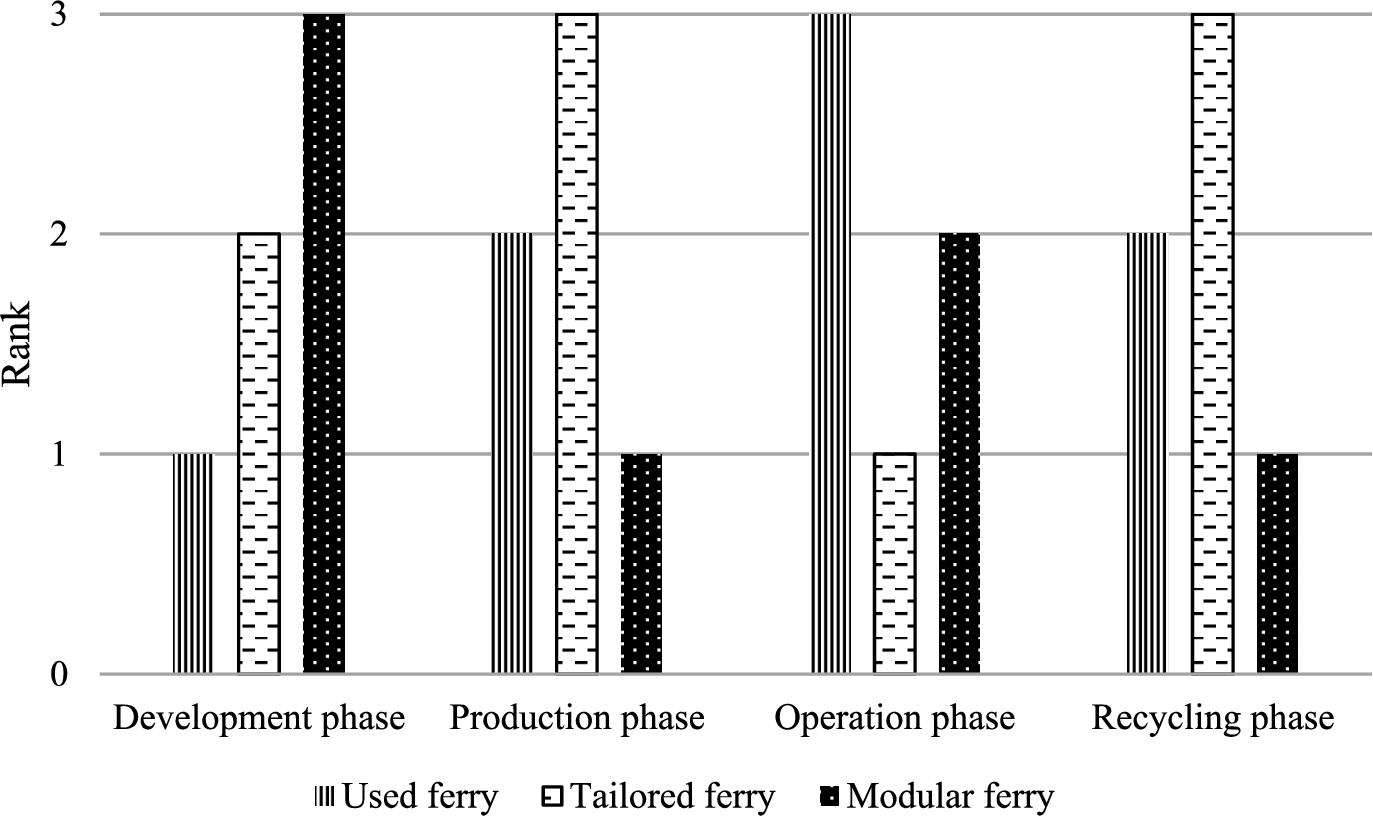
Comparison of estimated cost of second-hand vessel, tailored ferry and a modular ferry during development phase, production phase, operational phase and recycling phase.
In practice, operational costs are higher and more critical than capital costs for the operator. A tailored ferry would be the most cost-efficient option despite a high manufacturing cost. However, owing to sheltered WPT conditions, it would be possible to develop a set of standard energy efficient hulls for modular ferries. Moreover, tailored ferries represent longer procurement times than modular ferries. Considering these two factors, it is worth arguing for the adoption of modular ferries. The second-hand vessel in comparison would perform the worst as non-tailored hull shapes can have significant resistance penalties as well as poor superstructure space utilization. During the recycling phase, modular ferries are expected to be most favourable due to its higher reuse and recycling potential.
There are several thousand of ferry routes in Europe alone and we see very little in common between ferry designs. If these operating conditions can be defined under sets of system boundaries, it might be possible to introduce standardization of design. Then, the modular ferry represents a lot of potential in achieving customization. This is worth exploring in future studies.
The outlined modular ferry idea here requires further refinement. While the ferry is envisaged to follow classification society rules, the concept’s structural design needs to be thoroughly investigated. This includes local and global analyses for sub-modules, modules, interfaces, and assemblies. This could also lead the development of a function based regulatory framework. Further, detailed design and diligence are required for the development of interfaces. Inter-sub-module interfaces need to sustain and transfer structural loads efficiently while integrating piping and wiring kinematically. Intra-sub-module interfaces for mounting components like machinery and seating need to satisfy machinery requirements. Future work will focus on developing a modularization methodology and comparisons with non-modular vessels from a life cycle perspective.In general, the design methodology adopted in this paper may be applied for developing any vessel product family. But above identified shortcomings need to be addressed and further work is required towards a working methodology. We demonstrated the ideas in developing energy efficient ferry product family, comparable in speed with buses, economical and easy to procure. Through modular architecture, it is possible to tailor standard ferry units to meet local requirements. The concept makes it easier for the PTP to participate in tailoring the ferry to match requirements and address some of the limitations affecting the current perception of waterborne public transportation.
WPT offers an opportunity to complement the existing public transportation network in reducing growing congestion and pollution in cities. In contrast to contemporary view of ferries being polluting, slow, expensive and difficult to procure, the paper shows that the ferries can be comparable with land-based modes in terms of energy efficiency and speed. The problems associated with difficulties in procuring and high costs are tackled through proposing modular ferries resulting in a product family under platform architecture. In this regard, two standard sizes of commuter crafts with deck area 180 m2 and 140 m2 are presented. Naval architecture calculations show that the two ferry platforms have adequate stability, seakeeping properties and that the variation in draught during embarkation and disembarkation is reasonable. Further, speed ranges for different hull types are identified corresponding to the introduced three standard route types. The potential to save weight and in turn increase the energy efficiency is concluded. Function structure heuristics is used to divide the ferry platform into structurally independent modules. Standard definitions and sizes of these modules are proposed. The tailoring potential of the modular ferry is expressed by matching module characteristics with operational requirements. The modular ferry’s application in different cities is illustrated. It is concluded that by modularization, the procurement costs and manufacture time can decrease while the tailoring potential can increase. This can simplify the process of acquiring tailored ferries and positively influencing the current perception held by PTPs. The design concept allows for the PTP to be closely involved in fulfilling their various sets of requirements. With further development, it would be possible to see standardized ferries operating as part of the public transportation around the world. The modular standard ferry, as the equivalent to bus and articulated bus in the mind-set of the PTP, might be the key to using the free space on urban waters sustainably.
Author contributions
Author 1: Conceptualization, Methodology, Software, Validation, Formal analysis, investigation, writing – original draft and visualization.
Author 2: Conceptualization, Formal analysis, Resources, Writing – review and editing, Supervision, Project administration and Funding acquisition.
Footnotes
Acknowledgement
The Swedish Transport Administration is acknowledged for financially supporting the research program Waterborne Urban Mobility TRV 2018/6471.