




Abstract
Despite citizen calls for agile government, public service organizations often default to hierarchy and adopt dual structure organization designs combining agile and non-agile units. However, ensuring effective collaboration and avoiding accountability challenges at the interface of line and agile units remains a vexing issue. Although accountability is implicitly assumed in agile organizing, it is not readily manifested or experienced. Through this interpretive case study of a public service organization in the Nordics, we examine through the lens of felt accountability, the reaction and roles of line managers to emergent accountability challenges precipitated by parallel maintenance of agile and non-agile unit combinations.
Keywords
Introduction
Despite the fanfare surrounding newer, flatter forms of organizing, and the ongoing zeitgeist that encourages repudiation of hierarchy and adoption of new ways of governing (Mergel et al., 2021), organizing through hierarchical means remains prevalent, pragmatic and persistent (Foss & Klein, 2022; Lee & Edmondson, 2017). There is considerable research in the recent past that suggests that despite the benefits of flatter forms of organizing – employee autonomy, satisfaction, empowerment and entrepreneurialism, there are limits to less hierarchical organizing in large organizations where hierarchy proves to be more effective (Lee & Edmondson, 2017). Importation and supplantation of agile practices in government agencies and organizations has been found to be even more challenging and almost antithetical, given the idiosyncrasies of public organizations (Mergel et al., 2021).
The tendency for defaulting to hierarchy is broadly in consonance with the earlier findings which suggest that hierarchical arrangements are a prerequisite for organizations which grow beyond a certain size (Jacques, 1990; Monteiro & Adler, 2022). This is more so pertinent in public service organizations (PSOs) where hierarchical means of organizing are both entrenched and preferred (Li, 2023), but also hard to abandon, despite earnest attempts to pay heed to citizen calls for improved “customer” experience from government agencies (Mckinsey, 2020). A proposed remedy for improving citizen experience while interacting with government agencies and public service organizations has been the adoption of “agile government principles” (Mergel et al., 2021).
Both, academic literature (Mergel et al., 2021) and management consulting studies (Mckinsey, 2020) have highlighted the specific challenges which make adoption and operationalization of agile principles and practices particularly difficult in public sector environments. Obstacles to implementation of agile practices in PSOs include prevalence of hierarchical cultures, discouragement of iterative routines and fail fast approaches, reluctance in delegation of responsibility and complex procurement and partnership environments. These organizational characteristics of PSOs are often blamed for undermining successful adoption of agile practices and attendant gains in the public sector (Mergel et al., 2021).
Previous academic research has alluded that PSOs, by virtue of operating in a complex web of accountability relationships (Aleksovska et al, 2019; Overman & Schillemans, 2022), prefer a hierarchical organizational structure where accountability folds up in a vertical manner (Romme, 2019). This view of accountability maintenance through hierarchy has been dominantly employed by governance and policy scholars to understand accountability in public sector organizations (Schillemans & Busuioc, 2015).
Mergel (2023) concedes that it remains an empirical puzzle as to how PSOs which are predominantly hierarchically organized – not least for accountability considerations, can adapt to introduction of agile approaches. The accountability challenge of introduction of agile units in a wider non agile environment has also been highlighted in earlier research (Theobald & Diebold, 2018). In order to avoid drastic changes which may throw internal accountability mechanisms and routines into disarray, PSOs are embracing agile government prescriptions through partial introduction of agile unit configurations alongside more traditional hierarchical set-ups. This permits them to attend to both the need for faster decision making and greater citizen centricity in services, as well as effectively managing their complex partner and stakeholder relationships with departments and units which are more traditionally organized.
Such contexts of parallel maintenance of agile and non-agile units within the IT organization of PSOs opens up an interesting research avenue for understanding both theoretical and practical considerations relating to how these units and their managers interact to support both organizational and individual level accountability.
Our research question in this paper is to understand as to what are the accountability implications and roles of line managers in agile and non-agile unit combinations in Public Service Organizations? More specifically, we want to explore
This is an underexplored area within agile governance research wherein PSOs introduce agile structures and practices in their IT departments, while the rest of the organization remains hierarchical to support accountability considerations. To the best of our knowledge there have been no prior empirical studies which have examined accountability implications of interaction of agile and non-agile units in the public sector context.
To explore this question, we draw on an interpretive qualitative case study conducted in the IT department of a large Nordic public service organization in the postal sector which adopted a dual structure combining agile and non-agile units to pursue its aim of becoming more citizen centric. We rely on the concept of “felt accountability” to inform our analysis of line-agile structural forms in PSOs, which though intuitive, have received limited attention in terms of operationalization from an accountability perspective. We identify the specific challenges of parallel maintenance of agile and non-agile unit combinations, and how line managers compelled by felt accountability build bridges between the agile and non-agile unit combinations in public service organizations.
The remainder of the paper is organized as follows. In Section 2 we provide a theoretical background of the concepts we utilize in our study and introduce the analytical framework of felt accountability to examine the challenges surrounding the management of dual organizational structures – the parallel maintenance of hierarchical and non-hierarchical units, while specifically focussing our analysis on ‘line-agile’ unit combinations. In Section 3 we present the relevance of our research context, data collection methodology and data analysis details. In Section 4 we present our findings and results. Finally, in Section 5 we discuss our findings in view of the extant literature and in Section 6 present our conclusions, while also appreciating the theoretical and managerial implications of our study, identifying limitations thereof and suggesting avenues for future research.
Theoretical background and analytical framework
To situate the empirical puzzle within the relevant literature and also to establish an analytical framework, we review what we already know about accountability, agile governance and the role of line managers.
Agile government and the impetus for agile practices in public service organizations
Public service organizations around the world are under increasing pressure to provide citizen services in a faster and a more personalized manner prompting adoption of agile methodology prescriptions initially implemented and popularized by its benefits in IT environments (BCG, 2019). Mergel et al. (2018) describe agile government in administrative parlance as “responding to changing public needs in an efficient way”. More recently, Agile government has been described as “a form of governance innovation consisting of organization-specific mixes of cultural, structural, and procedural adaptations geared towards making public organizations more flexible in changing environments, ultimately pursuing the goal of increasing efficiency, effectiveness, and user satisfaction” (Neumann et al., Forthcoming). This view of agile governance necessitates examination of the organizational structure choices that PSOs make with the goal of striving for increased efficiency relating to their provisioning of citizen services.
Governments around the world rely on public service organizations to deliver a variety of direct and indirect citizen services. As governments fully or partially own these enterprises, PSOs are an important area of enquiry for understanding the implementation of agile practices, as in many industries and sectors such as electricity, transport, postage and telecommunications they are the key national players (Florio, 2014).
Partial introduction of agile units in largely hierarchical and line based PSOs
Agile organizational designs seem quite effective and intuitive by their promise of greater customer responsiveness and flexibility, and have prompted enterprises to adapt how they introduce agile and its variants internally (Gerster et al., 2020). However, implementation challenges of agile approaches and organizing principles in the public sector are in abundance, given the preference for hierarchical organizing, idiosyncratic leadership styles and complex partner relationships (Nuottila et al., 2022). Given these obstacles, past research has shown that implementation of organization wide agile transformations is often difficult (Wisitpongphan & Khampachua, 2016), and public sector organizations have experimented with introduction of agile ways of working mostly partially, and typically in their IT departments (Ylinen, 2021) to respond to citizen calls for more responsive and agile public services (Janssen & Van der Voort, 2016).
A possible remedy to the task of a complete overhaul of the organizational structure from hierarchy to flatness has been suggested with the adoption of a “dual structure organization” (Kotter, 2014) harnessing both “network” and the “hierarchy” and promising to combine benefits of hierarchy and the agility of flatness. McBride et al. (2022) argue that in Agile government, both structure and agility are dual necessities. This may provide a possible explanation as to why public service organizations embrace these line-agile unit combinations.
In public sector contexts, hierarchy provides stability and accountability for the enterprise, while parallel agile arrangements allows for entrepreneurialism, innovation and citizen centricity to flourish without being bogged down with rules, standard operating procedures and strict routines which are often lamented and said to plague contemporary PSOs (Baxter et al., 2023). This dual structure is possibly pursued so that the non-agile units provide guardrails of accountability necessary for a large, complex organization, while the agile units provide freedom of innovation that public sector organizations aspire for.
The choice of parallel maintenance of agile and (hierarchically organized) line units is a form of hybrid organization design which although prevalent in private enterprises is not a widely studied structural form in public administration scholarship. However, scholars in the adjacent field of strategy have examined such structural arrangements through the concepts of dual operating structures (Kotter, 2014) bimodal organization (Haffke et al., 2017) ambidexterity (O’Reilly & Tushman, 2013), exploration-exploitation (March, 1991), hybrid organizations (Battilana & Dorado, 2017) and matrix and project organizations (Ford & Randolph, 1992).
Accountability concerns in traditionally organized PSOs which are addressed by virtue of vertical orientation of hierarchical relationships are potentially exacerbated in agile forms of organizing and work arrangements. This is not surprising since the problem of accountability in agile set-ups is not new and has been documented in earlier academic research (Sharp & Taylor, 2020). Agile team members are often perplexed with issues of accountability and expect it to be “automatically” resolved and ensured through self-organized interactions but are left wanting. To remediate this, past research has predominantly focussed on developing accountability architectures within the agile units in the private sector contexts (Ross et al., 2019). However, as public organizations are not operating with a pure play, fully agile design, especially at scale, questions of maintaining internal accountability in structures combining agility and hierarchy assume even greater importance.
Evolving role of line managers in agile governance transformations
In the public sector, line managers implementing agile governance efforts by interacting with agile units are paradoxically faced with the challenge of managing teams which should be autonomous and yet accountable. This renders the role of line managers even more crucial.
The opportunities and challenges presented by the role and response of line managers in public sector environments has gained increased scrutiny as their adoption, support and acceptance of agile mindsets and practices is considered to be crucial to the success of agile governance initiatives (Mergel, 2023). The perception of line managers towards introduction of agile methods and organizing remains an empirical puzzle and is central to understanding why they may support or undermine success of agile governance programmes.
The specific dynamics of line managers’ interaction with their agile unit counterparts has also gained increased prominence in recent academic studies and have shown that even though middle level line managers are charged with facilitating agile implementation, they struggle to make sense of the change themselves and experience intense confusion (Annosi et al., 2020). Further, the evolution of line managers’ roles in their interactions with agile unit counterparts has been found to be quite important to success of agile transformation efforts (Annosi & Lanzolla, 2023).
Within this backdrop, line managers operating in dense webs of accountability are faced with the difficult challenge of providing both the necessary freedom to their associated agile units, but also erect necessary scaffolding to ensure requisite accountability.
Felt accountability amongst line managers in public service organizations
Accountability is generally defined as a “communicative interaction between an agent with a responsibility for some actions and decisions and an audience or accountability forum, demanding accountability and equipped with the ability to correct and punish the agent” (Bovens, 2007). Given the high expectation of accountability in the public sector (Schillemans, 2016), PSOs delivering citizen services operate in an “dense web of accountability” (Page, 2006) and are held to account at a number of forums to both justify their decisions, work and performance (Bovens et al., 2014).
Although accountability remains a well-researched topic in public administration scholarship, Overman and Schillemans (2022) have highlighted that empirical research within governance and policy domains has overwhelmingly focussed on the macro-organizational level, and that empirical insights are required to understand micro level actions and behaviours of managers or organizational actors to unravel how accountability mechanisms aggregate at the organizational level.
A possible way to understand accountability at the individual level – that of managers in the public sector, is through the concept of ‘Felt Accountability’ which has recently received increased attention and has been extended to public administration scholarship (Overman & Schillemans, 2022). Felt accountability has been defined as “an implicit or explicit expectation that one’s decisions or actions will be subject to evaluation by some salient audience(s) with the belief that there exists the potential for one to receive either rewards or sanctions based on this expected evaluation” (Hall & Ferris, 2011).
The advantage of viewing accountability through the lens of felt accountability amongst line managers during the course of adoption of agile practices in PSOs is that the focus of accountability considerations moves from the organizational to the individual level – an area of enquiry which is understudied in the current public administration and agile government scholarship. Han and Perry (2020) have suggested that accountability is a “state of mind” rather than a “state of affairs” for managers in the public sector. So, understanding the unfolding of felt accountability amongst managers operating at the interface of line-agile unit combinations presents itself as an especially interesting avenue for empirical explorative research and helps enrich understanding of accountability challenges in agile implementation (Burga et al., 2022).
Staying accountable and attending to accountability expectations is a major time commitment for managers in public service organizations as they typically spend 20–40 per cent of their time on administrative matters related to accountability (Li, 2023). So, it is likely that they will be spending an even greater proportion of their time on accountability maintenance in these line-agile structural forms where accountability is not mantained through vertical hierarchical relationships between line managers and their agile counterparts.
Moreover, managers consider accountability as a pervasive contingency in their professional lives and part of their professional identity (Schillemans, 2016). This especially presents line managers as an appropriate unit of analysis for understanding accountability challenges at the interface of agile and non-agile units.
Method
Our research question – “what are the accountability implications and roles of line managers in agile and non-agile unit combinations in Public Service Organizations?” – calls for understanding line managers’ and agile functionaries’ perception of accountability challenges which emerge from introduction of parallel agile and non-agile units. Consequently, in developing the present study we have adopted an interpretive case study approach (Walsham, 1995), wherein we collected and analysed data inductively following the principles of grounded theory methodology and relied on theoretical sampling (Eisenhardt, 1989; Glaser & Strauss, 1967). The use of the exploratory case study approach is appropriate for examining our research question as not much is known about accountability challenges which accompany parallel maintenance of agile and non-agile units. Further, the aim of understanding accountability in public sector agile governance within line-agile unit combinations, has driven the choice of case organization selection. The motive for theoretical sampling is not to aim for generalization to the entire population but strive for analytical generalization and validity (Yin, 2013, 2014).
Research setting and relevance of the case to the research question
Empirically, this qualitative interpretive case study (Walsham, 1995) is based and drawn from the IT function of a large state owned Nordic postal service organization with more than 27000 employees. The case organization is a PSO and has been in the postal business for many decades and has witnessed multiple rounds of mergers and acquisitions. The organization fulfils the definition of a public enterprise as defined by Florio (2014) as it is fully owned by two national governments and internalizes a public mission of ensuring postal connectivity even in sparsely populated areas with inadequate business case. The organization has a public service logic and shoulders a universal postal service obligation in two of the countries that it operates in within the Nordics and is subject to policies enshrined in the state ownership policy of one of the national governments which directly owns it.
The organization’s activities are divided into two areas: parcel and logistics services (eCommerce and Logistics) and digital and physical communication (Communication Services). The organization by virtue of its complete state ownership and universal public service obligation faces the twin challenge of ensuring reliability in services and delivering on national promises of citizen centricity.
Faced with the dominant megatrends in the postal and logistics industry of digitalization and sustainability, the IT department of the case organization has been faced with increasing internal and external stakeholder demands for quicker, more citizen centric and innovative IT offerings. This has to an extent been driven by the need for various business functions to optimize operations, dynamically plan and price offerings and arranging real time delivery information to citizens. This has necessitated the organization to dabble into adoption of advanced analytics and development of custom in house IT applications for use by other business areas.
The IT department in the organization is quite large with more than 1000 employees and had over the years, given the nationally strategic nature of the sector, not least universal postal service responsibilities, prioritized reliability over agility. However, evolving citizen expectations and the way competitors were organizing themselves, coupled with the imperative to stay competitive, necessitated the IT department to embrace agile ways of working and organizing to become more effective in meeting internal customer and external citizen requirements. At the same time, the organization didn’t want to tweak with a well-functioning organizational arrangement which was based on hierarchy and was grounded in the waterfall approach to software development and IT operations.
Given this particular situation, the organization decided to embark on an agile transformation journey which picked pace in 2019 and focussed on developing software utilizing “agile methodologies” and having an “agile organization” for software development which was structurally separated from other parts of the IT function where reliability was a higher priority, and where interdependencies amongst units was high. The pre and post agile transformation structure is given in Figs 1 and 2.
Pre-transformation hierarchical structure of the IT function. Legend: The solid lines in the figure depict formal reporting relationships in the hierarchical non-agile arrangement. The organizational structure is hierarchical with clear cascading lines of responsibility and ensuing accountability.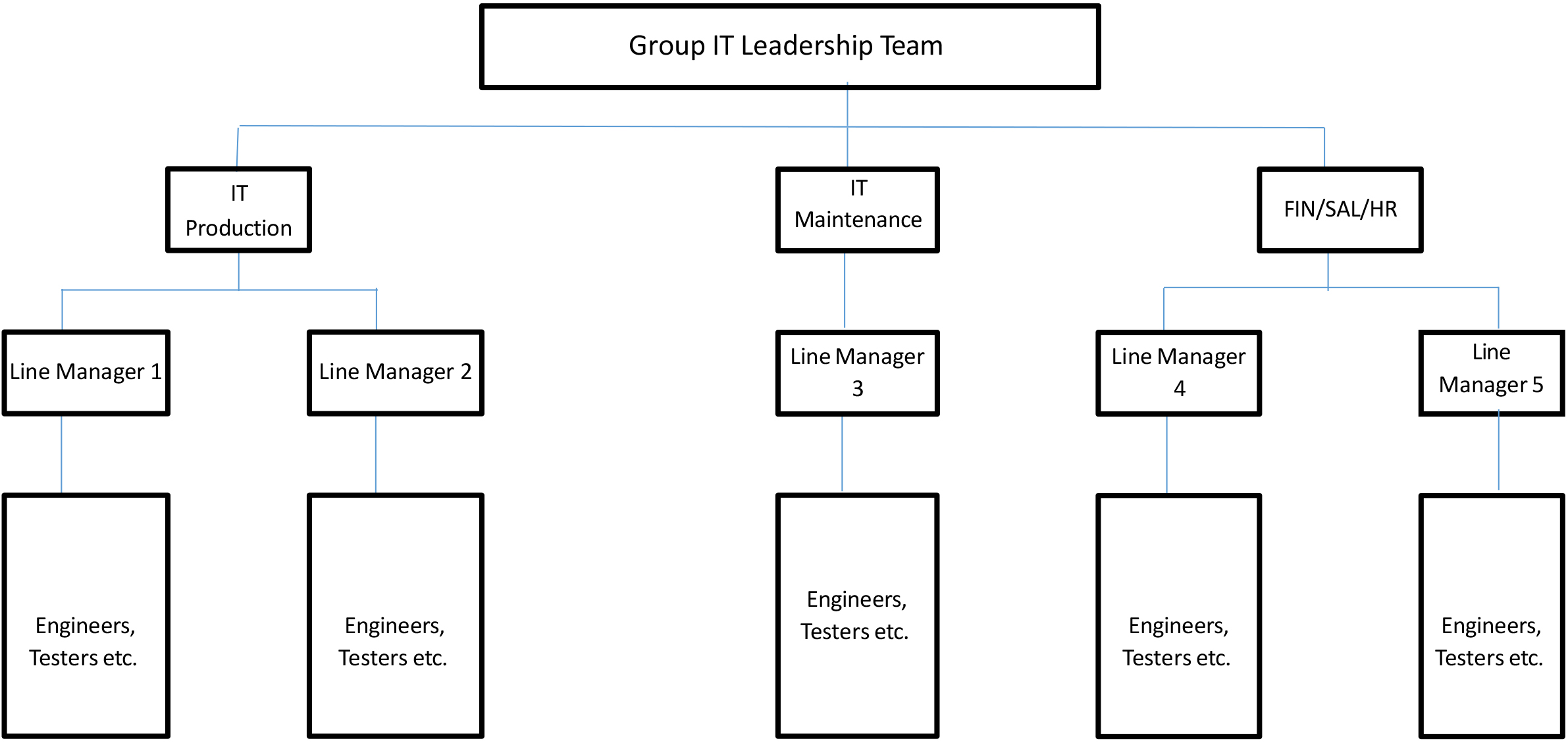
Post transformation combination of agile and non agile units in the IT function. The dual structure organization has hierarchy on one side and flat agile teams on the other. In the new set-up, reporting relationships of agile team members (engineers, testers etc,) are to line managers. The Agile coaches and masters of ceremonies (scrum masters, product owners) report to the central Agile Office. The IT Maintenance function continues to be organized in a non-agile manner for stability considerations. Legend: The solid lines in the figure depict formal reporting relationships between agile teams and associated Line Manager. The POs and SMs report to the Project Managers in the agile organization. PO: Product Owner. SM: Scrum Master. E: Engineer. T: Tester.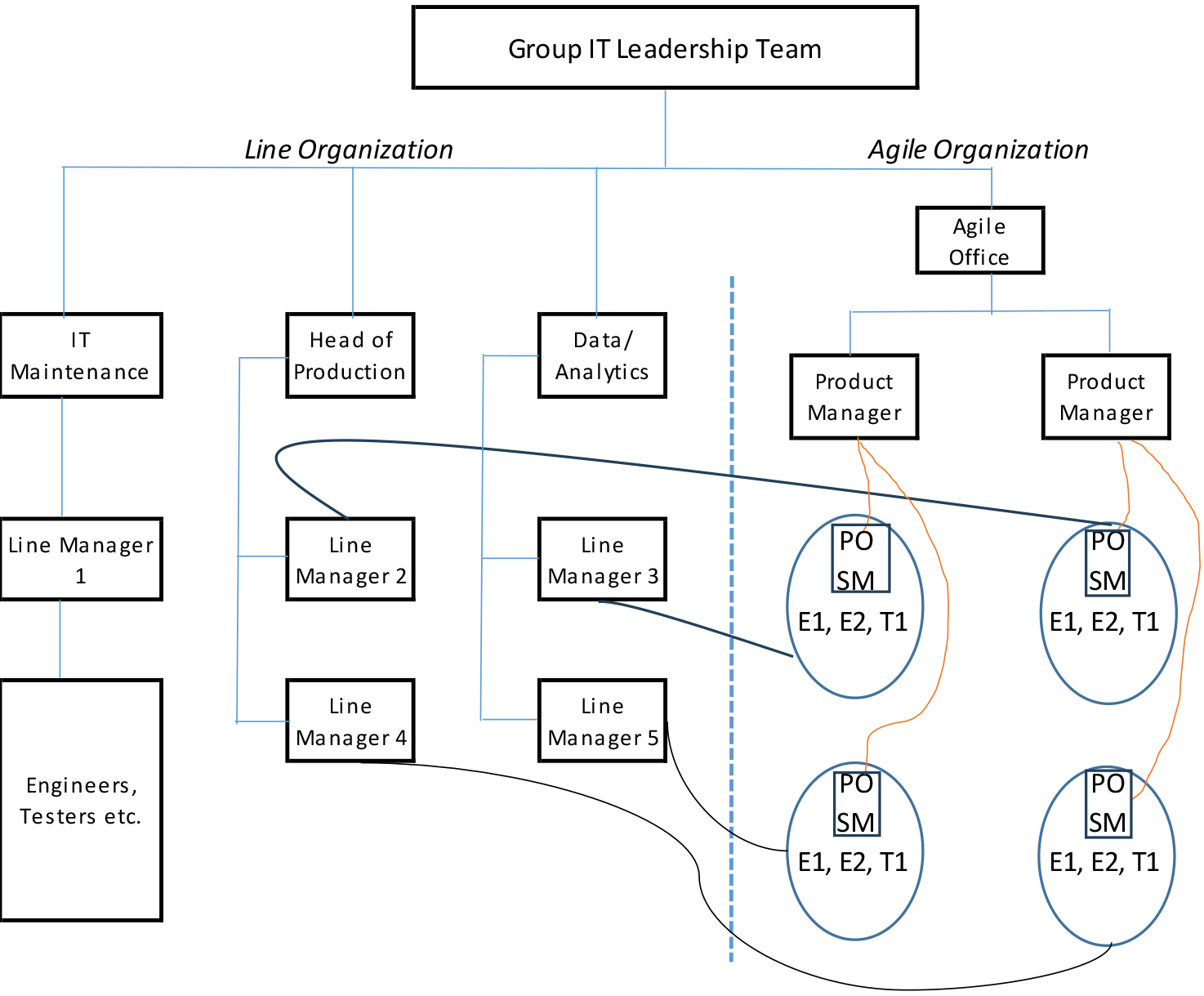
This case was selected and considered to be appropriate to explore our research question to explore how line managers situated in hierarchical non-agile units maintain accountability in agile units because the case organization presented a unique opportunity to explore proliferation of agile governance in a public service organization with a clear citizen service mandate and having non-agile units existing parallelly to agile work units. The case organization afforded the opportunity to explore and understand through the lens of felt accountability as to how line managers reconcile their interactions with perceptibly ‘less accountable’ counterparts in agile units in a public service organization context.
The data for the study was collected during multiple rounds of interviews in fall 2022 and early 2023. Given our interest in exploring accountability challenges at the interface of agile and non-agile units, we conducted in-depth interviews with members of the IT leadership team in the case organization to understand the public sector character, business model, organization design and set-up, internal governance and accountability routines. We initiated the data collection process by relying on analysis of internal organizational documents and free flowing conversations with the key IT department leadership team members to identify successes and challenges surrounding the implementation of a dual organization structure combining agile and non-agile units. The focus of these initial exploratory discussions and interviews was on gaining a comprehensive understanding of the organizational context, strategy, devolution of key work tasks and its allocation across line and agile units.
Subsequently, our emerging interpretation and understanding of the organization was refined and validated through a corroborative interview session with the entire group IT leadership team. In collaboration with the IT leadership team, relevant employees and internal stakeholders were identified for further interviews based upon their knowledge and placement in the organizational hierarchy with almost an equal split of informants across line and agile units. A total of 19 interviewees were initially identified, while 17 interviewees participated in the second phase of interviews. The details of informants are presented in Table 1. The informants represent those who shouldered both line and agile responsibilities to ensure that the voices, concerns and viewpoints of employees across the line-agile divide were equally represented to gain a complete and comprehensive picture of perspectives relating to accountability challenges and concerns.
Informants and interviews across agile and non-agile units
Informants and interviews across agile and non-agile units
The interviewees included both the upper and the middle management functionaries, as well as Scaled Agile Framework (SAFe) agile role holders such as scrum masters, testers, product owners and product managers. We applied several measures such as rapport building, guarantee of anonymity and confidentiality, avoiding judgemental comments and inviting additional comments when the recording was stopped. The one-to-one interviews which lasted on an average more than 60 minutes each were recorded and the IT leadership team in the case organization was not made privy to individual responses. The data management plan for the project was registered and approved by the Norwegian Centre for Research data and best practices for protection of personal data were observed in line with General Data Protection Regulation (GDPR) requirements. The interviews were transcribed and resulted in more than 700 pages of written data.
To analyse the collected data, we relied upon established techniques (Gioia et al., 2013) of developing a data structure based upon first order codes, second order themes and aggregate dimensions. The application of Gioia method to analyse our data is appropriate as epistemologically it is interpretive, suits single case study research designs, and allows for maximizing revelatory potential, richness and trustworthiness of data. The data structure so developed is presented in Fig. 3.
Data structure and coding scheme.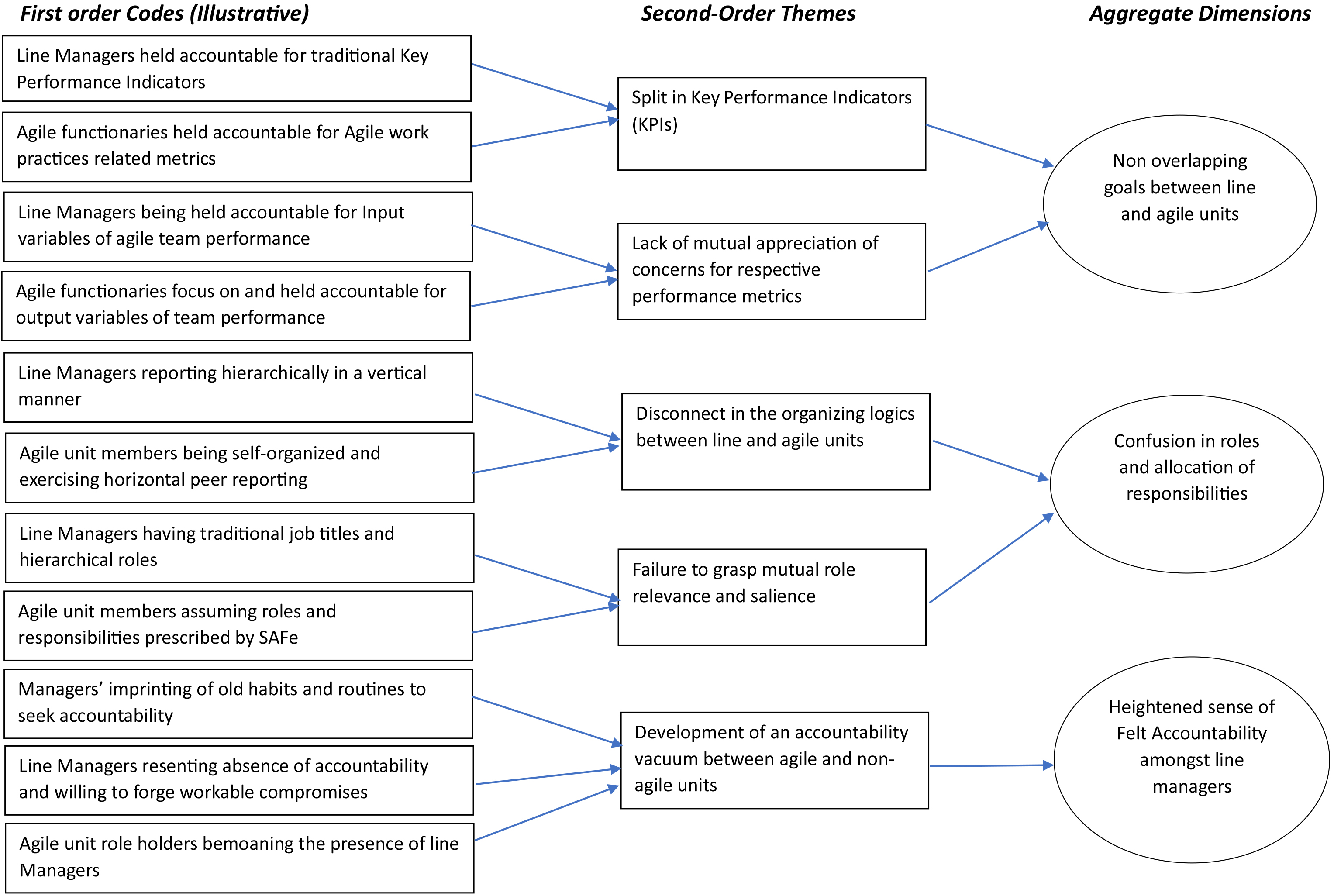
The recorded interviews and transcripts were systematically analysed to identify dominant themes, keywords and patterns to make sense of the accountability challenges and role of managers using a data driven approach (Walsham, 2006). We analysed the interview data inductively to identify the accountability challenges of ‘non-overlapping goals’ and ‘role and responsibility confusion’ amongst the agile and non-agile unit functionaries. Power quotes have been extensively used to present systematic claims (Rockmann & Vough, 2023). Further we inductively analysed the interviews of line managers in non-agile units to understand their experiences of felt accountability and drawing meaningful claims (Langley & Meziani, 2020). Finally, by iterating between the case data and theory we arrived at our findings.
Architectural structure of the IT department – move from hierarchy to a line-agile structure
As a starting point, we wanted to understand the reasoning and motivation of the PSO for transitioning from a purely hierarchical to a partially agile organization. The Head of IT Architecture and Strategy described the current organizational choice as that being that of:
“The architectural challenge is about removing part of our old bureaucratic legacy and implementing the new agile model. I would actually say that we have two ways of working … a dual structure. So, we have one way of working with the old legacy systems because they are big monoliths where we want them to be steady and reliable and then we have the agile teams which is essential for improved customer (citizen) centricity.” (Informant # L1)
We found that the choice of this dual operating structure was driven to an extent as the agile way of organizing and working promised to provide the organization with the ability to become quicker in IT delivery, allow for on-the-go specification development and customizations as per internal customer needs and help realize the organizational strategy to be a winner in the digital communications business while attending to the government’s push for niftier citizen experience in the postal business. At the same time, the need for stability and reliability was ensured through continued use of line managers situated in the organizational hierarchy.
The organization established an Agile transformation office to spearhead the new initiatives and ensure that the newly created agile organization was adhering to and embracing agile practices, ceremonies and ways of working. Given that there were more than 50 agile teams operating at the same time it was considered prudent to adopt the Scaled Agile Framework (SAFe) to manage both the scaling and the coordination challenge that emerged.
“Given our large size, it was considered prudent to adopt SAFe as it permitted that our agile work practices were quite systematic and ensured system accountability at scale”. (Informant # A1)
The adoption of SAFe suggested that the organizational IT leadership already had an inkling that given the scale of their operations, legacy work practices and culture, along with diverse stakeholder requirements, they required a systematic framework to ensure accountability.
Emergence of accountability rupturing forces in line-agile unit combinations
Challenge of non-overlapping goals
With the introduction of a dual structural arrangement with self-organizing agile teams on one side, there were multiple managers who were left behind in the line organization on the other side. As their former subordinates started functioning under the advice and direction of agile coaches, the managers who were earlier responsible for determining day to day work of their subordinates were left on the fringes, but still had accountability for traditional key performance indicators (KPIs) sought by IT department leadership. On the other hand, the agile role holders had accountability only for performance along the spectrum of agile metrics, which were different from the ones for which line managers were held account to. This split in KPIs for the two counterparts on either side of the line-agile divide were not inherently in conflict with each other, but simply distinct without overlaps.
This unique split between the KPIs and the ensuing accountability alongside input and output variables (as summarized in Table 2) was a source of confusion and lack of mutual appreciation for each other’s concerns. This rendered KPI alignment difficult, both at an operational level between the line managers and agile functionaries, but also in its holistic aggregation in the upper echelons of the IT leadership team which was concerned about attainment of both types of goals being pursued by the line and agile teams respectively to ensure strategic consistency.
The distribution of key performance indicators (KPIs)
The distribution of key performance indicators (KPIs)
This kind of a split in the responsibilities was not predetermined or pre-planned, but emerged as a residual responsibility with the line managers once they were stripped off their more direct supervisory task of controlling technical personnel. This resulted in widespread confusion and frustration in the minds of both agile and line functionaries as they came to terms with their renewed roles and associated key responsibility areas in this new dual structure organization.
“Lots of confusion regarding who has the ownership of the resources … we in the agile teams have delivery responsibility while the line managers are concerned with metrics which do not concern us …” (Informant # A2)
Resultantly, there was widespread lamentation of the mismatch and inability to mutually appreciate performance metrics of concern to both the line managers and the agile functionaries.
“You see the comparison of story points which matter to us, and the team resource utilization figures that the line managers are often concerned about, is simply as if we are comparing apples to oranges”. (Informant # A5)
The line managers also resonated with the problem of non-overlapping goals and bemoaned that the performance metrics of relevance and importance to them fail to figure in the prioritization scheme of the agile coaches:
“I am concerned with metrics, that is making things more economical … so metrics matter, but it is very difficult to measure efficiency and productivity in a team … because what agile coaches measure is story points and that is not very good at measuring business value” (Informant # L4)
This nonalignment of performance goals and priorities was not expected when the IT organization decided to introduce agile teams alongside the existing line units and resulted in making it difficult for the IT leadership to comprehensively manage the line-agile interface.
The dual structure adopted by our case organization combining non-agile and agile units also resulted in confusion regarding the roles and responsibilities of team members staffed on the two sides of the dual structure. The roles of the agile teams’ members were as per those prescribed by the Scaled Agile Framework (SAFe). However, those of line managers were not defined ex-ante, but emerged and evolved based upon the individual perception of line managers.
“the bosses and managers in the line organization are literally struggling where do they fit in this agile way of working … to us they (the line function) seem to be having if not any negative effect, hardly any positive influence as well …” (Informant # A7) “We never get any clear answers about the way we are organized … like why our team is accountable for certain deliverables …” (Informant # A9)
The line managers responsible for managing agile teams themselves experienced a lack of clarity surrounding their new role expectations. They constantly evaluated in view of their past experience if their role existed only for legacy reasons or if they had a more instrumental role. They constantly grappled with the dilemma of ensuring team cohesion, conflict management and performance appraisal when they had been ‘divorced’ from their subordinates and did not have a clear sense what their reportees were doing on a day-to-day basis. On the other hand, agile units seemed to resent the constant well intentioned interference and accountability seeking from line managers.
“Having the two (agile and non-agile units) together is a mumble jumble and a recipe for confusion and chaos … we struggle with that … we have a very messy organization where the line organization is constantly interfering in our agile way of working … they think they are helping but essentially slowing us down …” (Informant # A8)
So, even though line managers seem to find relevance for their roles understanding their responsibility as being that of taking care of managerial tasks that accompany managing any large-scale organizational system, agile functionaries interpret the new role of line managers as an assault on the agile ways of working.
Line managers propelled by felt accountability to forge workable compromises for repairing, restoring and remediating ruptured internal accountability
The emergence of disequilibrium in the internal accountability landscape underpinned by non-overlapping goals and unclear allocation of roles and responsibilities prompts line managers to feel a sense of accountability deficit, and metamorphize their role from that of traditional task allocators, to accountability “instillers” and “custodians”. In this new organizational set-up, the line managers interpret their roles to be that of accountability enforcers.
“So, my role is that of sort of a prime alignment and accountability manager. I take care of all the stuff that needs to be done when you have people, real people in your organization. In that sense, I would say that it is my formal role is to make the teams I am linked to accountable”. (Informant # L4)
To a great extent the motivation for adoption of this new role by the line managers in our case organization is both due to the accountability pressures from senior leadership that they experience, but also due to their own strong perception of being accountable for the agile teams they are managing from the periphery. By virtue of working in the public sector, and their imprinted habits (Marquis & Tilcsik, 2013), they are more inclined to erect (missing) ladders of accountability which no longer exist between them and their agile counterparts to deliver on the accountability demands which haven’t disappeared due to the adoption of agile practices.
The line managers who had been used to working in a hierarchical structure, and still do, take it as their own responsibility to hold agile teams accountable, even though they are no longer controlling their day-to-day work. This inclination and propensity of line managers to enlarge their roles to become accountability custodians’ aids in the repair of the ruptured accountability brought about by parallel maintenance of agile and non-agile units. The reparative measures that they undertake are based upon “forging workable compromises” with their agile counterparts in absence of formal reporting or hierarchical relationships to bridge the accountability gaps.
“The dilemma, and an interesting one to say is how should we make the line – agile combination work? In the end there is no perfect solution, we need to have compromises which work. I guess just some consequences that are easier to live with than others, I guess. Ultimately if we do not have formal control, we give and take and make it work” (Informant # L10)
The managers attempt to reconcile the differences in performance metrics and role confusion by trying to make the agile teams more amenable to accountability demands. Even though there is no formal reporting relationship between the agile coaches and the line managers, they remain tied to the teams through administrative reporting relationships with the team members (engineers, testers etc.).
As the line managers are still responsible and accountable for (human) resource allocation, deployment and development, they attempt to bridge the line-agile divide by surfacing questions and accountability concerns on measures such as team cohesion, cost etc. which escape the narrow focus of agile teams alone.
“I know some line managers think that they should have them (agile teams) under control … it is hard to let go, as then who will ask the tough questions and ensure accountability … so we in agile teams are willing to work with line managers for the sake of system?” (Informant #A8)
The line managers seem to appreciate that accountability seeking behaviours are best sustained by them being at the periphery of the agile teams and not within, as it allows the agile units to not perceive an encroachment on their ‘agile territory’.
“we are starting to do an agile organization on the side simply because a bigger totally agile organization may not work. So, we have to do a lot of stuff on the outside. It’s better that we stay outside and let them work without interference”. (Informant #L6)
The actions of the managers and their perceived sense of accountability prompts them to forge workable compromises with their agile counterparts. These compromises typically entail participation in agile routines and meetings, informally collaborating with agile coaches and product owners to align perspectives relating to budgetary controls, employee development, career progression and team cohesiveness. These actions of line managers resulting in closer collaboration with agile units are deemed to be workable compromises as they are not mandated by roles descriptions or structure, but by a sense of felt accountability.
Overall, our findings suggest that pursuit of agile governance through introduction of agile units alongside non-agile units in public sector context is a complex process and entails emergence of unanticipated accountability challenges relating to non-overlapping goals and role confusion. Moreover, in public sector contexts, the aspect of felt accountability amongst line managers in such structural configurations is underappreciated. Figure 4 graphically illustrates our findings.
Felt accountability amongst line managers prompting them to metamorphize as accountability custodians and instillers in line-agile combinations in public service organizations.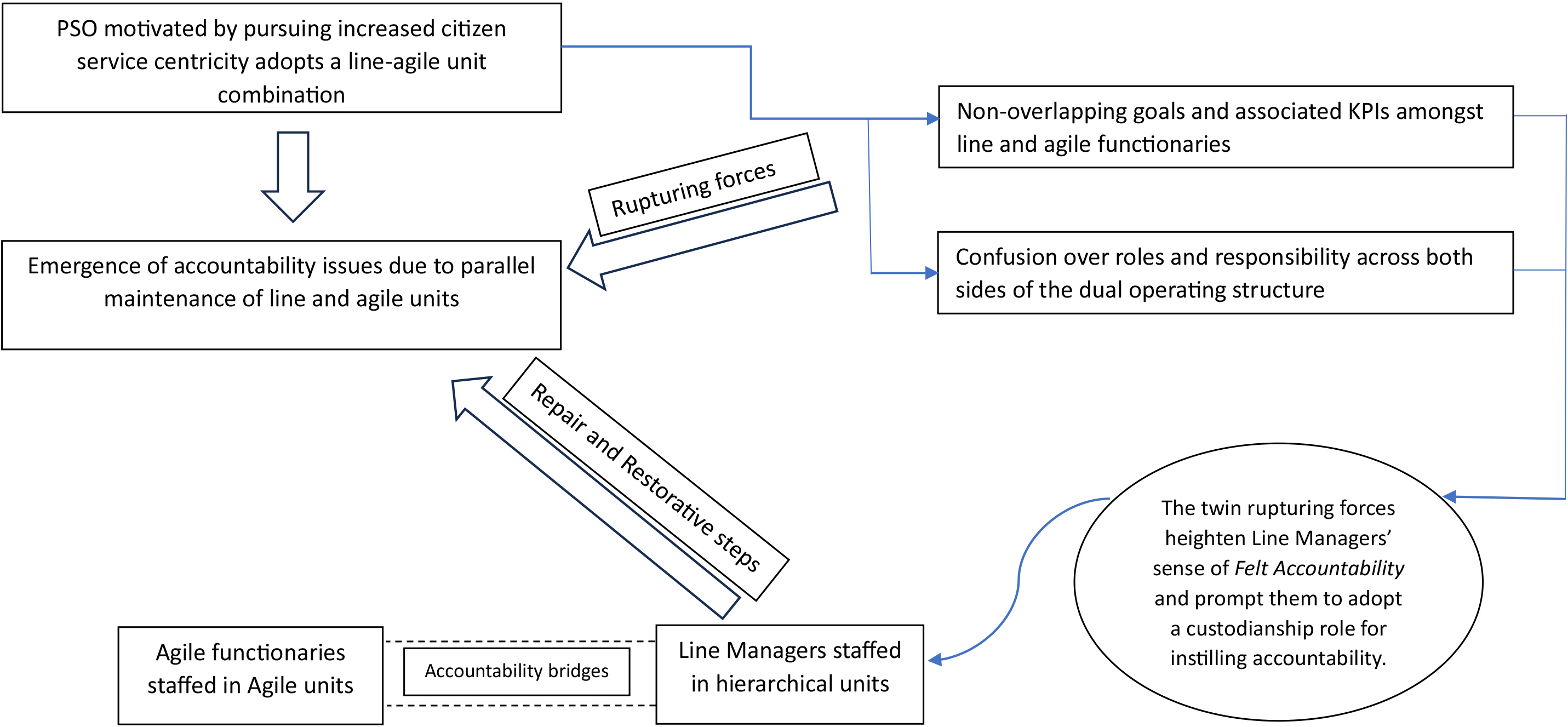
Through the above analysis of the case organization, interviews with stakeholders on both sides of the line-agile divide, we have outlined how internal accountability gets ruptured owing to no longer being ensured by hierarchy and exacerbated by non-overlapping performance metrics and role confusion. The same is partially repaired by line managers who acts as accountability custodians and operate at the periphery of agile teams to restore the same by means of forging workable compromises with their agile counterparts. Their primary motivation for assuming this role is because of “feeling” accountable and is in line with the theory of felt accountability in public administration.
Our analysis suggests that public service organizations having a dual operating model (line units interacting with agile units) when undergoing an agile transformation underestimate the role of imprinted felt accountability amongst line managers and their consequent adoption of the role of accountability custodians. The overlooked felt accountability amongst line managers in agile and non-agile unit combinations helps address a shortcoming of agile governance which assumes inherent and automatic accountability maintenance.
Our analysis suggests that the introduction of agile units alongside non-agile units in our case organization resulted in the emergence of unanticipated accountability challenges brought about by non-overlapping goals and role and responsibility allocation related confusion between agile and non-agile unit functionaries. We find that accountability, which already remains a concern in fully agile environments deteriorates further when public sector organizations experiment with conflicting organizing logics (Battilana & Dorado, 2017; Dalpiaz et al., 2016) of parallelly maintaining agile and non-agile units. We identify that accountability does not automatically manifest itself in such arrangements and is instilled by line managers fuelled by their sense of felt accountability.
Our study draws on and enriches the theory of felt accountability in public administration scholarship (Overman & Schillemans, 2022) and advances understanding of individual level manager accountability in public sector contexts attempting to pursue agile governance initiatives. Our findings suggest that even though line managers may consider agile governance as antithetical to line organizing (Mergel, 2023), their underappreciated sense of felt accountability may prompt them to both aid flourishment of agile units and also lead them to instil accountability at the line-agile interface. We also found that line managers residing in the organizational hierarchy who are often blamed and lamented for their resistance to change (Giangreco & Peccei, 2005), may prove to be a fulcrum of accountability maintenance.
This finding resonates well with earlier academic research that suggests that line managers, by virtue of their strong organizational identification and commitment can actually be a positive resource for change processes (Ford et al., 2008), that of agile transformation in our study. We provide empirical evidence of how line Managers, by being engaged change agents can help minimize resistance to change in public sector contexts (Buick et al., 2018) by drawing on their felt accountability to build bridges between line and agile units. Recent work within large bureaucratic organizations has also found that employees can be trained as active change agents in digital transformation and help minimize resistance to change (Fischer et al., 2023). This lends support to our findings that PSOs can perhaps actively train line managers who are already fuelled by their sense of felt accountability to act as change agents at the interface of hierarchical and agile units to support accountability imperatives.
Our findings also suggest that management of accountability at the line-agile interface without compromising on agile governance ideals is a complex undertaking and requires close collaboration between both line managers and agile functionaries. Our case indicates that line managers situated within non-agile units may acts as ‘conveyors and conduits of accountability’ for the senior management which is still traditionally organized in a command-and-control hierarchical manner.
Thus, our explorative interpretive case study of a public sector organization makes two contributions. Firstly, we aid to the understanding of practical challenges from an accountability perspective which emerge when agile and non-agile units are combined. Secondly, we highlight the potentially crucial role of line managers in furthering accountability in agile governance.
This paper adds to the understudied area of enquiry of line-agile interfaces and provides a nuanced understanding of the roles and reaction of line managers through the prism of felt accountability. Our findings also add to earlier research on role of line managers (Annosi & Lanzolla, 2023) in agile transformations and suggests that line managers can prove to be quite helpful in ensuring the success of agile teams co-existing with hierarchical units. In some ways, line managers make up for the lack of clarity surrounding line-agile unit combinations and provide a semblance of structure to help realize operationalization of “agile government” efforts.
Conclusion, limitations and managerial implications
Our paper sought to enhance our understanding of agile governance in the public sector organizations as they attempt to introduce agile units in a predominantly hierarchical milieu. Accordingly, our study contributes to theoretical research by enriching theory of felt accountability within public administration scholarship in its application to line managers’ reaction to line-agile unit combinations. Further, we showed how accountability challenges are exacerbated in agile and non-agile unit combinations and possibly remediated by line managers driven by felt accountability considerations.
Nevertheless, this study also has some limitations. Our study has relied on understanding accountability challenges and role of line managers in a public sector organization which also competes with private players. Possibly, fully government departments and agencies where accountability expectations are even higher may experience greater resistance, rather than support from line managers to the introduction of agile units. Also, we relied upon one case organization to seek analytical generalizability of our findings while focussing on one geographical region (the Nordics) and one sector (postal services). Therefore, further research could extend the present study by examining challenges of agile and non-agile unit combinations in other, perhaps purely government contexts. Also, future research efforts can attempt to conceptually examine the possible inherent tension between agility and accountability in public administration contexts.
This research has important managerial implications. Our results highlighted that given that there are high accountability expectations in the public sector, embracing agile governance requires that organizational managers pay attention to accountability concerns before introduction of agile units and attendant ways of working alongside line organization. Public sector managers may also find it useful to consider devising ways of aligning goals and role expectations across line-agile arrangements to minimize accountability challenges, and not entirely rely on agile frameworks such as SAFe alone to ensure requisite accountability. Line managers may benefit from seeking accountability from the agile teams on the traditional metrics of budgetary control, team effectiveness, career progression and performance appraisal of individuals – metrics for which the new age agile practices are not geared to draw light upon. Furthermore, our study, unlike previous ones demonstrates that line managers who are often blamed for resistance to agile initiatives may be useful as change agents, and even integral to accountability maintenance – which is a key concern in the public sector.
Footnotes
Acknowledgments
The author would like to thank two anonymous reviewers for their constructive feedback and genuine engagement with the paper and offering pinpointed and refreshingly relevant direction for focussing the study and contributing to substantial improvement in its quality and rigour. The author also extends thanks to Caroline Fischer and Oliver Neumann for their guidance, support and patience in managing the editorial review process. The author would like to acknowledge the case organization for the access to internal organizational data and time commitment of the interviewees for an extended period of time. The organization has signed a Non-Disclosure Agreement (NDA) and therefore cannot be publicly acknowledged, yet their support was instrumental in the operationalization of this study. The author would also like to thank Nicolay Worren, Andrea Carugati and Phanish Puranam for their feedback. The errors which remain, are solely attributable to the author alone.
Author biography
Yashwant Singh Yadav is a PhD candidate in Strategy & Organization Design area at the School of Economics & Business of the Norwegian University of Life Sciences. He has an educational background in Economics and Human Resource Management and has professionally worked as an internal consultant in the Oil & Gas industry.
His research interests and PhD work lies at the intersection of Strategy, Information Systems and Organization Design with a focus on Agile Organizing and accountability.