




Abstract
Pricing of public goods is particularly challenging for public services that are strongly rights-based in character. Such is the case of freedom of information requesting procedures. Costs have implications for how citizens will treat requesting procedures as well as how their views and attitudes towards procedures will be affected. This study examines these causes and consequences using an online experiment with 925 citizens. The findings show that even low costs can have an influence on how willing citizens are to submit requests as well as their satisfaction with the procedure and perception of fairness. Public service motivation and political orientation moderate these effects, but only to a small degree. These findings have implications for citizen participation policies given that citizen attitudes to the right to information depends strongly on trade-offs between the value of information and financial costs of requesting.
Keywords
Introduction
According to freedominfo.org, a global network of transparency scholars and advocates, 119 countries currently have some form of legal framework that recognizes a fundamental right of citizens to access government information. Laws dictate how public agencies should handle public information requests, how quickly they should respond, what criteria to apply in deciding whether to grant access, and the manner in which the information can be made available (Lagunes & Pocasangre, 2019; Mendel, 2008). FOI laws are thus part of the legal apparatus used by governments to encourage transparency and accountability (Grimmelikhuijsen et al., 2018; Ingrams, 2018; Piotrowski & Rosenbloom, 2002). As such, their implementation and use – including their purpose and framing – are politically consequential.
While open data initiatives prioritize open access and are premised on the idea that data is free and reusable, freedom of information laws rely on an active request process on the part of citizens. How to price information requests is a particularly important area to consider because it influences citizen information requesting behaviour in complex and sometimes unexpected ways (AbouAssi & Nabatchi, 2019; Hazell, 1989; Lagunes & Pocasangre, 2019). FOI pricing considerations touch on critical matters for government-citizen communication such as who should be informed about different areas of action within government, when government can keep information secret and for how long, and what procedures should be in place for citizens to request access to information that may be in their individual interests or the interests of the public in general (Hazell & Glover, 2011; Lagunes & Pocasangre, 2019; Roberts, 2005). Scholars have thus put forward various political and economic rationales to guide policy decisions on how to price public information requests. It has been argued from a legal perspective that public information is ultimately funded by taxes, so citizens have a right to the information government produces excepting cases where social or individual harms will result from disclosure (Moon, 2020; Shelby, 2000). Another rationale for FOI laws is a utilitarian one that free flow of information decreases information asymmetry, thus improving the chances of governments making better (more effective) decisions (e.g., Ingrams, 2017). Supporters of the economic view of information for commercial reuse are more likely to accept that information exchange is an economic transaction that can be priced according to market principles (e.g., Luscombe & Walby, 2017).
Scholars have also extensively analysed how the price of public information requests is not simply a product of ideological perspectives on the value of government information and access. Governments have ulterior motives for wanting to limit information requests. This includes deterring people from requesting information, addressing budget shortfalls, protecting corporate interests, or hiding information that may be politically sensitive (Roberts, 2010; Worthy & Hazell, 2017). There are many ways that governments circumvent compliance and public accountability, and a wide range of research on FOI suggests that fees can be one of those kinds of avoidance tools (Almanzar et al., 2017; DeLuca, 2020; Fink, 2018; Roberts, 2005; Roberts, 2010). Obscurantism of this kind is made possible because the cost of a FOI request is particularly difficult to measure. Finding out how to set prices of information requests is therefore a key matter of theoretical and empirical interest. It may be self-evident that a higher price dampens demand, but on an individual level these influences and motivations are interesting. Citizen reactions to FOIA costs are interweaved with complex array of normative and democratic motivations and expectations that are not only financial in nature. Prices of FOI requests have a strong influence on the consequences flowing from access to public information, ranging from questions of individual justice to establishing accountability and preventing corruption in government. Despite this importance, according to Cucciniello, Porumbescu and Grimmelikhuijsen (2017), there has been very little empirical research on contextual factors of transparency such as how the cost of FOI requests influences their use, and the perception among citizens of the legitimacy and fairness of the FOI request procedures. Professionals from the journalism or non-profit sector may be less deterred by fees but individual citizens and amateur journalists are a vital segment of FOI users and one where costs may have a more telling impact. By focusing on motivations of citizens and request costs, this study adds to the debates in public administration on how salient design choices in FOI procedures influence their use and influence would-be information requesters.
The study presents an experimental approach to studying citizen attitudes towards FOI request procedures. The research uses a sample of 925 participants in an online survey experiment using Amazon’s Mechanical Turk (MTurk) participants on the TurkPrime platform to investigate how different costs affect information requests in a fictional case of a public health issue. In addition to the effect of cost, we consider the influence of other important contextual variables that often influence decisions concerning implementation of FOI laws such as the public service motivation (PSM) and political leanings of the information requesters. In what follows, we outline our theoretical framework regarding how cost influences requester attitudes, set out our hypotheses, explain our experimental procedure, and describe and discuss our findings.
Brief background on FOI costs
The question of FOI costs has been closely tied to discussions about the normative value of freedom of information. Thus, most governments write their FOI laws following the principle that fees should only equal the direct costs of the duplication, copying, or printing of the documents (Jones, 1995), and that only direct costs of search and producing records should, in principle, be charged (Relyea, 2009). In the UK, an example on the website of the Information Commissioner’s Office estimates a release of information comprising 200 sheets of paper at 375 pounds sterling (Information Commissioner’s Office, n.d.). In South Africa, only the first 100 pages are free of charge and there is a nominal charge thereafter. Generally, governments try to minimise the transfer of labor and overhead costs to information requesters, as policymakers understand the importance of access for citizens (Jones, 1995).
These principles typically do not entail high financial burdens for governments. Operating costs of FOI procedures are only a small part of government budgets. AbouAssi and Nabatchi (2019) found that cost-related reasons were the least important reason for agency refusals to grant requests in the US between 2008 and 2016. According to an analysis by Wagner (2017) of 500 FOIA annual reports from 1975 to 2015 in the United States, FOIA expenses account for around 0.1% of federal agency budgets. During the same period of time, the US federal government collected fees that covered only 3% of these costs. The view among policymakers has generally prevailed that this budget gap in information access programs is necessary if they are to commit to their legal obligations to providing the right to information while also recovering some costs and regulating the quantity and quality of requests that they receive.
Thus, in most FOI laws around the world, many types of records in the public interest are made available free of charge or at very low cost. In some European countries such as Switzerland and Germany requests are free for non-commercial requests in most cases (Holsen & Pasquier, 2012). While many governments do charge a fee (in addition to printing and sending costs), laws require that public interest is explicitly taken into account when developing fee schedules, and these schedules must be reviewed periodically (Birkinshaw, 2002). Different prices for different types of requester are also common. In the United States, the 1986 amendment to the US FOIA introduced a three-level fee system of commercial, educational, and ‘other’ (non-commercial) purposes, and 2007 amendments extended reduced fees to freelance journalists and the news media (Relyea, 2009). FOI laws also typically try to minimise costs resulting from the legal complexity of access to information. For example, the European Union Access to Environmental Information Directive limits the kinds of legal costs that information requesters can be liable for (Bugdahn, 2007). Requesting documents from the European Commission is free.
Fee schedules and citizen legal subsidies protect the value of freedom of access for citizens while recouping some costs from commercial use requests. But it also highlights the need for balance of normative and economic considerations in FOI procedures. In many countries, fees are explicitly used as a way to regulate numbers of requests. For example, to deter very burdensome information requests from citizens, Australia places an upper limit of 40 administrative hours that can be used to find the information, and only the first 5 hours are free (Henninger, 2018). In broader political trends, some scholars have also remarked on the downsides of rising individual user costs in public services as part of the New Public Management (NPM) reforms since the 1980s. These have sought to rationalise public finances and apply market principles such as pay-for-use as a way to realize the full value of services.1
See the following: Riddell et al., 2005 on growth of fee-paying systems in education; Teixeira et al., 2014 on revenue diversification in public organisations such as schools and universities leads to institutional changes; Lowry, 1993 on introduction of fee-paying schedules in nature parks that can limit control of agencies because central budget authorities see it as a way to exert new controls; Duncan and Graham, 2013 on the debate about user fees for road and fuel taxes.
In the present study, we seek to add to the aforementioned debates on the costs entailed in FOI requests. We particularly want to investigate the trade-off between cost (both the actual costs for government and the costs borne by requesters), the perceived normative value of FOI requests, political attitudes, and the likelihood of citizens submitting requests. To do so, we draw on a wide body of public administration literature on the relationship between costs of services and citizen perceptions and attitudes. In order to explore the normative dimensions of debates about the costs of FOI requests, we also draw on the literature regarding the relationship between citizen public service evaluation and normative types of individual variability such as PSM and political orientation.
Costs and willingness to submit FOI requests
Public choice economics would lead us to believe that individuals are less likely to pay for a service that does not serve their self-interest (Cullis et al., 2009). Indeed, public administration research shows that this is true across a range of different service areas including education (e.g., Glaser et al., 2004), police and fire services (e.g., Donahue & Miller, 2006), and public parks (Glaser & Hildreth, 1996). In general, individuals are proportionately less willing to pay for a service as the cost increases.
The straightforward economic logic becomes slightly more complicated when it comes to a ‘higher level’ value of information when citizens consider whether to submit a public information request that could potentially benefit not only themselves, but society as well. Prior research shows that even citizen actions that are connected to higher level positive social impacts such as public policy participation are still dependent on having the right financial incentives in place (Weathers & Hemmeter, 2011). Thus, we expect financial incentives to also apply to ‘higher level’ public service use such as requesting public information.
H1: If a FOI procedure imposes high fees, requesters are less willing to submit a request than if a FOI procedure imposes low fees.
Costs and satisfaction with FOI procedures
Prior findings in literature on the relationship between costs of a service and resulting satisfaction with the service are quite mixed. Some research suggests that the introduction of individual user costs to public services is associated with greater service quality and therefore give greater satisfaction to citizens (Warner & Hefetz, 2008). On the other hand, higher costs have been found to be associated with lower levels of satisfaction (Dahlström et al., 2018; Rubery et al., 2013). Citizens approach public services with specific cost-quality expectations in mind and high cost services can lead them to judge the services poorly (Van Ryzin & Immerwahr, 2007).
Another consideration when it comes to FOI costs is that whether satisfaction is raised by a service cost or not may depend on the kind of services where the costs are being applied, and, in particular, whether it is a type of service where costs and user benefits can be clearly justified (Collins & Kim, 2009). Sometimes the real costs of public programs are difficult to quantify given the broad and far-reaching nature of their impacts (Willems et al., 2016). It is therefore easy for citizens to misinterpret the implications of price and the relationship with outcomes and outputs (Grosso et al., 2017). We reason that adding high costs to a public service such as delivering information seems particularly likely to raise dissatisfaction levels for two main reasons. First, for a strongly rights-based service such as freedom of information, a cost barrier could evoke a particularly negative response in terms of citizen satisfaction because being asked to pay for something undermines the sense of ‘having a right’ to it. Second, it is difficult for citizens to see what is entailed administratively in retrieving public information. Implementing a right does come with some operating costs, and may thus lead to misunderstanding of the purpose of fees.
H2: If a FOI procedure imposes high fees, requesters will be less satisfied than if a FOI procedure imposes low fees.
Costs and perceived fairness of FOI procedures
Smith (1996) argued that introducing market mechanisms with higher individual user costs for citizens through NPM reforms also introduces specific norms and expectations regarding fairness in public services. In general, this could have a positive impact on perception of fairness among citizens because costs are borne by the direct users of services rather than all taxpayers. Some research findings do support this perspective of cost. For example, Jang and Eger (2019) found that applying pay-for-performance reforms to services can increase the perceived procedural fairness of those services. On the other hand, introduction of higher costs may sometimes lead to lower perception of fairness. Indeed, contrary to Smith’s view, perceived equitability of services for citizens might go down when user fees are introduced to services because ability to pay can override the need to deliver a service equitably.
Similarly to the case of citizen satisfaction, the effect of cost may lie partially in citizen expectations and the service area. Concerns about cost and equitability are frequently linked in literature on public service delivery especially when it relates to an important public good. In this light, Hemelt and Stange (2016) found that when marginal price rises are introduced in public goods areas such as education, they negatively affect poorest students most. While individual costs and fees in public services can be a fairer way to distribute costs, the right to public information, like other public goods such as justice or education, is typically viewed as a right for everyone regardless of their economic situation. We expect this rights-based characteristic of FOI to influence individuals so that high cost information requests procedures are viewed as less fair than procedures that are not as costly.
H3: If a FOI procedure imposes high fees, requesters consider that process less fair than if a FOI procedure imposes low fees.
Moderating variables: PSM and political ideology
Decisions about the cost of FOI requests also circle around the question of individual normative values and attitudes. Evidence shows that how well FOI systems work is linked not just to the quality of the legal stipulations but also to the role of informal and symbolic mechanisms involved in the communication of public agencies with the public (Spáč et al., 2018; Worthy et al., 2017). According to Jones and Cullis (2003), when it comes to evaluation of public services, there is often an interactional relationship between instrumental considerations of cost and normative responses to public policies. Whether cost considerations influence attitudes partially depends on how a policy triggers normative and motivational attitudes of service users.
Freedom of information requests often have strongly normative, public accountability seeking goals, but they can also be motivated by purely individual or micro-political goals. Berliner, Bagozzi, and Palmer-Rubin (2018) offered big data insights into what proportion of FOI requests were of either kind of motivation in the context of the Mexican federal government. Just over half of the nearly 1 million requests analysed were about medium or high accountability relevant topics such as land and environment, budgets and spending, public utilities, education and welfare, finance, and behaviour of politicians. This suggests that pro-social motivations often drive FOI requests, but a large number of requests are for more mundane matters such as, for example, finding out how to apply for a public program or making a business-related request on patent ownership.
Motivations may also influence not just requesting behaviour but the perceptions that individuals have of the worth of the FOI requesting procedure as a whole. A similar relationship has been observed in research on other public service areas. For example, research by Overton and O’Mahony (2017) found that individual pro-social values moderated whether the introduction of individual cost schemes in public services will be perceived as fair or not. Pedersen, Stritch, and Taggart’s (2017) research found similarly that the involvement of a private provider in an internal administrative process was more likely to be perceived as fairer by staff who had higher PSM. In this case, PSM gives individuals a reason to look beyond the monetary costs to the bigger public service goal.
It appears that PSM gives individuals trust towards the public sector that allows a certain extra degree of acceptance when self-interested private motives may be at work. Of course, not all FOI requests are driven by public interest motives, but public interest does play a big role in motivating many individuals to submit requests (Berliner et al., 2018). Thus, we expect PSM to influence request behaviour by positively moderating (i.e., mitigating) the effect of cost on willingness to submit a request. Based on prior findings on the moderating role of pro-social motivation and PSM, we also expect cost information and PSM to interact in the same way in their effect on perceived fairness and satisfaction.
H4: High PSM mitigates the negative effect of the cost of a FOI procedure on willingness to request, perceived fairness, and satisfaction with the procedure.
When it comes to non-cost related factors that influence requesting behaviour, political orientation could play an important role. As the design of FOI laws has been shaped by political considerations of how information and costs of information should be distributed in society, we also expect that a similar moderating effect could be found in individual political orientation and the effect of cost on satisfaction and fairness. Political orientation including political preferences for levels of public spending and favourability towards public values such as transparency plays a significant role in whether individuals will be satisfied with the service they have paid for (Rabovsky, 2014). Given that citizen political orientation influences which types of policies are evaluated highly or poorly (Hoff et al., 2015), it appears likely that political ideology may play a role in the evaluation of the fairness of FOI procedures too as free-market liberals tend to be more tolerant of paying for improved public service performance (Dahlström & Lapuente, 2010; Rabovsky, 2014). Mediano and Carrasco (2019) have even shown that the political orientation of judges who review rejected FOI requests plays a role in adjudicating final decisions.
Liberals and conservatives tend to approach decisions about pricing of public services differently. In general, liberals support social equity and rights-based approaches to funding of public services delivery (Jacobs, 2014; Rudolph & Evans, 2005; Skitka & Tetlock, 1993). In contrast, conservative political ideology is generally associated with support for market-oriented public service delivery (Boyer & Van Slyke, 2019; Mohr et al., 2010; Schoute et al., 2018). While, in line with hypotheses 1–3 above, paying more for a service is generally likely to elicit a negative response from liberals and conservatives alike, the normative or rights-based character of FOI services is likely to be more important for liberals, and a cost barrier is more likely to be interpreted unfavourably. We therefore expect that the negative effect of cost on perception of fairness, and satisfaction to affect liberals more strongly than for conservatives.
H5: A more liberal political orientation strengthens the negative effect of the cost of a FOI procedure on perceived fairness, and satisfaction with the procedure.
Method
Experimental design
We conducted an online survey experiment to test our hypotheses. Experimental studies are a suitable tool for measuring perceptions of citizens in salient areas of public policy and public service provision (e.g., Bell, 2021; Favero & Kim, 2021), and are especially useful for studying the effects of small information variation or framing effects (Jones, 2014; Valant & Newark, 2020). By experimentally varying amounts of an independent variable in a treatment group where other variables are otherwise held constant, researchers can ascertain what leads to differences in an outcome of theoretical interest in the policy area (James et al., 2017). In our experiment, participants were randomly allocated to one of three treatment groups, each with different information on the fee associated with the procedure to submit an information request. Aside from the cost information, all participants received the same vignette describing a fictional case involving a situation where they had gone to a well-known restaurant chain and subsequently fallen sick with suspected food poisoning. A FOI request for information about the restaurant’s health and safety record was presented in the vignette as a way to take action that could prevent other people from getting sick in the future. In the US context this could be directed at local, state or federal government levels. The federal level was the most plausible choice to make as the Centers for Disease Control and Prevention (CDC) in the Department of Health and Human Services monitors foodborne illness outbreaks across the country and shares some of its data publicly, though not at the level of individual restaurant franchises. This choice also avoids the complication of having to specify a local agency for each survey participant. This specific focus of the vignette on a public health scenario was selected in order to draw upon a public service area where citizen attitudes to transparency are important to study because of the implications for citizen life and well-being (De Fine Licht, 2014; Ingrams et al., 2020). The full text of the vignettes can be found in Appendix A.
We manipulated cost using three realistic cost levels based on the rates given by the US federal agencies. A lower bound cost is frequently set as a guideline for agencies to determine whether administrative costs are negligible enough or not to make the request free for the requester. In the United States, where the study’s participants live, this lower bound ranges from $5 (Department of Education) to $50 (Department of the Interior) but most agencies set this amount at $15 or $25. We thus set the ‘low cost’ amount at $15, which is low but still substantial enough to give an average citizen requester pause for thought.
We set the high cost at $150, which is exactly ten times the low-cost amount. The high cost amount represents a cost level that is both substantial and realistic. Specifically, based on the clerical hour rates given by the Department of State FOI Office of $21 plus 15 cents per page, the high cost seems like a plausible amount for a more substantial request for information that took about 5 hours of clerical time to process plus page printing costs.2
Last accessed on 10 April 2020 from
After reading the vignette and seeing how much it would cost to submit the information request, participants were asked questions on the three dependent variables of interest: (1) how likely they would be to submit the request, (2) how satisfied they were with the request procedure, and (3) how fair they perceived the procedure to be (information on our measurement items and approach is in Appendix B).
We used the Qualtrics platform to implement the survey. TurkPrime, which is run with participants from MTurk, was used to recruit survey participants (James et al., 2017; Stritch et al., 2017). We took advantage of TurkPrime’s features to only select experienced and reliable participants. Specifically, participants were required to have at least a 99% approval rating from prior researchers, and to have completed at least 1,000 MTurk tasks for prior research. MTurk participants are paid for their work. We followed recent scholarly precedents to determine compensation rates and response validity checks, which we report below, to address data quality concerns (Kaufmann et al., 2019; Keiser & Miller, 2019; Vogel & Willems, 2020). However, it should be noted that MTurk participants do not represent a true random sample as they tend to be disproportionately male and have low levels of current organizational experience (Chmielewski & Kucker, 2020; Stritch & 2017). The mean length of time needed to complete the survey was just over five minutes, and the participants were paid 80 cents.
We collected 1002 usable responses from the survey. Reliability analysis showed that our principal component factors for PSM (
We carried out a test to assess the demographic balance in the experimental groups. An Analysis of Variance (ANOVA) suggests that there are no significant differences between the experimental groups on demographic variables like gender (
Because a Levene’s test suggests that variance for the variable gender is unequal (
ANOVA for background characteristics of the sample
Figure 1 shows mean responses for willingness to request, satisfaction, and perception of fairness in the three cost treatment groups. For all variables, average scores are highest for the no cost group, followed by low cost, and, finally high cost. This is in line with our theoretical expectations.
A series of ANOVA’s confirms these descriptives. For willingness, the results suggest that respondents are less likely to put in a FOI request as the cost of doing so increases (
A Levene’s test suggest that variances an unequal for both willingness to request (
Pairwise comparisons for the effect of cost on willingness to request, satisfaction, and perceived fairness
Mean scores, with 95% CI.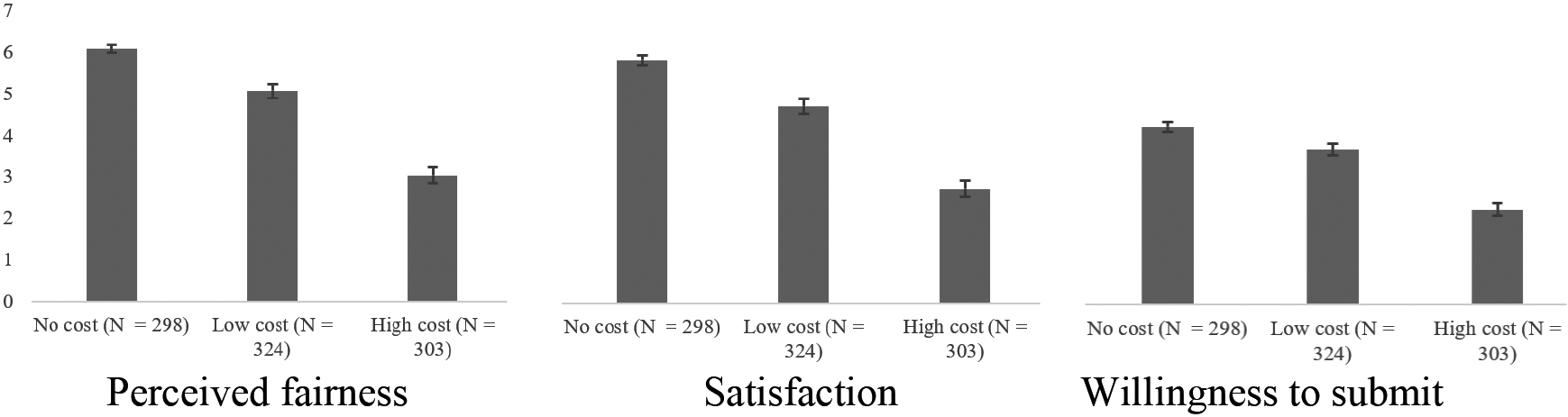
ANOVAs for interaction effect of PSM and cost
ANOVAs for treatment effect of political orientation and cost
Predicted values for willingness to request and PSM.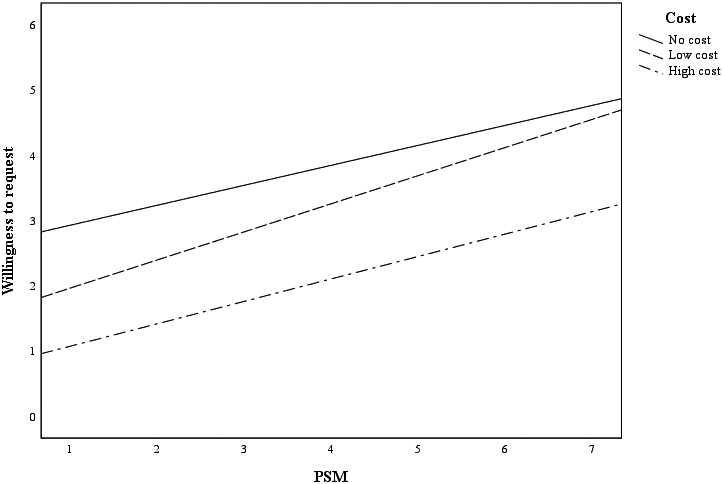
Predicted values for satisfaction and political orientation.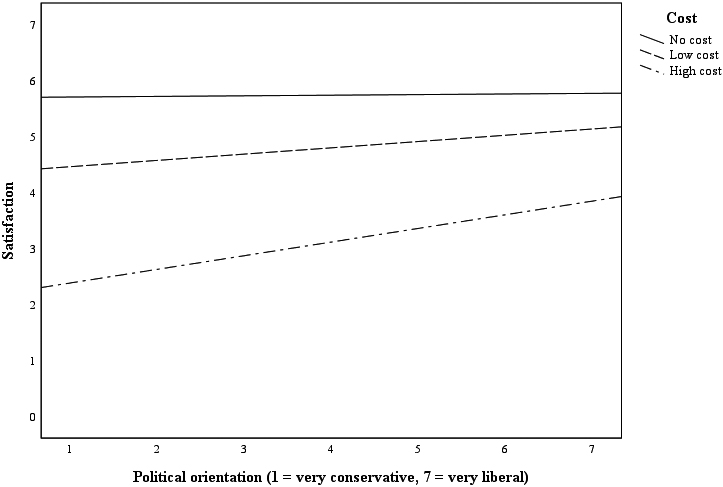
Predicted values for perceived fairness and political orientation.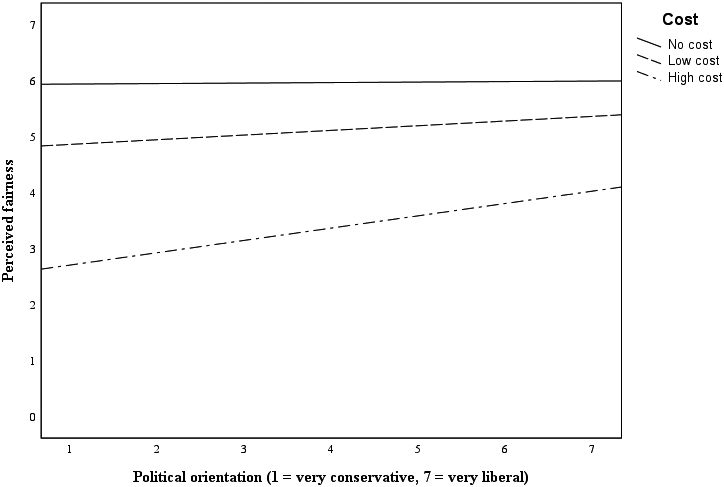
The results provide mixed evidence for our fourth hypothesis (see Table 3). For willingness to request, there is a significant interaction effect with PSM (
The results for the interaction effect of cost and political orientation (shown in Table 4) also show mixed support for our theory. Contrary to our results for the previous hypothesis, political orientation does not interact significantly with the effect of cost on willingness to request (
Pricing of public services is a complex matter that affects FOI systems no less than other areas of public administration. This study used a survey experiment to explore cost considerations that FOI policymakers take into account when implementing FOI request procedures. FOI systems are a fascinating case of how public organizations balance normative and utilitarian administrative considerations, and by operationalizing these considerations in an experimental vignette, this study shows how different citizens (as potential requesters) behave when faced with different cost options in a request scenario that carries public interest implications.
Prior research shows emphatically that there is an important difference between simply having a FOI law and making it work effectively (Michener & Nichter, 2022; Michener et al., 2021). It has also been argued that research around the effectiveness of government transparency could fruitfully focus on the role that contextual factors play in government-citizen relationships (Ben-Aron et al., 2017; Cucciniello, Porumbescu & Grimmelikhuijsen, 2017). But the role of request cost and associated attitudes and responses to cost requirements is a topic that has not received much attention despite the fact that financial and normative incentives are so pertinent in the FOI case. In this respect, one of the main findings of the research is quite intuitive: higher costs of FOI requests would result in fewer submissions. The context of our experimental vignette is important here because the situation suggests that there is a public interest in publishing such information about a public health risk. From a policymaking point of view, FOI systems should be a tool for making such information available to the public quickly and unambiguously. But even a small cost barrier of dollars made a significant difference. This is important for FOI policymakers interested in improving the transparency of government to take note of. These utilitarian and normative motivations are not unique to the FOI case. According to Thompson and Jones (1986), some policy domains are more elastic to price changes, and this may in part be due to the normative or rights-based character that they have. There may also be other aspects of FOI that influence this relationship as prior research has found that areas such as the trust in government (Grimmelikhuijsen et al., 2020; Worthy, 2010) and the performance of government (Wood & Lewis, 2017; Worthy, 2010) are important contextual factors in request behaviours. Further, scholarly discussions around proactive transparency facilitated by government digitalisation (Ruijer, 2017) and the impact of open data accessibility on FOI systems are relevant to the findings of this article when budgeting priorities of government as well as citizen expectations of transparency are shifting.
We also find that having to pay a cost affects perceptual and attitudinal implications. Perception of fairness and satisfaction decreased significantly even in response to the modest 15 dollar cost. While even a small price barrier can make a significant difference, the findings also reveal that across all outcome measures, the largest impact was noted in the third group that had to pay the high amount of 150 dollars. Thus, in general small costs make a difference to FOI procedures and large costs make an even greater difference. Whether this difference is more down to economic calculations or moral indignation, and if this dynamic varies depending on the type of FOI request (individual or public interest motivated) could be an interesting research question to explore in the future. In the context of recent research on the politics of transparency, it would also be interesting to explore whether and in what way economic and moral factors fall into contestation of ideologies of transparency and openness (Birchall, 2011). Heimstädt and Dobusch (2020) proposed that competing, incommensurable views of transparency’s role in government be approached through a third way of ‘ethical contestation’. This is a perspective that may help to constructively explore the kinds of political processes that lie behind perceptions of economic or moral rationality and so to begin understanding those systems more holistically rather than in terms of an economic-moral dualism.
An important finding in this study is that normative and economic considerations do indeed have concrete implications not just for government policies around transparency but also for citizens. This is backed up by prior research showing that emotional or moral overtones of request processes can have an effect on the responsiveness of agencies (Cuillier, 2010), and that tacit communication and cues shape the ways that FOI determinations are handled (Michener et al., 2020). We can add to those discussions here by noting the way that communication about cost and the symbolic or normative aspect of FOI as a public service and political norm could also be important for effective administration of FOI systems. In the present study, PSM made a difference in mitigating the effect of cost in the case of respondents’ reported willingness to request. From a FOI policymaker’s point of view, it is reassuring to see that pro-social motivations of requesters are not entirely crowded out by FOI fees, but clearly PSM can only do so much, and we cannot know how PSM works in other types of FOI requesting scenarios beyond the one presented here.
We would expect a similar set of psychological mechanisms to be at work for information requesters in any country given the human tendency to try to maximise economic self-interest as well as the moral motivations that may drive information requests. However, there are many possible local differences in political ideology, expectations for tax rates and levels of service provision, and cultural attitudes to pro-social responsibility. This leads the authors to advocate a high degree of caution in generalizing these findings beyond the context of the United States. A further limitation of the research is that willingness to request in the study does not measure actual requesting behaviour. The results might be different if individuals are in a real situation where they really need to pay these amounts. While this is important to note, psychological research on willingness to pay (WTP) for socially beneficial services has also shown that attitudes can be reliable predictors of actual behavior (Meyerhoff, 2006; Mugabi & Kayaga, 2010). Nonetheless, future research may want to use different methods, such as field experiments, to replicate and extend our findings in a context where real behaviour can be observed.
The results for political orientation are also interesting for theory and practice of FOI requesting. Political orientation influences satisfaction and perception of fairness, which suggests that it plays an important role in these kinds of attitudinal variables. But, like PSM, the effect size of political orientation is difficult to assess. Prior research has already shown that political orientation is a key variable in FOI adoption and design decisions, but the result in this study shows that design of FOI costs can influence individuals of different political orientations differently, and FOI policymakers should be cognizant of this fact when designing cost schedules that are meant to make requesting procedures fair for all kinds of citizens.
Footnotes
Appendix A
Appendix B
We operationalised our variables using measures that have been tested and employed in much of the recent public administration literature on political orientation, PSM, satisfaction, willingness to act, and fairness. All variables were measured using either 5- or 7-item Likert scales. Among the dependent variables, satisfaction was measured using 3 survey items measuring how participants view the FOI request procedure in comparison to their expected and ideal preferences (e.g., Kaufmann and Tummers 2017). Perception of fairness was operationalized with a 7-item Likert scale response to the statement: ‘This freedom of information procedure is fair’. The ‘willingness to request’ variable was based on prior literature examining willingness to act in specific ways particularly regarding actions involving submitting something or paying for something administrative (e.g., Collins & Kim, 2009; Donahue et al., 2011; Saxton et al., 2014).
Among the independent variables, PSM was measured using a widely used 12 item abridged version of Perry’s (1996) original 24-item scale of four dimensions: attraction to policy making, commitment to the public interest, compassion, and self-sacrifice (Esteve et al., 2016; Kim, 2011). Political orientation was based on a 7-item ‘very conservative’ (high) to ‘very liberal’ (low) scale.
Political ideology:
In general, how would you describe your political views?
Very liberal Liberal Somewhat liberal Neither liberal nor conservative Somewhat conservative Conservative Very conservative
PSM
Please indicate your level of agreement for the following statements
Attraction to policymaking
I am interested in those public programs that are beneficial for my country or the community I belong to. Sharing my views on public policies with others is attractive to me. Seeing people getting benefits from a public program where I would have been deeply involved in would bring me a great deal of satisfaction.
Commitment to the public interest
I consider public service my civic duty. Meaningful public service is very important to me. I would prefer seeing public officials do what is best for the whole community even if it harmed my interests.
Compassion
It is difficult for me to contain my feelings when I see people in distress. I am often reminded by daily events how dependent we are on one another. I feel sympathetic for the plight of the unprivileged.
Self-sacrifice
Making a difference in society means more to me than personal achievements. I am prepared to make enormous sacrifices for the good of the society. I believe in putting duty before self.
Willingness to request:
How likely are you to submit the freedom of information request? (1–5)
Very unlikely Somewhat unlikely Neither likely nor unlikely Somewhat likely Very likely
Perception of fairness
This freedom of information procedure is fair (1–7)
Strongly disagree Disagree Somewhat disagree Neither agree nor disagree Somewhat agree Agree Strongly agree
Satisfaction:
How satisfied are you with the freedom of information procedure? (1–5) How satisfied are you with the freedom of information procedure, compared to your expectations for a public information request procedure? (1–5) How satisfied are you with the freedom of information procedure compared to an ideal public information request procedure? (1–5)
Appendix C
Attention check
Manipulation check
Author biographies
Alex Ingrams is an assistant professor at Leiden University Institute of Public Administration. His research mainly focuses on transparency in government, and particularly the role of information management and technology in transparency policy.
Wesley Kaufmann is Strategic Advisor for Data Management and Information in the Dutch Department of Taxation. His research focuses on good governance, rules and red tape, and citizen participation.
Daan Jacobs is a researcher and lecturer of public governance at Tilburg University. He is currently working on his PhD dissertation, which focuses on the extent to which citizen participation can increase the legitimacy of public decision-making.