




Abstract
The broad and continued success of Free/Libre and Open Source Software (FLOSS) has helped to spread its ideology to many other domains, including Open Government Data (OGD), which has recently gained prominence due to its potential for feeding algorithms. Despite the anti-market and anti-corporation values around free sharing, citizen participation, and unrestricted transparency propagated in particular by a highly idealized academic discourse on OGD, our case study of the development of Switzerland’s national OGD portal suggests that the altruistic and philanthropic notion that is often associated with OGD needs to be reconsidered. We show that low use, on one side, and the practical necessity towards cost-recovery behaviors, on the other side, have led to a compromise of the altruistic ideological beginnings of OGD and paved the way for a pragmatic shift towards a more utilitarian, partly even protectionist, view on liberating and sharing data.
Introduction
Throughout the history of information technology (IT), society has been confronted with different ideologies –and ideals– of proper production, deployment, and distribution of digital artifacts (Mumford, 2006). Heroes and villains have been changing constantly. While in the 1970s much sympathy was shared with young, unconventional startup founders who challenged the corporate world unwilling to make computing accessible to the masses, it was the Free/Libre and Open Source Software (FLOSS) movement of the 1980s which fought back against exactly these firms which in the meantime have grown into global corporations (Stallman, 1985). Ever since, the notion of openness, sharing, participation, and transparency has enjoyed broad support (Schlagwein et al., 2017) because it has been framed as antithesis and a means to subvert and transcend the capitalist value-exchange rationale as well as to give power back to developers and users of software in a non-alienating and self-organized manner (Bentley et al., 2019; Bergquist & Ljungberg, 2001; Hahn et al., 2008). Apart from those directly threatened by the absence of intellectual property rights, considering FLOSS to be a modern-day sort of communism (Kanellos, 2005), most academics have developed a rather positive stance towards this new form of democratizing software production and praised its comparative advantages over proprietary solutions in terms of increased quality (August et al., 2017), modularity (Stamelos et al., 2002), diversity (Daniel et al., 2012), or speed of innovation (Boudreau, 2010) given that programmers may not only build on the discoveries of others but also engage with an entire community of like-minded people for massively parallel software development (Sanders, 1998).
However, as companies made FLOSS part of their business model (Daniel et al., 2018; Feller et al., 2008; Morgan et al., 2013; Wang et al., 2020), the idealized tale of Good versus Evil, David versus Goliath, has started to show some cracks. Whether we want to accept it or not, meritocracy (Hann et al., 2013), opportunism (Germonprez et al., 2016), and commercial appropriation (Medappa & Srivastava, 2020) have undermined the initial view of unconditional and generous disclosure of source code to the extent to which many programmers developed doubts concerning the appropriate ways of contributing to a collaborative effort (Maruping et al., 2019). In many cases, FLOSS projects have become a means for self-promotion of developers in order to kickstart a career in the corporate world (Carillo et al., 2017) and for companies –conscious of this fact– to spinout certain tasks to motivated but unpaid programmers (Ho & Rai, 2017). On the other hand, software projects adhering to the founding values and rejecting any sort of value-exchange rationale are often confronted with financial struggles or issues to mobilize the necessary amount of contributors (Crowston et al., 2003; Setia et al., 2020). Leaving the work to be done on the shoulders of a few idealists, many of these efforts are abandoned over time due to stress or burnout (Nowogrodzki, 2019; Raman et al., 2020) or, even worse, eroded (through new types of licensing models and financial dependencies) or absorbed (through acquisitions by their capitalist counterpart) as happened to GitHub, MySQL, or Symbian to mention just a few (Silver, 2018; West & Wood, 2014). In this sense, it can be stated that the altruistic ideal of FLOSS has suffered over the decades, or, as Fuller et al. (2017) would say, the general indifference towards the original sense of the open ideology has ushered in a new “post-FLOSS” era characterized by a more utilitarian – some would say more realistic or practical – view of the software industry.
In line with the tradition of critical research in Information Systems (IS) (Cecez-Kecmanovic et al., 2008; Howcroft & Trauth, 2004; Mumford & Sackman, 1975; Myers & Klein, 2011) and Critical Data Studies (Boyd & Crawford, 2012; Hepp et al., 2022; Iliadis & Russo, 2016; Kitchin, 2014), this article seeks out to explore how and why a similar shift from an altruistic ideology to a more utilitarian modus operandi is equally observable in the area of Open Government Data (OGD). A central tenet of this article is that the recent hype of datafication, sensorization, and artificial intelligence has not only moved our attention from software to data (Kane et al., 2021) but has equally changed the way we look at the value and uses of data (Szczepanski, 2020). Since machine learning (ML) algorithms require a steady flow of this precious resource to keep improving – so our thesis – the initially altruistic motive of enlightenment of the Open Data movement (which the OGD is one subset of it) is gradually being replaced by utilitarian considerations, while the same innocent narrative continues to be cultivated on the surface.1
Many companies (Facebook/Meta, 2023; SAS, 2023), non-profit organizations, and governments (Data For Good Canada, 2023; Data For Good France, 2023) have started to popularize a “Data for Good” metaphor, giving the impression that purely philanthropic –and not utilitarian or commercial– reasons are at the forefront of opening up data (George et al., 2020).
In order to address our research problem, we explore the case of opendata.swiss, the attempt by the Swiss Federal Government to grant its citizens free access to non-sensitive governmental data. The case inscribes itself into a long list of similar data liberation initiatives being implemented around the world, such as in Australia (data.gov.au), France (opendatafrance.net), Germany (govdata.de), the United States (data.gov), the United Kingdom (data.gov.uk) and, surprisingly, also China (ifopendata.fudan.edu.cn), with the inherent promise to improve transparency and accountability of government actions (Bertot et al., 2010; Linders, 2012), empower citizens and democratic participation (Bonina et al., 2021; Corbett & Mellouli, 2017), or to generally increase social welfare (Jetzek et al., 2019).
While more and more research is starting to reveal some negative effects from harmful or even malicious re-use of open data (Clarke, 2019; Link et al., 2017), only few studies have questioned the motive of and underlying narrative used for promoting governmental data liberation efforts (McGee & Edwards, 2016; Miscione et al., 2013). We believe this to be important because discursive constructions and rhetorical devices are frequently used to mobilize resources (e.g. financial and human ones) (Cornelissen & Werner, 2014) and minimize resistance to change (Sonenshein, 2010). In this sense, whether OGD is framed as a means for achieving social benefits, or to first and foremost serve economic interests, is crucial for influencing the public opinion so as to ensure broad and long-lasting support (which, of course, depends heavily on the political orientation and values of a country’s population).
The ways in which digital artifacts are developed and deployed, and how human choices during this process can compromise or reinforce democratic values and ideals, have long been the focus of interest for critical researchers in IS (Avgerou et al., 2004; Mumford & Sackman, 1975; Walsham, 2001). Although there are different nuances of what “being critical” means (Cecez-Kecmanovic, 2011; McGrath, 2005), there are certain commonalities between the different flavors of critical research. A common feature of critical research is its claim to explain a phenomenon in a nomological, interpretative, or historicist manner using a broad lens (as opposed to hypothetico-deductive research which typically emphasize reductionism) (Poutanen & Kovalainen, 2010). Immanent criticism, that is, the questioning of what is known about the world and what consequences this has, is equally central to critical research. Lastly, critical research is normative. Acknowledging personal bias and subjectivity, the objective of critical research is not only to reveal discrepancies in contemporary thinking but also to discuss how things ought to be (instead of leaving the conclusions and learnings to the interpretation of others).
An appropriate method to investigate how people interpret and deal with a contemporary phenomenon over longer periods of time and across multiple locations are case studies (Tsang, 2014). However, the purpose of this paper is not to establish causal relationships as is the primary focus of positivist case studies (Dubé & Paré, 2003). Rather, we aim to investigate the possibility of a shift in the fundamental worldview of the OGD movement and its potential drivers. To this end, we have selected a critical interpretivist methodology for collecting and analyzing our data, in line with the recommendations of Doolin & McLeod (2005) and Walsham (1995). To synthesize our critique, we employed a mode of inference which is called retroduction. According to Tsang (2014, p. 181), this mode of inference shares some similarities with induction, such as the fact that “the validity of a retroductive conclusion entailing the addition of new knowledge beyond what the premises contain cannot be assessed with certainty”, however, it is different from induction as it “is less structured and more creative”. As with critical research in general, it relies on the investigator’s perspective in identifying analogies or metaphors (Lawson, 1997) for the purpose of explaining emergent behavior or generative mechanisms (Henfridsson & Bygstad, 2013). To reduce bias and increase the validity and credibility of findings, we therefore used multiple triangulation approaches (Denzin, 1978). Table 1 summarizes our overall research strategy and outlines what comes next.
Research strategy
Research strategy
Before introducing our case study (Section 3) and presenting our critical account of the ideological state of the OGD movement (Section 4), let us first discuss the idealistic characterization of “openness” as it presents the starting point of our critical reflection. Rufus Pollock, the author of the famous book The Open Revolution (2018) and the founder of the Open Knowledge Foundation, a globally acting non-profit network advocating open ideology, understands openness to be unfeigned when “anyone can freely access, use, modify, and share [data] for any purpose (subject, at most, to requirements that preserve provenance and openness)” (2023a).2
A detailed description of what free and unrestricted access means and the corresponding principles for opening up government information is also discussed by the Sunlight Foundation (2023).
A context where publishing OGD can be free and mandated at the same time, are national data portals. For centuries, governments have been producing and hoarding data about all sorts of social, economic, or political activity. Even before the Internet, it was common in democratic countries that the Census Bureau or the Office for National Statistics was obliged to make certain data public. However, with the broader adoption of the Internet, the call for “citizens’ basic rights to get access to what they financed with their taxes” (Allen, 1992) has seen some remarkable upswing which is why today’s focus is no longer limited to statistical data but in principle to data from all areas of the public sector (European Commission, 2023). National data portals are a means to implement the OGD policies of a country (Jetzek et al., 2019; Francey & Mettler, 2022). Although such policies often specify a general mandate to publish data, the leeway for each agency, lower-tier institution, or parastatal enterprise is relatively large, especially since they decide which data may be published and which may not. In other words, they enjoy a certain level of freedom to implement the mandate.
We have chosen to study the unfolding of events around opendata.swiss, the national OGD portal of Switzerland, as it allowed us to study both free and mandated openness, and equally because of practical reasons because we had access to numerous stakeholders of the Swiss OGD movement. Being both a highly developed democracy and an international financial hub, we were intrigued by the prospect of exploring if the altruistic ideology of OGD remained genuine or a “crack”, as happened with FLOSS, is becoming noticeable.
Our case study starts in April 2014, when OGD gained official legitimacy as the Swiss Federal Council (2014) announced a new open data strategy for the planning horizon of 2014–2018. It would have extended the existing E-Government Strategy (Swiss Federal Council, 2007) with specific amendments regarding the opening-up and release of OGD, the adaptation of the existing regulatory framework (in particular a uniform description of the terms of use of OGD and the adjustment of the existing charging policy for certain datasets), the definition of OGD standards (in particular metadata formats), as well as the development of a centralized data infrastructure that would grant free access to government data for citizens and businesses as opposed to long-tail public policy approaches where only some limited consignees, such as think tanks, could access public information online. Our window of observation ends in March 2019, when a political postulate is filed which asks for the development of an admission system and the definition of uniform criteria under which governmental data is to be offered to specific actors either free of charge, free on request, or paid.
Our case study relies on a wide variety of information sources, collected over multiple years, applying qualitative and quantitative techniques (see Appendix A). For our empirical exploration, beside interviews and direct observations, we performed an analysis of relevant government documents, reports, and websites as well as conducted an in-depth quantitative analysis of datasets related to opendata.swiss.
Our qualitative inquiry consisted of two parts. In an ongoing process, we performed an extensive qualitative text analysis of relevant official documents since OGD was first mentioned in a political debate until the end of our observation period. Our text corpus consisted of OGD strategies, policy audits, guidelines, and mandated research reports, most of which are accessible via the website of the Swiss Federal Statistical Office (2023) and the Swiss Parliament (2023a). We also reviewed unofficial documents, such as practice reports, newspaper articles, and blogposts from hacktivists and associations, such as OpenData.ch (2023) or the Swiss Data Alliance (2023), which have some relation to the propagation of OD in Switzerland. The results from this step are mainly used to set the timeline of major events and to identify the general tone of the overarching discourse against which specific political decisions were made.
The second part of the qualitative inquiry consisted in interviewing people concerned with and active around OGD. Using a purposive sampling strategy (see Fig. 1) and applying the snowballing technique (Myers & Newman, 2007), we started to interview operators of the national OGD data portal as well as specialists developing and/or maintaining regional and local data repositories in May 2018. We then moved on to interviewing specialists charged to publish OGD for their organization. 18 semi-structured videoconferencing and telephone interviews (in German and French) were conducted in total. Considering the federalist structures of Switzerland our sources comprise eight respondents working for a national agency, five for a regional government, and another five for a large or medium-sized Swiss municipality. As proposed by Thompson (1966), we allowed a certain flexibility and openness during the interviews to capture the subjective perception of how different actors experience what we later interpreted as a paradigmatic shift. Each conversation began by asking broad questions about the respondent’s general attitude towards open ideology, before proceeding to ask more specific questions related to challenges in the production of publishable datasets, their experiences with using the opendata.swiss portal for data sharing, and their view on how OGD should be used in practice and society (see Appendix B). Each interview took approximately 45 minutes to an hour and was recorded with the consent of the interviewee. If needed, additional inquiries were made by e-mail, which we also included in our qualitative analysis.
Sampling strategy used for this case study.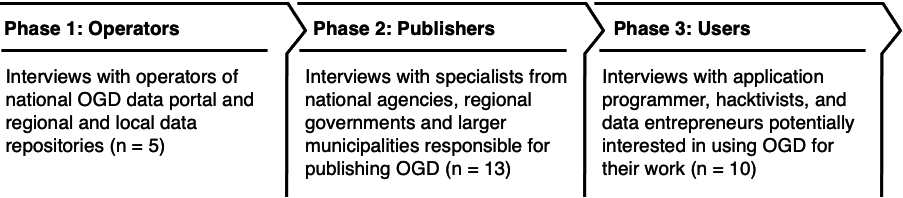
To not only involve respondents with a special authority in the maintenance or production of OGD, but who could also provide us with insights about the daily use of OGD, we conducted additional interviews and had follow-up e-mail exchanges with 10 application programmers, hacktivists, and data entrepreneurs which we met at a hackathon we co-organized in May 2019 on the premises of the university. The people we interacted with were very much active in the OGD scene, as most of them participate in hackathons on a regular basis. We use quotes from both, the semi-structured interviews with OGD producers and the informal conversations with OGD users to highlight their subjective experiences with the ideological state of OGD.
To triangulate the qualitative data, we also performed a quantitative analysis of two different data sources. Like many repositories for open data worldwide (Kirstein et al., 2019), the Swiss OGD portal uses the Comprehensive Knowledge Archive Network (CKAN), a web-based open-source management system to store and distribute datasets (Open Knowledge Fundation, 2023b). In May 2018, we harvested for the first time all the available CKAN metadata, such as resource titles, author’s name, or formats using the application programming interface (API) offered by the OGD portal.3
For a detailed description of how to access CKAN data resources, please consult the API documentation at
A full account of the rule-based coding and additional analyses is described in (Marmier & Mettler, 2020).
Chronology of key events related to the introduction of OGD in Switzerland.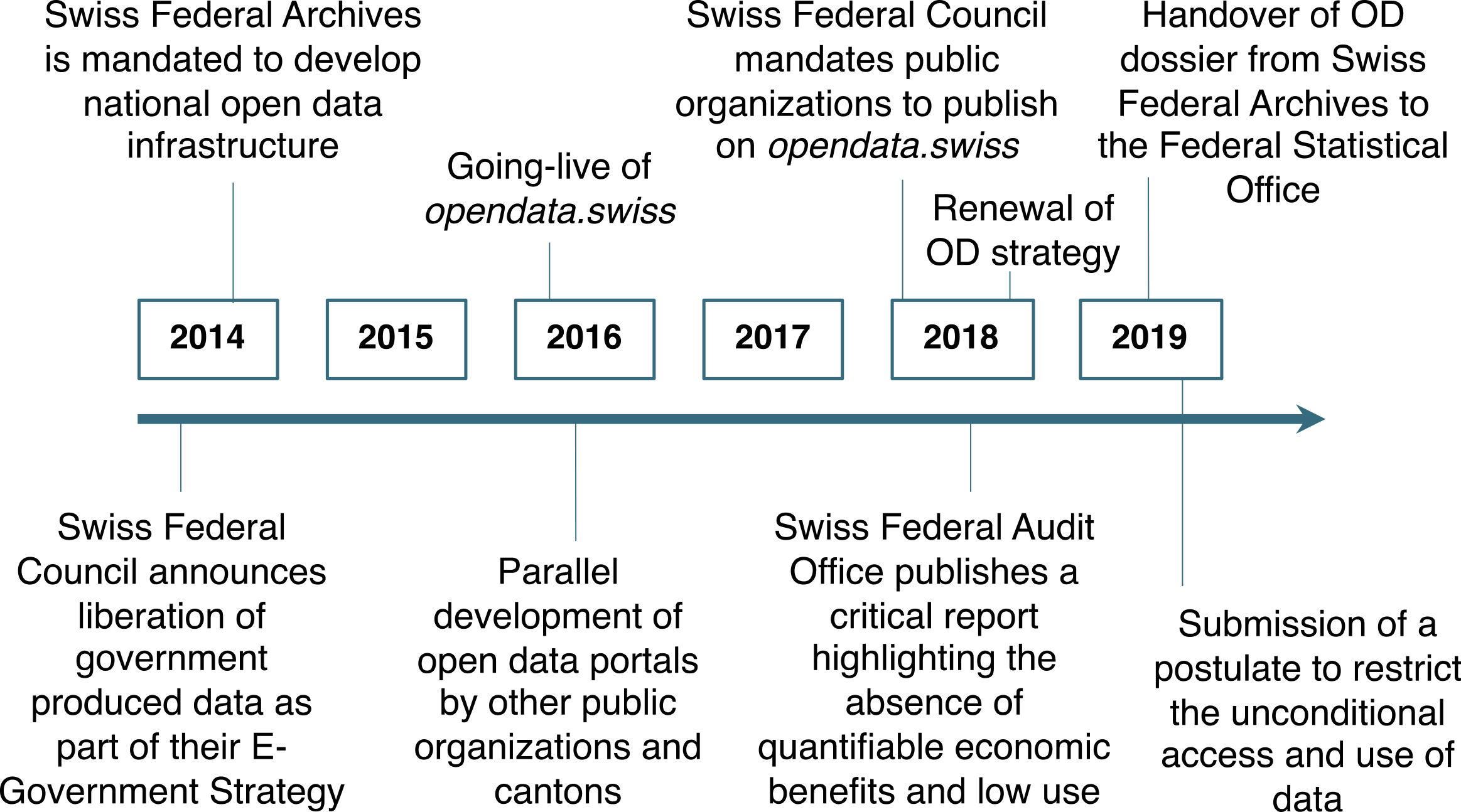
The analysis of the collected data followed three phases (see Appendix C). In the first phase, we concentrated on establishing a chronology of key events, which is illustrated in Fig. 2. We screened both qualitative and quantitative data sources to capture important decisions which may have influenced the OGD movement on national scale. In a second phase, we analyzed the interview transcripts less from a purely fact-based but rather from a value-based perspective. We also devised some visual analyses of the published datasets and data-traffic statistics of the OGD portal to provide a thicker description of the case and to develop an in-depth examination of possible value conflicts. In the tradition of critical research, we lastly concentrated on identifying alternative explanations and on re-contextualizing our critical understanding of the specific case findings in order to provide a broader, more reflexive view on the underlying factors that may have affected the altruistic ideology of OGD.
The beginnings of OGD in Switzerland
As stated by Veblen and Dowd (1978), modern politics is always business politics. OGD is not an exception. Already at the prelude of the Swiss OGD strategy, the Swiss Federal Council (2014) highlighted the continued potential for the creation of added value, particularly, for the “design new products and services making a decisive contribution to the innovative capacity of a country.” Building upon a basic principle of capitalism, that is a value-exchange rationale (Arvidsson & Colleoni, 2012), the Federal Council applied an utilitarian perspective right from the beginning, seeing value in OGD only when used as information resource (Vassilakopoulou et al., 2019). The realization of this value is dependent upon specific arrangements facilitating use (Aaltonen & Tempini, 2014). Opendata.swiss was, therefore, one way to expand the use of “idle” or “unproductive” data sources.
Yet, the mindset of the people who drove the initial implementation of opendata.swiss, as well as what was presented to society at large,5
See for example the promotional video by the Swiss Federal Archives (2016).
Opendata.swiss – the Swiss open repository for OGD at the beginnings of the endeavor in March 2016.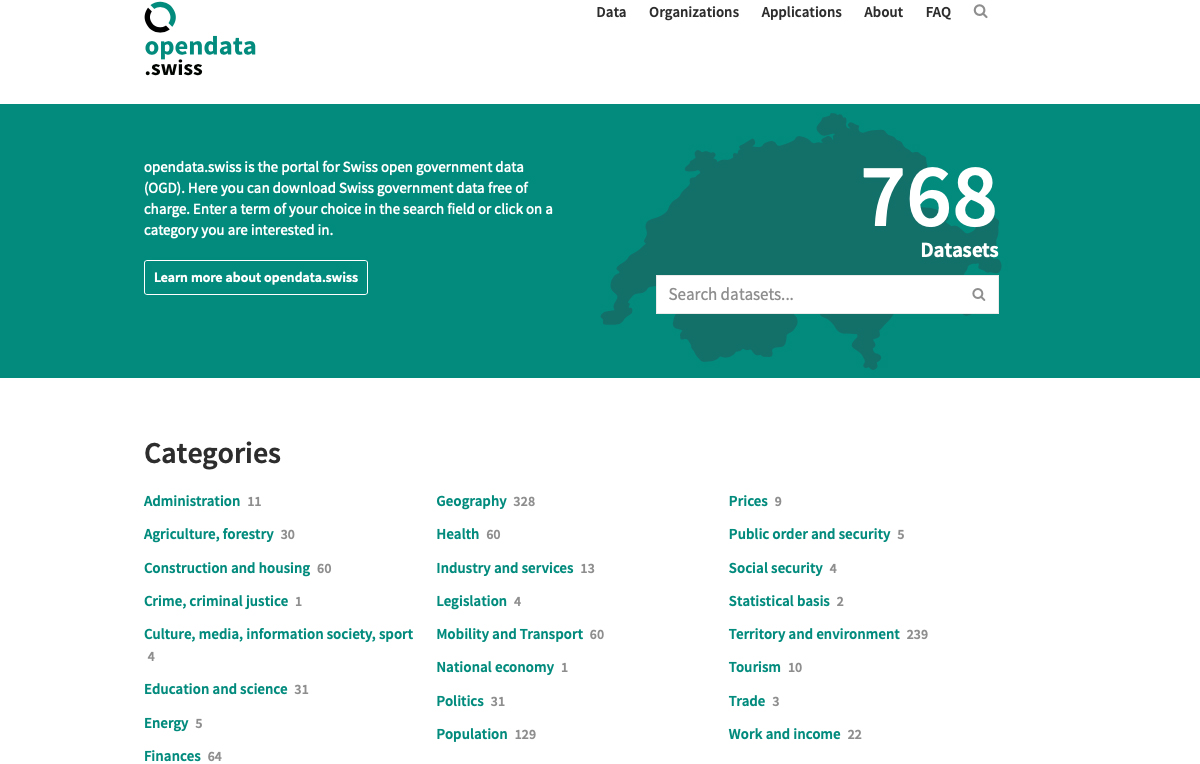
In the following months, the number of shared datasets increased steadily, but relatively slowly during 2017 and early 2018. Most of the data providers continued to be government agencies with a clear objective to publish data. Many regional/local governments and large parastatal enterprises – equally subject of the Federal Council’s mandate to share OGD – hardly participated in the publication of new datasets on opendata.swiss. Instead, several regional and local government agencies started to develop their own open data infrastructure to increase political credit towards transparency and to showcase the digital capabilities of local administrations. Likewise, parastatal enterprises, such as the Swiss Federal Railways and the Swiss Post likewise, decided to push forward with their own data portal. Their reason for stepping forward was less idealistic than business motivated: “[…] to support creative market participants in the development of new information and service offerings” as could be found on their website.
A rupture with a key principle of open data was becoming noticeable: unrestricted and unconditional access to data. Most of these regional or local repositories demanded from interested users a registration or some sort of identification to browse or obtain datasets (see Fig. 4). Indicating deviance from the ideas and objectives expressed in the Swiss OGD Strategy, this measure was justified by a respondent, responsible for the propagation of OGD at a Swiss municipality, as follows: “If we know how our data is being used, we can meet your needs more effectively and base further open data on these needs in future”. Other respondents also made no secret of their interest in knowing exactly who was using their datasets and what was being done with them. In typical business language a government employee spelled it out: “This helps us to understand our customers.”
First indications that open data is not free: The principle of unconditional access is contravened on regional and local OGD repositories.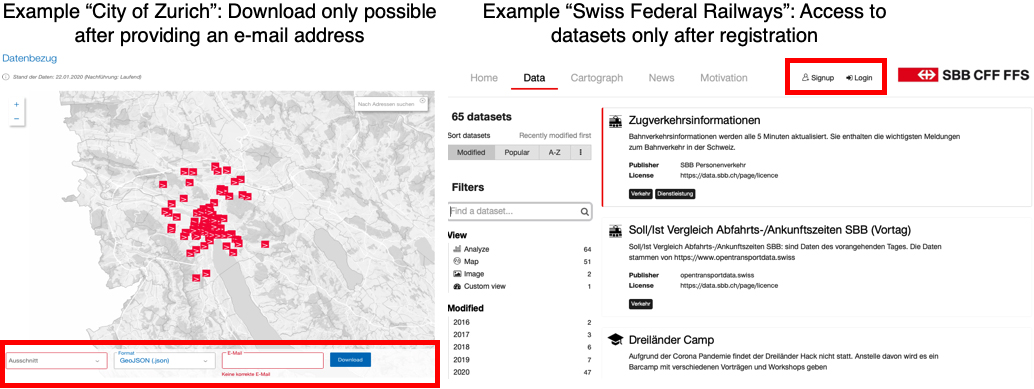
Consternated about (i) the general low enthusiasm for free sharing, (ii) some local organizations breaking ranks, and (iii) the strategic OGD objectives remaining unachieved, in May 2018 the Swiss Federal Council (2018a) decided to put on the brakes to this drift by changing the plan of action. Instead of building on voluntarism and invoking the importance of free access to public data, several measures were defined, which obliged parastatal enterprises (i.e. the Swiss Post, Swiss Federal Railways, and Swisscom) to publish their data on the national OGD portal and to report their OGD activities on annual basis. As shown in Fig. 5, this instantly yielded a boost to the centralized infrastructure. However, this steep upswing did not spark a new trend for increased sharing activity.
Evolution of opendata.swiss in terms of datasets, site visits, and downloads (own representation based on traffic data obtained from the Swiss Federal Statistical Office).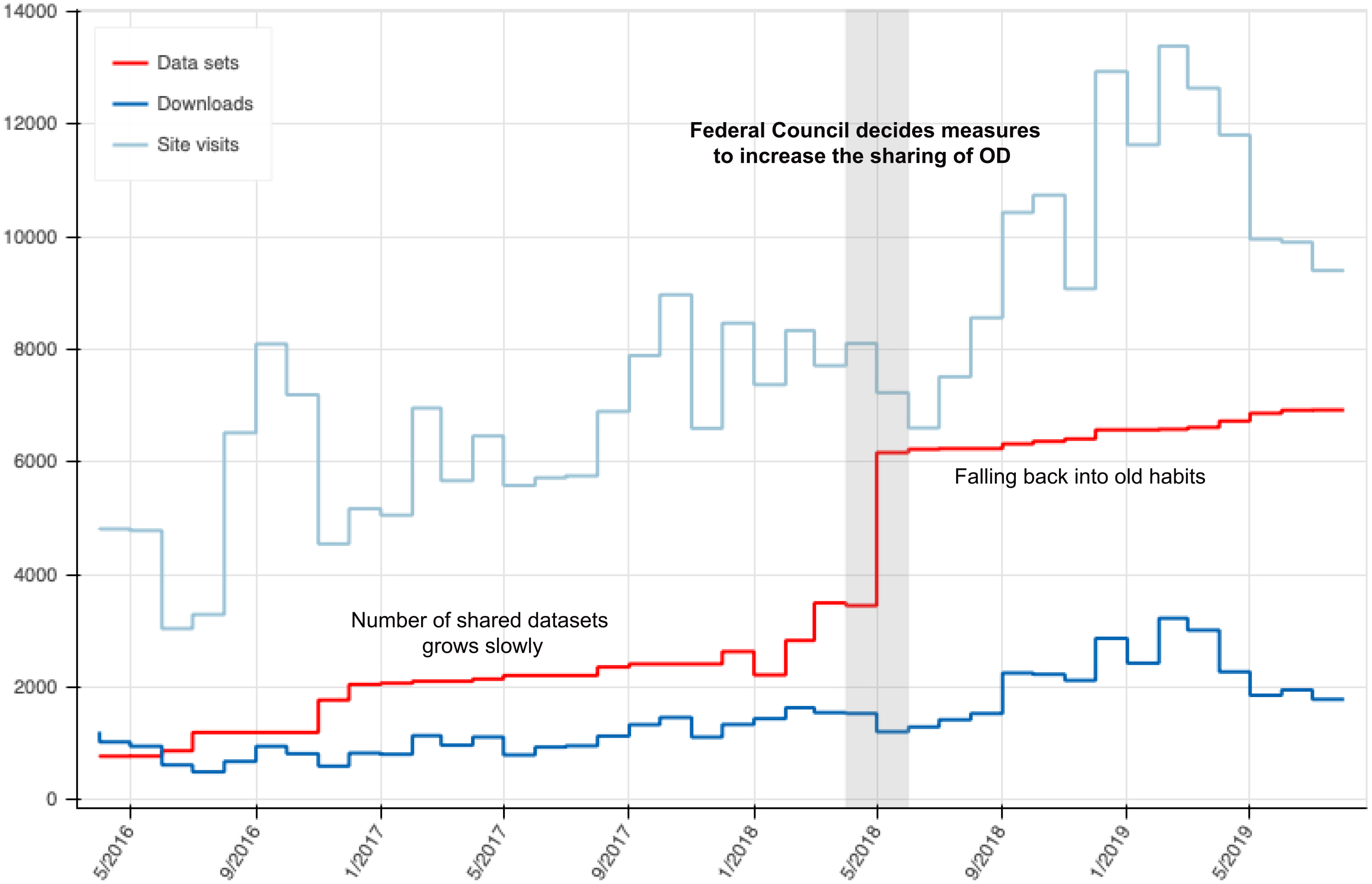
As we found out later, many government agencies and parastatal enterprises bypassed unrestricted access to data with a simple workaround. Only one percent of all entries published on opendata.swiss stored datasets on the portal (see Appendix D). Since it was nor the intention nor mandatory to store datasets on the national OGD portal –most data is hosted on municipal websites or other local data storage facilities– a continuation of the profiling practices remained possible. A young entrepreneur we met at the hackathon summarized this situation as follows: “The national OGD portal risks to become an expensive government project for dead links in a few years.” Another programmer we met stated: “Some [data] sources seem to be good; others are not. It is hard for us to tell in foresight. Sometimes we build software on sand”. Our analyses showed that only 9 percent of datasets provided additional information concerning the timeliness, frequency, and regularity of updates. Less than 20 percent of datasets were stored in a machine-readable format, indicating a low potential for re-use in data products, but most strikingly just over half was available in an open format.
On the other side, some of our interviewees from non-data-intensive government agencies argued that: “Publishing good-quality data is costly. Different than other public service departments (note: Federal Statistical Office), we don’t have the expertise nor a budget for this.” We started to notice a polarization of OGD producers, that is, on the one hand, those who were concerned with (or tried to oppose) the very act of producing OGD, on the other hand, those who wanted to find some personal and/or organizational gain from publishing. Interesting about this polarization is that it is less the manifestation of the usual resistance against top-down policies, than the result of a knowledge divide between public servants with extensive experience working with data, and those without.
Especially respondents who worked for data-intensive government agencies showed a gradual departure from the original ideals of OGD. A public manager of a municipal IT department, who claimed to have been in favor of unfeigned openness at first, stated: “For me, if it says ‘open’, it does not always mean that it is ‘free of charge”. Asking why OGD should not be per se free of charge, another interviewee argued that “Open Data is an opportunity for municipalities to improve their ties with the local economy […] and for co-creating data products based on unutilized data with selected business partners”. This departure from an altruistic ideology of openness towards a utilitarian view of OGD can also be observed empirically, as less than 20 percent of published datasets allow commercial use without previous approval.
As the planning horizon of the first Swiss OGD strategy was coming to an end, in September 2018, the Swiss Federal Audit Office (2018) was commissioned to evaluate this policy’s achievements. Their report highlighted several deficits concerning the governance and utility of the national OGD portal and concluded that “the objectives of the strategy have only been partially achieved so far” (Swiss Federal Audit Office, 2018). An important lesson learned from the report was that there is an ambiguity of formulated objectives in the OGD strategy which makes it hard to quantify economic benefits. After two years of operation and a considerable financial investment, download rates (and with it supposedly increased participation by the use of published datasets) increased only slightly even though considerable efforts were undertaken to augment the volume of entries on opendata.swiss. The interest of businesses and data users in OGD remained low, most notably because of, in their view, unattractive offering resulting from a missing commitment to actively manage and align supply and demand of data (which free data advocates argue would have happened spontaneously). A hacktivist commented: “There seems to be plenty of material available, but not necessarily the quality and type of data we looked for […].” Considerable pressure emerged to expand re-use of OGD.
In November 2018, following the issues and suggestions expressed in the policy audit report, the Swiss Federal Council (2018b) redrafted the OGD strategy for the second planning horizon of 2019–2023. In formulating the new strategy, a particular emphasis was given to improving the clarity and measurability of objectives, especially in terms of benefits and impacts for the economy. This should be partially achieved by a re-alignment with other digital initiatives on the national and international level, as well as the establishment of an ecosystem-based governance approach that fosters a more demand-driven publication of datasets and encourages local, regional, and federal government agencies to value their data assets. An immediate action taken by the Swiss Federal Council was the termination of the previous mandate of the Swiss Federal Archives to the Federal Department of Home Affairs, which assigned the Federal Statistical Office –an experienced agency concerning platformization of data sharing– to continue the activities of opendata.swiss. Changing to a demand-driven perspective for coordinating actions, several working groups were established to address specific issues of the data ecosystem, such as improving the user interfaces and documentation, or increasing user statistics and feedback mechanisms on the national OGD portal.
However, the stronger orientation towards economic use of OGD was not equally appreciated by all political forces. Several parliamentary debates in 2019 contested the idea of freely releasing data for commercial purposes as this would not be in the public interest given the high costs of data production for certain government agencies (Swiss Parliament, 2023a). To prevent large international tech companies to use OGD for improving their ML algorithms –particularly those that do not contribute to the refinancing of OGD production and sharing in form of taxes– an authorization system was proposed so that domestic firms and start-ups can request valuable data free of charge.
Critical reflection
Strengthened by numerous scientific publications (Janssen et al., 2012; Pereira et al., 2017; Weerakkody et al., 2017) and a political discourse that often obscures the true intentions of governmental IT investments, OGD is still predominantly associated with positive values, such as enlightenment, empowerment, democratic participation, and transparency (Francey & Mettler, 2021). Although these may have been what propelled OGD initially, we were interested in whether the OGD movement has been facing a fate similar to FLOSS, namely a gradual paradigm shift away from altruistic, unconditional openness to a more value exchange-oriented form of data sharing (Deloitte, 2012; Manyika et al., 2013). For practitioners, ideologies may pass overlooked. However, they are an integral part of consolidating power and to guide the future discourse of socio-technical phenomena (Agre, 2003; Avgerou & Bonina, 2020) and policy-making alike (Guenduez et al., 2020).
Over a longer period of observation, we therefore have tried to identify the motives and possible mechanisms of this ideological paradigm shift. Of course, this cannot be studied with numerical precision and is, as we acknowledge, also biased by our own experiences and active participation within the OGD movement. We have synthesized our findings in Fig. 6 and discuss them in more detail next.
Tentative explanation of the paradigm shift in OGD.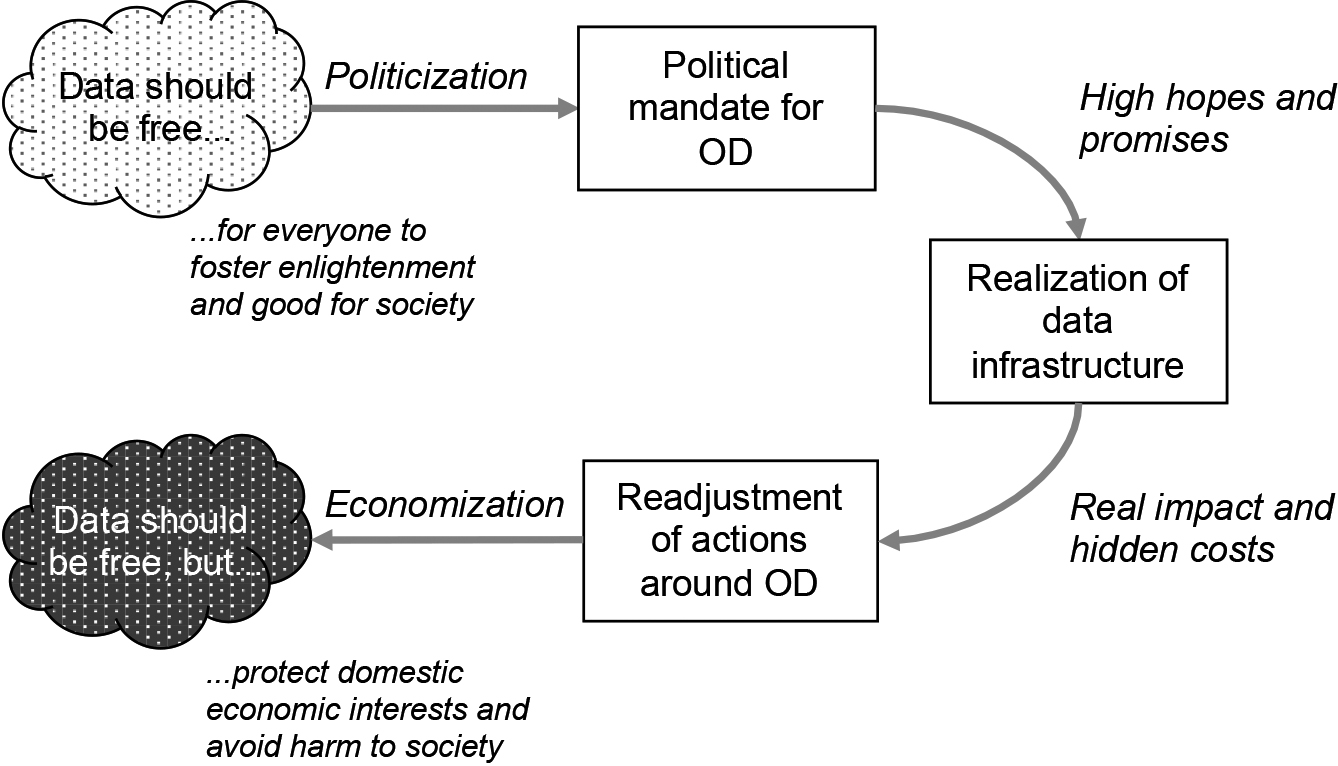
We found that our initial thesis that altruism is being replaced by utilitarian thinking turned out to be only partially correct. Reality has never been either black or white.6
The shades of gray in Fig. 6 show that both ideologies have always existed in parallel, but that the dominance has changed.
Mandated openness had affected distinct federal agencies, lower-tier institutions, or parastatal enterprises differently. Whereas some agencies had long-lasting competencies and adequate financial resources to fulfill the mandate, others have been struggling with both, the necessary IT skills and resources for data sharing, thus, publishing only the barely minimum. Still others, such as the business-driven parastatal enterprises, had the necessary prerequisites but little interest in sharing their data unconditionally. Only through enforcement it was possible to secure their participation on the national OGD portal. As other studies have shown, this has tended to have a negative impact on data quality (Hautz et al., 2017; Vassilakopoulou et al., 2019). This, in turn, had the effect that despite rapidly increasing availability, data re-use has not kept pace with this development.
Following Danziger et al. (1982), politics always had a major role in shaping IT innovation of the public sector (e.g. through investments, expansion of public activity) and private sector (e.g. through regulation, subsidization). It could be that already the very act of politicizing OGD as topic of public interest and wider societal impact may have drifted from the initially prevailing altruistic ideology. As niche topic, associated costs with producing and sharing data rested with those who followed the conviction that data should be free for everyone. As part of a political agenda, OGD became a pool resource (Lindman & Kuk, 2015). While the “tragedy of the commons” for digital artifacts follows a somewhat different logic as with physical resources (Greco & Floridi, 2004), it still remained true that a redistribution of financial resources was necessary: what is free to use for everyone, is not necessarily free to produce, maintain, and keep available. Also, potential access does not necessarily mean equal benefits for everyone. These concerns become problematic when OGD does not really respond to a societal need, such as increased participation, but remains a topic for technophile idealists that society pays for in the end.
Contrary to what one might expect, the politicization of OGD has not led to polarization, but rather to convergence toward a utilitarian worldview. Right-wing politicians strengthened this way of thinking about OGD by raising the argument of tax money being wasted due to the poor provision of data and resulting low demand for and use of data sets, which is why more intensified collaboration with the private sector as well as cost recovery and revenue-seeking behaviors by the public administration is necessary (Swiss Parliament, 2023b). Left-wing politicians, on the other hand, feared that the “wrong” actors, namely tax-evading global corporations, would be the only beneficiaries of the OGD movement Swiss Parliament (2023c). Given their competitive advantage in terms of computational and programming capabilities in developing advanced ML algorithms, free and unrestricted access must be abolished in order to counter the unequal sticks and potential risks for local laborers and innovators in the global competitive market for artificial intelligence. Hence, utilitarian (and not altruistic) thinking became a maxim for actors across the political spectrum.
Re-adjustment as way to avoid blame and secure a future
While politization of OGD instigated utilitarian thinking, it is not the same as agreeing on a shared vision or future roadmap of a publicly-funded data infrastructure. Different expectations of what will be shared and what can possibly be done with OGD (and what not) inevitably leads to issues, specifically over-estimations or under-estimations of the data’s potential (Nickerson & Rogers, 2014). Unfulfilled promises typically gear politicians toward blame avoidance behaviors (Cranefield & Oliver, 2014; Hinterleitner, 2020). It certainly did not help that, even before the launch of opendata.swiss a research report predicted net benefits for the economy of 0.9 to 1.2 billion Swiss Francs per year (Bürgi-Schmelz, 2013). As the case showed, after some years of the going live of opendata.swiss, the Swiss Federal Audit Office (2018) painted a more realistic picture of the societal and economic impacts of OGD. This has led politicians to ask not necessarily for the causes (e.g. lack of a data culture, limited legal means to enforce data publication, exclusive focus on the supply-side without involving potential users early on), but rather for the culprits (e.g. replacing Swiss Federal Archives by Federal Office of Statistics).
What is also striking about this case is that at the beginning, the focus was only on the potentials of data liberation, but not on the hidden costs of data maintenance and publication. A shift toward a more utilitarian worldview could, to a certain extent, also be a practical necessity for counteracting negative effects (e.g. international corporations largely benefiting but not contributing to the endeavor) and for securing OGD as public good in the long term (Lindman & Kuk, 2015).
Conclusion
Our objective was to investigate the occurrence of a possible shift in the fundamental worldview of the OGD movement, akin to the shift observed in the FLOSS movement. Our findings indicate that a paradigm shift has, in fact, transpired and we offer a tentative explanation for the motives behind governments transitioning from an altruistic ideology towards a more “utilitarian” worldview concerning OGD. More specifically, our case study has shown that while the idea of altruism was prevalent at the beginning and (mis)used to popularize the OGD movement, utilitarian thought patterns (that view OGD as a resource to be exploited and utilized) have always been present. However, the increasing politicization of the OGD movement (fueled by the increased media attention related to datafication, sensorization, and artificial intelligence) has led to high hopes and promises which were ultimately not met (it remains questionable whether this would ever have been possible). A readjustment of actions and ideological alignment toward utilitarianism was thus required as a shield from political blame as well as to secure the future of OGD as public good.
Our critical case study also showed that in practice ideologies and interests collide in a number of unexpected ways with unforeseen outcomes (Daniel et al., 2018). On one hand, ideologies can get problematic when –to project a positive light– they obfuscate a problem like cost-recovery, which can undermine the overall effort. On the other hand, practical problems can instrumentalized to undermine broader ideologies. When high hopes recede and mundane concerns take center stage, a disillusioned (or realistic) approach to openness may be key to align data supply and demand for use in organizations and society. This means allowing for a realistic acknowledgement of costs as much as the concrete risks that powerful actors rather than the people and businesses take advantage of the altruistic ideology. Overall, we hope to stimulate a more honest, or at least more reflective, debate on OGD in future studies to come.
Footnotes
Acknowledgments
This research has been supported by the Swiss National Science Foundation (grant no. 212637).
Appendix A: Overview of data sources
Swiss Federal Archives (2013): Economic Impact of Open Government Data Swiss Federal Council (2014): Open Government Strategy 2014–2018 Swiss Federal Council (2018b): Open Government Strategy 2019–2023 Swiss Federal Council (2018a): Report on the measures for a future-oriented data policy in Switzerland Swiss Federal Audit Office (2018): Cross-sectional audit of the implementation of the Open Government Data Strategy for Switzerland Swiss Federal Statistical Office: Swiss Parliament: Swiss Federal Railways: Swiss Post: Swiss Data Alliance: Opendata.ch: eCH:
Scrapping of metadata of approximately 7,000 datasets registered on opendata.swiss (May 2018 and August 2019) Analysis of web traffic on opendata.swiss obtained from Swiss Federal Statistical Office (September 2019)
Federal level: 3 x Swiss Federal Archives (60 min. each, Mai-Juli 2018), 2 x SwissTopo (45 min. each, January 2019), 3 x Swiss Federal Office of Statistics (45 min., February 2019) Regional/local level: department heads of distinct government branches in charge of publishing OD; 5x on cantonal level and 5x on municipal level (October-December 2019; approx. 45 min. each) Informal conversation with 10 application programmers, hacktivists, and data entrepreneurs (May 2019; approx. 30 min. each)
Documents/online sources
Datasets
Interviews/personal communication
Appendix B: Interview questions
What is your understanding of open government? How does your team/department embrace the OGD strategy of the Swiss Federation? Was/is there internal resistance? If so, why? Does the team/department you are working with have previous knowledge about or even a mandate for data publishing? Who decides what kind of datasets are published? Do you have a specific decision-making process implemented for that? What experiences did you make with publishing datasets on opendata.swiss? What were the biggest challenges internally or with the transfer of data onto the portal? Do you store the data on the portal or rather on your premises? In case of the latter, why? Would you generally agree that government agencies should publish their (non-sensitive) data for free? Could you specify some concrete arguments in favor or against OGD? Would you generally agree that data users should be given access to data without any strings attached? If not, why?
In which ways do you use OGD (e.g. commercial/leisure/research)? Have you used data published on opendata.swiss for one of your projects? If so, what were the biggest challenges in using the published datasets on opendata.swiss? How strongly do you rely on OGD? Besides opendata.swiss, where do you look for OGD about the Swiss government? What do you think of the idea to restrict access to datasets when used for commercial purposes? Should there be a preference of certain OGD users (e.g. research/media/start-ups)?
Questions related to OGD production
Question related to OGD use
Appendix C: Analytical procedure
Appendix D: Characteristics of published OGD as of August 2019
Author biographies
Tobias Mettler (tobias.mettler@unil.ch) is Professor of Information Management at the Swiss Graduate Institute of Public Administration (IDHEAP) of the University of Lausanne, Switzerland. His research interests are in the areas of design science research, technology adoption, and applications of data science, with a particular focus on digital government and healthcare.
Gianluca Miscione is a tenured academic in Management Information Systems at University College Dublin Smurfit Business School (Ireland) and researcher at the School of Management and Law of the Zürcher Hochschule für Angewandte Wissenschaften (Switzerland). He conducted and contributed to research in Europe, Latin America, India, East Africa, and on the Internet. His focus is on the interplay between technologies and organizing processes with a specific interest on innovation, development, organizational change, social networks, and trust.