




Abstract
In order to improve legitimacy, accountability and effectiveness for both policy making and service delivery, governance networks can benefit from the knowledge, skills and other key resources of external actors. However, these networks are often prone to social and cognitive exclusion of outsiders, reducing the potential benefits of greater inclusiveness and diversity. Inclusiveness within governance networks is defined here as the possibility for new actors to both enter the network and to influence its decisions. Based on an extensive literature review, this paper argues that Open Government Data (OGD) strategies and related technologies can potentially contribute to governance network management strategies aimed at preventing social and cognitive exclusion. We propose a conceptual model of how these relationships work. However, empirical evidence from the literature included very few cases in which the positive effect of OGD strategies has actually been achieved. Therefore, we also identify two critical success factors that appear to be needed: (1) proactive data strategies to expand the network of interested parties and their ability to use data, and (2) empowering new interested actors by promoting their access to structural and formal roles in the network and systematically integrating their feedback into the policy cycle.
Keywords
Introduction
Administrative action is increasingly carried out through networks of public, private and civic organizations (Isett et al., 2011). The literature on networks in Public Administration has been mainly focused on three types: policy networks, collaborative networks and governance networks (Isett et al., 2011). Governance networks deal with both decisionmaking and the delivery of public goods or services, recognizing that policy planning and implementation are often intertwined (Rethemeyer & Hatmaker, 2008).
As governance networks have become more common, several authors have questioned their democratic nature (Klijn & Skelcher, 2007; Nesti & Graziano, 2020; Sørensen & Torfing, 2005; Torfing et al., 2009). While one view sees governance networks as mainly closed, dominated by an exclusive club of powerful actors systematically excluding outsiders from the network’s key decisions, a different view highlights the opportunities for networks to effectively connect public decisionmaking to citizens and other stakeholders (Wang & Ran, 2021), fostering democratic values such as accountability, legitimacy, and justice (Fung 2006), as well as improving the effectiveness (Kickert et al., 1997; Provan & Milward, 1995) and legitimacy (Fossheim, 2021; Mosley & Wong, 2020) of public governance.
The concept of inclusiveness is used here to represent the capacity of a network to attract new individuals, organizations, and a variety of stakeholders in deliberative policy processes (Rethemeyer, 2007b; Vermeiren et al., 2021). In principle, more inclusive and open processes are expected to improve the quality of decision making or service provision, as well as to enable new forms of coproduction with individual citizens or external groups such as geographic and political communities, users of public services or beneficiaries of public policies (Nabatchi et al., 2017).
Open Government Data (OGD) strategies, which have the goal to disclose the information produced or financed by government agencies have similar goals in terms of accountability and effectiveness (Dawes, 2010; Sieber & Johnson, 2015). OGD strategies could therefore potentially contribute to network inclusiveness, by creating new participatory mechanisms in combination with complementary public policies aimed at fostering transparency, accountability, public participation and collaboration (Dawes et al., 2016).
However, the extent to which OGD can affect the nature of governance networks is still unknown. Both theoretical and empirical work is lacking. This paper therefore tackles the following research question: How and to what extent can Open Government Data strategies make governance networks more inclusive?
The research goal is to learn whether OGD can be used as a tool for previously excluded organizations to successfully permeate governance networks and proactively participate in shaping decisions. We contribute to existing literature by developing a conceptual framework connecting OGD strategies with management strategies for network inclusiveness, which, in turn, can influence the social and cognitive characteristics of governance networks making them more (or less) inclusive. We also highlight two main success factors as necessary conditions for OGD strategies to have a positive influence on network inclusiveness, namely the capacity (1) to entice new members through attention to data quality and usability and (2) to broker new relationships by encouraging systematic feedback from traditionally unrepresented actors.
To do so, the paper relies on an extensive literature review of research published in both Public Administration and Digital Government outlets. The paper is organized in seven sections, including the foregoing introduction. Section 2 describes our methodology. Section 3 introduces the concept of governance networks inclusiveness and proposes a definition. Then it describes the main social and cognitive characteristics of governance networks and the related network management strategies for network inclusiveness. Section 4 presents OGD strategies as complex sociotechnical phenomena potentially able to affect network management strategies. Each link between OGD and network strategies for inclusiveness is analyzed, based on theory and on successful cases as reported in the literature. The discussion section presents a complete conceptual framework encompassing all the potential links between OGD, management strategies, and network characteristics. It also considers two success factors that are likely to make the most of OGD’s contribution. Finally, the paper includes a concluding section with suggestions for future research.
Methodology
The analyzed articles were selected through a Boolean search in highly ranked journals identified either within the discipline of Public Administration (Administrative Science Quarterly, Journal of European Public Policy, Policy Studies Journal, Policy and Society, Public Administration Review, Journal of Public Administration Research and Theory, Public Management Review) or the interdisciplinary field of Digital Government (Government Information Quarterly and Information Polity). Journals were selected based on the 2021 Scopus CiteScore index. Public administration journals with CiteScore index higher than 7.6 were selected. Two additional Digital Government journals, both with with CiteScore index higher than 4, were also included for their specific focus on OGD.
Eleven different searches were conducted by one of the authors. Six of them comprised combinations of the keywords “policy networks”, “governance networks”, “network governance”, and “network management” with the keywords “inclusiveness” and “openness”. The other five searches considered combinations of the keyword “open government data” with “transparency”, “collaboration”, “coproduction”, “participation”, and “governance networks”. We did not restrict the publication dates. The searches yielded 41 articles from Public Administration outlets and 57 articles from the two Digital Government journals. In addition, articles, books, and conference proceedings from 2016 to 2021 were also selected for review by using the same keywords to carry out a Boolean search in the databases JSTOR, Web of Science, and Google Scholar. The output of this additional search was 157 studies. After removing duplicates, the two search strategies combined provided a total of 121 articles.
When screening the literature, we sought to include original theoretical or empirical studies that specifically described the relationships among concepts of governance network inclusiveness, network management strategies, or open government data strategies. Titles, abstracts, and keywords were screened. The initial search results were supplemented with a manual search of the references of the selected articles and other studies about which the authors were aware from their past research, which resulted in an additional 25 studies included. Our final selection comprised 59 studies, including 11 books, 5 book sections, 1 conference proceeding paper and 42 journal articles (27 published in Public Administration journals and 15 in Digital Government journals). See also the flow diagram in Fig. 1.
Selected literature was then mapped to identify core concepts and subconcepts that were relevant for the research topic, including the inclusiveness of governance networks, management strategies for improving inclusiveness, and OGD strategies. For each core concept, a list of elements from the selected literature was created to develop the main arguments, while relevant articles were used to identify the relationships among different elements and the variables that could affect such relationships (Machi & McEvoy, 2021).
Flow diagram of the literature review. Adapted from Page et al. (2021).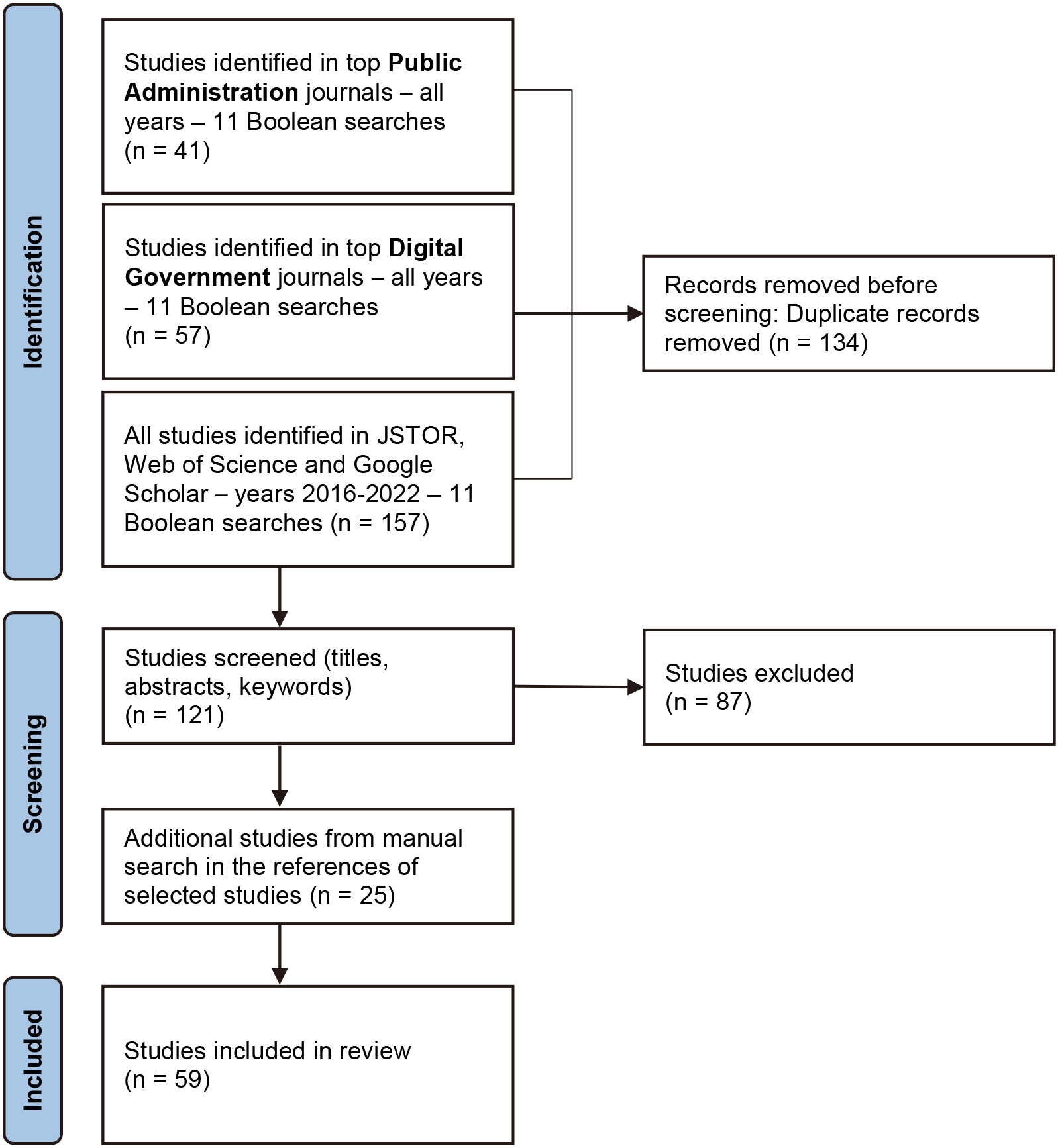
A variety of theoretical approaches highlight the benefits of networks in mobilizing and exchanging resources across institutional boundaries. Networks, as collaborative structures, can boost broad systemic responses when dealing with complex societal challenges (Janssen & Helbig, 2016; O’Toole, 1997). In particular, Resource Dependence Theory (Pfeffer & Salancik, 1978) suggests including the actors able to bring useful resources to a network. Information, knowledge, and skills are identified as key resources (Agranoff & McGuire, 2001; Klijn & Koppenjan, 2015; Shrestha, 2013). According to Koppenjan and Klijn (2004), increasing the number of actors is a viable strategy to create “substantive variety” of alternative solutions to a complex public policy problem, in a context of multiple perceptions and contested knowledge within the network.
Recent developments in governance network theory focus on networks as complex adaptive systems (Katz & Kahn, 1978; Koliba et al., 2018). These systems are characterized by dynamic relationships with the external environment, from which they receive inputs that shape internal processes and then generate outputs that are released back to the outside. They also systematically intersect other systems, with multiple network managers interacting with each other in a partly competitive, partly cooperative fashion (Rethemeyer & Hatmaker, 2008). In this view, the open or closed nature of the network is related to the characteristics of its boundaries. Koliba et al. (2018) describe the openness of a network system in terms of “permeability” of its boundaries, which is a measure of how significant are the barriers to entry. A related stream of literature deals with the activity of boundary spanning, which is carried out by selected actors in order to build new relationships with the external environment (van Meerkerk & Edelenbos, 2018).
Another stream of literature deals with empowerment of new actors. Even when new actors are formally or informally allowed to enter a network, they may have not enough power to make active contributions to the network’s activities (Torfing et al., 2009). Influence “involves the transmission of information [from an actor in the network] that changes other actors’ behaviors” (Knoke, 1990, p. 11) and largely depends on the distribution of authority and resources (Pfeffer & Salancik, 1978). Networks can experience power imbalances or asymmetries, as some actors possess greater ability than others to influence other actors (Agranoff & McGuire, 2001; McGuire & Agranoff, 2011). Reducing these imbalances implies that newcomers have more chances to participate in key decisions, as their voices, perspectives and contributions are not only considered but actually used by the network in policy making or service delivery.
Based on this literature, governance network inclusiveness can be defined as the composition of two fundamental aspects:
Access: Actors from outside the network are allowed to enter, and Influence: They can influence other actors’ behaviors, including key network decisions.
While governance networks can be steered by any type of organization, the Public Administration literature mainly deals with inclusiveness from the point of view of public management, with governments having a central role in operating and shaping the nature of governance networks (Ansell et al., 2020; Isett et al., 2011; Kickert et al., 1997; Provan & Kenis, 2008). Table 1 presents the main variables that can influence the inclusiveness of governance networks. For each variable, the expected effect is described in terms of potential negative (
Variables influencing the inclusiveness of governance networks
Variables influencing the inclusiveness of governance networks
In particular, the first variable influencing network inclusiveness is the most obvious one, which is the actual behavior of individual actors towards other actors, in particular new actors wishing to enter the network. The actors’ frame of reference, which is in part shaped by network culture, refers to individual perceptions of reality, which act as a filter when interacting with other actors. Network culture is a characteristic of the whole network concerning values and norms, customs, rules and discourse that place specific restrictions on the actors. An example of network culture is the use of language (“discourse”) where the use of specialized jargon instead of plain, intelligible language is a powerful barrier to entry for new actors wishing to interact with existing members.
In particular, management strategies can aim at improving social and cognitive openness by altering network culture and actors’ perceptions of different points of view. Specific strategies can be implemented to: (1) further a common language (for example, actors should invest in understanding each other’s interests and perceptions and develop shared codes and meanings for communication), (2) introduce new ideas from the external environment (for example, by organizing meetings and brainstorming sessions and give enough time for new ideas to get adequate support by most members), or (3) promote the process of reflection, which help discover and discuss individual perceptions and ideas (Termeer & Koppenjan, 1997), and build trust (Klijn & Koppenjan, 2015).
The relations among all the foregoing variables are represented in Fig. 2. It shows that strategies for cognitive openness are expected to affect both network culture and actors’ frames of reference, while the behavior of individual actors is mainly influenced by the institutional and process design of the network (Schaap, 2007).
Relations between intrinsic characteristics of the network and management strategies for inclusiveness. Source: Author’s elaboration, partly adapted from Schaap (2007).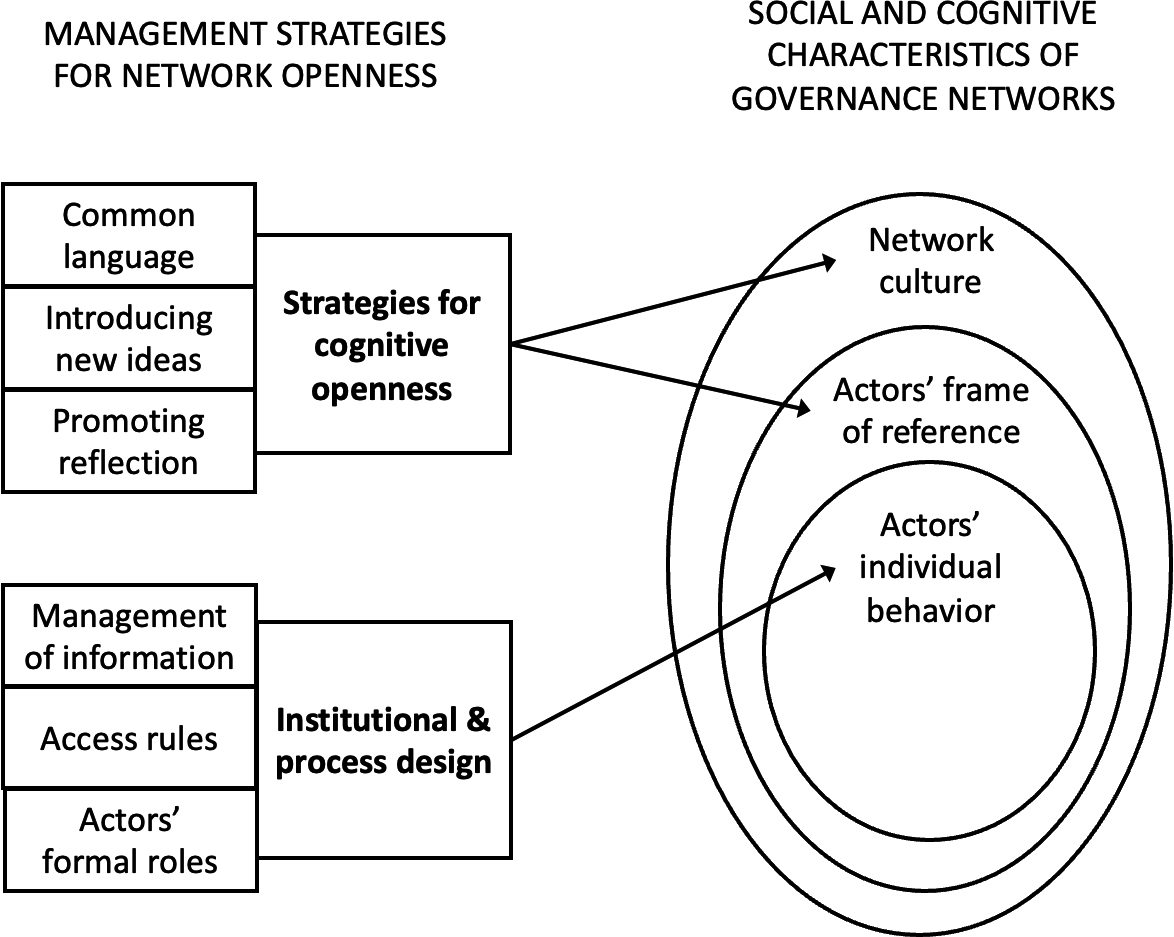
Since the 1990s, the Internet and related tools – from government websites to online forums to social media – promised to facilitate the flow of information among policy actors and foster public participation. By significantly diminishing transaction costs and removing the barriers to key information resources, the Internet is often perceived as a game-changing technology enabling fundamental shifts in the economy, society and culture worldwide, including public institutions (Fountain, 2001).
However, the initial optimism connected to the first cases of online activism and electronic democracy (Bertot et al., 2010) was soon tempered by some early findings during the 2000s. For example, Rethemeyer (2007a) found that in two instances of policy networks, the adoption of Internet technologies reinforced the influence of the most powerful actors instead of increasing the chances for new or less prominent players to have an impact on policy decisions. Other studies focus on the causes of ICT failures as a tool for inclusion, citing the digital divide and unequal access to ICTs as a powerful barriers to public policy inclusion (Helbig et al., 2009; Norris, 2001). This trend, despite the widespread diffusion of mobile technologies, has not significantly changed over time. Lack of technical and civic skills, knowledge about the policy processes, and institutional barriers such as budget constraints, organizational instability, policy shifts, political ambivalence, and legal risks all prevent or minimize engagement (Chadwick, 2011).
Open Government Data (OGD) are data produced or financed by public institutions and made publicly accessible on the web (Bertot et al., 2010; Janssen et al., 2012). The OGD ideal is that the data, once accessible by anyone in web portals or platforms, can be used by a wide array of organizations and individuals to become aware of specific issues, policies or service and then provide input or feedback on their effectiveness, or to develop innovative data-driven applications of their own (Gascó-Hernández et al., 2018). These OGD users include citizens, NGOs, businesses, journalists, entrepreneurs, and research organizations.
In this analysis, we focus not only on the data but also on OGD strategies implemented by government organizations, taking a sociotechnical perspective, which combines technological and organizational aspects in a dynamic interplay (Dawes et al., 2016). Unlike the mainly technological tools such as the Internet forums noted above, successful OGD initiatives are part of a wider strategy that encompasses organizational change in government information management, communication, and the relationships with stakeholders.
Three different types of OGD strategies with three different purposes can be distinguished, namely OGD strategies for transparency and accountability, for participation and collaboration, and for innovation and economic development. Figure 3 illustrates how policies and activities that accompany information disclosure can support each strategy.
From government information to OGD strategies and related examples. Source: Authors own elaboration.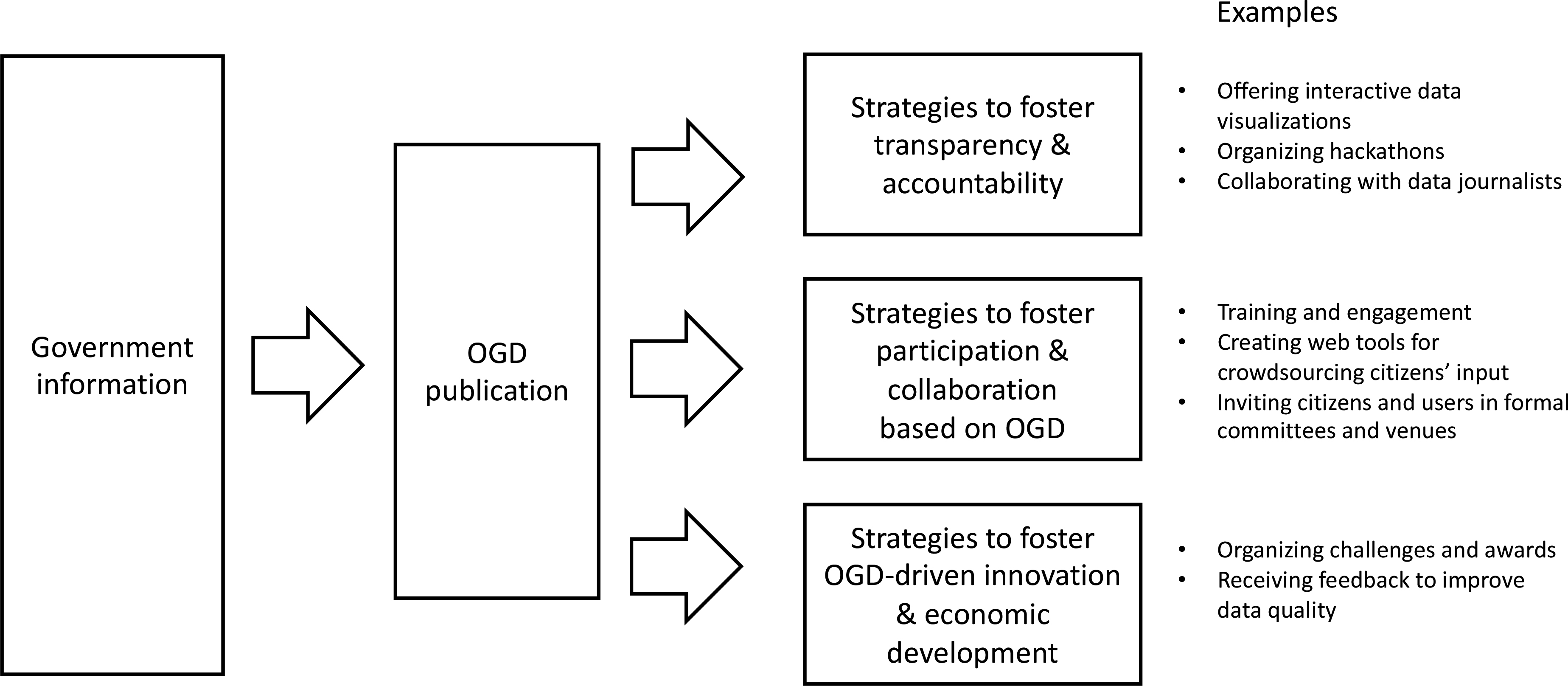
In this section, the potential links between OGD strategies and network management strategies are described, with reference to the three main types of OGD strategies. These links are represented in Fig. 4 and discussed below.
Potential contribution of OGD technologies and strategies to management strategies for inclusiveness. Source: Authors’ own elaboration. Note: Only direct effects are displayed.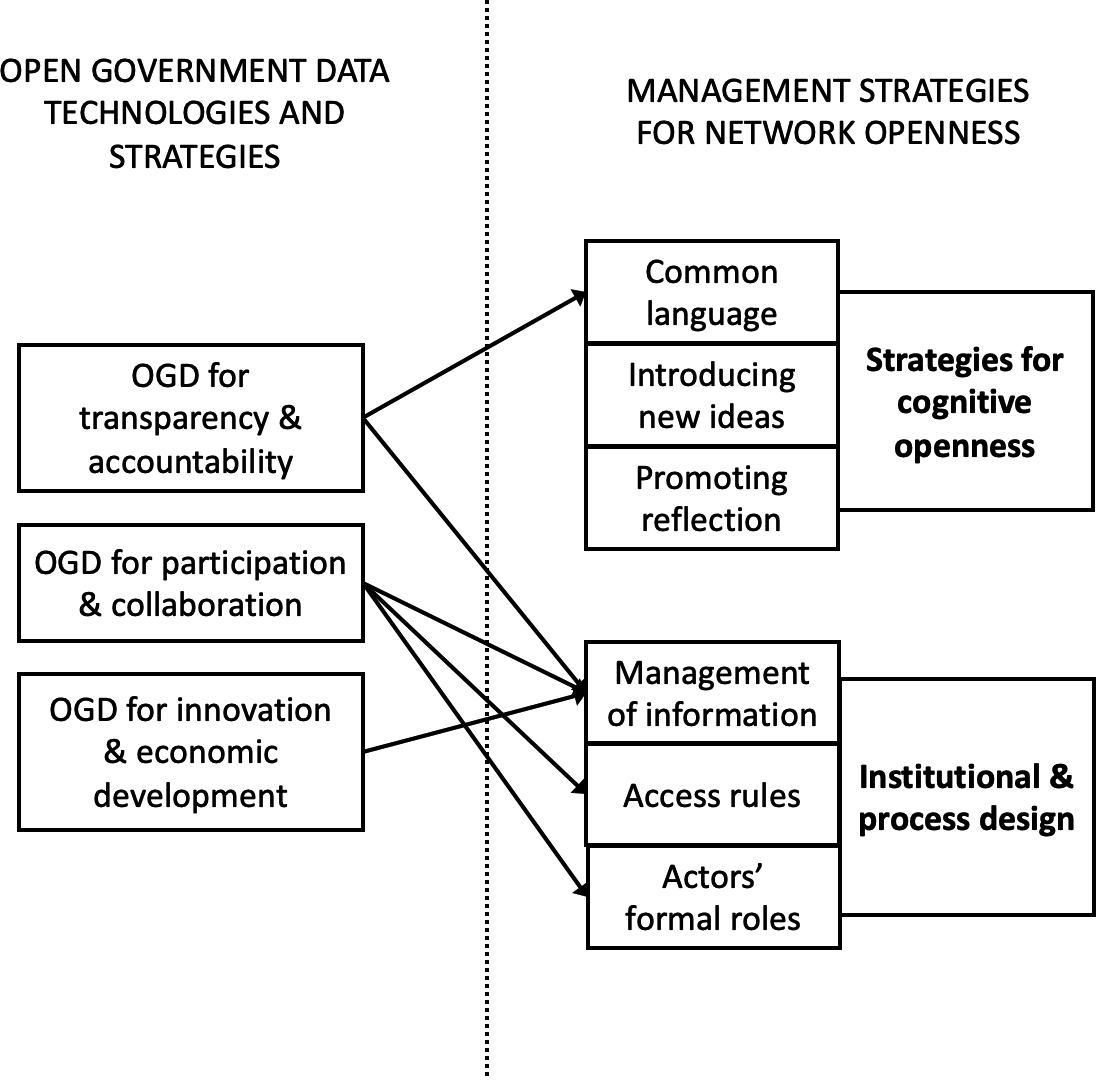
As noted above, all OGD strategies begin with the same fundamental step of disclosing government data. The main potential effect of OGD disclosure is therefore on the management of information strategy. When new channels of information are opened from the government to all interested parties, new actors can be encouraged to enter governance networks and provide their knowledge, expertise, and collaboration. In general, OGD disclosure is expected to allow for a “democratization” of information on key aspects of policy-making by decreasing the information asymmetries between government and citizen (Fung et al., 2007). This can be seen as an “expansionary form of policy entrepreneurship”, which “uses the Internet to distribute information that is usually closely held by core members, thereby diluting existing patterns of information brokerage” (Rethemeyer, 2007a, p. 211).
Links associated with each specific OGD strategy, including both direct and indirect effects on network management strategies, are discussed below.
One of the main goals of OGD strategies worldwide is fostering transparency and accountability of public action thanks to the creation of specific websites and web portals.
The most obvious, direct effect is on network rules for information management. In particular, OGD can increase the awareness of specific public policies or government spending, therefore increasing the chances that actors outside the network become interested in taking part in policy decisions or collaborating in public service provision. The disclosure of public information for accountability purposes can also have indirect effects on network rules about access and actors’ roles. First, thanks to this new information published in transparency portals or platforms, citizens, NGOs or other interested parties may develop enough knowledge and skills to effectively enter the network and voice their needs or offer useful inputs such as by monitoring the effect of a given policy (Fung, 2013). Second, intermediaries such as the media or transparency organizations can exert additional pressure on network managers to expand the boundaries of the network and consider input from previously excluded actors (Lassinantti et al., 2018). This process increases the amount of information going back to the governance network as a system, in the form of feedback loops (Dawes et al., 2016).
A second potential direct link is between OGD for transparency and accountability and strategies aimed at promoting a common language to improve network culture and the cognitive openness of individual actors. In some cases, the provision of data is accompanied by communication activities aimed at translating policy jargon into more understandable language. The publication on the web of metadata, data descriptions, and glossaries, for example, is aimed at improving clarity and facilitating interaction with non-experts (Lourenço, 2015), while data visualizations can help overcome the barriers created by the use of specialized jargon (Isett & Hicks, 2018) and complex statistics.
OGD strategies for participation and collaboration
OGD strategies can also have specific purposes of enhancing public participation and collaboration (Gascó-Hernández et al., 2018), with a direct positive effect on the inclusiveness of governance networks through the creation of new input and feedback channels. Examples include the provision in OGD platforms of engagement tools for collecting comments, suggestions, and ideas that are based on or driven by the data. Some EU Regional Policy OGD portals, for example, provide tools for engagement or partner with local NGOs to promote different forms of social monitoring of spending or public services (Reggi & Ricci, 2011). These NGOs are expected to become regular contributors of new information and policy feedback.
Furthermore, the use of OGD for participation and collaboration purposes can potentially empower new actors to effectively influence existing actors and network decisions by changing the rules about actors’ positions and roles. Government OGD strategies can actively invite previously excluded actors to formal meetings and committees to report on the effectiveness of local interventions such as public infrastructures and services, thus increasing their formal power (Ingold & Leifeld, 2016).
OGD strategies for innovation and economic development
The third goal of OGD is to stimulate innovation and economic development (Brito, 2008). The contribution of government is mainly focused on making data freely available on the web, as well as tools to facilitate their effective use, therefore directly impacting the network strategies for information management.
In particular, OGD-driven social innovation and “civic technologies” can play a key role in creating new opportunities for disseminating government information and facilitating the use of external expertise for coproducing public policies or services (Liu, 2017; Mergel, 2018). Innovative platforms created by social entrepreneurs or civic developers can facilitate the connections between incumbent actors in governance networks with new organizations and individuals, thus indirectly modifying network management strategies for new actors’ access, roles and positions. For example, New York City has organized challenges for application development (“BigApps”) to promote the use of open data that meets the needs of local communities(Dawes et al., 2016).
In summary, this literature provides evidence that in some cases and under certain conditions, OGD strategies have the potential to positively affect network inclusiveness. It shows how OGD strategies can, in successful cases, promote a more holistic approach to engagement by creating new opportunities or refining management strategies that enhance and encourage inclusiveness.
In the next section, the main barriers, conditions, and success factors are discussed.
The potential contribution of OGD to network inclusiveness: A conceptual framework and success factors
The complete framework derived from the analysis above is represented in Fig. 5. It shows the potential contributions of the three main types of OGD strategies to governance network management strategies, which, in turn, are set to improve the social and cognitive inclusiveness of governance networks.
Potential contribution of OGD strategies to governance networks inclusiveness – complete framework. Source: Authors’ own elaboration. Note: Only direct effects are displayed.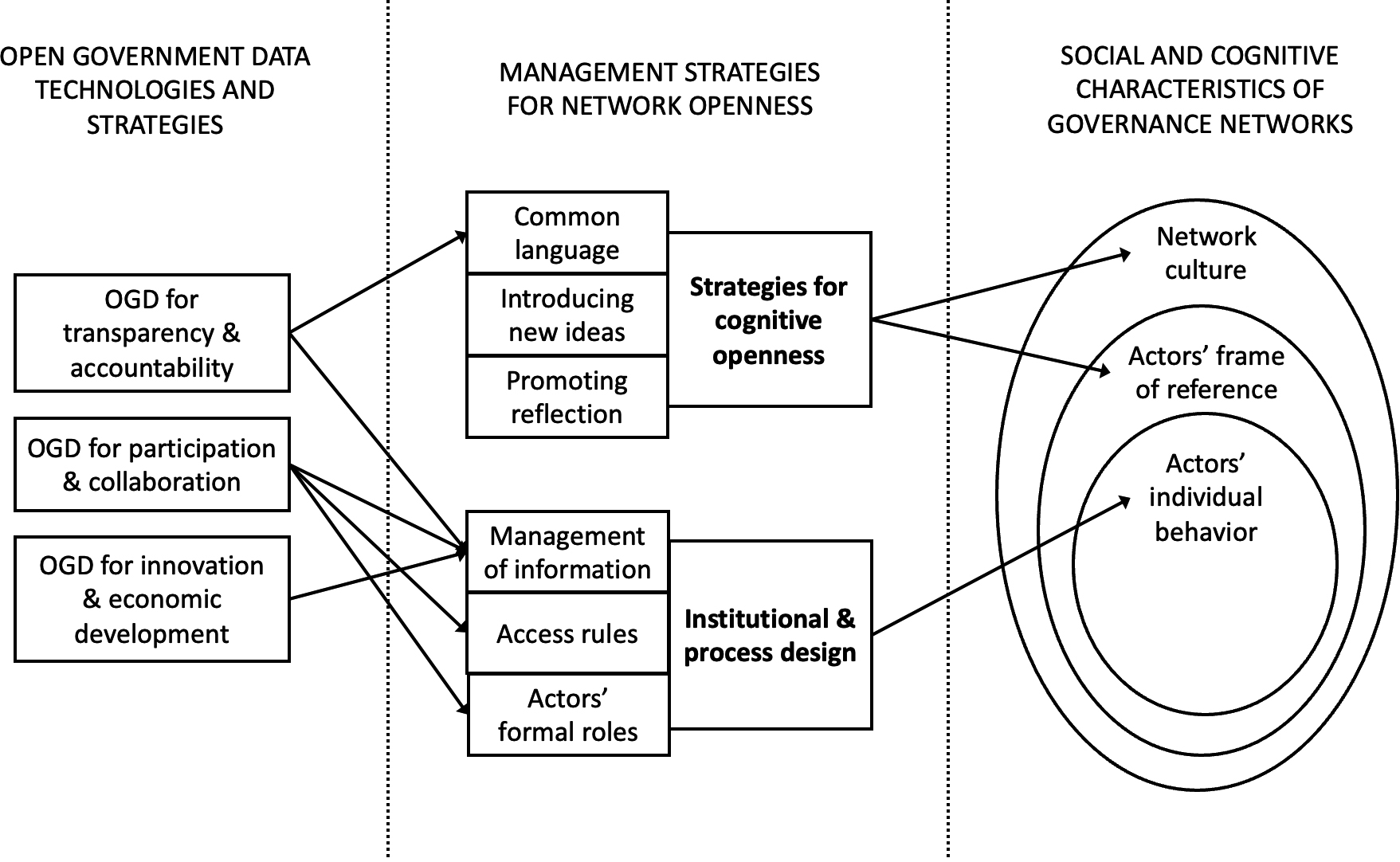
The analysis above suggests that OGD initiatives can be successful when accompanied by proactive strategies aimed at promoting meaningful use by a wide array of actors. However, the literature on digital government has also identified barriers and challenges that commonly limit the effectiveness of OGD strategies (Barry & Bannister, 2014; Janssen et al., 2012; Savoldelli et al., 2014). While a few empirical cases have offered evidence of the positive effect of OGD strategies, such as the examples in the cities of New York (Dawes et al., 2016) and Chicago (Kassen, 2013; McBride et al., 2018), it has also been argued that, on average, “mechanisms of participation related to open data largely have been limited to ad hoc events in which technologists and interested parties collaborate on software-related projects” (Peixoto, 2013).
Some specific challenges can be connected to the two main aspects of governance network inclusiveness as outlined in the definition at the end of Section 2.1 – access and influence:
To increase the permeability of governance network boundaries, OGD need not only leave the premises of the government but also effectively reach actors that are potentially interested in entering the network. Interested actors, then, need to understand, make sense of and use the information in order to develop awareness and understanding of complex network dynamics, policy mechanisms and the processes behind public service provision. To ensure new interested actors can also influence other members’ behaviors, OGD strategies must empower individuals and organizations that use OGD or OGD-driven innovations and services to participate. To do so, OGD strategies need to include mechanisms to gather, assess and use feedback when making decisions, and to integrate contributions from new actors into policy making or service provision.
Accordingly, two OGD success factors can be outlined to help make policy networks more inclusive.
The first success factor mainly deals with how OGD strategies can influence the management of information strategy aimed at making actors’ behavior more open and inclusive. The amount and quality of information provided by the government, as well as the specific way in which it is made accessible, play a crucial role in allowing actors from outside the network to develop an interest in specific policies or public services. In short, “To be of any value, information must be relevant, timely, and trustworthy” (Laumann & Knoke, 1987, p. 191).
First, OGD strategies must provide enough detail about the key aspects of public policy programming and implementation, especially those that are particularly relevant for the community of users. Those aspects include all significant phases of the policy cycle such as agenda setting, definition of strategic goals and multi-annual objectives, policy definition and related financial allocations, policy implementation, service delivery, monitoring, and evaluation.
Second, governmental data reach their full potential when data management practices follow two complementary principles of stewardship and usefulness (Dawes, 2010). The stewardship principle focuses on policies and activities that assure accuracy, validity, security, management, and preservation of information holdings, while the usefulness principle deals with policies and incentives to maximize the benefits for data users when OGD are released, such as investments in data presentation and analysis tools.
Third, successful management of information also includes proactive strategies to discover and use government information, therefore pulling new actors into the network and reinforcing cognitive openness. Recent literature on open government data ecosystems highlights the role of government as initiator and “orchestrator” of data use by different types of actors – such as civic communities, private companies, media outlets, and non-profit organizations (Dawes et al., 2016; Gupta et al., 2020). In practice, national and local governments can stimulate both OGD use by specific actors and the creation of meaningful relations among them based on different roles and different characteristics of specific data users (Reggi & Dawes, 2022). In these ecosystems, the role of intermediaries is crucial, such as the media, civic technology initiatives, or civil society organizations (Janssen & Zuiderwijk, 2014). These intermediaries need to be identified, encouraged, and supported in terms of activities related to data access, analysis, and interpretation. For example, providing data visualization tools and infographics is a useful strategy for these intermediaries (and for government itself) to communicate the meaning of large amounts of data and to encourage direct access to OGD by targeted users (Ansari et al., 2022). Successful data visualization practices in OGD platforms include the provision of interactive tools for the users to create their own analysis and to ask questions about data interpretation, therefore creating a collaborative learning environment that supports cognitive openness (Graves & Hendler, 2013).
Fourth, it is crucial to create the conditions for actual data usage among targeted users (Gascó-Hernández et al., 2018; Safarov et al., 2017). Only actual users of government information, in fact, have the chance to be selected as new network members based on their acquired potential to contribute to network deliberations (following the access rules and actors’ formal roles strategies). OGD use is a “complex process of interaction with technology, communication among stakeholders and government organizations, and collaborative learning” (Ruijer et al., 2018). One key condition to facilitate this process is to provide a shared cognitive framework for understanding open data (Cornford et al., 2013), which is strongly connected to the management strategies for cognitive openness aimed at furthering a common language and promoting reflection. In successful cases, government also provides or finances education and training activities to improve data literacy, analytical skills, civic skills, critical thinking, and context-specific knowledge to link the data with actual policy issues (Gascó-Hernández et al., 2018).
Success factors #2: Empowering interested new actors and using their feedback
Once OGD users are ready to participate in the governance network’s activities, they need to acquire enough structural and formal power to influence decisions on public policies or services (Ingold & Leifeld, 2016). This could take the form of specific activities for creating new relationships with local government administrators, elected officials, or service providers (Gilman, 2016), thus enhancing the structural power of new actors. In particular, structural power can be improved by using OGD portals or platforms not only to disclose information, but also to receive feedback from OGD users in a structured and actionable fashion. The decision to use feedback directly affects the institutional and process design of the network by altering the access rules for new actors, which in this case are OGD users ready to offer their contribution to network deliberations. Meaningful feedback loops can also reinforce existing strategies for introducing new ideas into the network, in terms of receiving suggestions and evidence from the bottom-up, thus also improving cognitive openness.
In addition, decisions about how to use feedback from outsiders changes the rules on actors’ formal roles in the network. In particular, OGD programs can act as a Network Administrative Organization (NAO), a coordinating body able to manage and facilitate the interactions among existing members and a large number of dispersed actors and to specify the formal roles and responsibilities of participants (Ansell & Gash, 2017; Provan & Kenis, 2008). Network managers can use OGD platforms, for example, to collect ideas, suggestions, and contextual information about policy results directly from the implementers and final beneficiaries (Linders, 2013), who, in turn, have the chance to increase their reputational power thanks to these newly created connections. This knowledge and information can then be re-distributed to key actors in the network in charge of policy design and implementation.
Second, actual influence emerges as new actors change the behavior of existing players (Knoke, 1990). This implies that network managers do not only collect the input from newcomers, but actually use it to collectively shape the design and implementation of public policies or services. The key is leveraging effective mechanisms to ensure meaningful participation and collaboration (Fung, 2006; Nabatchi, 2012). A possibility is to change the actors’ formal role strategy by increasing the formal power of new actors through “institutionalized rules of access […] to key policy venues” (Ingold & Leifeld, 2016, p. 6), such as policy committees or other arenas where decision making traditionally happens behind closed doors. For example, the European Commission regulation on policy partnerships requires state and local governments to identify relevant partners to be systematically included in the EU policy design, monitoring and evaluation. Partners include formal and informal groups that are “significantly affected” by European policy (p. 3), which are invited as official members to the monitoring committees of all EU-funded programs. Reggi and Dawes (2016) showed that, in some cases, local NGOs and informal groups of students were able to stimulate a discussion in official monitoring committees on the effectiveness of regional development funds. They did so through analysis of OGD on EU public spending and subsequent investigations of specific funded projects.
These kinds of legal and policy interventions refer to the formalization of informal relationships. For example, OGD programs, acting as NAOs, could set up legally binding agreements with a wide array of formal and informal actors (Isett et al., 2011). In the example above, the national OGD platform on EU funds facilitated the encounters between policy makers and informal groups, by legitimizing the voice of traditionally excluded actors offering a unique perspective on policy effectiveness on the ground. The systematic, formal integration of this feedback in the policy cycle could represent a significant next step towards both more inclusion and greater policy effectiveness.
Conclusions and future work
Governance network inclusiveness, defined in this paper as the possibility for external actors to enter the network and influence its decisions, represents a dynamic situation. Public managers can play an active role in this change by implementing network strategies that make governance networks more (or less) inclusive. OGD are part of wider government strategies to foster transparency, accountability, public participation, collaboration, and innovation. OGD strategies can potentially influence network management by promoting actual inclusion of new actors through a combination of technological tools, as well as organizational and cultural change.
Based on an extensive literature review and analysis, this paper contributes to the literature by developing a conceptual framework showing how OGD strategies can potentially affect network management strategies which, in turn, aim to shape the social and cognitive characteristics of governance networks.
The analysis showed that it is possible for OGD strategies to reinforce management strategies for network inclusiveness, although this is not frequently the case. As expected, the main effect of OGD is on network information management, due to the disclosure of government information to both incumbent and external actors. In addition, several other direct and indirect effects are also potentially capable of influencing the cognitive and social features of governance networks. For example, limited empirical research shows that OGD strategies specifically designed to improve public participation and collaboration show strong potential for expanding the boundaries of traditionally closed networks.
However, several challenges and barriers come into play, which can cause OGD strategies to have little or no effect. As a way to address these problems, a set of success factors were identified. They are connected to the two crucial aspects of governance network inclusiveness: access and influence. First, OGD strategies can help entice interested new actors when the detail and quality of information is sufficient, and the targeted actors are capable of effective data use supported by activities such as training and engagement. Second, new actors could gain enough structural and formal power to influence policy decisions through (a) the brokerage role of OGD programs in creating new relationships and (b) the creation of new policy and legal mechanisms to systematically integrate feedback from traditionally unrepresented actors into the policy cycle.
Finally, the analysis suggests several avenues for future research. First, further understanding is needed about what other variables can influence governance network inclusiveness, and whether and how OGD is related to them. One of the limitations of this paper is that it adopted a public management perspective focusing only on formal networks that can be steered by governmental organizations playing the role of the Lead Organization or the NAO (Provan & Kenis, 2008). Informal networks, however, are increasingly employed for information sharing, capacity building, problem solving, and service delivery, and these share most of the same risks of social and cognitive exclusion as formal networks (Agranoff, 2007). According to Isett et al. (2011), “[a]lthough one of the potential benefits of networks is that they allow for multiple stakeholders and perspectives to participate in the policy and implementation process, this is no guarantee that they will be representative or that certain voices or perspectives will be included” (p. 166). Future research could explore how both formal and informal networks deal with the issue of representativeness and what role OGD strategies could play.
Second, further reflection is needed to understand how the data on policy results generated by OGD users can become part of more evidence-informed, participatory decision making in the network (Head, 2016; Janssen & Helbig, 2016). For example, studies employing network analysis could investigate what actors are involved in this process, their connections and their different roles (e.g. policy makers, policy implementers, OGD providers, OGD users and intermediaries). In particular, this paper highlighted the crucial need for networks to actually use the feedback and the different contributions from relevant new actors in both policy making and service delivery. Future work may concentrate on what incentives, mechanisms, policies, or rules could assure that this new knowledge and expertise will be used by key network players.
Third, research could further investigate the relation between network inclusiveness and performance. For example, is there a “sweet spot” of diversity that makes policy making or service delivery more effective? Or a “tipping point” beyond which network performance degrades? In particular, while governance networks have been studied in several policy domains, it would be interesting to empirically verify the contribution of different types of OGD strategies to the performance of governance networks in different sectors, policy domains, geographical contexts, as well as over time. To what extent can existing successful cases, which now seem to be limited to a few fortunate instances of “perfect storms” (McBride et al., 2018), be replicated on a wider scale? In this regard, qualitative methods such as comparative case studies would be especially useful.
Footnotes
Author biographies
Luigi Reggi is a digital government policy analyst at the Agency for Territorial Cohesion, Italian Presidency of the Council of Ministers, Rome, Italy. He received a PhD in Public Administration and Policy from the State University of New York at Albany (USA) in 2020. His current interests include government transparency and accountability, open government data, governance networks, and information management.
Sharon S. Dawes is fellow emerita at the Center for Technology in Government and professor emerita of public administration policy at the University at Albany, State University of New York. Her main research interests are government information strategy and management, international research collaboration and cross-boundary information sharing and integration.
J. Ramon Gil-Garcia, Ph.D., MS is an Associate Professor of Public Administration and Policy and the Research Director of the Center for Technology in Government, University at Albany, State University of New York (SUNY). Dr. Gil-Garcia is a member of the Mexican Academy of Sciences and of the Mexican National System of Researchers as Researcher Level III. In 2009, he was considered the most prolific author in the field of digital government research worldwide and in 2013 he was selected for the Research Award, which is “the highest distinction given annually by the Mexican Academy of Sciences to outstanding young researchers.” More recently, Dr. Gil-Garcia was named “One of the World’s 100 Most Influential People in Digital Government” in 2018 and 2019 by Apolitical, which is a nonprofit organization based in London. Currently, he is also a professor of the Business School at Universidad de las Américas Puebla in Mexico, a Faculty Affiliate at the National Center for Digital Government, University of Massachusetts Amherst and an Affiliated Faculty member of the Information Science Doctorate Program at the College of Emergency Management, Homeland Security and Cybersecurity, University at Albany. Dr. Gil-Garcia is the author or co-author of articles in prestigious international journals in Public Administration, Information Systems, and Digital Government and some of his publications are among the most cited in the field of digital government research worldwide. His research interests include collaborative electronic government, inter-organizational information integration, smart cities and smart governments, adoption and implementation of emergent technologies, digital divide policies, and multi-method research approaches.