




Abstract
BACKGROUND:
There are conflicting reports on the acute effects of stretching on muscle strength. Some studies report reduction in muscle strength however others report no change following stretching.
OBJECTIVE:
To assess the acute effects of static stretching (SS) of different durations on the isometric maximum voluntary contraction force (MVCF) of the calf muscle.
METHODS:
Pretest-posttest experimental design was used. Ten male participants (mean age 25.4
RESULTS:
SS
CONCLUSIONS:
2-, 4-, and 8-minutes intermittent SS did not change the isometric muscle strength in the calf muscle up to 20-minutes after stretching and thus can safely be performed before those sporting events that require significant muscle strength.
Introduction
Warm-up routines usually involve stretching exercises before participating in any sporting event [1]. Several benefits are attributed to stretching, such as improving sports performance, reducing the risk of injury, and increasing flexibility [2, 3, 4]. Despite the widespread use of stretching exercises in warm-up activities, several researchers have questioned the claimed benefits of stretching exercises in injury prevention and performance enhancement [5, 6, 7, 8]. In addition, many researchers have reported acute detrimental effects of static stretching (SS) on muscle performance.
Stretching exercises have been reported to reduce maximal torque or force production [9, 10, 11, 12, 13], vertical jump performance [14, 15, 16, 17, 18], and running speed [19, 20]. A decrease in sprint performance after stretching has been reported by Fletcher and Jones [21] and a decrease in drop jump height has been reported by Young and Elliott [17]. However, almost all studies that reported significant decreases in muscle strength after stretching exercises have used longer and more intense stretch durations, which are practically not performed by most athletes or patients either during warm-up routines or in a rehabilitation setting.
This conflict between the accepted notion of stretching exercises as part of warm-up routines and adverse reports of stretching on strength has led researchers, athletes, and their coaches to question its utility. So the question arises here, whether athletes should avoid stretching exercises before events to enhance performance and increase the risks of injury, or should athletes perform stretching exercises and reduce their performance? So, if stretching exercises have detrimental effects on muscle strength, then it is prudent to drop stretching exercises if the sporting event requires maximal strength/force production, but if the sporting event does not require maximal strength/force production, then it is advisable to include stretching exercises in warm-up routines.
However, several studies did not report a decrease in muscle strength after stretching. For example, a study by Weir et al. reported no changes in % voluntary activation in plantar flexor muscles after 10-minutes stretching [22]. Garrison et al. [23] and Behm et al. [24] performed their studies on various muscles, also did not show any reduction in performance as a result of stretching. Since there are conflicting reports on the effects of stretching on muscle strength therefore one study was warranted that examines these effects. Therefore, to study the effects of different stretch durations (2-, 4- and 8-minutes) on muscular strength and how it changes over a period of time, the present study is conceptualized, to give guidance to individuals/athletes that a particular stretch duration is safe. And even if strength is reduced with stretching, there must be a period after which this loss would be regained and how much time is safe before an athletic event to perform stretching exercises. The present study involved active intermittent stretches of different durations (2-, 4- and 8-minutes) of the calf muscle and then measured the loss/gain of strength immediately after stretching and then over a period of time. We hypothesized that with active intermittent SS, the isometric strength of calf muscle will decrease and will return to its pre-stretching value over time. We also hypothesize that the greatest reduction in strength will be observed after 8-minutes stretching followed by 4- and then 2-minutes stretching.
Methods
Participant’s consent
The risks and benefits of the study were discussed with the participants. All participants gave their informed consent for participation in the research study.
Study design
The experimental pretest-posttest design was used.
Respondent’s demographic data (
10)
Respondent’s demographic data (
SD: standard deviation.
Based on the findings of Fowles et al. [11], the minimum sample size was calculated to be 6, to reach a statistical power (
Setting
Data collection was performed by a physical therapist at University Medical Center.
Instrumentation used
In this study we used a universal goniometer [26] and a digital strain gauge (Goldtech-model GTH, ENF Act 1985) [27, 28] that was embedded in a belt-cable assembly (Fig. 1).
Participant performing isometric testing of the calf muscle.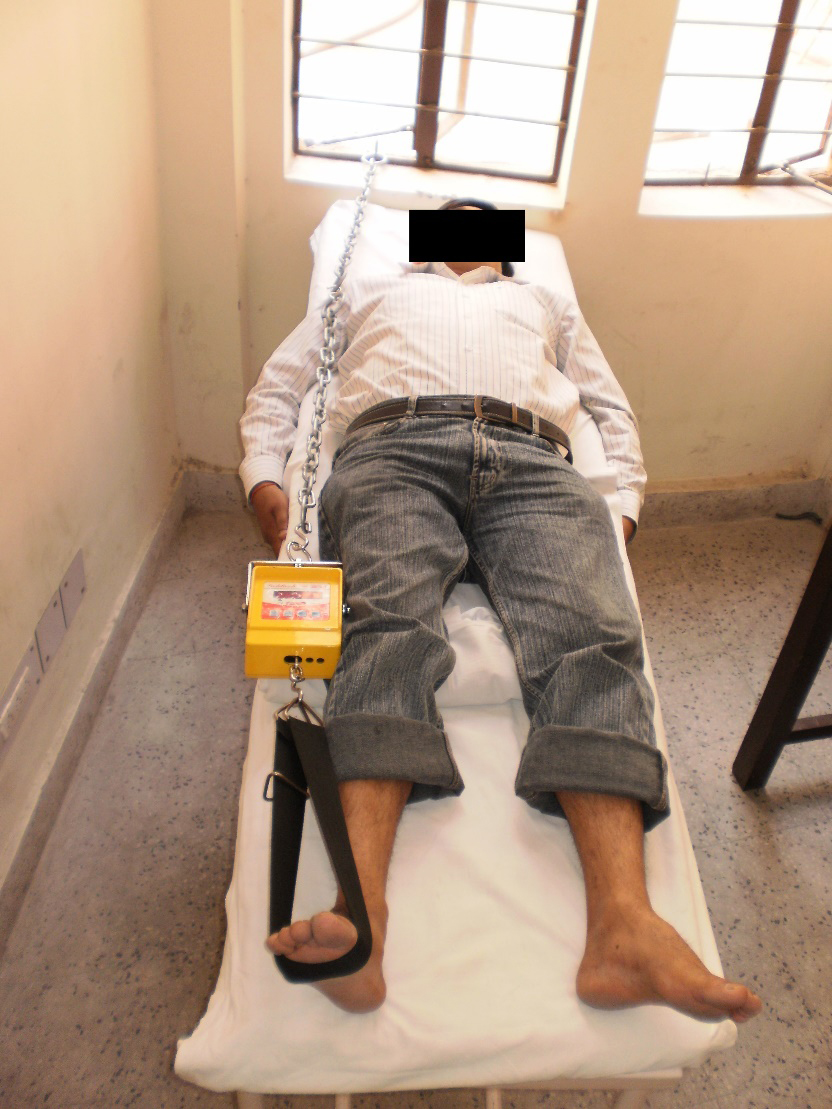
Each participant visited our rehabilitation center for three days: the first day for static stretching of 2-minutes (SS
Pre-intervention evaluation
Active range of motion (AROM) and isometric MVCF were measured in the dominant extremity. The dominant extremity was verified by asking the participants to kick a ball. Before taking the assessment, the participants were informed about the procedure.
(A). AROM measurement: The participants were made to lie in a supine position and then the fulcrum of the goniometer was placed over the lateral malleolus. Now placing the movable arm parallel to the lateral border of the foot and the immovable arm parallel to the fibula, participants were asked to actively dorsiflex the foot from a neutral ankle position (i.e. 90
(B). Isometric MVCF measurement: In the supine position, the participant’s knee was placed in 20
Intervention
Runner’s stretch: In the walk standing position, participants were asked to put the right lower extremity behind the left. Keeping the right knee extended, participants were asked to lean forward on the couch. Keeping the foot completely in contact with the ground, participants had to lean forward until they felt stretched in the calf region, but not pain [29].
The stretching protocol: Participants were instructed to stretch the muscle until they felt ‘stretch’ without feeling any ‘pain’. They had to maintain this position for 30-seconds and then release it for 20-seconds. Each stretch had to be repeated until a specific time under stretch for each condition was met (i.e. For SS
Post-intervention evaluation
The procedure was the same as the pre-intervention evaluation for isometric MVCF measurement. An evaluation was carried out immediately, 10-minutes, and 20-minutes after stretching [30].
As the outcome measure we used the MVCF reading from the dynamometer.
Statistical analysis
All statistical analyzes were performed using SPSS version 26.0 statistical software (SPSS Inc., Chicago, IL, USA). Shapiro-Wilk test of normality was performed to assess the normality of MVCF values in SS
Mean
SD and
-values for Shapiro-Wilk tests of normality for the dependent variable (isometric MVCF) for the SS
, SS
, and SS
interventions
Mean
Pairwise comparison between pre-intervention, 0-, 10- and 20-minutes post-intervention MVCF values for SS
MVCF: maximum voluntary contraction force; SS
The mean values for isometric MVCF are presented in Table 2. Shapiro-Wilk test of normality for MVCF values for all 3 stretching protocols (SS
Graph depicting the relationship between stretching durations (SS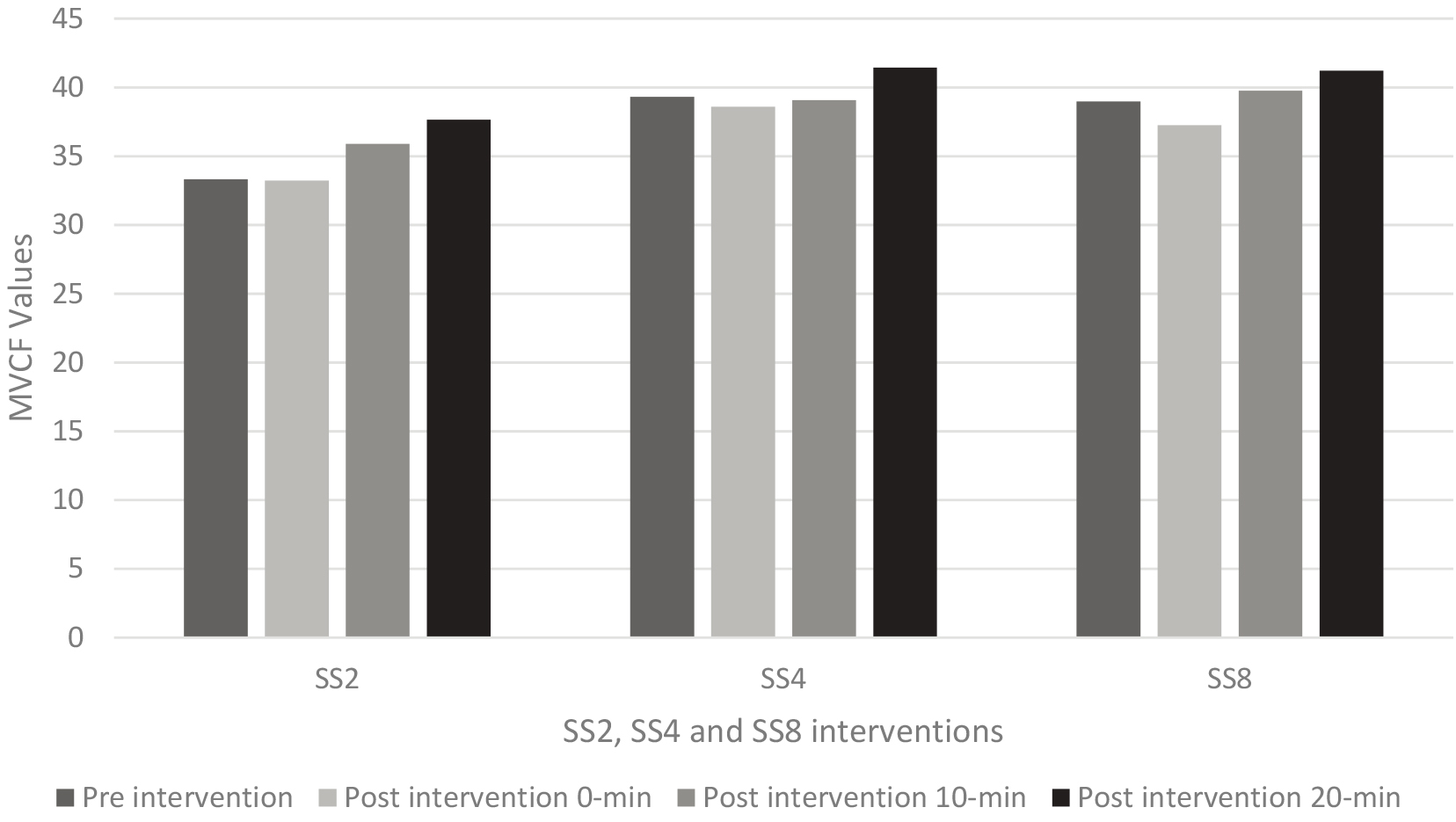
The present study aimed to examine the effects of 2-, 4-, and 8-minutes intermittent stretching on isometric MVCF of the calf muscle. The results revealed that stretching of 2-, 4-, and 8 minutes did not have statistically significant effects on the isometric strength of the calf muscle at 0-, 10- and 20-minutes post stretching intervals.
In recent times, researchers and professionals have grown concerned that stretching is not recommended before athletic events or strengthening sessions as it can cause a transient decrease in muscle strength in both professional and non-professional individuals [31, 32].
The findings in the present study are supported by some of the previous studies, eg, studies performed by Garrison et al. [33] and Behm et al. [24] on various muscles, which did not show any reduction in performance as a result of stretching. A study by Weir et al. did not report changes in % voluntary activation in plantar flexors as a result of 10-minutes stretching [34].
However, some studies had reported results contrary to the findings of the present study. For example, the study by Fowles et al. [11] is one of the most commonly cited studies that has examined the acute effects of stretching on muscle strength. That study reported that plantar flexor strength decreased immediately by 28% after 30-minutes of passive stretching, and even after 1 hour, there was still a 9% decrease in strength [11]. Although the results of the study by Fowles et al. cannot be considered for the general athletic population or individuals because the stretch duration performed in this study was 30-minutes, which is not usually performed before athletic events or strengthening exercises. Later, several other studies examined the effects of stretching on plantar flexor strength by using shorter stretch durations. These studies reported a 10% decrease with 20-minutes stretching [35], a 7% decrease with 10-minutes stretch duration [34], and a 0.3–3.6% decrease with 1–4-minutes stretch duration [18, 36]. The findings of the present study do not support the findings of previous studies, as no changes in isometric muscle strength were observed after stretching in our study. One of the reasons for this conflicting result may be that most of the studies that reported a decrease in muscle performance or strength used stretching durations greater than 8-minutes.
Therefore, there are two types of studies, one that has reported a reduction in muscle strength and the other that has not reported any changes in muscle strength. To our knowledge, no studies have reported an increase in muscle strength as an acute result of short-duration stretching. More studies should confirm the findings of the present study and examine the effects of stretching in different muscle groups (larger/smaller/proximal/distal) and with different durations and modes of stretching (e.g. passive, ballistic, static, dynamic, or PNF stretching).
This study has scope for further studies as well. The response to stretching might be specific to muscle size and location such that larger proximal muscles that are suboptimally activated might show more reduction in the stretch-induced force deficit, while nearly fully activated distal muscles might show less stretch-induced force deficit [37]. Therefore, further studies should compare the effects of stretching between proximal and distal muscles. Also, the effects of stretching on strength may vary at different joint angles and muscle lengths as reported in the previous study [38], therefore further studies are needed to examine the effects of stretching on strength at different joint angles. From a practical standpoint, our study showed that 2-, 4-, and 8-minutes of intermittent SS of plantar flexors did not alter strength up to 20-minutes post stretching interval. Since most of the pre-competition stretching routines occur more than 10-minutes before the actual start of the competition, therefore, stretching exercises could safely be performed before the start of the sporting event.
The present study has some limitations. First, it consisted of male volunteers. Second, all volunteers were men and although recreationally active, did not participate in professional sports. Thus, extrapolation into the latter cannot be made at this stage. Moreover, during training programs athletes undergo neuromuscular adaptations and hence their response to stretching could differ from the nonathletic population.
Conclusions
Two, 4- and 8-minutes intermittent SS do not affect isometric muscle strength in the calf muscle up to 20-minutes post stretching interval. Therefore, intermittent SS of such duration can be performed safely before athletic events or events that require significant strength production.
Author contributions
CONCEPTION: Masood Khan and Ahmad H. Alghadir.
PERFORMANCE OF WORK: Masood Khan.
INTERPRETATION OR ANALYSIS OF DATA: Masood Khan.
PREPARATION OF THE MANUSCRIPT: Masood Khan.
REVISION FOR IMPORTANT INTELLECTUAL CONTENT: Masood Khan and Ahmad H. Alghadir.
SUPERVISION: Ahmad H. Alghadir.
Ethical considerations
The study conforms with the Code of Ethics of the World Medical Association (Declaration of Helsinki), printed in the British Medical Journal (18 July 1964). The ethical committee of the Institutional Review Board (file id: RRC-2019-005, date of approval: 21/01/2019) approved this study. All participants gave their informed consent for participation in the research study.
Funding
Researchers Supporting Project number (RSP-2021/382), King Saud University, Riyadh, Saudi Arabia.
Footnotes
Acknowledgments
The authors are grateful to the Researchers Supporting Project number (RSP-2021/382), King Saud University, Riyadh, Saudi Arabia for funding this research.
Conflict of interest
The authors have no conflicts of interest to report.