




Abstract
BACKGROUND:
Prolonged fatigue effects may be a concern after futsal matches mainly because of the actions performed by futsal players (e.g., sprinting, jumping) that usually involve the stretch-shortening cycle (SSC). However, there no studies analyzed the prolonged effects of futsal-specific fatigue and how futsal players can recover from performance tasks.
OBJECTIVE:
To analyze the acute and prolonged effects of a protocol that simulates specific physical demands of futsal on countermovement-jump, sprint performance, muscle strength and muscle soreness.
METHODS:
Fifteen amateur futsal male athletes (18.3
RESULTS:
The main results indicated a decrement in the CMJ height (
CONCLUSION:
FIRP induced acute effects in the jump and sprint performances only. On the other hand, the knee moment production capability (mainly eccentric) suffered acute and also prolonged effects of the FIRP accompanied by delayed muscle soreness in the hamstring muscles.
Introduction
Futsal is a multiple-sprint sport in which there are more high-intensity phases than in most other team sports [1, 2]. This high-intensity characteristic is mainly attributed to the court dimensions and unlimited substitutions allowed during the futsal match [3, 4, 5, 6]. Barbero-Alvarez et al. [1] noted 8.6 specific futsal activities per minute per outfield player, while high-intensity runs are performed every 23 seconds of match play at the professional level [1]. When the analysis is made by the distance covered in a match, high-intensity runs (above 15 km/h) encompass
In view of these match characteristics, futsal players experience fatigue as the match progresses and consequently it can affect performance [10, 11]. The consequences of fatigue has been well documented for team sports like soccer, which may adversely affect many playing actions such as sprinting, jumping, and kicking [12, 13]. In futsal, two studies have analyzed the acute effects of a specific protocol that simulate the physical demands of matches. Dal Pupo et al. [14] verified that the specific protocol produced a time-dependent reduction of knee flexor and extensor moment in both concentric and eccentric actions, suggesting a possible impairment of neuromuscular performance and the emergence of potential risk factors for hamstring strains during a futsal match [14]. Analyzing the fatigue responses of the same protocol, Dal Pupo et al. [15] showed decrements in sprint performance post-protocol and alterations in the kinematics of the lower limbs (decreasing step rate and increasing leg angular velocity) [15]. However, it is worth mentioning that the prolonged effects of specific futsal fatigue were not previously investigated, especially considering 24 h and 48 h post matches.
The prolonged fatigue effects may be a concern after futsal matches mainly because of the actions performed by futsal players (e.g., sprinting, jumping) that usually involve the stretch-shortening cycle (SSC). It is known that SSC fatigue can be regarded as a bimodal recovery pattern, inducing a decrement in performance during the exercise, having a brief recovery of 1–2 hours, followed by a second decrement in performance [16]. Some studies showed decrements in performance in motor tasks and increases in muscle soreness that can be seen 8 hours after exercise and may last up to 96 hours, which can be associated with muscle damage [17, 18, 19, 20]. However, there are no studies that analyze the prolonged effects of futsal-specific fatigue and how futsal players can recover from performance tasks. An important concern is that the loss of eccentric force, verified acutely after a simulated futsal match [14] has been considered as a predisposing factor to hamstring-strain injury [21, 22], however no studies have been conducted to analyze the prolonged effects on this variable. We highlight that to reach an understanding of the effects of fatigue with high external validity it is necessary to use futsal-specific protocols that reproduce the similar demands of a futsal match. This information may help coaches on planning posterior training sessions and to organize the roster for matches, knowing that fatigued athletes could have poor performance levels or get injured.
Therefore, the aim of this study was to analyze the acute and prolonged effects of a protocol that simulated specific physical demands of futsal on the sport performance indicators (moment production, sprint and jumping performance) and perceptual markers (muscle soreness and rate of perceived exertion). It is hypothesized that the protocol would cause acute decrements in all performance markers, but delayed effects (24 h and 48 h) only in the eccentric strength performance.
Methods
Participants
Fifteen male futsal players from under-17 (
Experimental design
In the present study, we tested the effects of futsal-specific fatigue protocols (independent variable) on neuromuscular performances (sprinting and jumping performance and isokinetic moment production) and perceptual responses (i.e., muscle soreness). The protocol was designed to replicate the activity profile of a futsal match, the so-called ‘futsal intermittent shuttle-run protocol’ – FIRP [14]. Futsal players were evaluated at pre-protocol, half-time (HT), post-protocol (Post), post 24 h-protocol (Post_24) and post 48 h-protocol (Post_48).
On day 1, participants were familiarized with the testing procedures and then were evaluated to obtain data in the pre-condition (Pre_1). On the second day (72 h later), the same evaluations were repeated (Pre_2) to represent a control condition (i.e., to verify the reliability of the data and if any changes may occur in the dependent variables that are not due to the influence of the independent variable – FIRP). On the same day (one hour later), the FIRP was conducted. Prior to testing, participants completed a standardized warm-up procedure consisting of 5 min of jogging (8.5 km
Participants were requested to refrain from training during the experiment, and to maintain their regular diet. Water was supplied during all the tests and during the FIRP (ad libidum) for hydration.
Futsal intermittent shuttle-run protocol (FIRP)
The protocol used in this study was developed and described in detail by Dal Pupo et al. [14] to simulate the specific physiological and neuromuscular demands of futsal. According to the study, the physiological responses obtained during the FIRP (heart rate, blood lactate peak and rating of perceived exertion) were similar to those reported in the literature during futsal matches, indicating that the protocol was able to simulate the futsal demands. The protocol was based on adaptations of a time-motion analysis study [23], following the intermittent and multidirectional characteristics of a futsal match, with actions performed in a straight line, sideward and backward movements, with accelerations and decelerations during the course. The activities performed in the protocol were divided into the following categories: standing (0 km/h), walking (6 km/h), jogging (8.5 km/h), medium-intensity running (13 km/h), high-intensity running (17 km/h) and sprinting (
The protocol was divided into sets which had 2.3 minutes (137.5 s) of duration, 286 m of distance covered and nine actions. Each set was divided into nine activities with variable speeds in the course in the following order: jogging, jogging, sprinting, walking, medium-intensity running, medium-intensity running, jogging, high-intensity running and high-intensity running. In the first block of the protocol, the participants performed three sets, then rested for 3 minutes (simulating a substitution in a game) then performed three more sets, followed by 10 minutes of interval, simulating the first half of an official match and the interval. After the end of the interval, the participants performed the second block of the protocol that was identical to the first block (simulating the second half of a game). An audio system was used to inform the specific actions in each repetition and beeps were used to orientate the subjects to maintain the correct speed during the protocol.
Vertical jump performance
The participants performed the countermovement jump (CMJ) test using a jumping mat (Jump System Pro
Sprint performance
The participants performed a 20 m sprint test in a court with photocells (Speed Test 6.0 Telemetric -CEFISE, Brazil) placed at the 0, 10 and 20 meter marks. Subjects started from a standing position with the forward foot positioned 0.5 m behind the 0 m photocell. Subjects performed three sprint tests in the trials Pre_1, Pre_2, Post_24 and Post_48 and the mean of the three trials was retained for analysis. Prior to testing, participants completed a standardized warm-up procedure consisting of 5 min of self-paced jogging, in the FIRP testing venue and five min of dynamic and static stretches for the major lower-limb muscle groups (quadriceps, hamstrings and gastrocnemius), followed by two submaximal sprints. In the evaluations between blocks 1 and 2 (half-time) and immediately after the FIRP (Post), the individuals performed only one sprint trial, due to fatigue and to allow for recovery. Variables used in data analysis were times from 0–10 m and 0–20 m.
Moment measurement
The isokinetic moment of knee extensors and flexors in the concentric and eccentric phases in the moments Pre_1, Pre_2, Post, Post_24 and Post_48 were evaluated. All evaluations were performed on an isokinetic dynamometer (Biodex System 3, Biodex Medical Systems, Shirley, USA). On the first day of the visit, a very specific familiarization was made to ensure that all athletes understood how to ‘push’ and ‘pull’ the isokinetic machine in the concentric phase and how to ‘resist’ in the eccentric phase. The evaluation protocol was composed of four maximum repetitions of knee extension/flexion for concentric/eccentric measurements, respectively, followed by another set of four repetitions of knee extension/flexion for the eccentric/concentric measurements, respectively. The speed was set at 180
The individuals were seated on the dynamometer in an adjustable chair, with test positions recorded and repeated for each participant in subsequent trials. The axis of the dynamometer was lined up with the right knee flexion-extension axis rotation. According to the manufacturer’s recommendations, participants were asked to relax their legs so that passive determination of the gravity effects on the limb and the lever arm could be measured. The range of motion was set at 70
Moment curves were smoothed by using a low-pass fourth-order Butterworth filter with a cut-off frequency of 10 Hz determined on the basis of spectral analysis. Subsequently, the contraction with the highest moment value produced from the effort of the individual was considered for further analysis and the concentric and eccentric peak moments of the knee flexors and extensors were identified. The isokinetic data were analyzed using the MatLab software (The MathWorks, Natick, MA, USA).
Muscle soreness
Perceptual muscle soreness in some body parts (anterior thigh, posterior thigh and posterior leg) were assessed using a visual analogue scale ranging from ‘0’ (no pain) to ‘10’ (worst pain) [25]. During this evaluation, participants were required to maintain a squat position, with knees bent approximately to 90
Rate of perceived exertion (RPE)
To quantify the subjective internal load of the protocol the CR-10 Borg scale proposed by Foster et al. (2001) was used. Each athlete was assessed immediately after the first block of the FIRP and 10 minutes after the second block of the FIRP and chose one number between 0 (rest) and 10 (maximum effort) from the scale.
Baseline data reliability for all variable performances
Baseline data reliability for all variable performances
CMJ_JH: Countermovement jump height; CMJ_PO: Countermovement jump power output; KE
Descriptive statistics (mean and standard deviation) was used for presenting data of the Pre_1 and Pre_2 moments. The reliability of Pre_1 and Pre_2 was tested using an intra-class correlation coefficient (ICC), following the classification by Cohen [26]. After, verifying the reliability from the Pre_1 and Pre_2 variables we adopted the ‘Pre’ moment for posterior analysis, which was the mean between the Pre_1 and Pre_2. Shapiro-Wilk test was used to examine normal distribution of the dependent variables (CMJ height and power, 10 and 20 m sprints, peak moment and muscle soreness). Analysis of variance (ANOVA) with repeated measures using Bonferroni post hoc test was used to compare the dependent variables over the time points (Pre, half-time, Post, Post_24 and Post_48). Assumption of sphericity was evaluated using Mauchly’s test and Greenhouse-Geisser was used when necessary. Effect sizes for ANOVAs were calculated using partial eta squared (
Jump performance obtained during Pre, HT, Post, Post_24 and Post_48 of FIRP protocol. *different from Pre; #different from Int.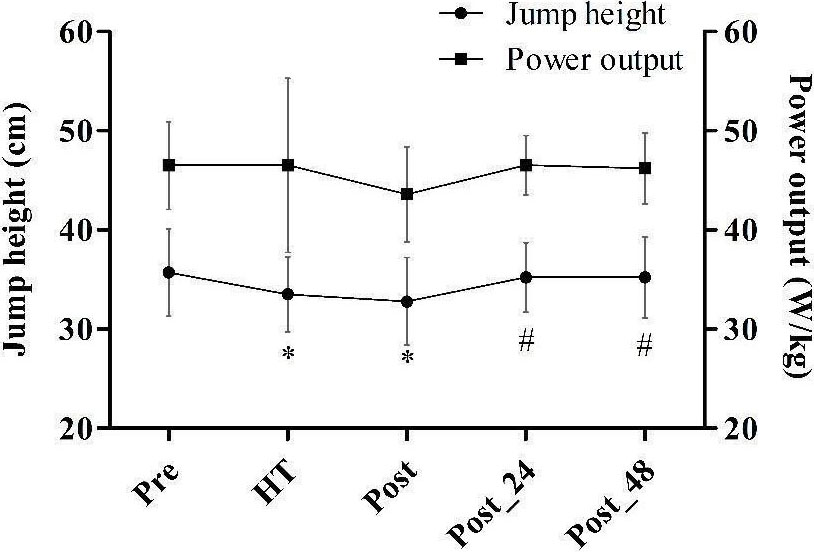
In Table 1, the reliability data of the variables considering Pre_1 and Pre_2 are presented. The ICC values of jump height, jump power, concentric peak moment of the knee extensors, and eccentric peak moment of the knee flexors were classified as excellent. The ICC values of eccentric peak moment of knee extensors and concentric peak moment of the knee flexors were classified as good. On the other hand, sprint performance (10 and 20 m times) presented only fair ICC.
Participants reported RPE mean values at half-time of 6.3
In Fig. 1, jump performance is presented over the time. ANOVA showed the effect of the fatiguing protocol on CMJ_JH (
Sprint performance showed the effect of the FIRP on the 10 m sprint (
Sprint performance (10 and 20 m times) obtained during Pre, HT, Post, Post_24 and Post_48 of FIRP protocol. *different from Pre, #different from HT, #different from Post.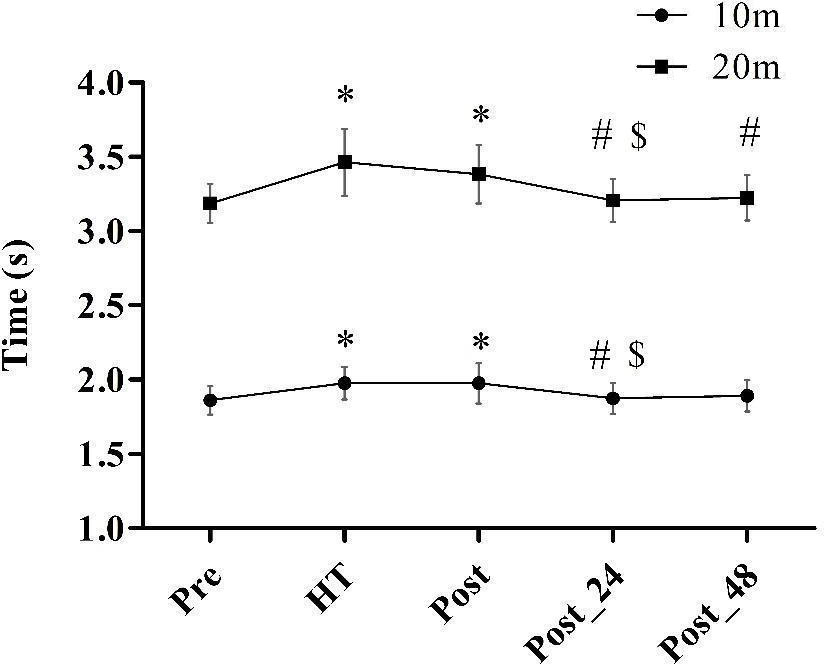
Regarding Fig. 3, ANOVA showed an effect of FIRP on the knee extensors only for the eccentric peak moment (KE_ECC) (
Peak moment of the knee extensors and knee flexors obtained during Pre, Post, Post_24 and Post_48. *different from Pre to KE_ECC, # different from Pre to KF_ECC, §different from Pre to KF_CON, †different from Post to KF_CON.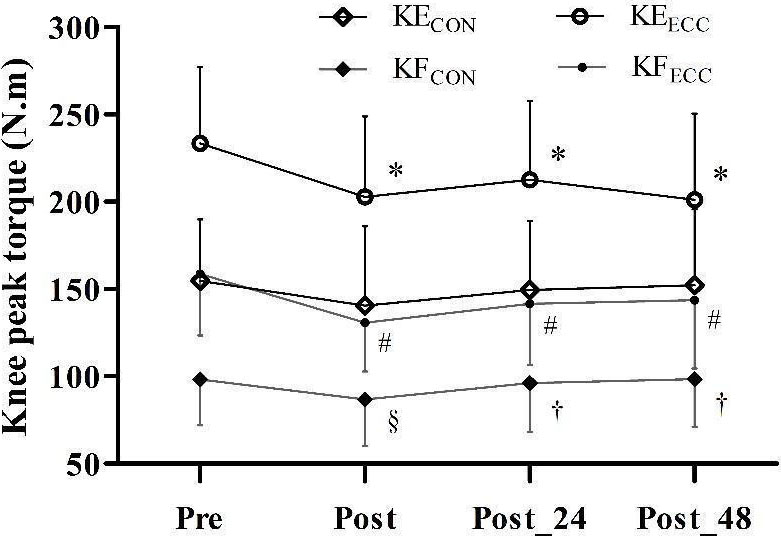
The ANOVA showed effects of the FIRP on muscle soreness in the posterior thigh (
The main results of the present study indicate that the fatiguing protocol induce acute effects in jump and sprint performance and moment production and some delayed effects are also observed for moment production. We highlighted that the protocol used in this study was developed based on the physiological and neuromuscular demands of a futsal match, with similar total distances covered (3436 m), duration (40 minutes) and effort distribution [23]. This indicates that the fatigue analyzed in this study was evaluated in a specific context with ecological validity.
The CMJ jump height and sprint performance presented significant decrements during the interval and immediately after the FIRP, showing that fatigue induced by physical match demands of futsal players can cause acute effects on important physical components of a futsal match. Previous studies [27, 28] found similar results indicating the high acute demands of lower limb performance of futsal players after simulated matches. Despite the multifactorial nature of fatigue [29], most studies have been attributing these alterations to ‘metabolic fatigue’ [30, 31, 32]. In a recent and interesting study, Jiménez-Reyes et al. [33] found that the decrease in jump height (CMJ) over a sprint training session was strongly related to the increase in blood lactate and ammonia and the loss of speed in the sprints. Thus, according to the authors, the decrease in CMJ height seems to reflect the impaired neuromuscular function related to metabolic fatigue. The acute fatigue responses have also been attributed to the mechanical stress suffered by muscles mainly during exercise with strong eccentric actions [34, 35]. This can be observed during the FIRP actions, such as sprints, changes in direction and deceleration that involve the SSC, i.e., a combination of concentric and eccentric actions [16]. A common response after such a fatiguing activity is a decrease in the capacity to produce strength and power, linked to neuromuscular changes such as stiffness regulation [36], which is an important factor in running [37] and jump performance [38, 39].
Considering the knee peak moment capability of futsal players, it was verified that the eccentric moment of knee flexors and extensors decreased until 48 h after the exercise, suggesting a prolonged fatigue. Such consequences are usually attributed to damage occurring in muscle structures due to intense eccentric actions [35, 40, 41, 42] that were present during the FIRP. Additionally, delayed muscle soreness is one of the most frequent symptoms of muscle damage as a response of inflammatory processes, which usually appears between 8–24 h and peak between 24–48 h after exercise [43]. In the present study, players reported an increase in muscle soreness condition in the posterior thigh within 24 hours compared to the pre, which may suggest this it is related to the loss of eccentric moment in this muscle group. This result corroborates previous findings showing that even well-trained athletes, match effort simulation is related to exercise induced muscle damage that lasts for several hours (or days) [44].
The loss of eccentric knee moment (both acute and prolonged) may have an important impact on injuries. During the kicking actions, for example, the eccentric force of the knee flexors are fundamental to decelerate the movement occasioned by the agonist muscle (quadriceps) in the concentric phase, as well as to maintain the dynamic stability of the knee joint [45]. In a similar example, decrements in the eccentric force of the knee flexors can have an influence on the final swing phase during sprinting, leading to a lack of force to decelerate the extension of the leg. This factor can be associated to hamstring strains [22], one of the main muscles involved with injuries in this sport [46]. Some studies already stated that the reduction in eccentric force, mainly in knee flexors, are related to muscle injuries during the match [21, 47, 48]. This risk tends to be larger when performing maximum sprints, which requires strong eccentric contractions of knee flexors during the balance phase of the free leg before the foot strikes in the ground [12].
Lastly, we highlight the possible limitations of this study as the absence of biochemical markers (e.g. creatine kinase) for analyzing muscle damage and the monitoring of fatigue effects for longer periods (e.g. 72 h – 96 h after the protocol).
Conclusion
We conducted this study using futsal-specific protocols that reproduced demands similar to those that occur in a futsal match; thus, providing more ecological validity to our results. In the practical context, it is important that the coach understands the demands of a match and the time-course in which fatigue can affect the performance of the player and also understanding the need for player substitution during the match. In addition, the loss of eccentric knee moment is an important concern for coaches and physical trainers and hence it is necessary to monitor player recovery while avoiding potential risk factors for increased and prolonged injuries that could impact on the optimal performance from the players.
Author contributions
CONCEPTION: Filipe E. Costa and Juliano Dal Pupo
PERFORMANCE OF WORK: Filipe E. Costa, Rafael L. Kons and Juliano Dal Pupo
INTERPRETATION OR DATA ANALYSIS: Filipe E. Costa, Rafael L. Kons and Juliano Dal Pupo
PREPARATION OF THE MANUSCRIPT: Filipe E. Costa, Rafael L. Kons, Fabio Y. Nakamura and Juliano Dal Pupo
REVISION FOR IMPORTANT INTELLECTUAL CONTENT: Fabio Y. Nakamura and Juliano Dal Pupo
SUPERVISION: Juliano Dal Pupo
Ethical considerations
The study was approved by the local ethics committee (Protocol number 3.437.161) in the Federal University of Santa Catarina, Santa Catarina, Brazil. Before the assessment, every participant received the same detailed information about the testing procedure and signed the informed consent.
Conflict of interest
The authors certify that there is no conflict of interest with any financial organization regarding the material discussed in the manuscript
Funding
This work was financed by Coordenação de Aperfeiçoamento de Pessoal de Nível Superior – Brazil (CAPES) – Finance Code 001.
Footnotes
Acknowledgments
The authors acknowledge all volunteer participants for their collaboration and the Biomechanics Laboratory of Federal University of Santa Catarina.