




Abstract
BACKGROUND:
Cluster Training (CL) is an alternative to traditional training where intra-set breaks are incorporated. Positive effects have been reported on sports performance. However, there is little research on body composition in trained subjects.
OBJECTIVE:
The aim of this study was to investigate the effects of three cluster training (CL) protocols comprised of different intra-set rest (RIntra) and blocks of repetitions (BK) on strength, power and body composition in individuals maintaining a high protein diet.
METHODS:
Twenty-nine resistance-trained male participants were randomized to RIntra 20 s and BK 3 RM (
RESULTS:
There were significant changes in FFM in CL1 (0.9
CONCLUSIONS:
We conclude that a RIntra of
Introduction
Resistance training is a well-established method for improving human health and performance. Traditionally, resistance training involves performing a set of repetitions with minimal pause resting for a prescribed period of time (also known as rest interval), performing another continuous set, and then proceeding along in this rest/work fashion until the prescribed number of sets is completed. Over the past decade, a strategy termed cluster training (CL) has gained popularity as an alternative to this traditional set configuration [26]. The concept of CL involves inserting preplanned rest intervals within a set (RIntra) after a prescribed block of repetitions are completed [26]. By allowing for partial recovery before the onset of complete fatigue, it is hypothesized that the strategy may increase performance, peak power output, barbell velocity, and displacement, among other parameters [10]. Current research has shown that CL allows greater maintenance of movement velocity and higher work outputs, which may translate into superior neuromuscular adaptations [22, 27, 28].
Current research suggests that CL increases strength similar to traditional protocols [21]. In fact, in a traditional set, longer rest intervals are related to an increased capacity to produce force [24]. The recovery of phosphocreatine (PCr) is established after 180 s, while incomplete pauses of between 60 and 90 s are associated with higher lactate [bLa
The majority of CL research to date has focused on its effects on performance-related measures such as sprint and jumping ability [1, 20], as well as peak power and speed [11, 29]; however, there is little research on how CL effects fat-free mass (FFM). The limited research relates indirectly the variables of strength training to increased FFM and cross sectional-area (CSA). CL generates higher volume, and higher volumes are associated with more hypertrophy [16, 25]. In fact the CL results in a higher number of repetitions than a traditional protocol [13]. It can be speculated that variations in RIntra and the number of repetitions per block would differentially affect changes in FFM. Repetition blocks ranging between 1 to 5 RMs (repetition maximums) offer a higher mechanical load, and thus would conceivably result in greater strength increases [2, 11, 17]. However, alterations in the duration of the RIntra can also elicit different metabolic and mechanical responses [6, 9, 19], which in turn may impact FFM.
It has been shown that smaller RIntra (15 s vs. 30 s) can be more effective for the lower limb [9], and RIntra between 10–15 s for the upper limb [7]. However, these data reflect lactate production and loss of speed; factors that may influence hypertrophic outcomes. It therefore needs to be determined whether changes in FFM evaluation respond similarly; that is, the smaller intervals are more effective than the longer ones. For this reason, the purpose of our study was to evaluate body composition and performance outcomes in lower limb (LL) CL using a RIntra of 20 versus 40 s with repetition blocks comprised of 3 RM or 6 RM while matching the total training volume over an eight-week program in resistance-trained men. Based on the theory that increased metabolic stress may enhance muscular adaptations [30], we hypothesized that a duration of 20 s would optimize the increase in LL-FFM, squat strength and countermovement jump (CMJ). We hypothesized that blocks of 3 RM would be superior to 6 RM blocks for increasing strength without compromising gains in LL-FFM.
Methods
Participants
Twenty-nine male participants with more than two years of continuous RT experience volunteered to participate in this study (age
CONSORT diagram.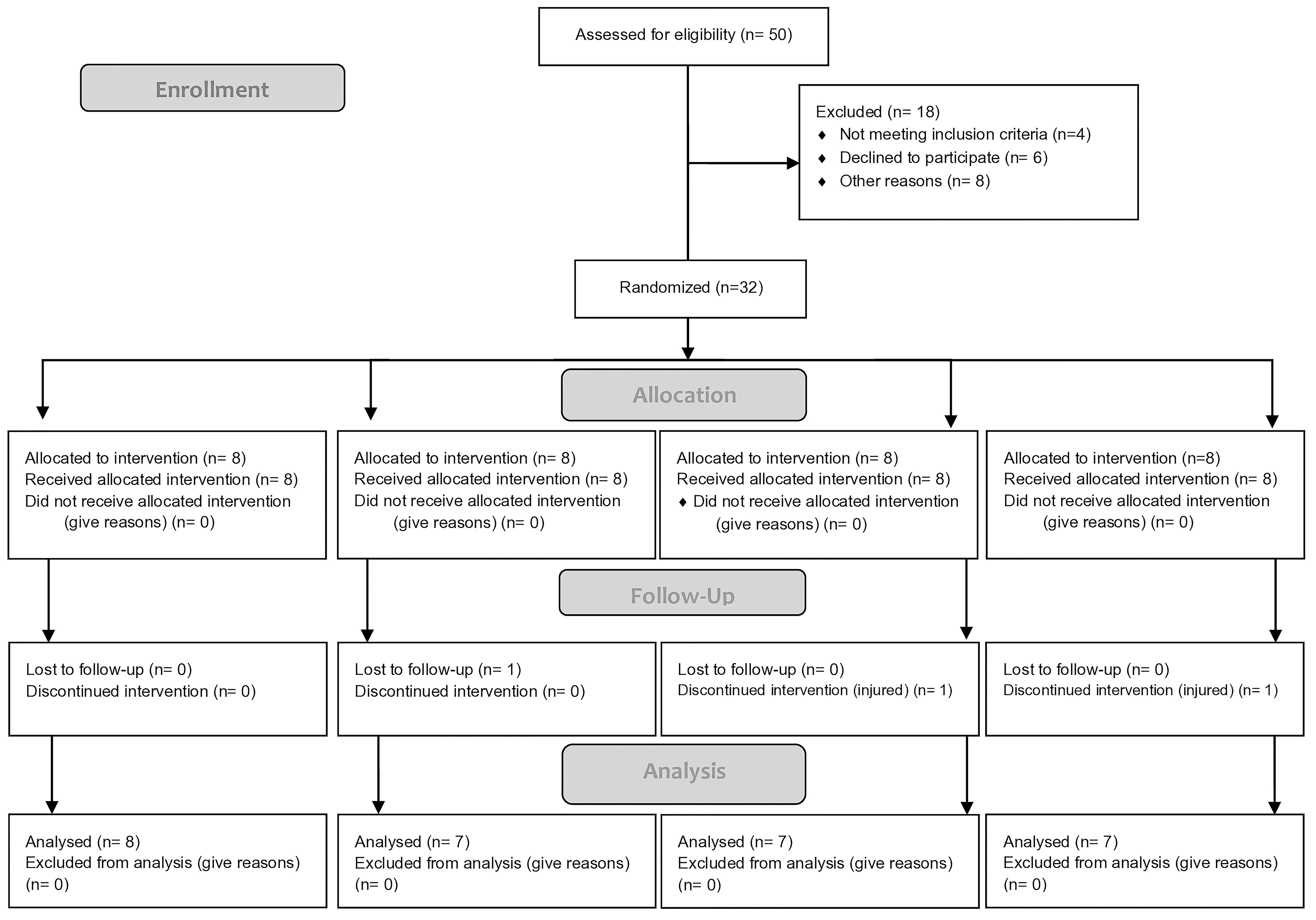
A randomized controlled trial with a parallel groups study design was used and the participants were randomly assigned to perform RT for the lower limbs under 1 of 4 conditions: (a) a RIntra 20 s approach and BK 3 RM (CL1) (
Procedures
All experimental groups trained twice a week with 72 hours of rest between sessions. The training program lasted 8 weeks. All sets in the experimental groups were carried out to volitional failure.
Training protocol
All routines were directly supervised by the research team, which included certified personal trainers, to ensure proper performance of the respective routines. All participants were familiar with the CL protocols. The CL1 and CL2 groups performed the same training protocol except that CL1 rested 20 s between blocks and CL2 rested 40 s. The CL3 group performed the same training protocol as CL1, except that two blocks of 6 RM were performed each block, whereas CL1 and CL2 performed four blocks of 3 RM. In addition, CL3 performed an extra set of the leg press exercise to equate total volume load between experimental groups (Volume load: sets
Training protocols for cluster training.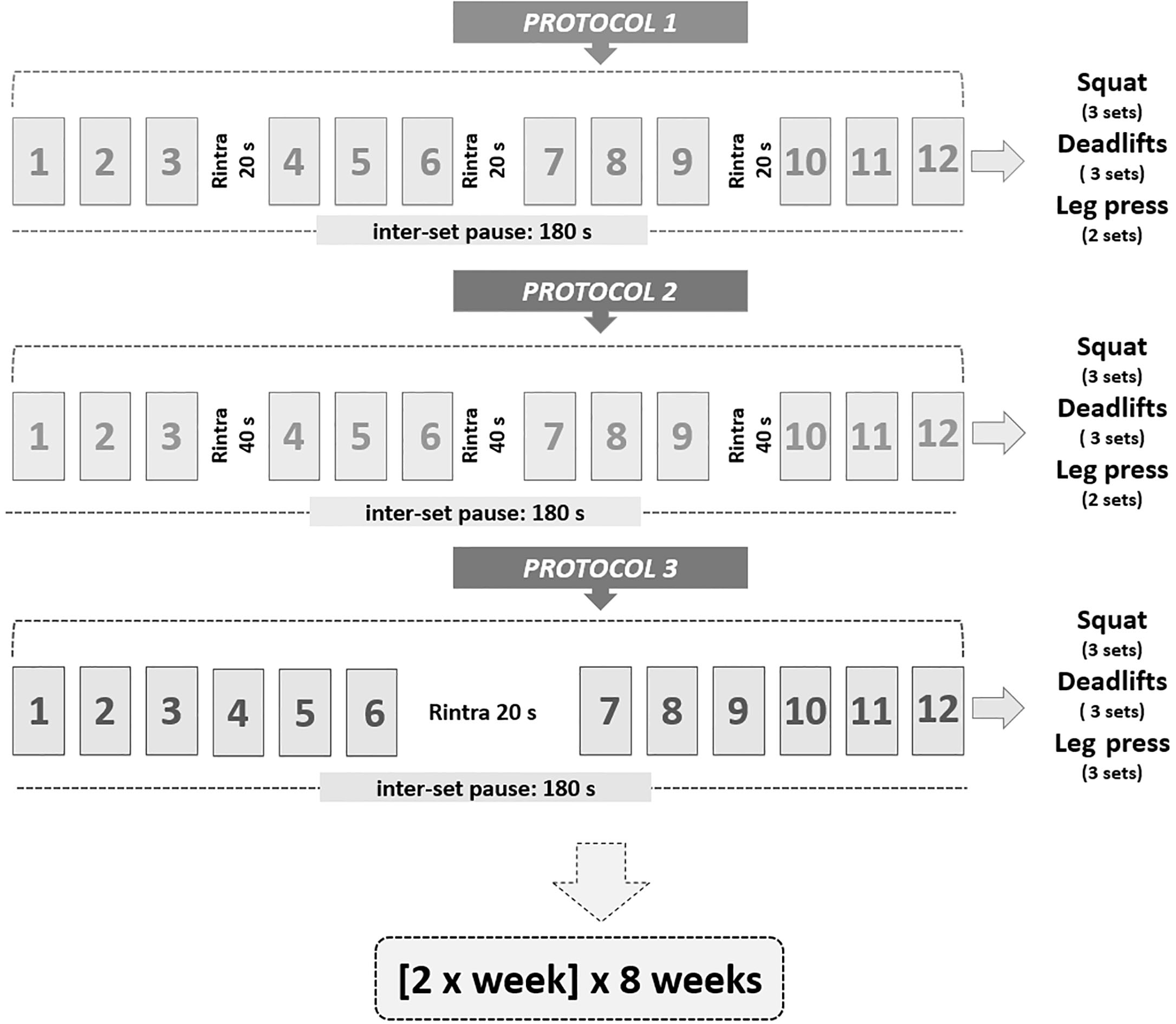
CL1, CL2 and CL3 groups were prescribed to consume a hyperenergetic diet (
Body composition
Total body and regional body composition were estimated using dual-energy x-ray absorptiometry (DXA). A certified technician scanned all participants and computer algorithms (software version APEX 3.0, Hologic QDR 4500, Bedford, MA) distinguished bone and soft tissue, edge detection, and regional demarcations. For each scan, participants wore light clothing and were asked to remove all materials that could attenuate the X-ray beam including jewelry items and underwear containing wire. Body composition testing was carried out in the early hours of the morning after an overnight fast. The coefficient of variation was less than to
Body composition was also analyzed regionally. The arm region included the hand, forearm, and arm, and was separated from the trunk by an inclined line crossing the scapulohumeral joint such that the humeral head was located in the arm region. The leg region included the foot, lower leg, and upper leg and was defined by an inclined line passing just below the pelvis crossing the neck of the femur. The head region comprised all skeletal parts of the skull and cervical vertebrae above a horizontal line passing just below the jawbone. The abdominal region was delineated by an upper horizontal border located at half of the distance between acromia and external end of iliac crests, a lower border determined by the external end of iliac crests, and the lateral borders extending to the edge of the abdominal soft tissue. All trunk tissue within this standardized height region was selected for analysis. To determine intertester reliability, two different observers selected the area for each subject manually.
Countermovement jump (CMJ) test
For measurement of variables related to muscular strength and power, participants were instructed to avoid vigorous exercise for 72 h before the tests in both the pre- and posttest periods. Prior to testing, participants performed a general warm-up consisting of light stretching and stationary cycling for 10–12 min. The CMJ test was performed on a jump mat (Smart Jump; Fusion Sport, Coopers Plains, Australia). Participants were instructed to initiate each jump by squatting to 90
Baseline values of the anthropometric variables, body composition and strength of the study participants
Baseline values of the anthropometric variables, body composition and strength of the study participants
BM, body mass; BMI, body mass index; FM, fat mass; FFM, fat-free mass; LL-FFM, fat-free mass of lower limbs; CMJ, jump counter movement.
Results of the study variables
The results are expressed as average
The 1 repetition maximum (1RM) for the back squat (SQ) was evaluated in a Smith machine (Gervasport, Madrid, Spain) at the beginning and end of the study. Participants reported to the laboratory having abstained from any exercise other than activities of daily living for at least 72 h before the reference test and at least 72 h before post-study testing. In brief, participants performed a general warm-up prior to testing, which consisted of 7 to 10 minutes of light cardiovascular exercise. A specific warm-up set of the given exercise was then provided for 12 to 15 repetitions with approximately 40% of the 1RM perceived by the participants, with a load progression for each exercise of three to six load increments. The increases in each load were approximately 10% 1RM until reaching a mean propulsive velocity (MPV) of 0.5 ms [8] followed by increments of 5 to 10 kg until attainment of 1RM. A rest interval of three to five minutes was afforded between each successive attempt. Participants had to reach parallel in the 1RM SQ for the trial to be considered a successful attempt. The correct performance was validated by two assistants who also recorded the data by means of a linear encoder (SmartCoach Power Encoder SPE-35, SmartCoach Europe AB, Stockholm, Sweden), to guarantee the precision of squat depth. The protocol followed the recommendations described by McGuigan [18] and the technical execution of the squat according [4].
Statistical analysis
Data are expressed as the mean and standard deviation. The normality of the data was verified with the Shapiro-Wilk test and the homogeneity of the variance with the Levene test. The comparison of the mean (pretest vs. posttest) of the groups was performed with the paired Student’s
Results
Data on the baseline values for anthropometric, strength, power, and body composition measurements of each group are outlined in Table 1. No statistical differences were noted at baseline (Table 1).
Fat free mass of lower limbs
A significant increase was found with a small effect size in the groups CL1 (0.9
a. Changes in LL-FFM; b. Changes in squat; c. Changes in CMJ. Confidence intervals that occur entirely greater than or less than zero are considered significant (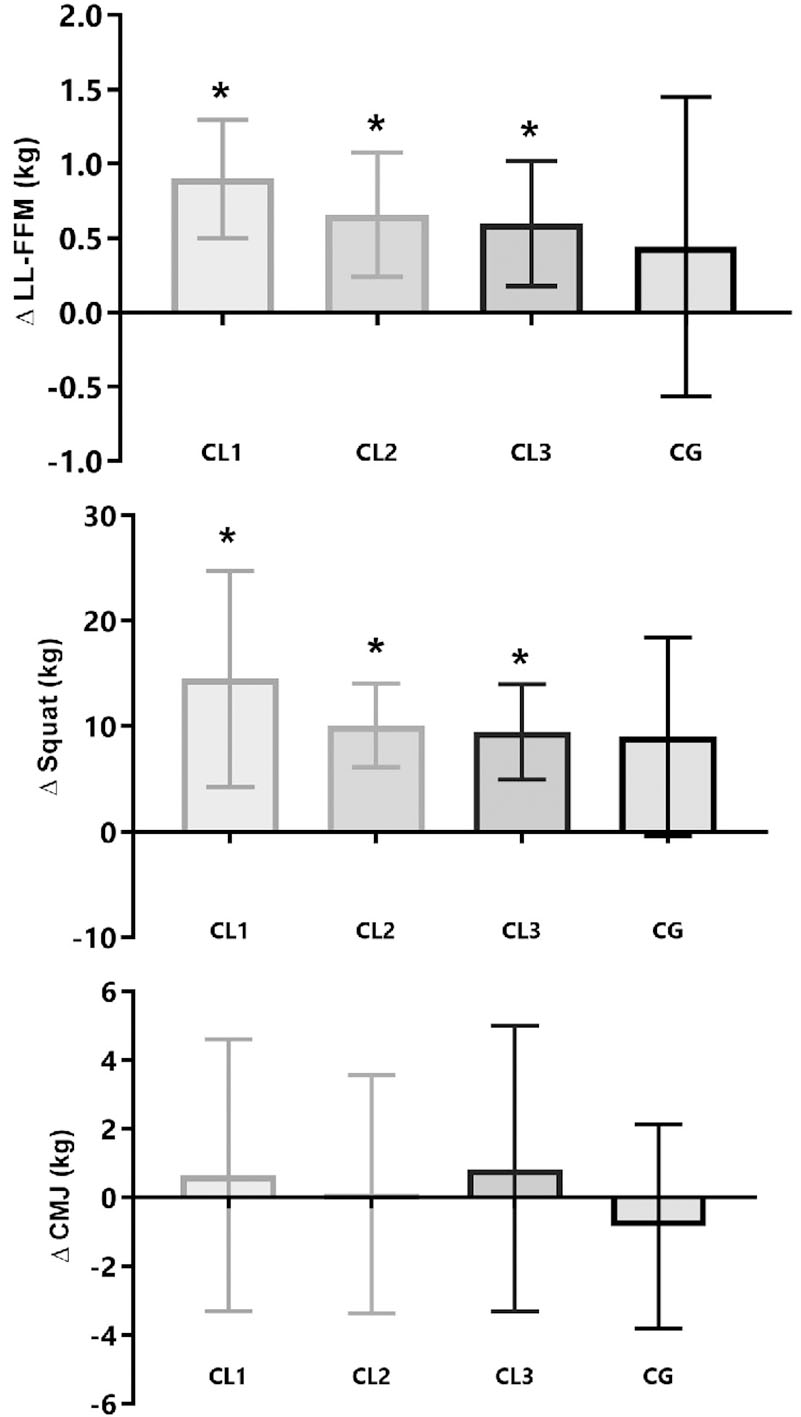
In the SQ, the cluster groups expressed significant changes with a large effect in CL1 (14.5
Discussion
There is an emerging interest in CL as a potential strategy for increasing athletic performance. It is conceivable that the effectiveness of this method can be improved by optimizing the number of repetitions, the blocks and sets, and the RIntra intervals. Therefore, the objective of this study was to investigate the impact of different RIntra intervals during high-load work blocks on changes in strength and, importantly, body composition, where research is scarce.
The findings regarding athletic performance seem to indicate that shorter RIntra intervals can be equally effective as longer ones. González-Hernández et al. [9] recently investigated markers of metabolic stress and mechanical performance associated with different RIntra intervals during squat training. The study compared two traditional protocols, in addition to three CL protocols of three sets of 10 repetitions with RIntra intervals of 10, 15 and 30 s. The protocol with 30 s of RIntra yielded the lowest [bLa
Similar results were obtained by Mora-Custodio et al., who compared a traditional protocol versus two CL protocols with RIntra intervals of 10 and 20 s, respectively [19]. The protocols were evaluated at different loading intensities (60, 70, 75 and 80% RM), measuring [bLa
Our research is consistent with the results obtained in the aforementioned studies [9, 19], providing further evidence that RIntra intervals longer than 20 s are superfluous for enhancing performance. Moreover, we expand these findings and show that the same prescription applies when the objective is to increase LL-FFM. Notably, these studies were performed on the LL (as in our research), and the volume used was limited to three sets in an acute protocol. Our study employed nine sets per session, with training carried out twice weekly frequency for eight weeks; therefore, it may be better to use 20 s, as shown in our research and indirectly in González-Hernández et al. [9], and not to reduce the RIntra to 10 s, as proposed by Mora-Custodio et al. [19]. In fact, González-Hernández et al. [9] employed a higher volume (3
Alternatively, no significant differences were noted in CMJ for any of the groups. This result may be due to the lack of familiarity with the jumping movement because it was only performed before and after the study, rather than during the study. Interestingly, the CL1 group showed a large effect size (0.8) for the squat compared with the CL2 and CL3 groups (0.6 and 0.5), since the 40 s RIntra was less than the 20 s RIntra.
This study has several limitations that should be considered when interpreting the results. No rigorous assessment of energy and protein intake was performed, since the subjects did not record food throughout the research. Subjects were given individual amounts and foods to select. Dietary instructions were provided only to increase energy and protein ingestion.
Therefore, it is not possible to know if participants adhered to these instructions and it is possible there may have been variations in energy intake. Moreover, determination of 90-degree knee angle during CMJ testing was assessed by visual observation of the researchers. It has been shown that the depth in the counter movement can affect the propulsion of the jump, and thus it is possible that subjective error may have confounded findings [3].
Conclusions
Our results indicate that performing CT with blocks of 3 RM and 6 RM repetitions increased LL-FFM, with optimal benefits noted using a PIntra of 20 s. Increasing the rest interval between repetitions could decreases the [bLa
The results of the current study also suggest that RIntra values between 20 and 40 seconds elicit favorable improvements in LL-FFM and performance in trained men when performing lower body CL protocols using multiarticular exercises. In addition, an increased number of blocks with reduced repetitions, such as 3 RM vs. 6 RM, can optimize the increase in strength levels. However, further studies are needed to verify our results as well as investigating other ranges of block repetitions with the same RIntra values. In future investigations, it would be of value to verify this methodology with a self-controlled volume using the rating of perceived exertion for measuring repetitions in reserve, with no training to failure compared to the same conditions when training to failure. It would also be important to measure body composition every 3 weeks with the aim of clarifying when the CL ceases to be efficient and therefore the appropriateness of introducing a recovery period and protocol completion.
Author contributions
CONCEPTION: Salvador Vargas-Molina.
PERFORMANCE OF WORK: Salvador Vargas-Molina and Manuel García.
INTERPRETATION OR ANALYSIS OF DATA: Jorge L. Petro.
PREPARATION OF THE MANUSCRIPT: Salvador Vargas-Molina, Jorge L. Petro and Diego A. Bonilla.
REVISION FOR IMPORTANT INTELLECTUAL CONTENT: Salvador Vargas-Molina, Brad J. Schoenfeld, Diego A. Bonilla and Richard B. Kreider.
SUPERVISION: Salvador Vargas-Molina, Brad J. Schoenfeld, Manuel García, Jorge L. Petro, Fernando Martín-Rivera, Diego A. Bonilla, Javier Benítez-Porres, Ramón Romance and Richard B. Kreider.
Ethical considerations
Participants were made aware of the possible risks of the experiment and signed an informed consent form acknowledging their willingness to participate. The research protocol was approved by the Ethics Committee of the University of Málaga (code: 38-2019-H) in accordance with the ethical guidelines of the Declaration of Helsinki
Funding
The authors report no funding.
Footnotes
Acknowledgments
This research was supported by the University of Málaga (Campus of International Excellence Andalucía Tech).
Conflict of interest
The authors declare that they have no competing interests.