




Abstract
BACKGROUND:
Local vibration (LV) used as part of the warm-up can stimulate a specific body part and muscle group, potentially increasing muscle flexibility and performance. However, the effect of its combination with static stretching (SS) has not been thoroughly examined.
OBJECTIVE:
To elucidate the acute effectiveness of combining LV and SS (V
METHODS:
Fifteen healthy men who were regularly involved in recreational sports participated in this study. Static Stretching, V
RESULTS:
The dorsiflexion improved significantly in SS and V
CONCLUSIONS:
This study suggests that V
Introduction
Acute stretching as part of a warm-up, especially static stretching, can cause a loss of maximum strength, rate of force development (RFD), power [1, 2] and reduction in performance capabilities that include dynamic balance after jump and landing [3]. Consequently, establishing a warm-up method that allows for increased muscular flexibility and explosiveness while not decreasing muscle stiffness is important for performance improvement.
In recent years, warm-up has been performed using LV [4, 5, 6, 7, 8]. It has been reported that in field hockey players, peak power and average power increased without changes in the EMG amplitude [7]. On the other hand, using a LV device at a pulsed frequency for 10 minutes had no effect on increasing maximum voluntary contraction (MVC), RFD, or muscle activation in trained healthy men. LV training has been shown to provide direct vibration to the muscle belly and tendons. Muscles with increased length and tension are the most susceptible to vibration [9]. A recent study that addressed the use of LV as part of the warm-up has shown that the anterior split flexibility of male gymnasts is significantly improved [10]. Therefore, the method of a combination of LV and static stretching (SS) as part of a warm-up may contribute to improve muscular flexibility and maintain/improve physical performance including jump and dynamic balance [11].
The purpose of this study was therefore to investigate the acute effects on range of motion, vertical jump ability, and dynamic balance after landing by comparing SS alone and a combination of LV and SS (V
Methods
Participants
Fifteen healthy men (age
Experimental design and procedures
The subjects were randomly allocated to three experimental conditions (SS, V
Stretching was performed with the subjects’ hips and knees in full extension while they stood on a footplate with the ankle at maximum dorsiflexion for both the SS and V
The application of the vibration device. The vibration frequency passed through a range of 0–170 Hz at amplitude of 0–0.12 mm during the 0.5-s, which created a pulsing effect. The device was placed on the muscle belly of the medial head of the gastrocnemius (GM) of the stretching limb and was held in place with a Velcro strap (Fig. 1).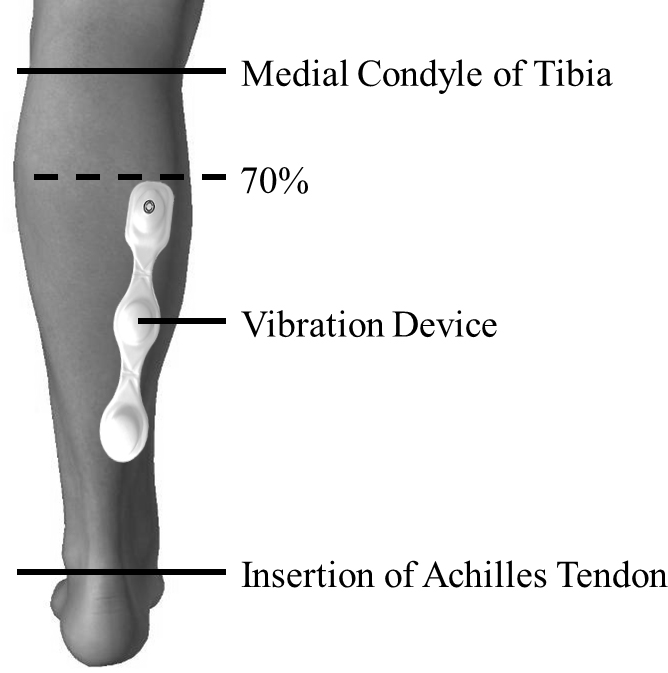
In this study, an ankle joint exercise device for stretching (Rakkun Walk R-1; Maruzen Industrial Co., Ltd. and Hiroshima University, Japan) was applied (Fig. 2). This computerized device enables to control angle and movement velocity of the ankles joints placed on two steps [15]. The two steps are installed horizontally in the base portion, and two actuators control the left and right vertical movements independently. The inclination angle of the step was used to define the dorsiflexion angle. This device was used for both the intervention and functional evaluation.
Ankle joint exercise device for stretching. This device can repeatedly move the ankle joint automatically at a constant velocity (10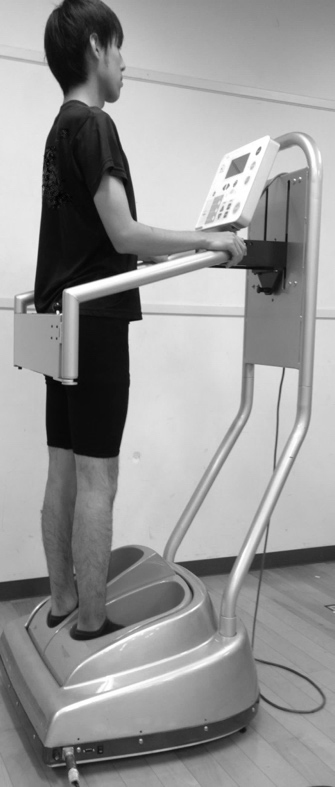
Equations for calculation of APSI, MLSI, VSI and DPSI. The DPSI is a composite of the anterior-posterior, medial-lateral, and vertical ground reaction forces, and also provides stability indices for the anterior-posterior (APSI), medial-lateral (MLSI), and vertical (VSI) directions. The DPSI was calculated using the ground reaction forces generated in the first three seconds immediately following initial contact that was identified as the instant when the vertical ground reaction force exceeded 5% of the body mass. The force plate data were normalized to body weight.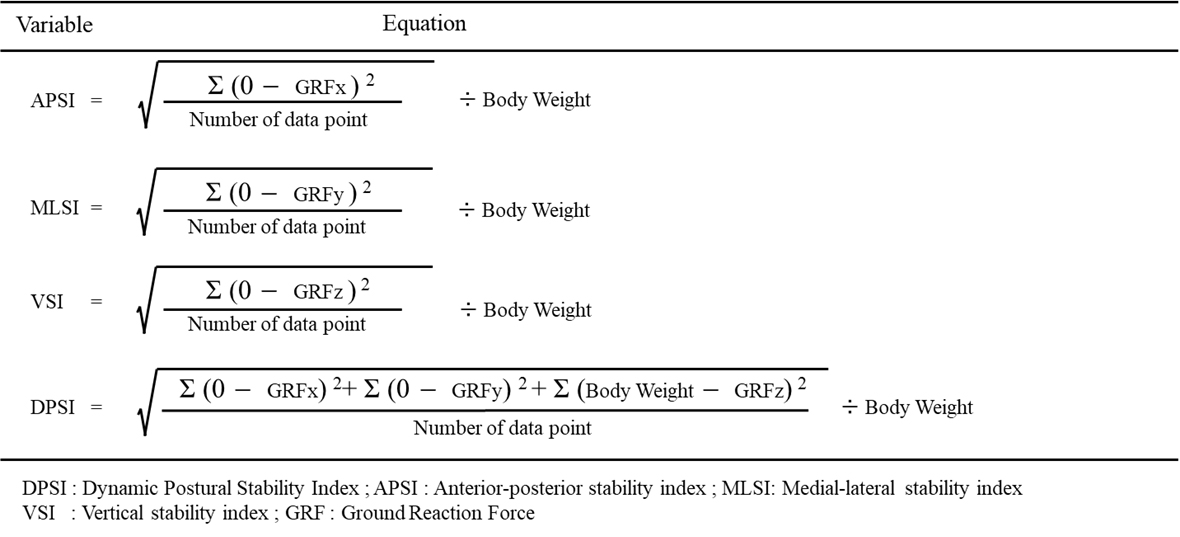
We measured the degree of maximum ankle dorsiflexion ROM before and after stretching in the SS, V
Assessment of vertical jump
Each subject performed a maximal voluntary vertical jump on the floor with non-dominant limb in two conditions: (1) from a semi-squatting position (squatting jump, SJ) and (2) from an upright standing position with a downward movement before starting to move upward (counter-movement jump, CMJ).
Vertical jump ability was assessed by measuring jump height during the SJ and CMJ using a jump gauge (Myotest SA, Sion, Switzerland). Subjects were instructed to jump vertically and attempt to land with the same body position and in the same location as takeoff to avoid lateral or horizontal displacement. The participants positioned their arms laterally throughout the entire jump and kept their torso in an upright position to emphasize the use of the leg extensor muscles [16]. The participants could recover for 2 minutes between jumps. The average height of the three jumps was used as the outcome value for each jump test. The standard error of the mean for inter-rater reliability of the composite test was 2.4 cm [17, 18].
Assessment of dynamic postural stability after landing
Dynamic postural stability after landing was evaluated using a two-leg jump and one-leg landing in the forward direction. In a previous study, this approach achieved an intersession reliability [ICC (3, k)] of 0.86 [19]. The jump height was standardized at 30 cm, and the jump distance was normalized to the subject’s body height [19]. The subjects placed 40% of their height from the end of the force plate, and a hurdle with a height of 30 cm was placed at the midpoint between the force plate and the starting position. The subjects performed the following actions three times: jump in the forward direction using both legs over the hurdle with subsequent landing on the force plate on the non-dominant limb, stabilize as quickly as possible, place both hands on the waist once stabilized, and keep still for 10 s while looking forward. They were permitted five practice trials for each condition to become familiar with the one-leg jump, with 2 minutes of rest after testing. The measurements in each condition were conducted on different days to avoid the subject becoming too familiar with the task and to prevent fatigue. The task was repeated if the subject fell upon landing, contacted the hurdle, or failed to jump. Three successful trials were performed for each condition (control, SS, and V
Ground reaction force data was collected at a sampling frequency of 200 Hz. The global reference system was set so that the anterior-posterior axis referred to the y-axis, the medial-lateral axis to the x-axis, and the vertical axis to the z-axis. A Microsoft Excel macro was used to process the ground reaction force data for calculating the DPSI. These data were passed through a zero-lag fourth-order low-pass Butterworth filter with a frequency cutoff of 20 Hz. The dependent variable was the DPSI, is shown in Fig. 3. The DPSI is the resultant of the anterior-posterior, medial-lateral, and vertical ground reaction forces while it also provides stability indices for the anterior-posterior (APSI), medial-lateral (MLSI), and vertical (VSI) directions. The DPSI was calculated using the ground reaction forces generated during the first 3 seconds immediately following initial contact, which was identified as the instant when the vertical ground reaction force exceeded 5% of the body weight. The force plate data was normalized to body weight [18]. We also used raw data signals to calculate the maximum vertical ground reaction force (vGRF max), which was expressed as the magnitude of the peak force in Newtons divided by the subject’s body weight. The average of three successful trials for each condition was used for further analysis [18].
Statistical analysis
An a priori power analysis by G*Power software (Heinrich-Heine University, Düsseldorf, Germany) revealed that at least 20 subjects were required for a statistical power of 0.75 at an effect size of 0.80 with an alpha level of 0.05 [19]. Repeated-measures 2 (time)
Change in ankle dorsiflexion angle between pre and post-measurement (
SD)
Change in ankle dorsiflexion angle between pre and post-measurement (
Control, control condition; SS, static stretching; V
Values for squat jump and countermovement jump according to stretching condition (
Control, control condition; SS, static stretching; V
Values for dynamic postural stability index and vGRF max according to stretching condition (
Control, control condition; SS, static stretching; V
Repeated-measures ANOVA detected a significant intervention
The SJ and CMJ data after the three conditions are shown in Table 2. The height of SJ after the control, SS, and V
The DPSI, APSI, MLSI, VSI, and vGRF max after the three conditions are shown in Table 3. The DPSI and VSI after the V
Discussion
The purpose of this study was to examine the acute effects of V
The CMJ was significantly higher after V
The DPSI and V were significantly lower after V
Thus, this is the first study to show an acute effect of V
A few limitations of the present study need to be considered. This study had a small sample size. However, this was a preliminary study to determine the effectiveness of V
Conclusions
This study examined the effects of V
Author contributions
CONCEPTION: Noriaki Maeda.
PERFORMANCE OF WORK: Somu Kotoshiba, Makoto Komiya and Masanori Morikawa.
INTERPRETATION OR ANALYSIS OF DATA: Yuichi Nishikawa.
PREPARATION OF THE MANUSCRIPT: Noriaki Maeda and Masanori Morikawa.
REVISION FOR IMPORTANT INTELLECTUAL CONTENT: Junpei Sasadai.
SUPERVISION: Yukio Urabe.
Ethical considerations
This study protocol was approved by Hiroshima University’s Institutional Review Board (study protocol ID number: C-271, date of approval: 2020-6-20). All subjects provided written informed consent before examination.
Funding
The authors report no funding.
Footnotes
Acknowledgments
The authors have no acknowledgments.
Conflict of interest
None to report.