




Abstract
BACKGROUND:
Few studies have reported the contribution of isometric-specific exercise of the biceps brachii muscle to increased strength under manual fixation of the scapula.
OBJECTIVE:
To investigate the activation amplitude of the biceps brachii (BB), serratus anterior (SA), and upper trapezius (UT) in a supine lying posture based on various exercise conditions.
METHODS:
The EMG activity of BB, SA, and UT was measured in 25 healthy adults while performing maximal elbow flexion exercise with or without manual stabilization of the scapula in two different loading conditions.
RESULTS:
Muscle activation of the BB was significantly greater when performed with manual fixation of the scapula under the wrist-loading exercise condition (
CONCLUSION:
Manual stabilization of the scapula is a useful therapeutic technique to increase BB strength. Such an intervention may also be indicated for accurate strength measurement of this muscle.
Introduction
Effective and isolated specific exercise of skeletal muscles is essential to achieving exercise goals and increasing general health [1]. Among the skeletal muscles, the elbow flexors are often used in activities of daily living such as lifting and carrying objects, turning the handle of the doors, and removing a cork from a bottle [2, 3]. The biceps brachii (BB) is not only an important main elbow flexor but also a powerful forearm supinator [3]. The function of the BB is important in decelerating the forearm in throwing and increasing the valgus stability of the elbow joint when the elbow is extended [4]. Although BB has an important role as a stabilizer of the glenohumeral joint during shoulder flexion, effective exercise methods for the BB have not been clarified.
Traditionally, BB strength has been measured in a sitting position maintaining 90
Because the origin of the long and short head of the BB attaches to the supraglenoid tubercle and apex of the coracoid process of the scapula, providing manual stabilization of the scapula may affect the contraction quality of the BB during exercises and is needed to accurately measure BB strength. In addition, most previous studies applied exercise loading using hand-grip patterns that can elicit compensatory contraction of the wrist flexors to increased force of the BB [1, 12, 13, 14]. Although manual scapular stability is related to sufficient force and appropriate recruitment of the BB muscle, only a few studies have reported strengthening protocols using standardized electromyography (EMG) methods [15, 16].
The purpose of this study was to compare elbow flexor and scapula stabilizer muscle activation with or without manual scapula fixation under different loading conditions during resistance exercises and introduce an effective force generation method for the BB.
Methods
Participants
Twenty-five (15 males, 10 females) healthy college students volunteered for this study. Table 1 provides the characteristics of participants by sex. Participants were excluded if they had shoulder problems, such as shoulder muscle tendonitis, adhesive capsulitis, instability, or impingement. Handedness was determined with the Edinburgh Handedness inventory, which consists of a self-reported questionnaire that evaluates the dominant limb when performing 12 different tasks [14]. The study was approved by the Institutional Review Board of Jeonju University (approval number: jjIRB-160919-HR-2016-0903). All participants provided written informed consent before participation. The mean age, height, and weight of all included participants were 24.1
Characteristics of participants (
25)
Characteristics of participants (
1RM: one repetition maximum; means and SDs presented.
Electromyography (EMG) data of muscle activation were collected from the BB, the serratus anterior muscle (SA), and the upper trapezius muscle (UT) while performing a resisted exercise with a dominant elbow flexion of 90
A hand-held dynamometer (SML-100, Interface Mfg Inc., Scottsdale, AZ, USA) was used to measure BB force [20]. It is available in capacities from 22 to 1300 N. The sampling rate of the force sensor was set to 500 Hz and analyzed using the MyoResearch software package. Force data were collected during the 5-seconds while performing the BB force test. This device was previously determined to have high inter-rater reliability for the elbow flexors (intraclass correlation coefficient (ICC
Maximal isometric contraction of elbow flexion position according to hand-loaded (A) and wrist-loaded (B) conditions for measurements of each muscle EMG activation. 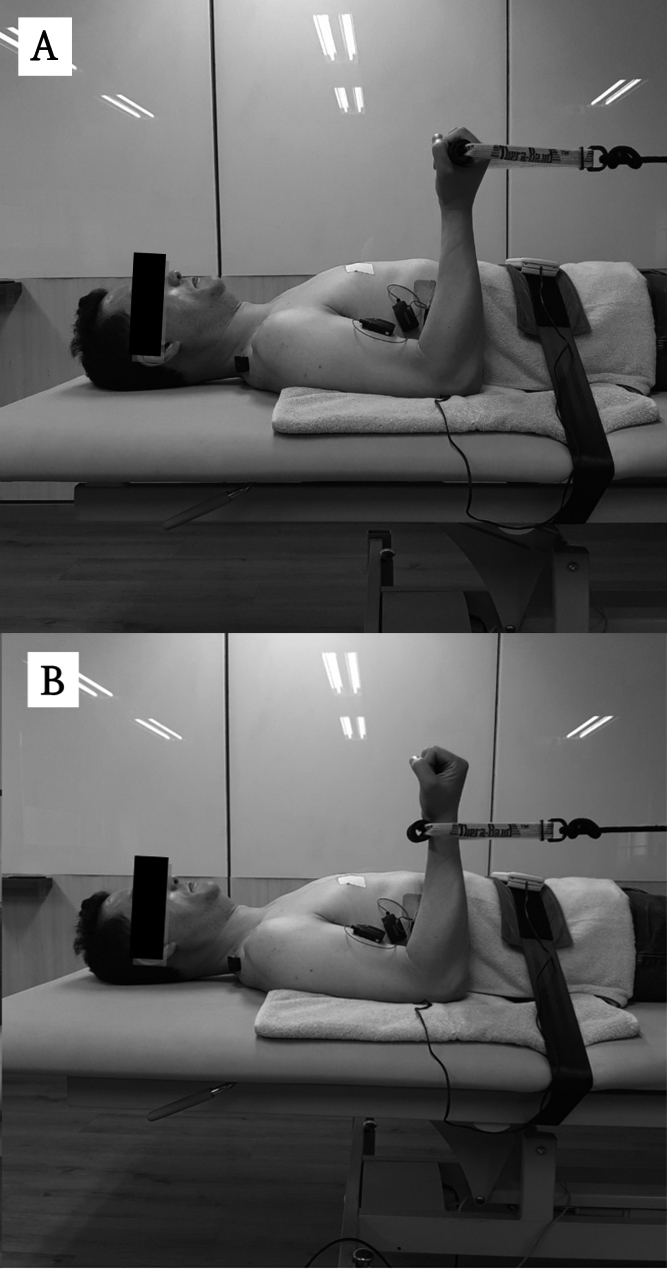
Before performing the experimental task, the participants were asked to perform three maximal voluntary isometric contraction (MVIC) exercises for normalization. The average RMS value of each muscle was calculated as a percentage of MVIC for the BB, SA, and UT muscles before the experimental exercise. Normalization exercises were selected according to recommendations from previous studies [13, 22]. For the BB exercise, the participants were in a seated position, with elbow flexion slightly less than or at a right angle, with the forearm in supination and resistance at the wrist provided by a tester pushing in the lower forearm extension direction. For the SA exercise, the subjects were in a supine position, with an abduction of the scapula, projecting the upper extremity anteriorly (upward from the table), with resistance provided by the fist of the tester, applying pressure downward through the extremity to the scapula in the direction of adducting the scapula. For the UT exercise, the subjects were in a seated position, with a straight elevation of the acromion end of the clavicle and scapula, and posterolateral extension of the neck, bringing the occiput toward the elevated shoulder with the face turned the opposite direction and resistance at the shoulder and head provided by a tester pushing in the shoulder depression and head flexion anterolateral directions. The normalization tasks of each muscle were executed in random order. Two trials were executed for each MVIC task with a 2-minute rest between the trials. The mean value of the trials was used for normalization.
Experimental tasks
Each subject performed three maximal elbow flexion efforts while lying supine, maintaining 90
Scapula manual stabilization technique by applying anteroposterior directional force against the coracoid process and lateral clavicle area.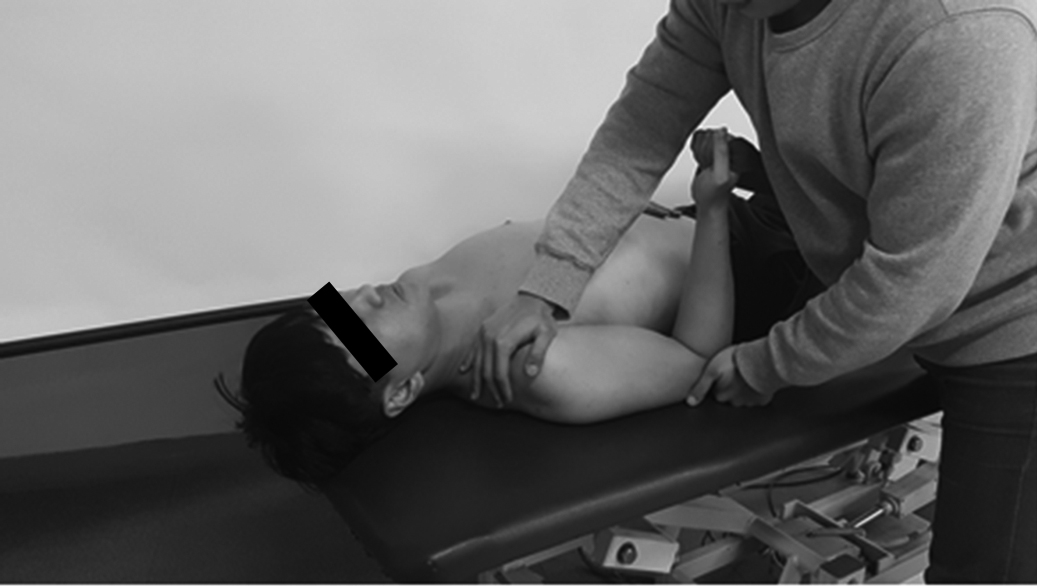
Electromyographic amplitudes (%MVIC) for each muscle during tasks (
Note. Significant differences are shown between with and without manual fixation of the scapula for the activation of that muscle during an exercise.
A 2 (hand-loaded or wrist-loaded conditions) x 2 (with or without manual fixation) x 2 (sex) repeated-measures analysis of variance (ANOVA) with Bonferroni adjustment was used to compare the muscle activations and force measurements. If the main effect was significant, the post-hoc test was used to determine the differences based on the ANOVA results. All analyses were conducted using SPSS version 23.0 (IBM, Armonk, NY, USA). The level of significance was set at
Results
Normalized %MVIC EMG data comparison between the exercise tasks
Table 2 shows that RMS amplitude results expressed as %MVIC normalized EMG data. For the BB muscle, the %MVIC activation value was significantly greater when performing manual fixation of the scapula in the wrist-loading exercise condition (
The results of repeated-measures ANOVA comparing each muscle activation during different exercise conditions with or without manual fixation of the scapula are shown in Table 3. There were no interaction effects among loading conditions, manual fixation, and sex in any of the muscle activation and force values (
Repeated measures ANOVA comparing each muscle activation during different exercise conditions with or without manual fixation of the scapula (
25)
Repeated measures ANOVA comparing each muscle activation during different exercise conditions with or without manual fixation of the scapula (
Elbow flexion force measured by a hand-held dynamometer showed a significant increase when applying manual fixation of the scapula (
Force (N) of biceps brachii muscle using a hand-held dynamometer during tasks (
25)
Force (N) of biceps brachii muscle using a hand-held dynamometer during tasks (
Effective and accurate muscle exercise is an essential component of physical therapy interventions and an important factor in determining successful therapeutic outcomes in patients with musculoskeletal dysfunctions [24]. This study investigated the EMG activity of the BB, SA, and UT muscles and the force of the elbow flexor muscles during the performance of maximal elbow flexion exercises with or without manual fixation of the scapula under different loading exercise conditions. The results of this study showed that the EMG activation and force of the BB were significantly greater when performing a maximal effort elbow flexion exercise with manual fixation of the scapula under wrist-loaded exercise conditions. In contrast, there was no significant difference in EMG activation of the BB muscle with or without scapula stabilization when performing the hand-loaded exercise. The results of this study could not be directly compared to the results of previous studies. However, the main reason for this pattern of EMG activation is likely linked to the different moment arms according to the exercise loading conditions [13]. When an elbow flexion exercise was performed by applying an exercise load to the hand, the action of the forearm flexors was further promoted, and the pure activity of the BB muscle would be relatively limited. Therefore, these study results indicate that the wrist-loaded exercise with elbow flexion and manual fixation of the scapula may be an effective clinical exercise protocol for the BB muscle. A previous study recommended 80% to 100% loading range to strengthen muscles for one repetition maximum based on the exercise ability of each subject [25]. Among the BB exercise methods used in this study, the activation amplitude (more than 80% of MVIC) of the BB with scapula fixation under the wrist-loaded exercise conditions was in the recommended range and considered to be unsuitable for BB muscle force.
In the elbow flexion force test using a hand-held dynamometer, a significant increase in force was measured when performing exercises with manual fixation of the scapula regardless of whether hand or wrist-loading exercise conditions were applied. These results showed that proper stabilization of the adjacent joints and segments was needed to accurately test and prevent patterns of substitution because the long and short head of the BB muscle attaches to the supraglenoid tubercle and coracoid process of the scapula. Although a significant positive correlation existed between the force and the EMG activation of the BB muscle in this study, the %MVIC of EMG activation would be more sensitive for evaluating muscle recruitment status than the elbow flexor force using a hand-held dynamometer.
The results of the SA muscle activity showed a significant increase when performing elbow flexion exercises with manual fixation applied to the scapula, regardless of the external loading conditions. Previous studies recommended that combining active elbow flexion with shoulder extension was an effective way of producing elbow flexor torque [2, 3]. The results of this study showed that not only BB muscle EMG activation and force significantly increased with manual scapula stabilization, but also significant EMG activation of the SA was observed. We thought that manual scapula stabilization during the experimental test might elicit greater activity of the SA muscle by assisting in maintaining optimal elbow flexor length and producing elbow flexor torque. Therefore, these study results showed that the SA is a stabilizer of the scapula and a very important synergistic contributor to the elbow flexor activities. A previous study reported that trunk stability was required to transmit force to the upper extremities during functional activities because scapulothoracic muscles like the SA have an important role as an anatomically functional linkage between the trunk and the upper extremities [26]. In this study, manual scapula stabilization was effective not only in increasing elbow flexor muscle activation and force but also to increase the activation of the SA muscle when preforming exercise of the elbow flexors. These findings demonstrated that manual scapula stabilization affected the length of the BB muscle, which may induce maximal contraction. However, this study also showed that the activation of the UT muscle was not affected by manual fixation of the scapula and external loading conditions during maximum isometric elbow flexion exercises. The main reason for this result is that the UT muscle mainly acts as an elevator and upward rotator of the scapula rather than a scapula stabilizer [27]. The clinical implication of this study is that if the goal of therapeutic exercise intervention is to increase the activation of the elbow flexor muscles, a 90
A few limitations of the study should be noted. Although there are a lot of elbow flexors, such as the biceps brachii, brachialis, and brachioradialis, only the activation and force of the BB muscle were measured in this study. Thus, we could not explain how the action of the other elbow flexor muscles may influence scapula stabilization. This study was conducted on healthy participants without any musculoskeletal problems of the upper extremities who were mostly young ages. Thus, the results of the study cannot be generalized to patients with shoulder instability dysfunctions. Therefore, further studies are needed to investigate the effect of scapula stabilization on the activation and force of shoulder and elbow muscles in patients with shoulder instability and scapula winging.
Conclusions
Manual scapular stabilization is a useful therapeutic intervention to increase the force of the BB muscle when performing maximal isometric contraction of the elbow flexors. Also, manual fixation of the scapula is recommended to accurately measure BB muscle activation or force.
Author contributions
CONCEPTION: Sungjoon Yun.
PERFORMANCE OF WORK: Sungjoon Yun.
INTERPRETATION OR ANALYSIS OF DATA: Yongwook Kim.
PREPARATION OF THE MANUSCRIPT: Sungjoon Yun and Yongwook Kim.
REVISION FOR IMPORTANT INTELLECTUAL CONTENT: Yongwook Kim.
SUPERVISION: Yongwook Kim.
Ethical considerations
The study was approved by the Institutional Review Board of Jeonju University (approval number: jjIRB-160919-HR-2016-0903). All participants provided written informed consent before participation.
Funding
This study was supported by the National Research Foundation of Korea (NRF) grant funded by the Ministry of Science and ICT (No. 2018R1C1B5042645).
Footnotes
Acknowledgments
The authors have no acknowledgments.
Conflict of interest
We can confirm that there is no conflict of interests for any of the authors.