




Abstract
BACKGROUND:
Small-sided games are a popular training method that have shown its effectiveness in improving athletic performance in football players.
OBJECTIVE:
To compare the acute physiological and neuromuscular responses and time-motion characteristics during small-sided games played with and without wildcard players.
METHODS:
Sixteen amateur male football players completed two small-sided games protocol: 4-a-side and 4-a-side with wildcard players. Time-motion characteristics during games, muscular performance parameters before and after small-sided games protocols, physiological response in terms of heart rate and muscle oximetry and rate of perceived exertion were collected.
RESULTS:
Both small-sided games formats induced changes in sprint performance (before-after comparison), in the rate of perceived exertion, heart rate-related variables and time-motion parameters (
CONCLUSIONS:
The inclusion of wildcard players during small-sided games cause a reduction in perceptual, physiological demands and time-motion parameters when compared to control condition.
Introduction
Small-sided games (SSGs) are a popular training method that has shown its effectiveness in improving athletic performance in football players [1, 2, 3]. Since it has been suggested that the maximum benefits in sports are achieved when the training stimuli are similar to competitive demands [4], it is worth noting that SSGs are characterized by simulating real match conditions [3, 5]. In that context, this training method (i.e., SSG) seems to be an efficient and suitable option for the development of particular physical characteristics of football players [6].
Additionally, SSGs demands can vary by modifying variables such as number of players [7], pitch area [8] or the playing rules (e.g., with or without wildcard players) [9] among others. Determining the acute effects of those alterations on internal and external loads and time-motion characteristics would facilitates the training design process and allows a better integration of SSGs within the whole football training periodization [3].
In competition matches, frequent situations of low and high inequality occur between teams. For example, when a player receives a red card, leaving one of the team with a lower number of players. However, most researches confronted teams that had the same number of players (i.e., 5-a-side, 3-a-side, 2-a-side), with a limited body of evidence focused on describing game imbalance situations, from which controversies have emerged. A previous study reported no differences between the fixed and variable (i.e., wildcard) SSGs formats, in terms of time-motion characteristics and physiological responses [10]. Other work showed that playing in low-inferiority (4 vs. 5 or 4 vs. 3) induced higher physiological demands compared to high-inferiority (4 vs. 7) [11]. Another study reported that the incorporation of wildcard players reduced the heart rate (HR) during different SSGs formats [12]. In addition, the effects of different types of wildcard players during SSG (e.g., without, with internal or with internal and external wildcard players) have been studied, showing that the inclusion of only internal wildcard players during SSG did not affect the variables studied when compared to SSG without wildcard players [9]. Nevertheless, the inclusion of internal and external wildcard players reduced HR, rate of perceived exertion (RPE) and dribbling actions when compared to SSG without wildcard players [9]. The lack of consensus on this topic, owing to the heterogeneity that exists among study protocols, demands further research to clarify the effects of using wildcard players within of SSGs.
Although the inclusion of wildcard players has been reported [9, 11] to affect a number of variables within the SSGs, no previous studies have compared the physiological and neuromuscular responses to SSG played with and without wildcard players in amateur senior football players. Additionally, the comparison of the influence of SSG played with and without wildcard players on time-motion characteristics has not yet been investigated. In an attempt to highlight the effects of including a wildcard player in a SSG from a multidisciplinary standpoint (i.e., physiological, neuromuscular and external load variables), describing the acute response to these protocols, typical in training in this sport modality, can be of great interest to coaches in order to know which type of SSG should be used depending on the target. Therefore, the aim of this study was to compare the acute physiological and neuromuscular responses and time-motion characteristics during SSGs played with and without wildcard players in amateur senior football. It was hypothesized that SSG played with wildcard players would obtain lower values for the variables studied when compared to SSG played without wildcard players.
Methods
Participants
Sixteen male football players (age, 23.9
Experimental approach to the problem
Athletes completed two 4-a-side SSGs protocols with the aim of maintain ball possession as long as possible, with no restrictions regarding number of ball touches. Both SSG formats (i.e. with and without wildcard players) included 4 bouts of 4-min, played without goalkeepers, in a pitch size of 30
Procedures
This is a single group repeated-measures study, in which all participants performed the two formats of SSG in two different testing sessions. During both sessions, the participants were monitored for external load (time-motion characteristics) and physiological parameters during one 4-a-side SSG and one 4-a-side SSG with wildcard players, and tested before and after (pre- and post-SSG) for physical fitness assessment (countermovement vertical jump [CMJ], 5-m and 20-m sprint) (Fig. 1). The participants were asked to avoid high-intensity exercise
Schematic of the experimental protocol and variable measurements followed in both SSG formats.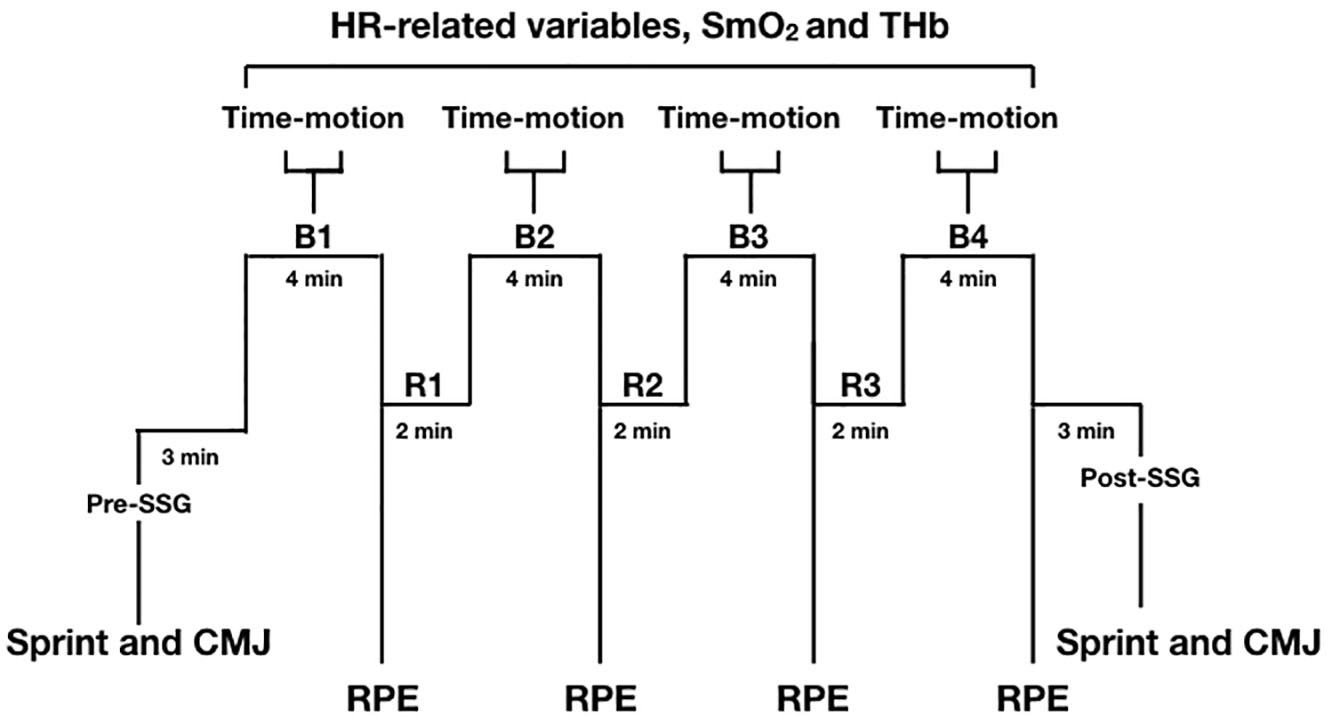
The athletes were randomized to 2 different SSG formats for 2 sessions. Each session was separated by a week. After the pre-SSG (physical fitness assessment), athletes completed one 4-a-side SSG or one 4-a-side SSG with wildcard players (with two internal wildcard players that played with the team in possession of the ball), that were conducted with the aim of maintain ball possession as long as possible, with no restrictions regarding number of ball touches. The two athletes that participated as wildcard players were not analysed for the study. The SSGs included 4 bouts of 4-min, played without goalkeepers, in a pitch size of 30
20-m sprint
Sprint evaluation (pre- and post-SSG) was accomplished through a speed test that was carried out in a straight 20-m line [13]. Markers were set up at 5-m and 20-m. Additionally, split sprint time of 5-m was analysed. Based on the method described by Lehance et al. [14], sprint times (s) were measured using two double-light barriers (Witty; Microgate Srl, Bolzano, Italy; accuracy of 0.001 s): (a) at knee height (60 cm) for the departure, (b) at the shoulder height (150 cm) for the arrival, and (c) at intermediate markers (at 5-m). To eliminate reaction time, the participants started from a static position with feet parallel behind the start line. No starting signal was given. The players performed 2 trials with a 3-min recovery in-between. The best trial was recorded for the subsequent statistical analysis.
Countermovement vertical jump (CMJ)
The jumping performance (pre- and post-SSG) was assessed through CMJ test. The participants were highly familiarized with the CMJ technique, as they performed CMJ in their daily training sessions. The CMJ was recorded using the Optojump system (Optojump, Microgate, Bolzano, Italy), which was also used in a similar study [14]. The Optojump system is a valid and reliable device to measure CMJ performance [15]. During the CMJ, subjects were instructed to rest his hands on his hips, foot and shoulders wide apart. Subjects performed a downward movement with no restriction imposed over the knee angle achieved [16], followed by a maximal effort vertical jump [17]. All subjects were instructed to land in an upright position and to bend their knees after landing [17]. Three trials were performed with a 15-s recovery period between them, and the best trial was used for the statistical analysis.
Rating of perceived exertion (RPE)
Global RPE was obtained, immediately after each of the 4 bouts of the SSG (during the recovery between bouts), using the 6-scale [18], to ensure that the perceived effort was referred to the SSG training only. Briefly, the subjects answers were recorded individually, without presence of other players, after the question (in Spanish): “How hard was the SSG?” [9]. All players were familiarized with the RPE scale before the research project started.
Physical fitness comparison (Mean
SD) between two different formats of small-sided games in amateur soccer players (
16)
Physical fitness comparison (Mean
ExC1
The HR was recorded at 5-s intervals during the 4-a-side SSG via short-range radio telemetry (Polar Team Sport System, Polar Electro Oy, Finland). It was expressed as a percentage of peak HR (HRpeak) by using generalized equation for predicting HRpeak [19], and were classified into four previously defined intensity zones: Zone 1 (
Muscle oxygen saturation (SmO
) and total muscle haemoglobin (THb)
The SmO
Time-motion characteristics
Players’ activity was recorded using 20-Hz global positioning system (WIMU PRO
Statistical analysis
Descriptive statistics are represented as mean and standard deviation (SD). Tests of normal distribution and homogeneity (Shapiro-Wilk and Levene’s test, respectively) were conducted on all data before analysis. A Student’s paired
Results
Physical fitness assessment
Table 1 outlines the physical fitness comparison (sprint and jump) between the two different formats of SSGs. No significant differences (Time
Physiological and perceptual responses comparison (Mean
SD) between two different formats of small-sided games in amateur football players on bout periods (
16)
Physiological and perceptual responses comparison (Mean
ExC1
Physiological responses comparison (Mean
ExC1
Table 2 outlines the physiological and perceptual responses comparison between the two different formats of SSGs during bout periods. Significant differences (Time
Table 3 shows the physiological responses comparison between two different formats of SSGs during recovery periods. Significant differences (Time
Time-motion characteristics
The time-motion characteristics comparison obtained at each of the 4 bouts of the two SSG formats are indicated in Table 4. The ANOVA results indicated significant differences (Time
Time-motion characteristics comparison (Mean
SD) between two different formats of small-sided games in amateur football players on bout periods (
16)
Time-motion characteristics comparison (Mean
ExC1
The aim of this study was to compare the acute physiological and neuromuscular responses and time-motion characteristics during SSGs played without and with wildcard players in amateur senior football. The main findings indicated that: (i) Sprinting performance was impaired after both SSG protocols, whereas jumping performance remained unchanged; (ii) Between-protocols differences were found in HRpeak and SmO
Physical fitness performance
In this study, the inclusion of wildcard players during a SSG did not affect the sprint and jumping capacities compared to a SSG format without wildcard players. The effect of SSGs on sprint and jump has been previously studied with some controversies reported [2, 26]. The 20-m sprint performance was impaired after the SSG protocols. This finding is consistent with a previous study that reported a higher decline after a similar SSG protocol (3-a-side) [27]. Sprint running involves stretch-shortening cycle muscle function of both lower and upper body musculature with increased metabolic demands [28]. According to a previous study [27], it seems that higher endurance levels are needed in order to maintain performance (sprint performance). Therefore, the fatigue induced by SSG protocols might help explain the reduction in 20-m sprint performance after SSG protocols. On the other hand, CMJ scores did not change after SSG protocols in agreement with another study [26]. This fact can be due and explained by the muscular contraction nature, since both the sprint and jump abilities might respond differentially to (peripheral) fatigue and metabolic perturbations (such as blood lactate accumulation) [29]. The knowledge of these factors may help to coaches to optimize the training control process.
Physiological and perceptual characteristics
The effects of the inclusion of wildcard players on physiological and perceptual variables during SSG is still not clear [5, 9, 10]. In our study, a lower RPE was recorder during 4-a-side SSG with wildcard players compared to 4-a-side SSG without wildcard players, as in a previous study [9]. When an unequal number of players is introduced with temporary superiority and inferiority numerical situations, it must be taken into account that the players participation in the SSG (i.e., direct and indirect ball participation) is lower than those games played with equal number of players [30]. This may lead to a reduction of individual actions (i.e., 1 vs 1 duel), then decreased RPE [9, 31].
With regard to physiological variables, the inclusion of wildcard players in this study affected the HRpeak and SmO
When the number of players is increased during a SSG, with the same pitch size and game rules, the intensity (in terms of physiological load) is lower [32]. The presence of wildcard players can become a greater incentive for each team to work harder to gain possession (which implies greater intensity developed by the players) and thereby, gain the benefit of having wildcard players join their team (increase the technical load on each player as the number of ball contacts per player) [10], however, in this study the 4-a-side SSG with wildcard players did show less intensity than the 4-a-side SSG without wildcard players (in terms of HRpeak and SmO
In terms of muscle oxygenation characteristics (SmO
Time-motion characteristics
Variations in player number have generally been indicated to affect SSG training intensity [3, 5]. In this study, time-motion characteristics were affected by the introduction of wildcard players. Therefore, this study demonstrated greater total distance travelled, total m/min, distances travelled at higher intensity, number of accelerations in zone 4, maximal speed and average speed during 4-a-side SSG without wildcard players compared to 4-a-side SSG with two internal wildcard players, although no additional differences were observed. This finding is similar to other studies [10, 11] that reported an increase in time-motion characteristics when the SSG was played with equal number of players (i.e., without temporary superiority and inferiority numerical situations). The results of this study suggested that the greater number of players during incorporation of two internal wildcard players caused a reduction of time-motion characteristics to achieve the goal, in this case the maintenance of the ball. This point has a subsequent impact on the physiological response to SSGs tested, which is consistent with previous studies that concluded that increasing the number of players during SSGs decreases the RPE and physiological responses [11, 33] and physical demands [11]. Therefore, if coaches design SSGs with the aim of conditioning, fewer players per team will cause a greater impact at physiological and physical level, regardless of whether the teams are composed of equal numbers or situations of temporary superiority and inferiority.
Finally, some limitations must be addressed. First, the level of players assessed as it could be interesting to examine the response to different SSG formats in male football professional players. Second, the lack of data about women’s response to different SSGs formats and variables.
Conclusions
The current article provides preliminary scientific support for the inclusion of internal wildcard players within small-sided games to facilitate the application of the load dynamic throughout the competitive period. From a practical standpoint, the inclusion of internal wildcard players might be well-suited during the competition, on those days of recovery, where the workload should be lower, since the intensity remains high (e.g., HR-related variables) and the volume decreases in terms of external load. This type of small-sided game format let players to train with a high intensity while not causing great fatigue, enabling training or playing a game the next day with maximum performance guarantees. Coaches and technical stuff might find this information very useful in order to accurately know how the inclusion of this variable influences football players from a multidisciplinary (i.e., neuromuscular, physiological and time-motion) approaching.
Author contributions
CONCEPTION: Pascual Bujalance-Moreno, Pedro A. Latorre-Román and Felipe García-Pinillos.
PERFORMANCE OF WORK: Pascual Bujalance-Moreno.
INTERPRETATION OR ANALYSIS OF DATA: Pascual Bujalance-Moreno, Pedro A. Latorre-Román and Felipe García-Pinillos.
PREPARATION OF THE MANUSCRIPT: Pascual Bujalance-Moreno.
REVISION FOR IMPORTANT INTELLECTUAL CONTENT: Pascual Bujalance-Moreno, Rodrigo Ramirez-Campillo, Antonio Martínez-Amat and Felipe García-Pinillos.
SUPERVISION: Pascual Bujalance-Moreno, Pedro A. Latorre-Román and Felipe García-Pinillos.
Ethical considerations
The study was conducted in adherence to the standards of the Declaration of Helsinki (2013 version). The local ethics committee (University of Jaen) approved the informed consent and the study design (reference number: CEHIH 111115, Date: 1/03/2016).
Funding
The authors report no funding.
Footnotes
Acknowledgments
The authors would like to acknowledge the collaboration of Atlético Menciano and C.D. Egabrense.
Conflict of interest
The authors declare that they have no conflict of interest.