




Abstract
BACKGROUND:
Lower-extremity muscle strength and ankle flexibility play key roles in underwater swimming movements.
OBJECTIVES:
To investigate the relationship between knee isokinetic strength and the speed of underwater dolphin kicks (UDK-S) in competitive male swimmers and identify whether ankle flexibility affects the association between knee isokinetic strength and UDK-S.
METHODS:
Fifty-two highly trained male swimmers participated in this study. The speed at which the participants travelled 15 m performing UDKs was calculated as UDK-S. Knee flexor and extensor concentric isokinetic strength at fast (240
RESULTS:
There was strong-to-extremely strong evidence (Bayes factor
CONCLUSIONS:
Knee extensor and knee flexor strength were significantly correlated with UDK-S, and the relationship between knee muscle strength and UDK-S was influenced by ankle plantar flexion flexibility in male competitive swimmers.
Introduction
The underwater dolphin kick (UDK) is different from the four competitive strokes (butterfly, backstroke, breaststroke, and freestyle) commonly performed in swimming competitions; it is considered a relatively new underwater swimming stroke and is performed in the starting or turning phase. When performing UDKs, athletes keep their bodies in a streamlined position with their arms stretched over their heads and fully submerged and extend and flex both knees simultaneously to perform extension-flexion kicks and propel their body forward. If performed well, UDKs can reduce the time required for the starting and turning phases and enhance athletes’ overall swimming performance. Furthermore, the interest in research related to UDKs is growing, particularly for coaches and athletes [2].
Biomechanical studies have demonstrated that knee joint movements are a key factor in UDK performance [3, 4]. For example, Connaboy et al. [3] reported that maximal knee angular velocity, range of motion (ROM) of the knee, and maximal ankle angular velocity can account for 92.2% of the variance in the maximal velocity of individuals performing UDKs. Arellano et al. [4] found that maximal knee flexion was significantly correlated with kick frequency and the velocity of the center of mass (Vcom) during UDKs [4]. On the other hand, ankle flexibility has also been reported to play a crucial role in UDK performance. Using computer simulation analysis, researchers [5]. found that the a 5
Increases in propulsive force lead to optimal swimming performance, as it is generally believed the ROM and muscle strength of the joints involved largely determine the magnitude of force generated in swimming. Knee function has been identified as a key factor of the speed of UDKs (UDK-S) in previous studies, but the relationship between knee muscle strength and UDK-S remains unclear. On the other hand, it has been reported that the inhibition of ankle ROM influences knee movement and consequently decreases the Vcom during UDKs [7]. The synergistic effect between the knee and ankle joint may have an important impact on UDK performance. The movements of these two joints have been reported in the literature to affect UDK-S, but scientific evidence to confirm the combined effects of knee muscle strength and ankle flexibility on UDK performance is still lacking. Knee muscle strength and ankle flexibility can be improved through specific training programs, so both researchers and swimming coaches are interested to learn how to design proper and specific training programs on land or in the water to improve UDK-S.
Thus, the purposes of this study were to investigate the relationship between knee strength and UDK-S and examine whether ankle flexibility influences the relationship between knee muscle strength and UDK-S.
Methods
Participants
Fifty-two highly trained, competitive male swimmers participated in this study (body height: 1.83
Design
The protocol was divided into three sessions: (i) ankle flexibility assessments, which were performed prior to sessions (ii) and (iii) and involved the assessment of active ankle plantar flexion (APF) and active ankle internal rotation (Int); (ii) underwater dolphin kick test, during which UDK-S was measured; (iii) an isokinetic evaluation, during which the isokinetic concentric strength in both the dominant (D) and non-dominant (ND) sides was evaluated. The interval between (ii) and (iii) was at least 24 hours. In a randomized and counterbalanced fashion, the order of sessions (ii) and (iii) was selected by the researchers, and no participants withdrew from the study.
Measurement of ankle flexibility
An experienced physical therapist evaluated ankle flexibility by using a goniometric toolset (HKNA, Shanghai, China). Active Plantar Flexion Flexibility (APF) was measured on the basis of the method described by Ekstrand [8], and Active Internal Rotation in ankle joint (Int) was defined as the angle between the anterior margin of the tibia and the head of metatarsal II in the movement axis of the head of the talus [6]. The measurements of APF and Int were conducted bilaterally, and the highest value was used for analysis.
Measurement of the speed of UDK-S
For this measurement, each swimmer completed 3 maximal effort trials, during which they performed UDKs in a prone position over 15 m after pushing off from a wall. To prevent the push-off phase from affecting the results, the time between when the participant’s head passed through the 5th and 15th meter markers was used to calculate UDK-S. Each trial was measured manually by two experienced swimming coaches (ICC
Measurement of peak isokinetic strength in the knee joint
Concentric isokinetic strength in the knee was evaluated using a dynamometer (Isomed 2000 Buehler Inc., Germany). The peak moment (PM, Nm) during knee extension and knee flexion in both legs were tested at fast (60
Statistical analysis
Open-source statistics software (JASP,
A moderating effect means that the relationship between variable
Without the interaction effect:
With the interaction effect:
where
Descriptive results and correlation coefficients for the correlations between variables
FL60: concentric knee flexor strength at 60
The moderation analysis results for ankle flexibility regarding the relationship between knee isokinetic strength variables and UDK-S
FL60: Concentric knee flexor strength at 60
The descriptive statistical results and the relationship between knee isokinetic strength, ankle flexibility, and UDK-S are presented in Table 1. There was strong evidence (BF
The results showed that APF was identified as the moderator of the relationship between EX60 and UDK-S. There is strong evidence (BF
The relationship between EX60 and UDK-S within the 25% (62.22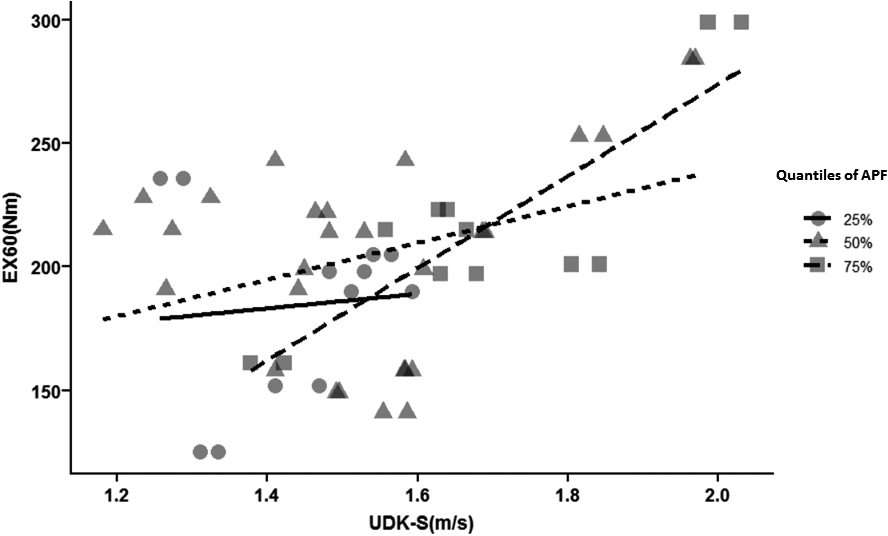
The main aim of our study was to examine the relationship between knee strength and UDK-S. Our results revealed that there was strong evidence (BF
The UDK-S value reported in our study (1.55
It was reported that the propulsive force and swimming velocity during UDKs are mainly generated by the extension kick during UDKs [20, 21], and knee extensor strength is mainly responsible for the knee extension movement during UDKs. Therefore, it was not unexpected that EX60 was positively correlated with UDK-S in our study. Due to a lack of previous pertinent studies, comparison with previous research outcomes was difficult to perform, but some studies related to kicking movements reported results that supported our results; EX60 was found to be highly correlated with the 100 m fin time (
The major finding of our study indicates that knee flexor strength at fast (240
Additionally, it is worth noting that although the PM of the knee extensors was much higher than that of the flexors the correlation strength was similar between EX60 and FL60, FL240, and UDK-S. One possible explanation is that the knee flexors become more important when the swimming velocity increases. Biomechanical analysis has shown that knee extension kicks at a low speed are the primary movements that generate propulsive forces, while the difference in the propulsive force between extension and flexion kicks becomes smaller as the UDK speed increases [20]. Thus, the authors suggested that extension and flexion kicks were equally important in generating propulsive forces during UDKs at a high speed. Taken together, these results suggest that both knee extensor and flexor strength should be increased to maximize UDK-S.
A larger APF ROM was positively and strongly linked with a higher UDK-S in this study. Our findings are consistent with those of several previous studies showing that good APF flexibility plays an important role in UDK performance. McCullough et al. reported that there was a moderate positive relationship (
Muscle strength and joint flexibility were considered independent variables, and their relationships with swimming performance were evaluated separately in previous studies [22, 23, 24, 25]; however, joint flexibility may affect the relationship between muscle strength and swimming performance. The present study revealed that there was a positive moderating effect of APF on the relationship between EX60 and UDK-S. More specifically, athletes with a higher APF value had a stronger correlation between EX60 and UDK-S. Compared with flexion kicks, extension kicks can produce greater propulsive forces and a higher swimming velocity [20], so optimal levels of APF and knee muscle strength during extension kicks can improve the efficiency of dolphin kicks. Therefore, it is logical that swimmers with greater knee extensor strength and a larger APF ROM have higher UDK-S values. The lower APF ROM during extension kicks may lead to propulsion inadequacy and reduce the positive effect of knee extensor strength on swimming velocity, so a weaker correlation between knee extensor strength and UDK-S may occur if APF deficiency occurs. During flexion kicks, a larger plantar flexion angle may increase the surface area of the end-effector (feet) in the frontal plane [2, 20] and increase the drag force. Therefore, it is unnecessary to maximize ankle ROM to execute flexion kicks. This result may explain why APF did not influence the relationship between knee flexor strength and UDK-S.
The variation in ankle internal rotation itself cannot accurately describe the changes in ankle ROM that occur in response to the plantar-flexion angle and internal rotation angle simultaneously during UDKs. A previous study demonstrated that the movement pattern at the knee during UDKs can change, and the swimming velocity can decrease only when both plantar flexion and internal rotation movements are restricted [6, 7]. On the other hand, the change in the Int angle was far smaller than that in the APF, so trivial changes in ankle ROM seem to have negligible effects on the generation of forces by the feet. Therefore, Int is not correlated with UDK-S and does not influence the association between knee muscle strength and UDK-S.
Our paper provides new insight regarding the relationship between muscle strength and swimming performance, as the moderating effect of ankle flexibility was investigated. The present study indicated that variations in joint ROM and flexibility result in the inhibition or enhancement of the effect of muscle strength on kicking performance. Swimmers with a similar knee muscle strength as other swimmers but higher ankle flexibility may have an advantage in kicking performance. The present results suggested that developing muscle strength in combination with joint ROM, which requires movement patterns, may lead to improvements in performance.
Our study has some limitations. First, there are two body positions for UDKs, but the only front position was evaluated with knee muscle strength because a previous study reported that no difference in the mean velocity was found between these two body positions for UDKs [26]. Second, isokinetic strength differ by body position [27], and the sitting position was used to assess knee isokinetic strength in our study. Finally, UDKs involve multiple joints, but only the knee joint was evaluated. Other lower extremity joints such as the hip and ankle need to be investigated in future studies to determine the effect of the strength of multiple joints on UDK-S.
Conclusions
The findings of our study demonstrate that a higher UDK-S value is related to greater knee flexor and extensor strength in male competitive swimmers. The relationship between knee muscle strength and UDK-S is influenced by the level of APF in this population.
Author contributions
CONCEPTION: Yupeng Shen and Yuhong Wen.
PERFORMANCE OF WORK: Yupeng Shen, Yanqing Fu and Yu Ge.
INTERPRETATION OR ANALYSIS OF DATA: Yupeng Shen.
PREPARATION OF THE MANUSCRIPT: Yupeng Shen and Yuhong Wen.
Ethical considerations
The study was conducted in accordance with the Declaration of Helsinki and approved by the university ethics committee on 2020/3/5 (SCNU-SPT-2020-035). All athletes were informed of the research procedure before they participated in the study and voluntarily participated in the tests.
Funding
This research was funded by Beijing Sports University, grant number 2018GJ011 and South China Normal University 2014WQNCX031.
Footnotes
Acknowledgments
Authors would like to thank the swimmers from the Beijing Sports University swimming team for participating in this experiment and university research center and staff members for providing assistance and all the necessary equipment.
Conflict of interest
The authors declare there are no conflicts of interest.