




Abstract
BACKGROUND:
Skeletal muscle strength can be impacted by various factors. However, the possible effects of different forms of exercises on the elderly’s muscle strength remain unknown. Furthermore, whether the level of physical activity influences the effects of an exercise-based training also remains unclear.
OBJECTIVE:
To investigate the characteristics of fatigued quadriceps by continuous maximum knee extension movements among different male groups under different physical conditions.
METHODS:
A total of 36 male participants (24 elderly and 12 youth) were divided into three groups, namely, young male group, and two groups of elderly participants: physically active and physically inactive. All groups underwent two sets of fatigue procedures. They initially finished 30 isokinetic maximum knee extension contractions at 60
RESULTS:
During the 60
CONCLUSION:
Exercise is associated with improved function and fatigue resistance of the quadriceps in elderly people. Moreover, the implications of the bilateral quadriceps’ imbalance in this group may be of functional importance and should thus be clinically considered.
Keywords
Introduction
Falling accidents are a serious public health problem as people age. Falls can lead to severe physical, psychological and economic consequences among older adults. Therefore, developing effective fall prevention programs is a pressing need.
The effects of sports on the improvement of the human skeletal muscle’s function has become the focus of many sports experts who paid considerable attention to muscle function evaluation and strength improvement for the elderly [1, 2, 3] since muscle weakness is a key fall risk factor that possibly affects the quality of life among older adults. Muscle strength loss in the elderly can easily produce limb weakness and cause problems, such as difficulty in rising from bed or chair, slow gait, imbalance and falls [4]. In an examination on the effect of sports on improving strength among older adults, Rui et al. found that 16 weeks of regular shadowboxing exercise could significantly improve the muscle strength of lower limbs and proprioception function in the elderly [5]. It also improved neuromuscular control ability of lower limbs but only slightly influence the balance function. Thus, shadowboxing exercise should be applied as a possible preventive measure against falling [5].
Skeletal muscle strength can be impacted by various factors. However, the possible effects of different forms of exercises on the elderly’s muscle strength remain unknown. Whether the level of physical activity can influence the effects of an exercise-based training also remains unclear. Therefore, the purpose of this study was to investigate the characteristics of fatigued quadriceps by continuous maximum knee extension movements among different male groups under different physical conditions.
Methods
Participants
A total of 36 community dwelling male subjects (12 younger and 24 older adults) were screened by consultation and questionnaire survey and enrolled in this study (Table 1). All participants volunteered to participate. Subjects were divided into three groups in accordance with the experimental needs, namely, young male group (OYP), physically active elderly male group (REE) and physically inactive elderly male group (IEE). The REE and IEE groups were divided according to the level of the physical activity in the questionnaire, namely, 0–1
Subjects’ information
Subjects’ information
A CON-TREX isokinetic dynamometer (Physiomed GmbH, Germany) was used for muscle strength measurement. The pre-experiment was conducted 1 week before the experiment. In this stage, subjects were familiarized with the whole process and were handed notes for daily activities. Before the formal experiment, subjects warmed up on a cycle ergometer for 5 minutes. During the actual experiment, subjects were required to complete 30 continuous maximal knee concentric extensions (at a RoM of
Statistical analysis
The experimental data collected were statistically processed using SPSS18.0 statistical software. The data in the Table was expressed in mean
Results
During the fatigue test with 30 repetitons at 60
The TW of dominant quadriceps with 30 times 60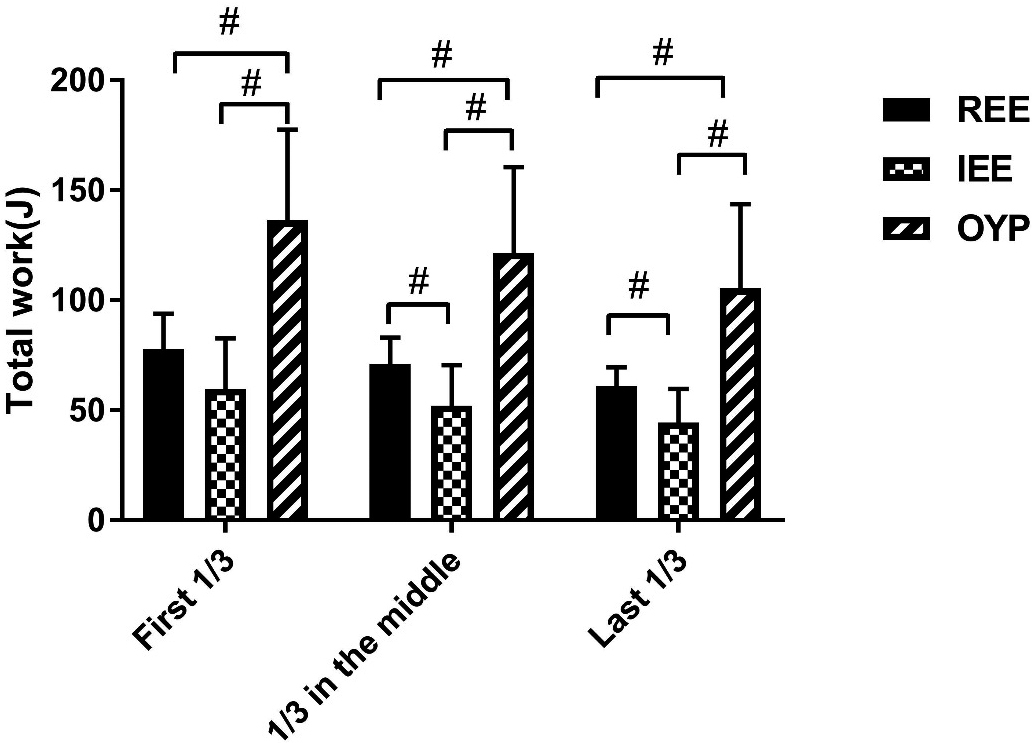
The TW of non-dominant quadriceps with 30 times 60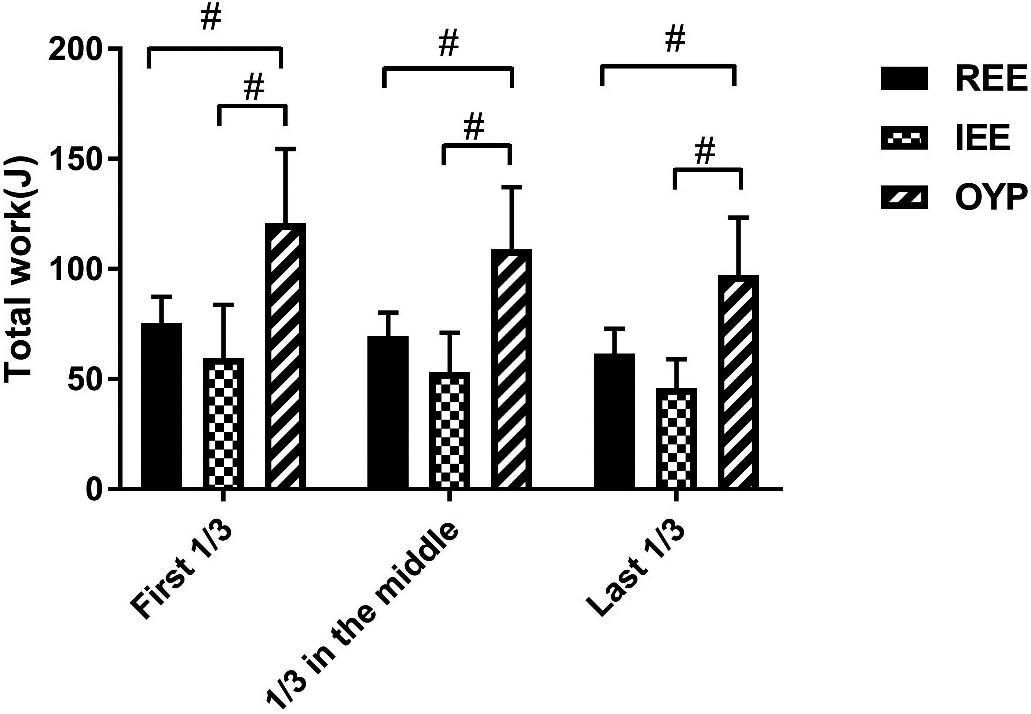
The TW of dominant quadriceps with 50 times 180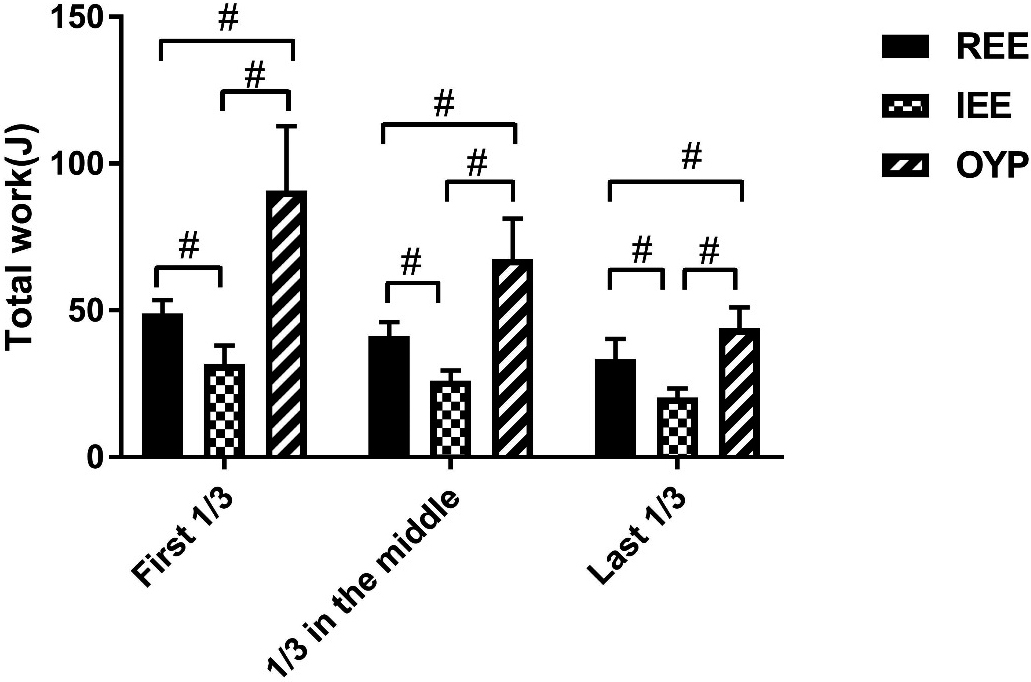
The TW of non-dominant quadriceps with 50 times 180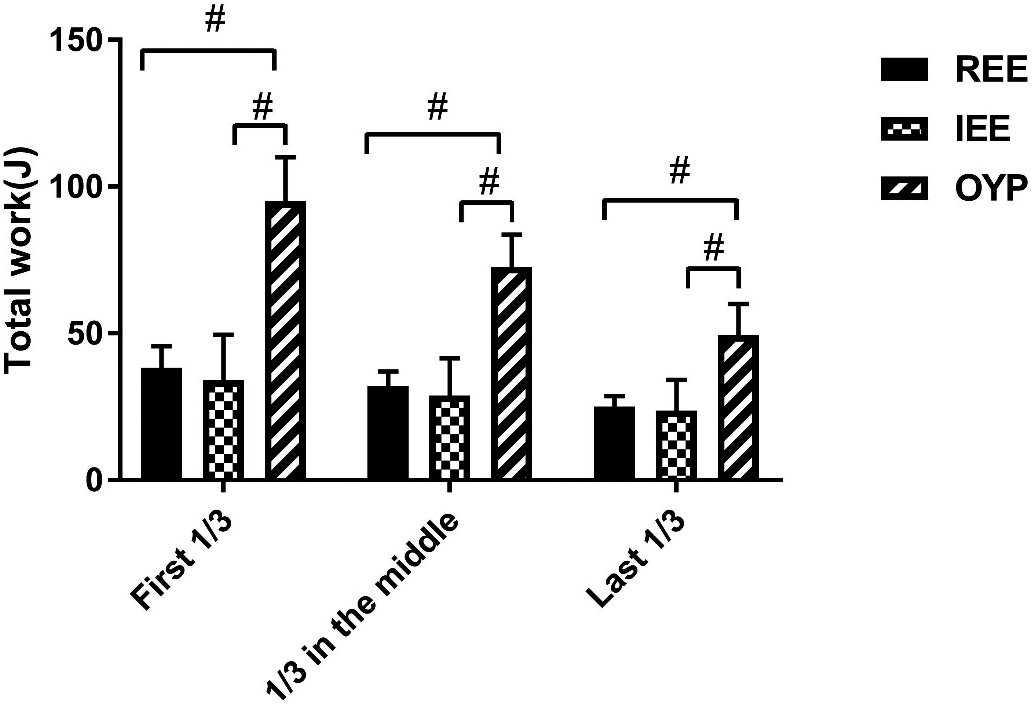
For the non-dominant side (Fig. 2) at same test conditions, the TW values of quadriceps in OYP group were respectively 120.8
During the fatigue test with 50 repetitions at 180
For same test conditions in the non-dominant side the findings for OYP were (Fig. 4): 95.1
The purpose of this study was to determine the characteristics of quadriceps fatigue by continuous maximum knee extension movements among different groups under different physical conditions. The main findings of this study are: 1) the TW of the dominant and non-dominant quadriceps in the young male group is the highest among three groups at each third of the fatigue phase; 2) the TW of dominant quadriceps in the physically active elderly male group group is higher than in physically inactive elderly male group at each third of the fatigue phase except the first third during the fatigue test with 30 repetitons at 60
With increasing age, the decline of the heart and lung function can lead to a decrease in muscle strength, thereby possibly affecting the elderly’s daily activity. Li et al. reported that as the elderly’s body functions decline, the senile frailty syndrome appears while biological function and resistance to stress are significantly reduced thereby greatly increasing the elderly’s loss of life ability [6]. Although our results show that the TW of the quadriceps in the elderly was less than young people, the anti-fatigue ability of the quadriceps in REE group was better than that of IEE group which was affected by exercise. Exercise can have a positive impact on the muscular function of the elderly. The 30/50 times of continuous knee extensions also reflect the elderly peoples’ ability to perform sports continuously. The engagement of the elderly in continuous activities ensures the smooth completion of the corresponding movement if muscular function is strong enough thereby avoiding the phenomenon of falling due to the decline in muscle function. Qu et al. screened 70 elderly subjects with poor stability and divided them into the observation group and control group [7]. After 3 months of intervention, they analysed the indices of lower limb muscle strength, physical stability, and body flexibility. Shadowboxing and catwalk exercise were found to further improve the lower limb muscle strength, physical stability and body flexibility of the elderly. Therefore, frequent exercise, especially the scientifically-based which can improve quadriceps strength in the elderly, is important for this cohort.
The present results underline the ability of physically active elderly people to perform rapid knee extension on the dominant side, significantly better than the non-dominant’s one. However, there was no significant difference in the non-dominant side between REE and IEE groups. Similar to the results of this study, the studies by Wong et al. demonstrated that walking for more than 30 mins increased variability of the non-dominant limb at the knee joint in the physically active older adults [8].
The asymmetry in lower extremity strength has been reported as a risk factor for falls among older people [9]. LaRoche et al. observed that asymmetry in lower extremity strength led to a disruption in balance in older people aged 65 to 80 years [10]. Also, the older fallers demonstrated a significantly increased asymmetry in lower extremity strength than the older non-fallers [11]. Despite significant improvements in muscle strength in elderly male with physically active, the resulting imbalance in the extensor muscles of the lower extremities may still expose themselves to accidental falls. Therefore, for the elderly who frequently exercise, should pay attention to it in the exercise process, that is, to add the balance training of bilateral lower limb muscle strength. Moreover, the lowest performance was demonstrated by the physically inactive individuals. Although no balance test was conducted in this study, we speculated based on the results of previous studies that poor lower limb muscle strength could affect balance, thus increasing the risk of fall [12].
Several limitations should be considered in this study. On the one hand, we only focused on the TW of quadriceps, thus, the assessment of muscle force and activation level could be considered in the further research. On the other hand, there is currently no gold standard for age-specific fatigue protocols. In this study, the same fatigue protocol was applied to the elderly and the young, which could be optimized in the next phase of the study.
Conclusions
Exercise is associated with improved function and fatigue resistance of the quadriceps in elderly people. Moreover, the implications of the bilateral quadriceps’ imbalance in this group may be of functional importance and should thus be clinically considered.
Author contributions
CONCEPTION: Sihong Zhou and Weijie Fu.
PERFORMANCE OF WORK: Sihong Zhou and Feng Yang.
INTERPRETATION OR ANALYSIS OF DATA: Sihong Zhou, Zhi Zhou and Xini Zhang.
PREPARATION OF THE MANUSCRIPT: Sihong Zhou and Lixin Zheng.
REVISION FOR IMPORTANT INTELLECTUAL CONTENT: Zhang Xini.
SUPERVISION: Lixin Zheng and Weijie Fu.
Ethical considerations
This study was approved by the Institutional Review Board of the Shaoxing University (approval number 2013-009). Written informed consent was obtained from each participant.
Funding
The research work was supported by the Natural Science Foundation of Zhejiang province of China (LY14C110001), the Talent Development Fund of Shanghai Municipal (2018107) and the “Dawn” Pro gram of Shanghai Education Commission (19SG47), China.
Footnotes
Acknowledgments
The authors have no acknowledgments.
Conflict of interest
No conflict of interests is declared.