Extensive research has been conducted related to muscle fatigue, but little attention has been given to shoulder rotator muscles. Many different formulas have been used to calculate fatigue. Therefore, there is a need for establishing a reliable fatigue assessment protocol to further assess shoulder rotators using a suitable fatigue formula.
OBJECTIVE:
To study the reproducibility of two different isokinetic set-ups for assessing shoulder rotators fatigability properties and explore a possible clinical implication when different fatigue calculation formulas are used.
METHODS:
Forty sedentary subjects took part in this study. They were randomly assigned to either the “45 group” or the “90 group”, where the upper limb was either abducted to an angle of 45 or 90 in the frontal plane, respectively. All participants completed two testing sessions, consisting of 30 maximal concentric contractions on dominant shoulder IR and ER muscles at 180/s. Relative reproducibility, absolute reproducibility and fatigue indices were assessed.
RESULTS:
ER was different ( 0.05) between trials (5%). Relative reproducibility was high for both muscles (ICC 0.97–0.99). Absolute reproducibility remained homogeneous with a SEM of 4–6% while the MDC varied between 11% and 16%. Fatigue formulas estimated no difference between trials (0–2%) for any muscle groups.
CONCLUSIONS:
Based on this study of reproducibility, both abduction set-ups may be used for assessing fatigue performance without indicating a superiority for either.
Isokinetic dynamometry has been widely used by clinicians and scientists to assess muscular performance and/or fatigue of different muscle groups, with the obtained data objectively used for the diagnosis, the evaluation and the monitoring of rehabilitation and specific training programs. Muscular fatigue can be defined as a reduction of the muscular force generating capacity that occurs during repetitive muscular contractions [1] and which may negatively affect human performance. Strength assessments of the internal rotators (IR) and external rotators (ER) in the shoulder have previously been investigated [4, 5, 6, 7]. But to the best of our knowledge, only 2 studies [11, 12] have assessed the reproducibility of isokinetic fatigability of the IR and ER in the shoulders. Considering fatigue in the shoulder rotator muscles has been shown to have implications for the upper limbs [1, 2] and has also been linked with sub-acromial impingement injury [3] therefore is a need for quality research to be conducted. The large differences between the previously applied protocols renders it difficult to compare between studies. Performance of the IR and ER in the shoulder have been tested using numerous different postures (standing, sitting and lying supine), varying arm positions (45 or 90 abduction angle or 90 flexion angle), different planes (frontal and scapular plane), different modes of contractions (concentric and eccentric) and varying velocities (30/s to 300/s), in addition to using different formulas to calculate fatigue indexes (). Therefore, it is evident and important that a reliable fatigue assessment protocol is established to further assess the fatigability properties in shoulder rotators
It is known that muscular strength is greatly influenced by the testing position of the individual [9, 16, 17] and in order to assess fatiguability properties, reproducibility of the assessment protocol plays a pivotal role [13]. Reproducibility refers to relative and absolute reproducibility [13]. Relative reproducibility can be further defined as the degree to which individuals maintain their rank over a sample with repeated measurements [9] and is often referred to as the intra-class correlation coefficient (ICC). On the other hand, absolute reproducibility refers to the variation in the repeated measurements made on the same individual under strict identical conditions [14]. Therefore, in an ideal setting, the variability in measurements made on the same individuals, during repeated assessments, can only originate through errors resulting from the measurement process itself. A classical method to assess the absolute reproducibility is the standard error of measurements (SEM) which provides data about the expected test re-test variation [15]. In addition, another useful index is the minimal detectable change (MDC) which represents the smallest difference between two sessions required for proclaiming the variation as clinically meaningful.
When assessing previous research on reproducibility, a study performed Forthomme et al. [16], found that the optimal position for isokinetic assessment of the shoulder rotators muscles’ strength was in a supine position with the arm abducted in a frontal plane, at an angle of 45 or 90. However, other factors such as the speed of execution, the mode of contraction and the number of repetitions were found to decisive effect. There is no agreement in the literature regarding what may be the optimal requirements for these factors. And although repeated maximal voluntary concentric contractions is the most used method to induce fatigue within shoulder rotator muscles [6, 8, 12, 18] no clear information is available regarding its reproducibility. A previous publication has indicated that slow speeds (i.e. 30/s or 60/s) produced an acute onset of fatigue overload, while higher speeds (i.e. 300/s) did not cause enough fatigue when using isokinetic dynamometers [15]. Therefore, speeds of 180/s have been recommended and used by different authors to induce fatigue [8, 10]. In addition, the optimal number of contraction cycles to assess shoulder muscles fatigability has been shown to vary from 20 [18] to as many contractions as is physically possible [8, 10]. The only known investigation regarding this aspect has been produced by Bosquet et al. [15] and relates to the knee flexors and extensors muscles. They concluded that “30 maximal reciprocal concentric contractions represent a good compromise between reproducibility of average performance and physiological interpretability of data”. Without any similar investigation about shoulder rotators we can only assume that 30 repetitions would suitable for assessing IR and ER.
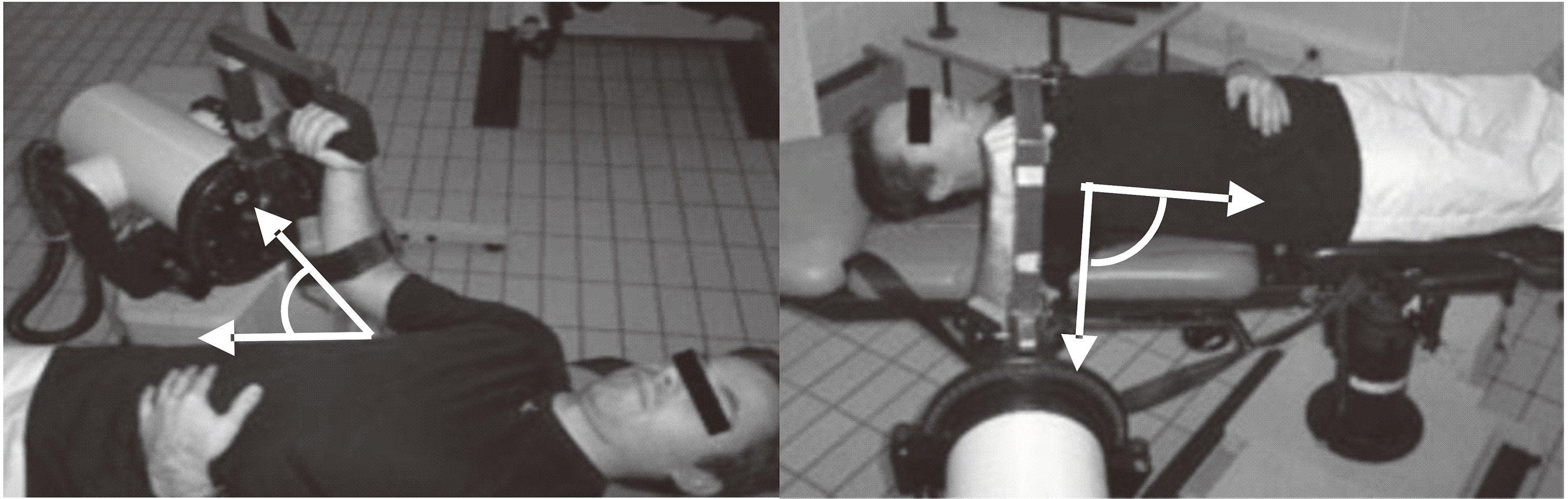
Protocol set up displaying the upper limb abducted at an angle of 45 or 90 respectively in the frontal plane in a supine position.
In addition to the various modalities that have been used to assess fatiguability, many different formulas have been used to quantify fatigue. Measures of work and maximal isometric strength using isokinetic dynamometers are two performance criterion which were associated with high levels of reliability i.e. with ICCs higher than 0.80, when assessing fatigue in the shoulder [12]. However, different fatigue measures have been previously used and described. The most common approach consists of comparing the amount of work done over the last ‘n’ repetitions with the work done at the initial ‘n’ [11, 18, 19]. The reliability of such fatigue indices was moderate to high, with ICC values ranging from 0.66 to 0.81 [11, 12]. However, due to differences in the total number of repetitions used it is hard to compare between findings. Another approach consisted of comparing the total amount of work done with the highest value obtained during the first 3 repetitions. It is important to note that none of these fatigue assessments have ever been used to investigate fatigue in the shoulder muscles. As a result, due to the diversity of assessment protocols and fatigue index formulas used it is very difficult for clinicians to decide what is a reliable and clinically relevant modality to assess the fatigability of shoulder rotator muscles.
Therefore, the primary objective of the present work was to look at the reproducibility of two isokinetic set-ups for assessing shoulder rotators fatigability properties. The second aim was to investigate the clinical implication of data interpretation, if any, when different fatigue calculation formulas are used and establish which formula is the most relevant to assess shoulder rotator fatigue.
Methods
Subjects
Forty sedentary adolescent subjects, 20 males (mean SD: age 23.6 2.3 yrs, height 179.0 7.6 cm and body mass 72.7 10.7 kg) and 20 females (mean SD: age 22 1.8 yrs, height 166 6 cm and body mass 58.7 7.4 kg) were voluntary recruited for this study. The participants were free to live a “normal life” between sessions. They were told to refrain from drinking alcoholic or caffeinated beverages and from training or heavy exertion 4 h prior to each experiment. None of the participants were involved in regular upper arm activities or had a history of upper extremity injuries. All participants gave their written informed consent. The study was conducted with the ethical standards of the journal, complied with the Declaration of Helsinki and was approved by the Ethics Committee of the Faculté de Médecine, Université de Liège.
Research design
All sessions took place under standard laboratory conditions. Before taking part in the main experiment, each participant completed one familiarisation session. This sessions ensured that participants fully familiarised with the experimental conditions required for the study. They were asked to perform as many repetitions required until they felt comfortable performing maximal concentric contractions on the dominant shoulder at a speed of 180/s. Following the familiarisation process, participants were randomly assigned to one of two groups: the “45 group” or the “90 group”, with each group consisting of 10 male and 10 female participants. All participants then completed two identical experimental sessions which took place ten days apart to minimize any learning effect and to exclude any muscle soreness.
The participants were free to live a “normal life” between sessions, sleeping at home at night and attending lectures and doing light office work in the day. They were told to refrain from drinking alcoholic or caffeinated beverages and from other training or heavy exertion for the 48 h before the experiments or during them. During each session, participants were required to perform 30 consecutive maximal concentric contractions on the dominant shoulder IR and ER muscles in a supine position at a speed of 180/s. The upper limb was abducted to an angle of 45 or 90 in frontal plane (see Fig. 1) depending on the group they were assigned to. All measurements were performed by the same investigator using the same dynamometer (Biodex Medical Systems, Shirley, NY, USA). The range of movement was preset on every occasion to mimic the testing conditions; 70 for ER and 50 for IR. All participants confirmed to be comfortable and pain free during both sessions.
Data analysis
The work (in Joule) during each repetition was computed and used to calculate performance individually. Reproducibility was assessed for directly derived parameters (i.e. cumulated performance, maximal performance and several fatigue indexes (). Cumulated performance (C.Perf) was calculated using the total work done during all repetition (). To assess the “optimal” maximal performance (Max.Perf) the best repetition (TWmax) during the test was multiplied with the total number of repetitions (Max.Perf 30*TWmax) and compared to the average.
was calculated using the following formulas in accordance with Bousquet et al. [15]:
considering the overall effort and maximal theoretical effort (C.Perf/Max.Perf)
considering the ratio between the last and first 3 repetitions (3 last/3 first)
considering the ratio between the last 5 and the first 5 repetitions (5 last/5 first)
considering the effort over the last 3 repetitions and maximal theoretical effort (3 last/Max. Perf)
considering the effort over the last 5 repetitions and the maximal theoretical effort (5 last/ Max.Perf)
Statistical analyses
All data were analysed using SPSS V.21 (IBM, Chicago, IL, USA). All data were checked for normality using the Shapiro-Wilk test. Differences between conditions were evaluated using a two-way general linear model with repeated measures. The alpha level of significance was set at 0.05 and values of 0.000 given by the statistical package are shown here as 0.05. In addition, the data were visually inspected by plotting the measurement differences (errors) against the respective means, according to a Bland – Altman plot. When the amount of error increased as the measured values increased, the data were suspected of being heteroscedastic.
Reproducibility of measures was assessed for each position and the clinical relevance investigated for each . Relative reproducibility was obtained using ICC [15]:
Where MSs mean squared subjects, MSe mean squared error, MSt mean squared trials, number of trials and number of subjects.
Absolute reproducibility was quantified using SEM (SEM SD (1-ICC) and MDC. SEM and MDC were presented as a percentage of the mean value of the two sessions (SEM% SEM/mean values; MDC% 1.96 2 SEM%; [NNN].
For clinical relevance we consider the ICC cut off acceptable, if equal or greater than, 0.80 [20, 21]. An ICC 0.75 is considered as good clinical reproducibility [22]. These criteria have previously been used to interpret reproducibility results reported in the literature.
Shoulder rotators performance and fatigue assessed in supine position with arm abducted at 90
Muscle
Parameter
Day 1
Day 2
Difference
ICC
SEM
MDC
group
Mean
STD
Mean
STD
Score
CI 95%
IR
C.Perf
1081.88
413.71
1069.62
422.79
1%
0.99
0.97
1
4%
12%
Max.Perf
1476.45
516.71
1472.00
556.82
0%
0.97
0.93
0.99
6%
16%
3 last/3 first
0.57
0.10
0.58
0.11
2%
0.79
0.47
0.92
8%
23%
5 last/5 first
0.57
0.07
0.57
0.09
0%
0.75
0.37
0.90
8%
23%
C.Perf/Max.Perf
0.73
0.07
0.72
0.06
1%
0.56
0.35
0.82
4%
11%
3 last/Max.Perf
0.05
0.01
0.05
0.01
0%
0.84
0.60
0.94
7%
19%
5 last/Max.Perf
0.09
0.02
0.09
0.02
0%
0.82
0.55
0.93
7%
20%
ER
C.Perf
881.93
333.46
837.29*
344.09
5%
0.98
0.94
0.99
5%
13%
Max.Perf
1241.70
484.51
1182.00*
465.63
5%
0.99
0.95
1
4%
11%
3 last/3 first
0.55
0.08
0.54
0.10
2%
0.83
0.58
0.94
7%
18%
5 last/5 first
0.57
0.07
0.57
0.09
0%
0.85
0.61
0.94
5%
15%
C.Perf/Max.Perf
0.71
0.06
0.71
0.07
0%
0.84
0.59
0.94
5%
14%
3 last/Max.Perf
0.52
0.01
0.52
0.01
0%
0.78
0.42
0.91
8%
21%
5 last/Max.Perf
0.09
0.01
0.09
0.01
0%
0.87
0.67
0.95
5%
15%
Results
The results concerning the shoulder rotators’ performance and fatigue assessment in a supine position with arm abducted at a 90 angle are presented Table 1. A statistically significant difference ( 0.05) in performance measures between trials (5%) was recorded for ER but not for IR ( 0.05). Relative reproducibility of performance was very high for both muscles (ICC 0.97–0.99). Absolute reproducibility remained homogeneous SEM 4–6% while the MDC varied between 11%–16%. When indices were calculated no significant difference was found between trials (0–2%) for any of the muscle groups. Relative reproducibility of was high with ICC values ranging from 0.75–0.87 except for C.perf/Max.Perf for IR (ICC 0.56). Absolute reproducibility remained low (SEM 4% to 8%) for all , while MDC fluctuated from 11% to as high as 23%. The acceptable clinical relevance, ICC 0.8, was reached on 6 occasions. It was deemed good (ICC 0.75) 3 times but was not met (ICC: 0.56) for C.Perf/Max.Perf during IR assessment.
Shoulder rotators performance and fatigue assessed in supine position with arm abducted at 45
Muscle
Parameter
Day 1
Day 2
Difference
ICC
SEM
MDC
group
Mean
STD
Mean
STD
Score
CI 95%
IR
C.Perf
1148.66
569.32
1195.31
585.75
4%
0.98
0.95
0.99
7%
20%
Max.Perf
1529.85
731.07
1573.95
273.35
3%
0.98
0.94
0.99
7%
20%
3 last/3 first
0.63
0.11
0.60
0.13
5%
0.71
0.28
0.88
11%
29%
5 last/5 first
0.65
0.09
0.61
0.11
7%
0.82
0.54
0.93
8%
22%
C.Perf/Max.Perf
0.75
0.06
0.75
0.08
0%
0.70
0.24
0.88
4%
10%
3 last/Max.Perf
0.60
0.01
0.58
0.01
3%
0.69
0.21
0.88
11%
32%
5 last/Max.Perf
0.10
0.02
0.10
0.02
0%
0.83
0.58
0.94
8%
21%
ER
C.Perf
770.36
284.90
752.30
278.98
2%
0.99
0.97
1
4%
11%
Max.Perf
1030.50
388.30
1041.15
386.88
1%
0.99
0.98
1
3%
8%
3 last/3 first
0.62
0.09
0.59
0.11
5%
0.68
0.22
0.87
10%
27%
5 last/5 first
0.63
0.11
0.61
0.11
3%
0.58
0.22
0.83
10%
29%
C.Perf/Max.Perf
0.75
0.03
0.73
0.07
3%
0.80
0.48
0.92
5%
14%
3 last/Max.Perf
0.06
0.01
0.06
0.01
0%
0.74
0.34
0.90
9%
25%
5 last/Max.Perf
0.10
0.01
0.09
0.02
11%
0.57
0.67
0.83
11%
30%
Table 2 presents findings concerning the shoulder rotators performance and fatigue assessment performed in a supine position with the arm abducted at an angle of 45. There inter-trial differences were non-significant (1–4% for IR and ER performances). Similar results as the 90 position were established for the relative reproducibility which was deemed very high for direct parameters, with ICCs of 0.98–0.99, while absolute reproducibility varied slightly more: SEM 4–7% and MDC 8–20%. Inter-trial differences ranges were larger when looking at Fi, ranging from 0 to 11% but these were non-significant ( 0.05). Relative reproducibility was moderate-high, but generally lower than the ones recorded for 90 position. SEM range was wider, 4–11%, and MDC was 10% (C.Perf/Max.Perf for IR) and as high as 32% (3 last/Max.Perf for IR). The clinical relevance, ICC 0.8, was reached during 3 occasions (3 last/Max.Perf for IR and ER and 5 last/5 first for IR) with established results less than “good” (ICC 0.75) for the other 7.
Discussion
The current study investigated the reproducibility of two frequently used set-ups to explore the fatigue performance of shoulder rotators using the isokinetic machine: supine with arm abducted to 90 and supine with arm abducted to 45 in a frontal plane. The reproducibility was expressed as ICC and considered the inter-trials differences, SEM and MDC. Simultaneously, the clinical relevance of different formulas was assessed. The main findings of this study were: 1) the reproducibility of both testing positions is very high based on the performance parameters with 90 being slightly more accurate for IR and 45 being slightly more accurate for ER; 2) estimates the relative and absolute reproducibility of the 90 position with better clinical trustworthiness compared to 45.
The C.Perf and Max.Perf are two performance parameters which have been computed based on the total work done over each concentric repetition. Although peak moment is the preferred measure for isokinetic users, it represents only one point of the moment-angular position curve, the highest one, while total work represents the entire area under the curve. Using one of these two isokinetic measures to assess average performance during a fatigue test does not seem to influence the absolute or relative reproducibility [15]. The 90 arm abduction position has been associated with higher impingement sensation compared to 45 especially in a fatigued state [3]. This finding justifies the significant performance decrease (5%) of ER between the two trials only when arm was abducted to 90 in this study. It is believed that the subjects restrained themselves from such sensation on the second trial by reducing and altering their performance. It is important to note and mention that none of the subjects complained of any pain or delayed onset muscular on the second occasion. Although both positions have been shown to have very high reproducibility with an acceptable clinical relevance (ICC 0.8) for both muscle groups, therapists ought to be conscious of the sensibility each position has in detecting changes in muscle performance in the shoulder rotator muscles. The SEM calculated for IR was lower at 90 than at 45 for both parameters: C.Perf 4% vs 7% and Max.Perf 6% vs 7% while for ER was reversed: C.Perf 5% vs 4% and Max.Perf 4% vs 3%. These differences are minimal showing that both positions are advisable for assessing shoulder rotator muscles performances when using a fatiguing protocol with an isokinetic machine. In a clinical practice such set-ups are used to determine whether a true change occurred after an intervention which is why MDC provides more useful information. Therefore, when using the 90 position, a change in C.Perf higher than 12% for IR or 13% for ER can be interpreted as a real variation. The present set-up and protocol has a better accuracy than the one used by Roy et al. [12] where C.Perf had a general SEM of 12% for IR and 15% for ER. In order to avoid any possible discomfort or apprehension sensation during the assessment it is recommended to use the 45 position considering that a real change occurs only if the C.Perf varies with more than 20% for IR and 11% for ER.
Therefore, we can affirm that a lying position is a suitable and reliable option for assessing shoulder rotators fatigue irrespective of whether the arm abduction amounts to 45 or 90. Both provide comfortable positions and offer good support by limiting the compensatory movements as they offer an unrestricted range of movement while the gravitational forces are equally distributed either side of starting position (vertical). Furthermore, during concentric assessments, the performance for both IR and ER is enhanced. This is not the case when a seating position is adopted as ER is working against the gravity [16]. As a result, the choice of arm spatial orientation should not be done only based on the evidence of reproducibility. It is important that it reflects the usefulness of revealed information in practice. In addition, clinicians should be aware of the possible alterations in muscles dimension (i.e teres minor and infraspinatus) when the arm is abducted at 45 or 90 in frontal plane [16].
The parameter intends to measure the amount of induced fatigue (strength loss) during an assessment or to estimate the theoretical fatigue as a ratio between the present performance and the maximal theoretical performance based on the best repetition. Induced fatigue as calculated by considers the last “n” repetitions and compares them with the repetitions performed at the beginning of the test. Such was reported to have moderate to high reproducibility for shoulder assessments. Dale et al. [11] found an ICC of 0.66 to 0.81 and Roy et al. [12] an ICC of 0.78 to 0.84. Our findings suggest had a high reproducibility for the 90 position (IR: ICC of 0.75–0.79; ER: ICC of 0.83–0.85) and a moderate (ER: ICC 0.58–0.68) to high (IR: ICC of 0.71–0.82) reproducibility for the 45 position. Similar concepts have been used to calculate , but results should be compared with precaution. It is important to be aware of the differences within the assessment protocols currently in the literature. Dale et al. [11] used a fast speed, 300/s, and only 12 maximal continuous concentric repetitions in seated position, while Roy et al. [12] used 60 repetitions, with a resistance of only 50% of maximal voluntary isometric contraction (MVIC) at an uncontrolled speed higher than 60/s in a standing position. The current assessment included 30 repetitions at a speed of 180/s with participants in a lying-supine position. Our results indicate no clinical differences between when using 3 or 5 repetitions for calculation purposes when establishing the amount of induced fatigue. Both s showed a good clinical reproducibility for IR and ER with findings of ICC 0.75 and 0.79 (ICC of 0.83 and 0.85), respectively, when assessed on 90 position. These findings are acceptable. The absolute reproducibility was found to be similar with results displaying 8% SEM for IR and 7% for ER. To use this in a practical setting, an MDC of more than 23% must be considered as real change for IR while for ER it should be greater than 15%. Our results showed that for the 45 position, accuracy was lower with higher SEM (8–11%) and MDC (22–29%). These are below the values reported before [12] namely SEM of 13% for IR and 12% for ER. Thus, based on the reproducibility results observed within this study it is important to take precaution when interpreting the amount of fatigue of ER when assessed at 45.
The theoretical fatigue ratios have never been calculated before for shoulder muscles. Our results need to be considered with precaution due the involved population being upper limb sedentary. They have wide range of reliabilities for both positions being highly muscle dependent. Every single have at least one data point with ICC 0.7 which represent poor clinical reproducibility. Investigating the clinical relevance of such in a sedentary population during repeated maximal reciprocal concentric contractions might not be the most adequate approach. The muscular performance (i.e. fatigue) is adapted to the specificity of performed activities. Therefore, when using a non-athletic population which is not used to repetitive maximal IR-ER contraction the current assessment modality might not be the most suitable one. The applicability of shoulder rotators fatigue assessment in upper limb sedentary population can be questioned. Therefore, similar investigations are required to be performed on an overhead athletic population, where due to the task specificity, it has a better relevance and the results could be used in clinical setting.
Conclusions
In summary, both set-ups demonstrated very high reproducibility for assessing fatigue performance of shoulder rotator muscles. We found no clinical difference between formulas using 3 or 5 repetitions for calculation of the amount of induced fatigue. The estimation of theoretical fatigue in a sedentary population might not be relevant. The choice of position and should be aligned with the scope of the clinician and practice but should not exclude the C.Perf and Max.Perf. If there are any suspicions of possible discomfort or apprehension sensation during the assessment we recommend the use of 45 instead of 90 arm abduction. Results should be interpreted with precaution for ER muscles when using 45.
Footnotes
Acknowledgments
We would like to thank all who participated in the study.
Conflict of interest
None to report.
References
1.
QinJLinJHFaberGSBuchholzBXuX. Upper extremity kinematic and kinetic adaptations during a fatiguing repetitive task. J Electromyogr Kinesiol.2014; 24(3): 404-411. doi: 10.1016/j.jelekin.2014.02.001.
2.
RotaSMorelBSaboulDRogowskiIHautierC. Influence of fatigue on upper limb muscle activity and performance in tennis. J Electromyogr Kinesiol.2014; 24(1): 90-97. doi: 10.1016/j.jelekin.2013.10.007.
3.
ChoppJNO’NeillJMHurleyKDickersonCR. Superior humeral head migration occurs after a protocol designed to fatigue the rotator cuff: a radiographic analysis. J Shoulder Elbow Surg.2010; 19(8): 1137-1144. doi: 10.1016/j.jse.2010.03.017.
4.
CodinePBernardPLPocholleMHerissonC. Isokinetic strength measurement and training of the shoulder: methodology and results. Ann Readapt Med Phys.2005; 48(2): 80-92. doi: 10.1016/j.annrmp.2004.07.002.
5.
EllenbeckerTSDaviesGJ. The application of isokinetics in testing and rehabilitation of the shoulder complex. J Athl Train.2000; 35(3): 338-350.
6.
ForthommeBCroisierJLCiccaroneGCrielaardJMCloesM. Factors correlated with volleyball spike velocity. Am J Sports Med.2005; 33(10): 1513-1519. doi: 10.1177/0363546505274935.
7.
NitschkeJE. Reliability of isokinetic moment measurements: A review of the literature. Aust J Physiother.1992; 38(2): 125-134. doi: 10.1016/s0004-9514(14)60557-2.
8.
CarpenterJEBlasierRBPellizzonGG. The effects of muscle fatigue on shoulder joint position sense. Am J Sports Med.1998; 26(2): 262-265.
9.
EdouardPCodinePSamozinoPBernardPLHerissonCGremeauxV. Reliability of shoulder rotators isokinetic strength imbalance measured using the Biodex dynamometer. J Sci Med Sport.2013; 16(2): 162-165. doi: 10.1016/j.jsams.2012.01.007.
10.
IidaNKanekoFAokiNShibataE. The effect of fatigued internal rotator and external rotator muscles of the shoulder on the shoulder position sense. J Electromyogr Kinesiol.2014; 24(1): 72-77. doi: 10.1016/j.jelekin.2013.10.008.
11.
DaleRBKovaleskiJEOgletreeTHeitmanRJNorrellPM. The effects of repetitive overhead throwing on shoulder rotator isokinetic work fatigue. North American Journal of Sports Physical Therapy.2007; 2(2): 74.
12.
RoyJSMaBMacdermidJCWoodhouseLJ. Shoulder muscle endurance: the development of a standardized and reliable protocol. Sports Med Arthrosc Rehabil Ther Technol.2011; 3(1): 1. doi: 10.1186/1758-2555-3-1.
13.
WeirJP. Quantifying test-retest reliability using the intraclass correlation coefficient and the SEM. J Strength Cond Res.2005; 19(1): 231-240. doi: 10.1519/15184.1.
14.
BartlettJWFrostC. Reliability, repeatability and reproducibility: analysis of measurement errors in continuous variables. Ultrasound Obstet Gynecol.2008; 31(4): 466-475. doi: 10.1002/uog.5256.
15.
BosquetLMaquetDForthommeBNowakNLehanceCCroisierJL. Effect of the lengthening of the protocol on the reliability of muscle fatigue indicators. Int J Sports Med.2010; 31(2): 82-88. doi: 10.1055/s-0029-1243168.
16.
ForthommeBDvirZCrielaardJMCroisierJL. Isokinetic assessment of the shoulder rotators: a study of optimal test position. Clin Physiol Funct Imaging.2011; 31(3): 227-232. doi: 10.1111/j.1475-097X.2010.01005.x.
17.
Tis Maxwell 1996.
18.
EllenbeckerTSRoetertEP. Testing isokinetic muscular fatigue of shoulder internal and external rotation in elite junior tennis players. J Orthop Sports Phys Ther.1999; 29(5): 275-281. doi: 10.2519/jospt.1999.29.5.275.
19.
MullaneyMJMcHughMP. Concentric and eccentric muscle fatigue of the shoulder rotators. Int J Sports Med.2006; 27(9): 725-729. doi: 10.1055/s-2005-872870.
20.
CurrierDP. Elements of research in physical therapy (2nd ed). Baltimore:: Williams & Wilkins, 1990.
21.
SaenzA et al., Knee isokinetic test-retest: a multicentre knee isokinetic test-retest study of a fatigue protocol. Eur J Phys Rehabil Med.2010; 46(1): 81-88.
22.
LeslieGPWatkinsM. P. Foundations of Clinical Research: Applications to Practice (3rd ed). Upper Slade River, N.J.: Prentice Hall, 2008.