The maintenance of maximal aerobic speed (MAS) until exhaustion is an important parameter for the evaluation of sports performance and prescription and planning of training.
OBJECTIVE:
To validate a 6-minute race test (6MRT) as a predictor of MAS in university endurance athletes.
METHODS:
Twenty two university endurance athletes (12 males and 10 females) were part of the study. The design was pre-experimental. The primary variables were the time of maintenance of the MAS on the field through a Time Limit Test (Tlim test), and the VO max (laboratory and field). The statistical analysis of the time and ventilatory variables was carried out using descriptive statistics; the comparison between males and females for all variables was carried out through a t-Student test for independent samples ( 0.05).
RESULTS:
The performance in the Tlim test was 356.4 52.9 and 327.0 120.2 s in males and females, respectively.
CONCLUSION:
Based on the time of maintenance of the MAS (Tlim test), the 6MRT is a valid test to determine the MAS in university endurance male athletes. However, the MAS in university endurance female athletes must be evaluated with a shorter test (between 5 and 5.30 minutes long).
Several factors influence the sports performance of athletes who train for endurance, including the environmental situation, training, and their biomechanical, psychological, and physiological state [1]. Valid tests are necessary to evaluate physical performance, associated with capacity and progress during the cycles of training [2].
Responding to this need, during the last years, several tests have been designed and validated to measure determinant physiological parameters for the endurance running performance [3]; the main parameters are the lactate threshold (LT), the running economy (RE) and the maximum oxygen uptake (VO max) [4].
VO max, directly assessed, is considered the gold standard to physical performance when associated with endurance race [5]. This parameter indicates the functional capacity and aerobic power of individuals [2]. VO max integrates the responses of the pulmonary, cardiovascular, and muscular systems; an optimum integration of systems will evidence an optimum capture, transport, and use of oxygen (O) [6]. The achievement of VO max is evidenced from a plateau [6] in the kinetics of this variable, which is considered the maximal aerobic speed (MAS) and corresponds to the minimum speed at which the VO max is reached [7]. The MAS seems to be a superior predictor of VO max since it is a variable that allows prescribing, more accurately, training plans inside the aerobic-anaerobic transition zones [8]. Also, the maintenance of MAS to the point of exhaustion, defined as the time limit (Tlim) [7], is a fundamental element in the prescription and the planning of training [9].
As mentioned before, the direct measure of VO max and MAS, through an incremental exercise test, is considered the gold standard indicator to quantify cardiorespiratory fitness [6]. However, this assessment has disadvantages since it is almost impossible to exactly reproduce the original environment of sports training [10]. A second disadvantage is these tests require special resources [8] such as time, equipment, and evaluators who must be specially trained in the gas analysis [11].
These disadvantages have led to the design and validation of field test protocols that indirectly measure and evaluate VO max and MAS, compromising fewer amounts of resources [8, 12]. These measures should estimate the physiological parameters that are determinant for endurance runners [2], which are fundamental for prescription training plans inside the aerobic-anaerobic transition zones [8]. In this context, some field tests reliably estimate the VO max and the MAS [12, 13, 14, 15]. The University of Montreal Track Test stands out in the academic literature; it allows us to estimate VO max by using an incremental-continuous maximal protocol until fatigue [13]. The Course Navette test is one of the most commonly applied tests due to its ease of preparation; it also estimates VO max and MAS using an incremental and maximum protocol of 20 meters that lasts until fatigue [14, 15]. However, and due to the specifications of the races in athletic tracks, it is essential to use a linear protocol in the evaluation for endurance athletes to reach VO max and MAS [15]. Considering the previous idea and the good correlation between VO max and the cardiovascular fitness of individuals [16], the 12-minute test (12-min-T) has been used by coaches for the indirect estimation of VO max [11]. Unfortunately, the 12-min-T lacks reliability in athletes [16], demonstrating an underestimation of the direct values obtained through ergo spirometry in endurance runners [17]. Likewise, the 6MRT has been used in very specific samples which does not allow to generalize results concerning the whole athletic population [12].
Considering the background information that suggests the use of a 6-minute race test (6MRT) to estimate the VO max in subjects with oxygen consumption equivalent to 58.3 2.9 mL0Kgmin [12], and whose MAS may be obtained through direct tests [10, 18] or tests on the field [11, 15], the main objective of this study was to validate a 6-minute race test (6MRT) as a predictor of MAS in university endurance athletes, through the Tlim test. The second objective was to compare the performance between males and females in laboratory tests, as well as in tests on the field.
Methods
Participants
The sample consisted of 22 university endurance athletes, 12 men and 10 women (personal data, Table 1) who have volunteered to take part in the study. All participants and coaches were informed of the study objectives and the possible risks of the experiment before the application of the protocol. At the same time, all the subjects signed informed consent. Both, the study protocol and the informed consent were approved by the Ethics Committee in Human Research of the University of Granada, Spain (Register 493/CEIH/2018). The investigators followed the principles outlined in the Declaration of Helsinki.
Characteristics of the sample (mean SD)
All ( 22)
Males ( 12)
Females ( 10)
Age (years)
24.2
4.4
24.3
4.0
24.0
5.4
Weight (Kg)
60.5
8.4
65.2
5.0
55
8.6
Height (cm)
167.4
8.4
173.2
4.4
160.4
6.5
IMC (kgm)
21.5
1.3
21.7
1.0
21.3
1.7
Body fat (%)
16.8
7.7
10.5
2.1
24.4
3.2
VO max (mLOKgmin)
56.9
9.0
63.3
5.8
49.2
5.0
MAS (ms)
5.10
0.58
5.54
0.24
4.57
0.34
SD (standard deviation); BMI (Body Mass Index); VO max (maximal oxygen uptake); MAS (maximal aerobic speed); kg (kilogram); cm (centimeters); kgm (kilogram per square meters); % (percent); mLOKgmin (milliliters of oxygen per kilogram per minute); ms (meters per second).
Experimental design and instruments
Pre-study laboratory tests were performed for the evaluation of VO max and, subsequently, a Tlim test on the field. The criterion for inclusion was athletes with a minimum of three years of training and competing in running events from 800 to 10,000 m. The exclusion criterion was the inability to execute the Tlim test, either by running at a lower or higher speed than the theoretical MAS, which is obtained from the direct measure of VO max on the treadmill.
The sample was characterized through an evaluation of weight, height, BMI, and body fat percentage. Four skinfolds were recorded (triceps, subscapular, supraspinal and biceps) for the evaluation of the percentage of body fat [19], using the Gaucho Pro “Mercosur” Kit (manufactured in Buenos Aires, Argentina, under license from Rosscraft, Vancouver, Canada).
The evaluation of VO max and the Tlim test, both involved standardized warm-up. This warm-up consisted of 10 minutes of jogging (at 8 kmh for women and 10 kmh for men) and then 5 min of ballistic movements of the lower extremity (hip adductions, abductions, flexion and extension, and knee and ankle flexion and extension). In the end, the athletes performed three accelerations of 80 m.
VO max and MAS evaluations in the laboratory
To determine the VO max and MAS, we used an ergo spirometer and an incremental treadmill test [20]. All respiratory variables were measured using automatic gas analyzer systems CORTEX model MetaMax3B (Leipzig, Germany). Before the tests, the analyzers and their respective software were calibrated strictly following the manufacturers’ recommendations. The data was processed through a laptop computer that calculated the results using a software developed by the manufacturer. All athletes started the experimental protocol with a standardized 10-minute warm-up and then performed the traditional VO max test [20]. The VO max test started at an intensity of 10 km/h for women and 12 km/h for men, gradually increasing by 1 km/h at intervals of two minutes until exhaustion, for both sexes. The inclination used in the treadmill for all measurements was 2%. The individual MAS obtained in the laboratory was later used for the Tlim test. Heart rate data was monitored using a Polar S410 heart rate monitor (Kempele, Finlandia), synchronized with the software of the gas analyzer systems.
Experimental protocol
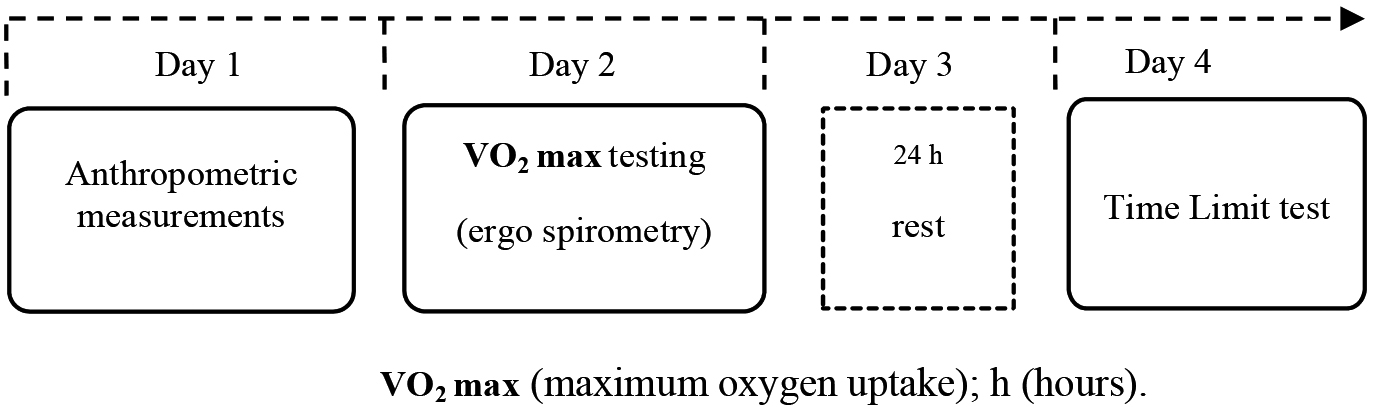
The study took place over a week. Before the tests, the participants were asked not to ingest caffeine, energy supplements, or any substance that may increase their metabolism (since 48 h before Day 1 and throughout the week of intervention). On Day 1, the subjects signed the informed consent and participated in the anthropometric evaluations. On Day 2, the incremental treadmill test was applied for the entire sample to determine VO max and MAS. On Day 3, the athletes were instructed to rest. Finally, the Tlim test on the field was applied on Day 4 (Fig. 1).
Methodological design for the application of the time limit test.
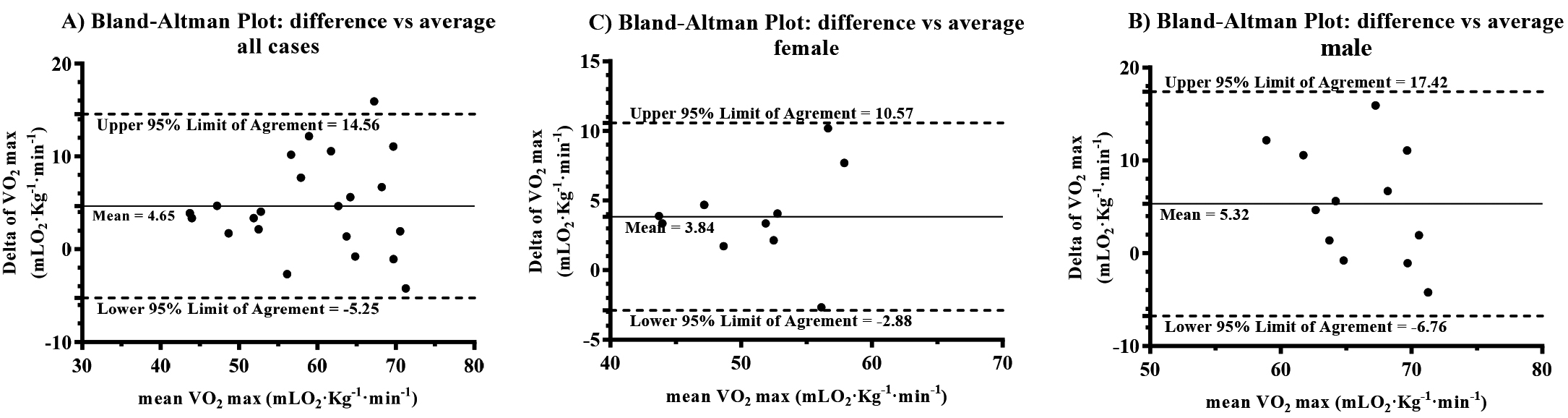
The solid line represents the average of the differences between the VO max evaluated in the laboratory (treadmill) and on the field (time limit test). The segmented lines represent 95% of the upper and lower confidence limits.
Tlim test on the field
To determine the time of MAS that athletes were able to maintain in a 400 m athletic track, they were requested to perform a Tlim test using the MAS obtained in the laboratory until fatigue (defined by the inability to maintain that precise velocity); the measure of performance was the time in seconds (s) of the Tlim [21]. This Tlim test then served to validate the 6MRT test as a predictor of the MAS in this population. Ventilatory variables during the execution of the Tlim test were monitored using an automatic gas analyzer CORTEX model MetaMax 3B (Leipzig, Germany).
Sound markers were used every 100 m to control the speed of movement on the 400 m athletic track. When the athletes did not reach the 100 m mark in the required time for the second consecutive time, the test was considered completed. The performance variables used in this study were time, distance, lactate concentrations ([La]), heart rate (HR), rating of perceived exertion (RPE), and ventilatory parameters at the end of the Tlim test. Besides, the HR and [La] of recovery were also considered as performance variables. In the Tlim test, the final time was registered in seconds (s), the traveled distance in meters (m), and RPE through the modified Borg scale (1 to 10) [22]. The concentrations of capillary lactate (mmolL) and the heart rate (HR) were also evaluated after recovery effort in minutes 1, 3, 5, 7, and 9. To obtain the [La] in capillary blood, a lactometer h/p/cosmos (Nußdorf, Germany), was used.
Nutritional control
To standardize the pre-workout meal, which consisted of 2 grams of simple carbohydrates per kilogram of body weight, all athletes were requested to arrive two hours before the Tlim test under fasting conditions. Then the carbohydrate load was given to the athletes before the test (nutritional timing) [23].
Statistical analysis
All the data were analyzed using SPSS version 19. The normal distribution of the results was determined with the Shapiro-Wilk test. The difference between males and females, in all variables, was calculated using a t-Student test for independent samples. A comparison of the mean values of laboratory VO max (Treadmill) and VO max (in the Tlim test) was carried out using a quantitative analysis of concordance, specifically the Bland-Altman technique. The level of significance was set at 0.05.
Results
Only the Ventilatory Threshold (VT) and the time obtained in the Tlim test on the field evidenced significant inter-gender differences ( 0.05). The VT was 2.50 0.16 and 1.81 0.28 L for men and women, respectively. Also, the time taken in the Tlim test was 356.4 52.9 and 327.0 120.2 s, respectively. The results of the evaluations of VO max in the laboratory (Treadmill) and the Tlim test in the field are both reported in Table 2.
Upon comparison of the mean values and the differences of the VO max in the laboratory (Treadmill) and the VO max in the field (Tlim test), a Bland-Altman analysis, showed a common bias of 4.65 5.06 mLOKgmin (95% limits of agreement from 5.25 to 14.56; 0.001) for 22 cases (Fig. 2A). For men the bias was 5.32 6.17 mLOKgmin (95% limits of agreement from 6.76 to 17.42; 0.05) (Fig. 2B) while for women it was 3.84 3.43 mLOKgmin (95% limits of agreement from 2.88 to 10.57; 0.01) (Fig. 2C).
Maximal oxygen uptake ratios on a treadmill and physiological parameters in the Tlim test
Variables
Units
Mean SD all (22)
Min
Max
Confidence interval
Mean SD males (12)
Min
Max
Confidence interval
Mean SD females (10)
Min
Max
Confidence interval
Lower
Upper
Lower
Upper
Lower
Upper
VO max (Lab)
LOmin
3.46
0.8
2.31
4.54
3.13
3.8
4.11
0.33
3.36
4.54
3.92
4.3
2.68
0.34
2.31
3.4
2.47
2.89
VO max (Lab)
mlOminkg
56.9
9.0
41.7
73.3
53.1
60.7
63.3
5.8
52.8
73.3
60.0
66.7
49.2
5.0
41.7
57.4
46.0
52.3
MAS (Lab)
ms
5.1
0.56
4.16
5.94
4.87
5.34
5.54
0.23
5.35
5.94
5.41
5.67
4.57
0.31
4.16
5.05
4.37
4.77
VO max (Tlim)
LOmin
3.75
0.89
2.56
5.31
3.38
4.12
4.47
0.44
3.97
5.31
4.22
4.72
2.88
0.29
2.56
3.25
2.7
3.07
VO max (Tlim)
mLOminkg
61.6
9.2
45.6
75.2
57.7
65.4
68.7
3.9
64.4
75.2
66.4
70.9
53.05
5.6
45.6
61.7
49.5
56.5
V’E/V’O (Tlim)
41.3
17.9
31.7
110.9
33.8
48.8
38.5
12.1
31.7
76.4
31.6
45.4
44.7
23.3
34.9
110.9
30.3
59.2
V’E/V’CO (Tlim)
40.1
19.4
29.4
113.7
32.0
48.2
37.3
14.2
29.4
81.8
29.2
45.4
43.5
24.7
34.1
113.7
28.1
58.8
RER (Tlim)
1.05
0.02
1.01
1.10
1.04
1.06
1.05
0.02
1.01
1.10
1.04
1.07
1.05
0.02
1.01
1.10
1.03
1.07
V’E (Tlim)
Lmin
130.4
26.4
91.5
181.7
119.3
141.5
151.4
13.3
130.6
181.7
143.8
159.0
105.2
10.9
91.5
127.5
98.4
111.9
VT (Tlim)
L
2.19
0.41
1.49
2.76
2.01
2.36
2.50
0.16
2.26
2.76
2.41
2.59
1.81
0.28
1.49
2.19
1.64
1.99
RR (Tlim)
breathsmin
59.2
5.5
49.0
71.2
56.9
61.6
60.1
4.3
53.2
68.3
57.6
62.6
58.2
6.8
49.0
71.2
53.9
62.4
Glycemia (pre-effort)
mgdL
115.7
12.3
90
149
110.5
120.8
115.0
8.4
99
129
110.3
119.8
116.5
16.2
90
149
106.4
126.5
Distance
(m)
1735.4
451
800
2400
1546.6
1924.2
1955.0
278
1400
2400
1797.3
2112.6
1472
490.1
800
2300
1168.1
1775.8
Time (Tlim)*
(s)
343.0
88.8
168
516
305.9
380.1
356.4
52.9
264
449
326.4
386.3
327.0
120.2
168
516
252.4
401.5
RPE (Tlim)
8.04
0.9
6
10
7.64
8.44
8.00
1.1
6
10
7.36
8.63
8.10
0.7
7
9
7.64
8.55
[La] Rep
(mmolL
2.3
0.6
1.1
3.6
2.0
2.5
2.4
0.6
1.1
3.6
2.0
2.8
2.1
0.6
1.2
3.1
1.7
2.5
[La] min 1
(mmolL
14.6
3.1
8.7
21.2
13.3
15.9
14.3
3.7
8.7
21.2
12.2
16.4
14.9
2.5
11.9
18.5
13.4
16.5
[La] min 3
(mmolL
14.8
3.6
7.7
21.3
13.3
16.4
14.9
4.1
7.7
21.3
12.5
17.2
14.8
3.0
9.6
18.3
12.9
16.7
[La] min 5
(mmolL
14.3
3.0
7.4
20.2
13.0
15.6
14.3
3.5
7.4
20.2
12.3
16.3
14.2
2.6
9.7
16.8
12.5
15.8
[La] min 7
(mmolL
13.4
3.7
7.3
21.7
11.9
15.0
14.3
4.3
7.3
21.7
11.9
16.8
12.3
2.6
8.2
15.8
10.7
14.0
[La] min 9
(mmolL
12.7
3.3
7.5
18.8
11.3
14.1
13.5
3.5
7.5
18.8
11.5
15.5
11.8
2.8
8.3
16.6
10.1
13.6
HR final
(bpm)
180.9
10.7
156
197
176.4
185.4
184.0
9.1
170
197
178.8
189.2
177.1
11.7
156
196
169.8
184.3
HR min 1
(bpm)
141.3
32.1
14.5
174
127.9
154.7
128.8
38.4
14.5
156
107.0
150.6
156.3
12.0
143
174
148.8
163.7
HR min 3
(bpm)
116.1
27.0
12.6
147
104.7
127.4
108.3
32.3
12.6
139
89.9
126.6
125.5
15.9
100
147
115.6
135.3
HR min 5
(bpm)
106.9
24.8
12.4
131
96.5
117.3
102.0
30.9
12.4
128
84.5
119.5
112.9
14.2
90
131
104.0
121.7
HR min 7
(bpm)
111.8
13.7
91
137
106.1
117.6
110.3
12.2
93
130
103.3
117.2
113.7
15.8
91
137
103.8
123.5
HR min 9
(bpm)
112.7
12.1
96
139
107.6
117.8
110.5
10.7
97
127
104.3
116.6
115.4
13.8
96
139
106.8
123.9
SD (standard deviation); Min (minimum); Max (maximum); VO max (maximal oxygen uptake); Lab (Laboratory); LOmin (liters of oxygen per minute); mLOminkg (milliliters of oxygen per kilogram per minute); Tlim (Time Limit test); MAS (maximal aerobic speed); ms (meters per second); V’E/V’O2 (relation pulmonary ventilation and oxygen consumption); V’E/V’CO2 (relation pulmonary ventilation and generation of carbon dioxide); RER (ratio between the amount of carbon dioxide produced in metabolism and oxygen used); V’E (pulmonary ventilation); VT (Ventilatory Threshold); RR (respiratory rate); Lmin (liters per minute); L (liters); breathsmin (breaths per minute); mgdL (milligrams per deciliter); m (meters); s (seconds); [La] (Lactate concentrations); RPE (rating of perceived exertion); mmolL (millimoles per liter); HR (heart rate); bpm (beats per minute); ( 0.05) between males and females.
Discussion
Concerning the main objective of the study, the derived values of Tlim validated the 6MRT as a predictor of MAS in university endurance athletes, congruent with the theoretical parameters of time described for MAS in previous studies (208–690 s) [18]. Recent investigations with similar samples reported higher means (404 s [24] and 422 s [9]), but these investigations were carried out under laboratory conditions (possibly involving lower or even no air resistance), potentially resulting in lower energy costs [25] and hence a longer time of execution [26]. On the other hand, Blondel et al. [27] applied a Tlim test in the field with physically active university students ( 10), ultimately reporting mean values of 357 s. Similarly, Boullosa and Tuimil [28] evaluated the performance of 16 medium- and long-distance runners through a Tlim test, reporting average performance of 342 88.6 s. Thus, these investigations presented similar results to those reported in the present study [27, 28]; however, the contributions of this research were direct evaluations of ventilatory parameters in the field (400 m athletic track) and the specificity of the selected sample (endurance university athletes).
When comparing the results of the Tlim test between men and women, the superior performance was observed in the former ( 0.05). This inter-gender difference may have been associated with the higher VO max values presented by men (63.3 5.8 and 49.2 5.0 mLOkgmin for men and women, respectively) [9]. Several studies have compared differences in Tlim testing by sex [29, 30, 31]. For instance, Marques de Azevedo et al. [29] demonstrated greater performance in healthy men on a Tlim test (308 84.3 and 285 51.1 s in men and women, respectively). Similarly, García et al. [30] reported higher values in men in the Tlim test (385.0 99.3 and 351.0 79.6 s in men and women, respectively). However, Billat et al. [31] reported lower values in men during an in-lab Tlim test (357 118 and 421 129 s in men and women, respectively). Without considering the report made by Billat et al. [31], the results of Tlim tests seem to depend on the sex and the type of sample. Performance evaluations through this type of test also allow more precise training plans to be prescribed, and the information obtained enables multiple aspects of a race to be monitored, such as the athlete’s performance level, VO max per se, lactate tolerance and ER [32].
On the other hand, in the Tlim test of the present study, the average ratio between the amount of carbon dioxide produced in the metabolism and the oxygen used (RER) was 1.05. Theoretically, this value suggests glycolytic predominance and high lactate production [33]. It also indicates that carbohydrate oxidation was the main source of energy in the Tlim test; due to the intensity of the test (MAS), excess CO was generated, resulting in an RER greater than 1.0 [9]. RER above 1.0 may be associated with increased in [La] in the Tlim test, as the values in this study exceeded 8 mmolL [4, 9]. It has been verified in previous research that the determination of RER, lactate production and the absence of a plateau can ratify the VO max, MAS, and the reliability of the Tlim test in the field [33]. Consequently, these values ensure that the participants reached the maximum levels in the Tlim test.
Comparing the results of the laboratory and the VO max field tests, the gas analysis showed significant differences in favor of the latter ( 0.001 for 22 cases, 0.05 for men and 0.01 for women). However, despite the evidence, the findings were ambiguous when comparing both methods of measuring VO max [34, 35, 36, 37]. Mooses et al. [36] found differences in favor of laboratory evaluation (68.5 5.3 and 71.4 6.4 mLOminkg in the field and the laboratory, respectively, 0.105), whereas Schram et al. [37] evidenced higher values for evaluation in the field than in the laboratory (5.28%, 0.03). A third study by Floriano et al. [35] revealed a higher VO max in the field than in the laboratory (Tlim test: 51.1 4.7 and 49.6 4.7 mLOminkg, respectively, 0.10). The results of most previous studies have shown higher VO max evaluations in the field than in the laboratory. We recommend evaluating the same conditions of training and competition (outside the laboratory) for prescribing and training planning [10]. Indeed, discrepant assessment results between running on athletic tracks and treadmills can be caused by differences in air currents, ground surfaces, and movement patterns [26]. Finally, coaches should consider differences between the assessment of VO max in the field and the laboratory, as this variable can affect the reliability of training loads.
Conclusion
In conclusion, based on the performance of the Tlim test in the field, the 6MRT is a valid test for determining MAS in male college endurance athletes. By contrast, MAS in female college endurance athletes should be evaluated with a shorter test (between 5 and 5.30 minutes).
Author contributions
CONCEPTION: Álvaro H. Ojeda and Sergio A.G. Maliqueo.
PERFORMANCE OF WORK: Álvaro H. Ojeda, Sergio A.G. Maliqueo, Juan I.P. Pizarro and Rodrigo F. Kloss.
INTERPRETATION OR ANALYSIS OF DATA: Álvaro H. Ojeda.
PREPARATION OF THE MANUSCRIPT: Álvaro H. Ojeda and Juan I.P. Pizarro.
REVISION FOR IMPORTANT INTELLECTUAL CONTENT: Álvaro H. Ojeda, Sergio A.G. Maliqueo and Rodrigo F. Kloss.
SUPERVISION: Álvaro H. Ojeda and Rodrigo F. Kloss.
Ethical considerations
Both the study protocol and the informed consent were approved by the Ethics Committee in Human Research of the University of Granada, Spain (Register 493/CEIH/2018). The investigators followed the principles outlined in the Declaration of Helsinki.
Funding
The authors report no funding.
Footnotes
Acknowledgments
We acknowledge the contribution of Dr. María Mercedes Yeomans Cabrera to the revision and edition of this article in English.
Conflict of interest
The authors declare no conflict of interest.
References
1.
Ogueta-AldayAGarcía-LópezJ. Factores que afectan al rendimiento en carreras de fondo Factors affecting long-distance running performance. Rev Int Cienc Deporte. 2016; 45(12): 278–308.
2.
SartorFVernilloGDe MorreeHMBonomiAGLa TorreAKubisHP, et al. Estimation of maximal oxygen uptake via submaximal exercise testing in sports, clinical, and home settings. Sport Med. 2013; 43(9): 865–73.
3.
McLaughlinJEHowleyETBassettDRThompsonDLFitzhughEC. Test of the classic model for predicting endurance running performance. Med Sci Sports Exerc. 2010; 42(5): 991–7.
PooleDCWilkersonDPJonesAM. Validity of criteria for establishing maximal O2uptake during ramp exercise tests. Eur J Appl Physiol. 2008; 102(4): 403–10.
6.
PooleDCJonesAM. Measurement of the maximum oxygen uptake VO2 max: VO2 peak is no longer acceptable. J Appl Physiol. 2017; 122(4): 997–1002.
7.
BillatVKoralszteinP. Significance of the velocity at VO2 max and time to exhaustion at this velocity. Sport Med. 1996; 22(2): 90–108.
8.
GarcíaGCSecchiJDArcuriCR. Comparación de las velocidades alcanzadas entre dos test de campo de similares características: VAM-EVAL y UMTT. Rev Andaluza Med Deporte [Internet]. 2014; 7(4): 143–8. Available from: www.elsevier.es/ramd.
9.
BertuzziRBuenoSPasquaLAcquestaFBatistaMRoschelH, et al. Bioenergetics and neuromuscular determinants of the time to exhaustion at velocity corresponding to Vo2 max in recreational long-distance runners. J Strenght Cond Res. 2012; 26(8): 2096–102.
10.
DeSouzaKMDeLucasRDGrosslTCostaVPGuglielmoLADenadaiBS. Performance prediction of endurance runners through laboratory and track tests. Rev Bras Cineantropometria e Desempenho Hum [Internet]. 2014; 16(4): 465–74. Available from: doi: 10.5007/1980-0037.2014v16n4p465.
11.
Mayorga-VegaDBocanegra-ParrillaROrnelasMVicianaJ. Criterion-related validity of the distance- and time-based walk/run field tests for estimating cardiorespiratory fitness: A systematic review and meta-analysis. PLoS One. 2016; 11(3): 1–24.
12.
OjedaÁHMaliqueoSGSerranoPC. Validación del test de 6 minutos de carrera como predictor del consumo máximo de oxígeno en el personal naval. Rev Cuba Med Mil. 2017; 46(4): 1–11.
13.
LégerLAMercierDGadouryCLambertJ. The multistage 20 metre shuttle run test for aerobic fitness. J Sports Sci. 1988; 6(2): 93–101.
14.
LégerLBoucherR. An indirect continuous running multistage field test: The Université de Montréal track test. Can J Appl Sport Sci [Internet]. 1980; 5(2): 77–84. Available from: http://www.ncbi.nlm.nih.gov/pubmed/7389053.
15.
GarcíaGCSecchiJD. Test course navette de 20 metros con etapas de un minuto. Una idea original que perdura hace 30 años. Apunts Medicina de l’Esport. 2014; 49: 93–103.
16.
Alvero-CruzJRGiráldez GarcíaMACarneroEA. Reliability and accuracy of Cooper’s test in male long distance runners. Rev Andaluza Med Deporte [Internet]. 2016; 10(2): 60–3. Available from: doi: 10.1016/j.ramd.2016.03.001.
17.
PesericoCMezzarobaPNogueiraGde MoraesFMachadoF. Comparação entre os métodos direto e indireto de determinação do consumo máximo de oxigênio em mulheres corredoras. Rev Bras Med Esporte. 2011; 17(4): 270–3.
18.
BillatVRenouxJ-CPinoteauJPetitBKoralszteinJ. Validation d’une épreuve maximale de temps limite à VMA (vitesse maximale aérobie) et à VO2 max. Sci Sport. 1994; 9(3): 135–43.
19.
DurninJWomersleyJ. Body fat assessed from total body density and its estimation from skinfold thickness: Measurements on 481 men and women aged from 16 to 72 years. Br J Nutr. 1974; 32: 77–97.
20.
MaugerARSculthorpeN. A new VO2 max protocol allowing self-pacing in maximal incremental exercise. Br J Sports Med. 2012; 46(1): 59–63.
21.
FernandesRJVilas-boasJP. Time to exhaustion at the VO2 max velocity in swimming: A review. J Hum Kinet. 2012; 32(May): 121–34.
22.
BorgG. Psychophysical scaling with applications in physical work and the perception of exertion. Scand Work Environ Health. 1990; 16(1): 55–8.
23.
CasazzaGATovarAPRichardsonCECortezANDavisBA. Energy availability, macronutrient intake, and nutritional supplementation for improving exercise performance in endurance athletes. Curr Sports Med Rep. 2018; 17(6): 215–23.
24.
DeLuccaLMeloS. Relationship between running kinematic changes and time limit at VO2 max. Rev Bras Cineantropom Desempenho Hum. 2012; 14(4): 428–38.
25.
JonesAMDoustJH. A 1% treadmill grade most accurately reflects the energetic cost of outdoor running. J Sports Sci. 1996; 14: 321–7.
26.
MeyerTWelterJPScharhagJKindermannW. Maximal oxygen uptake during field running does not exceed that measured during treadmill exercise. Eur J Appl Physiol. 2003; 88(4–5): 387–9.
27.
BlondelNBerthoinSBillatVLenselG. Relationship between run times to exhaustion at 90, 100, 120, and 140% of VO2 max and velocity expressed relatively to critical velocity and maximal velocity. Int J Sports Med. 2001; 22(1): 27–33.
28.
BoullosaDATuimilJL. Rendimiento y recuperación aguda en corredores de resistencia. Eur J Hum Mov. 2010; 24: 63–75.
29.
Marquez de AzevedoPJoao deOSimoesHBaldisseraVPérezS. Oxygen uptake kinetics and threshold time at the VO2 max: Comparison between men and women. Rev Bras Med Esporte [Internet]. 2010; 16(7): 278–81. Available from: http://www.scielo.br/scielo.php?pid=S1517-86922010000400009&script=sci_arttext.
30.
GarcíaGCSecchiJDArcuriCRSantanderMD. Evaluación de la resistencia aeróbica a través del tiempo límite medido en campo en ambos sexos. Arch Med del Deport. 2018; 35(1): 35–40.
31.
BillatVBeillotJJanJRochcongarPCarreF. Gender effect on the relationship of tim.pdf. Med Sci Sports Exerc. 1996; 28(8): 1049–55.
32.
BassetFAChouinardRBoulayMR. Training profile counts for time-to-exhaustion performance. Can J Appl Physiol. 2003; 28(4): 654–66.
33.
BellarDJudgeLW. Modeling and relationship of respiratory exchange ratio to athletic performance. J Strength Cond Res. 2012; 26(9): 2484–9.
34.
MidgleyAWMarchantDMcNaughtonLRCarrollSSieglerJ. Evaluation of true maximal oxygen uptake based on a novel set of standardized criteria. Appl Physiol Nutr Metab. 2009; 34(2): 115–23.
35.
FlorianoLTda SilvaJFTeixeiraASNascimentoPDittrichNCarminattiLJ, et al. Physiological responses during the time limit at 100% of the peak velocity in the carminatti’s test in futsal players. J Hum Kinet. 2016; 54(1): 91–101.
36.
MoosesMTippiBMoosesKDurusselJMäestuJ. Better economy in field running than on the treadmill: Evidence from high-level distance runners. Biol Sport. 2015; 32(2): 155–9.
37.
SchramBHingWClimsteinM. Laboratory-and field-based assessment of maximal aerobic power of elite stand-up paddle-board athletes. Int J Sports Physiol Perform. 2016; 11(1): 28–32.