




Abstract
BACKGROUND:
Muscle stretch reflexes are widely used to examine neural muscle function. The knowledge of reflex response in muscles crossing the shoulder is limited.
OBJECTIVE:
To quantify reflex modulation according to various subject postures and different procedures of muscle pre-activation steering.
METHODS:
Thirteen healthy male participants performed two sets of external shoulder rotation stretches in various positions and with different procedures of muscle pre-activation steering on an isokinetic dynamometer over a range of two different pre-activation levels. All stretches were applied with a dynamometer acceleration of 10
RESULTS:
Consistent reflexive response was observed in all tested muscles in all experimental conditions. The reflex elicitation rate revealed a significant muscle main effect (F (5,288)
CONCLUSION:
Muscular reflexive response was more consistent in the primary internal rotators of the shoulder. Supine posture in combination with visual feedback of muscle pre-activation level enhanced the reflex elicitation rate.
Keywords
Introduction
The stretch reflex was originally described by Liddell and Sherrington in 1924 [1]. Theoretically the stretch reflex can be evoked in any muscle resulting in up to three peaks in muscle activity [2]. The first peak coincides with the short latency stretch reflex (SLR) which is assumed to be a phasic monosynaptic response originating in Ia afferents providing homonymous excitation to the motor neurons of the stretched muscle. The SLR response is reported to begin as early as 20 ms to 50 ms after the stretch of the muscle and to last up to 40 ms (e.g. [3]). The second peak in muscle activity, first introduced by Hammond in 1954 [4], is usually defined as medium latency reflex (MLR). The MLR seems to be initiated by group II afferents with slower conduction velocity. Admittedly the exact reflex pathways of this reflex component remain mostly unknown. The MLR component of the stretch reflex is succeeded by a third considerably voluntary response. The long latency reflex (LLR) is believed to be a tonic polysynaptic muscular reaction. It is assumed that this late stretch response does not occur in relaxed muscles of healthy subjects in response to a rapid stretch [5].
Reflexive muscular responses as a complex reaction to short muscle contractions, sinusoidal movements or rapid displacement of a limb [6] are reported to be of major relevance to the involuntary control of posture and movement [7]. Moreover reflexive responses of muscles provide information that are highly supportive in diagnosing and grading of neuronal diseases such as spasticity and Parkinson [8]. Yet most of the previous findings on the stretch reflex in the literature are based on investigations of muscles around lower limb joints (the ankle [9], the knee [10] or the elbow [11]). Furthermore, the SLR component of the reflexive muscular response was mainly in the focus of previous research. So far, only few studies on the SLR were carried out on the muscles crossing the glenohumeral joint, especially on the internal rotator muscles of the shoulder [12, 13, 14]. In addition, these studies followed different and thus incomparable methodological approaches concerning the evocation of the stretch reflex resulting in a high variability in the reported results. Reflex amplitudes show a high inter-subject variability which complicates the interpretation of the results and comparison between subject groups. A strong evidence indicates that the stretch reflex is biased by several factors such as the velocity and the acceleration of the stretch, the limb position and the degree of muscle pre-activation [6]. Moreover, former research on the electrically evoked monosynaptic H-Reflex indicates that the position of the subject may also have a significant impact on the measurement outcomes [15].
The purpose of the current research was to investigate the influence of changes in subject posture, different procedures of regulating muscle pre-activation and the use of more potent shoulder abutment on the stretch reflex of the internal shoulder rotator muscles. We hypothesized that (a) external shoulder perturbation in an upright seated position, mimicking the functional position during the cocking phase in over-head sports, will yield significantly facilitated reflex response compared to a perturbation in a supine body position but (b) that the use of a visual muscle activity feedback and more potent shoulder abutment in the supine position will yield more consistent muscle pre-activation levels and consequently higher overall reflex elicitation rates than the control via a trigger set to a specific muscle pre-activation moment.
Methods
Participants
Thirteen healthy right-handed men (age: 24
Experimental protocol
The study consisted of one familiarisation and two test sessions. During the first test session subjects were seated in an upright position on an isokinetic dynamometer (IsoMed 2000, D&R GmbH, Hemau, Germany). Within this test condition the subject’s dominant arm was adjusted in the 90/90/90-postion (90
A subject positioned in the dynamometer. Left: Starting position (90/90/90-position) in the upright seated test condition during a test session. Right: Starting position in the supine test condition during subject familiarisation.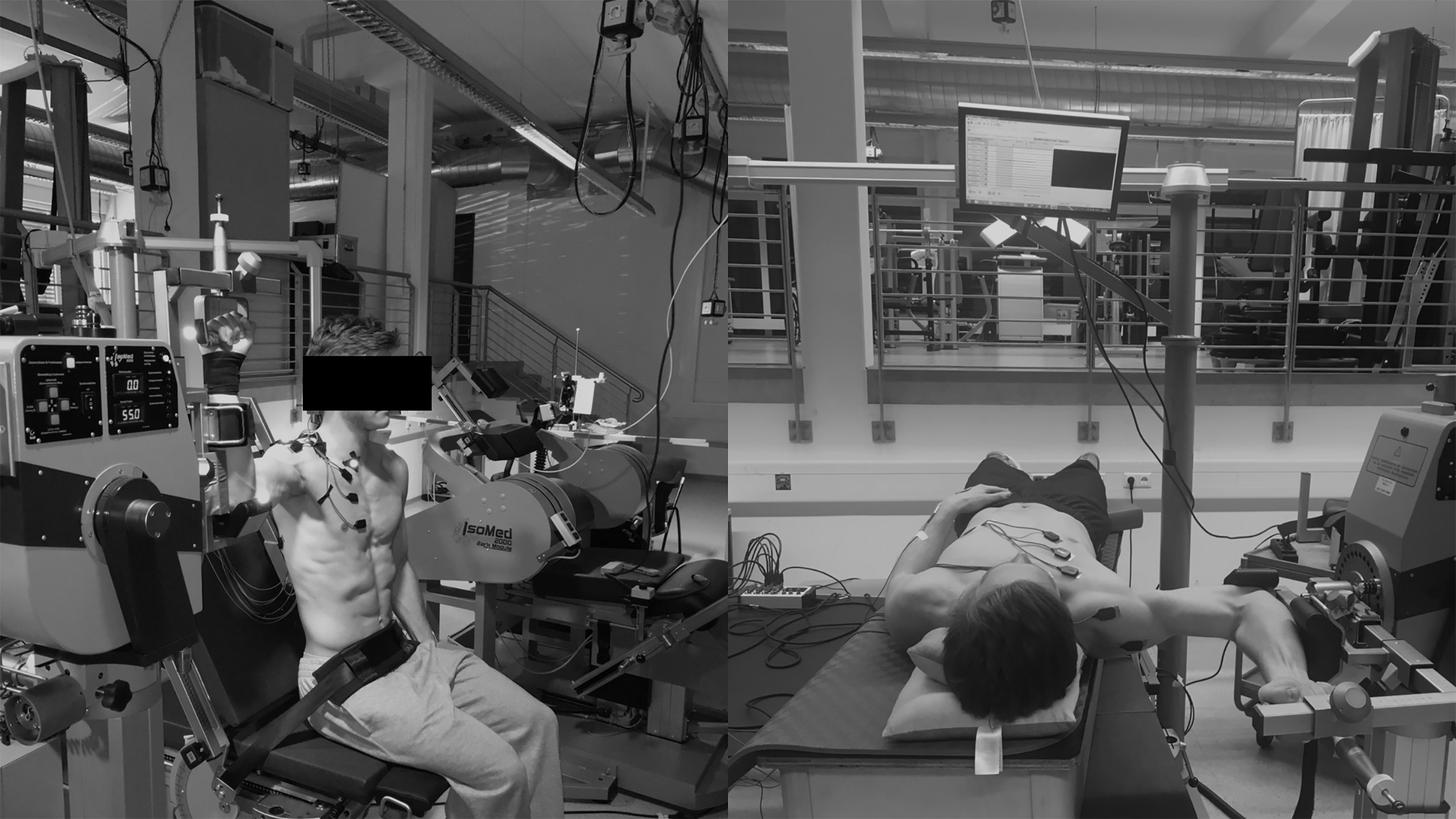
During the test sessions external shoulder rotation stretches with a stretch velocity of 150
The tests in the supine position were carried out in a second test session on a different day. The participants were placed in a supine posture on the isokinetic dynamometer with both shoulders stabilized to warrant a more potent abutment for the external shoulder stretches of their dominant arm (Fig. 1). The relative position of the dominant arm was identical to the tests in the upright seated posture (90/90/90-position). In terms of the dynamometer acceleration, velocity, muscle pre-activation level and maximal external rotation range of motion all stretches were applied under identical conditions as reported for the upright seated subject position. The muscle pre-activation level in this test session was not steered via the internal rotation moment values of the MVC-test but via a visual feedback (Feedback bar in EMGworks
Surface EMG (sEMG) activity was recorded at a sampling frequency of 2000 Hz via a Bangnoli
Data processing and analysis
Surface EMG signals were demeaned and bandpass zero-lag filtered (10–450 Hz) with a digital fourth-order Butterworth filter. Apart from that the signals were full wave rectified to obtain absolute values. Subsequent to this procedure the sEMG signals were smoothed using a sixth order low pass filter with a cut-off frequency of 50 Hz. The onset of the stretch reflex response within a timeframe of 0–50 ms after perturbation was determined utilising an algorithm in accordance with the recommendations of Hodges and Bui [22]. Therefore, the point at which the magnitude of the sEMG exceeded a prespecified threshold was determined using a sliding window with a width of 25 ms (50 samples). As long as the threshold was not exceeded the window was advanced one sample at a time until an onset was found or until 50 ms after perturbation onset was reached. If no onset was found within this timeframe a missing value was recorded and this trial was excluded from further analysis. The threshold was set to 3 standard deviations of the averaged baseline muscle activity level for the 50 ms prior to the start of each perturbation. Although Hodges and Bui [22] reported that using computer based algorithmic calculations yield accurate results each trial was visually inspected to ensure that no movement artifact or other malfunctions were wrongly quantified as stretch reflex response. For between and within subject comparisons of the pre-activation activity level the Root Mean Square (RMS) within the period of 100–0 ms before perturbation onset was calculated and normalized to the RMS of the MVC trial of each subject. For each valid reflex response, the reflex gain was quantified as
Statistical analysis
All statistical data analyses were carried out on SPSS 25 (IBM Corporation, Armonk, USA). Mean values and SDs were calculated for the elicitation rate, the stretch reflex latency, the reflex gain and the muscle activity 100 ms to 0 ms prior perturbation onset of each measurement condition. Verification of naturally distributed residuals and the Leven’s test for confirmation of variance homoscedasticity were carried out as prerequisites for a repeated measure three-within factor analysis of variance (three-way ANOVA) with Bonferroni correction. If the prerequisites were not met a pairwise analysis by Wilcoxon signed-rank test was carried out. The significance level for all analyses was set at
Results
Stretch reflexes were elicited in all tested muscles and in all test conditions. The elicitation rate revealed a significant muscle main effect (F (5,288)
Analysis of the muscle pre-activation revealed an interaction effect between muscle pre-activation level and the test condition (F (1,288)
Analysis of the reflex response revealed one identifiable component in all participants. Averaged results for all tested conditions showed that the onset of this component occurred at 29.0
The results for the reflex gain did not meet the prerequisites for the three-way ANOVA, therefore a pairwise comparison by Wilcoxon signed-rank test was carried out. Comparisons between the tested muscles (
Discussion
As shown previously, our results demonstrate that a stretch reflex response could be elicited relatively consistently in all tested muscles. The main finding of this study was that the elicitation rates were significantly higher in the primary internal rotator muscles of the shoulder joint than in the affiliated synergist muscles. The pectoralis and the anterior deltoid are major internal rotators of the shoulder that contribute to shoulder stability by opposing external rotation forces [23]. Since intrafusal fibers of the muscle spindle run parallel to the extrafusal contractile elements of the muscle [24] the sensitivity of the muscle spindle could be adjusted over the entire range of motion of the shoulder joint yielding continuous signal alterations due to muscle elongation and rate of length changes. Hence, a swift and consistent reflexive response in these two muscles seems to be expected in response to a rapid external perturbation of the shoulder. In addition, higher pre-activation levels led to significant higher elicitation rates in all muscles. This observation could be explained by an increase in muscle spindle sensitivity to intramuscular lengthening [7, 23] due to higher muscle activity levels. Proske [25] reported that voluntary muscle contractions of 20–25% of the maximum strength led to a recruitment of all muscle spindles through the fusimotor system while at a muscle activity level of 5% MVC only 75% of the retrievable spindles were recruited [26]. Moreover, the test conditions influenced the consistency of the reflex response in our study. Trials in supine position caused significant higher reflex elicitation rates than those in an upright seated position. To our knowledge no evidence on reflex modulation in the thorax and shoulder muscles due to subject positioning is currently available. Nevertheless, some contrary findings to our observations on the stretch reflex in the lower limbs are reported in the literature. Shimba et al. [27] demonstrated a significantly reflexive response facilitation in the soleus muscle in a passive upright posture compared to a supine position. Several neural mechanisms were presented as possible explanations for these findings. As demonstrated by Dietz et al. [28] the addition of weight to a subject’s body under water led to an increase in the soleus stretch reflex response. The authors interpreted this observation as a reinforcing sensory information related to load, comparable to carrying one’s own bodyweight in an upright posture, enhancing the reflexive response of the soleus muscle. In our investigation we assumed a substantial impact on shoulder muscles load related proprioception through supine or upright seated subject positioning. Klein et al. [29] suggested that the proprioceptive sensitivity could vary with the direction of arm displacement relative to the gravitational force vector. This observation most likely influenced our measurement outcomes due to different alignments of the arm’s gravitational force vector with respect to the frontal plane in the upright seated position and to the transverse plane in the supine position. In addition, Suprak et al. [30] demonstrated that subject body orientation biased the kinesthetia of the shoulder joint, which might lead to body positioning dependent adjustments in the reflex threshold of the muscles crossing the shoulder. Furthermore, a potential influence of a sympathetic outflow on the muscle spindle sensitivity due to an enhancement of the sympathetic nervous systems activity resulting from a passive standing body posture has been discussed by Hjortskov et al. [31]. Some evidence revealed that the muscle sympathetic nervous activity increased successively with a progressive tilt in body position from a supine to an upright standing position [32]. Our results did not support this observation, but we cannot rule out that a switch between a supine and an upright seated posture may potentially induce an alteration in sympathetic nervous activity and therefore may have impacted our measurement outcomes in an unpredictable way. We assumed that the higher elicitation rates in the supine position could be explained by lesser variability in the muscle pre-activation level in all tested muscles evoked by the ongoing visual feedback of the current muscle activity. Since the subjects were asked to achieve a predefined muscle activity level prior perturbation onset, rather than an internal rotation moment as a product of all muscle activity surrounding the shoulder joint, the variance in activity between agonist and synergist muscles was significantly smaller in the supine test condition. Furthermore, we assumed that the more potent shoulder abutment for both shoulders in the supine position resulted in a reduction of muscle slack. As we could not exclude the incidence of small evasive trunk movements in the upright seated position these could have potentially increased the effect of muscle slack as a consequence of a convergence of muscle attachment points [33].
Although the supine test condition yielded significant higher pre-activation levels and reflex elicitation rates in comparison to the upright seated test condition, no biasing of the reflex latency could be traced to differences in the test procedure. Comparison between trials with no muscle pre-activation and with 25% of MVC, either steered via the internal shoulder rotation moment or via ongoing visual feedback of the current muscle activity, showed a significant shortening of reflex latencies in the presence of muscle pre-activation, confirming formerly reported results on the reflex latency in healthy subjects [34]. Even though we found significantly higher pre-activation levels in all tested muscles in the supine test condition compared to its uprightly seated counterpart, the difference in the muscle pre-activation levels was apparently not big enough to reveal substantial variance in reflex latency.
Analysis of the reflex gain as an indicator of the number of motoneurons recruited in response to the perturbation [6] revealed significantly higher increases in the primary internal rotators of the shoulder in comparison to the other tested muscles. This observation agreed with our expectations taking the relevance of these muscles for the maintenance of the joint stability into account. The reflex amplitude substantially increases in the presence of muscle pre-activation in all muscles. However, the observed reflex gain as a descriptor of the slope of the relationship between the stretch reflex and the pre-activation level revealed only in two of the tested muscles significant differences between pre-activated and non-pre-activated muscles. In contrast to the expected results the reflex gain was higher in the absence of muscle pre-activation in the sternal head of the pectoralis and in the latissimus dorsi in the supine position. This observation contrasted former results reported in the literature. Cronin et al. [35] revealed a modulating interrelation between muscle and tendinous tissue with variations in contraction level. The velocity at which muscle fascicles were stretched initially increased in the presence of moderate muscle activation activity and then successively decreased with an ongoing increase in the force level of the muscle resulting in a progressive reduction in reflex amplitude. However, the authors showed that this effect caused a significant reduction of the reflex amplitude only at high to very high muscle activity levels of at least more than 60% MVC leaving our results in variance with the estimated response. Individual review of the observed results of the pectoral sternal head and the latissimus dorsi in our investigation revealed two outliers which had a great impact on the averaged test values in these muscles. We assumed that in the absence of muscle pre-activation those two subjects had a potentially decreased reflex threshold resulting in an accelerated muscle spindle sensitivity for length changes. Nevertheless, the reproducibility of this observation needs to be examined in further research.
Although this study presented some interesting spheres for further research, there were some limitations to the study design. Even though we used two accelerometers to assess the mechanical delay of the measurement and therefore determined the actual perturbation onset there still may remain some undetected delay in the transmission of the external shoulder rotation motion to the adjusted shoulder muscles in both test conditions. The simultaneous acquisition of sEMG and accelerometer data of all investigated muscles would permit an even more precise evaluation of the mechanical delay of the chosen set-up resulting in a further increased accuracy in reflex detection. Furthermore, the potential bias of anticipation of the perturbation onset on the reflexive muscular response needs to be reconsidered. Strong evidence indicates an interference of perturbation predictability on the long latency reflex component [36, 37]. Even though no standardized recommendations for the optimal configuration of the pre-activation phase prior perturbation onset is reported in the literature we need to revalidate potential bias in our data. The effect of more randomised, longer pre-activation phases on the reflex latency needs to be investigated in further research.
Conclusion
The results of the current research indicate that in healthy subjects regardless of posture and the procedure of muscle pre-activation level steering consistent stretch reflex responses may be elicited in the presence of muscle pre-activation in the muscles crossing the shoulder joint by applying a positional perturbation to the dominant arm of the subjects using an isokinetic dynamometer to produce external rotation at the shoulder. This observation further enhanced our knowledge of the stretch reflex in the upper extremities and therefore offers an applicable method of neural muscle function examination for clinical applications and for neuromechanical analysis of human movements. Although we could not reveal a significant effect of subject position on reflex modulation, we would recommend a supine subject posture for further investigation. Supine position in combination with a visual ongoing feedback of the level of muscle activity led to a substantial increase in the reflex elicitation rate in our investigation enhancing the reproducibility of the measurement.
Footnotes
Acknowledgments
The authors thank Florian Weiser for assistance in customizing the MATLAB R2019a software for sEMG-data processing.
Conflict of interest
None to report.