




Abstract
BACKGROUND:
High-speed resistive exercise increasingly serves as a modality to improve health and performance. In regards to high-speed resistive exercise, little research exists which elucidates factors that may serve as significant correlates, and therefore predict health and performance benefits. Furthermore what research exists on this topic usually examined male athletes.
OBJECTIVE:
To assess anthropometry’s role as a correlate to high-speed resistive exercise performance.
METHODS:
Before the workouts, subjects were measured for six anthropometric variables. At each two-set workout the average and peak force, as well as the total volume of work done, were recorded and used for analysis. To identify correlates to high-speed exercise performance, a series of multivariate analyses were done, in which an exercise performance variable served as a criterion and the six anthropometric measurements were predictor variables.
RESULTS:
Only one of our multivariate analyses achieved significance. With peak force from phasic workout as the criterion, a significant amount of variance correlated with anthropometry. Univariate analyses revealed height was the strongest correlate to phasic peak force variance.
CONCLUSIONS:
Our results are unlike those from studies done with men. Differences may be due, but not limited, to 1): the load used, 2): the timing and coordination of high-speed repetitions, and 3): height’s role in exercise performance.
Keywords
Introduction
High-speed resistive exercise increasingly serves as a modality to improve health and performance [1, 2]. For instance, recent research showed that a chronic high-speed resistive exercise intervention elicited large and significant increases in calcaneal accretion, such results holds promise for those who experience bone losses to this weight-bearing skeletal segment [3]. Yet a linear relationship, between the volume of high-speed resistive exercise training and subsequent health and performance improvements does not exist for this or any other modality [4]. With respect to high-speed resistive exercise, little research exists which elucidates factors that may serve as significant correlates, and therefore predict health and performance benefits. Furthermore whatever research which exists on this topic usually examined male athletes [5].
The paucity of female data on this topic is likely due to multiple reasons. Yet recent research on high-speed exercise now includes studies comprised exclusively of women [6] or compared results between male and female subjects [7]. Those investigations each exam-ined physiological responses to workouts done on a novel high-speed resistive exercise device [6, 7]. Referred to as the inertial exercise trainer (IET), numerous exercises may be done on it to target all major muscle groups of the body. Study results included performance of large volumes of work done by women with minimal metabolic cost [6], as well as higher power outputs achieved women, as compared to their male counterparts, when expressed relative to body or lean tissue mass [7]. Among the many factors that account for variations in exercise performance is anthropometry [5].
While it is one of the earliest identified factors to account for variations in exercise performance, anthropometry’s value as a predictor continues to this day. Generally anthropometry was a strong performance predictor when exercise occurred at slow velocities [8, 9, 10, 11]. With the exception of the vertical jump, far less research has examined anthropometry’s impact on high-speed exercise, which is suspected to be weaker due to the inherently greater variability seen with activities done at faster speeds [5, 12, 13]. Little data exists on the relationships between anthropometry and high-speed exercise done by women, but one study on this topic examined vertical jump performance [12]. That study revealed inter-gender anthropometric differences for arm swing’s contribution to vertical jump performance [12]. The vertical jump is an attractive high-speed modality to examine due to its short time duration and ease of performance. Anthropometry may also be a relatively stronger correlate to the variance seen with the vertical jump.
Yet other forms of high-speed exercise exist and, since they are increasingly used by women to improve their health and performance, warrant inquiry. They include the IET. Originally intended for rehabilitation that followed injuries, the IET is also used to enhance speed development in athletes. The IET entails performance of repetitive high-speed muscle actions done in rapid succession. A chronic 30-workout intervention on the IET led to a large and statistically significant osteogenic response to the calcaneus [3]. Those results are of particular interest to women, whom incur osteoporosis and osteopenia at greater rates than men [14]. Indeed most of its study subjects were women [3]. Workouts entailed multiple 60-s sets done as rapidly as possible for three exercises, which are inherently more challenging, and produce greater data variability, than vertical jumps that require less than a second to perform [3]. The purpose of our study is hence to assess anthropometry as a correlate to high-speed workouts done on the IET by women. We hypothesize that anthropometric data will correlate with significant amounts of variance associated with high-speed IET workouts.
Methods
Subjects
Project approval, prior to data collection, was grant-ed by a university-based institutional review board for the use of human subjects and conforms to guidelines put forth by The Code of Ethics of the World Medical Association. College-age female subjects (
Instrumentation
The simple design of the IET belies its ability to impart an impactful training stimulus. The IET’s permits repetitions done at high speeds and acceleration rates as its weight carriage, mounted on four stainless steel wheels that traverse a polyurethane-coated 1.9 m track, moves with as little as 0.45 N [6, 7]. The cord attached to the carriage possess high strength/low stretch pro-perties, as 890 N of force lengthen it less than 2.8 mm. The low stretch feature offers excellent proprioceptive connection to the carriage’s movement as force is exerted. The cord travels above two opposable centered guide pulleys fixed to the steel frame located midway along the track’s underside. As force is exerted the carriage accelerates toward the centered pulleys that in turn increase the kinetic energy. Eccentric torque must then be exerted to decelerate the carriage movement and complete each exercise repetition. Adjustable pulleys move the cord and attachment handle into various positions so a variety of exercises may be performed on the IET. Figure 1 is a photograph of the IET, with many of its component parts labeled.
Illustration of the IET (Impulse Training Systems; Newnan, GA, USA).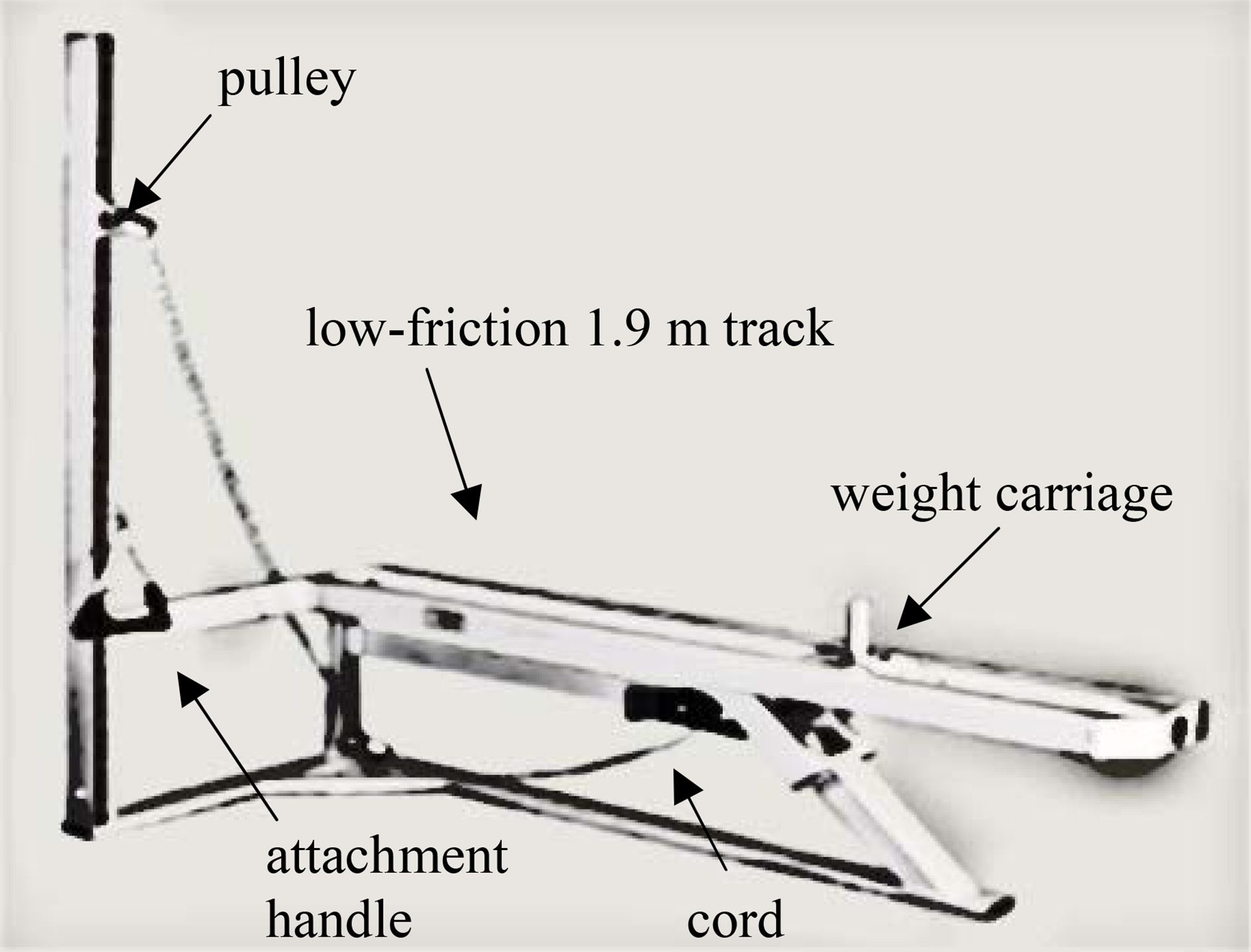
Throughout each set, our instrumentation methods continually assessed force output and carriage displacement as a function of time. A transducer (PCB N222b; Piezotronics Inc.; Depew, NY) measures cord forces. The calculated gravitational force applied by the cord as it passed over the pulleys was 1.42 N. Since the cord passes over the pulleys at a 90
Subject’s first visits commenced with anthropo-metric measurements, which were the independent variables that attempted to predict our criterion measures’ variance. As they stood upright in a relaxed posture the following measurements were recorded: height, mass, body fat percentage torso length, arm length and shoulder width. Heights were recorded with a cloth measuring tape. Mass and body fat percentage were obtained with a bioimpedance scale (BF-350 Tanita Corp.; Tokyo, Japan). They were instructed to arrive to their first visit euhydrated in order to yield accurate body fat percentage values. Torso and arm lengths were derived from the right side of subject’s bodies. Torso length was the distance from the acromioclavicular joint to the anterior superior iliac spine. Arm length equaled the distance from the acromioclavicular joint to the ulna’s styloid process. Shoulder width spanned the distance across the two acromioclavicular joints. The independent variables obtained with a measuring tape occurred in triplicate and averaged.
The anthropometric measurements were based on the IET exercise chosen for inquiry in the current study. Done at the first and second laboratory visits, subjects familiarized themselves to standing rowing motion exercise done on the IET. Proper technique entails standing with feet shoulder width apart with an attachment handle grasped by the users right hand, as their right shoulder flexes 90
Current study unilateral rowing motion done on the IET (Impulse Training Systems; Newnan, GA, USA).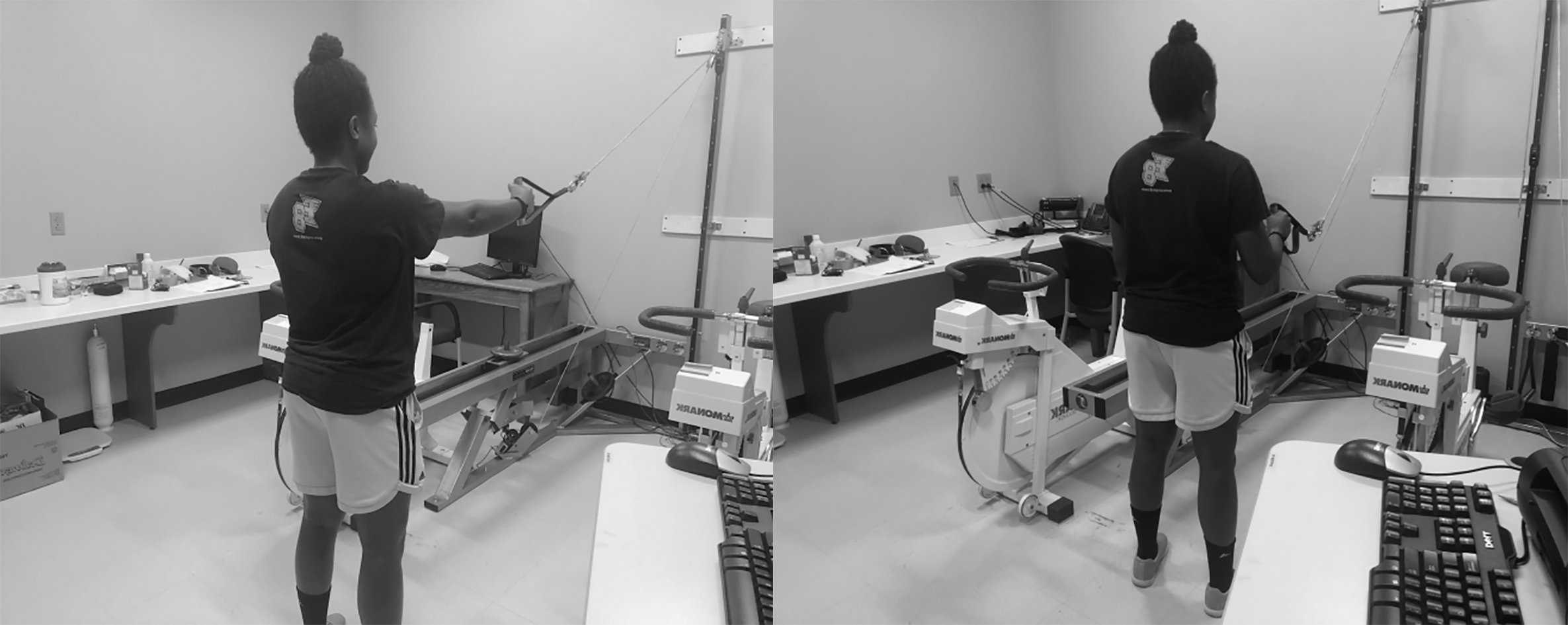
At the first and second visits subjects practiced the standing rowing motion for the two types of IET repetitions. Termed tonic and phasic, the former entails continual force exertion over a full range of motion and between successive repetitions. Continual force exertion causes the cord to stay taut as the carriage oscillates along the track. In contrast phasic repetitions involve intermittent force exertion to propel the carriage. Rapid intermittent force exertion sees the carriage attain high rates of acceleration, and the non-uniform ballistic pattern of force application sees the cord quickly alternates between being taut and slack. Phasic actions see a high impact force, which is the peak force per repe-tition, reverse carriage movement along the track to intiate the next repetition. Subjects practiced tonic and phasic rowing motion repetitions until they excelled at each, and were instructed on proper technique by the principal investigator (JFC).
The third and fourth visits entailed standing rowing motion workouts comprised solely of tonic or phasic repetitions. Subjects did one version of each type of workout, in a randomized sequence, as determined by coin flip. For warm-ups, subjects adopted the postures in Fig. 2a and b to perform repetitions (either tonic or phasic) specific to that workout’s assignment. Warm-ups were done at a submaximal level of effort until they were ready to begin the rest of their workouts. Subjects then did two 60-s sets specific to their workout assignment, separated by a 90-s rest period. They were told to exert maximal effort with each set, not pace themselves, and were verbally encoraged throughout each set. Per workout the average and peak force (AF, PF), as well as the total work (TW) were recorded and served as dependent (criterion) variables for our analy-ses. The AF, PF and TW values were recorded in accordance with our instrumentation methods. Sets done incorrectly, such as if proper repetition technique was not maintained, were excluded from analysis, which meant the entire workout had to be repeated.
Statistics
Multivariate regression was used to assess anthropometry’s ability to serve as a correlate to the variance seen with high-speed exercise performance variables obtained from IET workouts done by women. Our high-speed performance variables included the AF, PF and TW values from each type of IET workout (tonic, phasic). Thus the statistical approach included six separate multivariate regression analyses. To identify correlates to the variance seen with high-speed exercise we used the same six anthropometric variables: height, shoulder width, arm length, torso length, mass and body fat percentage.
With a large effect size of 0.33 typically produced with exercise interventions, as well as power and alpha levels of 0.8 and 0.05, respectively, our sample size allows for up to six independent (predictor) variables for our multivariate analyses [15]. AF values were calculated as the mean force output across the two 60-s sets for each type of workout. In contrast PF equaled the singular highest instantaneous force measured per workout. Finally, TW values were summed across each type of workout. For each significant analysis, univariate correlations,
Anthropometric (predictor) and exercise performance (criterion) variable data
Anthropometric (predictor) and exercise performance (criterion) variable data
Univariate matrix,
No subjects were injured as a result of their project participation, and each completed all four laboratory visits. Their anthropometric data appear in Table 1. Of the 6 multivariate regression analyses, only one reached statistical significance. With PF from the phasic workout as the criterion, that multivariate analysis showed anthropometry correlated fairly with a signifi-cant (
Discussion
The current results support our hypothesis, as our anthropometry correlated with significant amounts of high-speed exercise performance variance from workouts done by women on the IET. Yet our results are somewhat in contrast to prior studies related to this topic, as phasic exercise is associated with greater data variability than is tonic [5, 17]. In addition, PF sees more data variability than either AF and TW [17]. Therefore phasic PF data was anticipated to be the criterion measure least likely to elicit statistical significance, in direct contrast to our eventual results. Thus it is important to explain why our results may have occurred, since they are different than those seen previously [5, 17].
IET workouts comprised solely of tonic repetitions are thought to limit variability for performance measures since moment exertion is more uniform throughout sets, at least as compared to phasic efforts. Support for this idea comes from research that assessed test-retest data reproducibility obtained from IET workouts [17]. With 45 subjects performing two workouts one week apart, comprised exclusively of either tonic or phasic repetitions, intra-workout test-retest data variability for AF and TW were generally lower for the tonic workout [17]. However PF results general-ly showed less variability from the phasic workout, which may help explain current results [17]. Yet this is in contrast to our earlier statement that PF values exhibit greater variability than those for AF or TW; at the very least the prior statement appears to be true as it pertains to tonic repetitions. It was concluded the IET elicited reproducible data despite the unique opportunity to perform repetitive multiplanar and multi-joint movements over large ranges of motion [17]. The variability seen in IET performance is impacted by the type of repetitions performed.
A recent study examined the optimal load for power output for the standing unilateral knee extension exercise done on the IET [7]. With male and female participants and a Latin Squares Design, all subjects did four workouts comprised of the same number of sets against various (1, 4.4, 6.7, 9 kg) loads. Results showed signifi-cantly higher absolute average power values for men at the 9 kg load as compared to their female counterparts [7]. However when power values were expressed relative to body or fat-free mass female subjects produced higher values, as peak power/body mass results were significantly greater for women than men at 6.7 and 9 kg. In addition average power/fat-free mass and peak power/fat-free mass each showed women had significantly higher values than men at 4.4, 6.7 and 9 kg loads [7]. The very low inertial resistance to initiate each repetition on the IET in part explained the normalized power results, in which higher values were achieved by women [7]. It was concluded that low inertial resistance for IET repetitions negates male size and strength advantages typically seen when power is measured [7].
To date only two studies examined female responses to IET workouts [6, 18]. The earlier of these studies examined net energy costs seen with IET workouts IET [6]. With the same exercise as the current study and a similar design, women (
Testosterone results are different than those seen from men [18]. To date, only one study examined anthropometry’s impact on workouts done on the IET, and it utilized the same exercise as the current study but examined only male subjects [5]. With the same study design as our study, male athletes (
There may be multiple reasons for the current study outcomes, and why they differed from results on the aforementioned male athlete study [5]. They include, but are not limited to, 1): the load used, 2): the timing and coordination of exercise repetitions, and 3): height’s impact on exercise performance. With respect to load, both the current and male athlete studies added the same mass (8 kg) to the IET carriage to impart resistance during workouts [5]. It is quite possible, since men exhibit higher absolute force outputs, the load is a more appropriate level of resistance to evoke peak forces in women [4, 5].
In regards to timing and coordination, since current repetitions occurred in rapid succession they are intrinsically rhythmic in nature, which is essential to proper technique on the IET. Thus it is important to consider if women possess different neuromuscular timing and coordination patterns as their male counterparts. To date, evidence suggests inter-gender differences in neuromuscular physiology exist that potentially had a role in eliciting different results as seen in the current and male athlete investigations [5, 19, 20].
Women commonly exhibit differences in neuromuscular coordination and motor recruitment patterns as compared to their male counterparts [20, 21, 22]. Yet most work in this area examined lower body exercise [20, 21, 22]. The current study exercise mimics a repetitive reaching motion done against little added resistance. Functional MRI revealed significant inter-gender differences in brain activity for reaching tasks that relate to visuomotor control and primary motor cortex involvement [19]. Right-handed subjects (10 men, 9 women) did a series of reaching tasks of an increasingly greater complexity as their cortical activity was continuously monitored [19]. While there was a considerable degree of similar inter-gender brain function, results revealed greater lateral sulcus, right superior parietal lobe and left dorsal premotor activity in women [19]. Such regions of the brain play important roles in the timing and coordination of neuromuscular activity [19]. Thus perhaps a combination of loads and inter-gender differences in neuromuscular activity are responsible for the discrepancies in anthropometry’s impact on high-speed exercise performance on the IET, as seen in the current and male athlete studies [5].
Finally, in the current study, height’s positive univariate correlation to phasic peak force may be a more representative correlate to overall body size and strength performance in women than the other anthropometric variables examined. This univariate outcome is a far cry from results from the male athlete study, which showed shoulder width and lower arm length were the best predictors of standing rowing motion performance on the IET [5]. Since men typically have higher absolute force outputs than women, our study’s load was relatively greater for women to move, as compared to when the same load was used by male athletes [5]. Thus perhaps an anthropometric variable reflective of overall body size is a better correlate to phasic peak force performance, as occurred in the current study. Due to the novelty of the device, more research on women’s responses to IET workouts, particularly different exercises than those examined previously, is warranted.
Footnotes
Acknowledgments
We wish to thank our subjects for their participation.
Conflict of interest
The authors declare no conflict of interest.