




Abstract
BACKGROUND:
A number of studies have assessed the effect of kinesiology tape (KT) application with respect to the delayed onset of muscle fatigue.
OBJECTIVE:
To determine the effects of direction of KT application on the delayed onset of quadriceps fatigue.
METHODS:
An isokinetic dynamometer was used to induce concentric quadriceps fatigue in 15 healthy participants prior to applying KT. The KT was randomly applied on the muscles in two possible orientations: from origin to insertion or from insertion to origin. After the application the number of repetitions of knee extension required to induce fatigue was recorded.
RESULTS:
Regardless of the direction of application, the number of repetitions needed to generate muscle fatigue increased after the KT was applied. On the other hand, there was no significant difference between taping directions.
CONCLUSIONS:
KT application on the quadriceps delays the onset of its isokinetically-induced fatigue, irrespective of the direction of application. Therefore, using KT may be considered as a possible technique in those tasks where fatigue may seriously hamper performance.
Introduction
Application of KT during sports activities is used for the purposes of injury prevention [1], functional improvement [2], and reduction of muscle fatigue [3]. In this way, it is used not only for immobilization, but also for therapeutic purposes [4]. The primary cause of sports injuries is reported to be imbalance between joints and muscles, which control agile movement [5]. In particular, the inability of the nervous system to smoothly control muscle contraction due to fatigue is considered the primary cause of the higher incidence of sports injuries during the second half of an event in comparison to the first half [6].
Flow diagram for the study.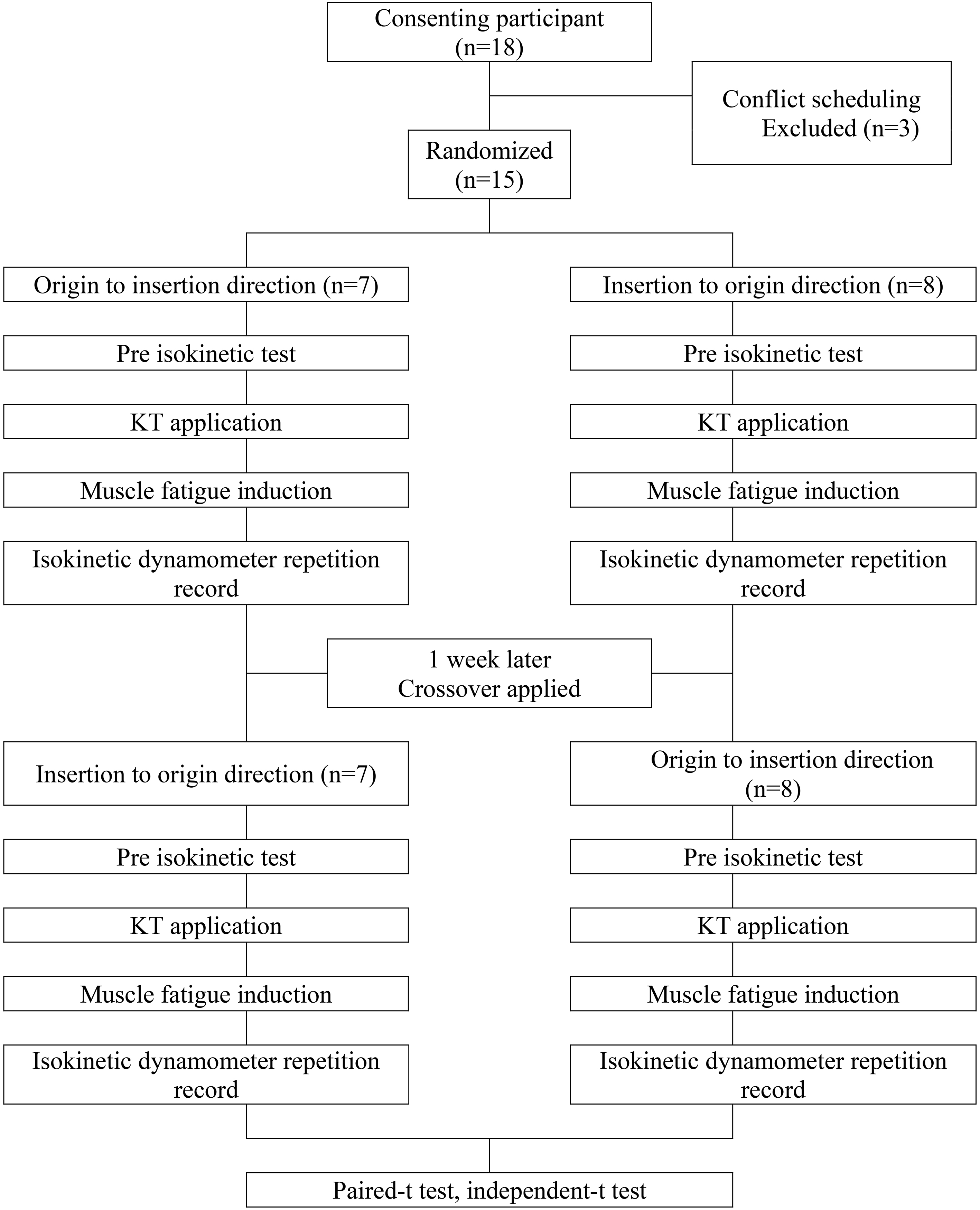
Fatigue is associated with muscle activity and reduced muscle performance [7]. Moreover, fatigue develops from complex and diverse processed involving nervous system activities and muscle metabolism, calcium secretion from the sarcoplasmic reticulum, and interaction between myosin and actin [8]. After muscle fatigue, the risk of injury and pain increases, while physical performance also decreased [9, 10]. Methods for preventing and reducing such muscle fatigue include stretching, massage, electrostimulation, and KT. In particular, KT can be applied directly to the skin to provide the effects of pain relief through mechanical stimulation [11], improved joint range of motion (ROM) [11, 12, 13], and alignment [14] increased muscle strength [15, 16, 17].
Yeung et al. [18] reported that applying KT to the quadriceps muscles had the effect of increased muscle strength, while Huang et al. [2] reported that applying KT on the gastrocnemius muscle increased muscle activities. Studies that applied KT on athletes after musculoskeletal injury demonstrated the efficacy of such an intervention in facilitating the return to sports [19, 20, 21]. Ward et al. reported that applying KT on the patella and anterior thigh of fatigued runners had the effect of reducing their level of fatigue [22]. However, there are few studies that have assessed the effect of KT application with respect to the delayed onset of muscle fatigue.
Accordingly, the present study applied KT while inducing muscle fatigue in the quadriceps muscles with an isokinetic device for the purpose of investigating the effects of such application on delaying the onset of muscle fatigue and the effects of the direction of KT application on delaying the onset of muscle fatigue.
Participants
The present study recruited a total of 15 athletes (10 males and 5 females) who consented to participate in the study (19.53
General characteristics of the subjects
General characteristics of the subjects
The present study used a single blind, crossover design and applied KT on 15 subjects in random directions over the course of one week interval. The experimental design is shown in Fig. 1. An isokinetic dynamometer was used to measure and record the peak moment (PM) of the quadriceps first. Applying a fatigue protocol [23], fatigue in this muscle was induced using the dynamometer without applying KT for providing the resistance and, recording the number of repetitions of knee joint motion required to induce muscle fatigue. One week later, the KT was applied on the quadriceps in random direction, after which the fatigue protocol was repeated. Following another week, KT was applied in the direction opposite of the previous application and the number of repetitions of knee joint motion required to induce muscle fatigue was again recorded.
Instrumentation
A Biodex system 4 (Biodex Medical System Inc., New York, USA), was used to induce quadriceps fatigue and measure PM.
The taping technique
With the knee bent at 90
Application of KT in quadriceps: A, Origin to insertion direction; (A) rectus femoris, (B) vastus medialis, (C) vastus lateralis; B, Insertion to origin direction; (A) rectus femoris, (B) vastus medialis, (C) vastus lateralis.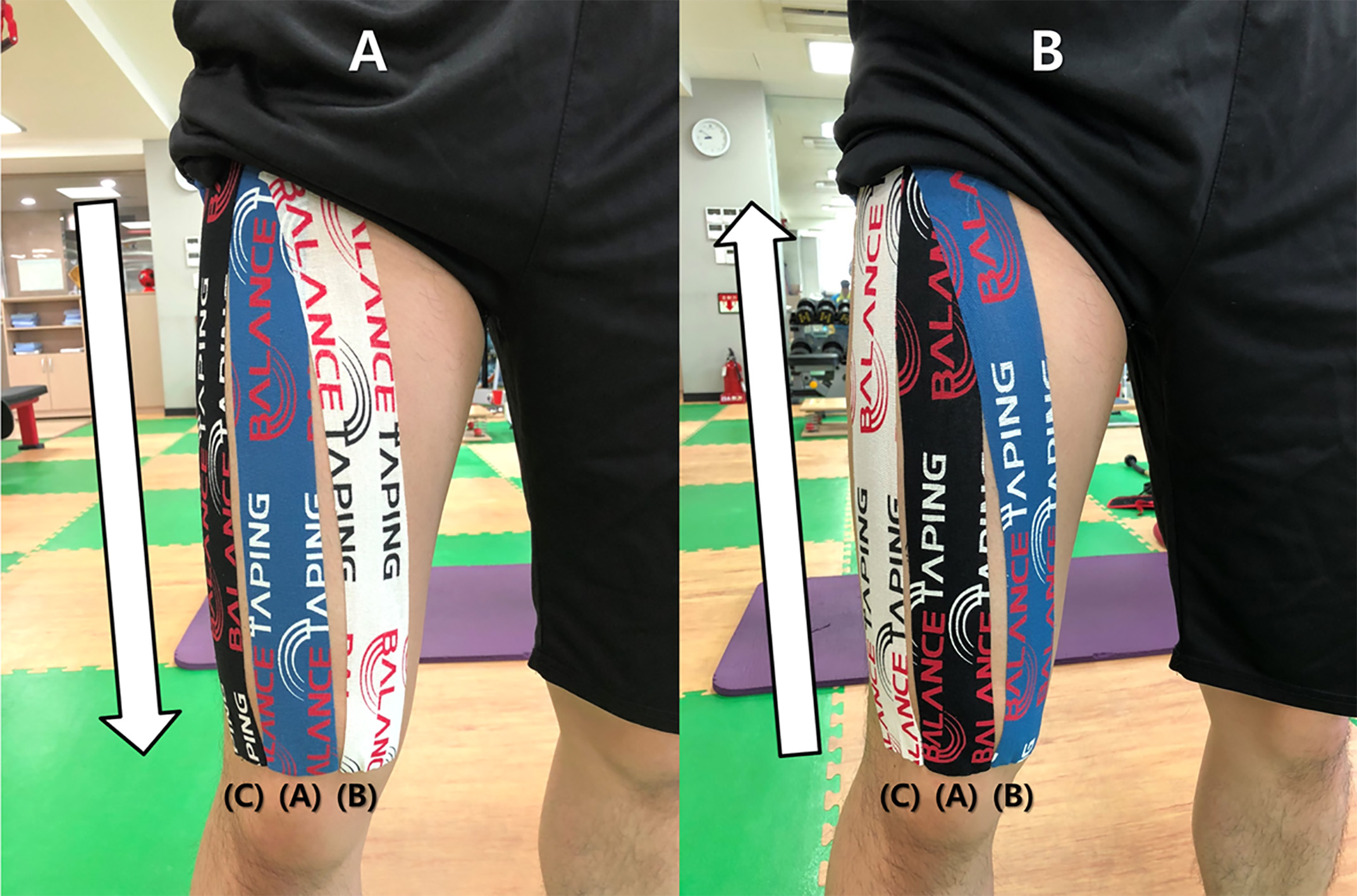
Comparison of the required number of repetitions to induce quadriceps muscle fatigue prior to and after intervention
Comparison of change quantity in variables between isokinetic peak moment of origin to insertion and insertion to origin taping direction
Prior to actual testing, the subjects performed 5 minutes of low-intensity warm up exercise consisting of cycling and stretching [16]. As the subject sat in the Biodex chair with his or her back against the chair, a belt was used to immobilize the torso, thighs, and ankles. Then, the knee joints were fixed to the axis of the dynamometer. A monitor was used to allow biofeedback and the examiner verbally encouraged the subject for maximum muscle recruitment. Maximal PM value was calculated from 5 repeated measurements with angular velocity of 60
Muscle fatigue protocol
After measuring the PM, fatigue was induced by performing maximal strength repetitions at 60
Statistical analysis
For comparing the number of repetitions, a paired t-test was used. To compare the effects of the direction of KT application on delaying the onset of muscle fatigue, an independent t-test was used. SPSS version 18.0 was used for the statistical analysis.
Results
Regardless of the direction of application, applying KT significantly increased the number of repetitions required to induce muscle fatigue (
Discussion
The current study indicates that applying KT on the quadriceps prior to inducing fatigue in this muscle increased the number of repetitions required to induce muscle fatigue, regardless of the direction of application. A study by Zulfikri and Justine reported that when KT was applied to the fatigued quadriceps, biceps femoris and the gastrocnemius it was effective as per the Modified Star Excursion Balance Test of fatigued lower extremity [29]. KT application such as tactile and mechanical receptor stimulation compensated for the reduction of afferent feedback caused by fatigue and enhanced dynamic balance by maintaining the accuracy of the muscle spindle information and maintaining the proprioceptive input [29].
Konishi reported that when KT was applied to weakened quadriceps after vibratory stimulation, maximum voluntary contraction and average EMG signal of the quadriceps increased significantly compared to when KT was not applied [30]. Tactile stimulation, such as KT application, increases maximum voluntary contraction and average EMG signal by stimulating the afferent nerves in the skin, while activation of gamma motor neurons regulates Ia afferent pathways to indirectly activate the alpha motor neurons [30].
Ward et al. applied KT on the anterior lower limb of runners after artificially inducing fatigue and found that there were no differences in their step length and stride length compared to the state of no fatigue [22]. Skeletal muscles possess extensibility and elasticity properties [31, 32, 33]. The stretch and recoil properties of muscles play an important role in generating force, but when muscle fatigue occurs, the muscle cannot function properly as these properties are compromised [34, 35]. It was reported that there were no changes in step length and stride length even when fatigue occurred because of the rubber band-like elasticity of KT [22]. In the present study, when the dynamometry was used to induce muscle fatigue after applying KT the elasticity of the KT applied to the skin helped the stretch and recoil properties of the quadriceps, which delayed the onset of muscle fatigue, as indicated by the increased number of repetitions required to induce muscle fatigue. Moreover, tactile stimulation from KT application activated alpha motor neurons, whereas applying KT stimulated the Golgi receptors to activate inhibitory motor neurons, which increased muscle strength that led to delayed onset of muscle fatigue.
Meanwhile, there was no significant difference in the number of repetitions required to induce muscle fatigue according to the direction of KT. Although there are no studies on the delayed onset of muscle fatigue after KT application, a study by Au et al. applied KT in different directions on patients with lateral epicondylitis and found no significant differences in muscle activities and pain in the wrist extensor [36], whereas studies by Cai et al. and Serrão et al. equally reported no significant differences in muscle activities of the wrist extensor and quadriceps according to the direction of KT application [37, 38]. Bravi et al. found no significant differences when KT was applied on the wrist [39], while Vercelli et al. have indicated no difference in muscle strength based on the direction of application when inhibition and facilitation tape were applied [40].
The present study is qualified by the following limitations. First, since the subjects were athletes, it would be difficult to generalize the results to all people. Second, since the study was a cross over study with a 1-week interval, there may have been some carryover effect. Finally, since the intervention was applied only on the quadriceps, the effects on other muscles are unknown. In the future, additional studies are needed to determine how to prevent muscle fatigue by using KT while addressing these limitations and applying KT on various other muscles.
Conclusion
In the present study, KT was applied to major components of the quadriceps muscles (i.e., the rectus femoris, vastus lateralis, and vastus medialis) prior to inducing muscle fatigue using the isokinetic dynamometer. The number of knee joint motion repetitions required to induce muscle fatigue increased, regardless of the direction of KT application on the quadriceps muscles, which indicated delayed onset of muscle fatigue. Therefore, prior to the onset of muscle fatigue in the quadriceps muscles during muscle activity, KT may be applied, regardless of direction, on the rectus femoris, vastus lateralis, and vastus medialis muscles.
Footnotes
Acknowledgments
This manuscript is based on a part of the first author’s Doctor’s Dissertation from Dong-Eui University.
Conflict of interest
The authors declared no conflict of interest.