




Abstract
BACKGROUND:
Long-term habitual rear-foot strike (RFS) pattern with modern running shoes may negatively affect the intrinsic muscle function of the medial longitudinal arch, which can increase the risk of foot disease.
OBJECTIVE:
This study aims to explore whether habitual RFS pattern with modern running shoes can affect the muscle strength of the medial longitudinal arch.
METHODS:
A total of 12 runners who exhibited habitual RFS pattern (RR) with modern running shoes and 12 nonhabitual runners (NR) underwent plantar muscle group strength test for 10 s, hallux flexion and lesser toe flexion strength test. The maximal strength for all tests was normalised by body mass.
RESULTS:
No significant differences, on any of the outcome measures, were noted between the two groups. However, in RR the normalized strength of plantar muscle group demonstrated a decreasing trend (
CONCLUSIONS:
Runners who exhibit habitual RFS pattern with modern running shoes present a decreasing trend in the muscle strength of the medial longitudinal arch. The effects of posture and cushioned shoes should be explored further.
Introduction
The medial longitudinal arch (MLA) enables the foot to function in a spring-like manner in conjunction with the entire lower extremities [1]. The passive ligamentous structure of MLA can return 8%–17% of the mechanical energy, which was stored during the early stance, to improve the efficiency of one running stride [1, 2]. Intrinsic and extrinsic foot muscles, which comprise an active support system for MLA that is parallel to the plantar aponeurosis function, can control MLA compression in response to the magnitude of forces during locomotion [3]. However, the weakness of any of these contractile structures may lead to an injury [4]. Some researchers have reported that weak intrinsic foot muscles may be associated with symptoms of plantar fasciitis amongst runners because such muscles provide insufficient dynamic support to MLA, thereby increasing strain on the plantar fascia [4, 5].
Personal and AHI data
Personal and AHI data
Many researchers have recently focused on the relationships amongst foot plantar muscle strength, rear-foot strike (RFS) pattern and cushioned running shoes. Although maximum MLA deformation is not associated with running strike posture [6], various landing strategies have different requirements for plantar muscles. Fore-foot strike (FRS) initially loads a three-point bending on MLA when the ball of the foot comes in contact with the ground, which increases loading on MLA [2] and the mechanical work performed by intrinsic foot muscles [6]. Elastic energy may be simultaneously stored and recoiled effectively in the tendons, ligaments and muscles of the lower extremities [2]. By contrast, RFS runners experience minimal or no MLA compression during impact phases because the vertical ground reaction, tibialis anterior and body forces are all applied around the arch’s apex at the medial cuneiform. These forces may stiffen the arch until the foot flattens, thereby preventing the elastic storage of any form of energy that may be generated by the impact [2, 7]. Therefore, some runners transition from an RFS pattern to an FFS pattern with regard to injury prevention and management [8].
However, 75%–80% of cushion-shod runners, typically RFS, and barefoot or minimally shod runners frequently choose FFS [2, 9]. RFS runners must repeatedly cope with the transient impact of the vertical ground reaction force, and the abrupt collision force is approximately 1.5–3 times the body weight within the first 50 ms of stance [9]. The high rates and magnitudes of this loading move rapidly upward to the lower extremities and may increase the risk of running-related injuries, such as tibial stress fractures and plantar fasciitis [10, 11, 12]. Thus, modern running shoes that are designed with elastic materials in a large heel to absorb some of the transient force can make RFS running more comfortable and less injurious [9, 13]. A defining characteristic of modern running shoes is their thick viscoelastic midsole that allows them to function similar to a spring; another key feature of these shoes is their contoured midsole, which is designed to provide external support and reduce excessive strain on the muscles and ligaments of MLA [1, 14]. However, despite the advantages of modern running shoes, the rate of running-related injuries has not changed over the last 40 years [15]. Many researchers even believe that cushioned midsoles may actually hinder running performance [16, 17] because a thick cushioned interface between the runner and the ground may impair mechanosensory feedback, which will affect the inherent capacity of the central nervous system to adjust leg-and foot-spring stiffness in accordance with changing large impact force transients [1, 2, 16]. Some researchers have pointed out that many running shoes have arch supports and stiffened soles that may weaken foot muscles, reduce arch strength [2, 9] and increase running cost [2, 18].
RFS and modern running shoes exert some negative effects on the MLA muscle function; however, studies on MLA muscle strength between runners who exhibit habitual RFS pattern with modern running shoes and nonhabitual runners are lacking. Accordingly, the current study aimed to test the effects of RFS pattern with modern running shoes on MLA muscle strength. We hypothesised that habitual RFS runners who wear modern running shoes have weakened MLA muscle strength compared with nonhabitual runners.
Participants
For the group of nonhabitual runners (NR), we collected data from 12 males who exercise irregularly without wearing running shoes. We also recruited 12 males (RR) who run a minimum of 20 km per week in RFS patterns whilst wearing modern running shoes (Table 1). The exclusion criteria included musculoskeletal injuries of the lower extremities over the previous one year, the left leg being the dominant lower extremity, pes planus or cavus and knee or ankle joint inversion or eversion. Each participant signed an informed consent proved by the Human Ethics Committee of Shanghai University of Sport prior to the study (IRB no. 2017007).
Procedures
AHI
For AHI assessment, we required the participants to keep their bare feet pelvis-width apart whilst they are in an upright bilateral standing position and to try to make their legs parallel as much as possible to avoid inversion and eversion of the foot. We measured the height of the dorsum of the foot at 50% of the foot’s length and the truncated foot length using the same digital calliper [19]. All morphological tests were performed by the same tester.
Plantar muscle group strength test.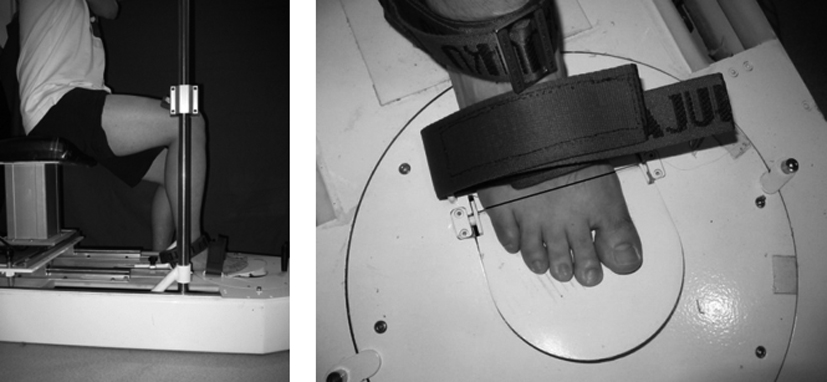
Separated toe flexion strength.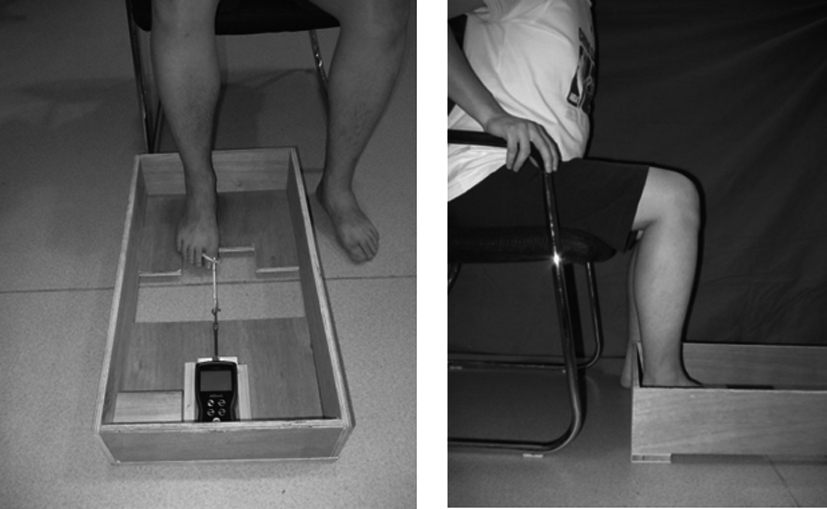
Plantar muscle group strength was measured using a self-developed strength tester at a sampling rate of 120 Hz (CN103278278B, China) [21]. The metatarsophalangeal joints (MPJs) strength tester included a chassis, a pedal, a seat, force sensors and a computer. The participants sat on a chair with their knees and feet fixed by a stopper plate to avoid the interference of other joints. During the tests, the participants were required to try their best to flex all their plantar muscles together for 10 s to press the 30
Results of plantar muscle group strength test
Results of plantar muscle group strength test
Toe flexion strength was also investigated, initially whilst the hallux unaided, and then simultaneously with the 2nd, 3rd, 4th, and 5th toes. A modified dynamometer (Ailitech ADF 500, China) was attached to a wooden frame (Fig. 2), and the sampling rate was 16 kHz. After the participants sat on a chair and adjusted their knee and ankle joints to 90
Results of separated toe flexion strength test
Results of separated toe flexion strength test
For both strength tests, three successful peak forces were recorded from the three trials for each test. The peak force values were normalized by body mass.
The mean and standard deviation of all the tests and statistics in this study were assessed using IBM SPSS Statistics version 19.0 (IBM Co., Armonk, NY, USA). An independent
Results
Plantar muscle group strength
Measurement of the AHI yielded a value of 0.34
Toe flexion strength
Compared with the NR group, the RR group did not show a significant strength decline neither in the absolute peak force nor in the relative peak force of both hallux flexion and lesser toe flexion strength, respectively (Table 3).
Discussion
This study investigated the effects of habitual RFS pattern with modern running shoes on MLA muscle strength. No significant decrease was observed in the MLA muscle strength of RR group compared with the NR group. However, a certain trend was evident.
The human foot is the interface between the lower extremity and the ground. The special structure of MLA allows the force produced by the lower limb muscles to be transmitted to the ground to simultaneously support body weight and generate forward propulsion [1]. MLA consists of bones, ligaments, joint capsules, plantar aponeurosis and muscles. The plantar aponeurosis and plantar ligaments constitute the functional half dome of the foot, which is responsible for flexibly adapting to load changes during dynamic tasks; however, the local dynamic support is provided by intrinsic foot muscles in the active subsystems and indirectly by the contractions of extrinsic foot muscles [23, 24]. The three largest plantar intrinsic foot muscles are the abductor hallucis, flexor digitorum brevis and quadratus plantae; these muscles are described as accessory toe flexors, which may help maintain fore-foot stabilisation during the push-off phase in gait [25]. In early EMG research, Mann and Inman suggested that these muscles may contribute to stabilising MLA when muscle recruitment occurs in response to increased loading [26]. Kelly et al. supported this hypothesis and explored the potential for active muscular contribution to the biomechanics of MLA deformation and recoil [25]. They found that the recruitment of intrinsic foot muscles increased with load. In addition, muscle activities were the greatest when MLA deformation and muscle stretch plateaued towards the maximum load of 150% body weight.
Therefore, the strength of the plantar muscles of RFS runners must be observed with regard to maintaining the arch function and promoting the health of the foot. Our results show a decreasing trend in the plantar muscle group strength test. In particular, the weakness or altered activation of intrinsic foot muscles is associated with multiple issues in the foot and the lower extremity, such as plantar fasciitis [5], pes cavus in patients with Charcot–Marie–Tooth disease, heel pain, claw toe deformity, hammer toe deformity, hallux valgus and posteromedial shin pain [22]. Given the special function of the arch in gait, foot muscles must strongly control the velocity and magnitude of MLA deformation to ensure that MLA will not collapse during stance. Therefore, runners should focus on MLA strength changes and conduct plantar muscle strength training, including towel curls, marble pickups and short foot exercises [24].
In running gait, modern running shoes can compress in the loading phase to absorb the impact of transient forces that are experienced when the foot comes in contact with the ground and return some of the energy to aid in the power generation for propulsion during the unloading phase [1, 27]. However, the average runner strikes the ground 600 times per kilometre [9], and the elastic properties of the soles of modern running shoes degrade with usage; hence, runners must replace their shoes after 500–800 km [2]. When the shoe sole function can no longer work as effectively as a spring, MLA muscles and the plantar fascia are forced to do more work [2]. Although some running injuries are caused by accidents, most injuries result from overuse, such as the tibial band friction syndrome, plantar fasciitis and stress fractures of the metatarsals and tibia; most common foot and ankle injuries are reported amongst long-distance runners [28]. Meanwhile, when the strength of the plantar muscles decreases, it does not only affect the function of the MLA. During the push-off phase in gait, the heel leaves the ground, the dorsal flexion of MPJs increases and the resultant ground reaction forces can cause an external dorsal flexion moment around MPJs. Major short toe flexion muscles, such as the abductor hallucis, flexor digitorum brevis and quadratus plantae, work against the external dorsal flexion moment by producing an internal plantar flexion moment around MPJs that interact with long toe flexion muscles [29].
In summary, the MLA muscle group plays an important role in the foot and ankle segments. For long-term habitual cushion-shod runners, the effect of the external MLA support features of modern running shoes cannot be estimated accurately. The limitation of this study was that we only performed a comparative analysis of two different populations. However, continuous changes in MLA muscle strength amongst RFS runners wearing modern running shoes should be explored further in the future.
Conclusion
MLA muscle strength plays an important role in maintaining MLA shape and elastic function in gait, which helps ensure the effective transmission of lower limb strength to the ground. Compared with nonhabitual runners, no significant difference was observed in the toe strength of runners who wear cushioned running shoes. However, the relative strength of plantar muscle group strength is declining.
Footnotes
Acknowledgments
This work was supported by the National Natural Science Foundation of China (11772201, 81572213); National Key Research and Development Program of China (2018YFF0300500); the Talent Development Fund of Shanghai Municipal (2018107); Shanghai University of Sport “Overseas Visiting Program” (stfx20180111).
Conflict of interest
The authors declare no conflicts of interest.