




Abstract
BACKGROUND:
The use of unstable training environments has been proposed to enhance the specific effects of movement through an increased activation of stabilizers and core muscles, but not for athletic or sport performance training requiring power.
OBJECTIVE:
The purpose of the study was to determine the effects in muscular strength and power outputs after eight weeks of stable and unstable resistance training in physically active subjects with maximal velocity of movement during concentric phase with the load of 50% of 1RM.
METHODS:
Seventy two male recreationally active subjects were divided into three groups (Unstable-UTG, Stable-STG and Control-CG). Unstable and Stable training groups trained twice a week for 8 weeks, bench press and squat exercises, 6 sets of 6 repetitions for each exercise. Pre and post-training measures included 1RM and peak power in stable and unstable conditions for bench press and squat.
RESULTS:
The results showed that there was a significant difference in main effects found with the training induced improvement between the training groups in pre- to post-test in squat 1RM, showing the transfer of specific unstable training exercises on 1RM squat. However, this was not the case in 1RM bench press. Both modalities (Stable and Unstable) produced statistically significant (
CONCLUSION:
The increase of 1RM in previously resistance untrained subjects is lesser than expected. The largest 1RM & peak power increases occurred after squat training on unstable surface, which suggests that unstable surface will not necessarily have negative effects on lower body performance.
Introduction
Resistance training exercises under unstable conditions, such as with unstable devices (Swiss ball, BOSU ball, hemispheric and inflatable discs) have gained popularity in the past decade, and additionally, numerous studies have evaluated the role of unstable surfaces in resistance training programs. The use of unstable training environments has been proposed to enhance the specific effects of movement through an increased activation of stabilizers and core muscles [1, 2] and thus has been advocated as more beneficial than machines [3]. According to the concept of training specificity, a training under unstable or unbalanced conditions may provide the instability that can occur with the activities of daily living, work, and athletic environments, providing a more effective transfer of training adaptations [2].
The use of unstable platforms in resistance training should result in the development of higher levels of muscle activation via increased reliance on their stabilizing functions. Intervention studies have indicated that a short-term training program using a Swiss ball is more effective compared with floor exercises in improving the trunk stability [4, 5]. A greater instability should challenge the neuromuscular system to a greater extent than stable conditions, possibly enhancing strength gains attributed to neural adaptations [6]. However, training activities on unstable surfaces and with unstable devices are not recommended as the primary exercise for hypertrophy, absolute strength, or power [6]. As muscle power is an essential component in many athletic activities, it is not unusual that some organizations like The Canadian Society for Exercise Physiology do not fully endorse training on unstable surfaces for athletic or sport performance training. Their position stand [6] warns that “From a performance standpoint, unstable devices should not be utilized when hypertrophy, absolute strength, or power is the primary training goal, because force generation, power output, and movement velocity are impaired and may be insufficient to stimulate the desired adaptations, especially in trained athletes”.
However, the majority of studies involving unstable surfaces, focusing on the training program effects, have used very high loads (above 70% of 1RM) [7, 8, 9]. Similarly, training interventions in previously healthy, well trained subjects [10], have also used high loads (5–15RM), implying moderate movement velocities.
In the literature, loads between 30% and 60% have been suggested as the loads that produce the highest values of muscular power in bench press output [11, 12, 13, 14] and 40–65% of 1RM in half squats [11]. The load of 50% of 1RM should be considered reasonable for power enhancement on unstable surfaces, allowing proper techniques to be employed during the exercises, without any excessive anxiety about falling.
The only study examining explosive movement on an unstable surface, to the best of our knowledge, has been conducted by Koshida et al. [15]. They observed a loss of peak outputs in unstable conditions during dynamic bench press exercises performed with the load of 50% of 1RM. However, the reduction rates remained relatively low, approximately 6% for force, and 10% for power and velocity outputs.
According to the principle of training specifi- city [16], a training activity must attempt to mimic closely the desired physical activity. Similarly, any success in sports and other physical activities that require dynamic action and certain level of muscle power should be best achieved by the training performed with similar movement velocity. Moreover, any testing of power demands maximum movement velocity and it is therefore reasonable that training should be performed with maximum movement velocity allowed by the unstable surface in question.
The purpose of the study was to determine the effects in muscular strength and power outputs after eight weeks of stable and unstable resistance training in physically active subjects with limited resistance training experience in organized free weight training. It was hypothesized that unstable resistance training performed with maximal possible velocity of movement during the concentric phase of movement would provide significantly greater training gains.
Method
Participants
The sample consisted of 72 male subjects (age 20.6
The participants were allocated into 3 groups: Unstable Training group (UTG), Stable Training group (STG), and Control Group (CG). Group allocation was designed in such a way that any initial differences between the groups in dependent variables of muscular strength and power were minimized. There were no statistically significant differences between the groups in bench and squat measurements.
The Unstable Training group (UTG) consisted of the participants who in addition to their usual daily physical activities (DPA) were involved in programmed resistance training under unstable conditions. The Stable Training (STG) group consisted of participants who in addition to their usual DPA were involved in resistance training under stable conditions. The control group consisted of participants who were engaged solely in their everyday DPA, without any form of resistance training. There were no statistically significant differences between the groups in body height, mass and body mass index.
All of the participants volunteered to take part in the study. They were informed about the main purpose of the study, procedures, and experimental risks, and they all signed informed consent prior to the study. The presented procedures were in accordance with the ethical standards on human experimentation. The Institutional Review Board approved of the study. A standard medical screening was performed before the study. None of the participants showed any evidence of recent injury in their anamnesis or clinical reports.
Measurement of bench press strength and power under unstable conditions.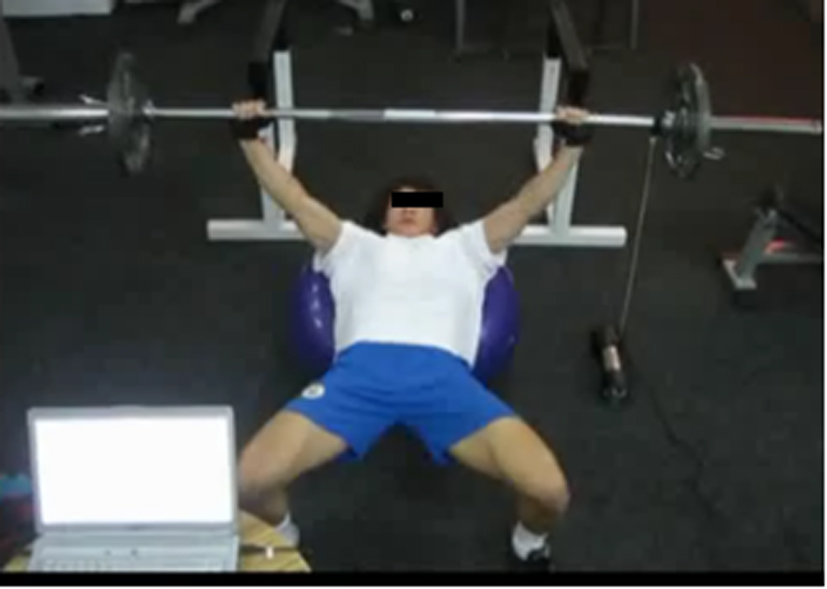
Measurement of squat strength and power under unstable conditions.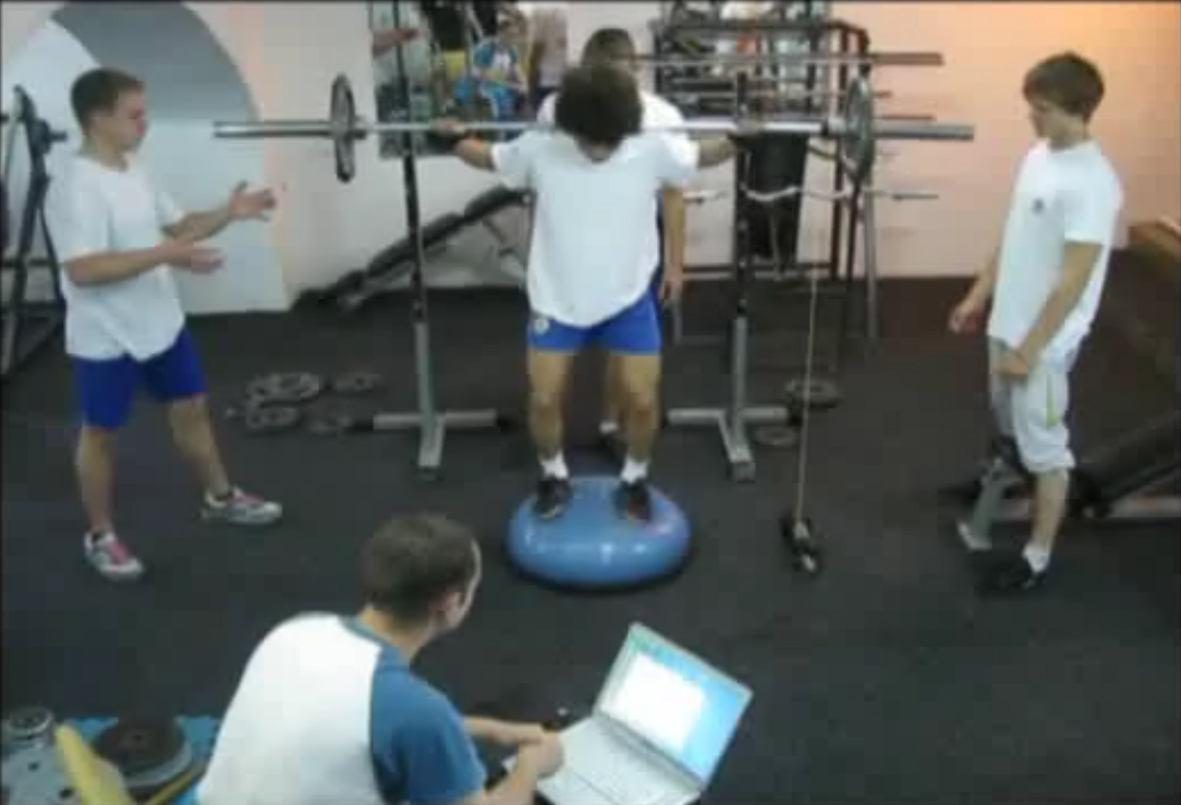
1RM in bench press and squat test for unstable training group (UTG), stable training group (STG) and control group (CG), pre- and post-training. All values are expressed as mean 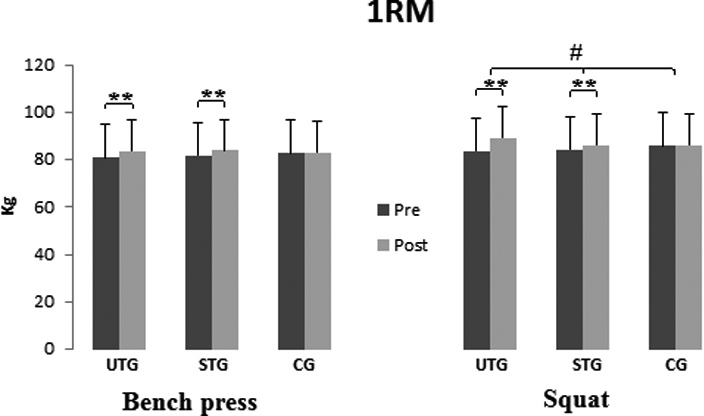
Peak power in different testing. A) Bench press test on stable surface; B) Bench press test on unstable surface; C) Squat test on stable surface; and D) Squat test on unstable surface (BOSU ball). Unstable training group – UTG, Stable training group – STG and Control group CG pre- and post-training. All values are expressed as mean 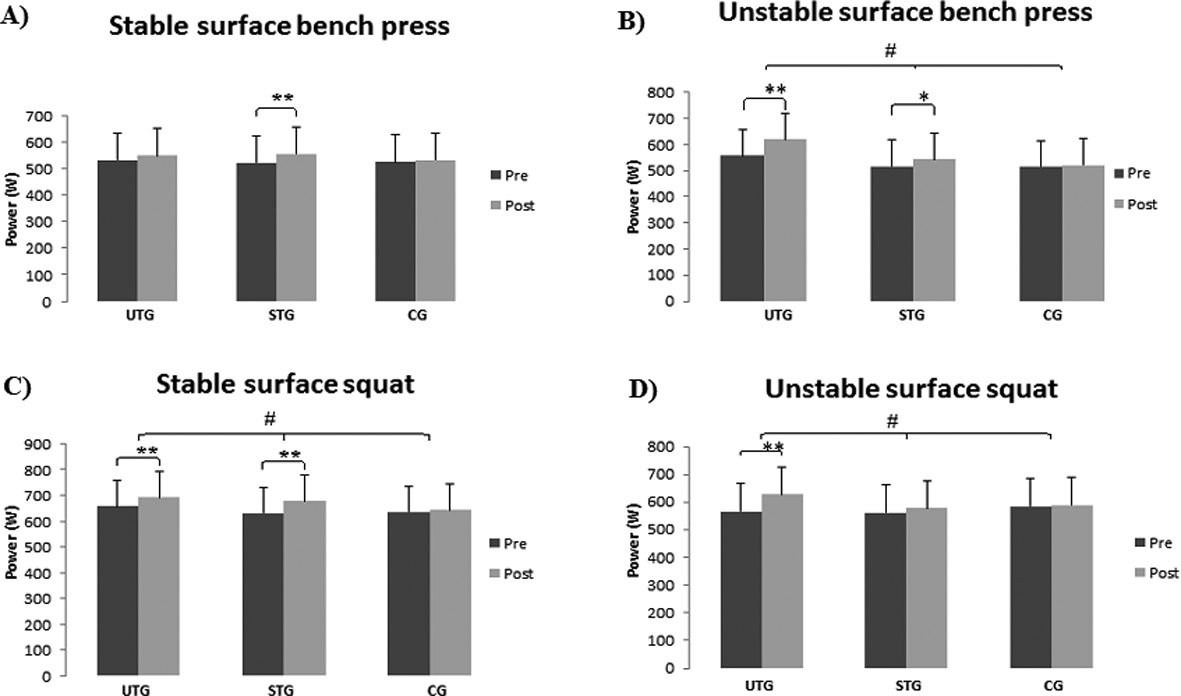
The participants underwent a one-repetition maximum (1RM) test only on a stable surface. Prior to each 1RM test, two warm-up sets were performed: first with 8 repetitions at approximately 50% of 1RM, and then with 4 repetitions at approximately 70% 1RM. Next, single attempts with increasingly heavier resistance of at least 2.5 kg were performed until each participant reached the greatest weight that he could lift once with the correct technique. A 3-minute rest period was given between each lift. The 1RM was achieved within 3–6 attempts. For safety, two spotters were present at all times. The correct chest press technique involved lowering the bar in a controlled manner until it lightly touched the chest, after which the bar was lifted back to the start position with elbows fully extended. Careful attention was paid to ensuring the bar did not bounce off the chest. No compensatory motion was allowed during the chest press movement. Barbell squats on a stable surface were performed from full extension to a knee angle of 90
1RM in unstable conditions were not obtained, since previous research [17] showed that there is no reduction in 1RM strength or any differences in muscle EMG activity for the barbell chest press exercise on an unstable exercise ball when compared to a stable flat surface. Due to safety reasons, like a possible ball defect during maximal load or fall with maximal load during the testing, especially during the squat on unstable BOSU ball, the authors decided not to perform 1RM on unstable surfaces.
Muscular power outputs for stable and unstable conditions were measured by means of the Fitrodyne dynamometer (Fitronic, Bratislava, Slovakia) according to the suggested protocol. The validity and reliability of the device has been confirmed by Jennings et al. [18]. During each of the sessions, the participants were instructed to accelerate the barbell as much as possible during the concentric motion phase, during which the peak power and velocity of movement were measured by means of a computer-interfaced Fitrodyne attached to the barbell via a tether.
Stable conditions were provided using a flat bench and unstable conditions were created using a Swiss ball with the diameter of 55 and 65 cm (based on the subject height) placed to support the upper back with cervical area or head and with the participants’ feet placed on the floor (Figs 3 and 4). Complete inflation of the ball was confirmed before each experiment. Barbell squats under stable conditions (floor of the gymnasium) and an unstable BOSU ball (BOSU; Fitness Quest, Canton, OH, USA) were performed from full extension to a knee angle of 90
Procedures
Familiarization
Prior to group allocation, the participants were exposed to two familiarization sessions, where they were instructed regarding the proper technique of both exercises, especially on unstable surfaces. An emphasis was placed on achieving a knee angle of 90
Study setting
All of the testing sessions took place in a gymnasium. Prior to testing, the participants warmed up for approximately 10–15 minutes (submaximal intensity aerobic activity on stationary bikes and/or step machines and short bouts of dynamic muscle stretching).
Training under stable and unstable conditions
The 8-week training program consisted of two training sessions per week. Subjects performed only two exercises: bench press and squat (under different conditions, depending on the group). All of them performed 6 sets of 6 repetitions for each exercise, with 90 second rest between the sets. The first training session in a week started with bench and the second session started with squat exercises. There was 3 minutes rest between the bench and squat exercises. All the subjects alternatively changed the initial exercise on every training session (eg. Monday starting with bench press and Thursday starting with squat). The load for all repetitions (in both stable and unstable conditions) was set at 50% of previously determined 1RM in stable conditions for both exercises.
During each repetition, the participants were instructed to accelerate the barbell as much as possible during the concentric phase of motion. In unstable conditions, all subjects performed the exercises with their maximum velocity of movement during concentric phase, which made possible for them to use the proper technique during exercises, without any excessive anxiety about falling. In the attempts where subjects lost their balance, they had to make a rest of 90 seconds and repeat the set with 6 repetitions.
All the sessions were performed in morning hours twice a week (Monday-Thursday; Tuesday-Friday; Wednesday-Saturday) in three different periods of time (from 8 till 9; from 9 till 10; and from 10 till 11 hours). The participants were allocated in groups according to their curricula group allocations and timetables, so they could regularly attend their regular classes. The participants were monitored during the training by at least one of the researchers to ensure a full effort was applied in each session. For safety reasons, during each exercise, two participants were watching the attempt standing on each side during the lift, and one participant stood behind the participants to prevent a possible fall. In addition, one of the researchers confirmed the consistency in the quality of the bench press and squat techniques.
Statistical analyses
Descriptive statistic was calculated for all experimental data as mean and SD. The Kolmogorov Smirnov test of normality was performed on all variables, and all the data were normally distributed. To examine the influence of platform and effect of training on 1RM and maximal muscle power output, a three-way repeated measure analysis of variance (ANOVA) was performed with between factor training group (UTG vs. STG vs. CG), within factors platform (unstable vs. stable), and time (pre-training vs. post-training). To examine the effect of training on 1RM and effects on unstable surface and stable surface, a two-way repeated measure ANOVA was performed with between factor training group (UTG vs. STG vs. CG), and within factor time (pre-training vs. post-training). In cases in which significant differences in the interaction Group
Mean (SD) 1RM bench press and squat
Mean (SD) 1RM bench press and squat
UTG – unstable training group; STG – stable training group; CG – control Group. **Significant difference pre/post training
Mean (SD) maximal power output for bench press and squat on different surfaces
UTG – Unstable training group; STG – Stable training group; CG – Control Group. **Significant difference pre/post training
Muscle strength: bench press and squat
Repeated measures 3
Significant main or interaction effects (groups
Muscular peak power tested on stable and unstable surfaces
Repeated measures 3
Repeated measure 3
In the unstable bench press test there was a significant F (2, 69)
Repeated measures 3
Repeated measure 3
Similarly, there were significant main effects observed for peak power F (2,69)
Discussion
The results of this study found the training-induced improvement between the training groups in pre- to post-test in squat 1RM, showing the transfer of specific unstable training exercises on 1RM squat. However, this was not the case in 1RM bench press. No significant difference in the main effect was found with the training-induced improvement between the training groups in pre- to post-test on 1RM bench press. Both modalities (Stable and Unstable) produced statistically significant (
These findings suggest that unstable resistance training may have had a small tendency to be more efficient in increasing muscle strength in some exercises. Some of the earlier studies [7, 8] have also shown a similar tendency for training on unstable surfaces. One training study [8] showed no significant main effect difference after seven weeks of resistance training in stable vs. unstable conditions, but the interaction effects showed that unstable training provide an advantage in some of the test performance measures. It is important to mention that the percentage of 1RM was not the same for both groups (75% for stable and 50% of 1RM for unstable exercises). A study by Sparkes et al. [7] found no training effects in any measure, but they suggested a tendency for unstable training to be more efficient for maximum voluntary isometric contraction in bench press exercises. They used the same relative resistance for both surfaces (10RM), but the repetition maximum on unstable surface was lower compared to stable surface, which implied that the group that trained on unstable surfaces used lower loads during exercises. In our study both experimental groups had the same external resistance (50% of 1RM tested on stable surface), which with additional instability resulted in increased intensity of the exercise for unstable group. This may be the principal reason for better results of unstable training group in strength test expressed as 1RM on stable surface.
Previous studies that examined the impact of platforms on power outputs on bench press have shown conflicting results. Several studies [21, 22, 23] showed a significant reduction of prime movers maximum force in unstable conditions, while some studies [7, 9, 17, 24] focused on the effects of instability revealed no significant difference in muscle activation between surface types for bench press exercises. However, all these studies examined different parameters of muscle output: maximum force in isometric conditions, rate of force development, maximal strength expressed as 1RM in different conditions. Common for the above studies was that all of them used maximal or submaximal resistance with high loads.
The study of maximum power output in dynamic conditions was performed by Koshida et al. [15], who found a 10% loss of peak power output on unstable surface. The results of our study did not show any statistically significant difference in maximal power output in bench press exercise under stable and unstable conditions in the initial testing. In contrast, non-significant higher values of power were obtained in unstable compared to stable conditions. The reason for the difference between maximal muscle power under the same load of 50% of 1RM could be found in different postures adopted during the use of exercise ball. In our study, the participant head and neck regions were supported, as commonly recommended in the literature [17, 25, 26]. Goodman et al. [17] hypothesized that different postures taken during resistance exercises on an exercise ball could be the reason for the observed discrepancy of the results. Moreover, one additional familiarization session compared to the study by Koshida et al. [15] could have resulted in a better learning effect and better use of elastic energy of the ball.
One of the most important findings of this study was that both training programs (eight weeks of training on stable and unstable surfaces, with load of 50% of 1RM) produced greatest power gains on the surface on which the training took place (for both exercises, bench and squat). There was a significant main effect for peak power after 8 weeks of training on different surfaces between groups (UTG, STG & CG) for both bench press and squat exercises. Training on stable surface bench press was effective only on stable surface testing, without transfer on unstable bench press power testing. On the other hand, training on unstable bench press produced significant increases for both surfaces, with larger increases on unstable (7%) compared to stable conditions (5%). Squat training on stable surface showed significant main effects observed for peak power, indicating that there were training advantages of power training with 50% of 1RM in stable surfaces on squat power test in stable and unstable conditions. The stable training group had a larger increase in stable power testing (7%) compared to unstable testing conditions (5%). However, the training resulted on statistically significant increases for both conditions. The experimental group that trained on unstable conditions (BOSU ball) also showed significant main effects for peak power tested on different surfaces. Similarly to the stable training group, the largest increases were observed during surface on which the training occurred. Only, increases during testing on unstable surface were statistically significant (12%), compared to increases obtained in stable conditions (3%). Specificity during testing indicates that gains were in part specific to the type of exercise employed in the training. This specificity of strength gains is well known [16, 27] and has been attributed to neural adaptations resulting in the ability to recruit the muscles to perform a particular type of action.
The largest peak power increases occurred after squat training on unstable surface, which suggests that unstable surface will not necessary have negative effects on performance. Previous research [10] suggests that unstable interventions could prove to negatively affect performance in the lower extremities, which typically operate in a closed-chain fashion in most athletes. By training slowly and tentatively, the athlete may be conditioned to perform in the same slow manner when faced with athletic challenges. The antagonist activity is heightened during unstable training to maintain joint stability [22], stating that it is not unreasonable to conjecture that such a training effect could be detrimental to optimal rate and magnitude of force production when applied for an extended training period [10]. In the current study the participants were instructed do perform the movement with the maximal possible speed of movement in current conditions, which lead to larger increases in unstable surfaces compared to stable conditions.
However, compared to other similar studies, the training-related increases in our study on both surfaces were relatively small (up to 12% in testing specific to training conditions), with maximal effect size of 0.6, indicating small to moderate changes. Some previous studies [7, 8, 9] similar in duration (five to eight weeks) and test types (bench and squat), have demonstrated that resistance training on unstable surfaces may be considered as effective as traditional stable resistance training. Moreover, all of the studies have produced larger overall pre- to post-training improvements.
In the study by Cowley et al. [9], 1RM bench press increases between 15 and 19% on stable and unstable surfaces, with no intergroup differences, have been found after only five weeks. A larger increase after shorter study could be explained by the subject status (young untrained women, with initial 1RM bench of 32 kg and 33 kg). An experimental study by Behm and colleagues [8] employed the identical squat exercises as we did (50% of 1RM on BOSU ball), but resulted in an increase of over 30% compared to maximum 12% found in our research. However, their training program consisted of several additional exercises. Another study by Behm and colleagues [7] used the same resistance for both surfaces (10RM). Their 8-weeks of unstable resistance training program resulted in the improvement in 3RM bench press exercises (11%) and squats (14.9%). The smaller observed increase of muscle strength (3–7%) and power (3–12%) in our study could be explained by the fact that we used recreatively active students as subjects. Even though none of the subjects participating in this study was not involved in organized and programmed resistance training in the period of six months before the study, they still had average of 6 hours of practical classes per week involving different exercises and sport drills within their faculty curricula in the previous three semesters. Also, the training program with only two exercises had much less impact than the previously mentioned experimental program. Finally, the lack of overload and variation in the design of experimental program may explain why the magnitude of the changes in both the bench press and the squat are smaller than expected. These could be considered as one of the limitations of this study.
Another problem in the current power assessment is fact that there are some limitations for lower body movements [28], suggesting that barbell kinematics should not be used for power assessment applied to the barbell and body system center of mass during a lower body resistance exercise. Participants accelerated the barbell as much as possible during the concentric phase not throwing the bar during the bench press or jump during the squat because of unstable conditions, which lead to the deceleration phase during the concentric phase. Otherwise the bench press would be a bench throw and the squat a squat jump.
Finally, the use of additional performance evaluation would give more light on the effect of the program on performance test. The limitation of this study is the lack of performance test that would be an appropriate evaluator of training program effects. The use of a performance test (e.g. medicine ball throw or standing high jump) would give more insights into the effectiveness of the experimental program in stable and unstable surface with 50% of 1RM on performance test that require explosiveness and fast movement.
Although unstable training produced significant increases when tested on unstable surfaces and also showed a positive transfer in 1RM squats, additional research is warranted to examine if this increase is only the result of adaptation to the training task or the effects of unstable training could be transferred to different physical performance tasks, especially the ones that demand a certain level of instability, as well as the tasks that include fast explosive movement.
Conclusion
The current study suggests that a 8-week resistance training program under unstable conditions with load of 50% of 1RM focused on the maximal velocity of movement could be effective for the increase of power in bench press and squat. The greatest power gains occurred on the surface on which the training took place (for both exercises, bench and squat) confirming the principle of specificity. The largest peak power increases occurred after squat training on unstable surface, which suggests that unstable surface will not necessarily have negative effects on lower body performance. However, there was no clear evidence that training under unstable conditions is more effective in increasing the values of muscular power outputs in relation to traditional exercise under stable conditions for every exercise and every condition.
The results of this study also found training-induced improvement between the training groups in pre- to post-test in squat 1RM, showing the transfer of specific unstable training exercises on 1RM squat. However, this was not the case in 1RM bench press. The increase of 1RM in previously resistance untrained subjects is lesser than expected, and it is therefore necessary to include additional exercises or additional loads in the training program on unstable surface if the increase of maximal strength is the training goal.
Footnotes
Acknowledgments
This study was conducted under the project “Effects of applied physical activity on locomotor, metabolic, psycho-social and educational status of the population of the Republic of Serbia” No. III47015, funded by the Ministry of Science and Technology of the Republic of Serbia – The 2011–2019 cycle of scientific projects.
Conflict of interest
The authors declare no conflicts of interest.